
THE HUBERT KAIRUKI MEMORIAL UNIVERSITY SCHOOL OF MEDICINE

THE HUBERT KAIRUKI MEMORIAL UNIVERSITY SCHOOL OF MEDICINE THE DEPARTMENT OF BEHAVIOURAL SCIENCE AND ETHICS SUBJECT: BEHAVIORAL SCIENCE TOPIC: STIGMA FACILITATIOR: Masalakulangwa PRESENTERS: Noel Juvenal Munishi Emilian Busigasi Mbwana Rabia Roshein Nassoro Jacquiline Robi
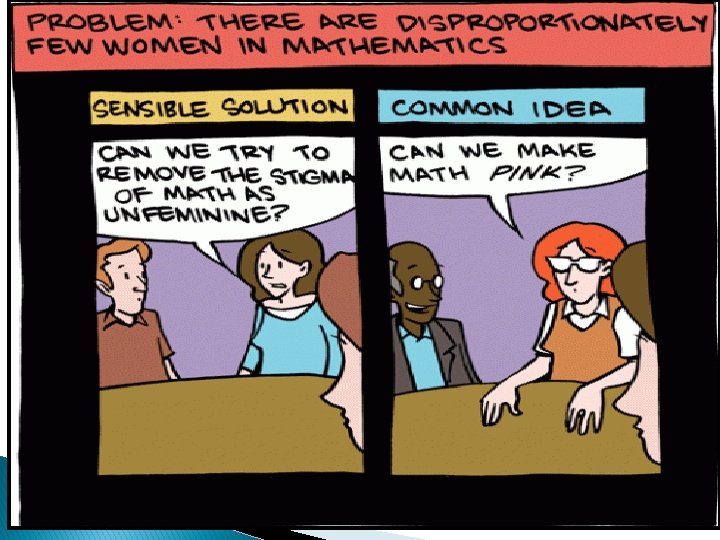

TABLE OF CONTENTS � INTRODUCTION � DEFINITION OF TERMS � OBJECTIVES � MAIN PRESENTATION � SUMMARY � RECOMMENDATIONS � REFERRENCES
INTRODUCTION According to Wikipedia Stigma is a Greek word that refers to a type of “marking” or “tattoo” that was cut or burnt into the skin of criminals, slaves or traitors in order to visibly identify them as blemished or morally polluted persons. These individuals were to be shunned or avoided particularly in public places. In a different perspective Richard Schaefer in his book Sociology defines stigma as ‘a label used to devalue members of certain social groups’. (pg. 195)
DEFINITION OF TERMS Courtesy Stigma: Stigma towards the family members of the stigmatized e. g. stigma to the family whose grandma is accused of being a witch. Deviance: behavior that violates the standards of conduct or expectations of a group or society. Enacted Stigma: This is society reaction which may produce actual discriminatory Felt Stigma: This is ‘imagined’ social reaction which can drastically change a person’s self-identity. Group: any number of people with similar norms, values and expectations who interact with one another on a regular basis.
Label: a note fixed to something or someone to describe its content or that person. � Labeling Theory: An approach to deviance that attempts to explain why certain people are viewed as deviants, while others engaging in the same behavior are not. � Stereotype: an unreliable generalization about all members of a group that does not recognize individual differences within the group. � Stigma: a label used to devalue members of certain social groups or a symbol (negative social label) of disgrace that affects a person’s identity. �
OBJECTIVES To know the Labeling Theory To understand stigma in general and social stigma To know stigma according to the Theorists To know the six dimensions of stigma To understand the relationship between stigma and HIV/AIDS To understand the difference between stigma and stereotyping
MAIN PRESENTATION Labeling Theory: � Becker (1963), ‘Social groups create deviance by making the rules whose infarction constitutes deviance’. Applying these rules of deviance to individuals or groups means labeling them as ‘outsiders’. He argues : ‘deviance is not a quality that lies in behavior itself, but in the interaction between the person who commits an act and those that respond to it’. The theory focuses more on the societal reaction (judgment) to the particular behavior.
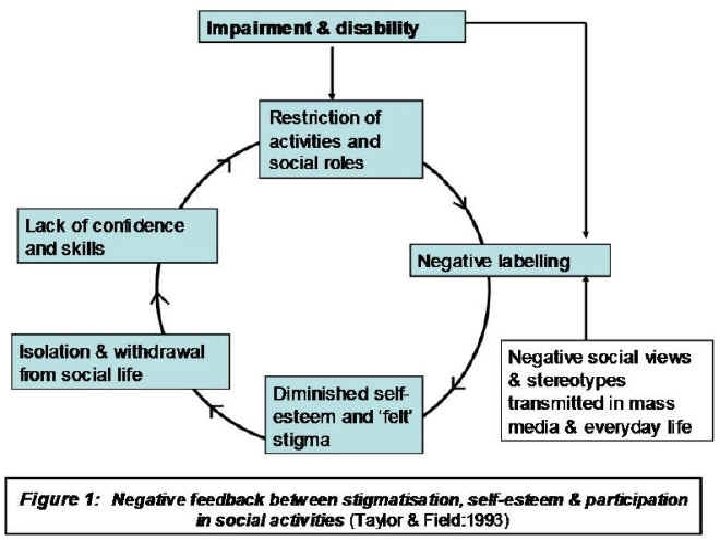
� An important aspect of the labeling theory is the recognition that some individuals or groups have the power to define labels and apply them to others. Lemert’s (1967) it is in direct response to this labeling that the person changes their behavior in accordance with the label, i. e. the label constituting a ‘self-prophecy’. � The impact of labeling and its consequences for stigmatization can be represented as a negative feedback circle, which resulting in greater and greater reduction of social participation, diagrammatically represented below:
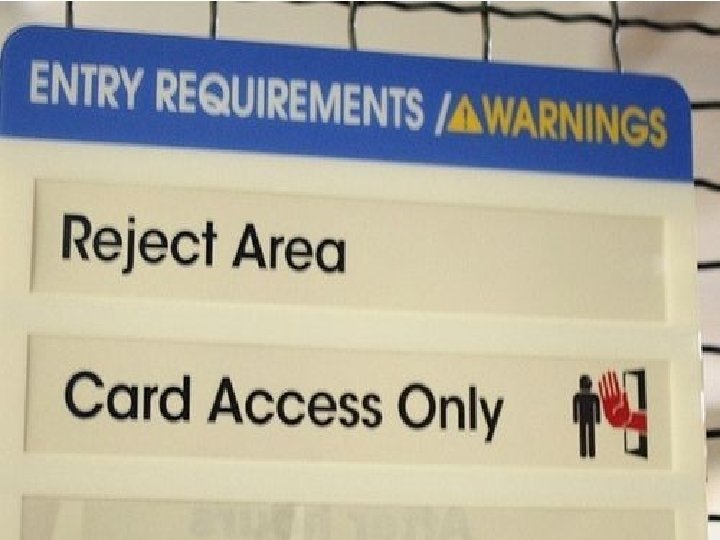
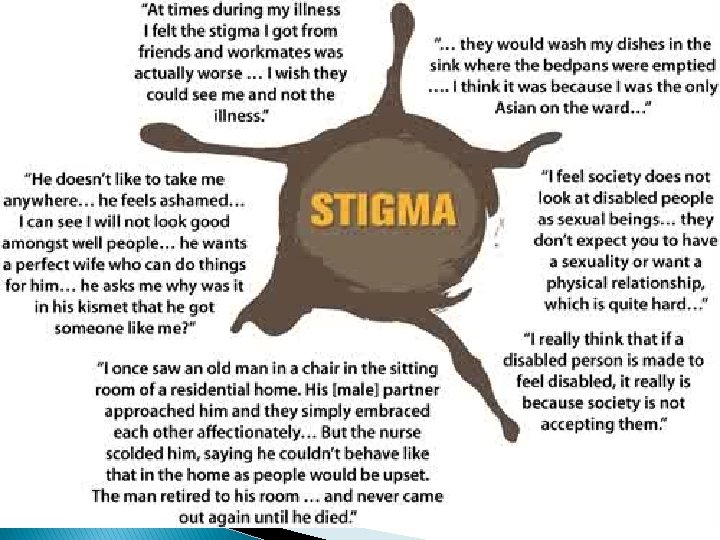
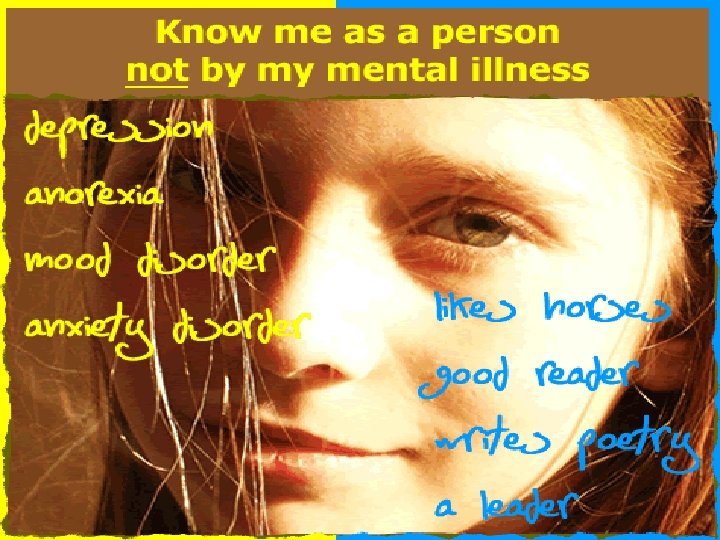
STIGMAS The most common stigmas deal with culture, obesity, gender, race and diseases. Many people who have been stigmatized feel as though they are transforming from a whole person to a contaminated one. They feel different and devalued by others. This can happen in work places, educational settings, health care, the criminal justice system, and even in their own families.
� For Example: ◦ Parents of an overweight woman are less likely to pay for their daughter’s college education than are parents of average weight counter partner. When society categorizes individuals into certain groups the labeled person is subjected to status loss and discrimination. Conflict theorists argue that the mass media serve to maintain the privileges of certain groups. Moreover, while protecting their own interests, powerful groups may limit the representation of others in media.
� The term dominant ideology describes a set of cultural beliefs and practices that help to maintain powerful social, economic, and political interests. The media transmit messages that virtually define what we regard as the real world, even though these images are frequently at wide variance from what the larger society experiences.
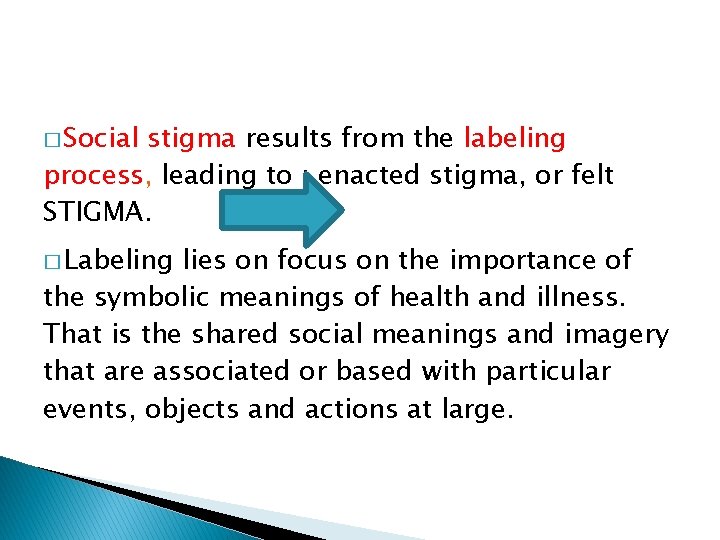
� Social stigma results from the labeling process, leading to : enacted stigma, or felt STIGMA. � Labeling lies on focus on the importance of the symbolic meanings of health and illness. That is the shared social meanings and imagery that are associated or based with particular events, objects and actions at large.

THEORISTS � Emile Durkheim: � “imagine a society of saints, a perfect cloister of exemplary individuals. Crimes or deviants, properly so called, will there be unknown; but faults, which appear venial to the layman, will there create the same scandal that the ordinary offence does in ordinary consciousness. If then, this society has the power to judge and punish, it will define these acts as criminal (deviant) and will treat them as such. ” (1895)
� Erving Goffman: � Distinguishes three types of stigma; v. Defects of the body v. Defects of character (mental character) v. Extremist political or religious beliefs, or drug addiction; membership in social devalued groups (ethnical and racial minorities or gender)
Erving Goffman: “Stigmas always carry negative evaluations, individuals develop coping strategies to protect themselves when dealing with “normals”. Individuals may try to hide their stigma If it can be disguised, and limit its social impact on ones identity. Other stigmas such as major physical deformities or handicaps are so visible that they become a subjects master status. One coping strategy maybe withdrawal, by limiting ones participation in society or creating a social movement to fight the negative stereotypes attached to a given stimuli. ”
� Gerhard � “All Falk: societies will always stigmatize some conditions and some behaviors because doing so will provide group solidarity by delineating “outsiders” from “insiders” (2001)”
� Falk describes stigmas in two categories; ◦ Existential Stigma: stigma deriving from a condition which the target of the stigma either did not cause or over which he has little control ◦ Achieved Stigma: stigma that is earned because of conduct and/or because they contributed heavily to attaining the stigma in question
THE SIX DIMENTIONS OF STIGMA v v v Concealable: extent to which others can see the stigma. Course of the mark: whether the stigmas prominence increases, decreases or stays the same over time. Disruptiveness: the degree to which the stigma and or others reaction to it impede social interactions. Aesthetics: others reactions to the stigma comprising reactions that are positive/approving or negative/disapproving, but represent estimates of qualities other than the stigmatized persons worth or dignity. Origin: whether others think the stigma is present at birth, accidental or deliberate. Peril: The danger that others perceive, whether accurately/inaccurately, the stigma to pose to the.
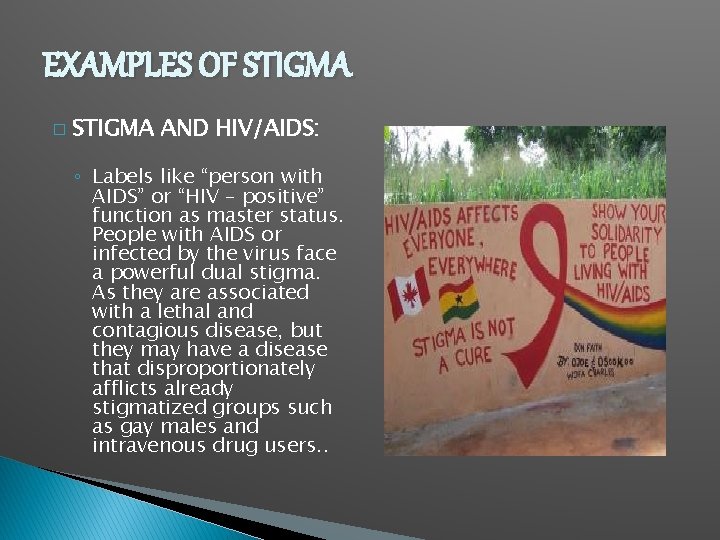
EXAMPLES OF STIGMA � STIGMA AND HIV/AIDS: ◦ Labels like “person with AIDS” or “HIV – positive” function as master status. People with AIDS or infected by the virus face a powerful dual stigma. As they are associated with a lethal and contagious disease, but they may have a disease that disproportionately afflicts already stigmatized groups such as gay males and intravenous drug users. .
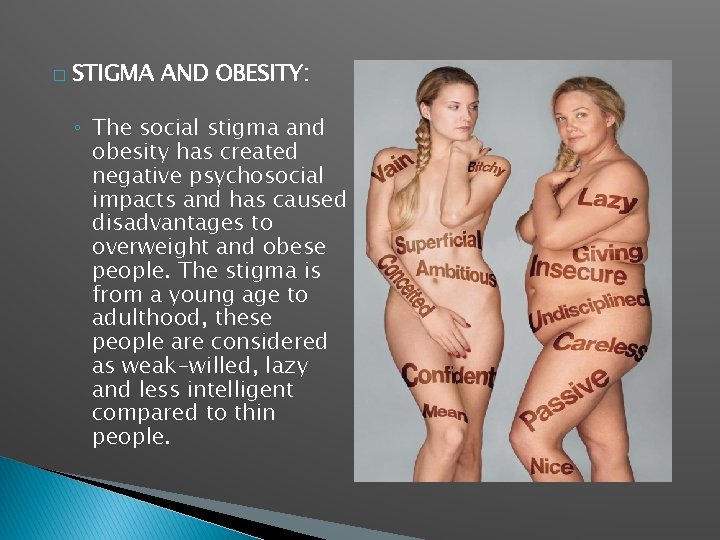
� STIGMA AND OBESITY: ◦ The social stigma and obesity has created negative psychosocial impacts and has caused disadvantages to overweight and obese people. The stigma is from a young age to adulthood, these people are considered as weak-willed, lazy and less intelligent compared to thin people.
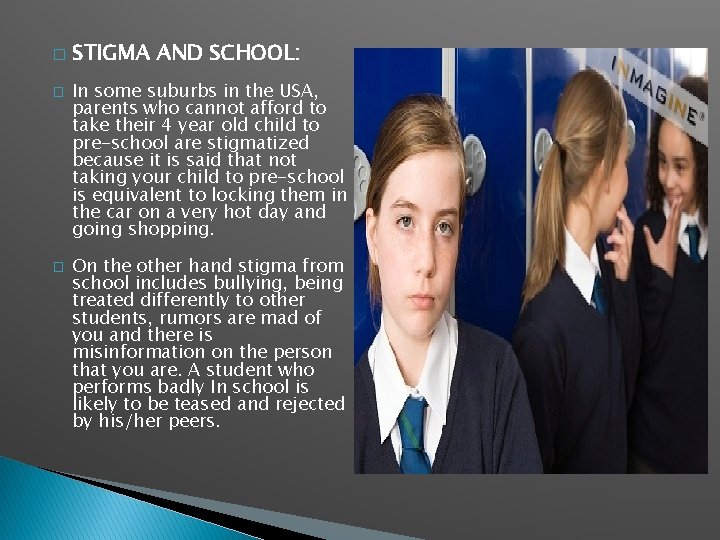
� � � STIGMA AND SCHOOL: In some suburbs in the USA, parents who cannot afford to take their 4 year old child to pre-school are stigmatized because it is said that not taking your child to pre-school is equivalent to locking them in the car on a very hot day and going shopping. On the other hand stigma from school includes bullying, being treated differently to other students, rumors are mad of you and there is misinformation on the person that you are. A student who performs badly In school is likely to be teased and rejected by his/her peers.
STEREOTYPING ◦ A stereotype is a thought that may be adopted about specific types of individuals or certain ways of doing things thought to be the majority of individuals in that area, but that belief may or may not accurately reflect reality.
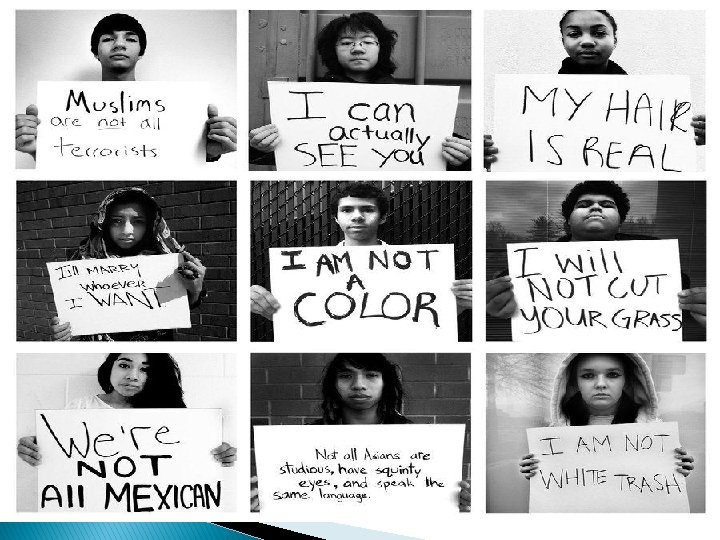
SUMMARY � Stigma may affect the behavior of those who are stigmatized, so it is NOT a behavior, but also shapes their emotions and beliefs. And those who are stereotyped often start to act in ways that their stigmatizers expect them. Members of stigmatized social groups often face prejudice that causes depression. The counselor needs to know how to deal with different groups of people either being in a clinic setting or in the community based environment.
RECOMMENDATIONS � Medical practitioners and nurses should be aware of the social stigmas and stereotypes in their society so as to not stir conflict, or bitterness with the patients they attend.
REFERRENCES � www. healthknowledge. org. uk/public-healthillness/section 3 � http: //sociology. wetpaint. com/page/Erving+Goffman � http: //en. wikipedia. org/wiki/Social_stigma � www. ncbi. nlm. gov/pmc/articles/PMC 2745872/ � www. mendthemind. ca/help/stigma-at-work-and-school � www. merriam-webster. com/dictionary/stigma � R. T Schaefer, Sociology, Mc. Graw Hill companies, (2005), 9 th ed, De. Paul university, NYC, USA, pages , 180, 154 -155, 253, 556
- Slides: 32