NHTSA AACN Activities Stephen Ridella Human Injury Research
- Slides: 24
NHTSA AACN Activities Stephen Ridella Human Injury Research Division Office of Vehicle Safety Research
Outline 1. Overview 2. NHTSA and NHTSA/CDC AACN Work 3. EDR Rule and Analysis 4. Injury Prediction Algorithms 5. AACN Scorecard/Next Steps 2
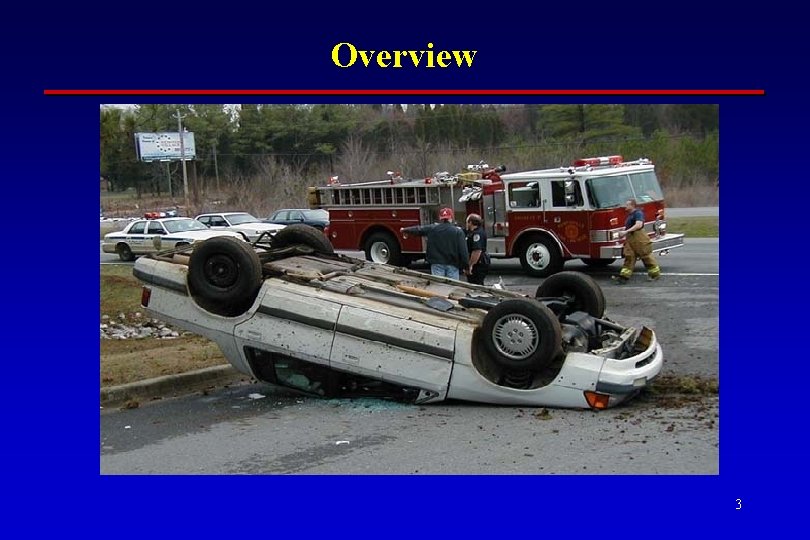
Overview 3
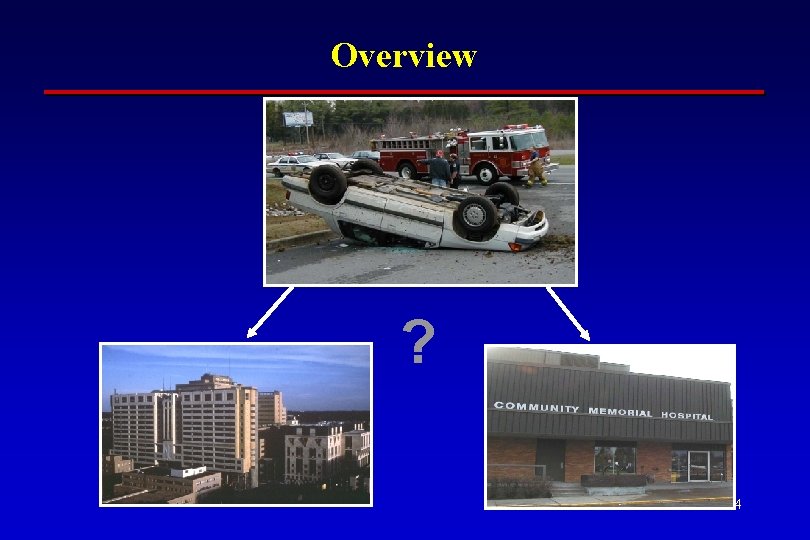
Overview ? 4
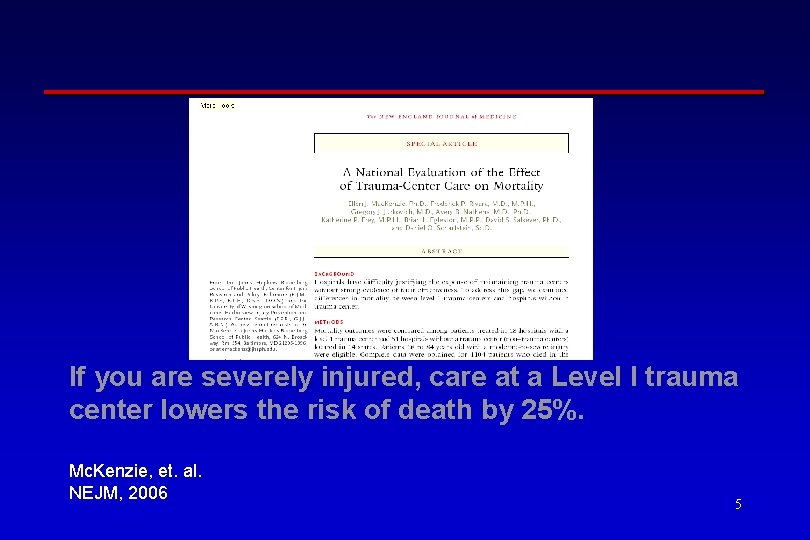
If you are severely injured, care at a Level I trauma center lowers the risk of death by 25%. Mc. Kenzie, et. al. NEJM, 2006 5
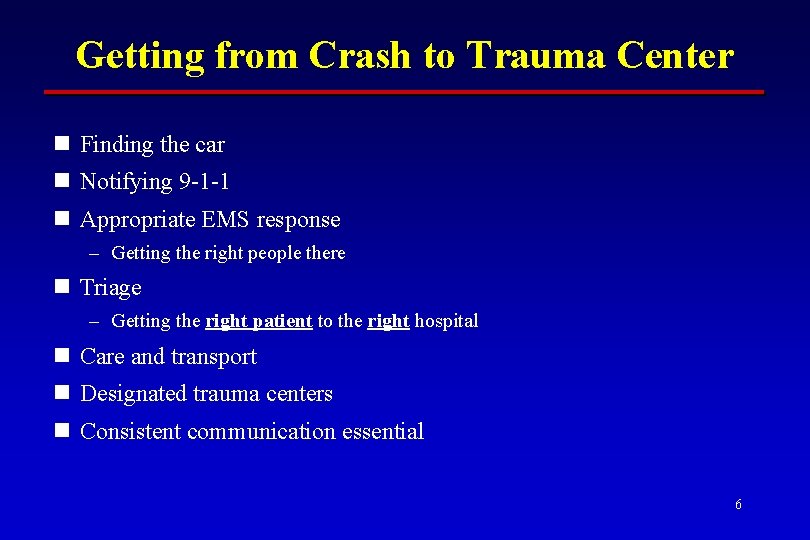
Getting from Crash to Trauma Center n Finding the car n Notifying 9 -1 -1 n Appropriate EMS response – Getting the right people there n Triage – Getting the right patient to the right hospital n Care and transport n Designated trauma centers n Consistent communication essential 6
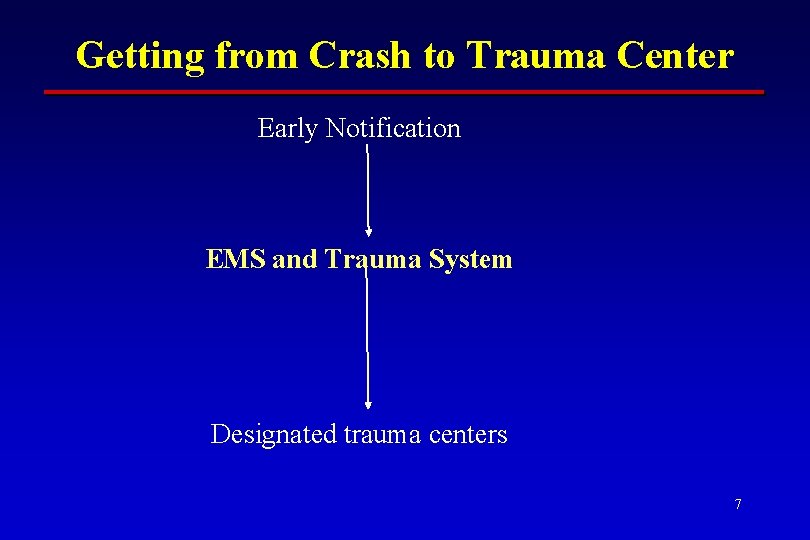
Getting from Crash to Trauma Center Early Notification EMS and Trauma System Designated trauma centers 7
NHTSA Historical AACN Work 8
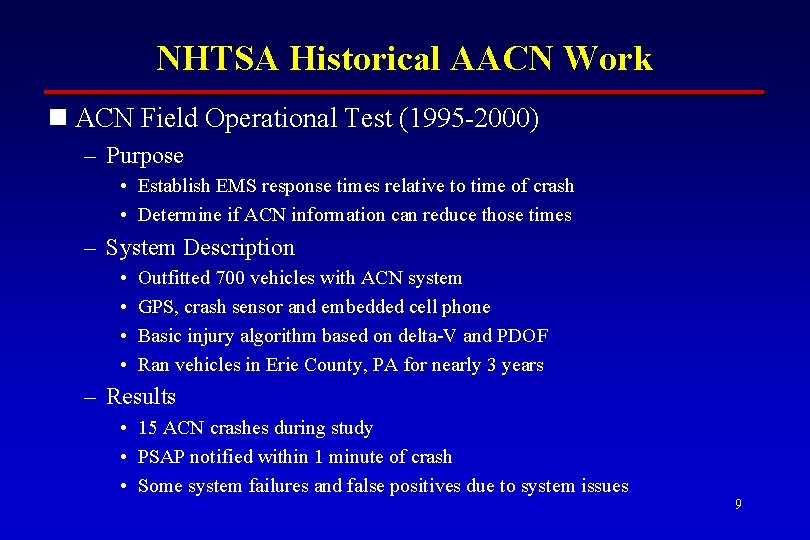
NHTSA Historical AACN Work n ACN Field Operational Test (1995 -2000) – Purpose • Establish EMS response times relative to time of crash • Determine if ACN information can reduce those times – System Description • • Outfitted 700 vehicles with ACN system GPS, crash sensor and embedded cell phone Basic injury algorithm based on delta-V and PDOF Ran vehicles in Erie County, PA for nearly 3 years – Results • 15 ACN crashes during study • PSAP notified within 1 minute of crash • Some system failures and false positives due to system issues 9
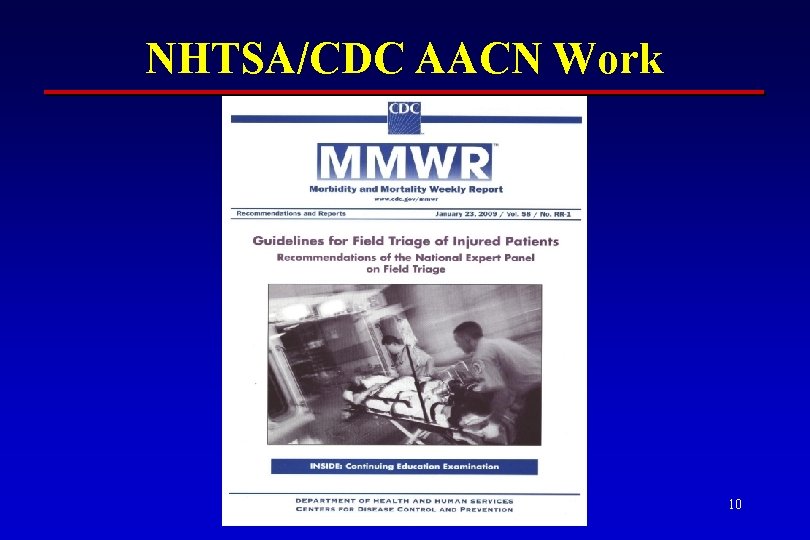
NHTSA/CDC AACN Work 10
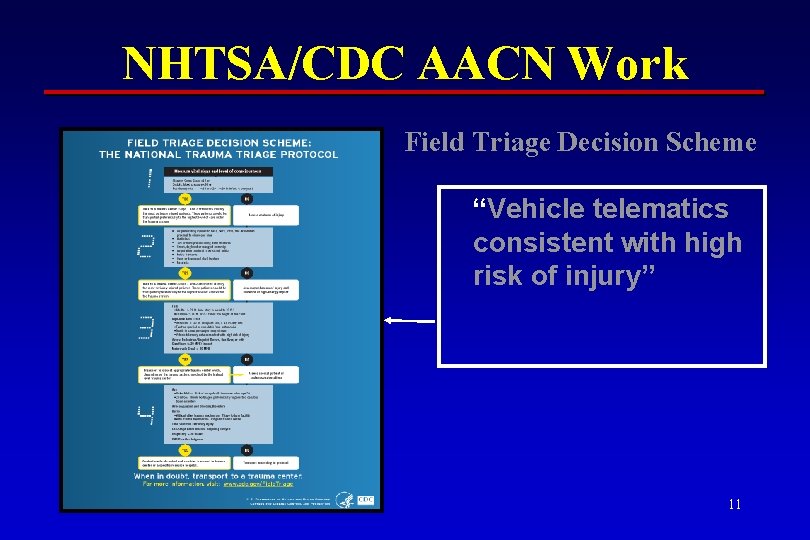
NHTSA/CDC AACN Work Field Triage Decision Scheme “Vehicle telematics consistent with high risk of injury” 11
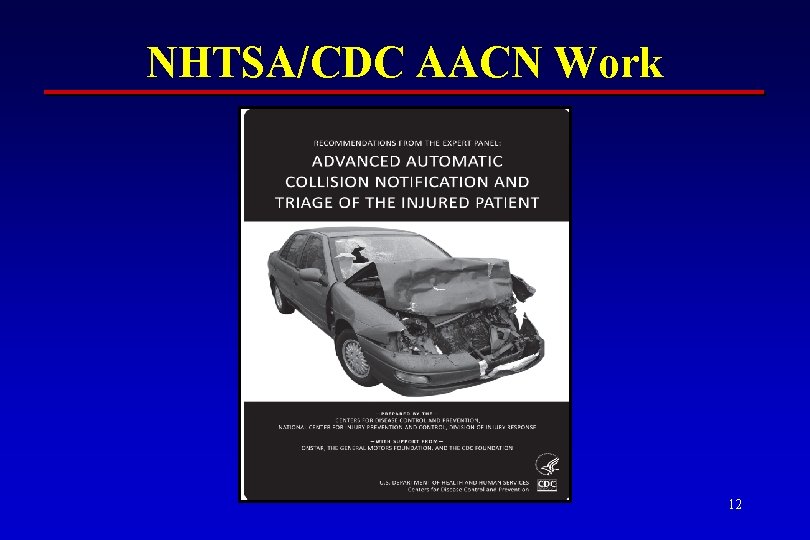
NHTSA/CDC AACN Work 12
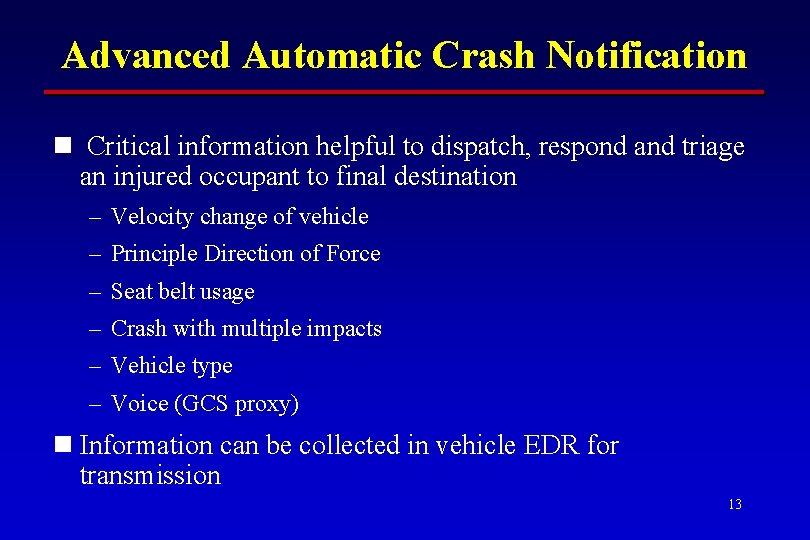
Advanced Automatic Crash Notification n Critical information helpful to dispatch, respond and triage an injured occupant to final destination – Velocity change of vehicle – Principle Direction of Force – Seat belt usage – Crash with multiple impacts – Vehicle type – Voice (GCS proxy) n Information can be collected in vehicle EDR for transmission 13
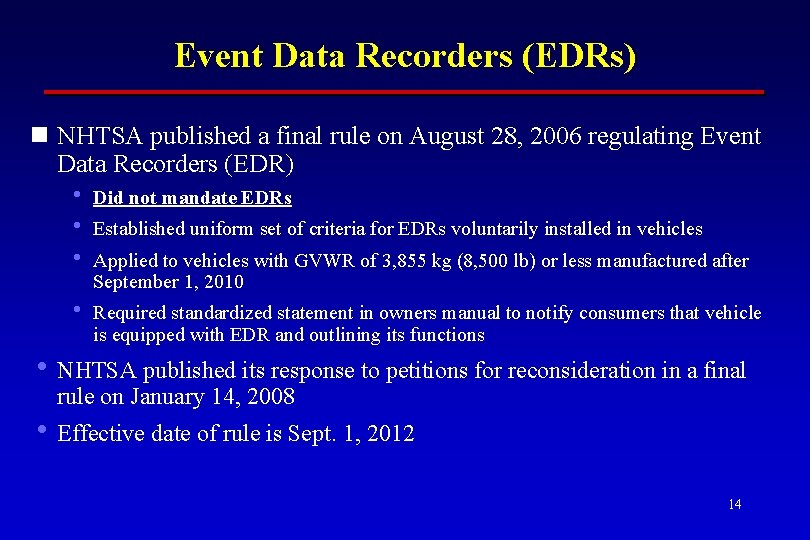
Event Data Recorders (EDRs) n NHTSA published a final rule on August 28, 2006 regulating Event Data Recorders (EDR) h Did not mandate EDRs h Established uniform set of criteria for EDRs voluntarily installed in vehicles h Applied to vehicles with GVWR of 3, 855 kg (8, 500 lb) or less manufactured after September 1, 2010 h Required standardized statement in owners manual to notify consumers that vehicle is equipped with EDR and outlining its functions h NHTSA published its response to petitions for reconsideration in a final rule on January 14, 2008 h Effective date of rule is Sept. 1, 2012 14
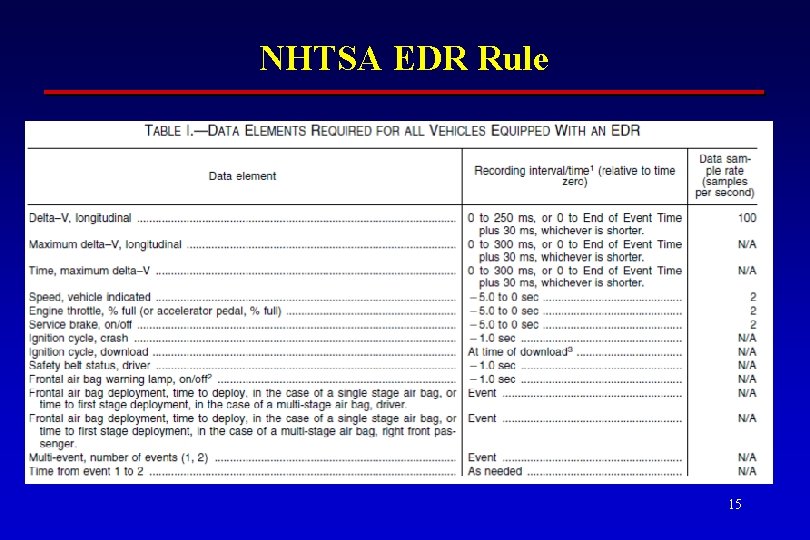
NHTSA EDR Rule 15
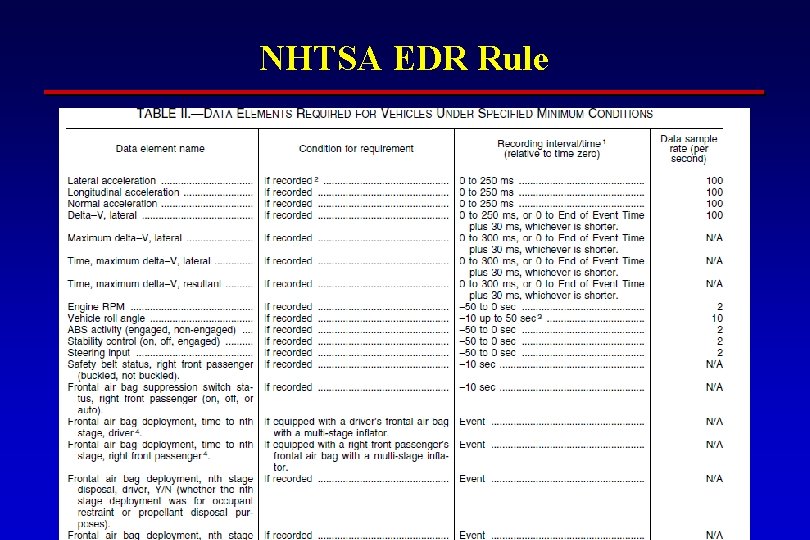
NHTSA EDR Rule 16
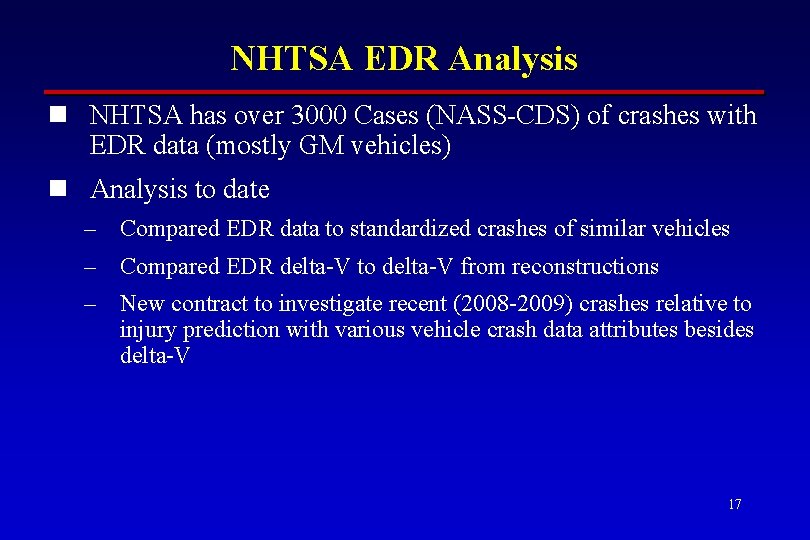
NHTSA EDR Analysis n NHTSA has over 3000 Cases (NASS-CDS) of crashes with EDR data (mostly GM vehicles) n Analysis to date – Compared EDR data to standardized crashes of similar vehicles – Compared EDR delta-V to delta-V from reconstructions – New contract to investigate recent (2008 -2009) crashes relative to injury prediction with various vehicle crash data attributes besides delta-V 17
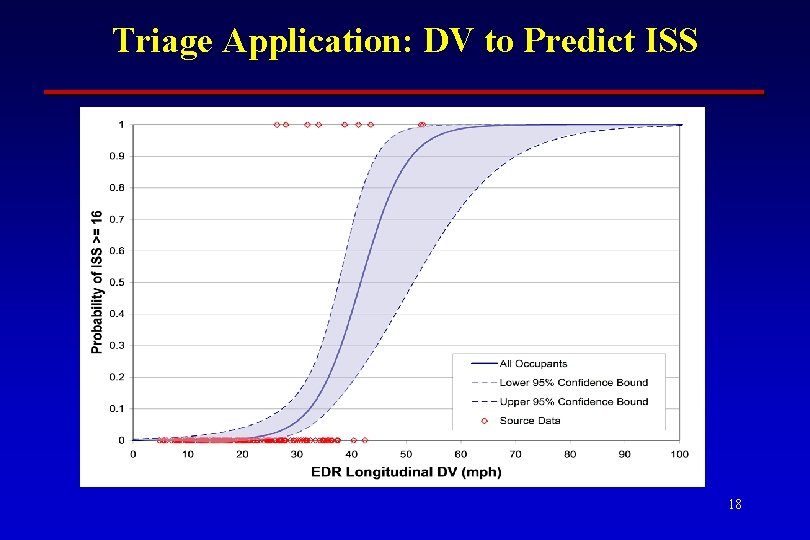
Triage Application: DV to Predict ISS 18
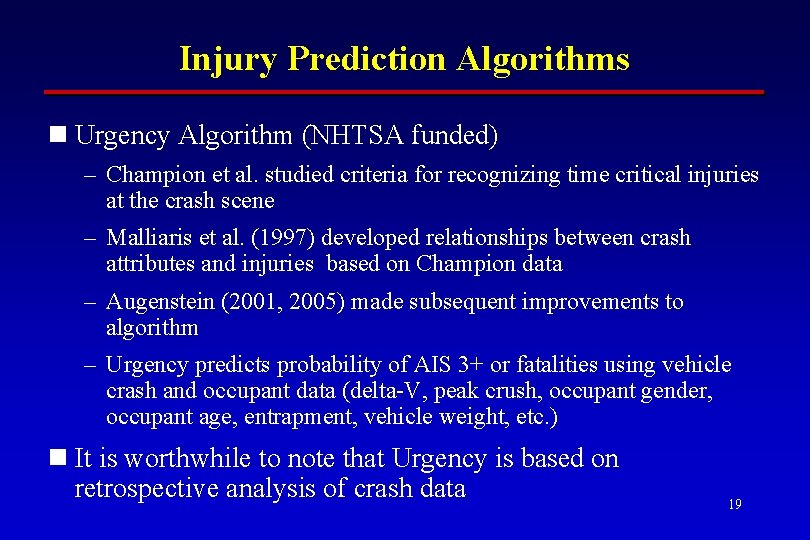
Injury Prediction Algorithms n Urgency Algorithm (NHTSA funded) – Champion et al. studied criteria for recognizing time critical injuries at the crash scene – Malliaris et al. (1997) developed relationships between crash attributes and injuries based on Champion data – Augenstein (2001, 2005) made subsequent improvements to algorithm – Urgency predicts probability of AIS 3+ or fatalities using vehicle crash and occupant data (delta-V, peak crush, occupant gender, occupant age, entrapment, vehicle weight, etc. ) n It is worthwhile to note that Urgency is based on retrospective analysis of crash data 19
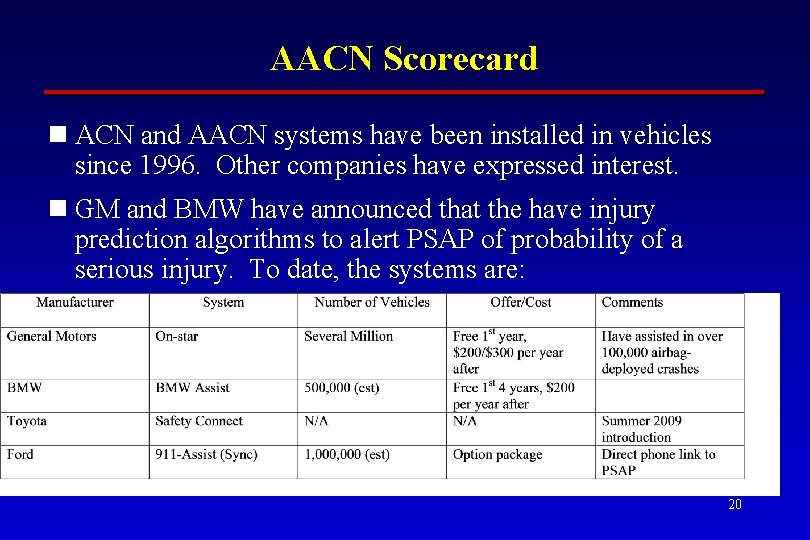
AACN Scorecard n ACN and AACN systems have been installed in vehicles since 1996. Other companies have expressed interest. n GM and BMW have announced that the have injury prediction algorithms to alert PSAP of probability of a serious injury. To date, the systems are: 20
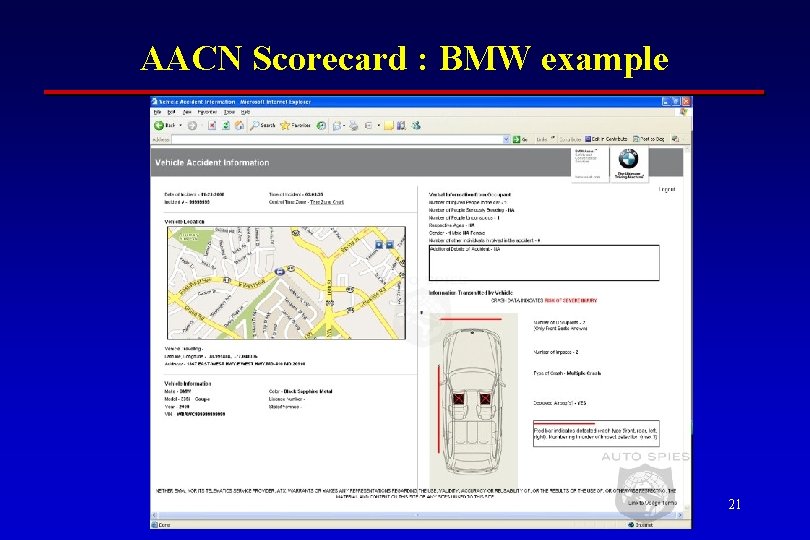
AACN Scorecard : BMW example 21
AACN : Next Steps n AACN data can be used to predict injury severity, conveyed to EMS services and trauma centers, and integrated into the field triage process. n CDC and NHTSA – Working together to create awareness – Meeting with industry to solicit cooperation – Determining course of action relative to Expert Panel Recommendations – Determining benefits 22
AACN n Shows promise in improving outcomes in severely injured crash patients by: – Predicting the likelihood of serious injury – Decreasing response time – Assisting with field triage decisions – Decreasing time to trauma center – Decreasing death and disability 23
END TM 24