Next homework is 6 due Friday at 11

- Slides: 37
• Next homework is #6– due Friday at 11: 50 am. • There will be another make-up nighttime observing session on Thursday October 30 th this week, with a cloud date of November 4 th. Stay tuned to the webpage. Oct 29, 2003 Astronomy 100 Fall 2003
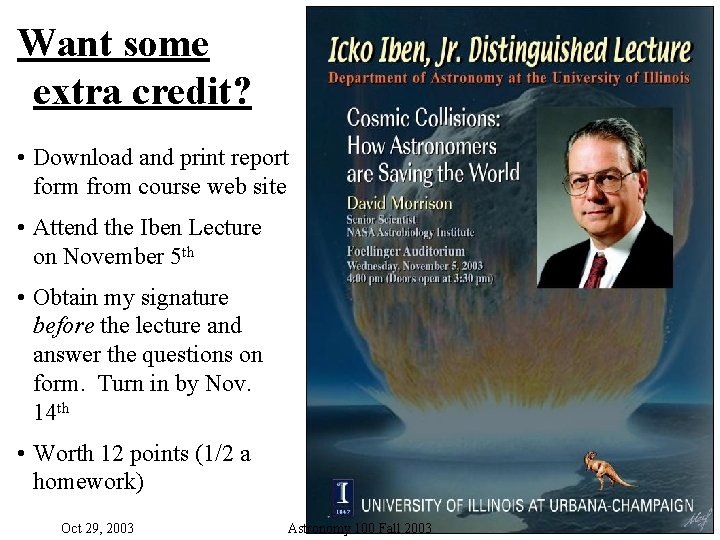
Want some extra credit? • Download and print report form from course web site • Attend the Iben Lecture on November 5 th • Obtain my signature before the lecture and answer the questions on form. Turn in by Nov. 14 th • Worth 12 points (1/2 a homework) Oct 29, 2003 Astronomy 100 Fall 2003
Outline • Doppler shift– also shifts light • Apparent Brightness compared to Absolute Brightness • Move away from the Solar System– onto stars! • How to tell how far away a star is– parallax. • A stellar consensus • The HR Diagram– it’s your friend. • Main Sequence Stars, Giants, Super Giants, White Dwarves, Red Dwarves, Brown Dwarves, and Black Dwarves Oct 29, 2003 Astronomy 100 Fall 2003
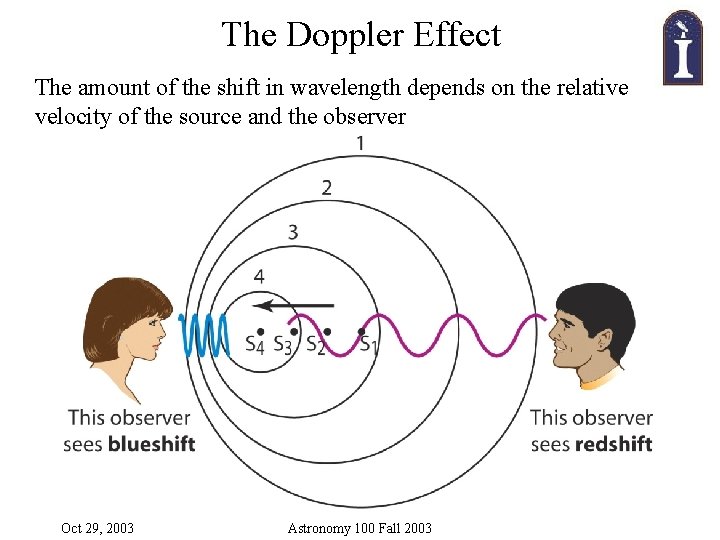
The Doppler Effect The amount of the shift in wavelength depends on the relative velocity of the source and the observer Oct 29, 2003 Astronomy 100 Fall 2003
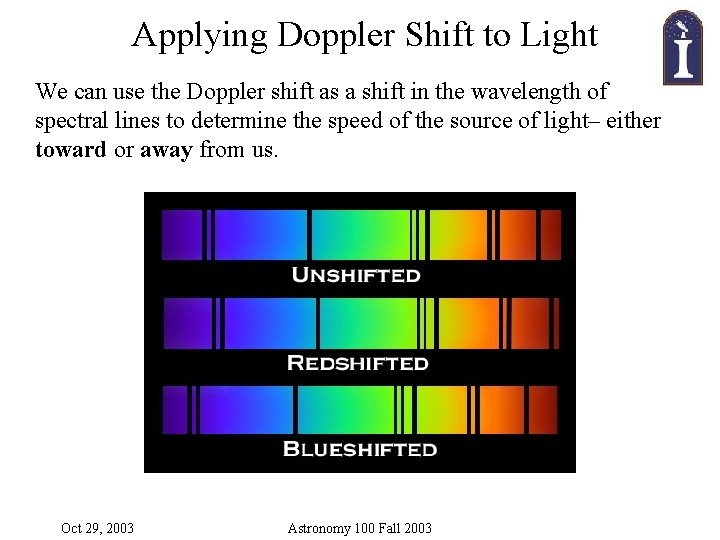
Applying Doppler Shift to Light We can use the Doppler shift as a shift in the wavelength of spectral lines to determine the speed of the source of light– either toward or away from us. Oct 29, 2003 Astronomy 100 Fall 2003
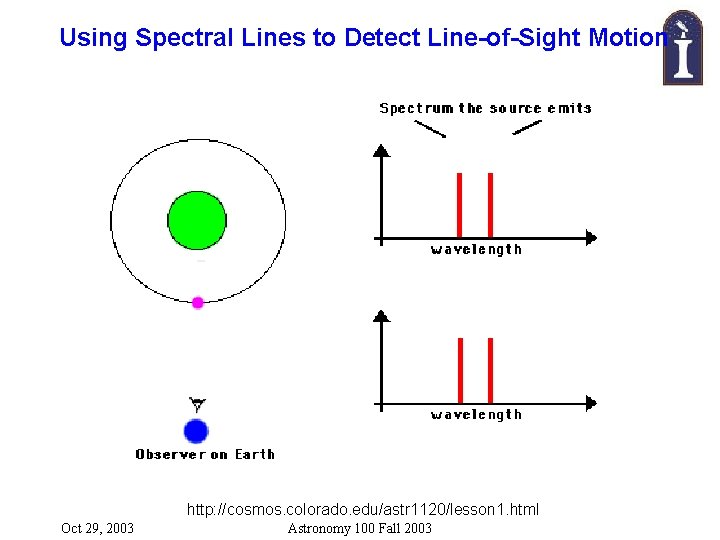
Using Spectral Lines to Detect Line-of-Sight Motion http: //cosmos. colorado. edu/astr 1120/lesson 1. html Oct 29, 2003 Astronomy 100 Fall 2003
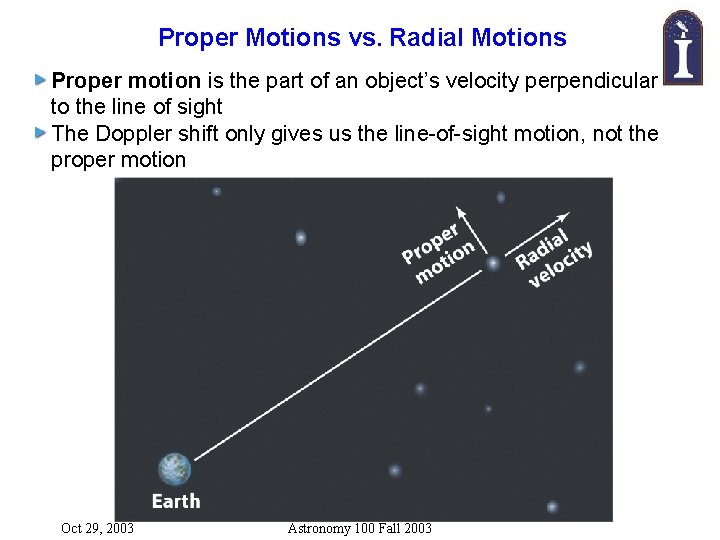
Proper Motions vs. Radial Motions Proper motion is the part of an object’s velocity perpendicular to the line of sight The Doppler shift only gives us the line-of-sight motion, not the proper motion Oct 29, 2003 Astronomy 100 Fall 2003
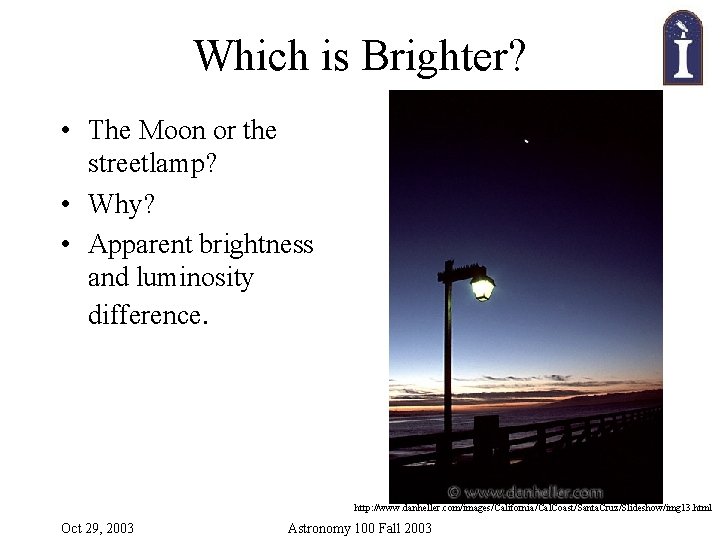
Which is Brighter? • The Moon or the streetlamp? • Why? • Apparent brightness and luminosity difference. http: //www. danheller. com/images/California/Cal. Coast/Santa. Cruz/Slideshow/img 13. html Oct 29, 2003 Astronomy 100 Fall 2003
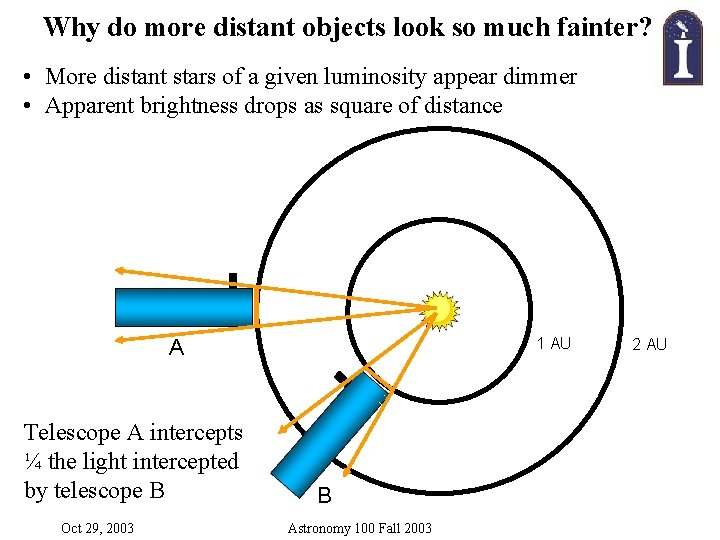
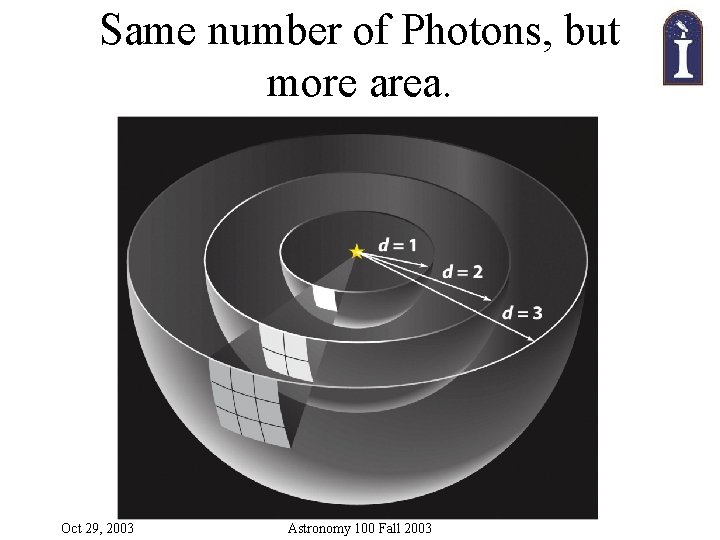
Why do more distant objects look so much fainter? • More distant stars of a given luminosity appear dimmer • Apparent brightness drops as square of distance 1 AU A Telescope A intercepts ¼ the light intercepted by telescope B Oct 29, 2003 B Astronomy 100 Fall 2003 2 AU
Same number of Photons, but more area. Oct 29, 2003 Astronomy 100 Fall 2003
Astronomy: The Big Picture Now, on to other stars! Oct 29, 2003 Astronomy 100 Fall 2003
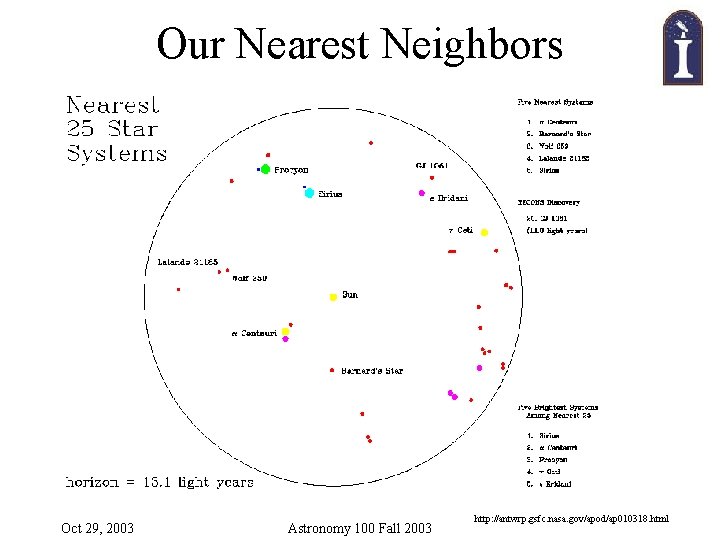
Our Nearest Neighbors Oct 29, 2003 Astronomy 100 Fall 2003 http: //antwrp. gsfc. nasa. gov/apod/ap 010318. html
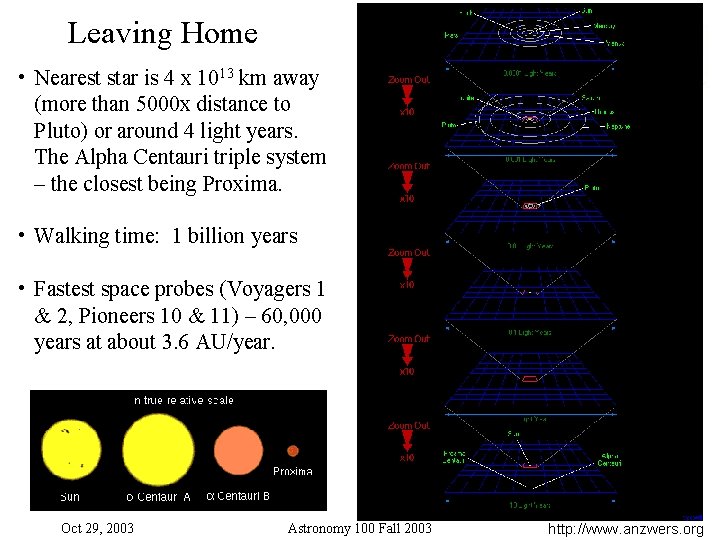
Leaving Home • Nearest star is 4 x 10¹³ km away (more than 5000 x distance to Pluto) or around 4 light years. The Alpha Centauri triple system – the closest being Proxima. • Walking time: 1 billion years • Fastest space probes (Voyagers 1 & 2, Pioneers 10 & 11) – 60, 000 years at about 3. 6 AU/year. Oct 29, 2003 Astronomy 100 Fall 2003 http: //www. anzwers. org
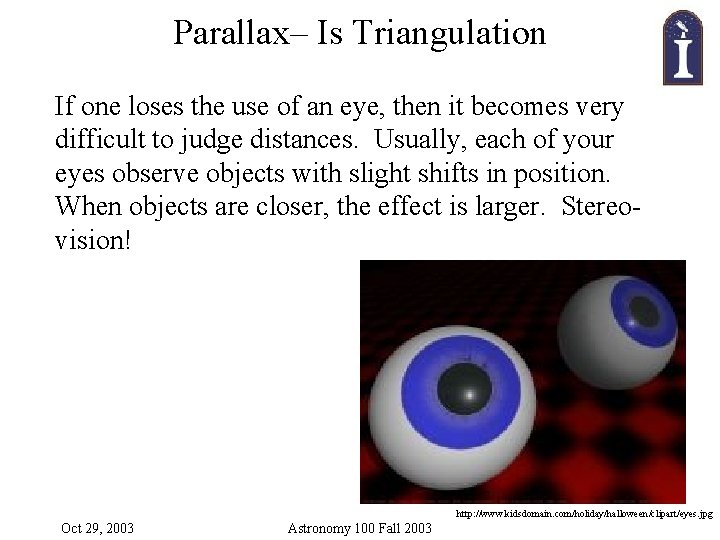
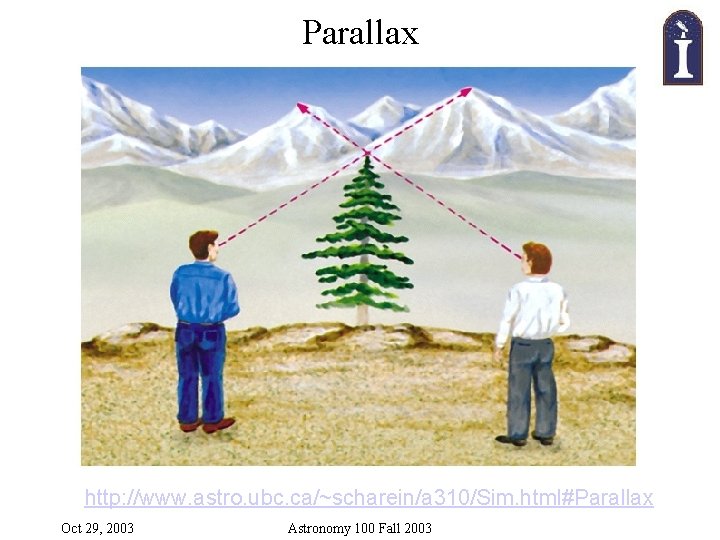
Parallax– Is Triangulation If one loses the use of an eye, then it becomes very difficult to judge distances. Usually, each of your eyes observe objects with slight shifts in position. When objects are closer, the effect is larger. Stereovision! http: //www. kidsdomain. com/holiday/halloween/clipart/eyes. jpg Oct 29, 2003 Astronomy 100 Fall 2003
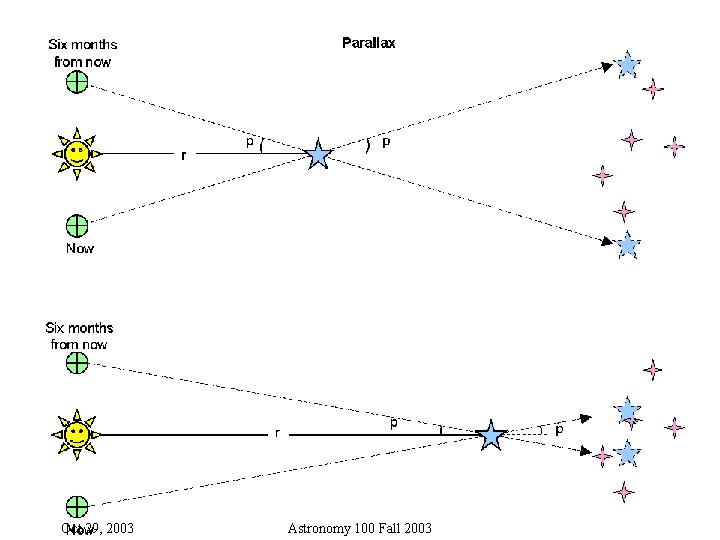
How Astronomers Measure Parallax. • Look at a star compared to background stars– and wait 6 months. • How much, if any, have the stars moved? Oct 29, 2003 Astronomy 100 Fall 2003
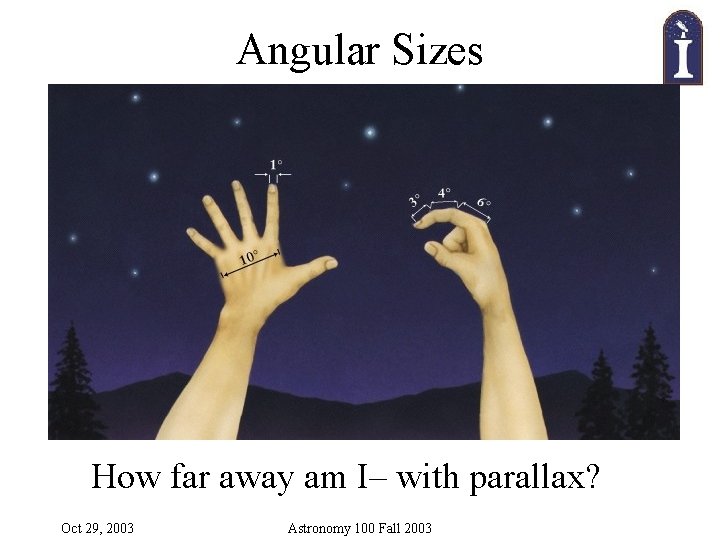
Angular Sizes How far away am I– with parallax? Oct 29, 2003 Astronomy 100 Fall 2003
Parallax Oct 29, 2003 Astronomy 100 Fall 2003
Parallax http: //www. astro. ubc. ca/~scharein/a 310/Sim. html#Parallax Oct 29, 2003 Astronomy 100 Fall 2003
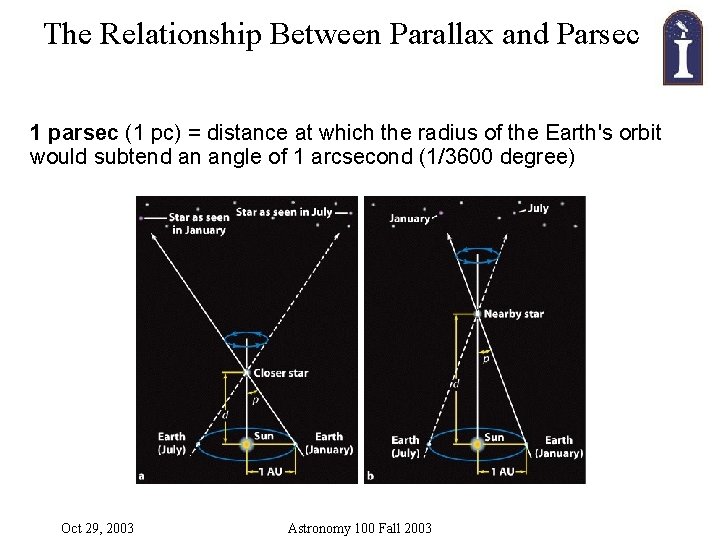
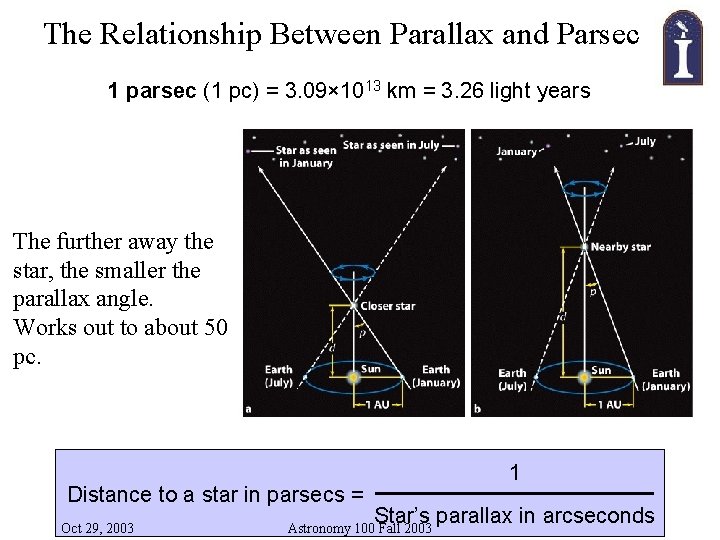
The Relationship Between Parallax and Parsec 1 parsec (1 pc) = distance at which the radius of the Earth's orbit would subtend an angle of 1 arcsecond (1/3600 degree) Oct 29, 2003 Astronomy 100 Fall 2003
The Relationship Between Parallax and Parsec 1 parsec (1 pc) = 3. 09× 1013 km = 3. 26 light years The further away the star, the smaller the parallax angle. Works out to about 50 pc. Distance to a star in parsecs = Oct 29, 2003 1 Star’s parallax in arcseconds Astronomy 100 Fall 2003
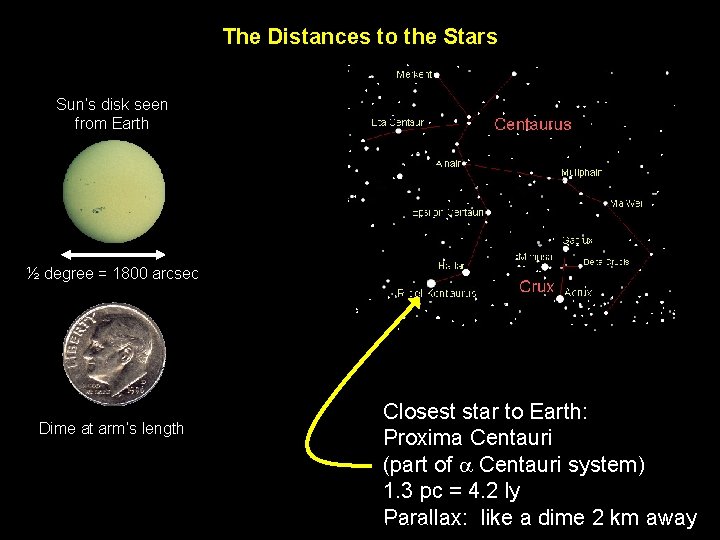
The Distances to the Stars Sun’s disk seen from Earth ½ degree = 1800 arcsec Dime at arm’s length Oct 29, 2003 Closest star to Earth: Proxima Centauri (part of Centauri system) 1. 3 pc = 4. 2 ly Parallax: like a dime 2 km away Astronomy 100 Fall 2003
Stellar Consensus • Are all stars the same? Are they all just like our Sun? • Do they have different masses? • Do they have different sizes? • Do they have different temperatures? Colors? • What happens to them? Just grow old and get retirement? Oct 29, 2003 Astronomy 100 Fall 2003
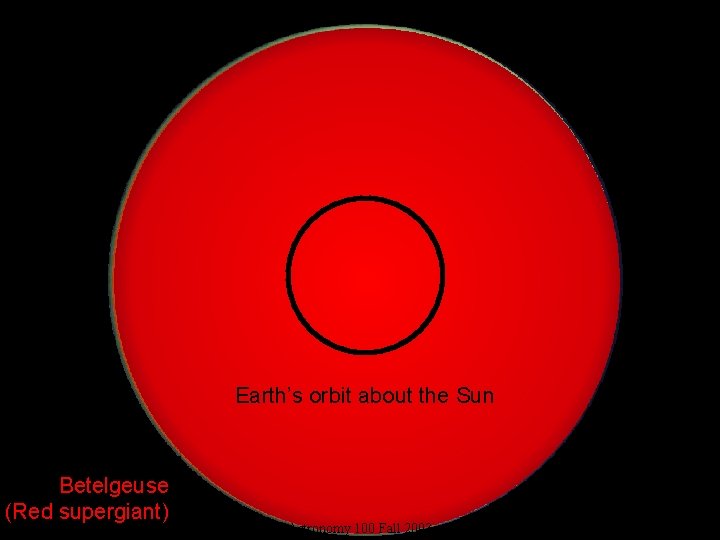
Earth’s orbit about the Sun Arcturus (Yellow Betelgeuse Earth (Red giant) (Reddwarf) supergiant) Oct 29, 2003 Astronomy 100 Fall 2003
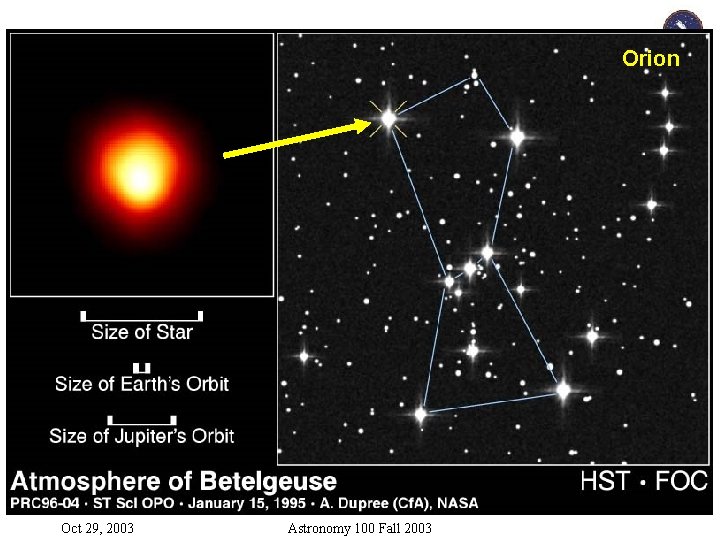
Orion Oct 29, 2003 Astronomy 100 Fall 2003
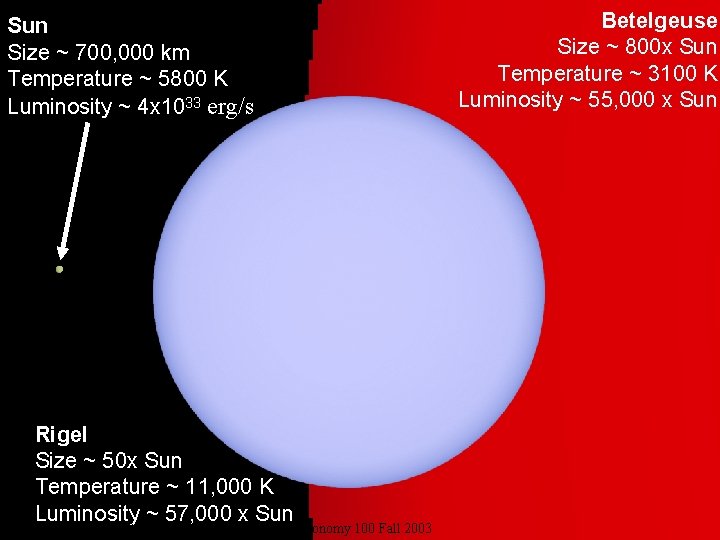
Betelgeuse Size ~ 800 x Sun Temperature ~ 3100 K Luminosity ~ 55, 000 x Sun Size ~ 700, 000 km Temperature ~ 5800 K Luminosity ~ 4 x 1033 erg/s Rigel Size ~ 50 x Sun Temperature ~ 11, 000 K Luminosity ~ 57, 000 x Sun Oct 29, 2003 Astronomy 100 Fall 2003
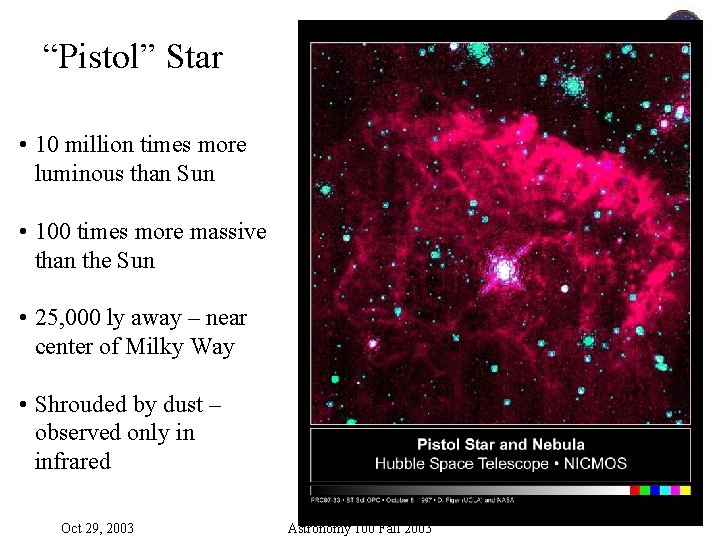
“Pistol” Star • 10 million times more luminous than Sun • 100 times more massive than the Sun • 25, 000 ly away – near center of Milky Way • Shrouded by dust – observed only in infrared Oct 29, 2003 Astronomy 100 Fall 2003
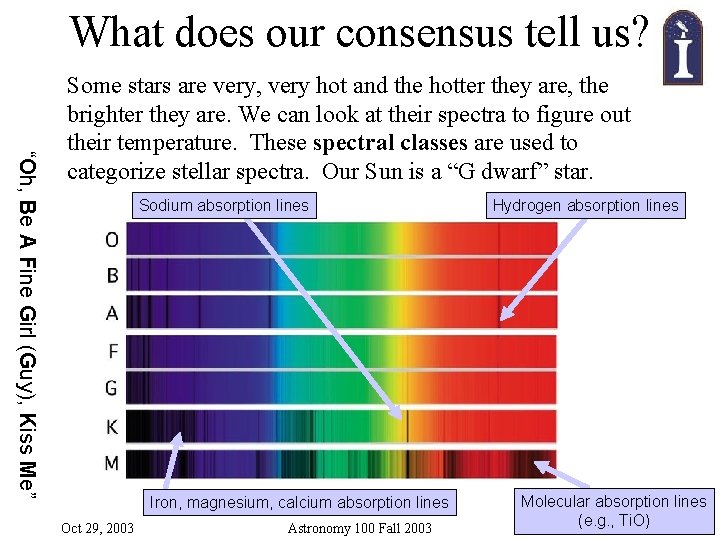
What does our consensus tell us? “Oh, Be A Fine Girl (Guy), Kiss Me” Some stars are very, very hot and the hotter they are, the brighter they are. We can look at their spectra to figure out their temperature. These spectral classes are used to categorize stellar spectra. Our Sun is a “G dwarf” star. Sodium absorption lines Iron, magnesium, calcium absorption lines Oct 29, 2003 Astronomy 100 Fall 2003 Hydrogen absorption lines Molecular absorption lines (e. g. , Ti. O)
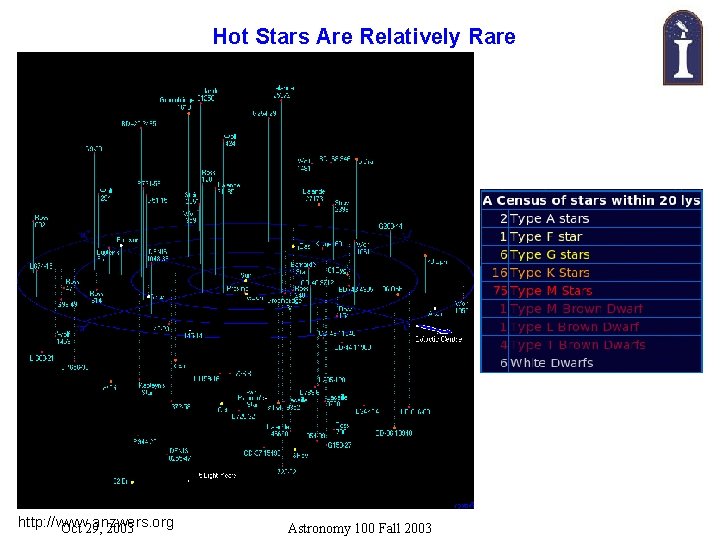
Hot Stars Are Relatively Rare http: //www. anzwers. org Oct 29, 2003 Astronomy 100 Fall 2003
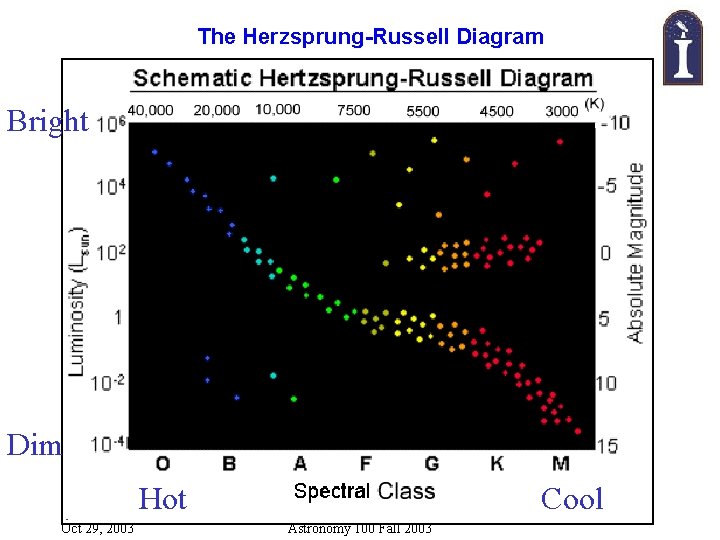
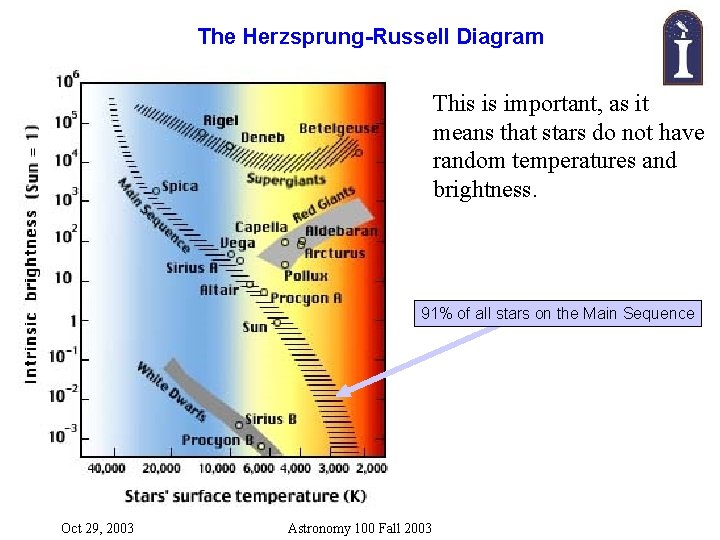
What else does our consensus tell us? • Well, we can guess that there might be some relationship between temperature and luminosity. • Also, as a star evolves from birth to death, the star will change its temperature (hotter or cooler) and its size (expands or contracts). • The first astronomers to discover this (independently) was Ejnar Hertzsprung and Henry Russell– now this relationship is called the HR Diagram. Oct 29, 2003 Astronomy 100 Fall 2003
The Herzsprung-Russell Diagram Bright Dim Hot Oct 29, 2003 Cool Astronomy 100 Fall 2003
The Herzsprung-Russell Diagram This is important, as it means that stars do not have random temperatures and brightness. 91% of all stars on the Main Sequence Oct 29, 2003 Astronomy 100 Fall 2003
How does Stellar Radii Change Across the HR Diagram P. Flower, Clemson U. Oct 29, 2003 Astronomy 100 Fall 2003
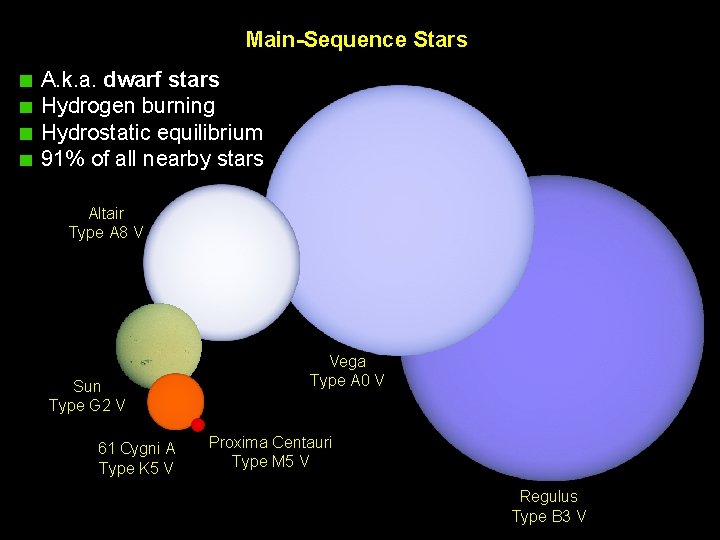
Main-Sequence Stars A. k. a. dwarf stars Hydrogen burning Hydrostatic equilibrium 91% of all nearby stars Altair Type A 8 V Sun Type G 2 V 61 Cygni A Type K 5 V Oct 29, 2003 Vega Type A 0 V Proxima Centauri Type M 5 V Astronomy 100 Fall 2003 Regulus Type B 3 V
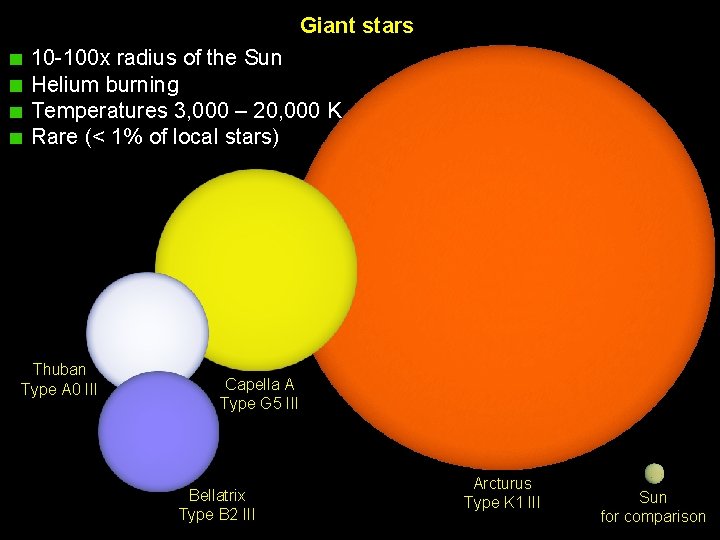
Giant stars 10 -100 x radius of the Sun Helium burning Temperatures 3, 000 – 20, 000 K Rare (< 1% of local stars) Thuban Type A 0 III Oct 29, 2003 Capella A Type G 5 III Bellatrix Type B 2 III Arcturus Type K 1 III Astronomy 100 Fall 2003 Sun for comparison
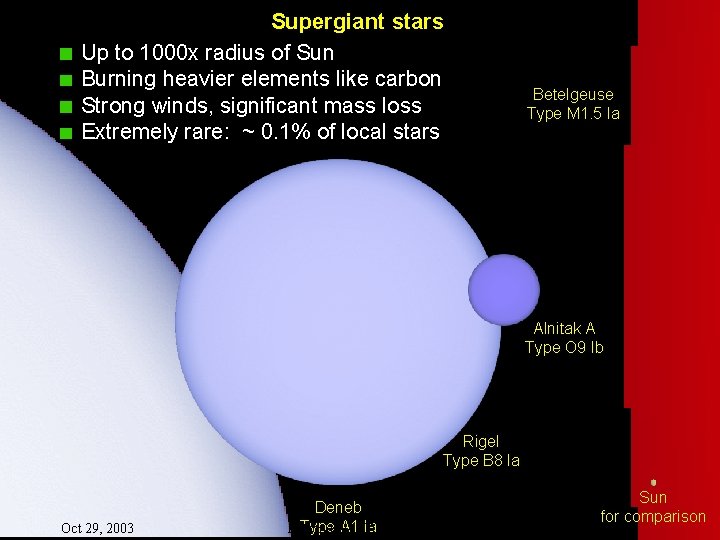
Supergiant stars Up to 1000 x radius of Sun Burning heavier elements like carbon Strong winds, significant mass loss Extremely rare: ~ 0. 1% of local stars Betelgeuse Type M 1. 5 Ia Alnitak A Type O 9 Ib Rigel Type B 8 Ia Oct 29, 2003 Deneb Type A 1100 Ia Fall 2003 Astronomy Sun for comparison
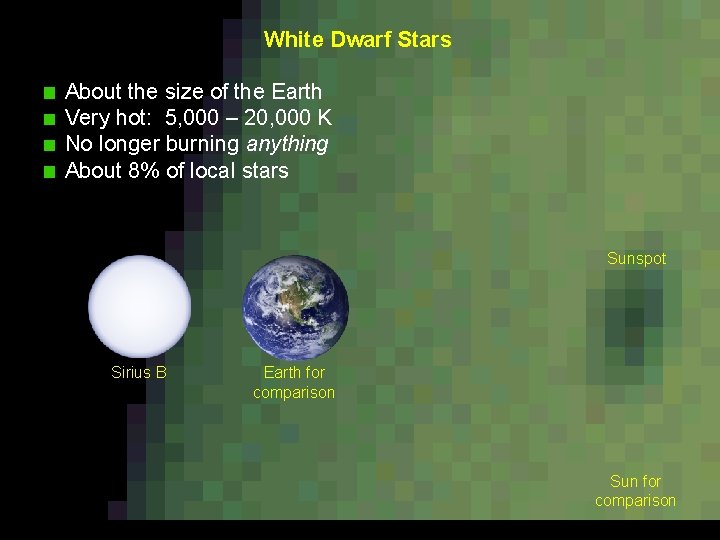
White Dwarf Stars About the size of the Earth Very hot: 5, 000 – 20, 000 K No longer burning anything About 8% of local stars Sunspot Sirius B Earth for comparison Sun for comparison Oct 29, 2003 Astronomy 100 Fall 2003
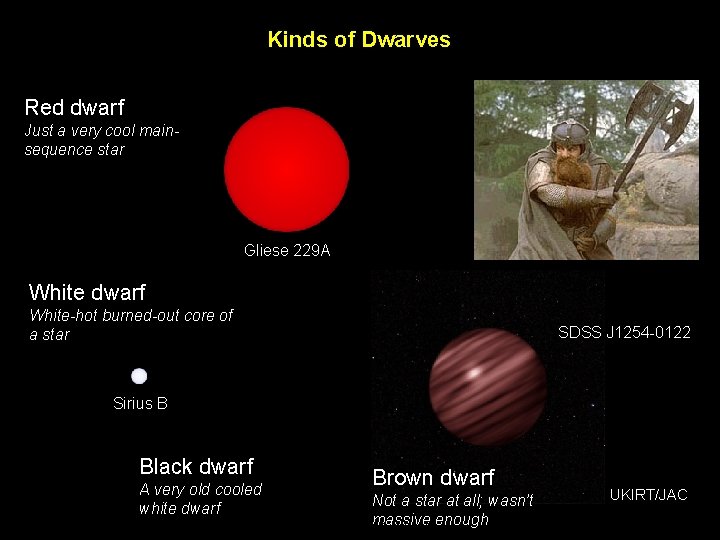
Kinds of Dwarves Red dwarf Just a very cool mainsequence star Gliese 229 A White dwarf White-hot burned-out core of a star SDSS J 1254 -0122 Sirius B Black dwarf A very old cooled white dwarf Oct 29, 2003 Brown dwarf Not a star at all; wasn’t massive enough Astronomy 100 Fall 2003 UKIRT/JAC