News Recommendation with CFIDF Emma de Koning 370761

- Slides: 21
News Recommendation with CF-IDF+ Emma de Koning 370761 ek@student. eur. nl Frederik Hogenboom Flavius Frasincar fhogenboom@ese. eur. nl frasincar@ese. eur. nl Erasmus University Rotterdam PO Box 1738, NL-3000 DR Rotterdam, the Netherlands June 13, 2018 30 th International Conference on Advanced Information Systems Engineering (CAISE 2018)
Introduction (1) • Recommender systems help users to plough through a massive and increasing amount of information • Recommender systems: – Content-based – Collaborative filtering – Hybrid • Content-based systems are often term-based • Common measure: Term Frequency – Inverse Document Frequency (TF-IDF) as proposed by [Salton and Buckley, 1988] 30 th International Conference on Advanced Information Systems Engineering (CAISE 2018)
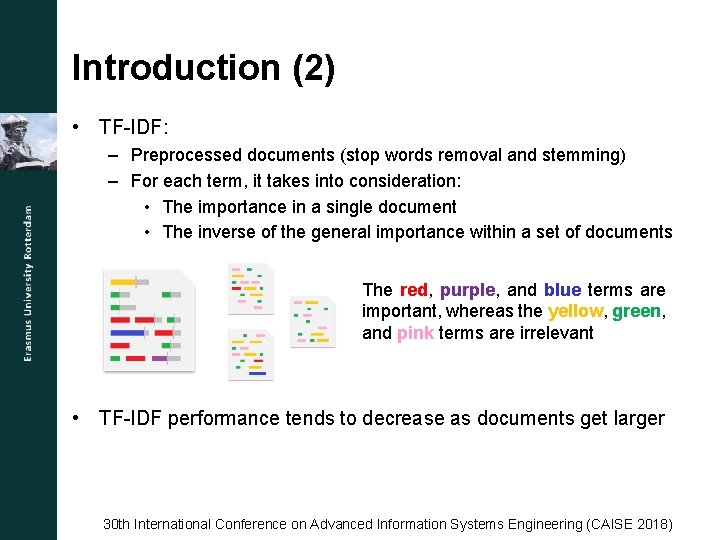
Introduction (2) • TF-IDF: – Preprocessed documents (stop words removal and stemming) – For each term, it takes into consideration: • The importance in a single document • The inverse of the general importance within a set of documents The red, purple, and blue terms are important, whereas the yellow, green, and pink terms are irrelevant • TF-IDF performance tends to decrease as documents get larger 30 th International Conference on Advanced Information Systems Engineering (CAISE 2018)
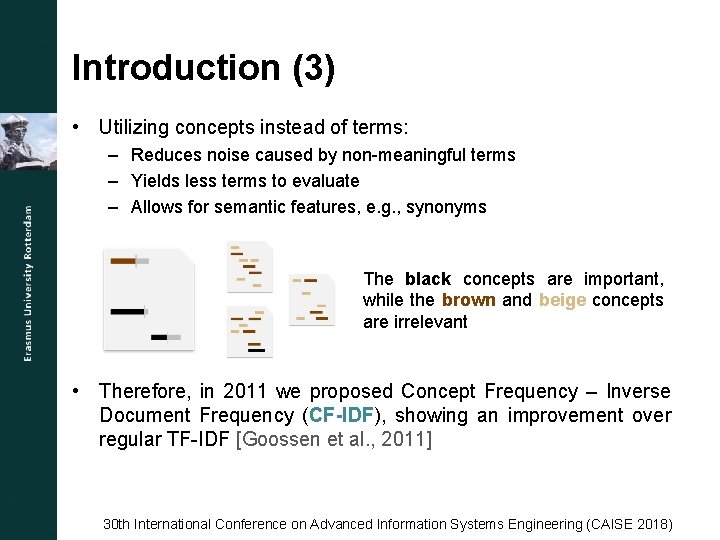
Introduction (3) • Utilizing concepts instead of terms: – Reduces noise caused by non-meaningful terms – Yields less terms to evaluate – Allows for semantic features, e. g. , synonyms The black concepts are important, while the brown and beige concepts are irrelevant • Therefore, in 2011 we proposed Concept Frequency – Inverse Document Frequency (CF-IDF), showing an improvement over regular TF-IDF [Goossen et al. , 2011] 30 th International Conference on Advanced Information Systems Engineering (CAISE 2018)
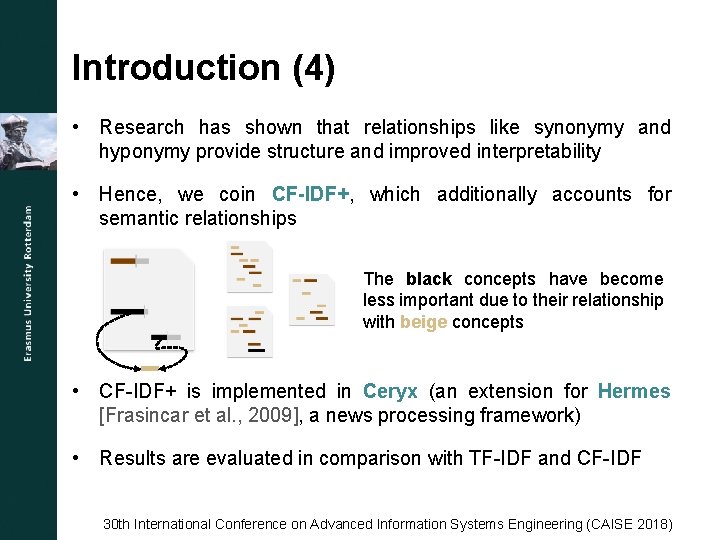
Introduction (4) • Research has shown that relationships like synonymy and hyponymy provide structure and improved interpretability • Hence, we coin CF-IDF+, which additionally accounts for semantic relationships The black concepts have become less important due to their relationship with beige concepts • CF-IDF+ is implemented in Ceryx (an extension for Hermes [Frasincar et al. , 2009], a news processing framework) • Results are evaluated in comparison with TF-IDF and CF-IDF 30 th International Conference on Advanced Information Systems Engineering (CAISE 2018)
Introduction (5) • Earlier work has been done: – CF-IDF-like methods: [Baziz et al. , 2005], [Yan and Li, 2007] – Frameworks: Onto. Seek [Guarino et al. , 1999], Quickstep [Middleton et al. , 2004], News@hand [Cantador et al. , 2008] • Although some work shows overlap: – Methods are not thoroughly compared with TF-IDF – Often, WSD and synonym handling is lacking 30 th International Conference on Advanced Information Systems Engineering (CAISE 2018)
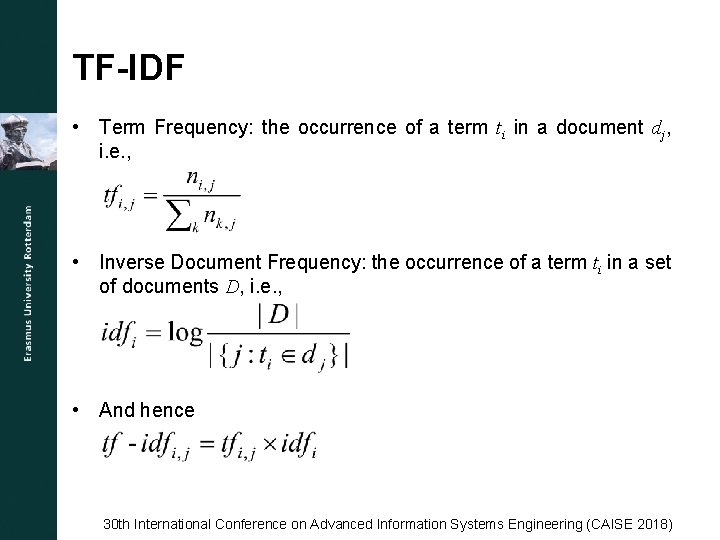
TF-IDF • Term Frequency: the occurrence of a term ti in a document dj, i. e. , • Inverse Document Frequency: the occurrence of a term ti in a set of documents D, i. e. , • And hence 30 th International Conference on Advanced Information Systems Engineering (CAISE 2018)
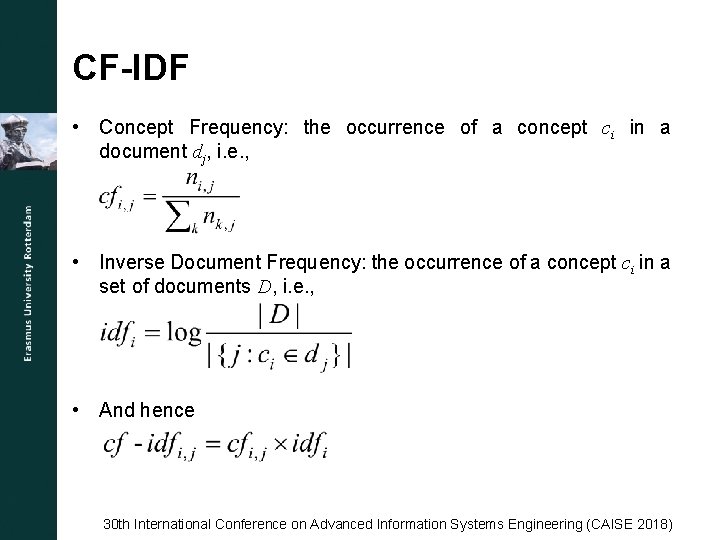
CF-IDF • Concept Frequency: the occurrence of a concept ci in a document dj, i. e. , • Inverse Document Frequency: the occurrence of a concept ci in a set of documents D, i. e. , • And hence 30 th International Conference on Advanced Information Systems Engineering (CAISE 2018)
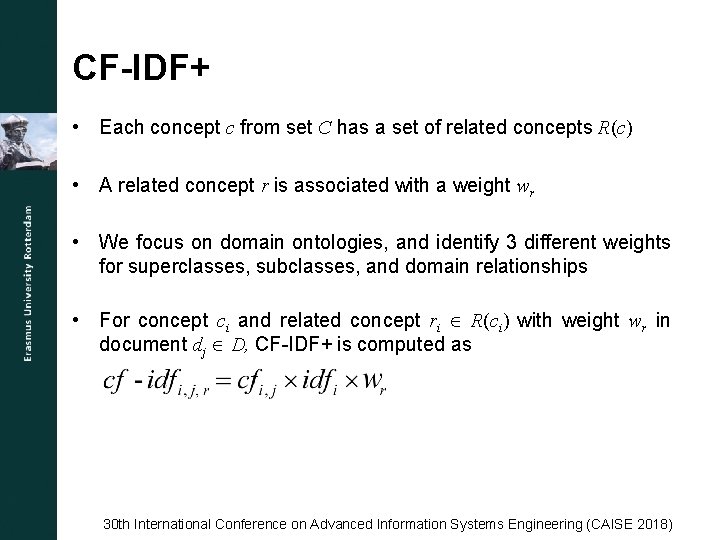
CF-IDF+ • Each concept c from set C has a set of related concepts R(c) • A related concept r is associated with a weight wr • We focus on domain ontologies, and identify 3 different weights for superclasses, subclasses, and domain relationships • For concept ci and related concept ri R(ci) with weight wr in document dj D, CF-IDF+ is computed as 30 th International Conference on Advanced Information Systems Engineering (CAISE 2018)
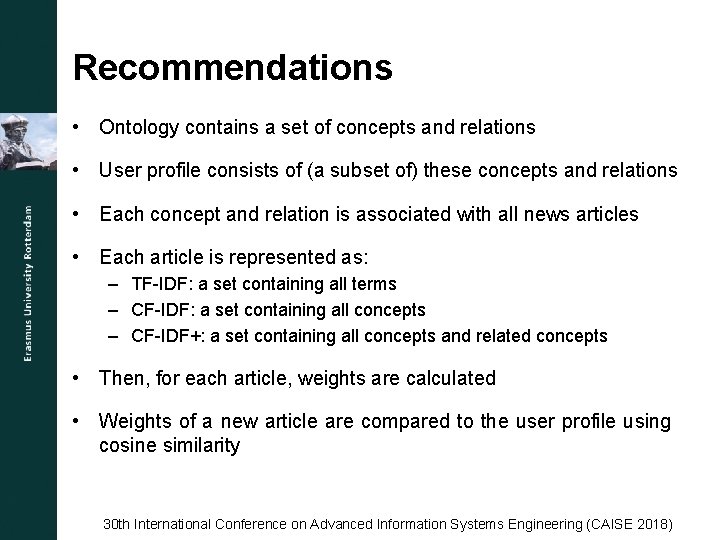
Recommendations • Ontology contains a set of concepts and relations • User profile consists of (a subset of) these concepts and relations • Each concept and relation is associated with all news articles • Each article is represented as: – TF-IDF: a set containing all terms – CF-IDF: a set containing all concepts – CF-IDF+: a set containing all concepts and related concepts • Then, for each article, weights are calculated • Weights of a new article are compared to the user profile using cosine similarity 30 th International Conference on Advanced Information Systems Engineering (CAISE 2018)
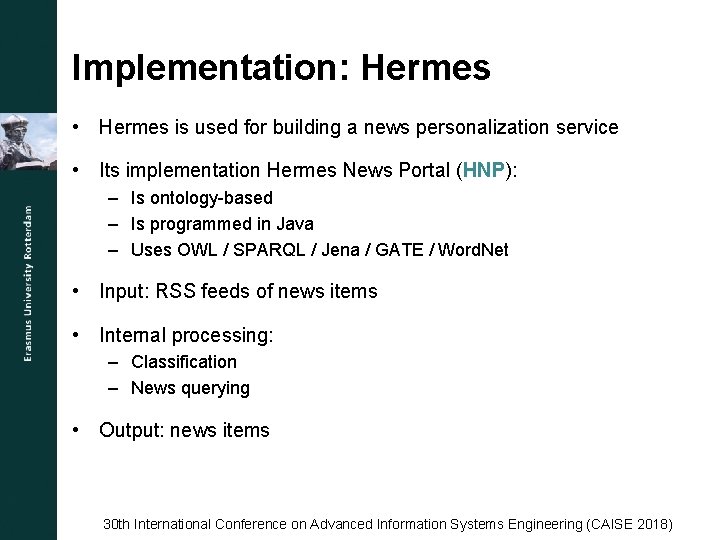
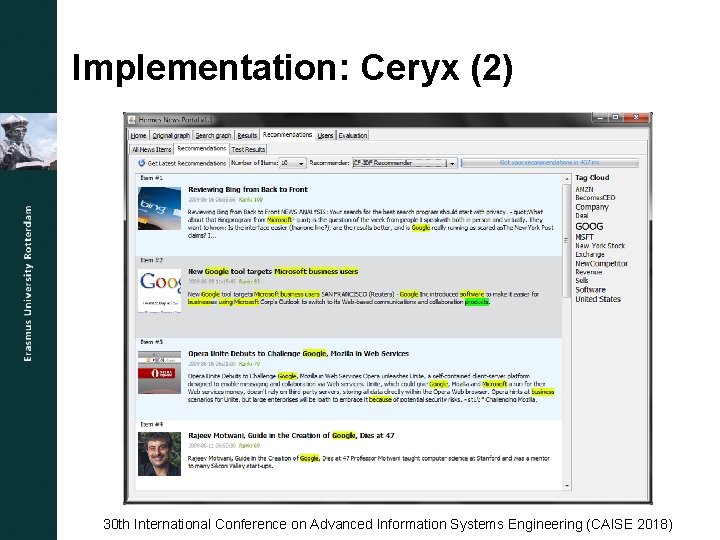
Implementation: Hermes • Hermes is used for building a news personalization service • Its implementation Hermes News Portal (HNP): – Is ontology-based – Is programmed in Java – Uses OWL / SPARQL / Jena / GATE / Word. Net • Input: RSS feeds of news items • Internal processing: – Classification – News querying • Output: news items 30 th International Conference on Advanced Information Systems Engineering (CAISE 2018)
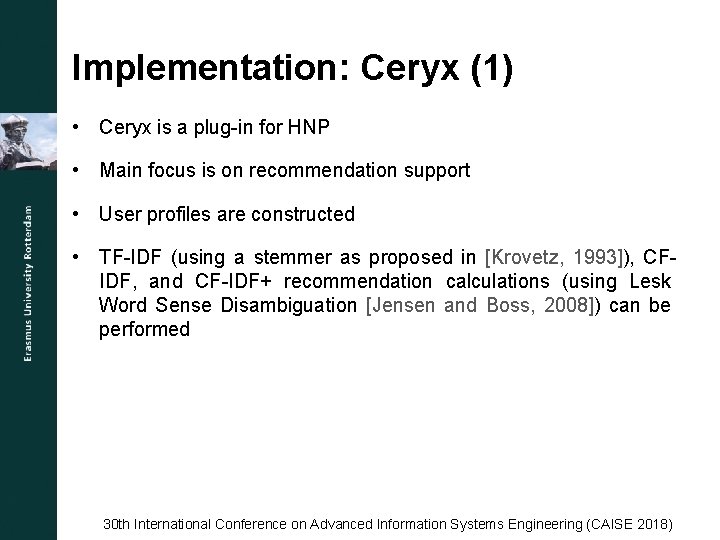
Implementation: Ceryx (1) • Ceryx is a plug-in for HNP • Main focus is on recommendation support • User profiles are constructed • TF-IDF (using a stemmer as proposed in [Krovetz, 1993]), CFIDF, and CF-IDF+ recommendation calculations (using Lesk Word Sense Disambiguation [Jensen and Boss, 2008]) can be performed 30 th International Conference on Advanced Information Systems Engineering (CAISE 2018)
Implementation: Ceryx (2) 30 th International Conference on Advanced Information Systems Engineering (CAISE 2018)
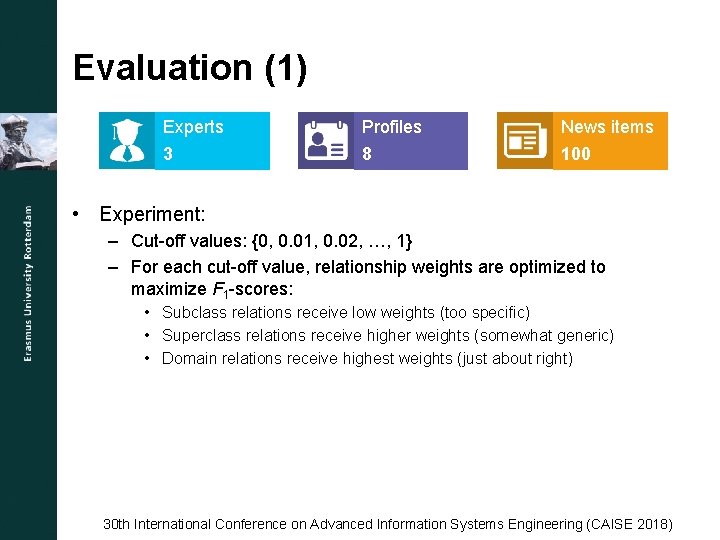
Evaluation (1) Experts 3 Profiles 8 News items 100 • Experiment: – Cut-off values: {0, 0. 01, 0. 02, …, 1} – For each cut-off value, relationship weights are optimized to maximize F 1 -scores: • Subclass relations receive low weights (too specific) • Superclass relations receive higher weights (somewhat generic) • Domain relations receive highest weights (just about right) 30 th International Conference on Advanced Information Systems Engineering (CAISE 2018)
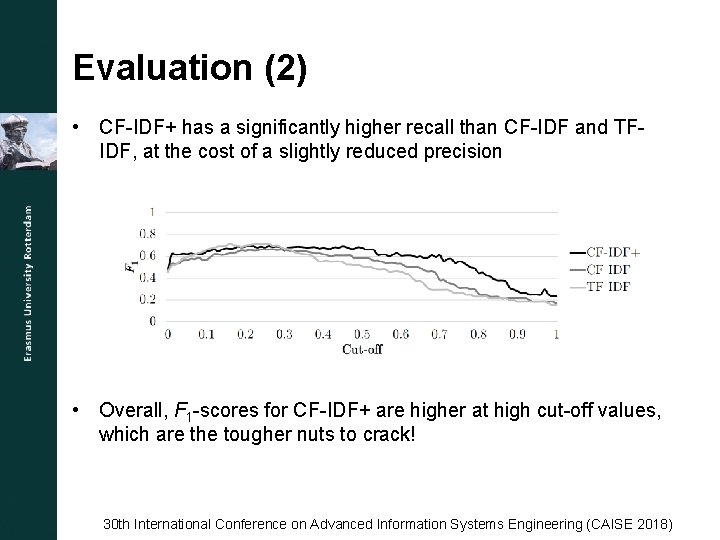
Evaluation (2) • CF-IDF+ has a significantly higher recall than CF-IDF and TFIDF, at the cost of a slightly reduced precision • Overall, F 1 -scores for CF-IDF+ are higher at high cut-off values, which are the tougher nuts to crack! 30 th International Conference on Advanced Information Systems Engineering (CAISE 2018)
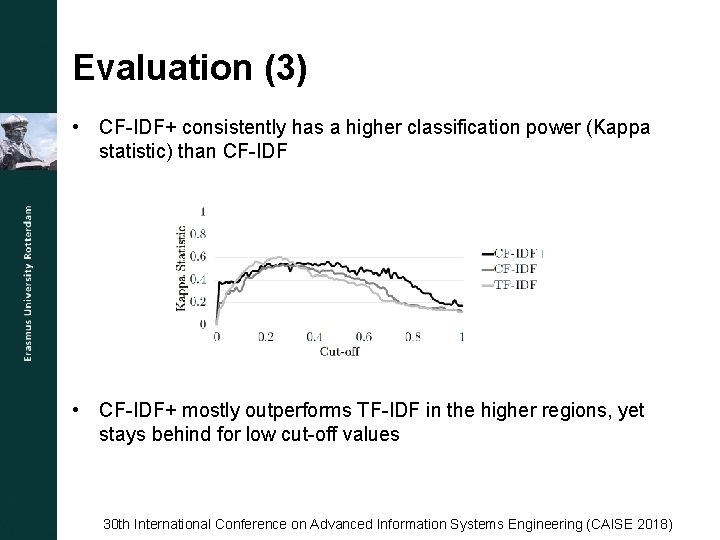
Evaluation (3) • CF-IDF+ consistently has a higher classification power (Kappa statistic) than CF-IDF • CF-IDF+ mostly outperforms TF-IDF in the higher regions, yet stays behind for low cut-off values 30 th International Conference on Advanced Information Systems Engineering (CAISE 2018)
Conclusions • For strict recommendation settings, CF-IDF+ outperforms CF-IDF and TF-IDF significantly • Especially classification power and recall show vast improvements, at the cost of a slight loss in precision • Hence, using key concepts and semantic relations instead of analyzing all terms could be beneficial for recommender systems • Future work: – – Invest in a more fine-grained weight learning procedure Include a larger collection of relationships Use other large ontological resources like Evaluate on a larger set of news items 30 th International Conference on Advanced Information Systems Engineering (CAISE 2018)
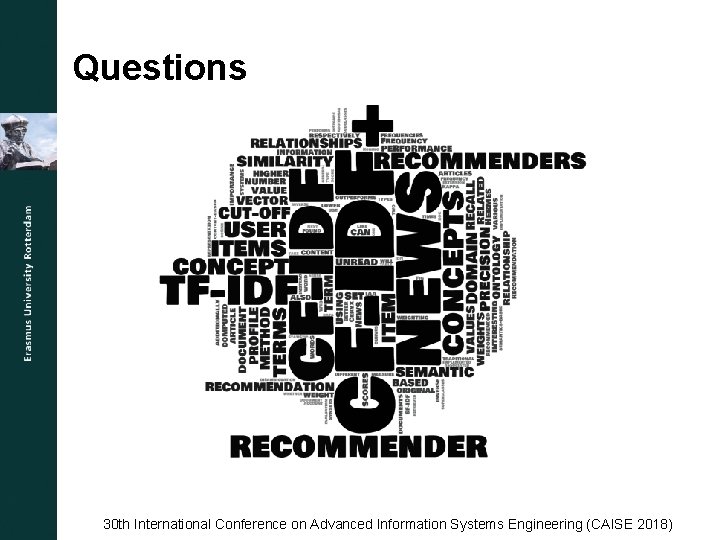
Questions 30 th International Conference on Advanced Information Systems Engineering (CAISE 2018)
References (1) • Baziz, M. , Boughanem, M. , Traboulsi, S. : A Concept-Based Approach for Indexing Documents in IR. In: Actes du XXIIIème Congrès Informatique des Organisations et Systèmes d'Information et de Décision (INFORSID 2005). pp. 489 -504. HERMES Science Publications (2005) • Cantador, I. , Bellogín, A. , Castells, P. : News@hand: A Semantic Web Approach to Recommending News. In: 5 th International Conference on Adaptive Hypermedia and Adaptive Web-Based Systems (AH 2008). pp. 279 -283. Springer-Verlag, Berlin, Heidelberg (2008) • Frasincar, F. , Borsje, J. , Levering, L. : A Semantic Web-Based Approach for Building Personalized News Services. International Journal of E-Business Research 5(3), 35 -53 (2009) 30 th International Conference on Advanced Information Systems Engineering (CAISE 2018)
References (2) • Goossen, F. , IJntema, W. , Frasincar. F. , Hogenboom, F. , Kaymak, U. : News Personalization using the CF-IDF Semantic Recommender. In: 1 st International Conference on Web Intelligence, Mining and Semantics (WIMS 2011). ACM (2011) • Guarino, N. , Masolo, C. , Vetere, G. : Onto. Seek: Content-Based Access to the Web. IEEE Intelligent Systems 14(3), 70 -80 (1999) • Jensen, A. S. , Boss, N. S. : Textual Similarity: Comparing Texts in order to Discover How Closely They Discuss the Same Topics. Bachelor’s thesis, Technical University of Denmark (2008) • Krovetz, R. : Viewing Morphology as an Inference Process. In: 26 th ACM Conference on Research and Development in Information Retrieval (SIGIR 1993). pp. 191 -202. ACM (1993) 30 th International Conference on Advanced Information Systems Engineering (CAISE 2018)
References (3) • Middleton, S. E. , Roure, D. D. , Shadbolt, N. R. : Ontology-Based Recommender Systems. In: Handbook on Ontologies, pp. 577498. International Handbooks on Information Systems, Springer (2004) • Salton, G. , Buckley, C. : Term-Weighting Approaches in Automatic Text Retrieval. Information Processing and Management 24(5), 513 -523 (1988) • Yan, L. , Li, C. : A Novel Semantic-based Text Representation Method for Improving Text Clustering. In: 3 rd Indian International Conference on Artificial Intelligence (IICAI 2007). pp. 1738 -1750 (2007) 30 th International Conference on Advanced Information Systems Engineering (CAISE 2018)