NEW INSTITUTIONAL ECONOMICS NIE Slides are from a



- Slides: 25
NEW INSTITUTIONAL ECONOMICS (NIE): Slides are from a presentation made by: Mylène Kherallah, John Maluccio, & Nancy Mc. Carthy IFPRI
NIE: A NEW SCHOOL OF THOUGHT “There you go gentlemen. According to this, we are now a “school of thought. ” Every school of thought is like a man who has talked to himself for a hundred years and is delighted with his own mind, however stupid it may be. (J. W. Goethe, 1817, Principles of Natural Science)
WHAT IS NIE? • No commonly agreed upon definition • Basic premise: Institutions matter for economic performance • Purpose is to explain the determinants of institutions and their evolution over time, and to evaluate their impact on economic performance, efficiency and distribution
What are Institutions? A set of formal and informal rules of conduct that facilitate coordination or govern relationships between individuals.
Why is it called “New”? • To distinguish it from the “old” institutionalist school (Veblen, Commons) • NIE operates within the framework of neo-classical economics, but it relaxes some of its assumptions and incorporates institutions as an additional constraint.
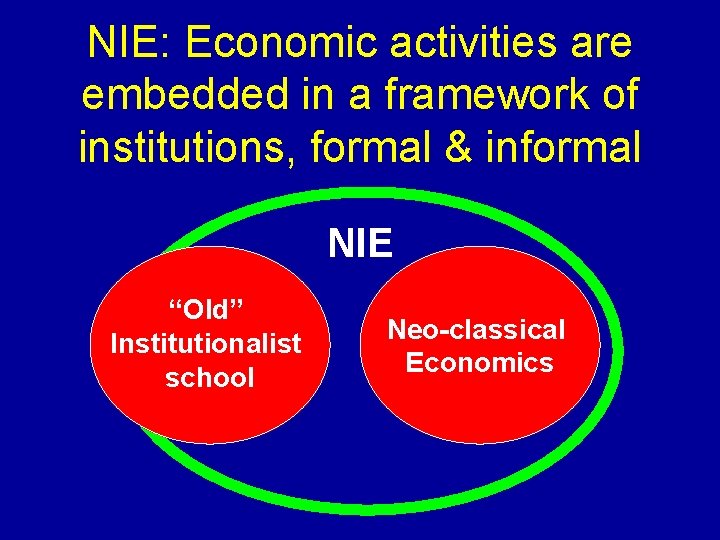
NIE: Economic activities are embedded in a framework of institutions, formal & informal NIE “Old” Institutionalist school Neo-classical Economics
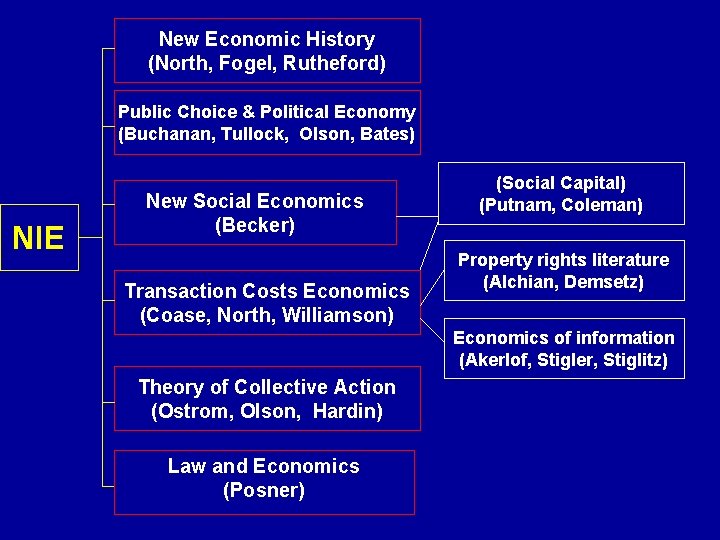
New Economic History (North, Fogel, Rutheford) Public Choice & Political Economy (Buchanan, Tullock, Olson, Bates) NIE New Social Economics (Becker) Transaction Costs Economics (Coase, North, Williamson) (Social Capital) (Putnam, Coleman) Property rights literature (Alchian, Demsetz) Economics of information (Akerlof, Stigler, Stiglitz) Theory of Collective Action (Ostrom, Olson, Hardin) Law and Economics (Posner)
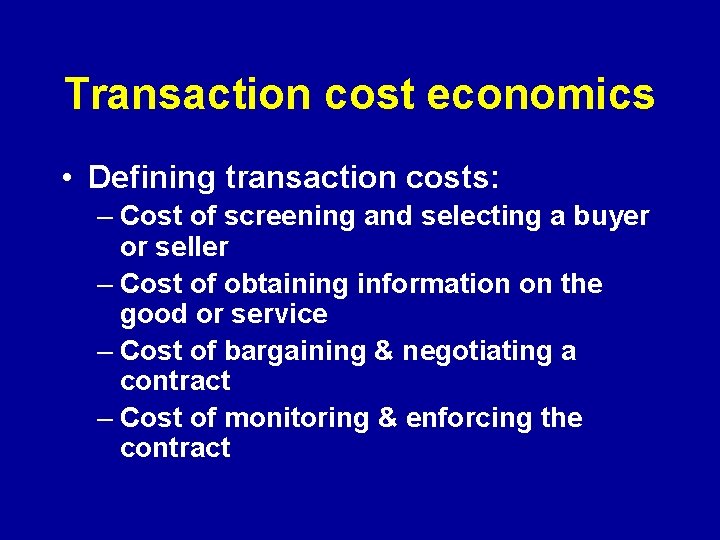
Transaction cost economics • Defining transaction costs: – Cost of screening and selecting a buyer or seller – Cost of obtaining information on the good or service – Cost of bargaining & negotiating a contract – Cost of monitoring & enforcing the contract
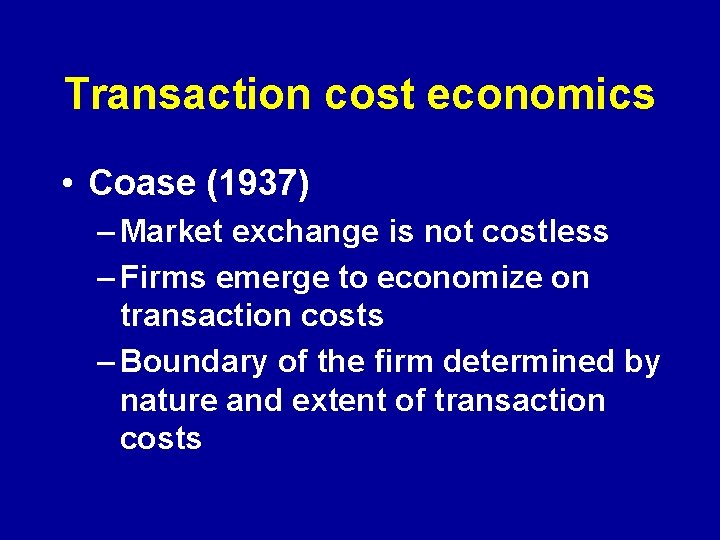
Transaction cost economics • Coase (1937) – Market exchange is not costless – Firms emerge to economize on transaction costs – Boundary of the firm determined by nature and extent of transaction costs
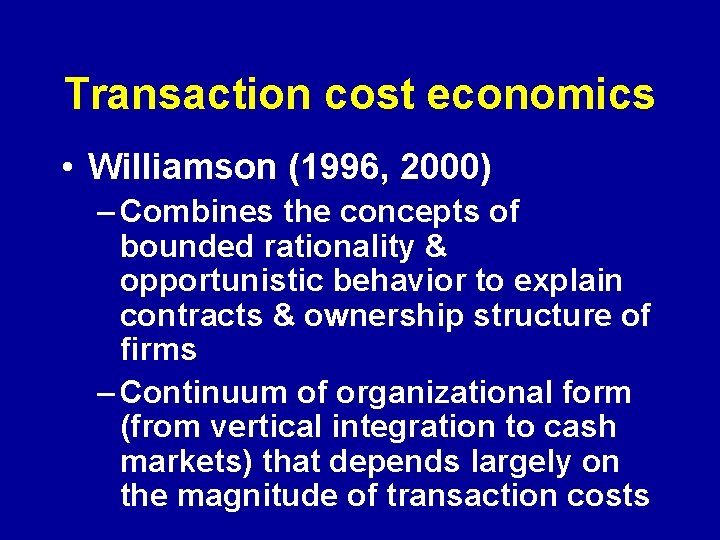
Transaction cost economics • Williamson (1996, 2000) – Combines the concepts of bounded rationality & opportunistic behavior to explain contracts & ownership structure of firms – Continuum of organizational form (from vertical integration to cash markets) that depends largely on the magnitude of transaction costs
Transaction cost economics • North (1986, 1989, 1994) – Institutions that evolve to reduce transaction costs are key to the performance of economies – Not all institutions that emerge are efficient – Role of government is crucial in specifying property rights and enforcing contracts
Transaction cost economics • North (1990) “The inability of societies to develop effective, low-cost enforcement of contracts is the most important source of both historical stagnation and contemporary underdevelopment in the third world. ”
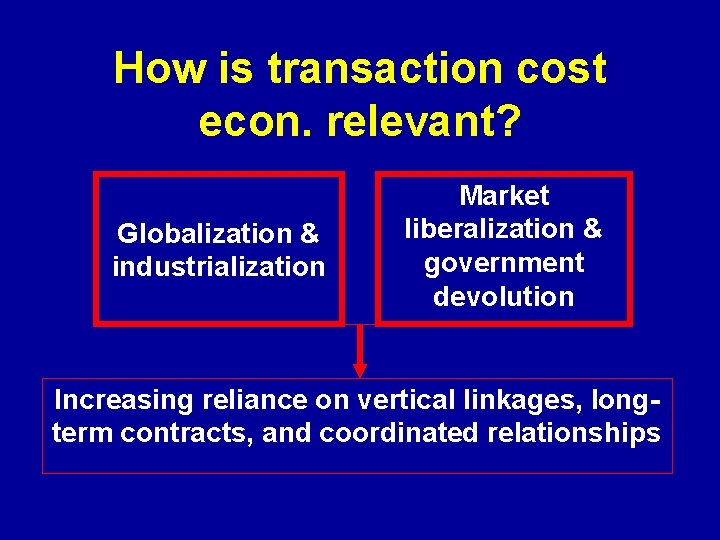
How is transaction cost econ. relevant? Globalization & industrialization Market liberalization & government devolution Increasing reliance on vertical linkages, longterm contracts, and coordinated relationships
New Institutional Economics: Social Capital • Isn’t “standard” economics enough? • What is social capital? How does it operate? • How is it currently measured? • Empirical examples • The (many? ) problems
Beyond neo-classical economics • Objective is modeling behavior • Other social sciences, social relations matter A need to extend the models economists use and to incorporate findings from other fields - in fact already exist many examples
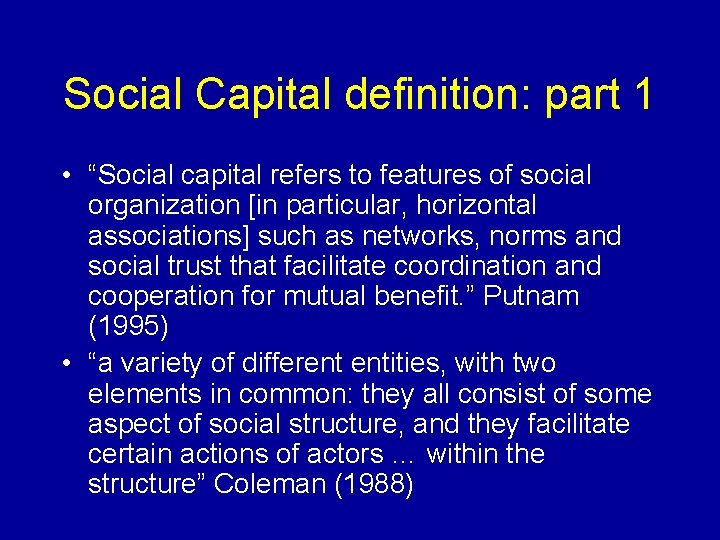
Social Capital definition: part 1 • “Social capital refers to features of social organization [in particular, horizontal associations] such as networks, norms and social trust that facilitate coordination and cooperation for mutual benefit. ” Putnam (1995) • “a variety of different entities, with two elements in common: they all consist of some aspect of social structure, and they facilitate certain actions of actors … within the structure” Coleman (1988)
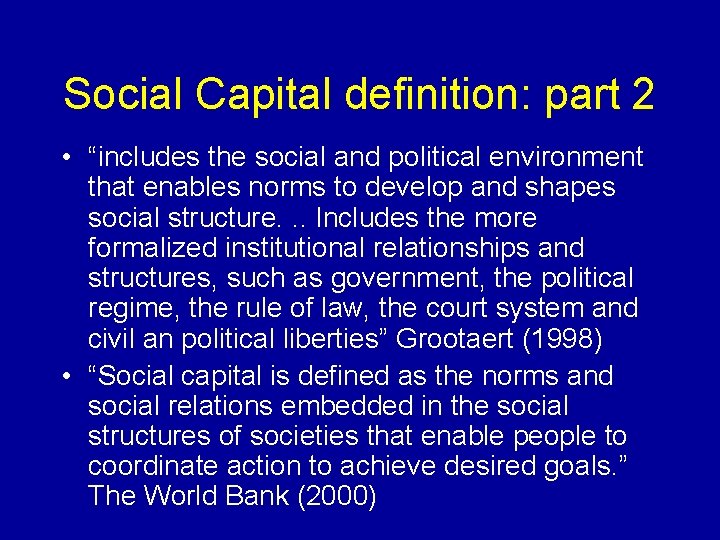
Social Capital definition: part 2 • “includes the social and political environment that enables norms to develop and shapes social structure. . . Includes the more formalized institutional relationships and structures, such as government, the political regime, the rule of law, the court system and civil an political liberties” Grootaert (1998) • “Social capital is defined as the norms and social relations embedded in the social structures of societies that enable people to coordinate action to achieve desired goals. ” The World Bank (2000)
Social Capital Definitions: part N • Enough already!
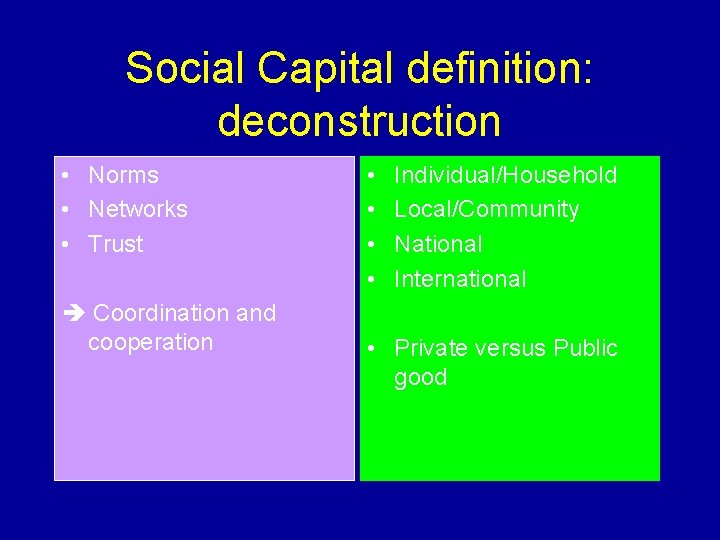
Social Capital definition: deconstruction • Norms • Networks • Trust Coordination and cooperation • • Individual/Household Local/Community National International • Private versus Public good
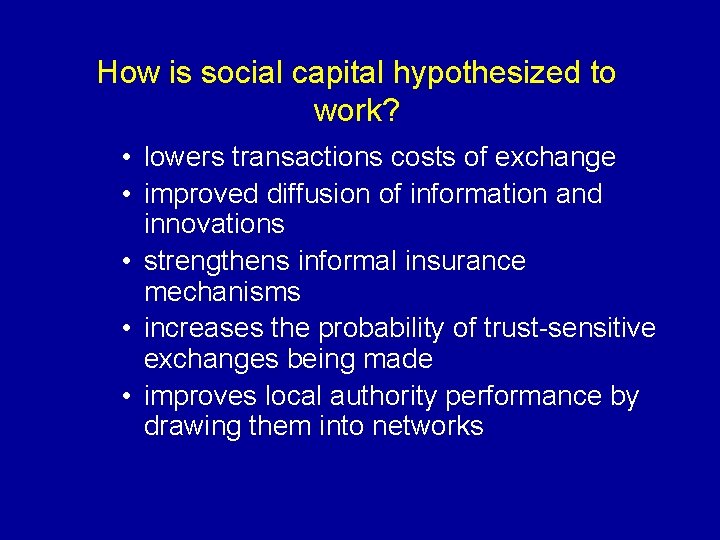
How is social capital hypothesized to work? • lowers transactions costs of exchange • improved diffusion of information and innovations • strengthens informal insurance mechanisms • increases the probability of trust-sensitive exchanges being made • improves local authority performance by drawing them into networks
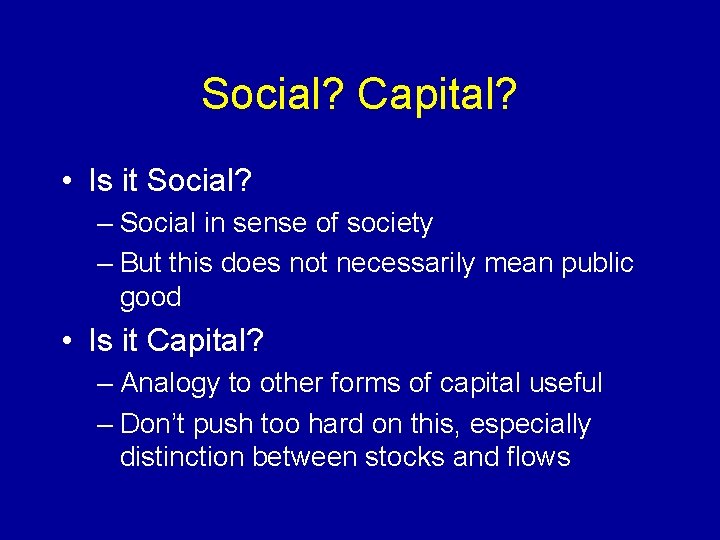
Social? Capital? • Is it Social? – Social in sense of society – But this does not necessarily mean public good • Is it Capital? – Analogy to other forms of capital useful – Don’t push too hard on this, especially distinction between stocks and flows
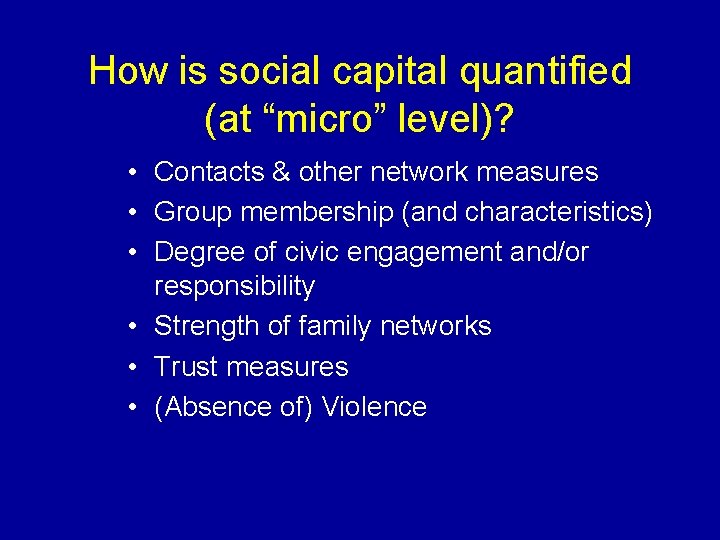
How is social capital quantified (at “micro” level)? • Contacts & other network measures • Group membership (and characteristics) • Degree of civic engagement and/or responsibility • Strength of family networks • Trust measures • (Absence of) Violence
What’s the purpose of Institutional Research • To sufficiently capture the institutional context so that we can more accurately predict how other policies are likely to impact on households (&/or members in the household)? • To capture the institutional context, and to capture how any particular policy may in turn affect the functioning of the institution? • To determine factors that directly affect the institution, and so derive policy recommendations to directly change the institution?
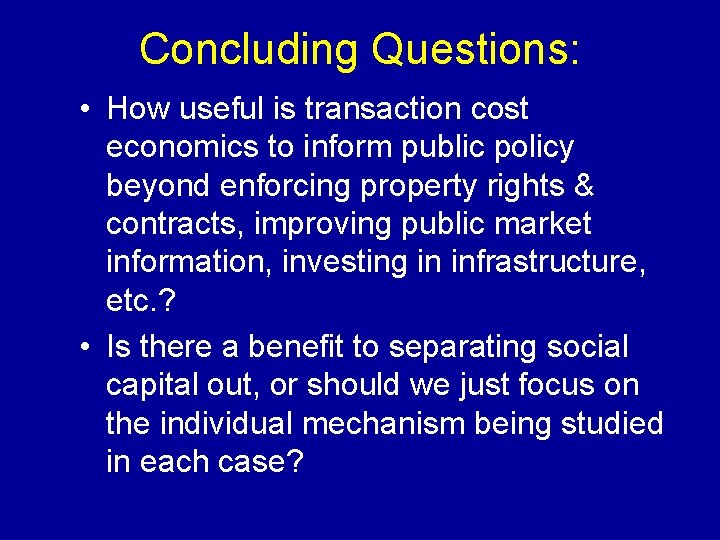
Concluding Questions: • How useful is transaction cost economics to inform public policy beyond enforcing property rights & contracts, improving public market information, investing in infrastructure, etc. ? • Is there a benefit to separating social capital out, or should we just focus on the individual mechanism being studied in each case?
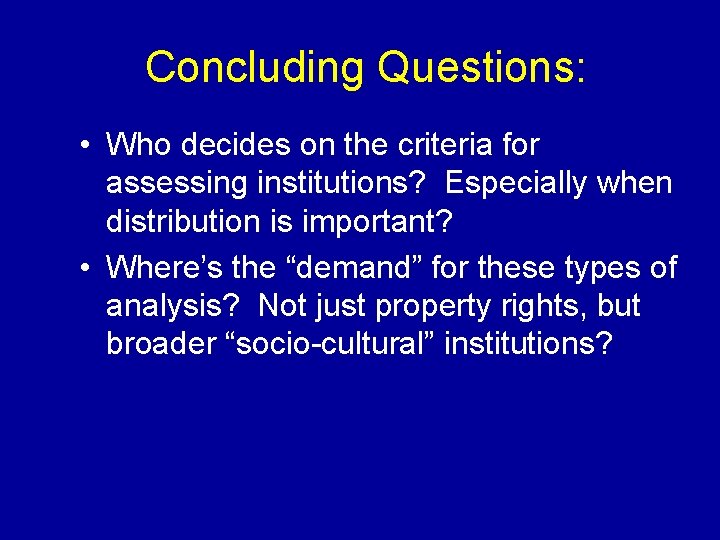
Concluding Questions: • Who decides on the criteria for assessing institutions? Especially when distribution is important? • Where’s the “demand” for these types of analysis? Not just property rights, but broader “socio-cultural” institutions?