NEW DEPTH FROM FOCUS METHOD FOR 3 D


- Slides: 17
NEW DEPTH FROM FOCUS METHOD FOR 3 D PTZ CAMERA TARGET TRACKING Tiago Gaspar (tgaspar@isr. ist. utl. pt)
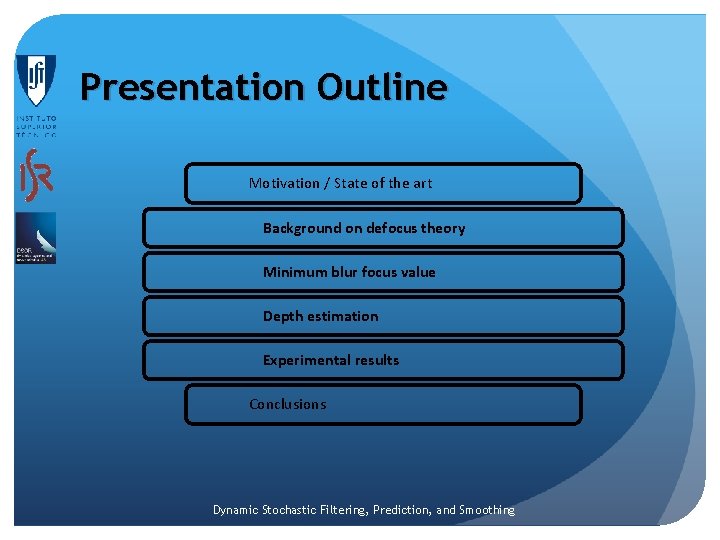
Presentation Outline Motivation / State of the art Background on defocus theory Minimum blur focus value Depth estimation Experimental results Conclusions Dynamic Stochastic Filtering, Prediction, and Smoothing
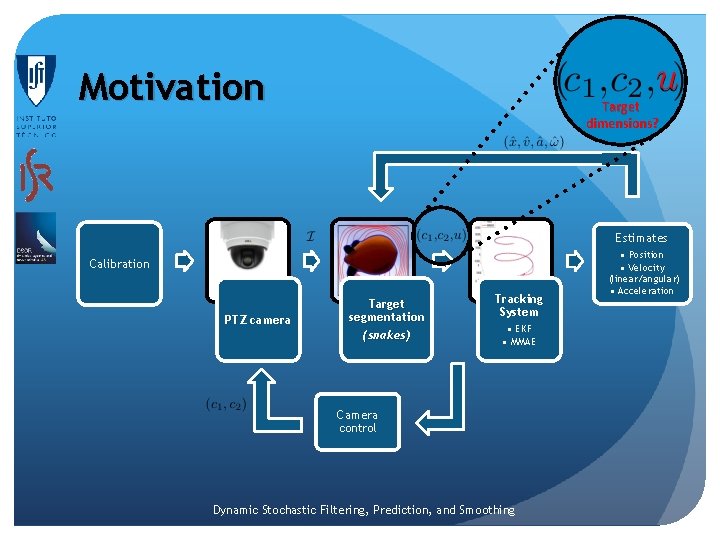
Motivation Target dimensions? Estimates Calibration PTZ camera Target segmentation (snakes) Tracking System • EKF • MMAE Camera control Dynamic Stochastic Filtering, Prediction, and Smoothing • Position • Velocity (linear/angular) • Acceleration
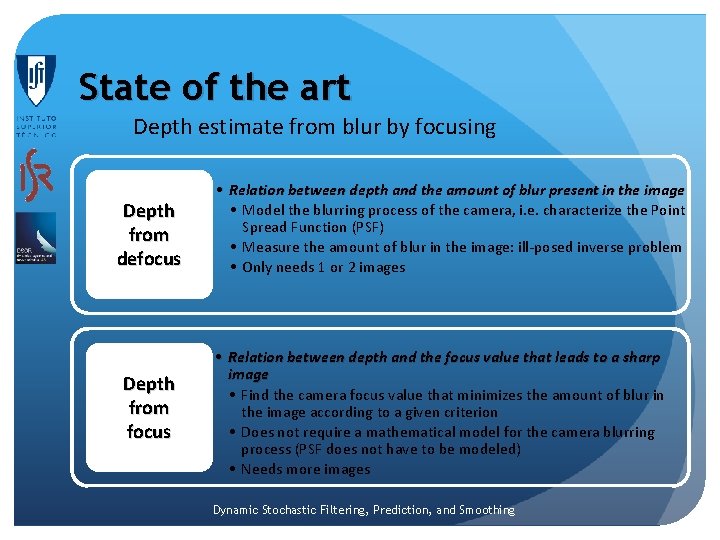
State of the art Depth estimate from blur by focusing Depth from defocus Depth from focus • Relation between depth and the amount of blur present in the image • Model the blurring process of the camera, i. e. characterize the Point Spread Function (PSF) • Measure the amount of blur in the image: ill-posed inverse problem • Only needs 1 or 2 images • Relation between depth and the focus value that leads to a sharp image • Find the camera focus value that minimizes the amount of blur in the image according to a given criterion • Does not require a mathematical model for the camera blurring process (PSF does not have to be modeled) • Needs more images Dynamic Stochastic Filtering, Prediction, and Smoothing
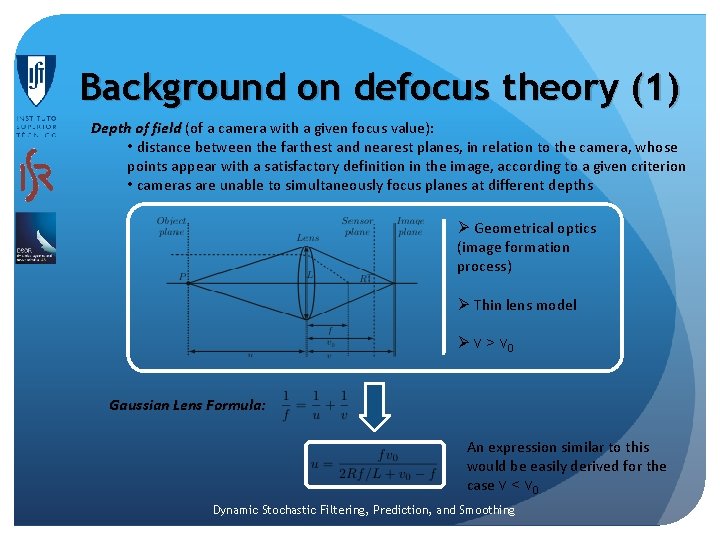
Background on defocus theory (1) Depth of field (of a camera with a given focus value): • distance between the farthest and nearest planes, in relation to the camera, whose points appear with a satisfactory definition in the image, according to a given criterion • cameras are unable to simultaneously focus planes at different depths Ø Geometrical optics (image formation process) Ø Thin lens model Ø v > v 0 Gaussian Lens Formula: An expression similar to this would be easily derived for the case v < v 0 Dynamic Stochastic Filtering, Prediction, and Smoothing
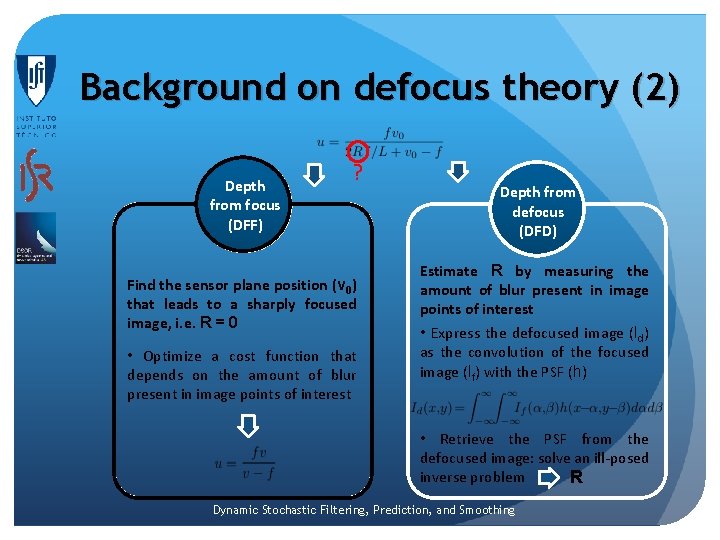
Background on defocus theory (2) Depth from focus (DFF) ? Find the sensor plane position (v 0) that leads to a sharply focused image, i. e. R = 0 • Optimize a cost function that depends on the amount of blur present in image points of interest Depth from defocus (DFD) Estimate R by measuring the amount of blur present in image points of interest • Express the defocused image (Id) as the convolution of the focused image (If) with the PSF (h) • Retrieve the PSF from the defocused image: solve an ill-posed inverse problem R Dynamic Stochastic Filtering, Prediction, and Smoothing
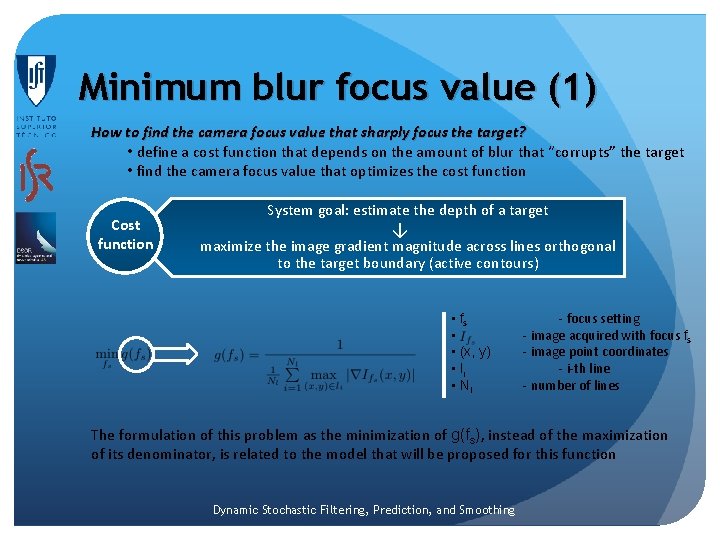
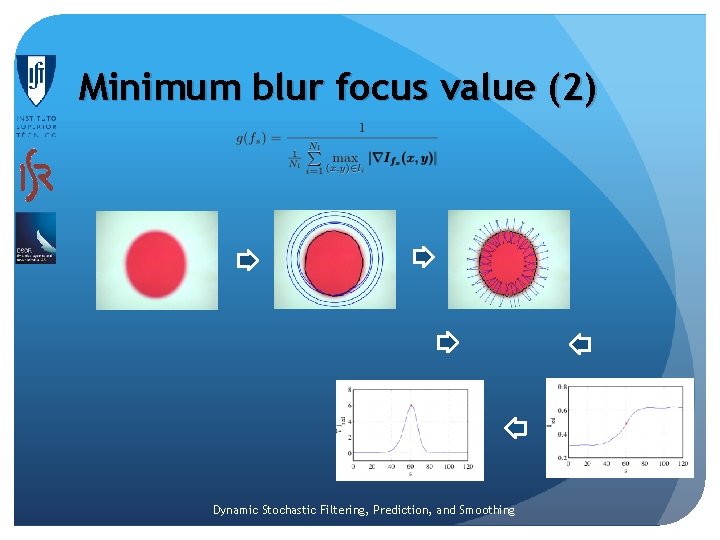
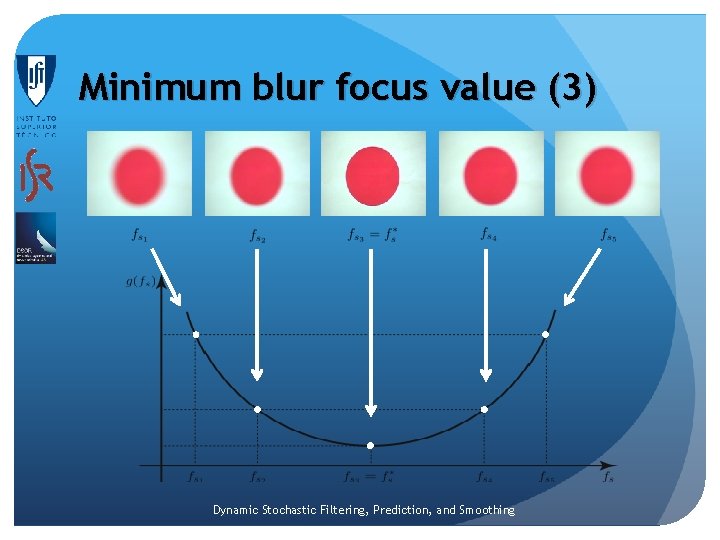
Minimum blur focus value (1) How to find the camera focus value that sharply focus the target? • define a cost function that depends on the amount of blur that “corrupts” the target • find the camera focus value that optimizes the cost function Cost function System goal: estimate the depth of a target maximize the image gradient magnitude across lines orthogonal to the target boundary (active contours) • fs • • (x, y) • li • Nl - focus setting - image acquired with focus fs - image point coordinates - i-th line - number of lines The formulation of this problem as the minimization of g(fs), instead of the maximization of its denominator, is related to the model that will be proposed for this function Dynamic Stochastic Filtering, Prediction, and Smoothing
Minimum blur focus value (2) Dynamic Stochastic Filtering, Prediction, and Smoothing
Minimum blur focus value (3) Dynamic Stochastic Filtering, Prediction, and Smoothing
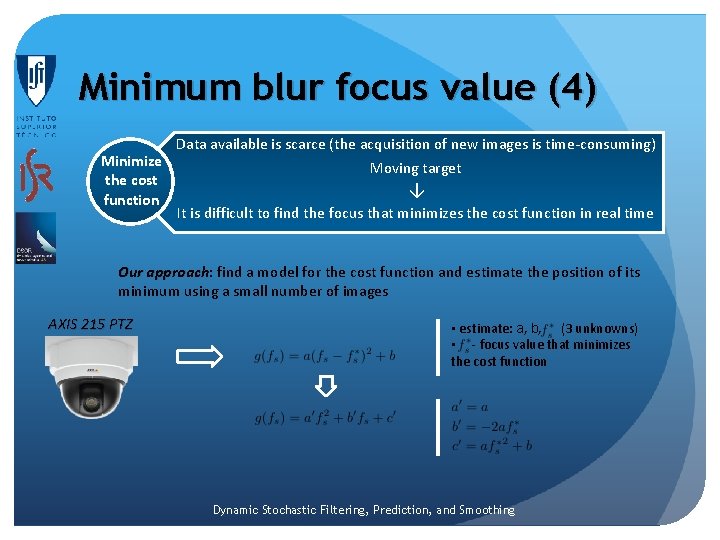
Minimum blur focus value (4) Data available is scarce (the acquisition of new images is time-consuming) Minimize Moving target the cost function It is difficult to find the focus that minimizes the cost function in real time Our approach: approach find a model for the cost function and estimate the position of its minimum using a small number of images AXIS 215 PTZ • estimate: a, b, (3 unknowns) • - focus value that minimizes the cost function Dynamic Stochastic Filtering, Prediction, and Smoothing
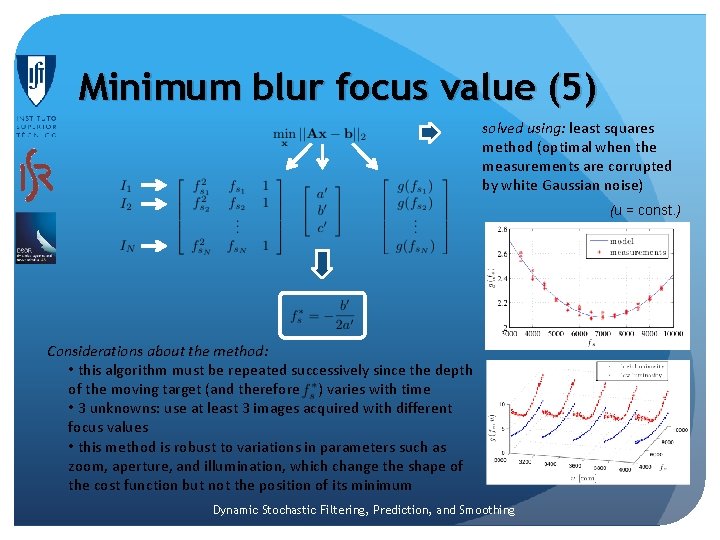
Minimum blur focus value (5) solved using: least squares method (optimal when the measurements are corrupted by white Gaussian noise) (u = const. ) Considerations about the method: • this algorithm must be repeated successively since the depth of the moving target (and therefore ) varies with time • 3 unknowns: use at least 3 images acquired with different focus values • this method is robust to variations in parameters such as zoom, aperture, and illumination, which change the shape of the cost function but not the position of its minimum Dynamic Stochastic Filtering, Prediction, and Smoothing
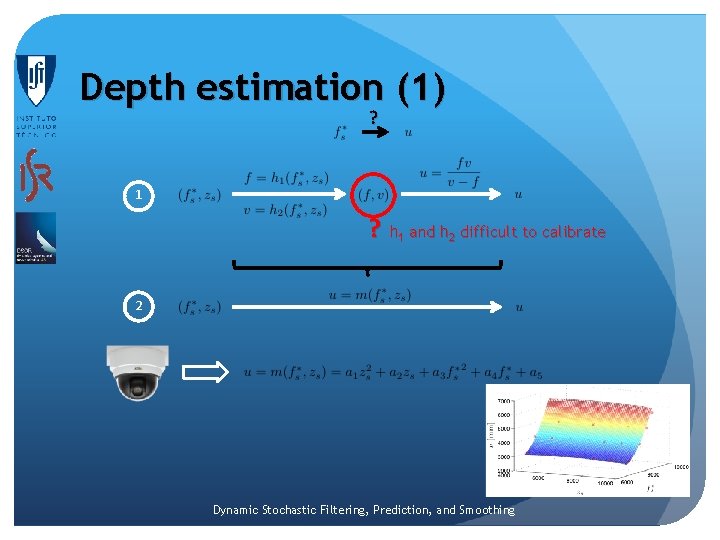
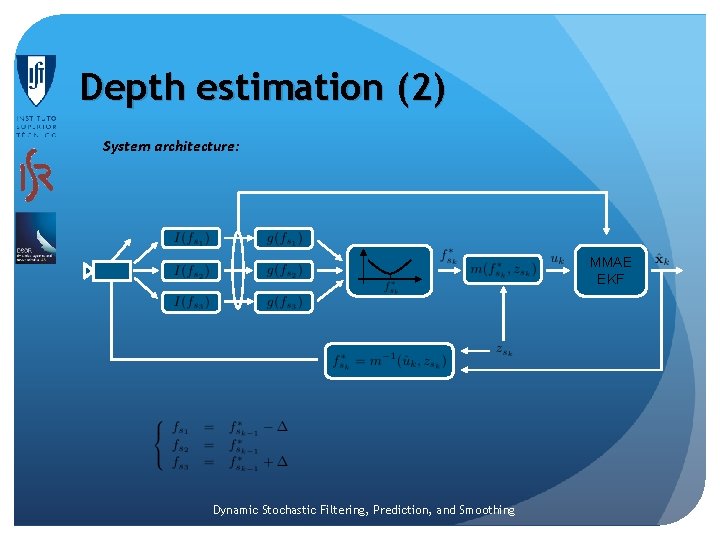
Depth estimation (1) ? 1 ? h 1 and h 2 difficult to calibrate 2 Dynamic Stochastic Filtering, Prediction, and Smoothing
Depth estimation (2) System architecture: MMAE EKF Dynamic Stochastic Filtering, Prediction, and Smoothing
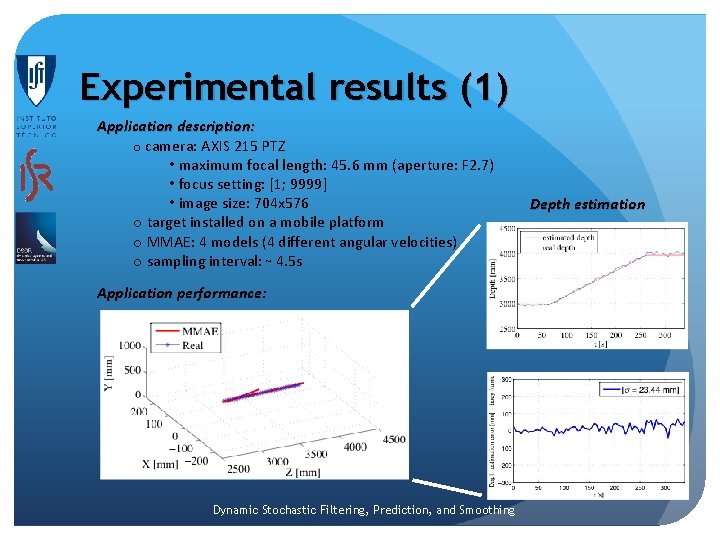
Experimental results (1) Application description: o camera: AXIS 215 PTZ • maximum focal length: 45. 6 mm (aperture: F 2. 7) • focus setting: [1; 9999] • image size: 704 x 576 o target installed on a mobile platform o MMAE: 4 models (4 different angular velocities) o sampling interval: ~ 4. 5 s Application performance: Dynamic Stochastic Filtering, Prediction, and Smoothing Depth estimation
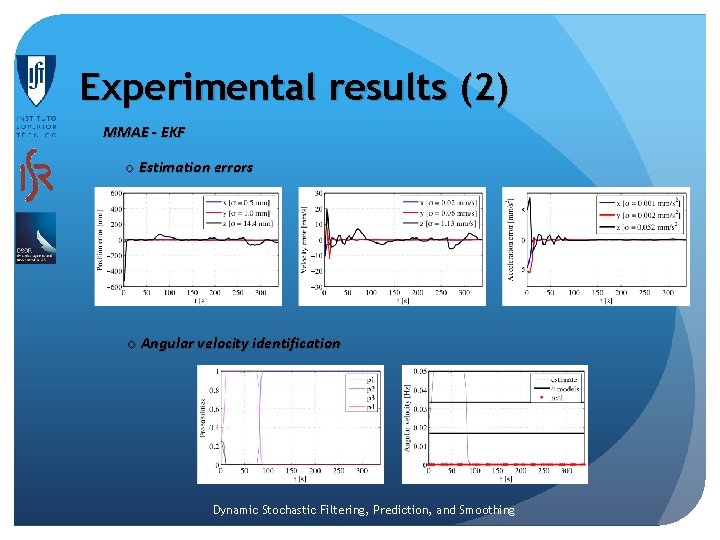
Experimental results (2) MMAE - EKF o Estimation errors o Angular velocity identification Dynamic Stochastic Filtering, Prediction, and Smoothing
Conclusions Ø A new active depth from focus method that estimates the depth of a moving target in real time, using a single PTZ camera, was presented, implemented, and tested in a real scenario • information present on the target boundary is used to infer depth, which is combined with a (sud-)optimal MMAE-EKF resulting in a full 3 D nonlinear tracking system • depth and position estimates with accuracies on the order of few centimeters were obtained Ø Main limitation: slow rate at which the target can change its depth (a consequence of) • slow velocity at which the camera acquires images with different focus values • 3 images per iteration of the algorithm Ø Future work: • implement the algorithm in C • study new strategies to reduce the number of images required per iteration of the algorithm Dynamic Stochastic Filtering, Prediction, and Smoothing
Thank you. Dynamic Stochastic Filtering, Prediction, and Smoothing