NEC NEC Necrotizing enterocolitis NEC is an acquired




- Slides: 25
NEC
NEC �Necrotizing enterocolitis (NEC) is an acquired neonatal disorder representing an end expression of serious intestinal injur y af ter a combination of vascular, mucosal, and metabolic (and other unidentified) insults to a relatively immature gut. �Spontaneous intestinal per foration is a clinical syndrome of undetermined cause resembling NEC with less systemic �involvement and a less severe clinical course. It may �represent a variant of classic NEC
�Why is it impor tant to identify NEC as early as possible ? NEC is a progressive disease with mor tality rates from 15 -30% (inversely related to gestational age and bir th weight ) �Etiology of NEC is unclear; May be Multifactorial Prematurity is the single greatest risk factor
EPIDEMIOLOGY �Occurs in 1 -3 out of 1000 live bir ths �Males = Females �Ethnic Incidence: Black > White While it is more common in premature, VLBW infants (<1500 g), 13% occur in term infants (of ten with preexisting illness).
RISK FACTORS � V L BW i n f a n t s � P r e m a t u r i t y – i n a d e q u a te p e r f u s i o n g u t m u c o s a � A g g r e s s i ve a d va n c e m e n t o f e n te r a l fe e d i n g. � H y p e ro s m o l a r i t y o f s o l u t i o n s � B a c te r i a l ove r g row t h �Enteral Feeding Fo r m u l a i s a s s o c i a te d w i t h h i g h e r r i s k o f N E C �Disadvantages of Formula: Higher osmolality L a c k o f i m m u n o p rote c t i ve f a c to r s L a c k o f g row t h f a c to r s A l te r i n g i n te s t in a l fl o r a
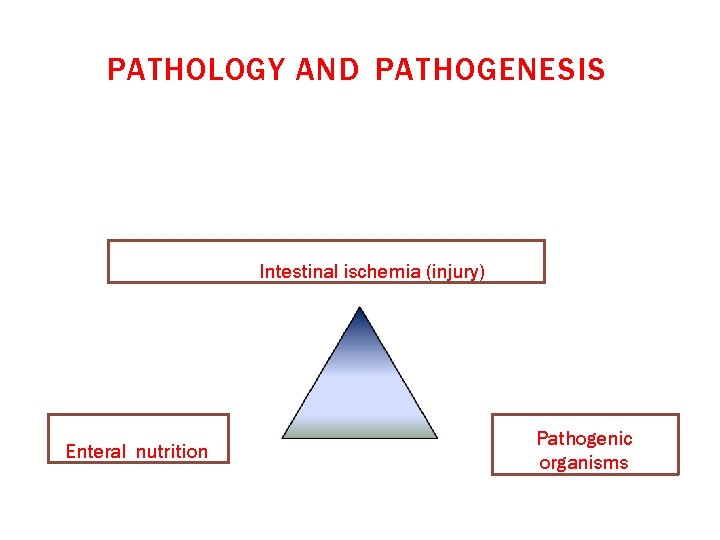
PATHOLOGY AND PATHOGENESIS Intestinal ischemia (injury) Enteral nutrition Pathogenic organisms
�Distal par t of the ileum and Proximal segment of colon are Involved most frequently �In fatal cases, gangrene may extend from the stomach to the rectum. �A ggressive enteral feeding may predispose to the development of NEC. �Coagulation necrosis is the c haracteristic histologic finding of intestinal specimens
CLINICAL PRESENTATION �The time of NEC onset varies inversely with gestational age. � In the (VLBW) group, onset invariably follows initiation of enteral feedings and is usually diagnosed between 14 and 20 days of age. �In full-term infants, age of onset is within the first week of life.
CLINICAL PRESENTATION � The presentation may var y from abdominal distention ( the most frequent early sign, noted in 70% of cases), ileus, and increased volume of gastric aspirate or bilious aspirate ( two thirds of cases) to frank signs of shock , bloody stools , peritonitis, and per foration. �NEC may also present insidiously with nonspecific signs such as labile temperature, apnea, bradycardia, or other signs of suspect sepsis
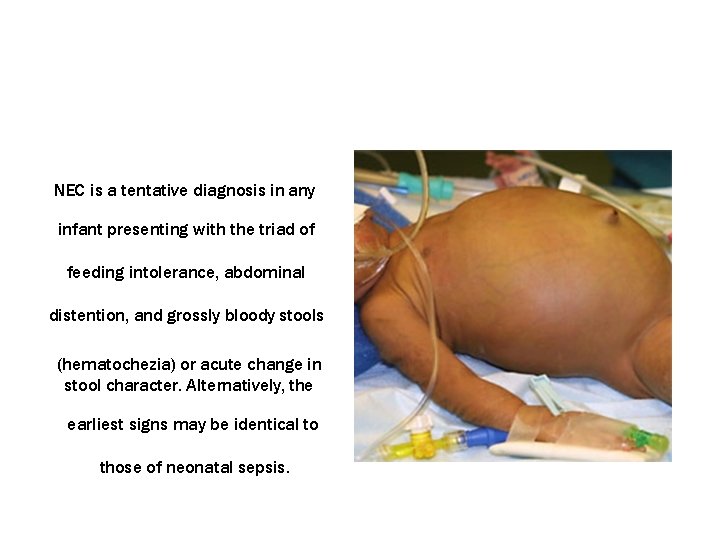
NEC is a tentative diagnosis in any infant presenting with the triad of feeding intolerance, abdominal distention, and grossly bloody stools (hematochezia) or acute change in stool character. Alternatively, the earliest signs may be identical to those of neonatal sepsis.
LABORATORY STUDIES �. The following should be per formed as baseline studies. If there is clinical progression of disease or if these laborator y tests are abnormal, the tests should be repeated ever y 8 -1 2 h. 1. Complete blood cell count (CBC) with dif ferential. � 2. Platelet count. Thrombocytopenia is seen. 50%v of � NEC Pts have PLT< 50, 000/u. L. Blood culture � 3. Stool screening for occult blood. � 4. � 5. Ar terial blood gas measurements. Metabolic or combined acidosis or hypoxia may be seen. � 6. Electrolyte panel. , par ticularly hypo - or hypernatremia, and hyperkalemia are common. 7. Stool cultures for rotaviruses and enteroviruses � should be obtained if diarrhea is an epidemic in the nur ser y
�No lab test is specific for NEC �The most common triad ƒ 1 Thrombocytopenia 2 Persistent metabolic acidosis 3 Severe refractor y hyponatremia
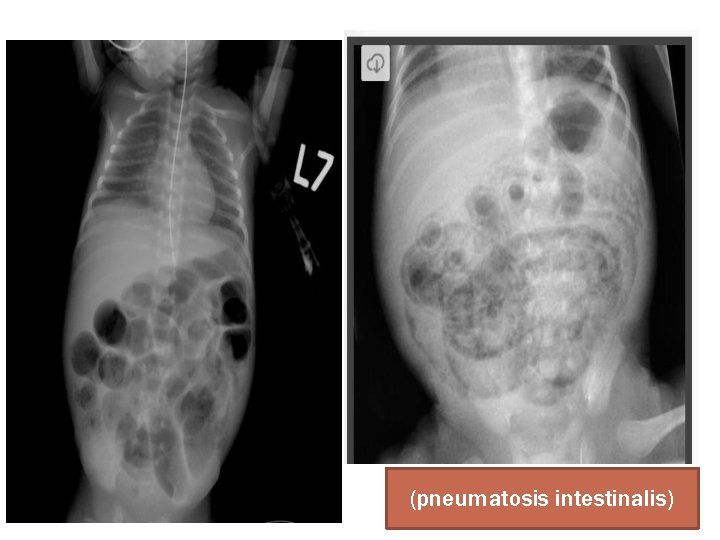
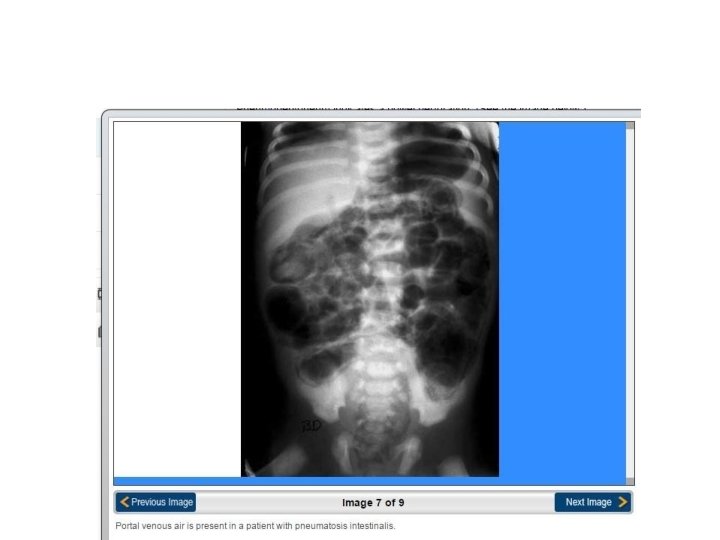
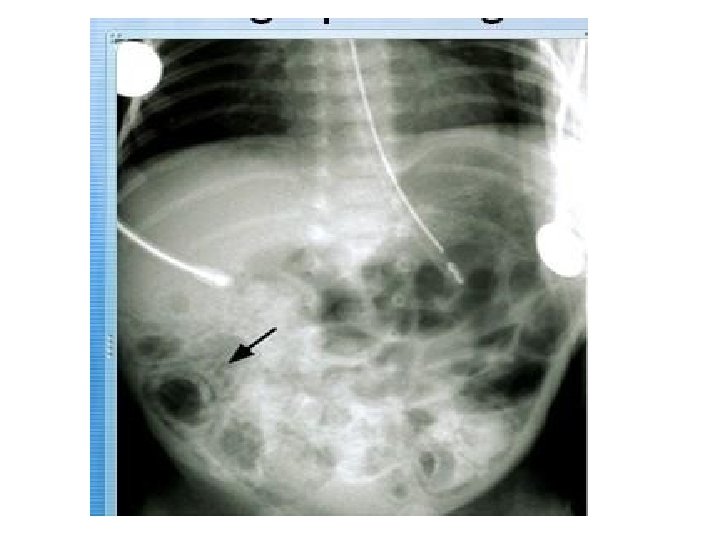
RADIOLOGIC STUDIES 1. . Flat plate x -ray studies of the abdomen � Suppor tive for NEC. Look for abnormal bowel gas �a. patterns, ileus, a fixed sentinel loop of bowel, or areas suspicious for pneumatosis intestinalis. Confirmator y of NEC. Look for ( 1) intramural bowel �b. gas (pneumatosis intestinalis ) and (2) intrahepatic por tal venous gas (in the absence of an umbilical venous catheter ). 2. Lateral decubitus and cross -table lateral studies of � the abdomen. These studies are more likely to demonstrate a pneumoperitoneum.
�Abdominal ultrasound: 1 -Thick-walled loops of bowel with hypomotility. 2 -ƒIntraperitoneal fluid is of ten present. 3 Intramural gas can be identified in early -stage NEC 31 4 In the presence of pneumatosis intestinalis , gas is identified in the por tal venous circulation within the liver. 5 -Color Doppler US is more accurate than abdominal radiography in depicting bowel necrosis in NEC
(pneumatosis intestinalis)
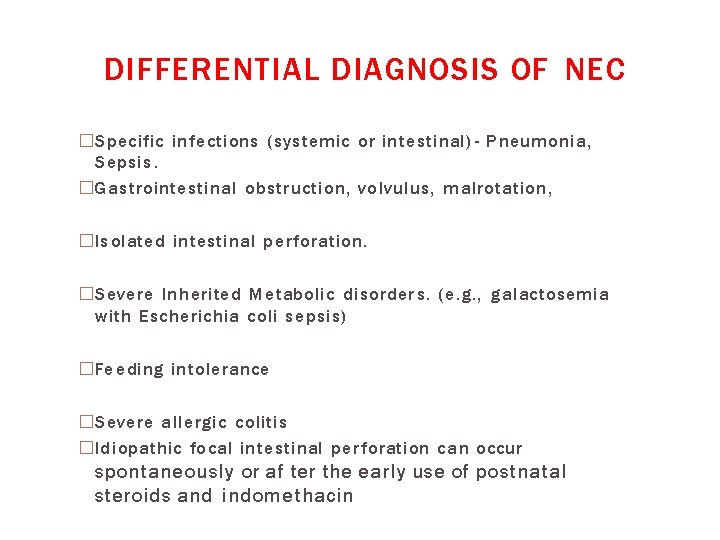
DIFFERENTIAL DIAGNOSIS OF NEC �S pecific in fections ( s ystemic o r in testinal) - P neumonia, S epsis. �G a strointestinal o bstruction, vo lvulus, m alrotation , �Is olated in testinal p e r foration. �S evere In h erited M etabolic d isorder s. ( e. g. , g a lactosemia w ith E sc herichia c o li s e psis) �Fe eding in tolerance �S evere a llergic c o litis �Id iopathic fo cal in testinal p e r foration c a n o ccur spontaneously or af ter the early use of postnatal steroids and indomethacin
COMPLICATIONS �Intestinal perforation �*Intestinal stricture �*Peritonitis �*Sepsis
MANAGEMENT �Medical management (10 -14 days) �Make NPO, star t on IVF (consider TPN). �Inser tion of nasogastric tube to suction for decompression �Empiric antibiotics �Ampicillin, gentamicin �Clindamycin and/or flagyl are of ten added for severe cases �Cardiovasculator y /pulmonar y suppor t as needed �Pediatric surger y consultation �Lab/radiologic monitoring: �Q 6 -8 hours while patient remains acutely ill �Check urine output ever y 1 -2 hours �If low, give 10 -20 ml/k g/hr NS
MONITORING: �Sequential anteroposterior and cross-table lateral or lateral decubitus abdominal x -rays to detect intestinal per foration; �Serial determination of hematologic status, �Serial determination of electrolyte status, and �Serial determination of acid -base status
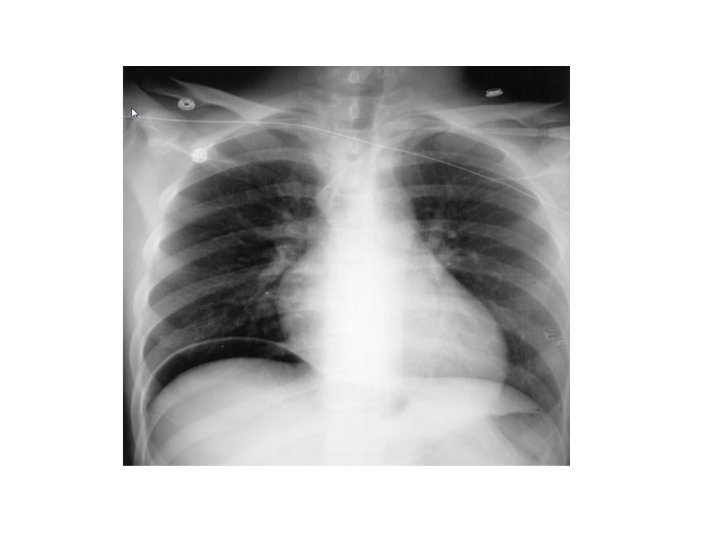
SURGICAL MANAGEMENT �Absolute indication for surgery Pneumoperitoneum �Relative indication for surgery failure to improve progressive thrombocytopenia Por tal vein gas Severe peritonitis Peritoneal drainage Laparotomy with resection of af fected bowel.
PROGNOSIS �Medical management fails in about 20– 40% of patients with pneumatosis intestinalis at diagnosis; of these, 10– 30% die. �Early postoperative complications : Wound infection, dehiscence, and stomal problems (prolapse, necrosis). �Later complications : Intestinal strictures develop at the site of the necrotizing lesion in about 10% of surgically or medically managed patients.
PREVENTION �N ew bo rn s exc lusively b r east - fed h ave a r educed r i sk o f N E C. �E a r ly i n it iat ion o f a g g ressive f eedin g m ay i n c r ea se t h e r i sk o f N E C i n V L BW i n f a nt s. �G u t s t imula tion p r otoco l o f m in ima l e n teral f eeds f o llowed by j u dicious vo lume a dva n cemen t m ay d e c rea se t h e r i sk. �P r o biotic p r epa ra tio ns h ave a l so d ec reased t h e i n c iden ce o f N E C. . I n duction o f G I m a tura tion. �I n c idence o f N E C i s s i g n ifica nt ly r e duced a f ter p r en at al s teroid t h era py. �A ltera tion o f t h e i mmun olog ic s t a tus o f t h e i n testin e u s ing i m mun og lobulin A ( I g A) a n d i mmuno glo bulin G ( I g G) s u pplement at ion