Native Science Conservation CoManagement Dr Jeanine Pfeiffer with

- Slides: 13
Native Science, Conservation & Co-Management Dr. Jeanine Pfeiffer with Megan Rocha, Robert Mc. Connell and the Yurok Tribe California Department of Fish and Game Commission April 6, 2011 IMAGE CREDITS UPPER: David Mc. Lain, National Geographic LOWER: Little Ike (Yurok) fishes for salmon with a plunge net at pame-kya'-ra-m, Klamath River, California, before 1898. National Anthropological Archives, Smithsonian Institution.
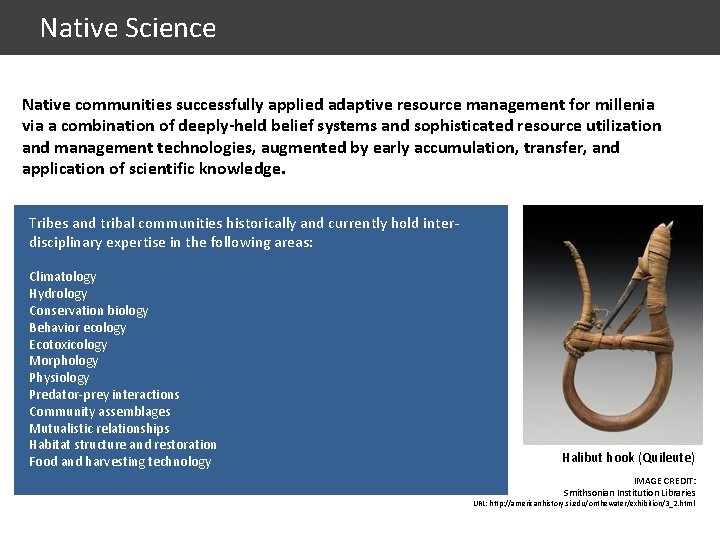
Native Science Native communities successfully applied adaptive resource management for millenia via a combination of deeply-held belief systems and sophisticated resource utilization and management technologies, augmented by early accumulation, transfer, and application of scientific knowledge. Tribes and tribal communities historically and currently hold interdisciplinary expertise in the following areas: Climatology Hydrology Conservation biology Behavior ecology Ecotoxicology Morphology Physiology Predator-prey interactions Community assemblages Mutualistic relationships Habitat structure and restoration Food and harvesting technology Halibut hook (Quileute) IMAGE CREDIT: Smithsonian Institution Libraries URL: http: //americanhistory. si. edu/onthewater/exhibition/3_2. html
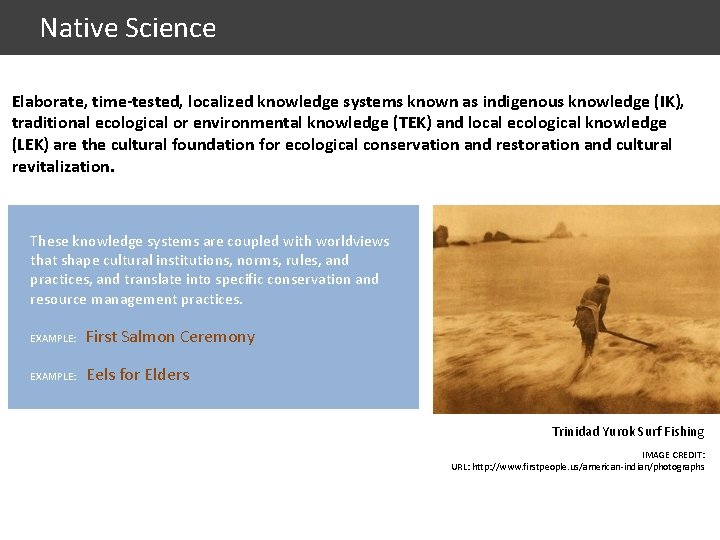
Native Science Elaborate, time-tested, localized knowledge systems known as indigenous knowledge (IK), traditional ecological or environmental knowledge (TEK) and local ecological knowledge (LEK) are the cultural foundation for ecological conservation and restoration and cultural revitalization. These knowledge systems are coupled with worldviews that shape cultural institutions, norms, rules, and practices, and translate into specific conservation and resource management practices. EXAMPLE: First Salmon Ceremony EXAMPLE: Eels for Elders Trinidad Yurok Surf Fishing IMAGE CREDIT: URL: http: //www. firstpeople. us/american-indian/photographs
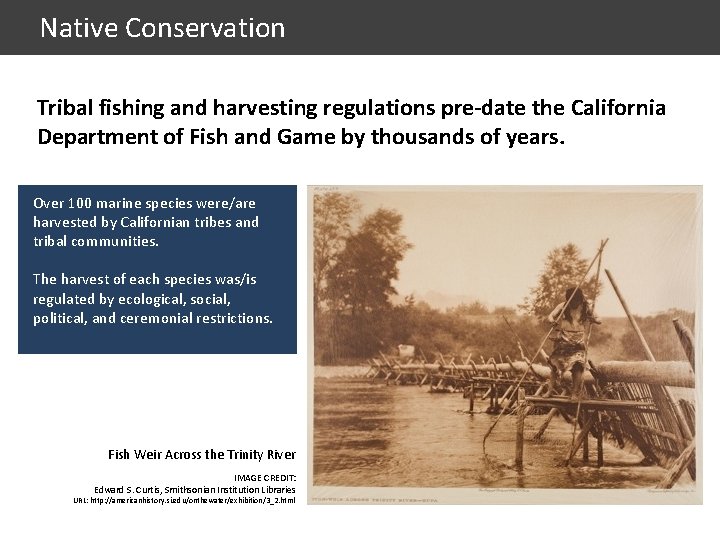
Native Conservation Tribal fishing and harvesting regulations pre-date the California Department of Fish and Game by thousands of years. Over 100 marine species were/are harvested by Californian tribes and tribal communities. The harvest of each species was/is regulated by ecological, social, political, and ceremonial restrictions. Fish Weir Across the Trinity River IMAGE CREDIT: Edward S. Curtis, Smithsonian Institution Libraries URL: http: //americanhistory. si. edu/onthewater/exhibition/3_2. html
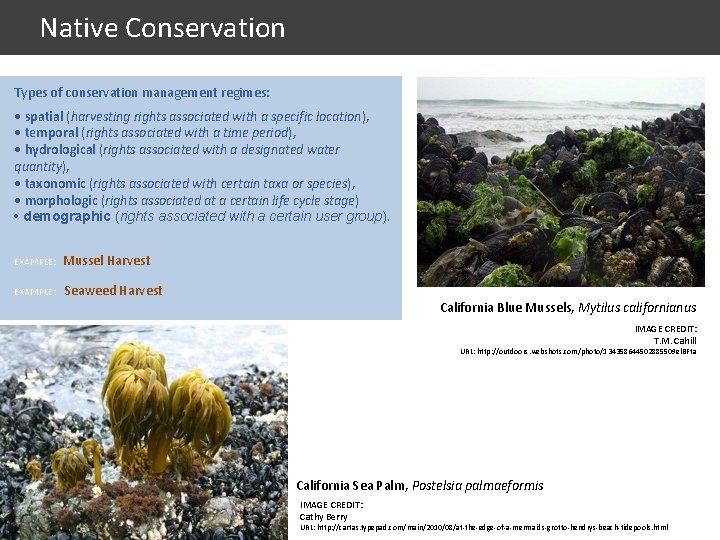
Native Conservation Types of conservation management regimes: • spatial (harvesting rights associated with a specific location), • temporal (rights associated with a time period), • hydrological (rights associated with a designated water quantity), • taxonomic (rights associated with certain taxa or species), • morphologic (rights associated at a certain life cycle stage) • demographic (rights associated with a certain user group). EXAMPLE: Mussel Harvest EXAMPLE: Seaweed Harvest California Blue Mussels, Mytilus californianus IMAGE CREDIT: T. M. Cahill URL: http: //outdoors. webshots. com/photo/134358644502885509 el. BFta California Sea Palm, Postelsia palmaeformis IMAGE CREDIT: Cathy Berry URL: http: //cartas. typepad. com/main/2010/08/at-the-edge-of-a-mermaids-grotto-hendrys-beach-tidepools. html
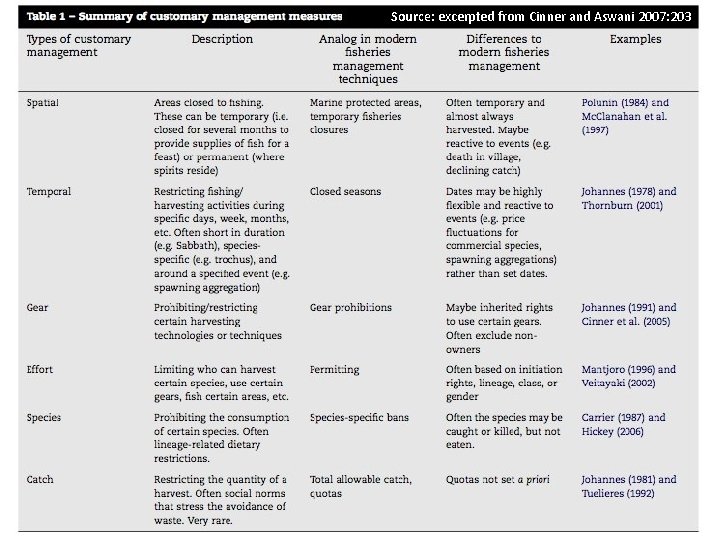
Source: excerpted from Cinner and Aswani 2007: 203
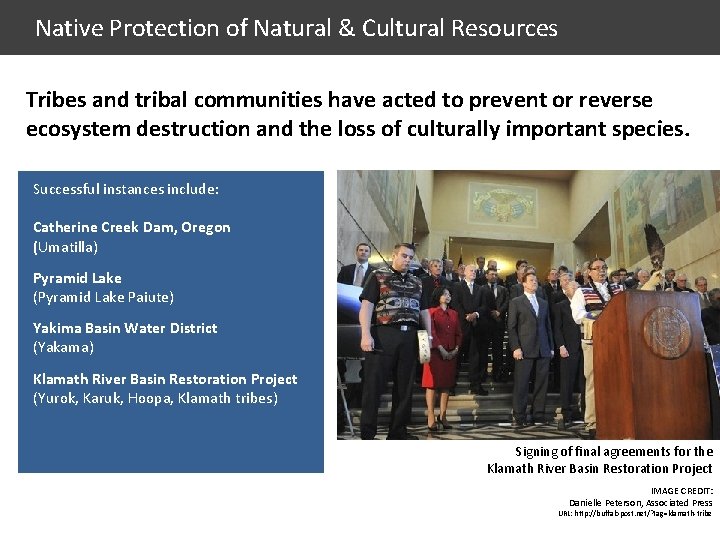
Native Protection of Natural & Cultural Resources Tribes and tribal communities have acted to prevent or reverse ecosystem destruction and the loss of culturally important species. Successful instances include: Catherine Creek Dam, Oregon (Umatilla) Pyramid Lake (Pyramid Lake Paiute) Yakima Basin Water District (Yakama) Klamath River Basin Restoration Project (Yurok, Karuk, Hoopa, Klamath tribes) Signing of final agreements for the Klamath River Basin Restoration Project IMAGE CREDIT: Danielle Peterson, Associated Press URL: http: //buffalopost. net/? tag=klamath-tribe
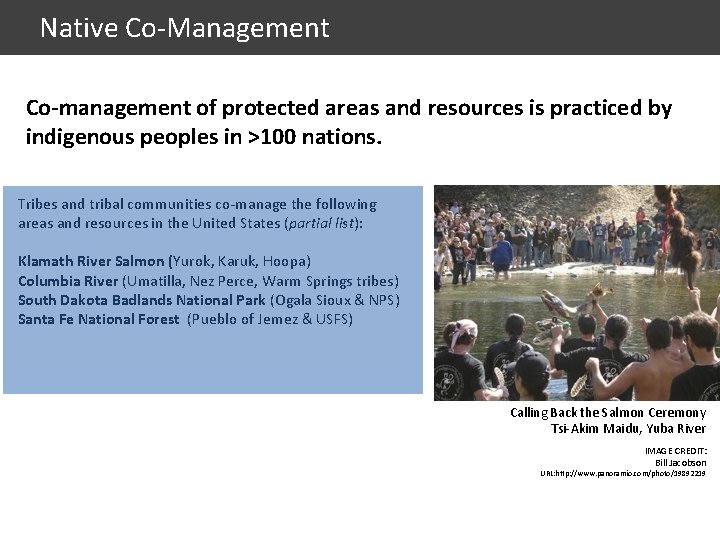
Native Co-Management Co-management of protected areas and resources is practiced by indigenous peoples in >100 nations. Tribes and tribal communities co-manage the following areas and resources in the United States (partial list): Klamath River Salmon (Yurok, Karuk, Hoopa) Columbia River (Umatilla, Nez Perce, Warm Springs tribes) South Dakota Badlands National Park (Ogala Sioux & NPS) Santa Fe National Forest (Pueblo of Jemez & USFS) Calling Back the Salmon Ceremony Tsi-Akim Maidu, Yuba River IMAGE CREDIT: Bill Jacobson URL: http: //www. panoramio. com/photo/19892219
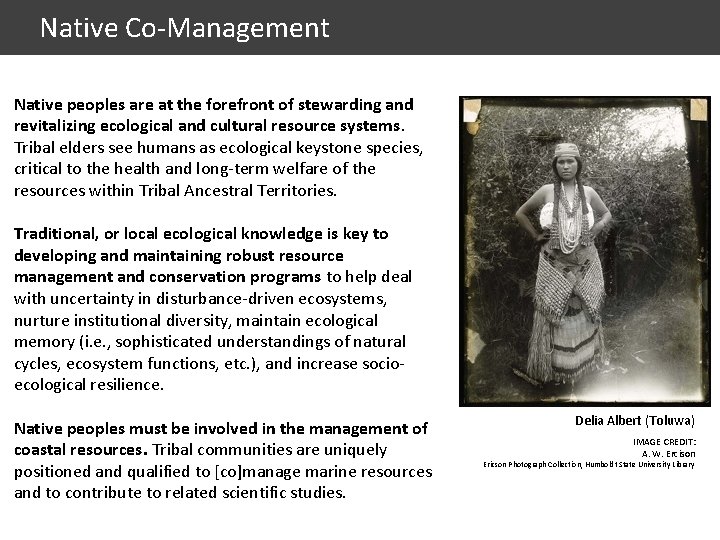
Native Co-Management Native peoples are at the forefront of stewarding and revitalizing ecological and cultural resource systems. Tribal elders see humans as ecological keystone species, critical to the health and long-term welfare of the resources within Tribal Ancestral Territories. Traditional, or local ecological knowledge is key to developing and maintaining robust resource management and conservation programs to help deal with uncertainty in disturbance-driven ecosystems, nurture institutional diversity, maintain ecological memory (i. e. , sophisticated understandings of natural cycles, ecosystem functions, etc. ), and increase socioecological resilience. Native peoples must be involved in the management of coastal resources. Tribal communities are uniquely positioned and qualified to [co]manage marine resources and to contribute to related scientific studies. Delia Albert (Toluwa) IMAGE CREDIT: A. W. Ercison Ericson Photograph Collection, Humboldt State University Library
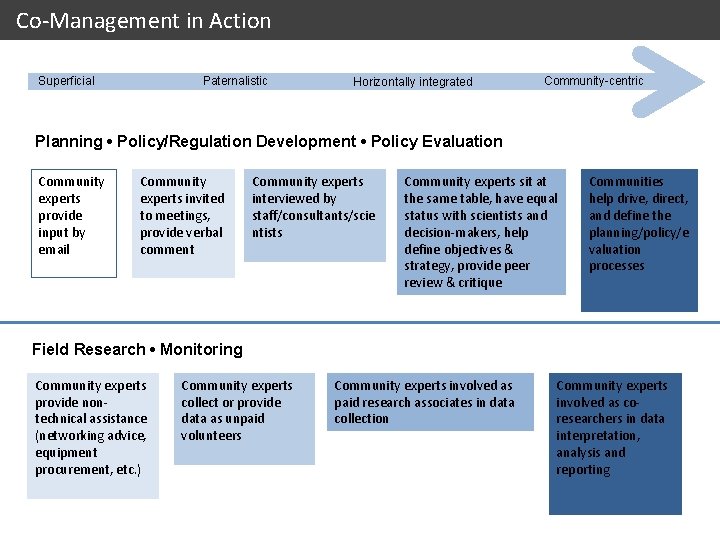
Co-Management in Action Superficial Paternalistic Horizontally integrated Community-centric Planning • Policy/Regulation Development • Policy Evaluation Community experts provide input by email Community experts invited to meetings, provide verbal comment Community experts interviewed by staff/consultants/scie ntists Community experts sit at the same table, have equal status with scientists and decision-makers, help define objectives & strategy, provide peer review & critique Communities help drive, direct, and define the planning/policy/e valuation processes Field Research • Monitoring Community experts provide nontechnical assistance (networking advice, equipment procurement, etc. ) Community experts collect or provide data as unpaid volunteers Community experts involved as paid research associates in data collection Community experts involved as coresearchers in data interpretation, analysis and reporting
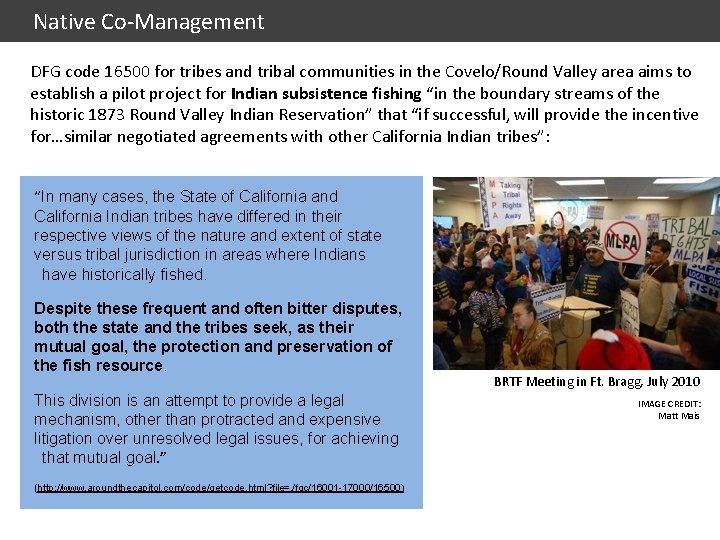
Native Co-Management DFG code 16500 for tribes and tribal communities in the Covelo/Round Valley area aims to establish a pilot project for Indian subsistence fishing “in the boundary streams of the historic 1873 Round Valley Indian Reservation” that “if successful, will provide the incentive for…similar negotiated agreements with other California Indian tribes”: “In many cases, the State of California and California Indian tribes have differed in their respective views of the nature and extent of state versus tribal jurisdiction in areas where Indians have historically fished. Despite these frequent and often bitter disputes, both the state and the tribes seek, as their mutual goal, the protection and preservation of the fish resource. This division is an attempt to provide a legal mechanism, other than protracted and expensive litigation over unresolved legal issues, for achieving that mutual goal. ” (http: //www. aroundthecapitol. com/code/getcode. html? file=. /fgc/16001 -17000/16500) BRTF Meeting in Ft. Bragg, July 2010 IMAGE CREDIT: Matt Mais
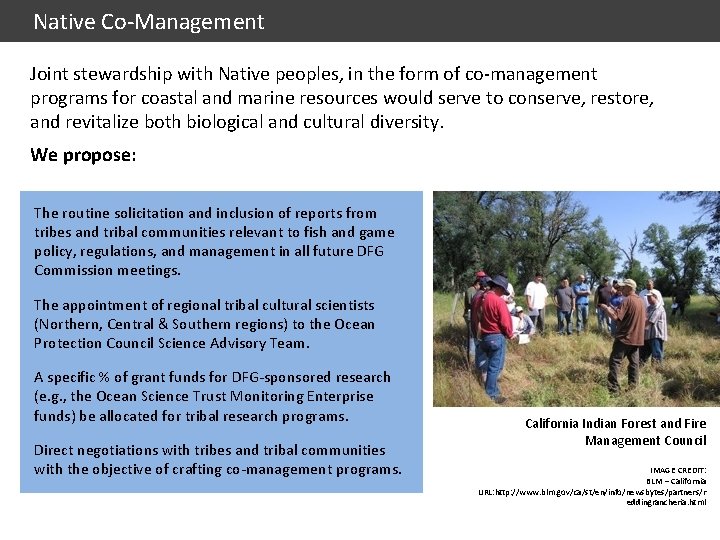
Native Co-Management Joint stewardship with Native peoples, in the form of co-management programs for coastal and marine resources would serve to conserve, restore, and revitalize both biological and cultural diversity. We propose: The routine solicitation and inclusion of reports from tribes and tribal communities relevant to fish and game policy, regulations, and management in all future DFG Commission meetings. The appointment of regional tribal cultural scientists (Northern, Central & Southern regions) to the Ocean Protection Council Science Advisory Team. A specific % of grant funds for DFG-sponsored research (e. g. , the Ocean Science Trust Monitoring Enterprise funds) be allocated for tribal research programs. Direct negotiations with tribes and tribal communities with the objective of crafting co-management programs. California Indian Forest and Fire Management Council IMAGE CREDIT: BLM – California URL: http: //www. blm. gov/ca/st/en/info/newsbytes/partners/r eddingrancheria. html
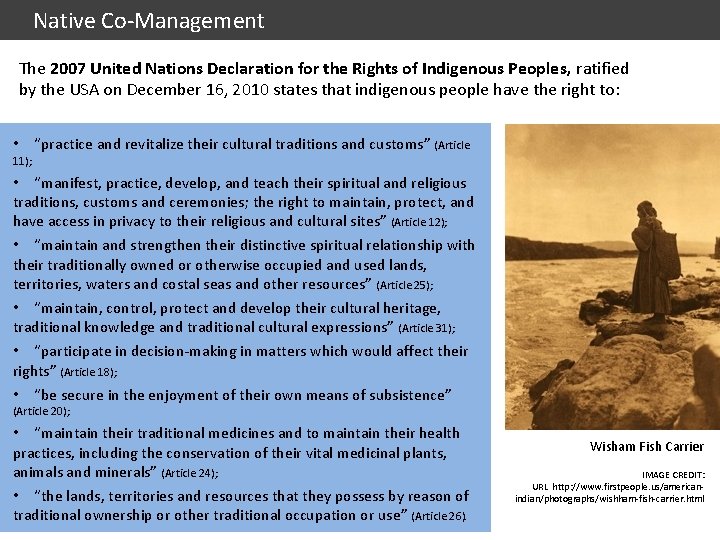
Native Co-Management The 2007 United Nations Declaration for the Rights of Indigenous Peoples, ratified by the USA on December 16, 2010 states that indigenous people have the right to: • “practice and revitalize their cultural traditions and customs” (Article 11); • “manifest, practice, develop, and teach their spiritual and religious traditions, customs and ceremonies; the right to maintain, protect, and have access in privacy to their religious and cultural sites” (Article 12); • “maintain and strengthen their distinctive spiritual relationship with their traditionally owned or otherwise occupied and used lands, territories, waters and costal seas and other resources” (Article 25); • “maintain, control, protect and develop their cultural heritage, traditional knowledge and traditional cultural expressions” (Article 31); • “participate in decision-making in matters which would affect their rights” (Article 18); • “be secure in the enjoyment of their own means of subsistence” (Article 20); • “maintain their traditional medicines and to maintain their health practices, including the conservation of their vital medicinal plants, animals and minerals” (Article 24); • “the lands, territories and resources that they possess by reason of traditional ownership or other traditional occupation or use” (Article 26). Wisham Fish Carrier IMAGE CREDIT: URL http: //www. firstpeople. us/americanindian/photographs/wishham-fish-carrier. html