
DROUGHT STATE RESPONSE Jeanine Jones DWR Outline Californias




- Slides: 24
DROUGHT & STATE RESPONSE Jeanine Jones, DWR
Outline • California’s current drought –Water conditions –Selected impacts –State response actions
First a Word About Defining Drought When Does “Dry” Become “Drought”? • • • Meteorological drought Hydrological drought Regulatory drought Drought indices, US Drought Monitor Sector-based definitions Drought is a function of impacts (which are typically regional or local)
Points to Keep in Mind • Droughts/dry years are a normal part of the hydrologic cycle • Drought conditions develop slowly; drought by itself is not an emergency • Drought impacts are site-specific and sector-specific • The greatest drought impacts are related to unmanaged water uses – rangeland grazing, wildfire • The greatest economic impacts of drought have been associated with wildfire and forestry damages, not with urban & agricultural water uses
Current Drought Conditions
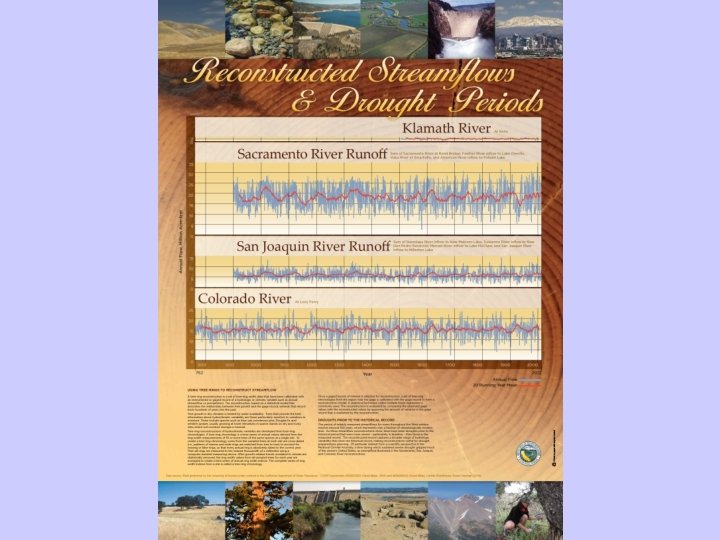
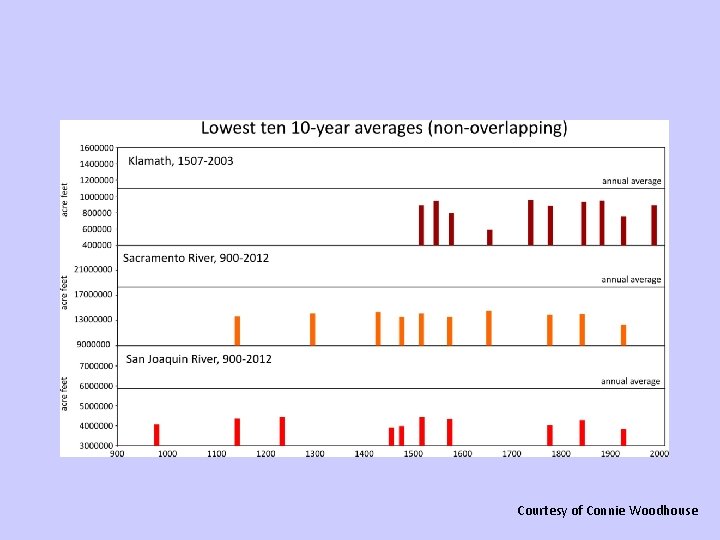
Courtesy of Connie Woodhouse
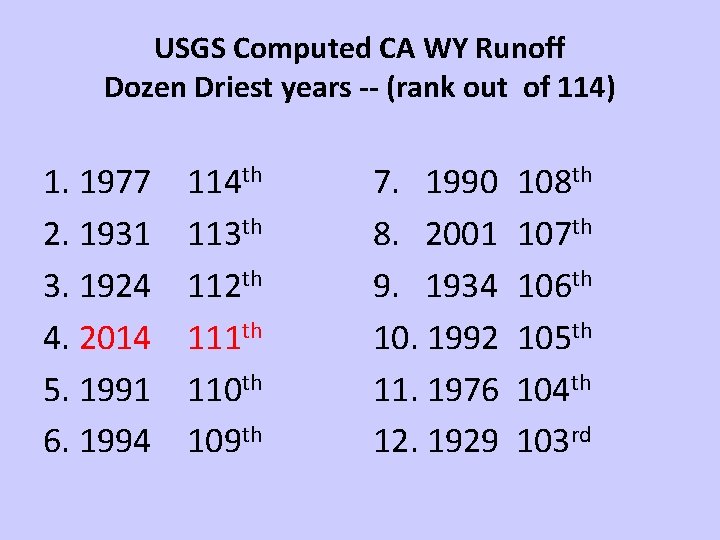
USGS Computed CA WY Runoff Dozen Driest years -- (rank out of 114) 1. 1977 2. 1931 3. 1924 4. 2014 5. 1991 6. 1994 114 th 113 th 112 th 111 th 110 th 109 th 7. 1990 8. 2001 9. 1934 10. 1992 11. 1976 12. 1929 108 th 107 th 106 th 105 th 104 th 103 rd
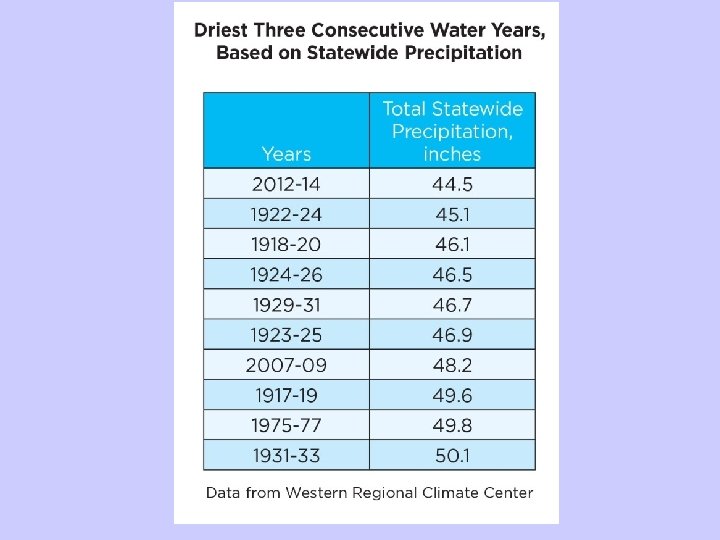
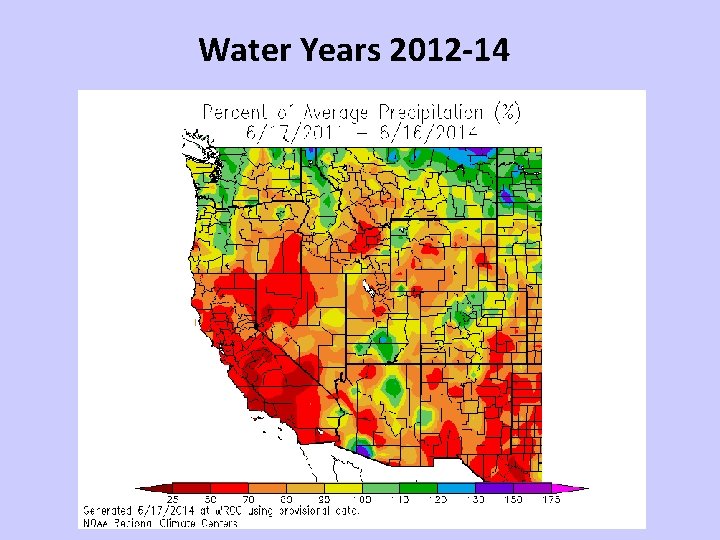
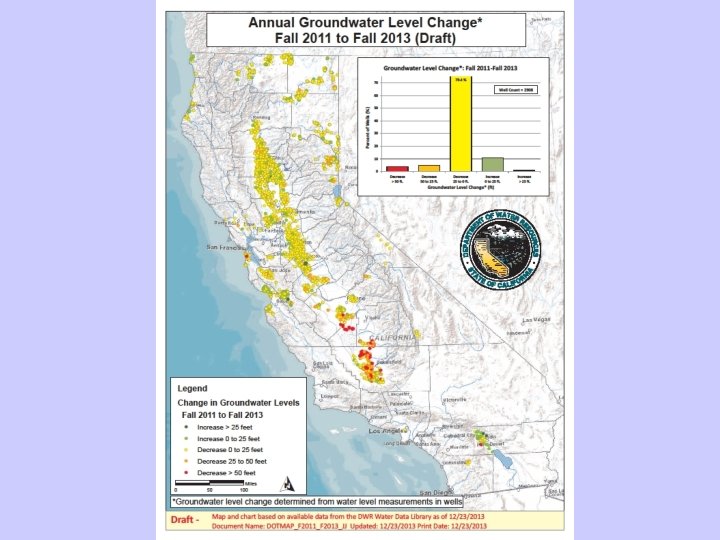
Water Years 2012 -14
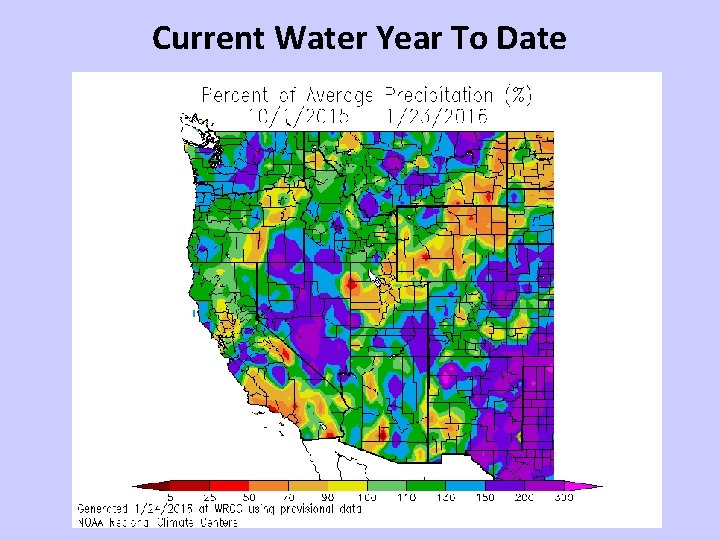
Current Water Year To Date
State Response Actions
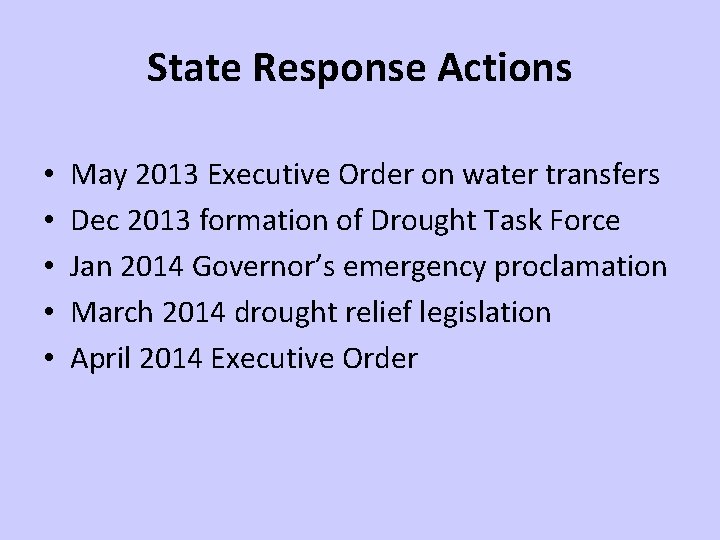
State Response Actions • • • May 2013 Executive Order on water transfers Dec 2013 formation of Drought Task Force Jan 2014 Governor’s emergency proclamation March 2014 drought relief legislation April 2014 Executive Order
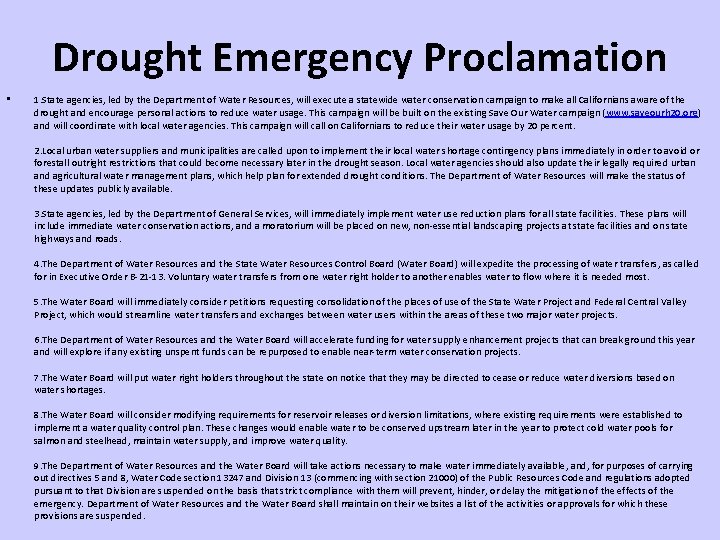
Drought Emergency Proclamation • 1. State agencies, led by the Department of Water Resources, will execute a statewide water conservation campaign to make all Californians aware of the drought and encourage personal actions to reduce water usage. This campaign will be built on the existing Save Our Water campaign (www. saveourh 20. org) and will coordinate with local water agencies. This campaign will call on Californians to reduce their water usage by 20 percent. 2. Local urban water suppliers and municipalities are called upon to implement their local water shortage contingency plans immediately in order to avoid or forestall outright restrictions that could become necessary later in the drought season. Local water agencies should also update their legally required urban and agricultural water management plans, which help plan for extended drought conditions. The Department of Water Resources will make the status of these updates publicly available. 3. State agencies, led by the Department of General Services, will immediately implement water use reduction plans for all state facilities. These plans will include immediate water conservation actions, and a moratorium will be placed on new, non-essential landscaping projects at state facilities and on state highways and roads. 4. The Department of Water Resources and the State Water Resources Control Board (Water Board) will expedite the processing of water transfers, as called for in Executive Order B-21 -13. Voluntary water transfers from one water right holder to another enables water to flow where it is needed most. 5. The Water Board will immediately consider petitions requesting consolidation of the places of use of the State Water Project and Federal Central Valley Project, which would streamline water transfers and exchanges between water users within the areas of these two major water projects. 6. The Department of Water Resources and the Water Board will accelerate funding for water supply enhancement projects that can break ground this year and will explore if any existing unspent funds can be repurposed to enable near-term water conservation projects. 7. The Water Board will put water right holders throughout the state on notice that they may be directed to cease or reduce water diversions based on water shortages. 8. The Water Board will consider modifying requirements for reservoir releases or diversion limitations, where existing requirements were established to implement a water quality control plan. These changes would enable water to be conserved upstream later in the year to protect cold water pools for salmon and steelhead, maintain water supply, and improve water quality. 9. The Department of Water Resources and the Water Board will take actions necessary to make water immediately available, and, for purposes of carrying out directives 5 and 8, Water Code section 13247 and Division 13 (commencing with section 21000) of the Public Resources Code and regulations adopted pursuant to that Division are suspended on the basis that strict compliance with them will prevent, hinder, or delay the mitigation of the effects of the emergency. Department of Water Resources and the Water Board shall maintain on their websites a list of the activities or approvals for which these provisions are suspended.
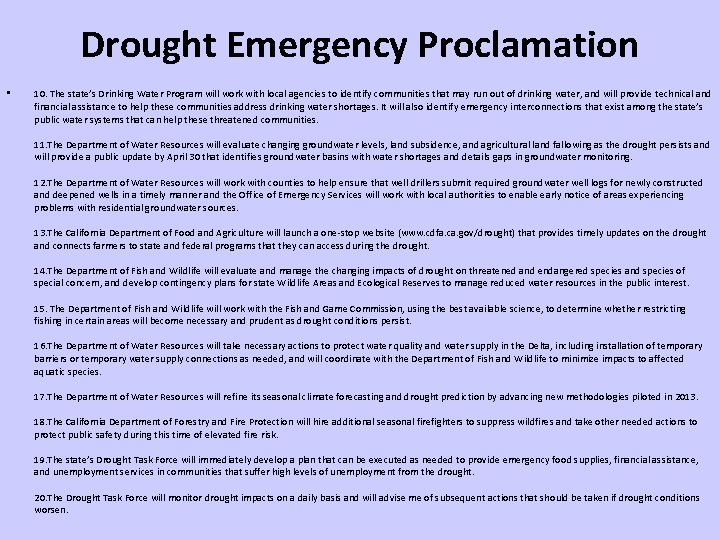
Drought Emergency Proclamation • 10. The state’s Drinking Water Program will work with local agencies to identify communities that may run out of drinking water, and will provide technical and financial assistance to help these communities address drinking water shortages. It will also identify emergency interconnections that exist among the state’s public water systems that can help these threatened communities. 11. The Department of Water Resources will evaluate changing groundwater levels, land subsidence, and agricultural land fallowing as the drought persists and will provide a public update by April 30 that identifies groundwater basins with water shortages and details gaps in groundwater monitoring. 12. The Department of Water Resources will work with counties to help ensure that well drillers submit required groundwater well logs for newly constructed and deepened wells in a timely manner and the Office of Emergency Services will work with local authorities to enable early notice of areas experiencing problems with residential groundwater sources. 13. The California Department of Food and Agriculture will launch a one-stop website (www. cdfa. ca. gov/drought) that provides timely updates on the drought and connects farmers to state and federal programs that they can access during the drought. 14. The Department of Fish and Wildlife will evaluate and manage the changing impacts of drought on threatened and endangered species and species of special concern, and develop contingency plans for state Wildlife Areas and Ecological Reserves to manage reduced water resources in the public interest. 15. The Department of Fish and Wildlife will work with the Fish and Game Commission, using the best available science, to determine whether restricting fishing in certain areas will become necessary and prudent as drought conditions persist. 16. The Department of Water Resources will take necessary actions to protect water quality and water supply in the Delta, including installation of temporary barriers or temporary water supply connections as needed, and will coordinate with the Department of Fish and Wildlife to minimize impacts to affected aquatic species. 17. The Department of Water Resources will refine its seasonal climate forecasting and drought prediction by advancing new methodologies piloted in 2013. 18. The California Department of Forestry and Fire Protection will hire additional seasonal firefighters to suppress wildfires and take other needed actions to protect public safety during this time of elevated fire risk. 19. The state’s Drought Task Force will immediately develop a plan that can be executed as needed to provide emergency food supplies, financial assistance, and unemployment services in communities that suffer high levels of unemployment from the drought. 20. The Drought Task Force will monitor drought impacts on a daily basis and will advise me of subsequent actions that should be taken if drought conditions worsen.
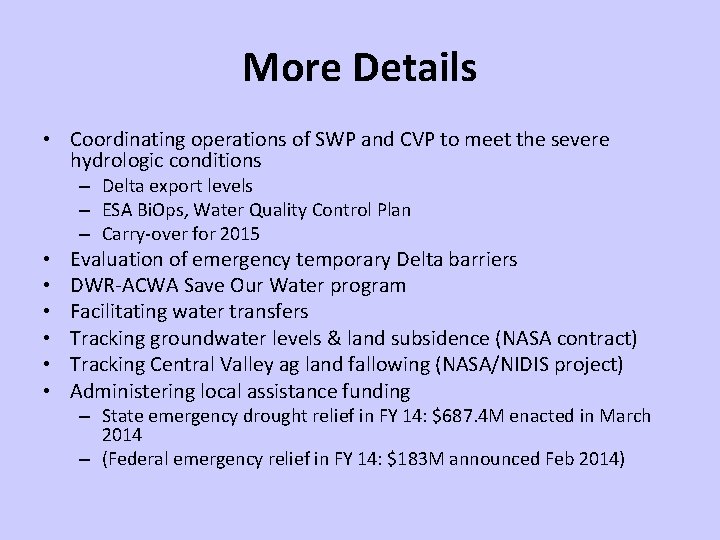
More Details • Coordinating operations of SWP and CVP to meet the severe hydrologic conditions – Delta export levels – ESA Bi. Ops, Water Quality Control Plan – Carry-over for 2015 • • • Evaluation of emergency temporary Delta barriers DWR-ACWA Save Our Water program Facilitating water transfers Tracking groundwater levels & land subsidence (NASA contract) Tracking Central Valley ag land fallowing (NASA/NIDIS project) Administering local assistance funding – State emergency drought relief in FY 14: $687. 4 M enacted in March 2014 – (Federal emergency relief in FY 14: $183 M announced Feb 2014)
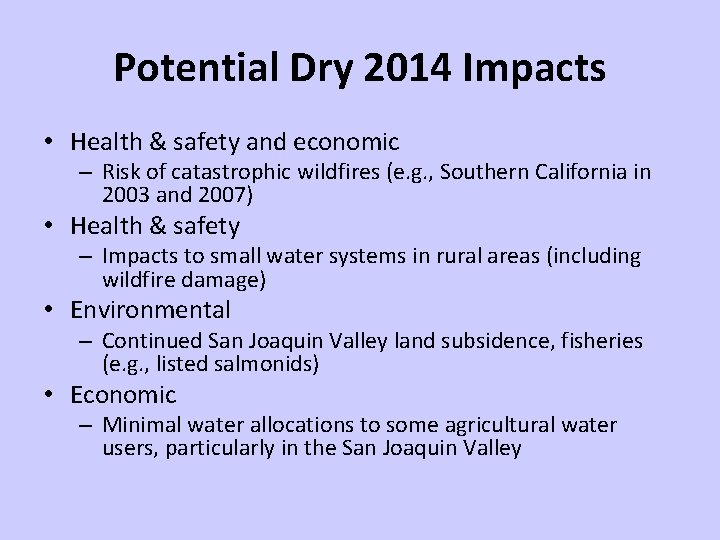
Potential Dry 2014 Impacts • Health & safety and economic – Risk of catastrophic wildfires (e. g. , Southern California in 2003 and 2007) • Health & safety – Impacts to small water systems in rural areas (including wildfire damage) • Environmental – Continued San Joaquin Valley land subsidence, fisheries (e. g. , listed salmonids) • Economic – Minimal water allocations to some agricultural water users, particularly in the San Joaquin Valley