NAFA Guide To Air Filtration Fifth Edition Chapter


- Slides: 17
NAFA Guide To Air Filtration Fifth Edition Chapter 8 HEPA and ULPA Filter Testing presented by the National Air Filtration Association
HEPA Testing Challenge • Has to be non-destructive as each HEPA is individually tested – Should generate an aerosol whose size is MPPS – Monodispersed – Confirm particle size – Measure concentration upstream & downstream of filter
High Efficiency Filters HEPA Minimum Particle Collection Efficiency • 99. 97% for 0. 3 micron particles (Type A) Penetration Tested • 99. 99% for 0. 3 micron particles (Type C) Penetration and Leak Tested ULPA Minimum Particle Collection Efficiency • 99. 999% For 0. 10 -0. 20 Micron Particles (Type F) Penetration and Laser Tested See Page 8. 5 for all HEPA Ratings and MOT
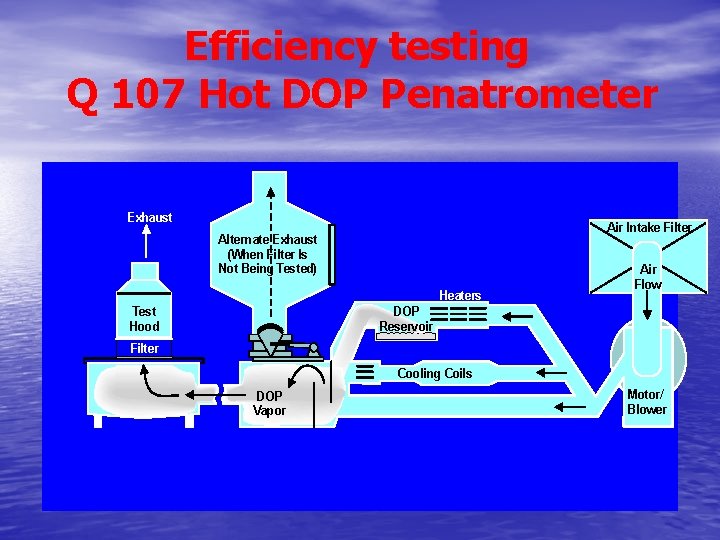
Efficiency testing Q 107 Hot DOP Penatrometer Exhaust Air Intake Filter Alternate Exhaust (When Filter Is Not Being Tested) Heaters Test Hood Air Flow DOP Reservoir Filter Cooling Coils DOP Vapor Motor/ Blower
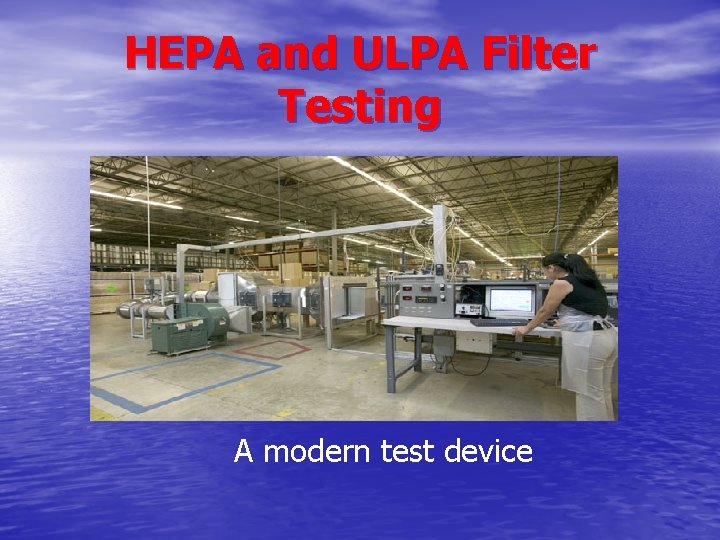
HEPA and ULPA Filter Testing A modern test device
HEPA Filter Testing • Penetration converted to overall efficiency including gaskets, sealing and framing • Initial resistance • Two-Flow Testing - leak test (scanning for leaks)
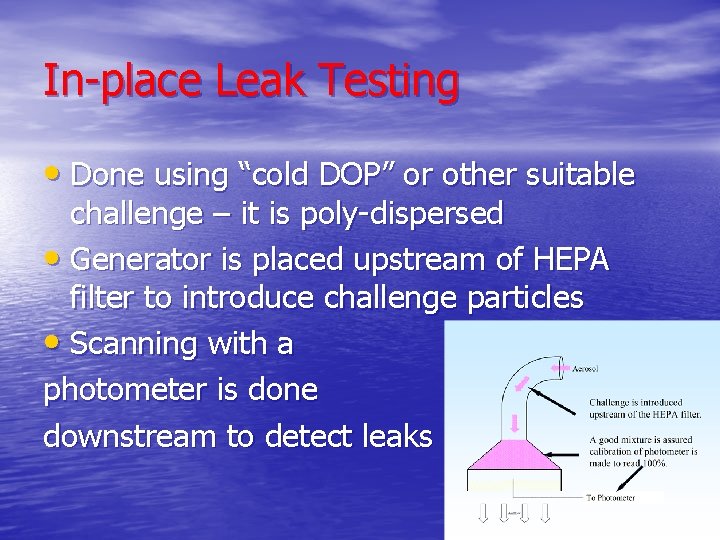
In-place Leak Testing • Done using “cold DOP” or other suitable challenge – it is poly-dispersed • Generator is placed upstream of HEPA filter to introduce challenge particles • Scanning with a photometer is done downstream to detect leaks
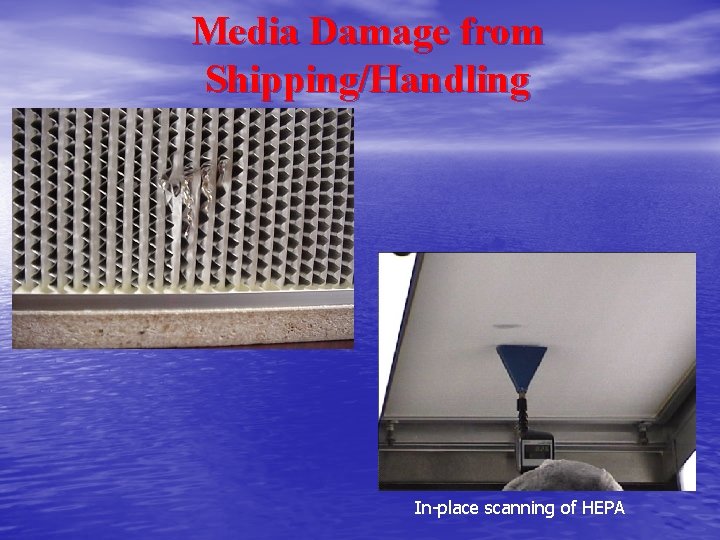
Media Damage from Shipping/Handling In-place scanning of HEPA
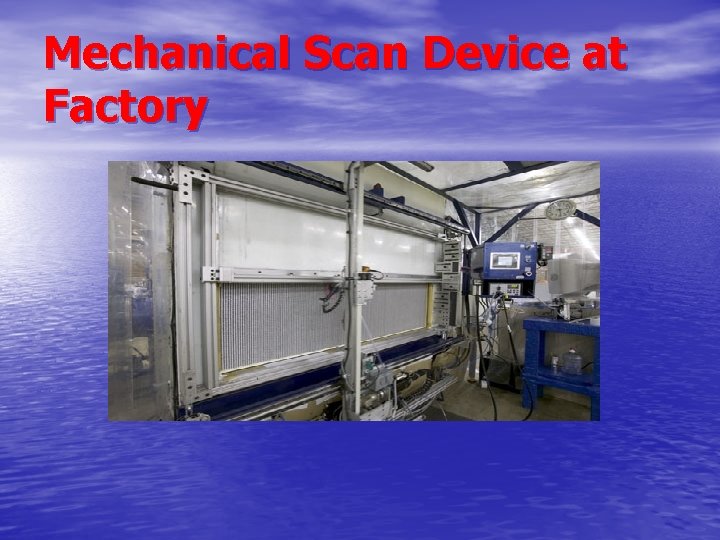
Mechanical Scan Device at Factory
Standards for HEPA Filters • UL 900 – Listed • UL 586 – involves exposing HEPA filter not only to aerosol penetration test, but heated air, moist air, cold air, flame, and others as required by user • IEST – has categorized filter testing for Type A through Type K
Standards for HEPA Filters • EN 1822 – is the European Standard for HEPA and ULPA filters and classifies them from H 10 -14 for HEPA and U 15 -17 for ULPA • Factory Mutual – 3 rd party testing and verification company • ASME AG-1 (Nuclear applications) • Off-Gassing Qualifications
Not On Test But Good To Know Information Handling HEPA Filters • l l l Limit Handling to Minimum Use two people to move if >30” high or >36” wide Do not drop, bump, stack or sit on filters Do not allow filters to lay flat
Not On Test But Good To Know Information Removing HEPA Filter From Carton l l Do not lift filter out of box! Open one end, turn box upside down, lift box off filter Do not try to remove the filter by lifting it up from the box. You may puncture the media with your fingers If a filter is equipped with a removal strap, you may carefully use this to remove the filter from the box When handling, grasp the filter only on outside surface of frame
Storage of HEPA Filters • Store filter standing upright on edge so pleats are vertical, not lying flat. • Make sure filters are marked ‘Fragile” and stored in a ‘safe zone’ away from traffic or activity. • Filters <24” under high; stack 3 high. If filters are > 24” high or greater; stack only two high. • Do not expose to dampness, excessive heat or cold (120 degree F. max. ), rapidly changing temperature or out of doors.
Summary - HEPA Filters • At least 99. 97% Efficient on 0. 3 • • • micrometer challenge particles Tested (scan and / or efficiency) using DOP or suitable substitute Used to filter hazardous materials Always changed with knowledge and PPE Used in Bag In/Bag Out application Should always be handled with care
Sample Questions • Minimum efficiency for filter to be a HEPA? 99. 97% on 0. 3 micrometer particles • European Standard for HEPA and ULPA filters is? EN 1822 • Difference between Hot DOP and Cold DOP is? Size of particle challenge • Testing HEPA filters after installation is called? In-place Leak Testing or Cold DOP Test
Thank you. Other Questions ?