Mycotoxins in Grain and Feed Industries I Mycotoxin


- Slides: 31
Mycotoxins in Grain and Feed Industries I. Mycotoxin Development Erin Bowers, Iowa State University, Agricultural Engineering Charles Hurburgh, Iowa State University, Agricultural Engineering Alison Robertson, Iowa State University, Plant Pathology page 1
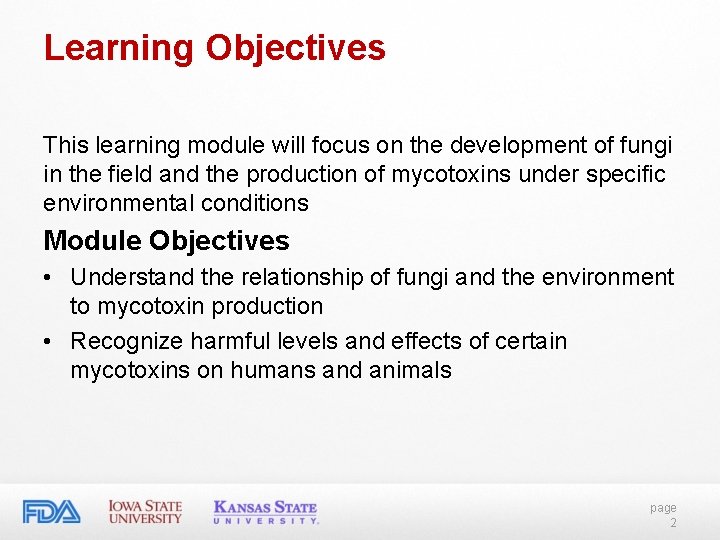
Learning Objectives This learning module will focus on the development of fungi in the field and the production of mycotoxins under specific environmental conditions Module Objectives • Understand the relationship of fungi and the environment to mycotoxin production • Recognize harmful levels and effects of certain mycotoxins on humans and animals page 2
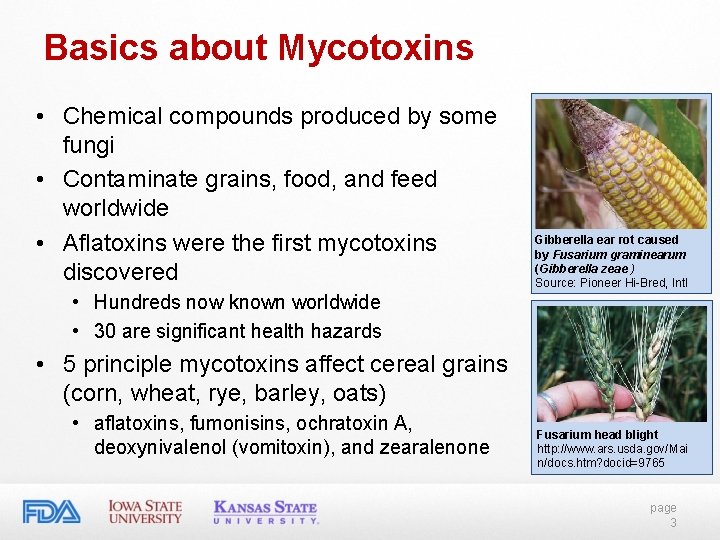
Basics about Mycotoxins • Chemical compounds produced by some fungi • Contaminate grains, food, and feed worldwide • Aflatoxins were the first mycotoxins discovered Gibberella ear rot caused by Fusarium graminearum (Gibberella zeae ) Source: Pioneer Hi-Bred, Intl • Hundreds now known worldwide • 30 are significant health hazards • 5 principle mycotoxins affect cereal grains (corn, wheat, rye, barley, oats) • aflatoxins, fumonisins, ochratoxin A, deoxynivalenol (vomitoxin), and zearalenone Fusarium head blight http: //www. ars. usda. gov/Mai n/docs. htm? docid=9765 page 3
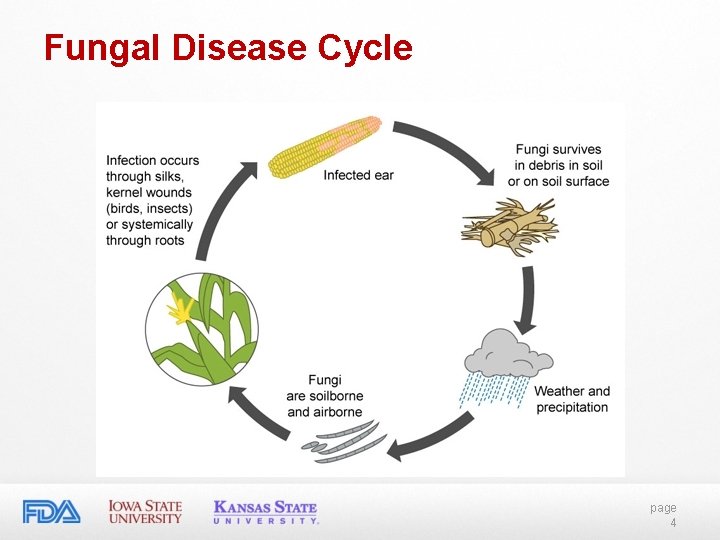
Fungal Disease Cycle page 4
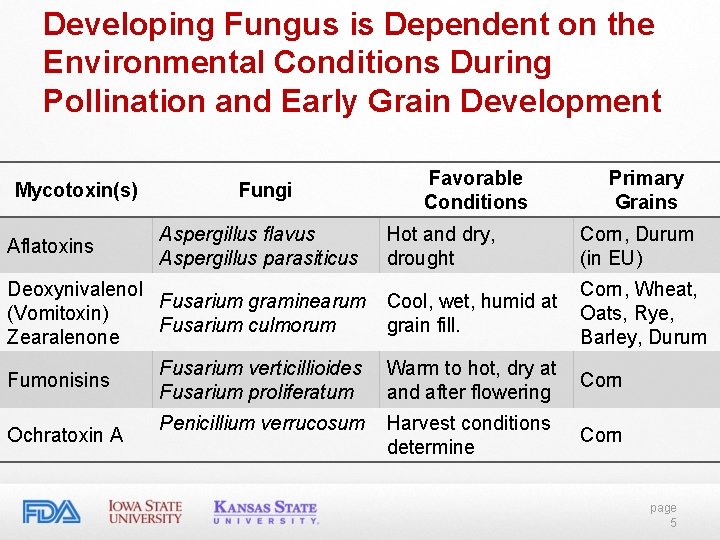
Developing Fungus is Dependent on the Environmental Conditions During Pollination and Early Grain Development Mycotoxin(s) Fungi Aspergillus flavus Aspergillus parasiticus Favorable Conditions Primary Grains Hot and dry, drought Corn, Durum (in EU) Deoxynivalenol Fusarium graminearum (Vomitoxin) Fusarium culmorum Zearalenone Cool, wet, humid at grain fill. Corn, Wheat, Oats, Rye, Barley, Durum Fusarium verticillioides Fusarium proliferatum Warm to hot, dry at and after flowering Corn Penicillium verrucosum Harvest conditions determine Corn Aflatoxins Fumonisins Ochratoxin A page 5
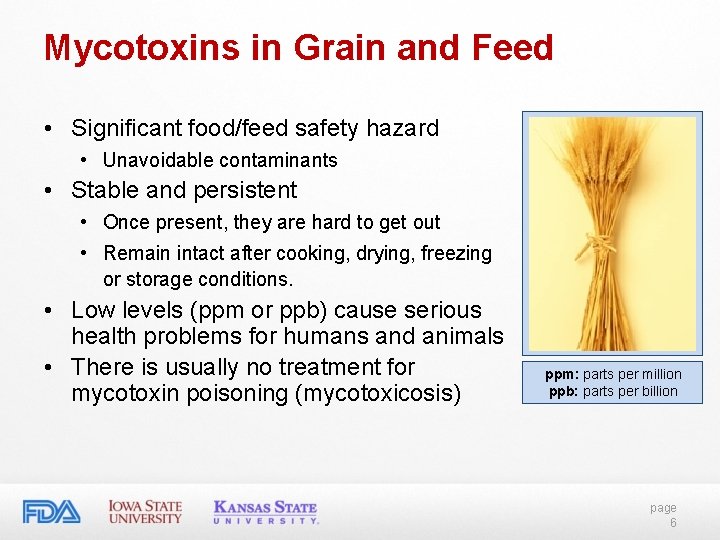
Mycotoxins in Grain and Feed • Significant food/feed safety hazard • Unavoidable contaminants • Stable and persistent • Once present, they are hard to get out • Remain intact after cooking, drying, freezing or storage conditions. • Low levels (ppm or ppb) cause serious health problems for humans and animals • There is usually no treatment for mycotoxin poisoning (mycotoxicosis) ppm: parts per million ppb: parts per billion page 6
Economic Impact of Mycotoxins • Worldwide, ~25% of crops are affected by mycotoxins • Annual economic burden of mycotoxins to U. S. agricultural estimated at $1. 4 billion • Product recalls (pet food is especially sensitive) • 2005 dog food • 2008– 2009 dog food • 2012 dog food and other feed page 7
Poisonous Ingredients in Food Federal Food, Drug, and Cosmetic Act § 402 [21 U. S. C. 342] A food shall be deemed adulterated—(a)(1) If it bears or contains any poisonous of deleterious substance which may render it injurious to health; but in case the substance is not an added substance such food shall not be considered adulterated under this clause if the quantity of such substance does not ordinarily render it injurious to health.
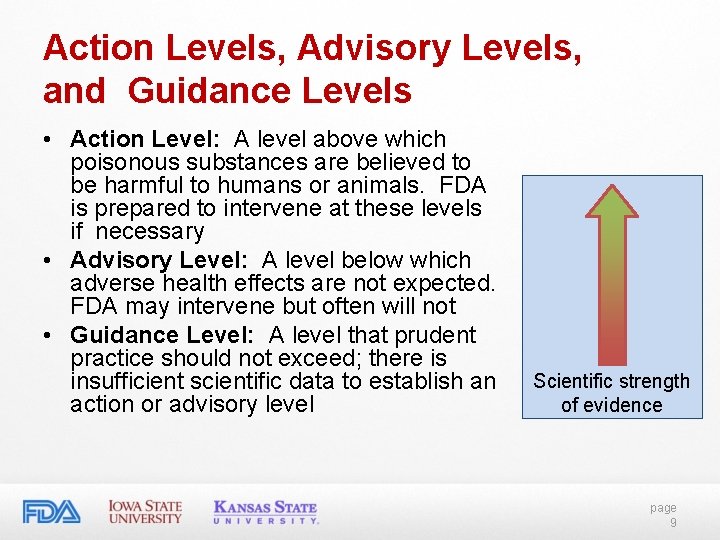
Action Levels, Advisory Levels, and Guidance Levels • Action Level: A level above which poisonous substances are believed to be harmful to humans or animals. FDA is prepared to intervene at these levels if necessary • Advisory Level: A level below which adverse health effects are not expected. FDA may intervene but often will not • Guidance Level: A level that prudent practice should not exceed; there is insufficient scientific data to establish an action or advisory level Scientific strength of evidence page 9
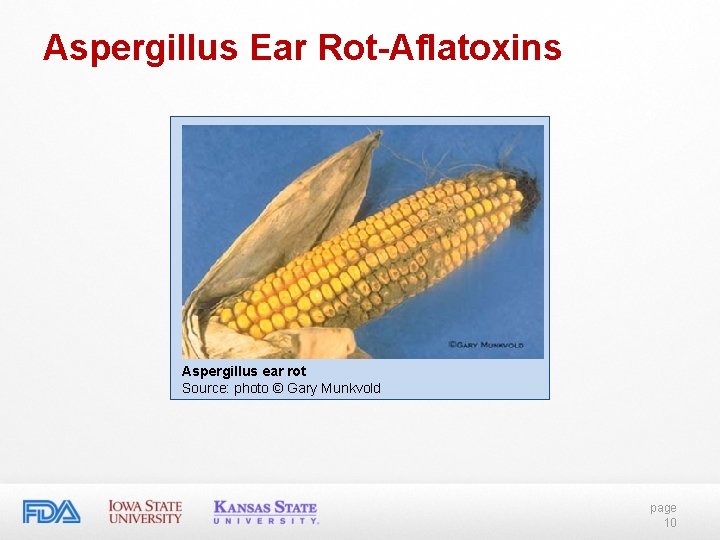
Aspergillus Ear Rot-Aflatoxins Aspergillus ear rot Source: photo © Gary Munkvold page 10
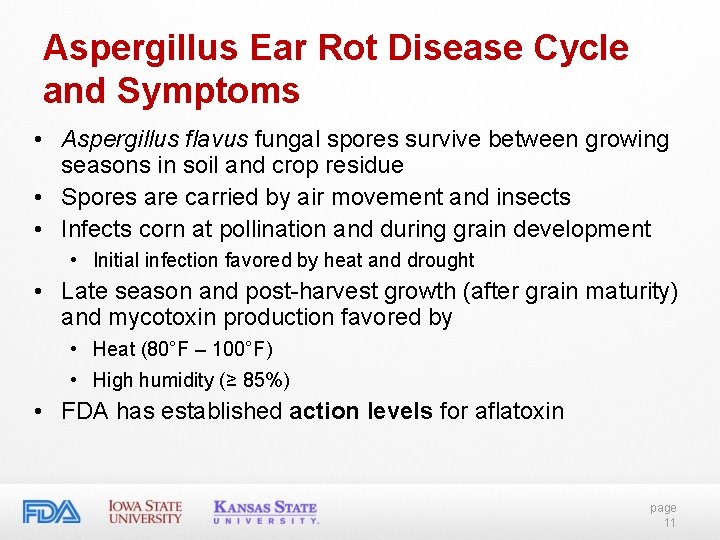
Aspergillus Ear Rot Disease Cycle and Symptoms • Aspergillus flavus fungal spores survive between growing seasons in soil and crop residue • Spores are carried by air movement and insects • Infects corn at pollination and during grain development • Initial infection favored by heat and drought • Late season and post-harvest growth (after grain maturity) and mycotoxin production favored by • Heat (80°F – 100°F) • High humidity (≥ 85%) • FDA has established action levels for aflatoxin page 11
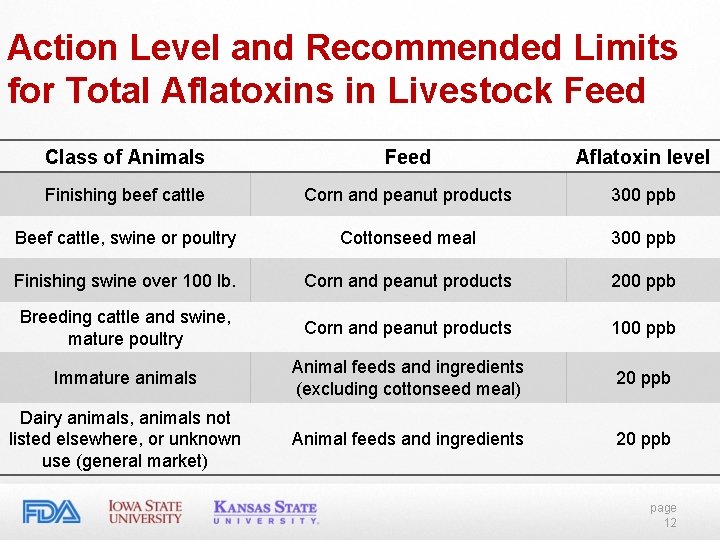
Action Level and Recommended Limits for Total Aflatoxins in Livestock Feed Class of Animals Feed Aflatoxin level Finishing beef cattle Corn and peanut products 300 ppb Beef cattle, swine or poultry Cottonseed meal 300 ppb Finishing swine over 100 lb. Corn and peanut products 200 ppb Breeding cattle and swine, mature poultry Corn and peanut products 100 ppb Immature animals Animal feeds and ingredients (excluding cottonseed meal) 20 ppb Dairy animals, animals not listed elsewhere, or unknown use (general market) Animal feeds and ingredients 20 ppb page 12
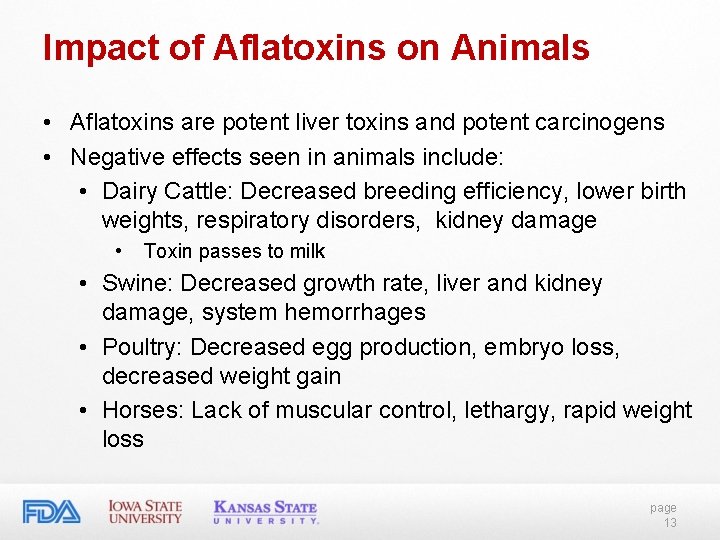
Impact of Aflatoxins on Animals • Aflatoxins are potent liver toxins and potent carcinogens • Negative effects seen in animals include: • Dairy Cattle: Decreased breeding efficiency, lower birth weights, respiratory disorders, kidney damage • Toxin passes to milk • Swine: Decreased growth rate, liver and kidney damage, system hemorrhages • Poultry: Decreased egg production, embryo loss, decreased weight gain • Horses: Lack of muscular control, lethargy, rapid weight loss page 13
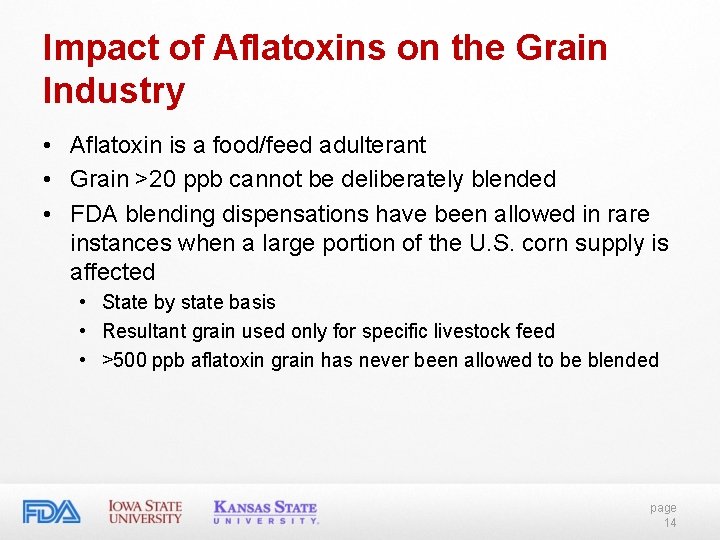
Impact of Aflatoxins on the Grain Industry • Aflatoxin is a food/feed adulterant • Grain >20 ppb cannot be deliberately blended • FDA blending dispensations have been allowed in rare instances when a large portion of the U. S. corn supply is affected • State by state basis • Resultant grain used only for specific livestock feed • >500 ppb aflatoxin grain has never been allowed to be blended page 14
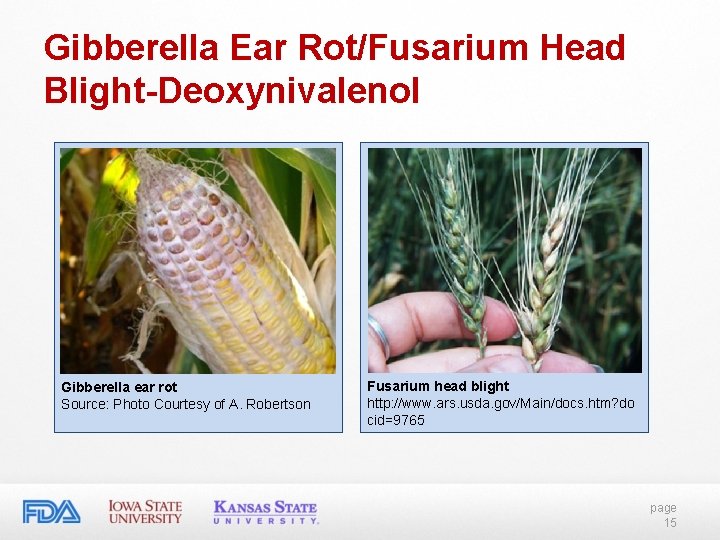
Gibberella Ear Rot/Fusarium Head Blight-Deoxynivalenol Gibberella ear rot Source: Photo Courtesy of A. Robertson Fusarium head blight http: //www. ars. usda. gov/Main/docs. htm? do cid=9765 page 15
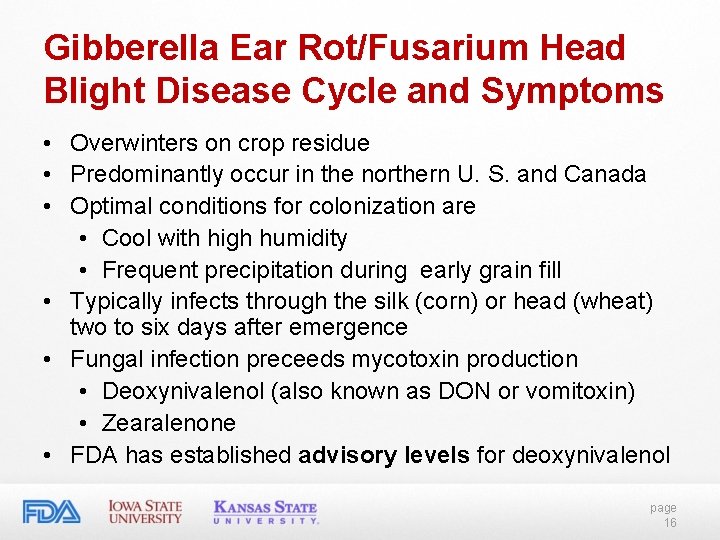
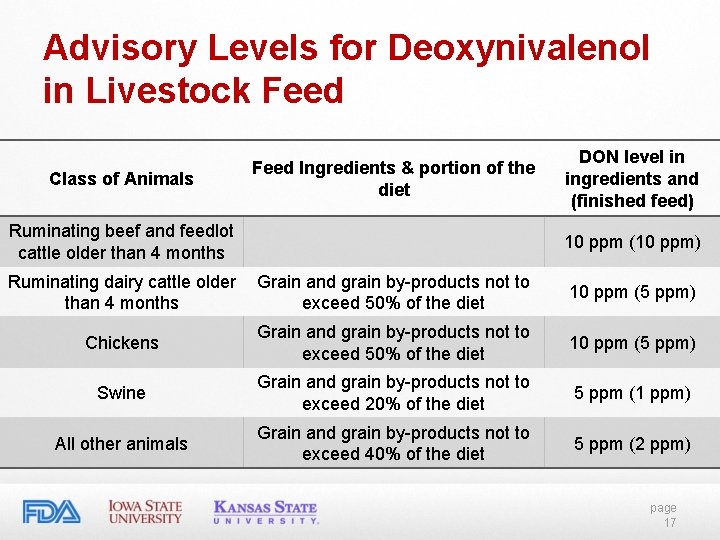
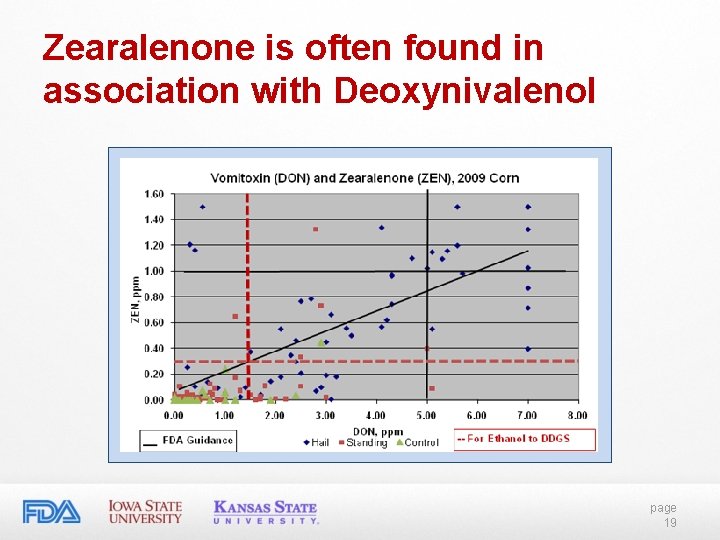
Gibberella Ear Rot/Fusarium Head Blight Disease Cycle and Symptoms • Overwinters on crop residue • Predominantly occur in the northern U. S. and Canada • Optimal conditions for colonization are • Cool with high humidity • Frequent precipitation during early grain fill • Typically infects through the silk (corn) or head (wheat) two to six days after emergence • Fungal infection preceeds mycotoxin production • Deoxynivalenol (also known as DON or vomitoxin) • Zearalenone • FDA has established advisory levels for deoxynivalenol page 16
Advisory Levels for Deoxynivalenol in Livestock Feed Class of Animals Feed Ingredients & portion of the diet Ruminating beef and feedlot cattle older than 4 months DON level in ingredients and (finished feed) 10 ppm (10 ppm) Ruminating dairy cattle older than 4 months Grain and grain by-products not to exceed 50% of the diet 10 ppm (5 ppm) Chickens Grain and grain by-products not to exceed 50% of the diet 10 ppm (5 ppm) Swine Grain and grain by-products not to exceed 20% of the diet 5 ppm (1 ppm) All other animals Grain and grain by-products not to exceed 40% of the diet 5 ppm (2 ppm) page 17
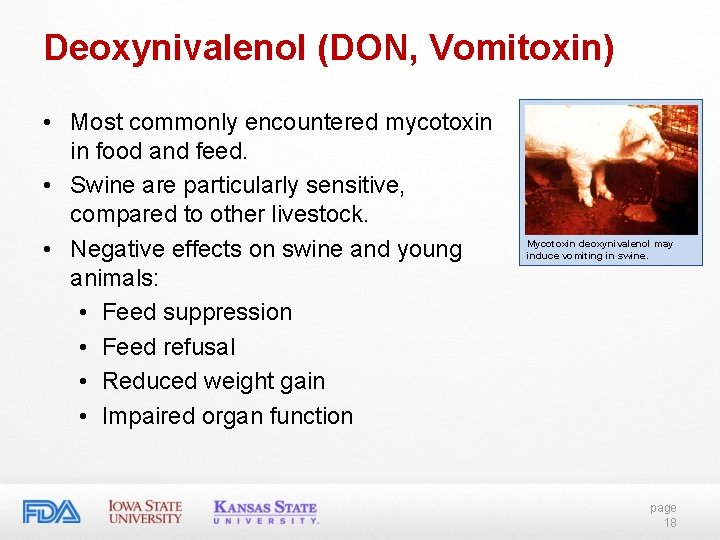
Deoxynivalenol (DON, Vomitoxin) • Most commonly encountered mycotoxin in food and feed. • Swine are particularly sensitive, compared to other livestock. • Negative effects on swine and young animals: • Feed suppression • Feed refusal • Reduced weight gain • Impaired organ function Mycotoxin deoxynivalenol may induce vomiting in swine. page 18
Zearalenone is often found in association with Deoxynivalenol page 19
Zearalenone • Estrogenic activity in swine and dairy that manifests as reproductive effects • Negative effects on cattle: • Infertility • Reduced milk yield • Hyper-estrogenism • Negative effects on swine: • • Enlarge mammae Swelling of uterus and vulva Atrophy of the ovaries Withered testes • There are no FDA action, advisory, or guidance levels page 20
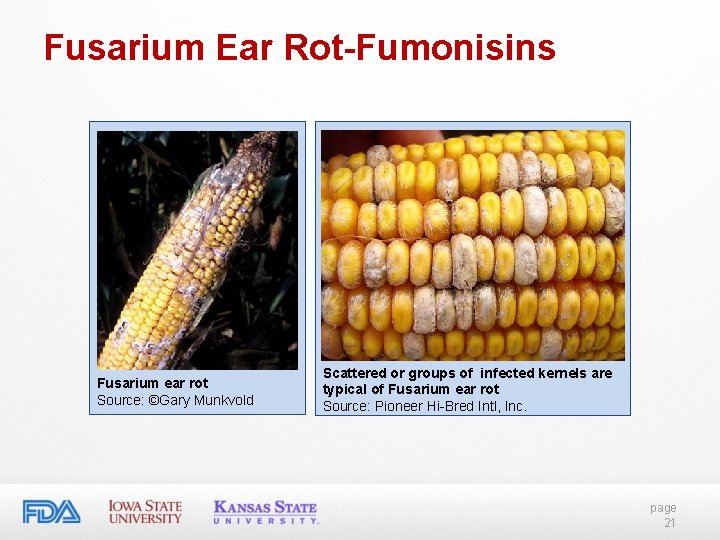
Fusarium Ear Rot-Fumonisins Fusarium ear rot Source: ©Gary Munkvold Scattered or groups of infected kernels are typical of Fusarium ear rot Source: Pioneer Hi-Bred Intl, Inc. page 21
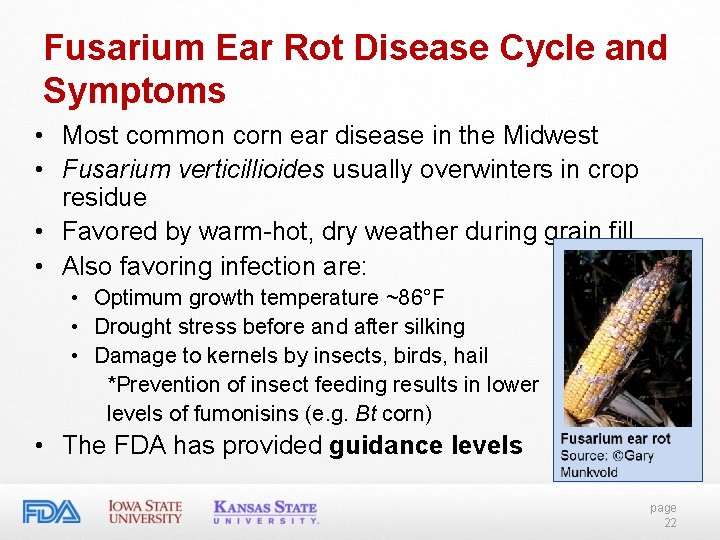
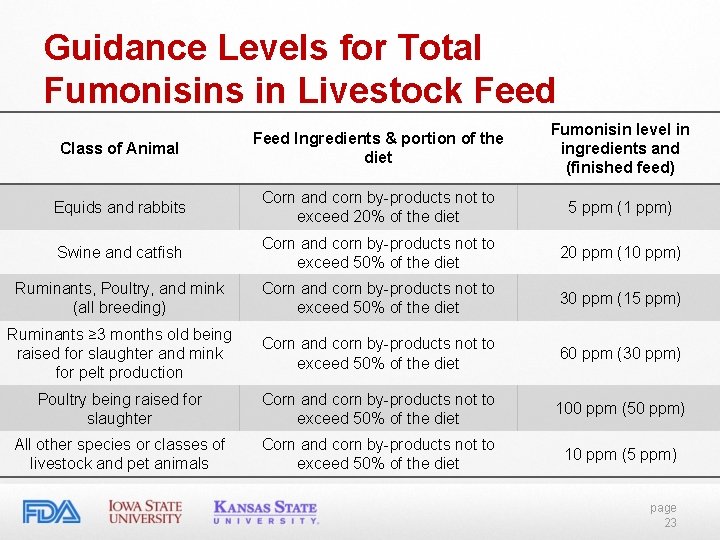
Fusarium Ear Rot Disease Cycle and Symptoms • Most common corn ear disease in the Midwest • Fusarium verticillioides usually overwinters in crop residue • Favored by warm-hot, dry weather during grain fill • Also favoring infection are: • Optimum growth temperature ~86°F • Drought stress before and after silking • Damage to kernels by insects, birds, hail *Prevention of insect feeding results in lower levels of fumonisins (e. g. Bt corn) • The FDA has provided guidance levels page 22
Guidance Levels for Total Fumonisins in Livestock Feed Class of Animal Feed Ingredients & portion of the diet Fumonisin level in ingredients and (finished feed) Equids and rabbits Corn and corn by-products not to exceed 20% of the diet 5 ppm (1 ppm) Swine and catfish Corn and corn by-products not to exceed 50% of the diet 20 ppm (10 ppm) Ruminants, Poultry, and mink (all breeding) Corn and corn by-products not to exceed 50% of the diet 30 ppm (15 ppm) Ruminants ≥ 3 months old being raised for slaughter and mink for pelt production Corn and corn by-products not to exceed 50% of the diet 60 ppm (30 ppm) Poultry being raised for slaughter Corn and corn by-products not to exceed 50% of the diet 100 ppm (50 ppm) All other species or classes of livestock and pet animals Corn and corn by-products not to exceed 50% of the diet 10 ppm (5 ppm) page 23
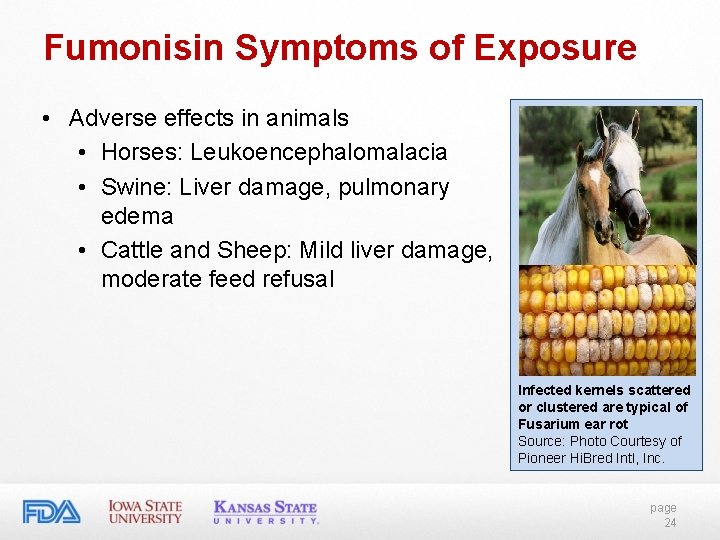
Fumonisin Symptoms of Exposure • Adverse effects in animals • Horses: Leukoencephalomalacia • Swine: Liver damage, pulmonary edema • Cattle and Sheep: Mild liver damage, moderate feed refusal Infected kernels scattered or clustered are typical of Fusarium ear rot Source: Photo Courtesy of Pioneer Hi. Bred Intl, Inc. page 24
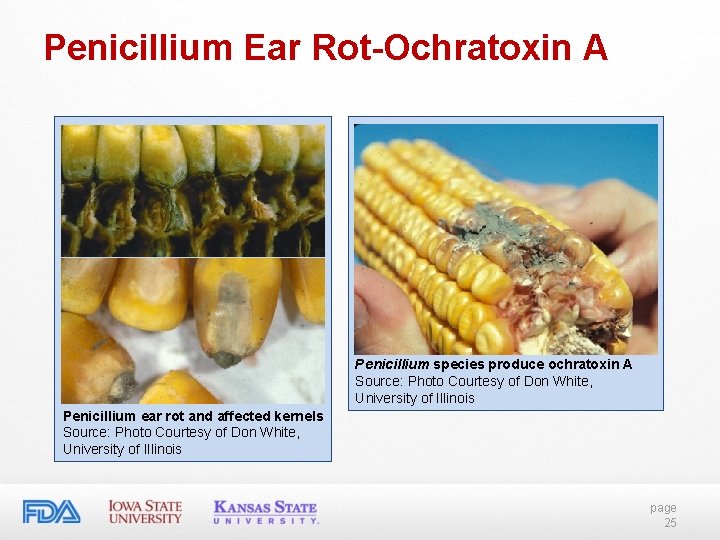
Penicillium Ear Rot-Ochratoxin A Penicillium species produce ochratoxin A Source: Photo Courtesy of Don White, University of Illinois Penicillium ear rot and affected kernels Source: Photo Courtesy of Don White, University of Illinois page 25
Penicillium Ear Rot Disease Cycle and Symptoms • Primarily caused by Penicillium verrucosum • Fungus invades at maturity, not during grain development • Optimal growth conditions for fungus: • Temperatures between 68 -77°F • Grain moisture content ≥ 16% • Harvested corn stored at moisture levels >18% can increase disease severity • Humidity > 80% during and after maturity • Most commonly found in fields infested with stalk boring insects page 26
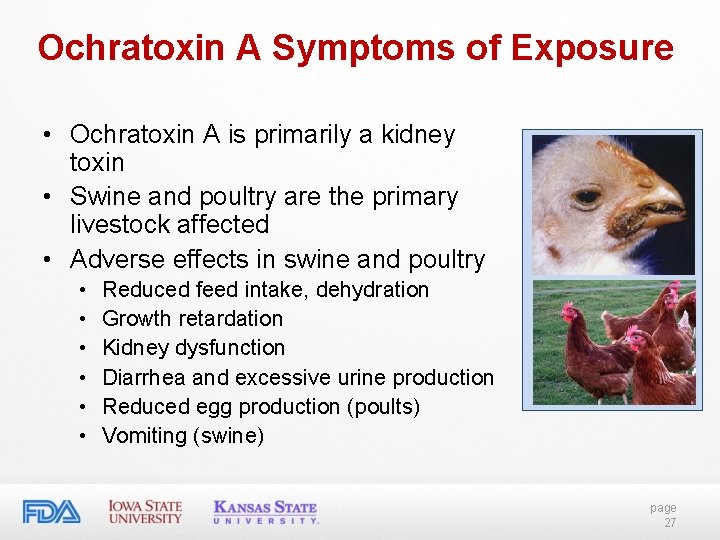
Ochratoxin A Symptoms of Exposure • Ochratoxin A is primarily a kidney toxin • Swine and poultry are the primary livestock affected • Adverse effects in swine and poultry • • • Reduced feed intake, dehydration Growth retardation Kidney dysfunction Diarrhea and excessive urine production Reduced egg production (poults) Vomiting (swine) page 27
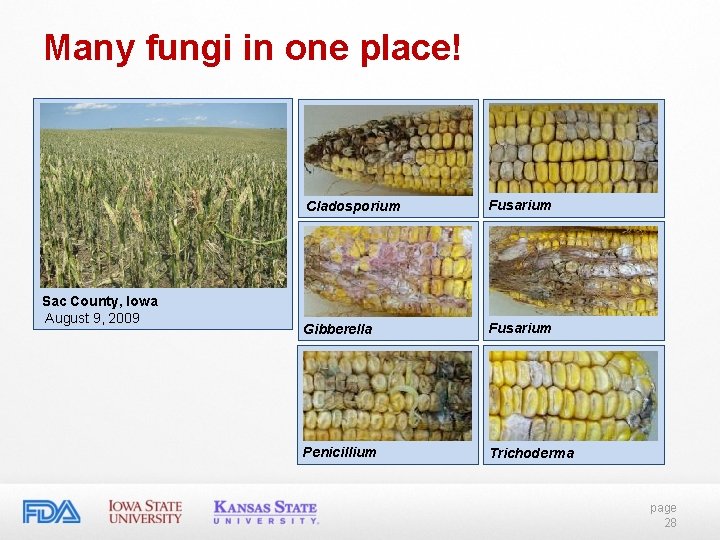
Many fungi in one place! Sac County, Iowa August 9, 2009 Cladosporium Fusarium Gibberella Fusarium Penicillium Trichoderma page 28
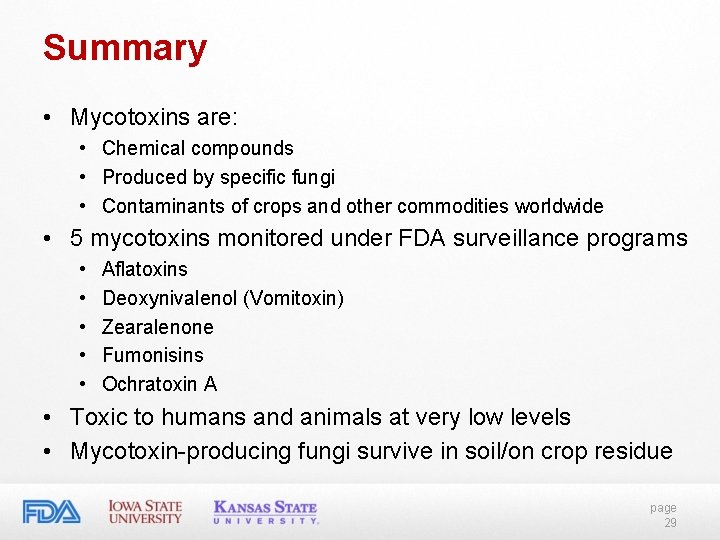
Summary • Mycotoxins are: • Chemical compounds • Produced by specific fungi • Contaminants of crops and other commodities worldwide • 5 mycotoxins monitored under FDA surveillance programs • • • Aflatoxins Deoxynivalenol (Vomitoxin) Zearalenone Fumonisins Ochratoxin A • Toxic to humans and animals at very low levels • Mycotoxin-producing fungi survive in soil/on crop residue page 29
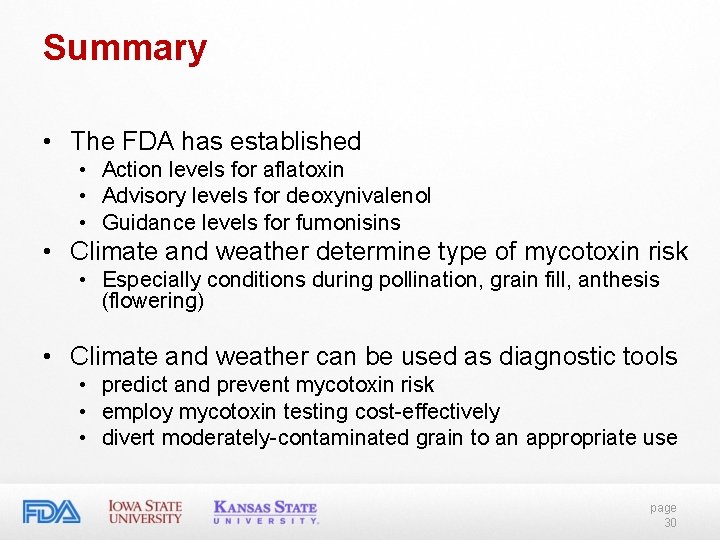
Summary • The FDA has established • Action levels for aflatoxin • Advisory levels for deoxynivalenol • Guidance levels for fumonisins • Climate and weather determine type of mycotoxin risk • Especially conditions during pollination, grain fill, anthesis (flowering) • Climate and weather can be used as diagnostic tools • predict and prevent mycotoxin risk • employ mycotoxin testing cost-effectively • divert moderately-contaminated grain to an appropriate use page 30
This training was a joint effort of *Funding for this Grain and Feed Mill Operations course was made possible, in part, by the Food and Drug Administration through grant (1 U 54 FD 004333 -01), views expressed in written materials or publications and by speakers and moderators do not necessarily reflect the official policies of the Department of Health and Human Services; nor does any mention of trade names, commercial practices, or organization imply endorsement by the United States Government. * page 31