
MultiCore CPUs Matt Kuehn Roadmap Intel vs AMD

- Slides: 19
Multi-Core CPUs Matt Kuehn
Roadmap ► Intel vs AMD ► Early multi-core processors ► Threads vs Physical Cores ► Multithreading and Multi-core processing ► Current development direction ► Passmark benchmarks ► Conclusion
Intel ► Founded July 1968 ► Integrated Electronics ► Largest provider of CPUs ► Inventor of the x 86 architecture ► First commercial microprocessor chip in 1971 ► CISC
CISC ► Complex Instruction Set Computing ► Emphasis on hardware ► Memory to Memory operations ► Commands that are operations § Ex) MULT X*Y translates to x = x * y ► Small code size
AMD ► Advanced Micro Devices ► Founded May 1969 ► Second largest supplier of microprocessors ► Merged with ATI Technologies in 2006 ► Only significant rival to Intel in CPU Market ► RISC
RISC ► Reduced Instruction Set Computing ► Emphasis on software ► Register to Register operations § Similar to COSC 300 ► Commands that are single steps § Ex LOAD X, LOAD Y, PROD X, Y, STORE X ► Simple operations translate to lengthy code
Pentium 4 HT ► First mainstream solution to add an additional ‘core’ ► One core on the chip ► Used Hyper-Threading Technology ► Two ‘logical’ or ‘virtual’ CPUs ► OS can schedule two processes at the same time
First Dual Core Processor ► Opteron server CPU ► First demonstrated in August 2004 ► Created by AMD ► Dual Core ► Demonstration machine was a server powered by 4 Opteron chips
WHAT? ! So what’s the difference between a core and a thread? ? ?
Core ► Essentially a CPU ► Has own resources § Registers, cache, etc… ► Everything a physical CPU would have § ALU § Control Unit § Clock ► Costly to add to chip
Thread ► Essentially a virtual CPU ► Does not have any physical resources § Shares resources with a physical core ► Inexpensive compared to a Core ► Does not provide the same throughput as a physical Core ► High improvement to cost ratio
Multi Core Processing ► Exploit concurrency to spread work ► Running tasks = Processors in a system ► Improves absolute performance ► Optimal single core processor leads to a new CPU with multiple optimal single cores
Multithreading ► Also exploit concurrency of multiple tasks ► Processor level optimization § Improve area and energy efficiency ► Replicates resources virtually ► Slightly larger chip, greatly increased performance § Ex) 15% increase in area leads to 60% increase in throughput
Current Direction ► Intel § Multiple Physical Cores § Threads Current high end: ► Core i 7 § 4 Cores § 8 Threads of execution ► AMD § Multiple Physical Cores § Multi-core processing Current high end: ► FX 8 -Core § 8 physical cores
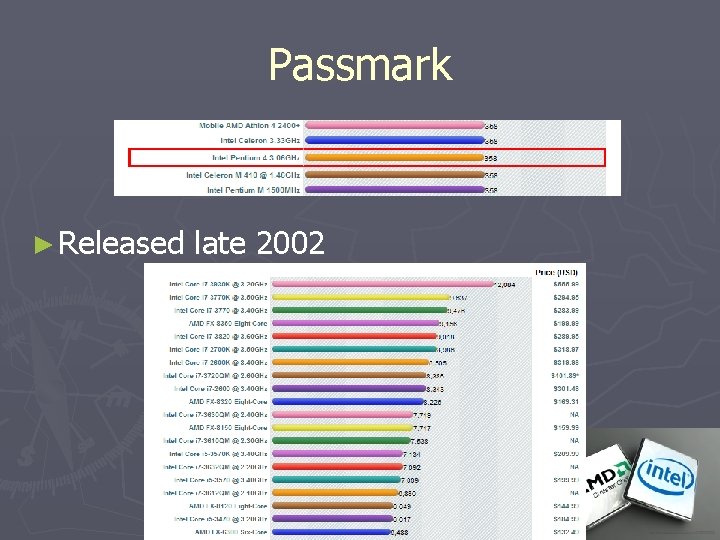
Passmark ► Released late 2002
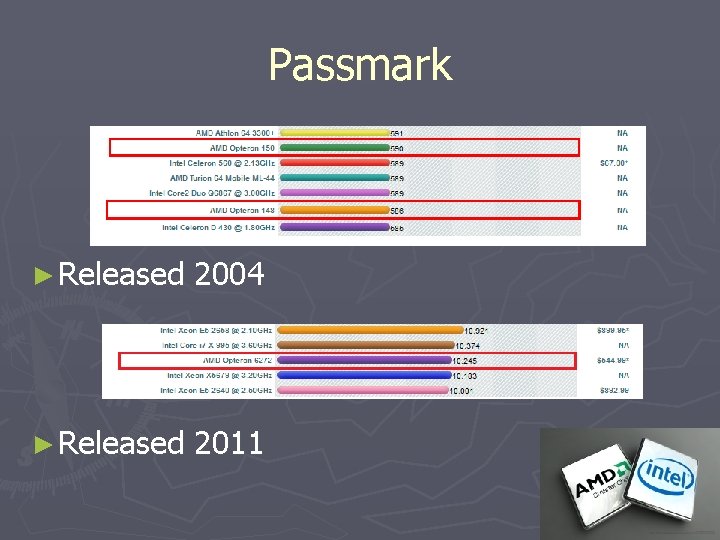
Passmark ► Released 2004 ► Released 2011
Conclusion ► Intel vs AMD § RISC and CISC ► Early solutions to Multi-Core CPUs § Physical and Logical ► Threads vs Cores ► Multithreading vs Milti-Core processing ► Benchmark testing via Passmark
Questions?
References ► ► ► http: //www. amd. com/us/press-releases/Pages/Press_Release_89872. aspx http: //www. intel. com/content/www/us/en/company-overview/companyfacts. html http: //www. amd. com/us/aboutamd/corporate-information/Pages/corporateinfo. aspx http: //www-csfaculty. stanford. edu/~eroberts/courses/soco/projects/risccisc/ http: //eetimes. com/design/automotive-design/4004762/Demystifyingmultithreading-and-multi-core http: //www. passmark. com/