Moringa oleifera an underutilised tree with amazing versatility























- Slides: 50
Moringa oleifera – an underutilised tree with amazing versatility Newton K. Amaglo Department of Horticulture, Faculty of Agriculture, Kwame Nkrumah University of Science and Technology, Kumasi Ghana-West Africa
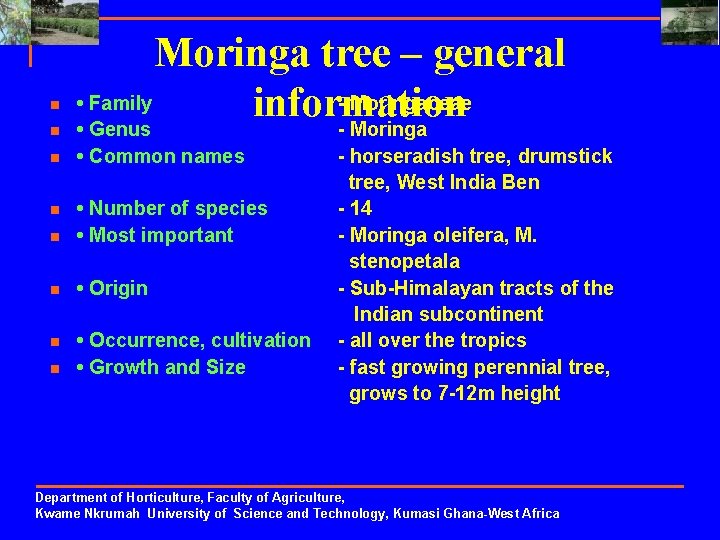
n Moringa tree – general • Family - Moringaceae information • Genus - Moringa n • Common names n n • Number of species • Most important n • Origin n • Occurrence, cultivation • Growth and Size n n - horseradish tree, drumstick tree, West India Ben - 14 - Moringa oleifera, M. stenopetala - Sub-Himalayan tracts of the Indian subcontinent - all over the tropics - fast growing perennial tree, grows to 7 -12 m height Department of Horticulture, Faculty of Agriculture, Kwame Nkrumah University of Science and Technology, Kumasi Ghana-West Africa
Multiple uses of Moringa n Human food n Water purification n Pharmaceutical products n Animal and fish feed n Green manure n Plant growth hormone Department of Horticulture, Faculty of Agriculture, Kwame Nkrumah University of Science and Technology, Kumasi Ghana-West Africa
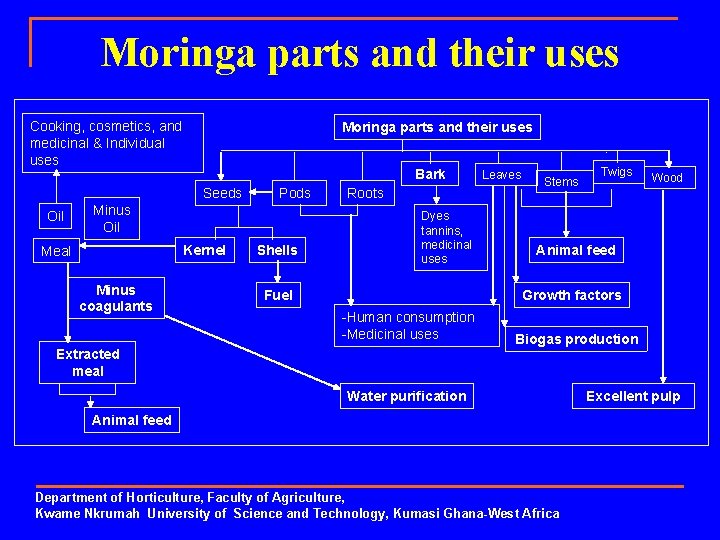
Moringa parts and their uses Cooking, cosmetics, and medicinal & Individual uses Moringa parts and their uses Bark Seeds Oil Pods Minus Oil Kernel Meal Minus coagulants Shells Roots Dyes tannins, medicinal uses Leaves Stems Twigs Wood Animal feed Growth factors Fuel -Human consumption -Medicinal uses Extracted meal Biogas production Water purification Animal feed Department of Horticulture, Faculty of Agriculture, Kwame Nkrumah University of Science and Technology, Kumasi Ghana-West Africa Excellent pulp
Moringa in Ghana Currently Moringa can be found in every part of the country n In Volta region, it is called Yevu-ti (The white man’s tree). It was introduced by the Germans during the second world war. It is being used mainly as live fence. n In Ashanti region, it is reported that the royal clan brought it on their return from the Sesheles Island*. it is known by the name “Buid” n In the upper west region, It is one of the traditional foods of the Dagatis where it is known as “Onwukowo” (chew and drink water) * Mrs Alice Kunadu Acheampong, 2004 Kumasi. Department of Horticulture, Faculty of Agriculture, Kwame Nkrumah University of Science and Technology, Kumasi Ghana-West Africa
Methods of Moringa culture Traditionally cultivated as a backyard plant • It can also be grown as a hedge • • Trials in Nicaragua have shown that it is ideally suited also for more intensive production Department of Horticulture, Faculty of Agriculture, Kwame Nkrumah University of Science and Technology, Kumasi Ghana-West Africa
Production of nutrients from intensive M. oleifera cultivation in Nicaragua Nutrient/Component Yield (tons/ha/yr) Concentration (% DM) Dry matter 126 Protein 21. 4 17. 0 Sugar 12. 6 10. 0 Starch 10. 0 7. 9 Lipid 4. 4 3. 5 NDF 30. 2 24. 0 NSP, Ash, Others 47. 4 37. 6 Source: N. Foidl, personal communication; NSP-non-starch polysaccharides Department of Horticulture, Faculty of Agriculture, Kwame Nkrumah University of Science and Technology, Kumasi Ghana-West Africa
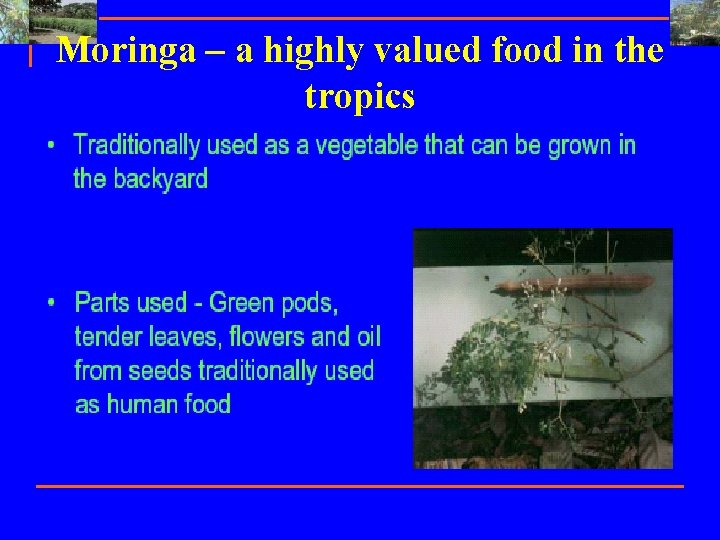
Moringa – a highly valued food in the tropics
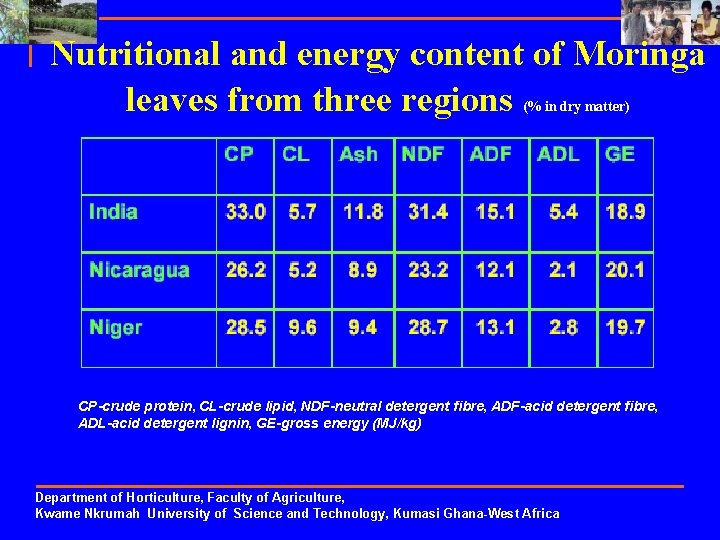
Nutritional and energy content of Moringa leaves from three regions (% in dry matter) CP-crude protein, CL-crude lipid, NDF-neutral detergent fibre, ADF-acid detergent fibre, ADL-acid detergent lignin, GE-gross energy (MJ/kg) Department of Horticulture, Faculty of Agriculture, Kwame Nkrumah University of Science and Technology, Kumasi Ghana-West Africa
Mineral Composition of M. oleifera leaves from Y different origins Department of Horticulture, Faculty of Agriculture, Kwame Nkrumah University of Science and Technology, Kumasi Ghana-West Africa
Essential amino acid composition of M. oleifera leaves from different regions (g/16 g. N) FAO/WHO (1990) reference pattern suggested for pre-school children (2 -5 years old); acystine+ methionine; btyrosine+ phenylalanine Department of Horticulture, Faculty of Agriculture, Kwame Nkrumah University of Science and Technology, Kumasi Ghana-West Africa
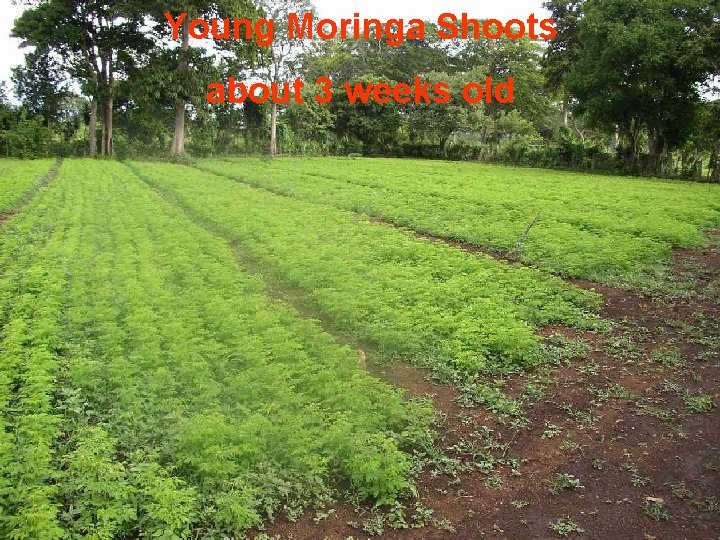
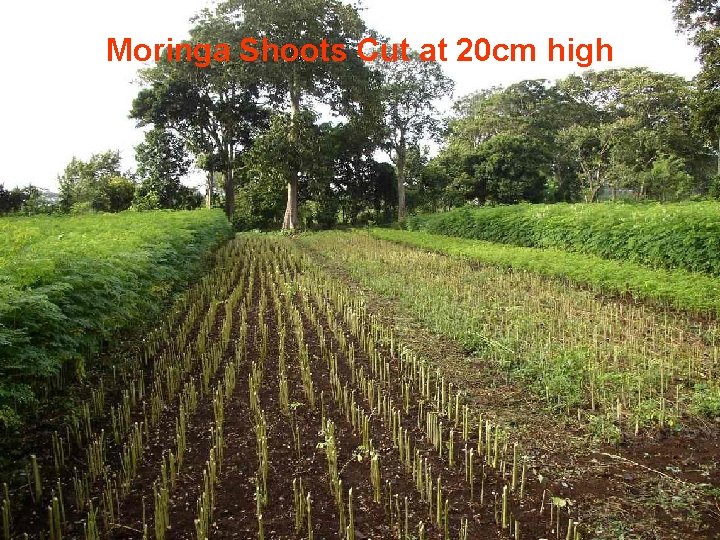
Intensive moringa leaf production n n Moringa can be grown intensively with yields of up to 650 metric tons of green matter per hectare. This compares very well to other green manure crops such as Lablab beans, which yield up to 110 tons/hectare of green matter in pure stands. The green matter is harvested when plants reach a height of 50 cm or more (every 35 -40 days), cut at a distance of 15 -20 cm above the ground. Although losses of seedlings may be 20 -30% in the first year, the vigorous regrowth of the remaining seedlings will produce 3 or 5 new shoots after each cutting. Up to nine harvest can be obtained annually. Department of Horticulture, Faculty of Agriculture, Kwame Nkrumah University of Science and Technology, Kumasi Ghana-West Africa
Young Moringa Shoots about 3 weeks old
Moringa Shoots Ready for first Harvest
Moringa Shoots Cut at 20 cm high
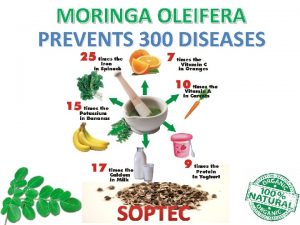
Moringa- Nutritional Content India's ancient tradition of ayurveda says the leaves of the Moringa tree prevent 300 diseases. Modern science confirms the basic idea. Scientific research has proven that these humble leaves are in fact a powerhouse of nutritional value. Gram for gram, Moringa leaves contain: Department of Horticulture, Faculty of Agriculture, Kwame Nkrumah University of Science and Technology, Kumasi Ghana-West Africa
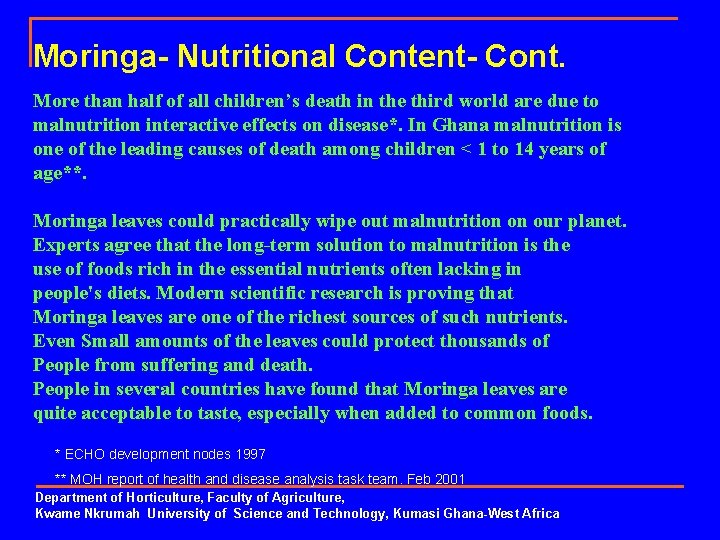
Moringa- Nutritional Content- Cont. More than half of all children’s death in the third world are due to malnutrition interactive effects on disease*. In Ghana malnutrition is one of the leading causes of death among children < 1 to 14 years of age**. Moringa leaves could practically wipe out malnutrition on our planet. Experts agree that the long-term solution to malnutrition is the use of foods rich in the essential nutrients often lacking in people's diets. Modern scientific research is proving that Moringa leaves are one of the richest sources of such nutrients. Even Small amounts of the leaves could protect thousands of People from suffering and death. People in several countries have found that Moringa leaves are quite acceptable to taste, especially when added to common foods. * ECHO development nodes 1997 ** MOH report of health and disease analysis task team. Feb 2001 Department of Horticulture, Faculty of Agriculture, Kwame Nkrumah University of Science and Technology, Kumasi Ghana-West Africa
M. oleifera leaves have become a recommended food supplement Classical supplement for catch-up growth in malnourished children Moringa leaf powder supplement Whole milk powder – 110 g Sugar – 50 g Oil – 30 g Electrolyte/mineral – 20 ml Made up with water to 1000 ml Spoonful thrice daily (total 25 g) along with millet broth Problem of availability and affordability in poor far flung areas Available and affordable to all, spectacular results, improvement from day 10 Department of Horticulture, Faculty of Agriculture, Kwame Nkrumah University of Science and Technology, Kumasi Ghana-West Africa
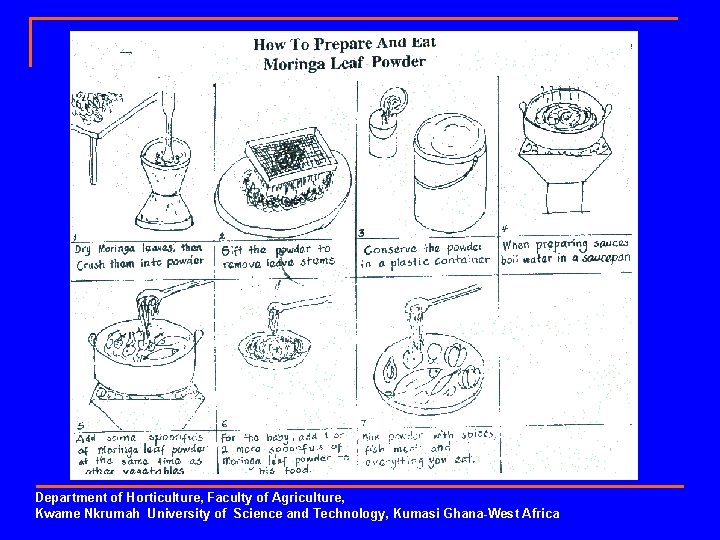
Moringa – a nutritious vegetable to a “functional food” • Leaf powder now recommended in Africa and Asia as a nutritional supplement for –Lactating mothers –Infants and children Photo: Lowell J. Fuglie, Church World Service Department of Horticulture, Faculty of Agriculture, Kwame Nkrumah University of Science and Technology, Kumasi Ghana-West Africa
Department of Horticulture, Faculty of Agriculture, Kwame Nkrumah University of Science and Technology, Kumasi Ghana-West Africa
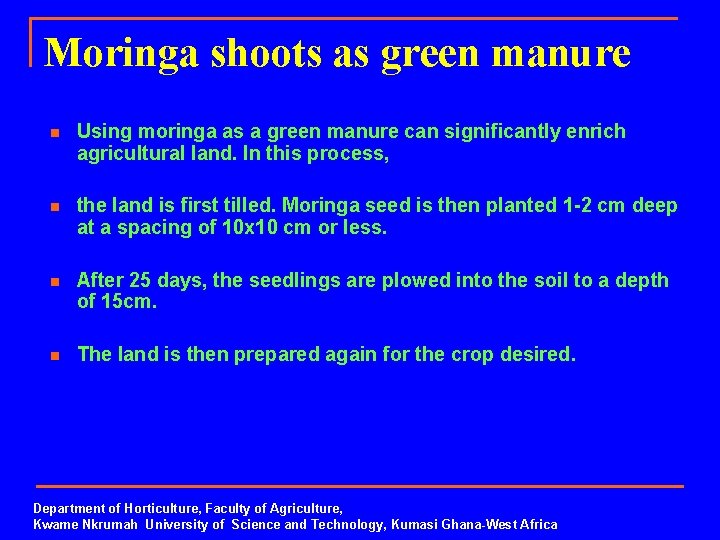
Moringa shoots as green manure n Using moringa as a green manure can significantly enrich agricultural land. In this process, n the land is first tilled. Moringa seed is then planted 1 -2 cm deep at a spacing of 10 x 10 cm or less. n After 25 days, the seedlings are plowed into the soil to a depth of 15 cm. n The land is then prepared again for the crop desired. Department of Horticulture, Faculty of Agriculture, Kwame Nkrumah University of Science and Technology, Kumasi Ghana-West Africa
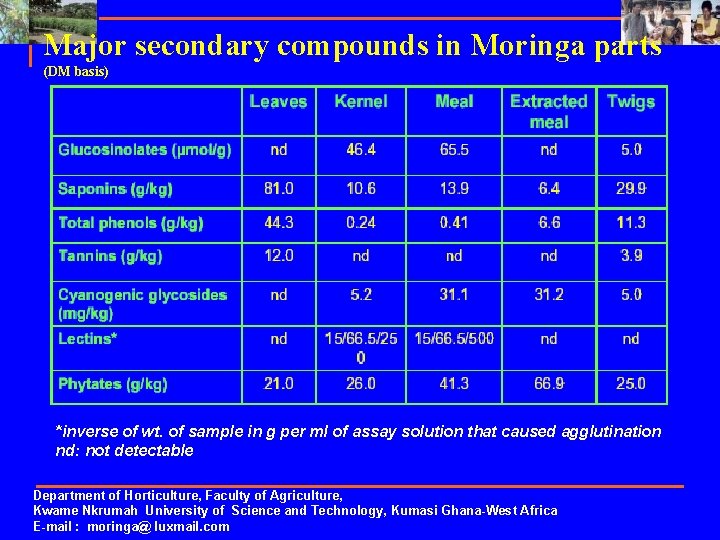
Major secondary compounds in Moringa parts (DM basis) *inverse of wt. of sample in g per ml of assay solution that caused agglutination nd: not detectable Department of Horticulture, Faculty of Agriculture, Kwame Nkrumah University of Science and Technology, Kumasi Ghana-West Africa E-mail : moringa@ luxmail. com
Level of two bioactive flavonoids in Moringa leaves and extracts Prof Dr Klaus Becker Department of Horticulture, Faculty of Agriculture, Kwame Nkrumah University of Science and Technology, Kumasi Ghana-West Africa E-mail : moringa@ luxmail. com
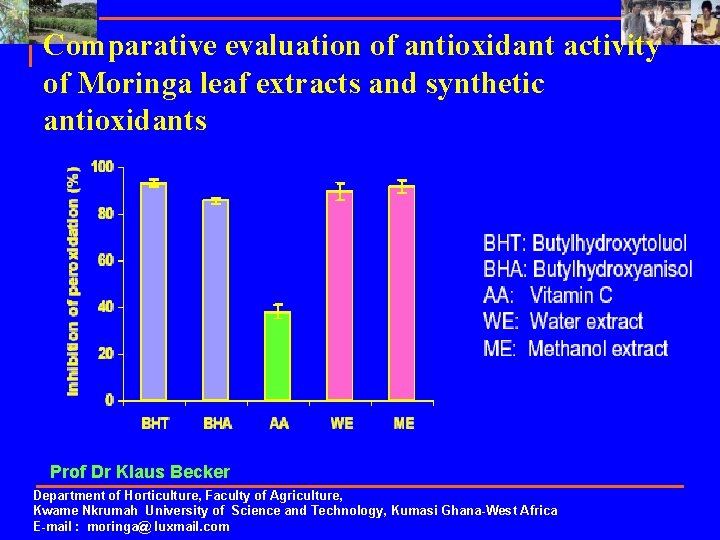
Comparative evaluation of antioxidant activity of Moringa leaf extracts and synthetic antioxidants Prof Dr Klaus Becker Department of Horticulture, Faculty of Agriculture, Kwame Nkrumah University of Science and Technology, Kumasi Ghana-West Africa E-mail : moringa@ luxmail. com
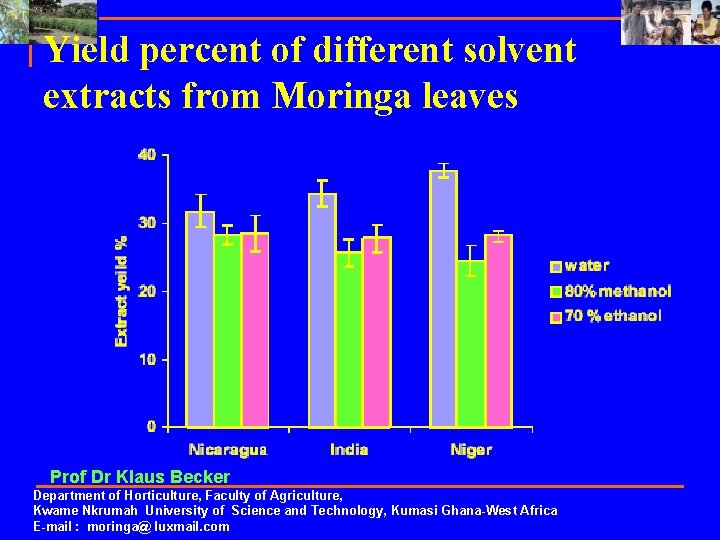
Yield percent of different solvent extracts from Moringa leaves Prof Dr Klaus Becker Department of Horticulture, Faculty of Agriculture, Kwame Nkrumah University of Science and Technology, Kumasi Ghana-West Africa E-mail : moringa@ luxmail. com
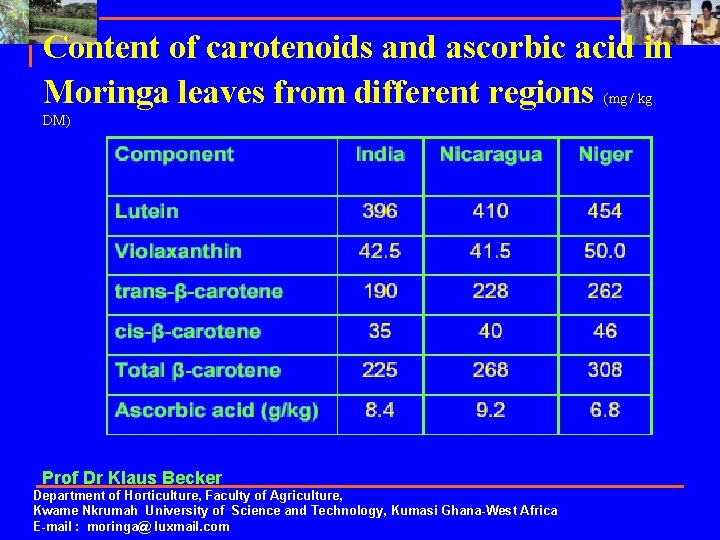
Content of carotenoids and ascorbic acid in Moringa leaves from different regions (mg / kg DM) Prof Dr Klaus Becker Department of Horticulture, Faculty of Agriculture, Kwame Nkrumah University of Science and Technology, Kumasi Ghana-West Africa E-mail : moringa@ luxmail. com
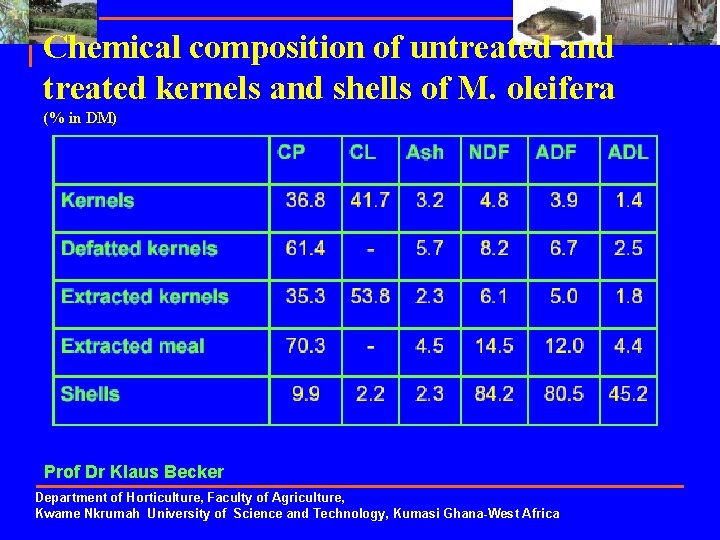
Chemical composition of untreated and treated kernels and shells of M. oleifera (% in DM) Prof Dr Klaus Becker Department of Horticulture, Faculty of Agriculture, Kwame Nkrumah University of Science and Technology, Kumasi Ghana-West Africa
Content of carotenoids and ascorbic acid in Moringa leaves from different regions (mg / kg DM) Prof Dr Klaus Becker Department of Horticulture, Faculty of Agriculture, Kwame Nkrumah University of Science and Technology, Kumasi Ghana-West Africa E-mail : moringa@ luxmail. com
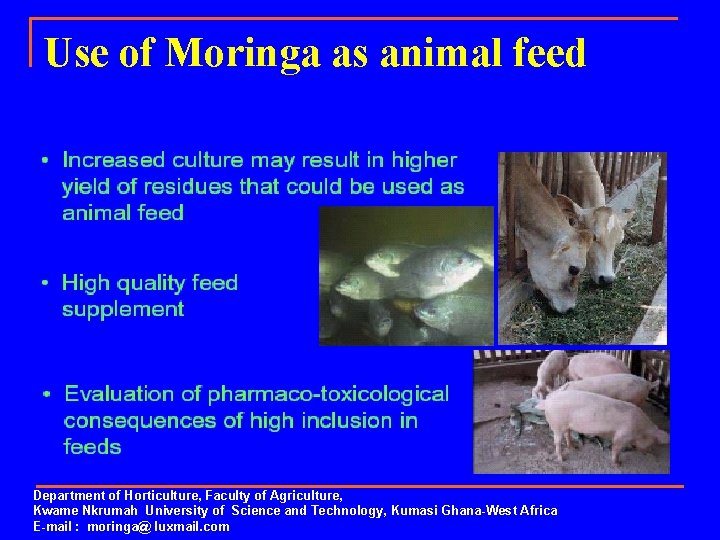
Use of Moringa as animal feed Department of Horticulture, Faculty of Agriculture, Kwame Nkrumah University of Science and Technology, Kumasi Ghana-West Africa E-mail : moringa@ luxmail. com
Effect of Moringa forage supplementation on body mass development in cattle* * From N. Foidl; Nicaragua, dry season Department of Horticulture, Faculty of Agriculture, Kwame Nkrumah University of Science and Technology, Kumasi Ghana-West Africa E-mail : moringa@ luxmail. com
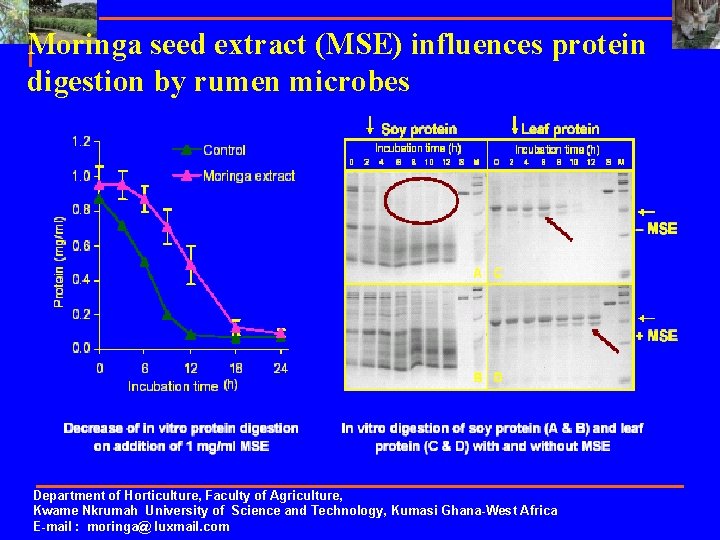
Moringa seed extract (MSE) influences protein digestion by rumen microbes Department of Horticulture, Faculty of Agriculture, Kwame Nkrumah University of Science and Technology, Kumasi Ghana-West Africa E-mail : moringa@ luxmail. com
Moringa forage as supplement in fattening diets for pigs* * From N. Foidl; Nicaragua Department of Horticulture, Faculty of Agriculture, Kwame Nkrumah University of Science and Technology, Kumasi Ghana-West Africa E-mail : moringa@ luxmail. com
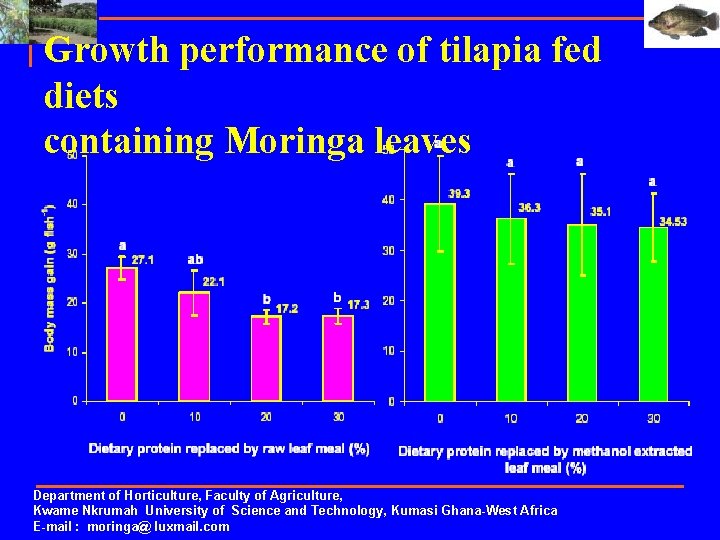
Growth performance of tilapia fed diets containing Moringa leaves Department of Horticulture, Faculty of Agriculture, Kwame Nkrumah University of Science and Technology, Kumasi Ghana-West Africa E-mail : moringa@ luxmail. com
Liver retinol (vitamin A) enrichment in tilapia fed Moringa leaves Department of Horticulture, Faculty of Agriculture, Kwame Nkrumah University of Science and Technology, Kumasi Ghana-West Africa E-mail : moringa@ luxmail. com
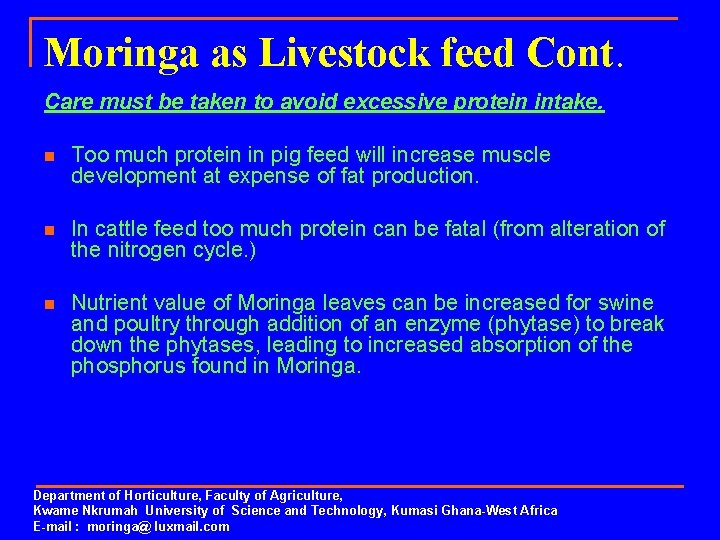
Moringa as Livestock feed Cont. Care must be taken to avoid excessive protein intake. n Too much protein in pig feed will increase muscle development at expense of fat production. n In cattle feed too much protein can be fatal (from alteration of the nitrogen cycle. ) n Nutrient value of Moringa leaves can be increased for swine and poultry through addition of an enzyme (phytase) to break down the phytases, leading to increased absorption of the phosphorus found in Moringa. Department of Horticulture, Faculty of Agriculture, Kwame Nkrumah University of Science and Technology, Kumasi Ghana-West Africa E-mail : moringa@ luxmail. com
Moringa as Livestock feed Cont. n With Moringa feed, milk production was 10 liters/day. -Without Moringa feed, milk production was 7 liters/day. n With Moringa feed, daily weight gain of beef cattle was 1200 grams/day. -Without Moringa feed, daily weight gain of cattle was 900 grams/day. n The higher birth weight (3 -5 kg) can be problematic for small cattle. n It may be advisable to induce birth 10 days prematurely to avoid problems. Incidence of twin births also increased dramatically with Moringa feed: 3 per 20 births as opposed to the usual average of 1: 1000. Department of Horticulture, Faculty of Agriculture, Kwame Nkrumah University of Science and Technology, Kumasi Ghana-West Africa E-mail : moringa@ luxmail. com
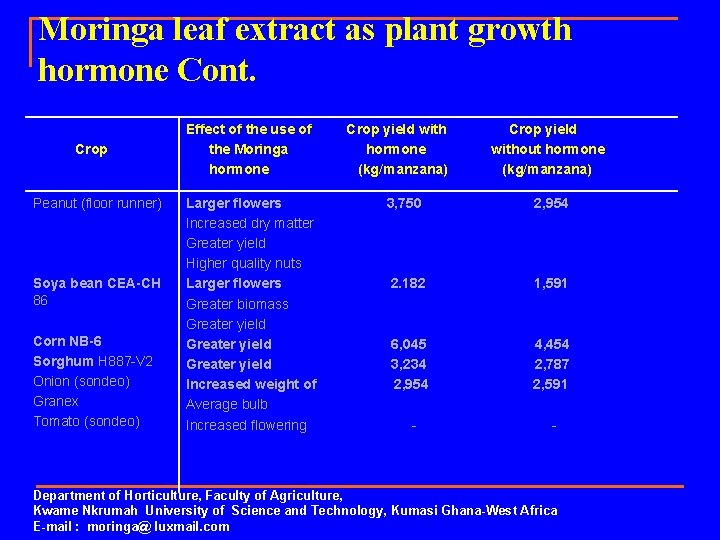
Moringa leaf extract as plant growth hormone The juice from fresh moringa leaves can be used to produce an effective plant growth hormone, increasing yields by 25%-30% for nearly any crop: onions, bell pepper, soya, maize sorghum, coffee tea, chili, melon… One of the active substance is zeatin: a plant hormone from the Cytokinines group This foliar spray should be used in addition to other fertilizers, watering and sound agricultural practices. Department of Horticulture, Faculty of Agriculture, Kwame Nkrumah University of Science and Technology, Kumasi Ghana-West Africa E-mail : moringa@ luxmail. com
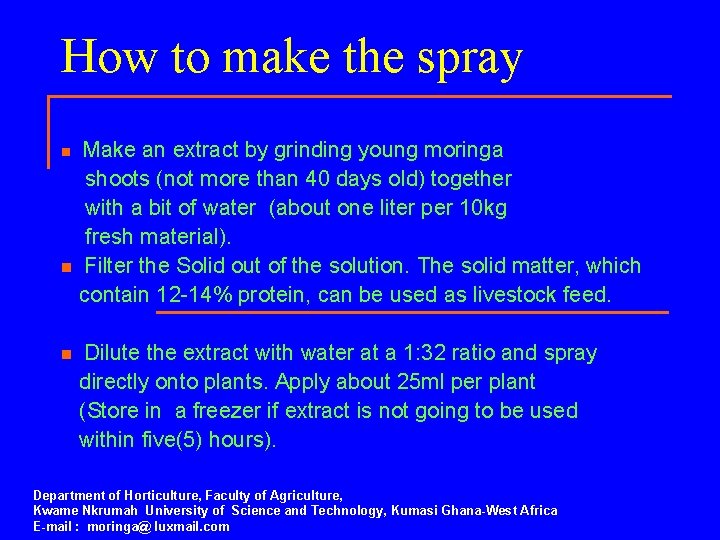
How to make the spray n n n Make an extract by grinding young moringa shoots (not more than 40 days old) together with a bit of water (about one liter per 10 kg fresh material). Filter the Solid out of the solution. The solid matter, which contain 12 -14% protein, can be used as livestock feed. Dilute the extract with water at a 1: 32 ratio and spray directly onto plants. Apply about 25 ml per plant (Store in a freezer if extract is not going to be used within five(5) hours). Department of Horticulture, Faculty of Agriculture, Kwame Nkrumah University of Science and Technology, Kumasi Ghana-West Africa E-mail : moringa@ luxmail. com
Moringa leaf extract as plant growth hormone Cont. Crop Peanut (floor runner) Soya bean CEA-CH 86 Corn NB-6 Sorghum H 887 -V 2 Onion (sondeo) Granex Tomato (sondeo) Effect of the use of the Moringa hormone Larger flowers Increased dry matter Greater yield Higher quality nuts Larger flowers Greater biomass Greater yield Increased weight of Average bulb Increased flowering Crop yield with hormone (kg/manzana) Crop yield without hormone (kg/manzana) 3, 750 2, 954 2. 182 1, 591 6, 045 3, 234 2, 954 4, 454 2, 787 2, 591 - - Department of Horticulture, Faculty of Agriculture, Kwame Nkrumah University of Science and Technology, Kumasi Ghana-West Africa E-mail : moringa@ luxmail. com
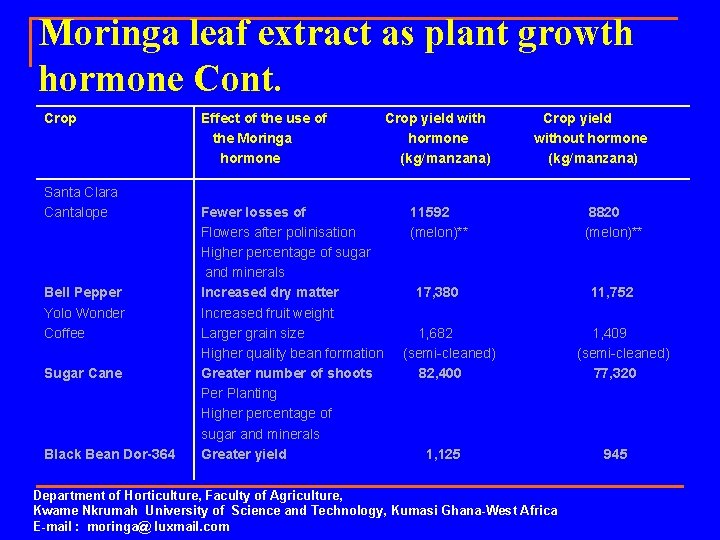
Moringa leaf extract as plant growth hormone Cont. Crop Santa Clara Cantalope Bell Pepper Yolo Wonder Coffee Sugar Cane Black Bean Dor-364 Effect of the use of the Moringa hormone Fewer losses of Flowers after polinisation Higher percentage of sugar and minerals Increased dry matter Increased fruit weight Larger grain size Higher quality bean formation Greater number of shoots Per Planting Higher percentage of sugar and minerals Greater yield Crop yield with hormone (kg/manzana) Crop yield without hormone (kg/manzana) 11592 (melon)** 8820 (melon)** 17, 380 11, 752 1, 682 (semi-cleaned) 82, 400 1, 125 Department of Horticulture, Faculty of Agriculture, Kwame Nkrumah University of Science and Technology, Kumasi Ghana-West Africa E-mail : moringa@ luxmail. com 1, 409 (semi-cleaned) 77, 320 945
Immature Pods as Vegetables n Immature fruits are eaten as vegetable and has export market value in European markets n The pods can also be processed into canned vegetables Department of Horticulture, Faculty of Agriculture, Kwame Nkrumah University of Science and Technology, Kumasi Ghana-West Africa E-mail : moringa@ luxmail. com
Moringa seed oil Extraction Seeds yield 38 -40% of a non-drying oil, known as Ben Oil, n used in arts and lubricating watches and other delicate machinery. n Oil is clear, sweet and odourless and never becomes rancid. It is useful as cooking oil, bio-fuel for diesel engines, the manufacture of perfumes n and hairdressings. Department of Horticulture, Faculty of Agriculture, Kwame Nkrumah University of Science and Technology, Kumasi Ghana-West Africa E-mail : moringa@ luxmail. com
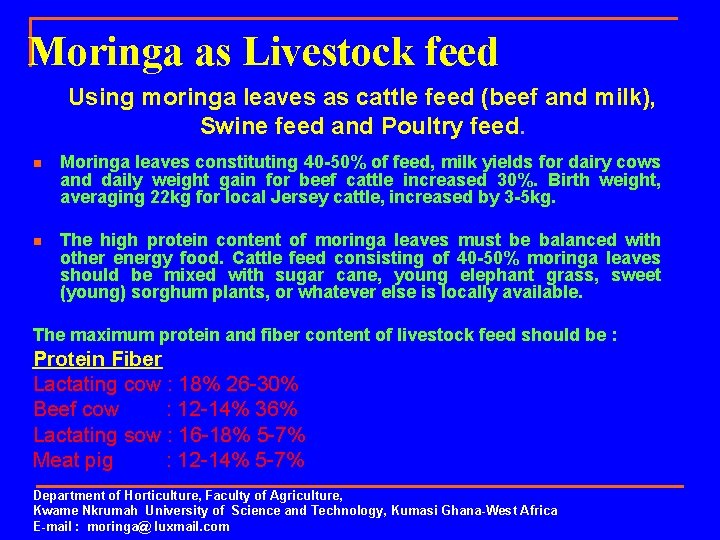
Moringa as Livestock feed Using moringa leaves as cattle feed (beef and milk), Swine feed and Poultry feed. n Moringa leaves constituting 40 -50% of feed, milk yields for dairy cows and daily weight gain for beef cattle increased 30%. Birth weight, averaging 22 kg for local Jersey cattle, increased by 3 -5 kg. n The high protein content of moringa leaves must be balanced with other energy food. Cattle feed consisting of 40 -50% moringa leaves should be mixed with sugar cane, young elephant grass, sweet (young) sorghum plants, or whatever else is locally available. The maximum protein and fiber content of livestock feed should be : Protein Fiber Lactating cow : 18% 26 -30% Beef cow : 12 -14% 36% Lactating sow : 16 -18% 5 -7% Meat pig : 12 -14% 5 -7% Department of Horticulture, Faculty of Agriculture, Kwame Nkrumah University of Science and Technology, Kumasi Ghana-West Africa E-mail : moringa@ luxmail. com
Use of Moringa as water purifiers in rural tropics Department of Horticulture, Faculty of Agriculture, Kwame Nkrumah University of Science and Technology, Kumasi Ghana-West Africa E-mail : moringa@ luxmail. com
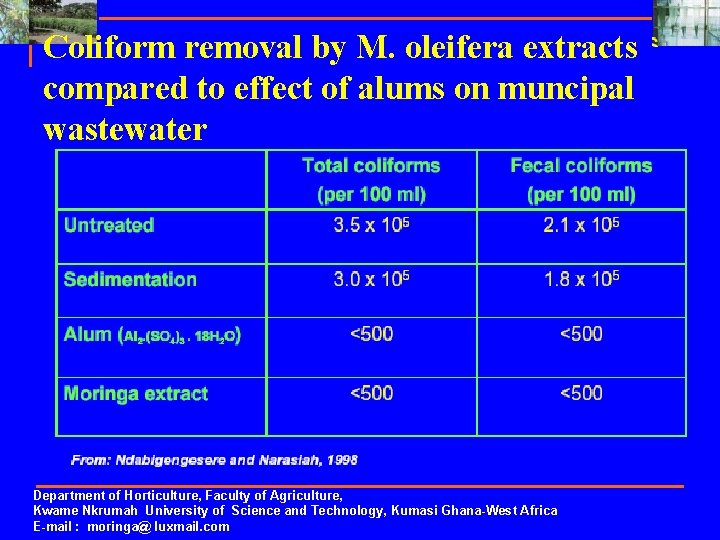
Coliform removal by M. oleifera extracts compared to effect of alums on muncipal wastewater Department of Horticulture, Faculty of Agriculture, Kwame Nkrumah University of Science and Technology, Kumasi Ghana-West Africa E-mail : moringa@ luxmail. com
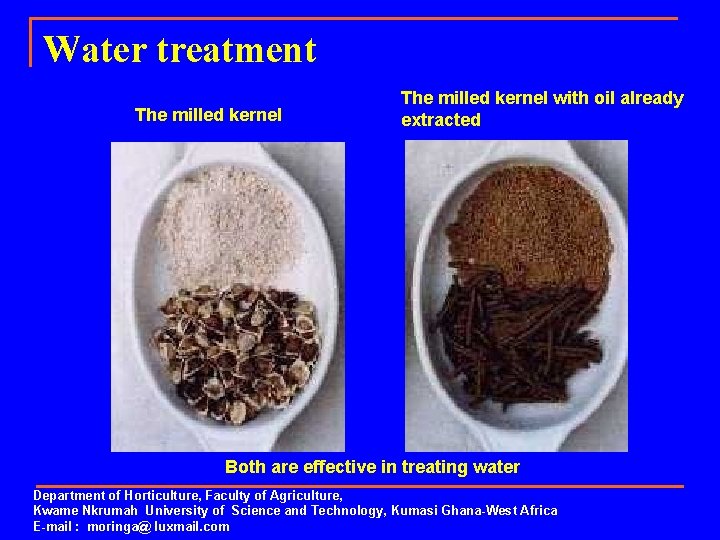
Water treatment The milled kernel with oil already extracted Both are effective in treating water Department of Horticulture, Faculty of Agriculture, Kwame Nkrumah University of Science and Technology, Kumasi Ghana-West Africa E-mail : moringa@ luxmail. com
Water treatment Cont. n n The active ingredient (a polyelectrolyte) has been isolated in the laboratory 100 kg of moringa kernels will produce about 1 kg of (almost pure electrolyte) The seed powder can also be used to harvest algae from waste water The seed powder has been used in large scale community water treatment Department of Horticulture, Faculty of Agriculture, Kwame Nkrumah University of Science and Technology, Kumasi Ghana-West Africa E-mail : moringa@ luxmail. com
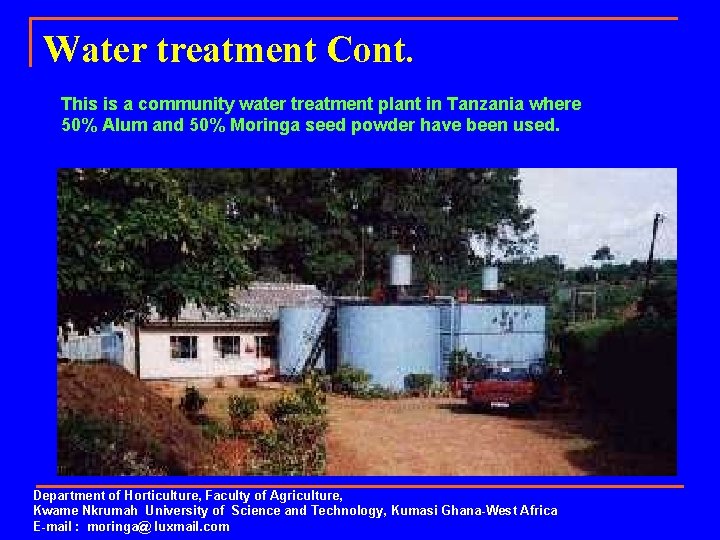
Water treatment Cont. This is a community water treatment plant in Tanzania where 50% Alum and 50% Moringa seed powder have been used. Department of Horticulture, Faculty of Agriculture, Kwame Nkrumah University of Science and Technology, Kumasi Ghana-West Africa E-mail : moringa@ luxmail. com
Water treatment Cont. Department of Horticulture, Faculty of Agriculture, Kwame Nkrumah University of Science and Technology, Kumasi Ghana-West Africa E-mail : moringa@ luxmail. com
Multiple uses and future perspectives Department of Horticulture, Faculty of Agriculture, Kwame Nkrumah University of Science and Technology, Kumasi Ghana-West Africa E-mail : moringa@ luxmail. com