MOLIT Ministry of Land Infrastructure and Transport KATRI

- Slides: 15
MOLIT Ministry of Land, Infrastructure and Transport KATRI Korea Automobile Testing & Research Institute Informal document VIAQ-02 -08 Proposal on Substances To Be Measured Hyunwoo Lee KATRI peterlee@ts 2020. kr 1 p
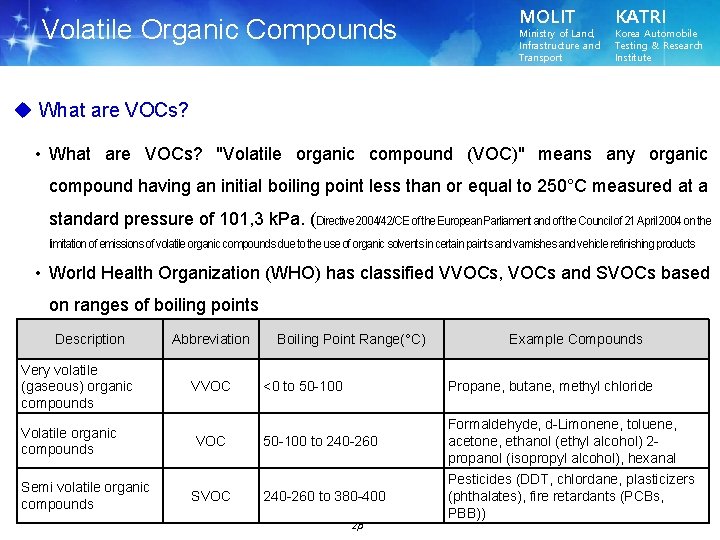
Volatile Organic Compounds MOLIT Ministry of Land, Infrastructure and Transport KATRI Korea Automobile Testing & Research Institute u What are VOCs? • What are VOCs? "Volatile organic compound (VOC)" means any organic compound having an initial boiling point less than or equal to 250°C measured at a standard pressure of 101, 3 k. Pa. (Directive 2004/42/CE of the European Parliament and of the Council of 21 April 2004 on the limitation of emissions of volatile organic compounds due to the use of organic solvents in certain paints and varnishes and vehicle refinishing products • World Health Organization (WHO) has classified VVOCs, VOCs and SVOCs based on ranges of boiling points Description Very volatile (gaseous) organic compounds Volatile organic compounds Semi volatile organic compounds Abbreviation VVOC SVOC Boiling Point Range(°C) Example Compounds <0 to 50 -100 Propane, butane, methyl chloride 50 -100 to 240 -260 Formaldehyde, d-Limonene, toluene, acetone, ethanol (ethyl alcohol) 2 propanol (isopropyl alcohol), hexanal 240 -260 to 380 -400 Pesticides (DDT, chlordane, plasticizers (phthalates), fire retardants (PCBs, PBB)) 2 p
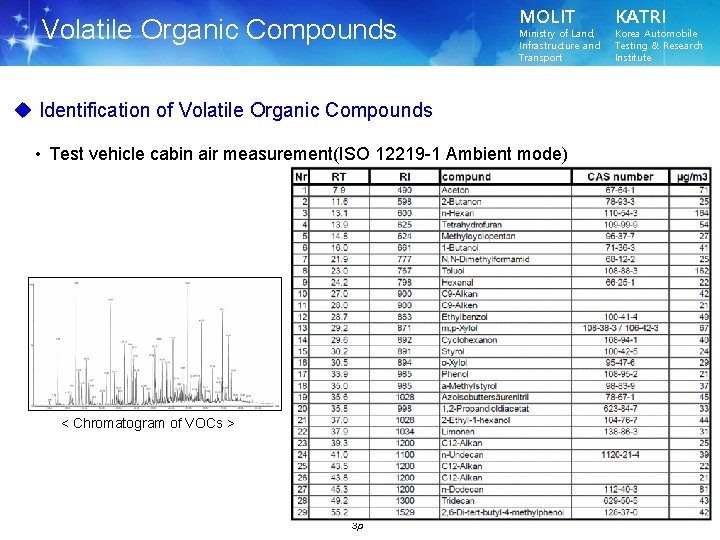
Volatile Organic Compounds MOLIT Ministry of Land, Infrastructure and Transport u Identification of Volatile Organic Compounds • Test vehicle cabin air measurement(ISO 12219 -1 Ambient mode) < Chromatogram of VOCs > 3 p KATRI Korea Automobile Testing & Research Institute
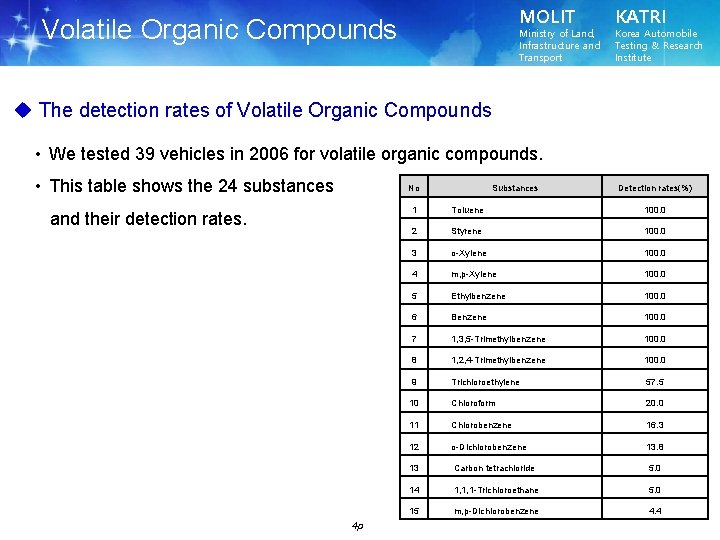
MOLIT Volatile Organic Compounds Ministry of Land, Infrastructure and Transport KATRI Korea Automobile Testing & Research Institute u The detection rates of Volatile Organic Compounds • We tested 39 vehicles in 2006 for volatile organic compounds. • This table shows the 24 substances No and their detection rates. 4 p Substances Detection rates(%) 1 Toluene 100. 0 2 Styrene 100. 0 3 o-Xylene 100. 0 4 m, p-Xylene 100. 0 5 Ethylbenzene 100. 0 6 Benzene 100. 0 7 1, 3, 5 -Trimethylbenzene 100. 0 8 1, 2, 4 -Trimethylbenzene 100. 0 9 Trichloroethylene 57. 5 10 Chloroform 20. 0 11 Chlorobenzene 16. 3 12 o-Dichlorobenzene 13. 8 13 Carbon tetrachloride 5. 0 14 1, 1, 1 -Trichloroethane 5. 0 15 m, p-Dichlorobenzene 4. 4
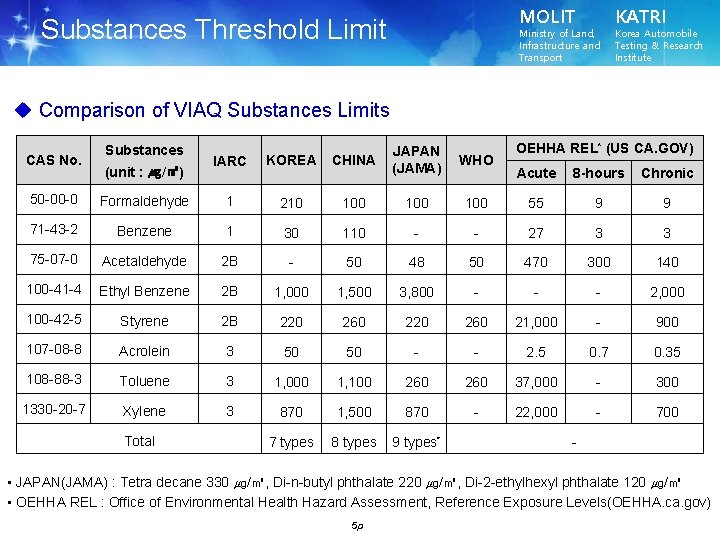
MOLIT Substances Threshold Limit Ministry of Land, Infrastructure and Transport KATRI Korea Automobile Testing & Research Institute u Comparison of VIAQ Substances Limits CAS No. Substances (unit : ㎍/㎥) IARC KOREA CHINA JAPAN (JAMA) WHO OEHHA REL* (US CA. GOV) Acute 8 -hours Chronic 50 -00 -0 Formaldehyde 1 210 100 100 55 9 9 71 -43 -2 Benzene 1 30 110 - - 27 3 3 75 -07 -0 Acetaldehyde 2 B - 50 48 50 470 300 140 100 -41 -4 Ethyl Benzene 2 B 1, 000 1, 500 3, 800 - - - 2, 000 100 -42 -5 Styrene 2 B 220 260 21, 000 - 900 107 -08 -8 Acrolein 3 50 50 - - 2. 5 0. 7 0. 35 108 -88 -3 Toluene 3 1, 000 1, 100 260 37, 000 - 300 1330 -20 -7 Xylene 3 870 1, 500 870 - 22, 000 - 700 7 types 8 types 9 types* Total - • JAPAN(JAMA) : Tetra decane 330 ㎍/㎥, Di-n-butyl phthalate 220 ㎍/㎥, Di-2 -ethylhexyl phthalate 120 ㎍/㎥ • OEHHA REL : Office of Environmental Health Hazard Assessment, Reference Exposure Levels(OEHHA. ca. gov) 5 p
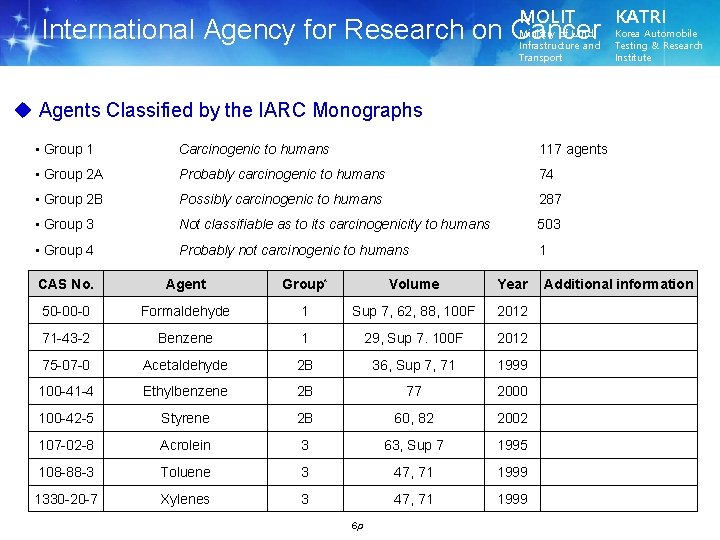
MOLIT International Agency for Research on Cancer Ministry of Land, Infrastructure and Transport KATRI Korea Automobile Testing & Research Institute u Agents Classified by the IARC Monographs • Group 1 Carcinogenic to humans 117 agents • Group 2 A Probably carcinogenic to humans 74 • Group 2 B Possibly carcinogenic to humans 287 • Group 3 Not classifiable as to its carcinogenicity to humans 503 • Group 4 Probably not carcinogenic to humans 1 CAS No. Agent Group* Volume Year Additional information 50 -00 -0 Formaldehyde 1 Sup 7, 62, 88, 100 F 2012 71 -43 -2 Benzene 1 29, Sup 7. 100 F 2012 75 -07 -0 Acetaldehyde 2 B 36, Sup 7, 71 1999 100 -41 -4 Ethylbenzene 2 B 77 2000 100 -42 -5 Styrene 2 B 60, 82 2002 107 -02 -8 Acrolein 3 63, Sup 7 1995 108 -88 -3 Toluene 3 47, 71 1999 1330 -20 -7 Xylenes 3 47, 71 1999 6 p
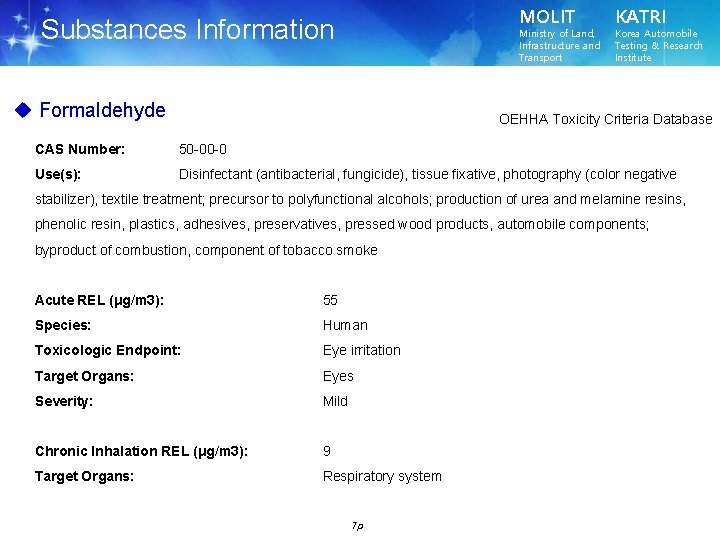
MOLIT Substances Information Ministry of Land, Infrastructure and Transport u Formaldehyde KATRI Korea Automobile Testing & Research Institute OEHHA Toxicity Criteria Database CAS Number: 50 -00 -0 Use(s): Disinfectant (antibacterial, fungicide), tissue fixative, photography (color negative stabilizer), textile treatment; precursor to polyfunctional alcohols; production of urea and melamine resins, phenolic resin, plastics, adhesives, preservatives, pressed wood products, automobile components; byproduct of combustion, component of tobacco smoke Acute REL (μg/m 3): 55 Species: Human Toxicologic Endpoint: Eye irritation Target Organs: Eyes Severity: Mild Chronic Inhalation REL (μg/m 3): 9 Target Organs: Respiratory system 7 p
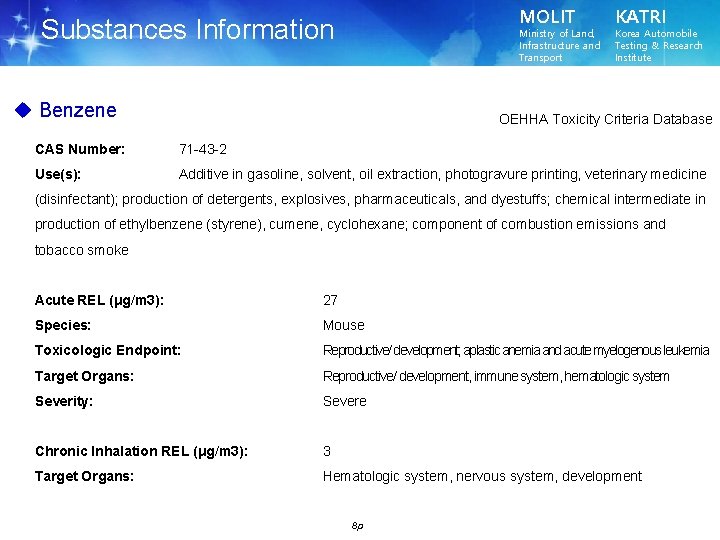
MOLIT Substances Information Ministry of Land, Infrastructure and Transport u Benzene KATRI Korea Automobile Testing & Research Institute OEHHA Toxicity Criteria Database CAS Number: 71 -43 -2 Use(s): Additive in gasoline, solvent, oil extraction, photogravure printing, veterinary medicine (disinfectant); production of detergents, explosives, pharmaceuticals, and dyestuffs; chemical intermediate in production of ethylbenzene (styrene), cumene, cyclohexane; component of combustion emissions and tobacco smoke Acute REL (μg/m 3): 27 Species: Mouse Toxicologic Endpoint: Reproductive/ development; aplastic anemia and acute myelogenous leukemia Target Organs: Reproductive/ development, immune system, hematologic system Severity: Severe Chronic Inhalation REL (μg/m 3): 3 Target Organs: Hematologic system, nervous system, development 8 p
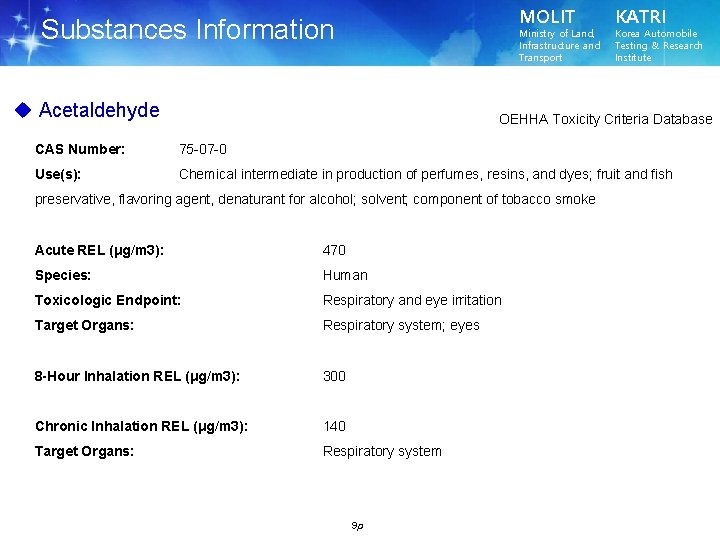
MOLIT Substances Information Ministry of Land, Infrastructure and Transport u Acetaldehyde KATRI Korea Automobile Testing & Research Institute OEHHA Toxicity Criteria Database CAS Number: 75 -07 -0 Use(s): Chemical intermediate in production of perfumes, resins, and dyes; fruit and fish preservative, flavoring agent, denaturant for alcohol; solvent; component of tobacco smoke Acute REL (μg/m 3): 470 Species: Human Toxicologic Endpoint: Respiratory and eye irritation Target Organs: Respiratory system; eyes 8 -Hour Inhalation REL (μg/m 3): 300 Chronic Inhalation REL (μg/m 3): 140 Target Organs: Respiratory system 9 p
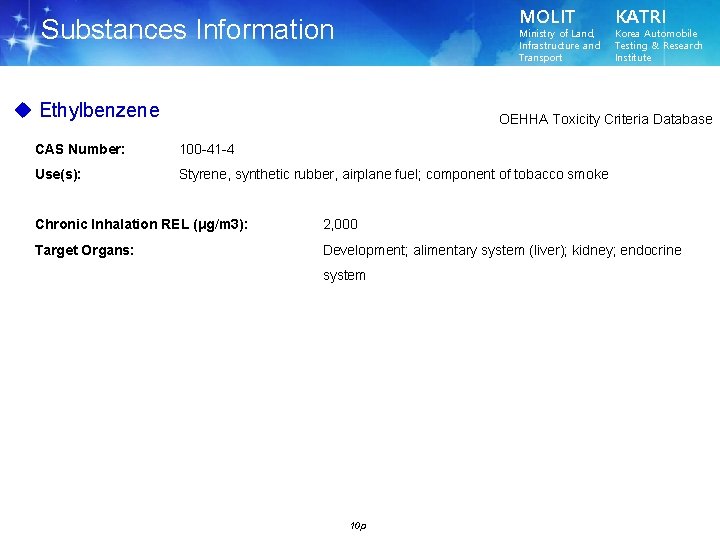
MOLIT Substances Information Ministry of Land, Infrastructure and Transport u Ethylbenzene KATRI Korea Automobile Testing & Research Institute OEHHA Toxicity Criteria Database CAS Number: 100 -41 -4 Use(s): Styrene, synthetic rubber, airplane fuel; component of tobacco smoke Chronic Inhalation REL (μg/m 3): 2, 000 Target Organs: Development; alimentary system (liver); kidney; endocrine system 10 p
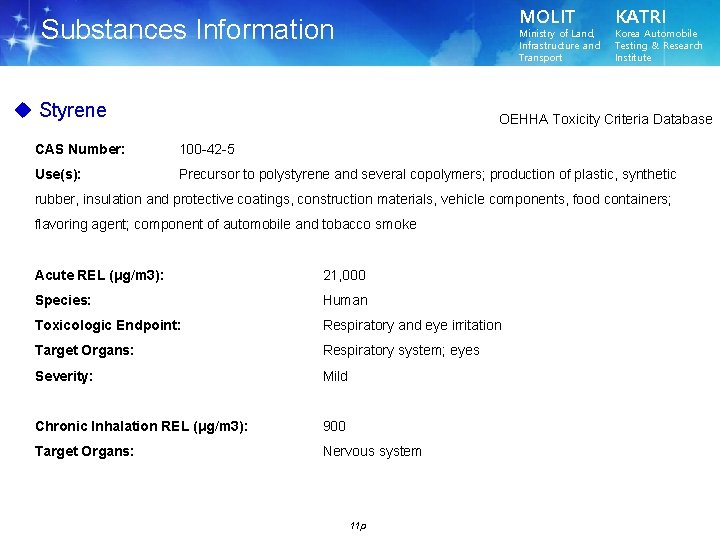
MOLIT Substances Information Ministry of Land, Infrastructure and Transport u Styrene KATRI Korea Automobile Testing & Research Institute OEHHA Toxicity Criteria Database CAS Number: 100 -42 -5 Use(s): Precursor to polystyrene and several copolymers; production of plastic, synthetic rubber, insulation and protective coatings, construction materials, vehicle components, food containers; flavoring agent; component of automobile and tobacco smoke Acute REL (μg/m 3): 21, 000 Species: Human Toxicologic Endpoint: Respiratory and eye irritation Target Organs: Respiratory system; eyes Severity: Mild Chronic Inhalation REL (μg/m 3): 900 Target Organs: Nervous system 11 p
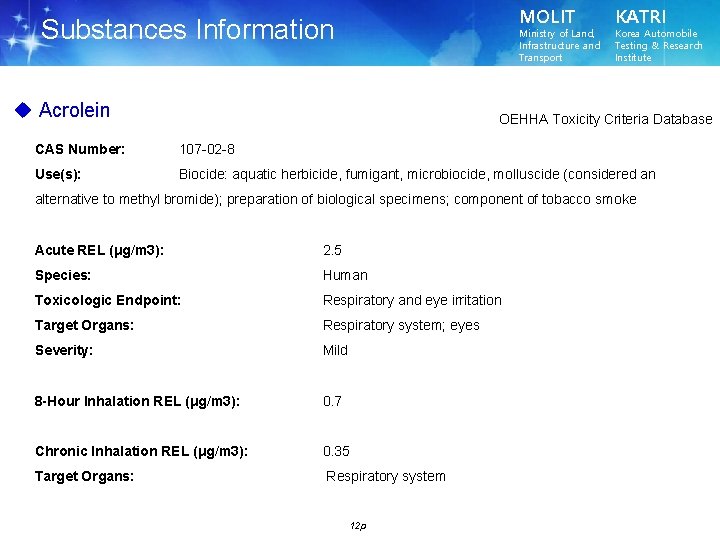
MOLIT Substances Information Ministry of Land, Infrastructure and Transport u Acrolein KATRI Korea Automobile Testing & Research Institute OEHHA Toxicity Criteria Database CAS Number: 107 -02 -8 Use(s): Biocide: aquatic herbicide, fumigant, microbiocide, molluscide (considered an alternative to methyl bromide); preparation of biological specimens; component of tobacco smoke Acute REL (μg/m 3): 2. 5 Species: Human Toxicologic Endpoint: Respiratory and eye irritation Target Organs: Respiratory system; eyes Severity: Mild 8 -Hour Inhalation REL (μg/m 3): 0. 7 Chronic Inhalation REL (μg/m 3): 0. 35 Target Organs: Respiratory system 12 p
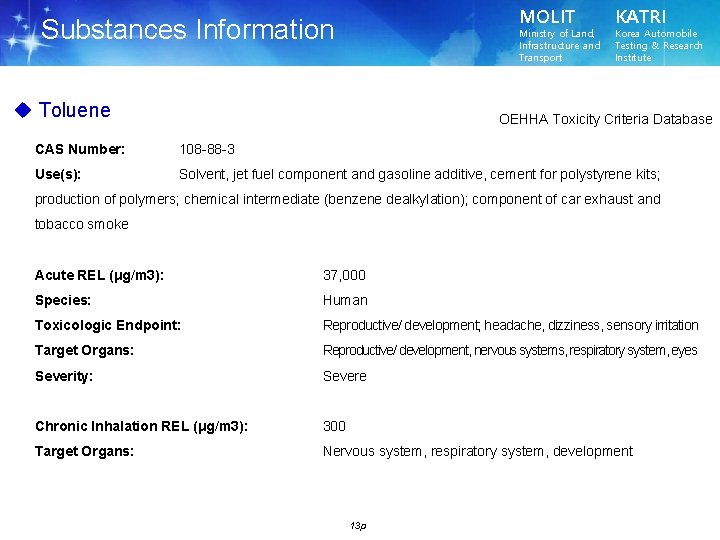
MOLIT Substances Information Ministry of Land, Infrastructure and Transport u Toluene KATRI Korea Automobile Testing & Research Institute OEHHA Toxicity Criteria Database CAS Number: 108 -88 -3 Use(s): Solvent, jet fuel component and gasoline additive, cement for polystyrene kits; production of polymers; chemical intermediate (benzene dealkylation); component of car exhaust and tobacco smoke Acute REL (μg/m 3): 37, 000 Species: Human Toxicologic Endpoint: Reproductive/ development; headache, dizziness, sensory irritation Target Organs: Reproductive/ development, nervous systems, respiratory system, eyes Severity: Severe Chronic Inhalation REL (μg/m 3): 300 Target Organs: Nervous system, respiratory system, development 13 p
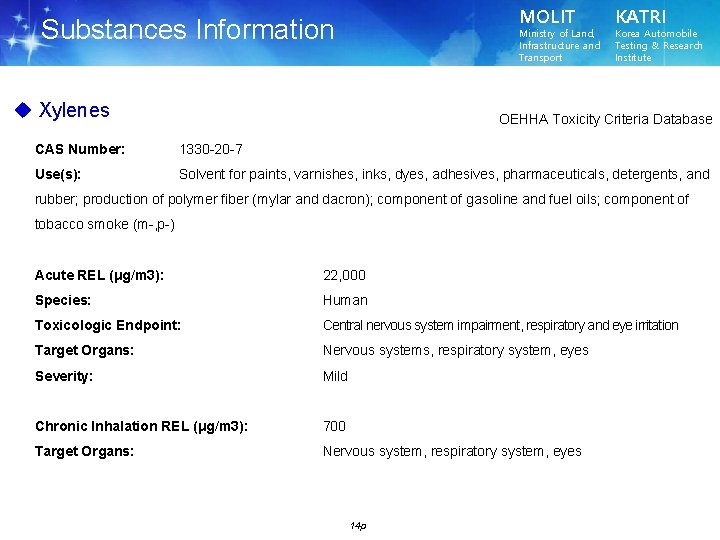
MOLIT Substances Information Ministry of Land, Infrastructure and Transport u Xylenes KATRI Korea Automobile Testing & Research Institute OEHHA Toxicity Criteria Database CAS Number: 1330 -20 -7 Use(s): Solvent for paints, varnishes, inks, dyes, adhesives, pharmaceuticals, detergents, and rubber; production of polymer fiber (mylar and dacron); component of gasoline and fuel oils; component of tobacco smoke (m-, p-) Acute REL (μg/m 3): 22, 000 Species: Human Toxicologic Endpoint: Central nervous system impairment, respiratory and eye irritation Target Organs: Nervous systems, respiratory system, eyes Severity: Mild Chronic Inhalation REL (μg/m 3): 700 Target Organs: Nervous system, respiratory system, eyes 14 p
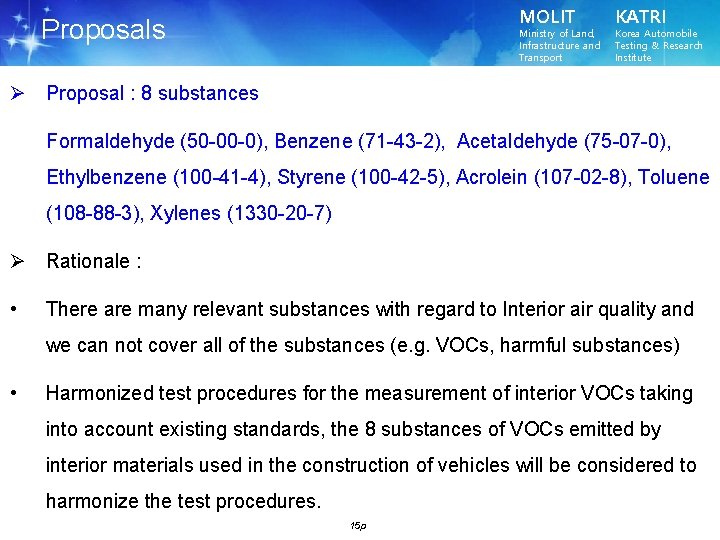
MOLIT Proposals Ministry of Land, Infrastructure and Transport KATRI Korea Automobile Testing & Research Institute Ø Proposal : 8 substances Formaldehyde (50 -00 -0), Benzene (71 -43 -2), Acetaldehyde (75 -07 -0), Ethylbenzene (100 -41 -4), Styrene (100 -42 -5), Acrolein (107 -02 -8), Toluene (108 -88 -3), Xylenes (1330 -20 -7) Ø Rationale : • There are many relevant substances with regard to Interior air quality and we can not cover all of the substances (e. g. VOCs, harmful substances) • Harmonized test procedures for the measurement of interior VOCs taking into account existing standards, the 8 substances of VOCs emitted by interior materials used in the construction of vehicles will be considered to harmonize the test procedures. 15 p