MIS 2000 Information Systems for Management Section A
- Slides: 11
MIS 2000 Information Systems for Management Section A 04, Bob Travica Introduction to Course Updated: 2020
Outline • What is Management Information Systems (MIS)? • Focus of MIS 2000 • Course at a Glance • Teamwork • Assignments • Hands-on: Class Exercises & Labs • MIS on your resume • Mutual expectations 2
What is Management Information Systems (MIS)? • An area of management study and practice (as marketing or HRM*). • MIS focuses on managing organizational information systems (IS) in order to improve organization, and achieve greater efficiency (productivity) and effectiveness (accomplishment of goals). • Central concept is Information System (IS), which includes data, information technologies (IT), and work procedures. • The term “MIS” is historical, created when the main kind of IS was called MIS. It recorded transactions and reported on basic operations (e. g. , payroll, inventory, sales). • Today, MIS is about any type of IS (see Syllabus for types). 3
Focus of MIS 2000 • An introductory course, with both conceptual and practical focus. • Management approach taken: Focusing on business (organizational) processes (BP). Main goals are to understand: – organizational data (in various states of organization) – BP working with these data – how IS support BP (present focus) – how IS support can be improved (future focus). Consequently, the whole organization and its performance improves. • Critical thinking: Not a magic stick approach. New technology solves some problems but not all. 4
Course at a Glance • Course outline and all study materials: Online at my Website – E-text by Bob Travica (free!) – E-slides*, e-assignments and solutions - Wait for updates, see timestamp! – Some handouts • D 2 L/UMLearn: Will be used for the lab, and for class communication, grades, and submitting of assignments (assignment dropbox) • Study methods: – Lectures, discussion, class exercises – Laboratory practice (online) on MS Access and Excel – Teamwork (class exercises and assignments) 5
Course at a Glance • Assignments: – Laboratory (MS Access & Excel) – check the lab schedule once it is available – Three homework assignments – Two exams • Class Contribution (participation): – Not just attendance but talking on the topic in class (1 -2 marks; 1 mark is a brief input, and 2 for a longer one) – Another way of earning credits is by answering questions by i. Clicker – Participating in teamwork on class exercises (0. 5 marks) – If you feel public speech apprehension, let me know, and we’ll work something out 6 of 9
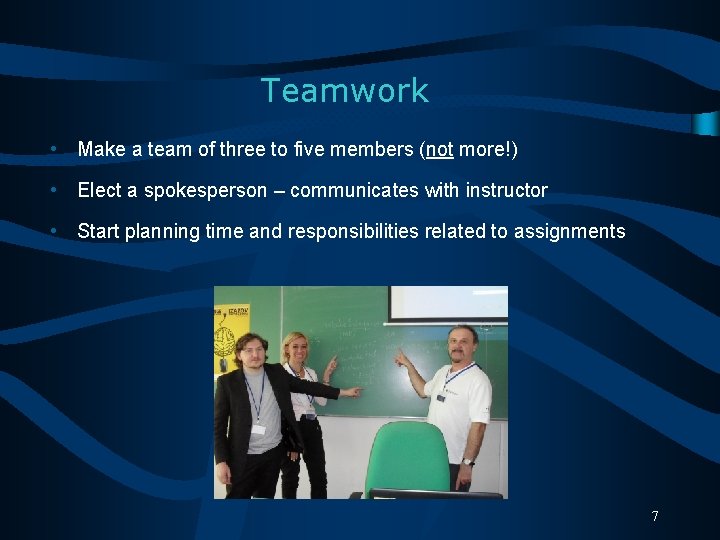
Teamwork • Make a team of three to five members (not more!) • Elect a spokesperson – communicates with instructor • Start planning time and responsibilities related to assignments 7
Assignments • 1. Data Analysis & Diagramming: The task is to analyze a description of a business situation and to create a data diagram. Teams. • 2. Business Process Analysis & Diagramming: The task is to analyze a description of a business situation and to create a process diagram. Teams. • 3. Research paper. Teams. • 3. Labs will have assignment that can be individual or team-based. 8
Hands-on: Class Exercises & Labs • Class exercises in teams; focus of some key aspects of the topics studied (e. g. , process diagramming, decision making…) – Problem to solve as the team; instructor helps – Present your work to the class, and learn from others • Laboratory training online: – MS Access and MS Excel – NOTE: If you do not have MS Access software on your computer, you need to team up with student who have it. – Total 6 sessions; assignments and a final lab grade – Lab instructor is in charge! 9
MIS on Your Resume • Information systems support every department and most work in today’s organizations. • MIS is related to all management disciplines. • Understanding MIS makes a better accountant, marketer, HR manager, purchasing manager… • It pays back to double major with MIS! • MIS courses cover IS Strategy, databases, IS Analysis & Design, computer networks, accounting IS, business data analytics, and on trendy topics. 10
Mutual Expectations • I (Bob) expect that you do your study-related work the best you can for a high grade, given your time constraints and goals. • For your coursework you will get a grade that reflects best your performance, based on careful grading that I will apply. • I will do my best to support you in your study, respond to your questions and needs, and keep an open book policy. • My goal is to get your ratings 4 or 5 on question 32 (instructor’s overall rating) for my work, when you evaluate the course at the end of term. • The ongoing pandemic situation and the forced online course require adjustments and more patience from both of us. 11