
MIS 2000 Information Systems for Management Bob Travica
MIS 2000 Information Systems for Management Bob Travica Class 6 Organization in Process View Updated 2020
Outline • • Organization and process Concept of Process Business (Organizational) Process Management in process view Operational & strategic processes Process Design Process Performance Summary PRoc & Roll 2 of 17
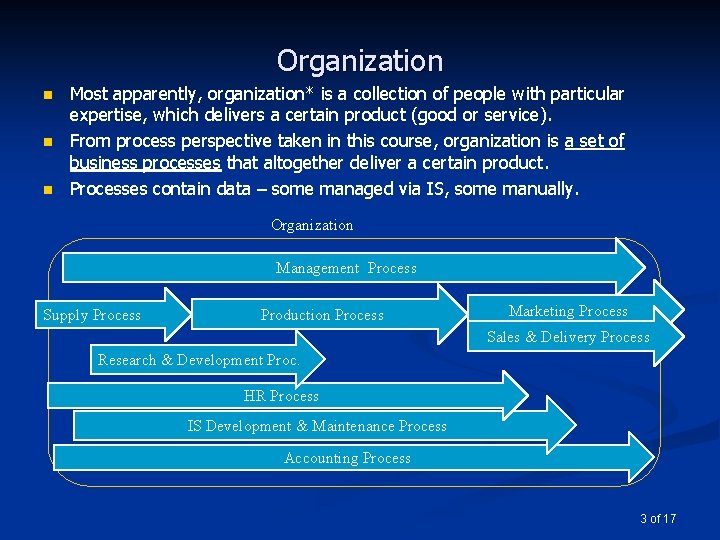
Organization n Most apparently, organization* is a collection of people with particular expertise, which delivers a certain product (good or service). From process perspective taken in this course, organization is a set of business processes that altogether deliver a certain product. Processes contain data – some managed via IS, some manually. Organization Management Process Supply Process Production Process Marketing Process Sales & Delivery Process Research & Development Proc. HR Process IS Development & Maintenance Process Accounting Process 3 of 17
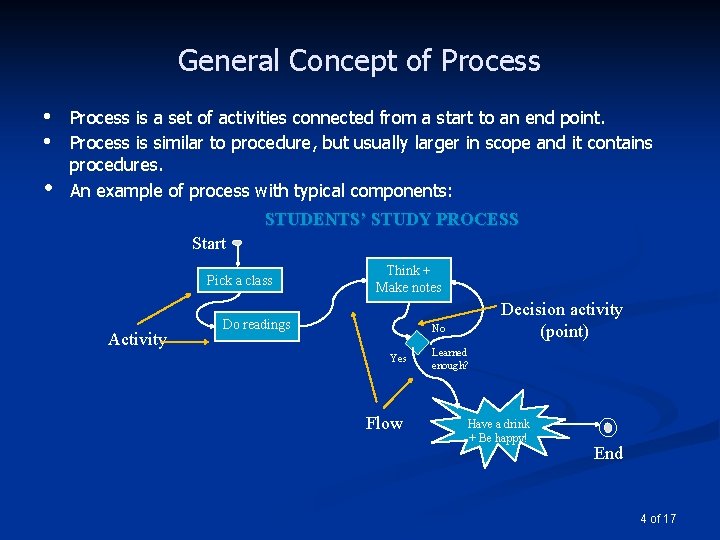
General Concept of Process • • • Process is a set of activities connected from a start to an end point. Process is similar to procedure, but usually larger in scope and it contains procedures. An example of process with typical components: STUDENTS’ STUDY PROCESS Start Pick a class Activity Think + Make notes Do readings Decision activity (point) No Yes Flow Learned enough? Have a drink + Be happy! End 4 of 17

Business or Organizational Process n Definition: Business process is a set of activities connected from a start to an end point, which delivers a product of a measurable value to a customer (internal or external). Start PRODUCTION PROCESS IN FACTORY (scheduling, assembly, quality control) HR PROCESS IN ANY ORG. (hiring, professional development, pay, wellness) End Deliverable Good for market Services for employees Customer (External) Buyer (Internal) Employee Value Utility/Price, Timing, Quality Q&A 5 of 17
Operational and Strategic Processes • Strategic processes happen in some intervals (e. g. , setting long-term goals, activities leading to materializing the goals); game plan. • Operational processes make regular, everyday work. Resemble moves (step patterns) in a game. Operational processes Strategic processes Daily “grind”, short time horizon Occasional activities, longer time Steps patterns, with small known variation (Routines) More variation in process IS are embedded in operations, provide necessary support IS support is partial (e. g. , decision making as part of planning) 6 of 17
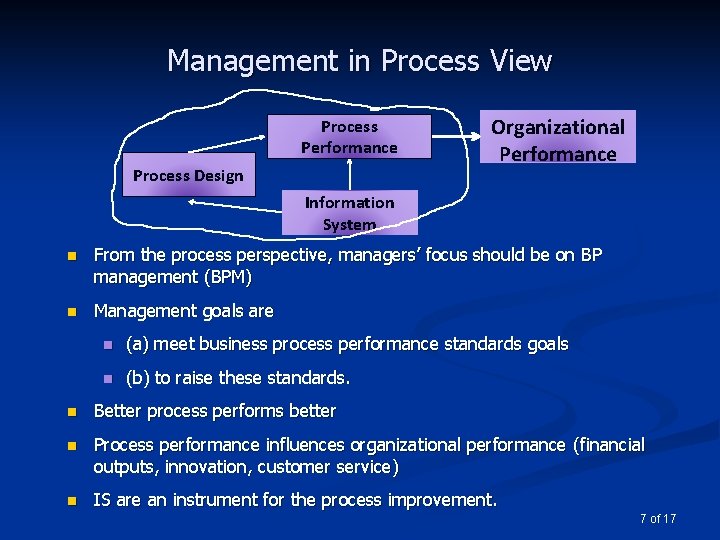
Management in Process View Process Performance Process Design Organizational Performance Information System n From the process perspective, managers’ focus should be on BP management (BPM) n Management goals are n (a) meet business process performance standards goals n (b) to raise these standards. n Better process performs better n Process performance influences organizational performance (financial outputs, innovation, customer service) n IS are an instrument for the process improvement. 7 of 17
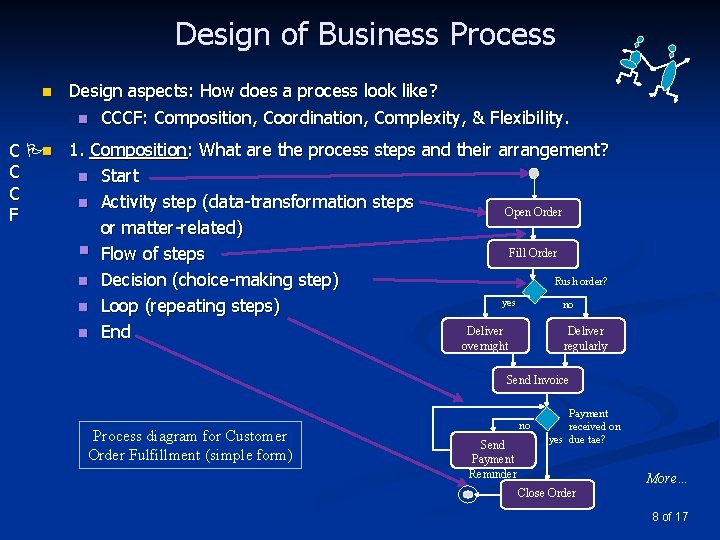
Design of Business Process n Design aspects: How does a process look like? n CCCF: Composition, Coordination, Complexity, & Flexibility. C Pn 1. Composition: What are the process steps and their arrangement? C n Start C n Activity step (data-transformation steps Open Order F or matter-related) Fill Order § Flow of steps Rush order? n Decision (choice-making step) yes no n Loop (repeating steps) Deliver n End overnight regularly * * Send Invoice Process diagram for Customer Order Fulfillment (simple form) no Send Payment Reminder Payment received on yes due tae? Close Order More… 8 of 17
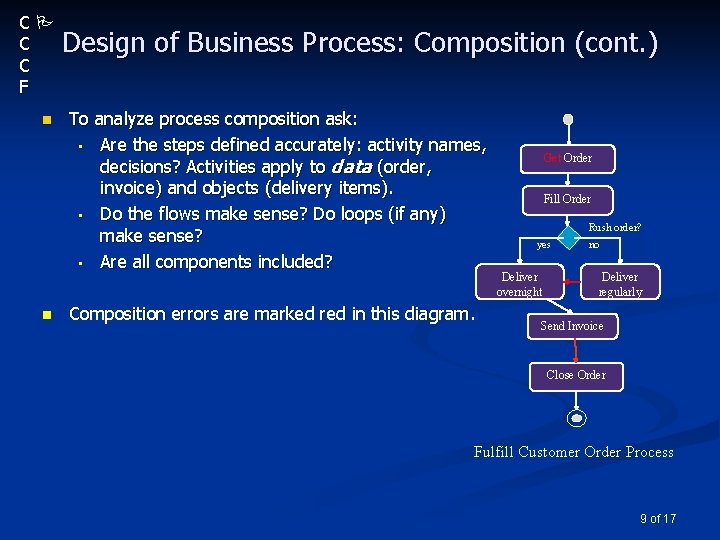
CP C C F n n Design of Business Process: Composition (cont. ) To analyze process composition ask: • Are the steps defined accurately: activity names, decisions? Activities apply to data (order, invoice) and objects (delivery items). • Do the flows make sense? Do loops (if any) make sense? • Are all components included? Composition errors are marked red in this diagram. Get Order Fill Order Rush order? yes Deliver overnight no Deliver regularly Send Invoice Close Order Fulfill Customer Order Process 9 of 17
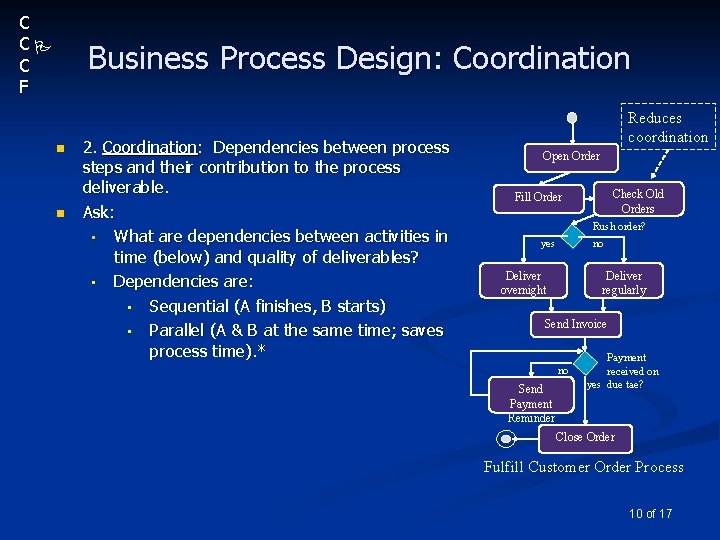
C CP C F Business Process Design: Coordination n n 2. Coordination: Dependencies between process steps and their contribution to the process deliverable. Ask: • What are dependencies between activities in time (below) and quality of deliverables? • Dependencies are: • Sequential (A finishes, B starts) • Parallel (A & B at the same time; saves process time). * Reduces coordination Open Order Check Old Orders Fill Order Rush order? yes no Deliver overnight Deliver regularly Send Invoice no Send Payment Reminder Payment received on yes due tae? Close Order Fulfill Customer Order Process 10 of 17
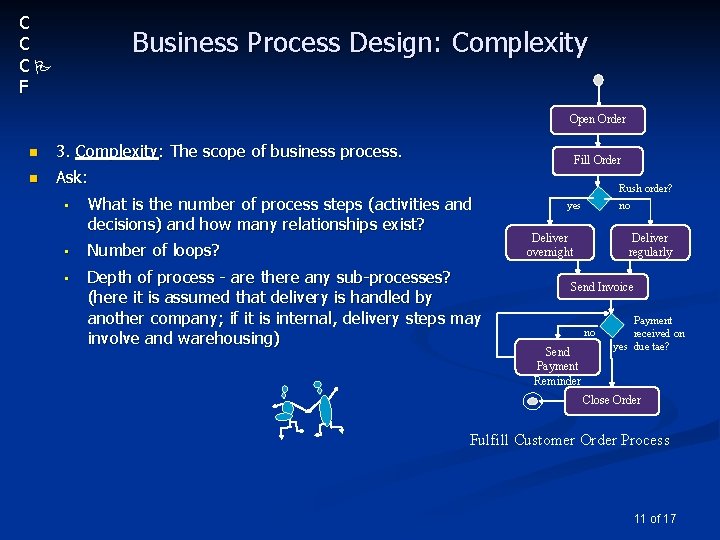
C C CP F Business Process Design: Complexity Open Order n 3. Complexity: The scope of business process. n Ask: • Fill Order What is the number of process steps (activities and decisions) and how many relationships exist? • Number of loops? • Depth of process - are there any sub-processes? (here it is assumed that delivery is handled by another company; if it is internal, delivery steps may involve and warehousing) Rush order? yes no Deliver overnight Deliver regularly Send Invoice no Send Payment Reminder Payment received on yes due tae? Close Order Fulfill Customer Order Process 11 of 17
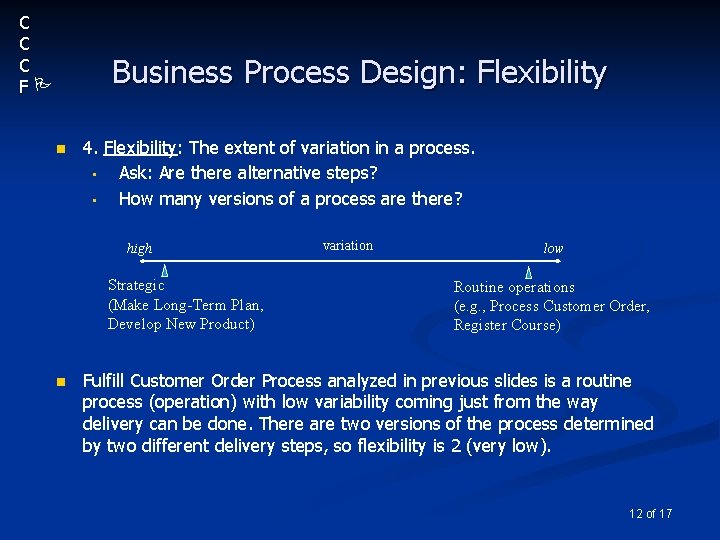
C C C FP Business Process Design: Flexibility n 4. Flexibility: The extent of variation in a process. • Ask: Are there alternative steps? • How many versions of a process are there? high Strategic (Make Long-Term Plan, Develop New Product) n variation low Routine operations (e. g. , Process Customer Order, Register Course) Fulfill Customer Order Process analyzed in previous slides is a routine process (operation) with low variability coming just from the way delivery can be done. There are two versions of the process determined by two different delivery steps, so flexibility is 2 (very low). 12 of 17
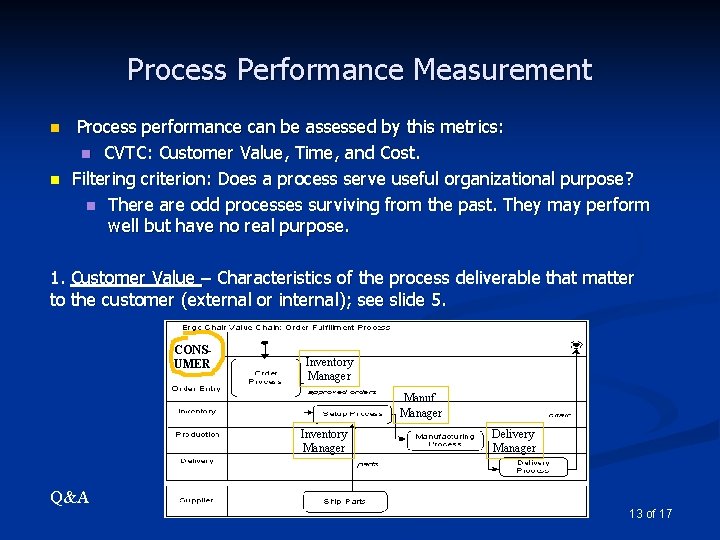
Process Performance Measurement n n Process performance can be assessed by this metrics: n CVTC: Customer Value, Time, and Cost. Filtering criterion: Does a process serve useful organizational purpose? n There are odd processes surviving from the past. They may perform well but have no real purpose. 1. Customer Value – Characteristics of the process deliverable that matter to the customer (external or internal); see slide 5. CONSUMER Inventory Manager Manuf. Manager Inventory Manager Q&A Delivery Manager 13 of 17
CV TP CP IS Process Metrics: Time & Cost 2. Time: What is the total time between the start and end point of a process? • sum up execution times of all steps • for parallel steps, take time of the longest step 3. Cost: What is the amount of expenditures in monetary figures? • sum up costs for labor, materials, IS, other technologies, overhead Q&A 14 of 17
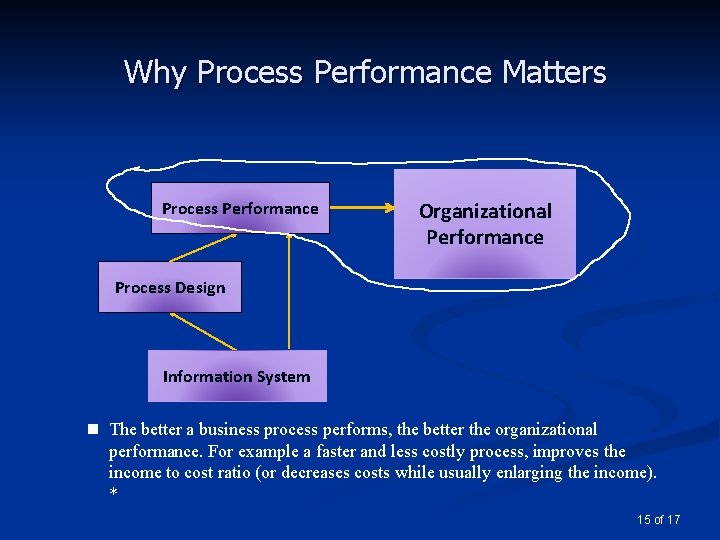
Why Process Performance Matters Process Performance Organizational Performance Process Design Information System n The better a business process performs, the better the organizational performance. For example a faster and less costly process, improves the income to cost ratio (or decreases costs while usually enlarging the income). * 15 of 17
Summary 1/2 n Organization is a whole consisting of business processes that altogether deliver a certain product (good or service). n Business process is a set of activities connected from a start to an end point, which deliver a product of a measurable value to a customer (internal or external). BP can be inside and outside of organizations. BP works with data and physical objects. n The goal of managing organizations from the process perspective is to improve process performance and design, which leads to higher organizational performance. n There are operational and strategic processes. 16 of 17
Summary 2/2 n Process design refers to process composition, coordination, complexity , and flexibility (CCCF). n Process performance can be measured in terms of customer value, cost, and time (CVCT). n Process performance influences organizational performance. n How do information systems fit in this process perspective – next class. 17 of 17
- Slides: 17