
MIS 2000 Communication and Social Networking Processes Systems

- Slides: 20
MIS 2000 Communication and Social Networking Processes & Systems Updated: 2020
Outline • Communication concepts • Organizational communication (characteristics) • Communication Systems & Technologies • Social Networking and Social Media Systems 2
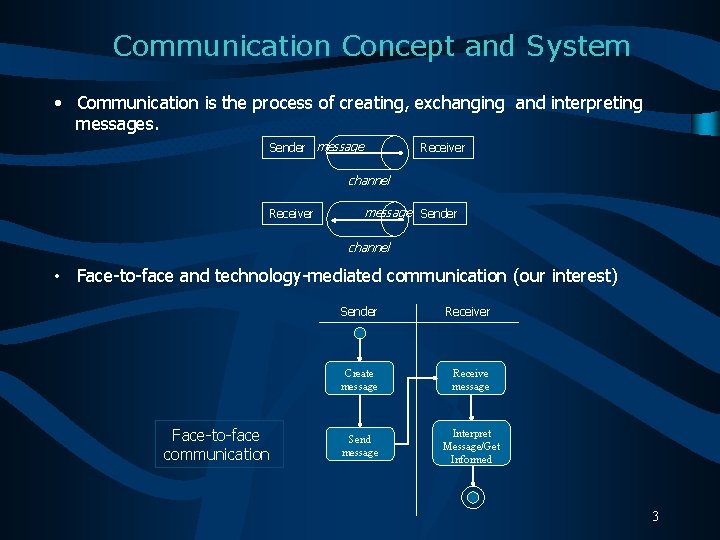
Communication Concept and System • Communication is the process of creating, exchanging and interpreting messages. Sender message Receiver channel Receiver message Sender channel • Face-to-face and technology-mediated communication (our interest) Face-to-face communication Sender Receiver Create message Receive message Send message Interpret Message/Get Informed 3
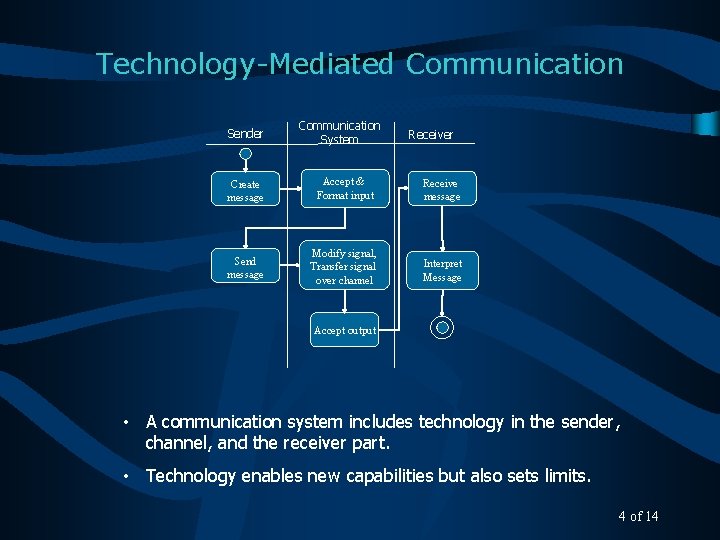
Technology-Mediated Communication Sender Communication System Receiver Create message Accept & Format input Receive message Send message Modify signal, Transfer signal over channel Interpret Message Accept output • A communication system includes technology in the sender, channel, and the receiver part. • Technology enables new capabilities but also sets limits. 4 of 14
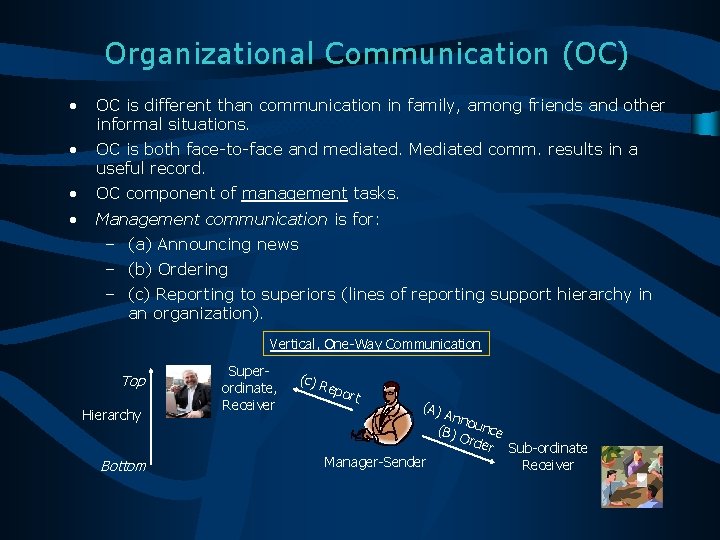
Organizational Communication (OC) • OC is different than communication in family, among friends and other informal situations. • OC is both face-to-face and mediated. Mediated comm. results in a useful record. • OC component of management tasks. • Management communication is for: – (a) Announcing news – (b) Ordering – (c) Reporting to superiors (lines of reporting support hierarchy in an organization). Vertical, One-Way Communication Top Hierarchy Bottom Superordinate, Receiver (c) Rep ort (A) Ann o (B) unce Ord er Sub-ordinate Manager-Sender Receiver 5
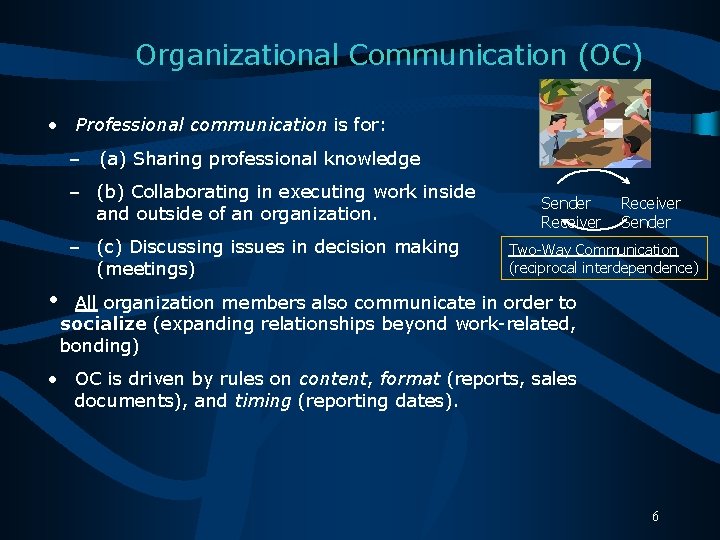
Organizational Communication (OC) • Professional communication is for: – (a) Sharing professional knowledge – (b) Collaborating in executing work inside and outside of an organization. – (c) Discussing issues in decision making (meetings) • Sender Receiver Sender Two-Way Communication (reciprocal interdependence) All organization members also communicate in order to socialize (expanding relationships beyond work-related, bonding) • OC is driven by rules on content, format (reports, sales documents), and timing (reporting dates). 6
Organizational Communication (OC) • Organizational culture also influences OC (acceptable/ “politically correct” language; who talks to whom) • Hierarchy vs. professional culture differ on who should talk to whom & when • Organizational culture also influences use & roles of communication systems. Q 7
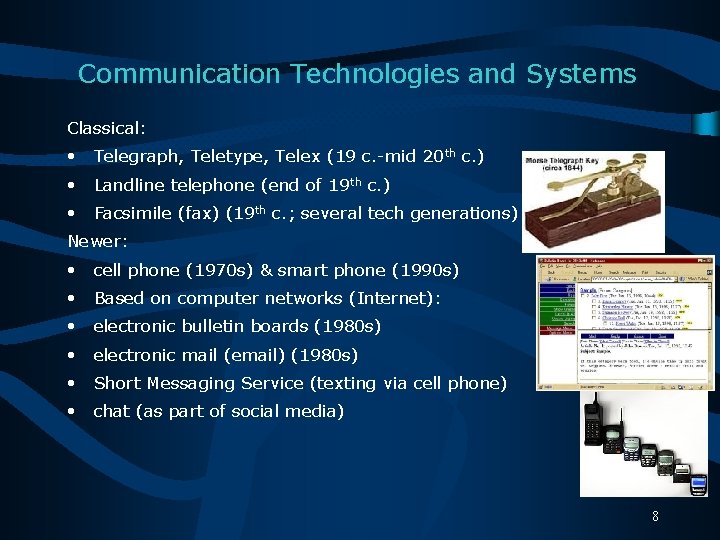
Communication Technologies and Systems Classical: • Telegraph, Teletype, Telex (19 c. -mid 20 th c. ) • Landline telephone (end of 19 th c. ) • Facsimile (fax) (19 th c. ; several tech generations) Newer: • cell phone (1970 s) & smart phone (1990 s) • Based on computer networks (Internet): • electronic bulletin boards (1980 s) • electronic mail (email) (1980 s) • Short Messaging Service (texting via cell phone) • chat (as part of social media) 8
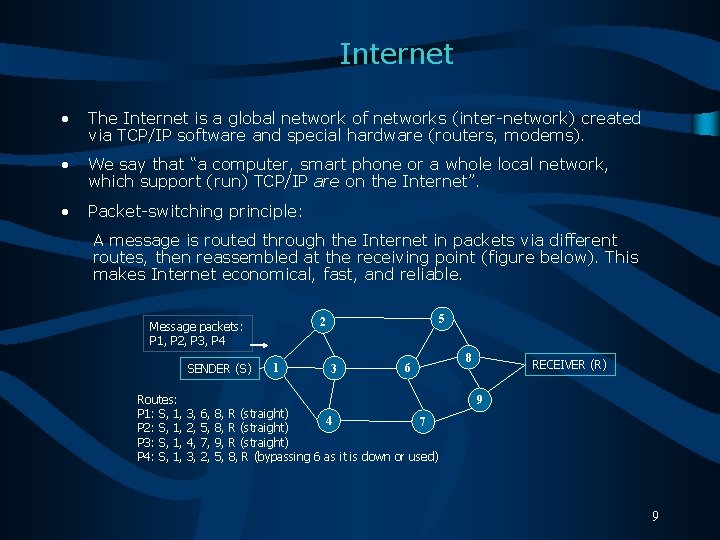
Internet • The Internet is a global network of networks (inter-network) created via TCP/IP software and special hardware (routers, modems). • We say that “a computer, smart phone or a whole local network, which support (run) TCP/IP are on the Internet”. • Packet-switching principle: A message is routed through the Internet in packets via different routes, then reassembled at the receiving point (figure below). This makes Internet economical, fast, and reliable. SENDER (S) Routes: P 1: S, 1, P 2: S, 1, P 3: S, 1, P 4: S, 1, 3, 2, 4, 3, 6, 5, 7, 2, 8, 8, 9, 5, 5 2 Message packets: P 1, P 2, P 3, P 4 1 3 6 R (straight) 4 7 R (straight) 8, R (bypassing 6 as it is down or used) 8 RECEIVER (R) 9 9
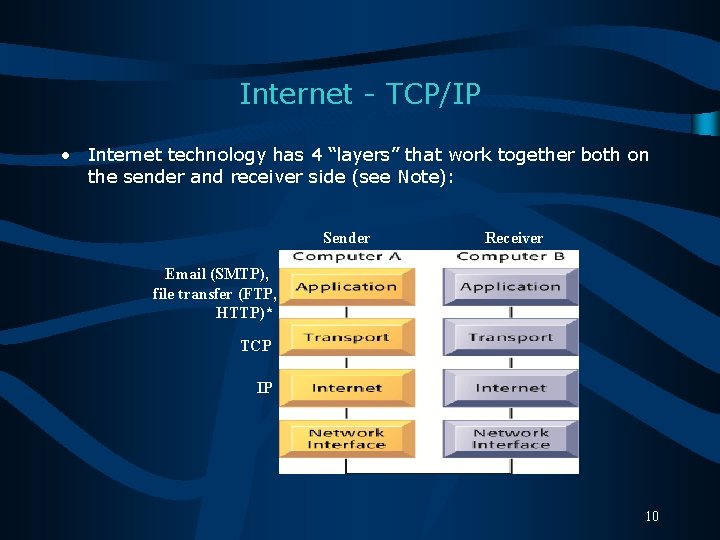
Internet - TCP/IP • Internet technology has 4 “layers” that work together both on the sender and receiver side (see Note): Sender Receiver Email (SMTP), file transfer (FTP, HTTP)* TCP IP 10
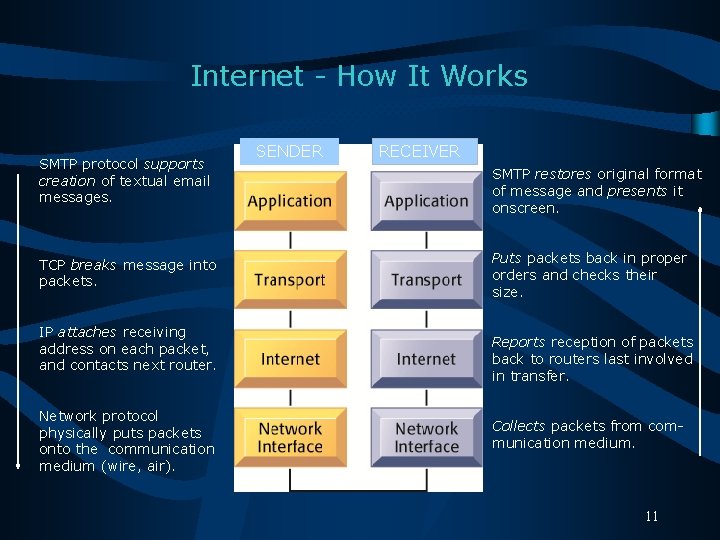
Internet - How It Works SMTP protocol supports creation of textual email messages. TCP breaks message into packets. IP attaches receiving address on each packet, and contacts next router. Network protocol physically puts packets onto the communication medium (wire, air). SENDER RECEIVER SMTP restores original format of message and presents it onscreen. Puts packets back in proper orders and checks their size. Reports reception of packets back to routers last involved in transfer. Collects packets from communication medium. 11
Wireless Internet 1) Wi. Fi (Wireless Fidelity) – wireless access to Internet (cell/smart phone, other mobile tech. , laptop) Wi-Fi hot spots, tethering*, data transfer part of cell phone networks, mobile Internet Access ranges from 100 m to kilometers 2) Wi. MAX covers 50 km range (video on virtual school in Somalia). * Sharing Internet access across computers, smart phones, etc. Q 15
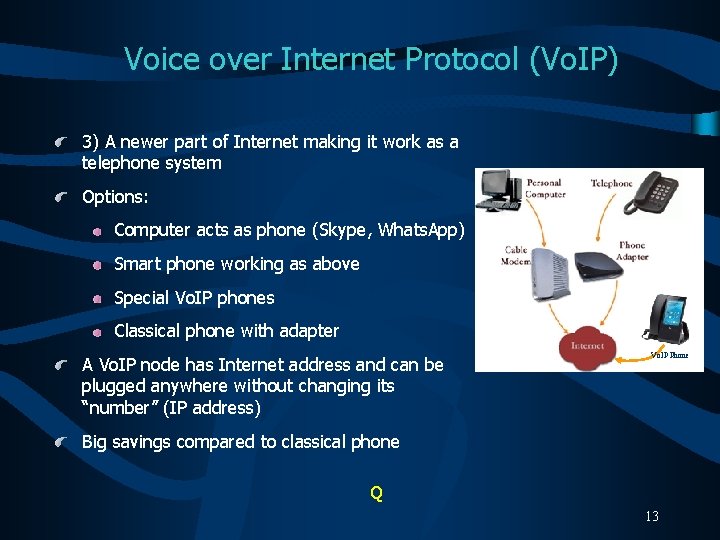
Voice over Internet Protocol (Vo. IP) 3) A newer part of Internet making it work as a telephone system Options: Computer acts as phone (Skype, Whats. App) Smart phone working as above Special Vo. IP phones Classical phone with adapter A Vo. IP node has Internet address and can be plugged anywhere without changing its “number” (IP address) Vo. IP Phone Big savings compared to classical phone Q 13
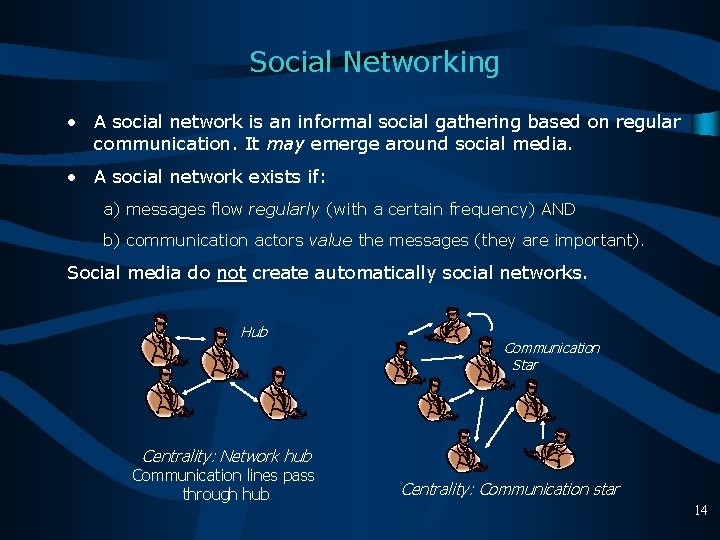
Social Networking • A social network is an informal social gathering based on regular communication. It may emerge around social media. • A social network exists if: a) messages flow regularly (with a certain frequency) AND b) communication actors value the messages (they are important). Social media do not create automatically social networks. Hub Communication Star Centrality: Network hub Communication lines pass through hub Centrality: Communication star 14
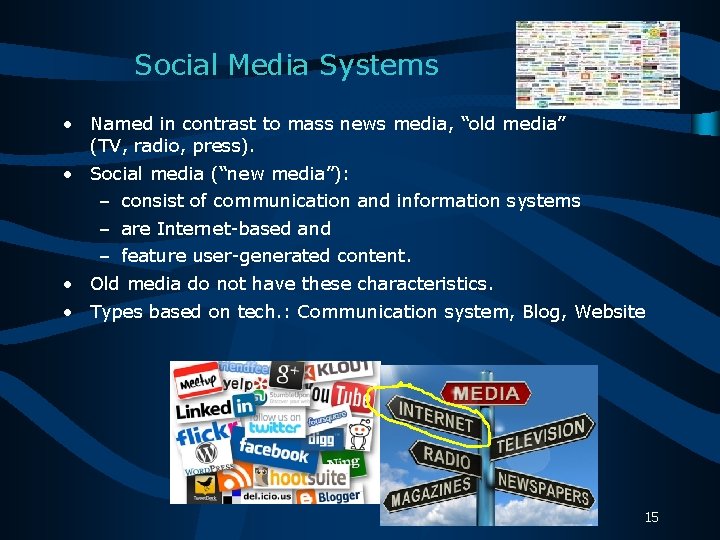
Social Media Systems • Named in contrast to mass news media, “old media” (TV, radio, press). • Social media (“new media”): – consist of communication and information systems – are Internet-based and – feature user-generated content. • Old media do not have these characteristics. • Types based on tech. : Communication system, Blog, Website 15
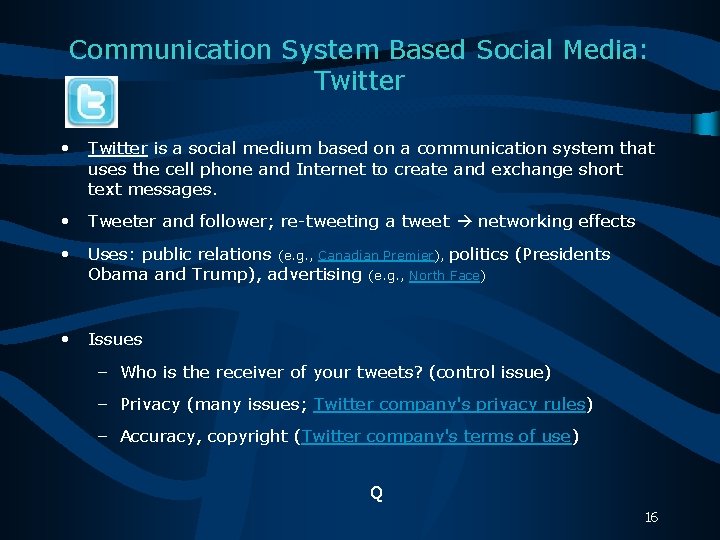
Communication System Based Social Media: Twitter • Twitter is a social medium based on a communication system that uses the cell phone and Internet to create and exchange short text messages. • Tweeter and follower; re-tweeting a tweet networking effects • Uses: public relations (e. g. , Canadian Premier), politics (Presidents Obama and Trump), advertising (e. g. , North Face) • Issues – Who is the receiver of your tweets? (control issue) – Privacy (many issues; Twitter company's privacy rules) – Accuracy, copyright (Twitter company's terms of use) Q 16
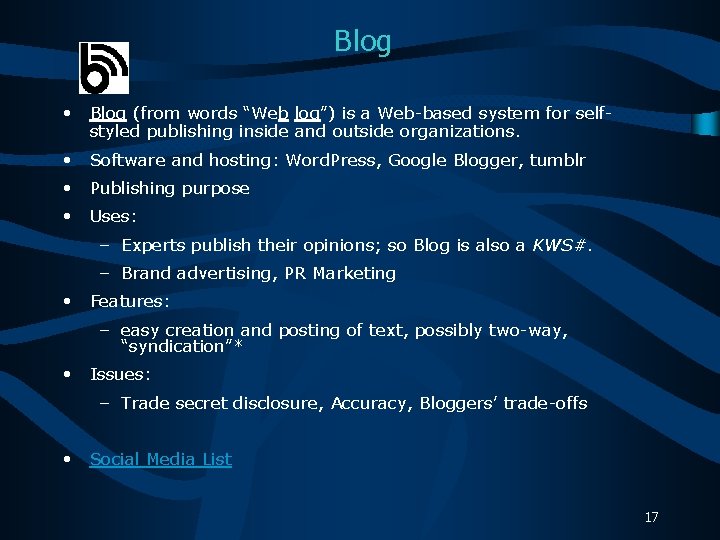
Blog • Blog (from words “Web log”) is a Web-based system for selfstyled publishing inside and outside organizations. • Software and hosting: Word. Press, Google Blogger, tumblr • Publishing purpose • Uses: – Experts publish their opinions; so Blog is also a KWS#. – Brand advertising, PR Marketing • Features: – easy creation and posting of text, possibly two-way, “syndication”* • Issues: – Trade secret disclosure, Accuracy, Bloggers’ trade-offs • Social Media List 17
Social Networking Website (Platform) • Social Networking Website supports informal communication between Internet users and possibly special functions (digital items sharing, music streaming, gaming, etc. ). • The most complex social medium, multi-media, multi-purpose. • Examples: Facebook, My. Space, Linked. In • Deploys various communication systems: – text messaging (chat), electronic bulletin boards (postings— responses) • Deploys other systems as well (e. g. , digital photo album) • Used for: Advertising, Job market, communication among professionals (Linked. In), Public Relations • Issues: privacy, socially adverse effects (negative social comparison, isolation (!), etc. ) 18
Summary 1/2 • Communication is the process of creating, exchanging and interpreting messages. • A communication system has a sending device, receiving device, and connecting network. • Managers use OC for announcing, ordering, and reporting. • Professionals use OC for discussion, knowledge exchange, and collaboration. • OC is shaped by rules on content, format (reports, sales documents), timing (reporting dates), and organizational culture. • OC can be face-to-face and mediated by communication technologies, inside and outside an organization. • Social network is a grouping of people who communicate regularly and value the messages exchanged. It can be peer, hierarchical, or flat. 19
Summary 2/2 • Social media (SM) are special websites and communication systems supporting Internet users; the content is user-generated. • SM attract ordinary people with shared interests (Facebook, Linked. In, Twitter, blogs). Organizational uses: marketing, public relations, HR. • Privacy, accuracy, copyright and trade secret protection are some of issues social media have brought up. • The Internet is a global network of networks created by special software and hardware. TCP/IP is the software with four layers, which connects different networks into the Internet. A message is routed through the Internet in packets processed by TCP/IP. • Voice over IP (Vo. IP) is an Internet capability for working as a telephone system. Creates big savings. • Wireless networks use radio waves for transfer of messages (Wi. Fi, cell phone). 20