Metalligand s interactions in an octahedral environment Six

- Slides: 20
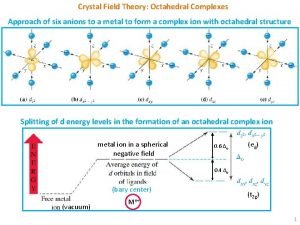
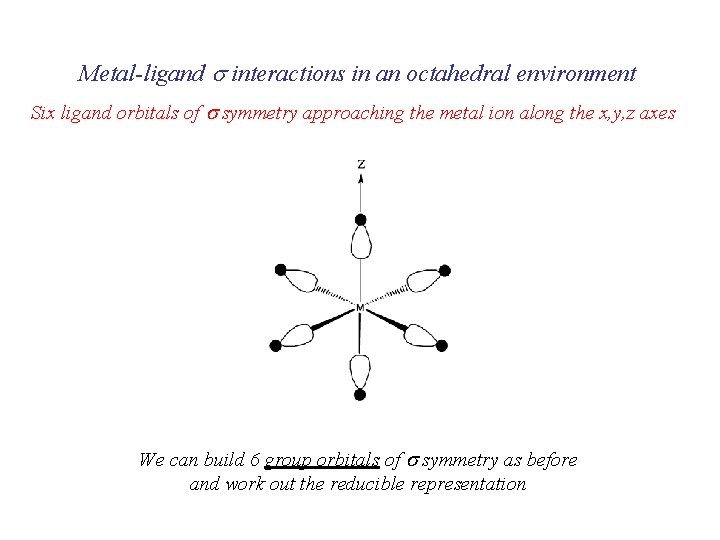
Metal-ligand s interactions in an octahedral environment Six ligand orbitals of s symmetry approaching the metal ion along the x, y, z axes We can build 6 group orbitals of s symmetry as before and work out the reducible representation
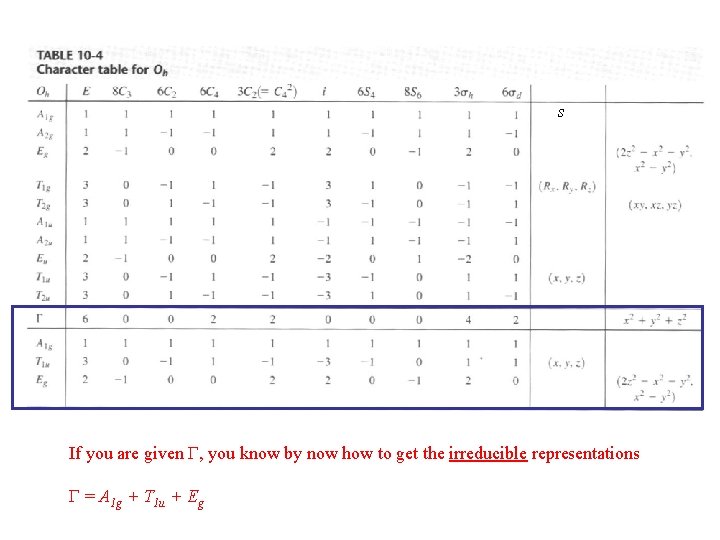
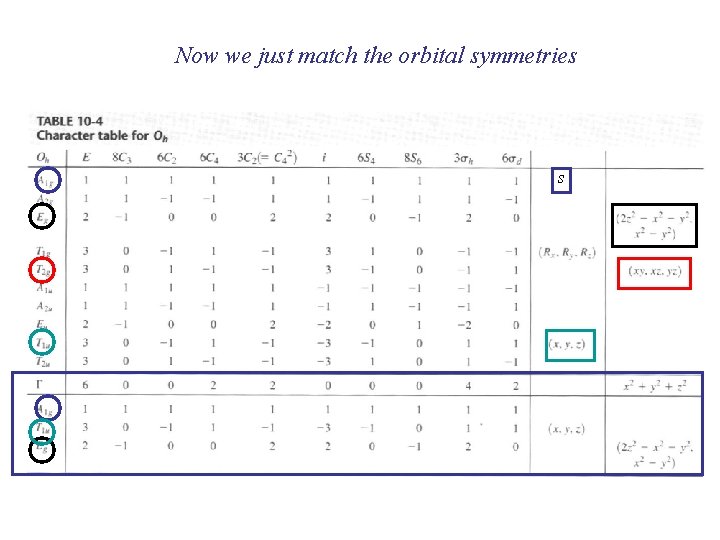
s If you are given G, you know by now how to get the irreducible representations G = A 1 g + T 1 u + Eg
Now we just match the orbital symmetries s
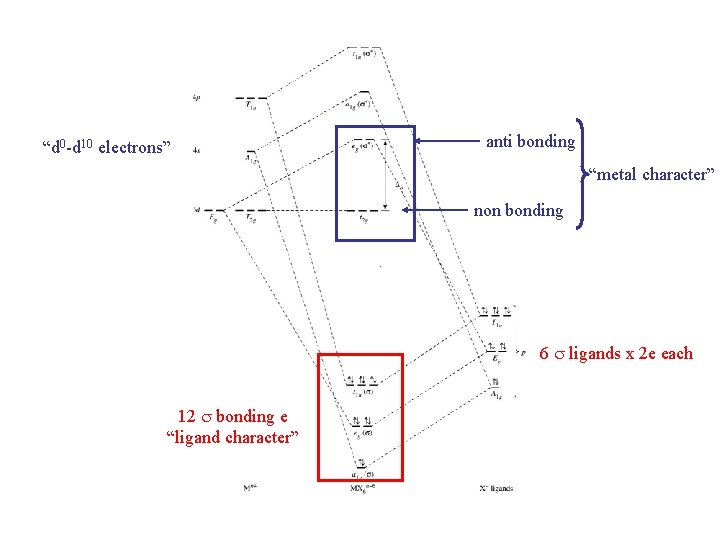
“d 0 -d 10 electrons” anti bonding “metal character” non bonding 6 s ligands x 2 e each 12 s bonding e “ligand character”
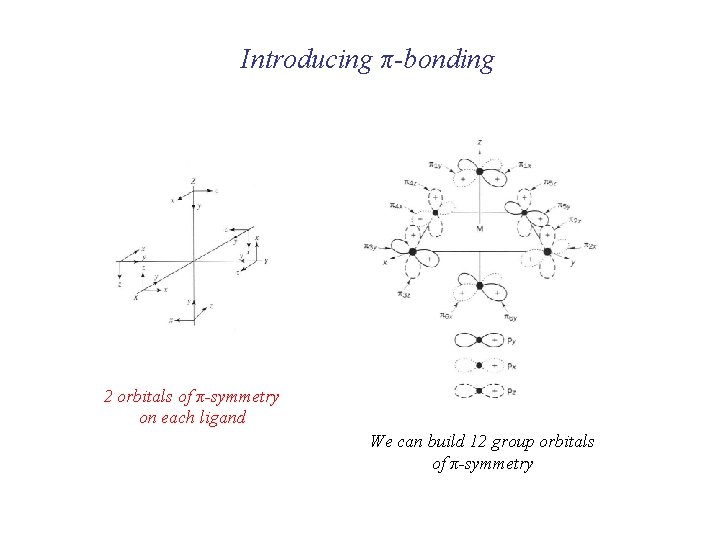
Introducing π-bonding 2 orbitals of π-symmetry on each ligand We can build 12 group orbitals of π-symmetry
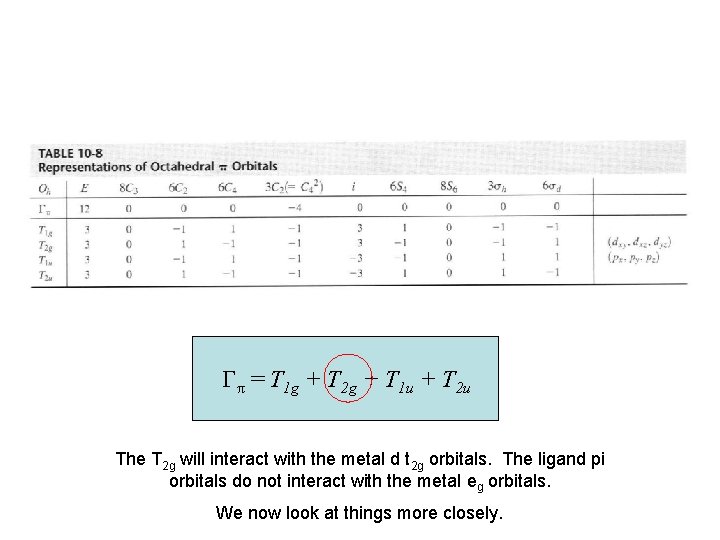
Gπ = T 1 g + T 2 g + T 1 u + T 2 u The T 2 g will interact with the metal d t 2 g orbitals. The ligand pi orbitals do not interact with the metal eg orbitals. We now look at things more closely.
Anti-bonding LUMO(π) First, the CN- ligand
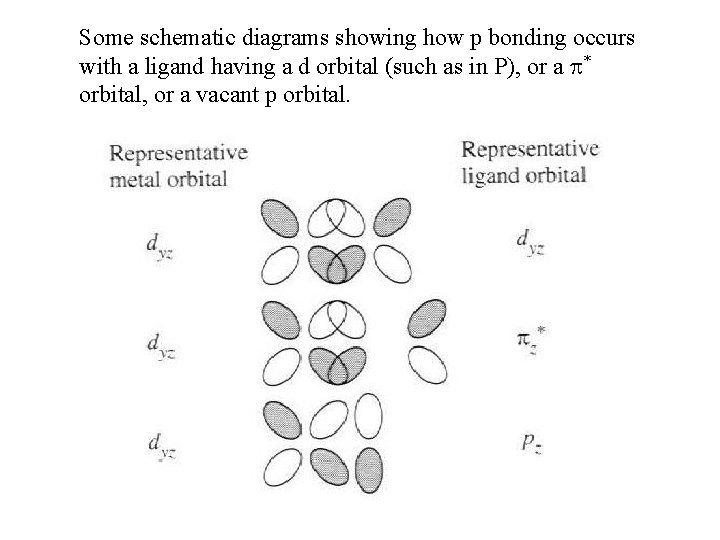
Some schematic diagrams showing how p bonding occurs with a ligand having a d orbital (such as in P), or a p* orbital, or a vacant p orbital.
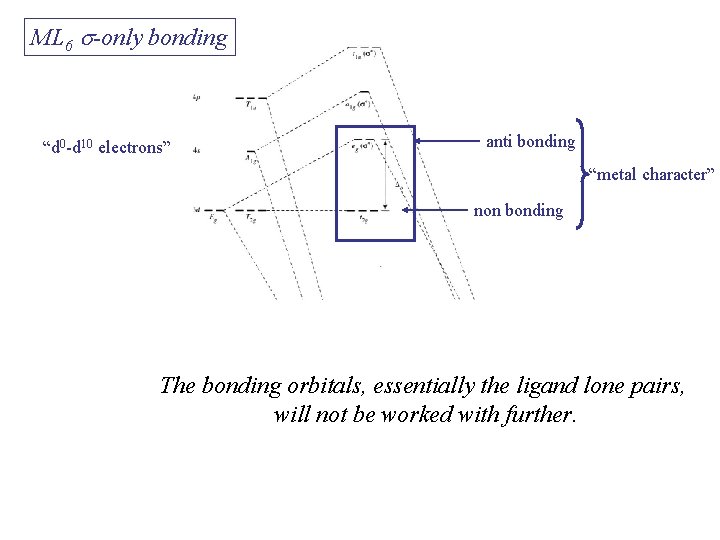
ML 6 s-only bonding “d 0 -d 10 electrons” anti bonding “metal character” non bonding 6 s ligands x 2 e each The bonding orbitals, essentially the ligand lone pairs, 12 s bondingwill e not be worked with further. “ligand character”
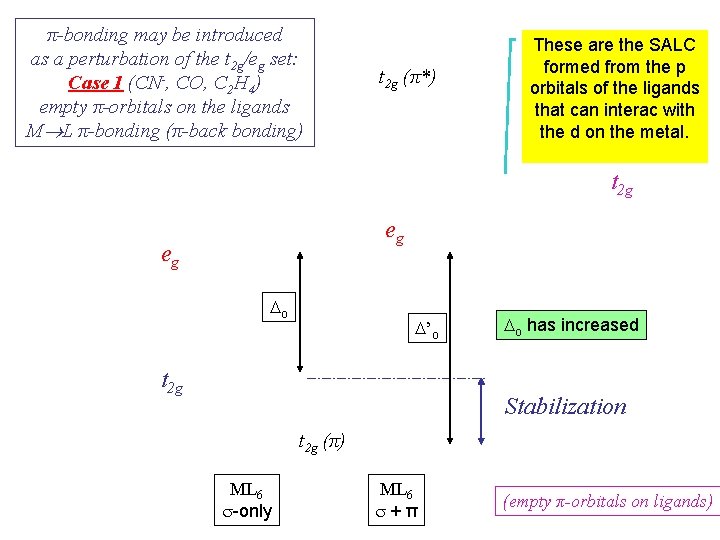
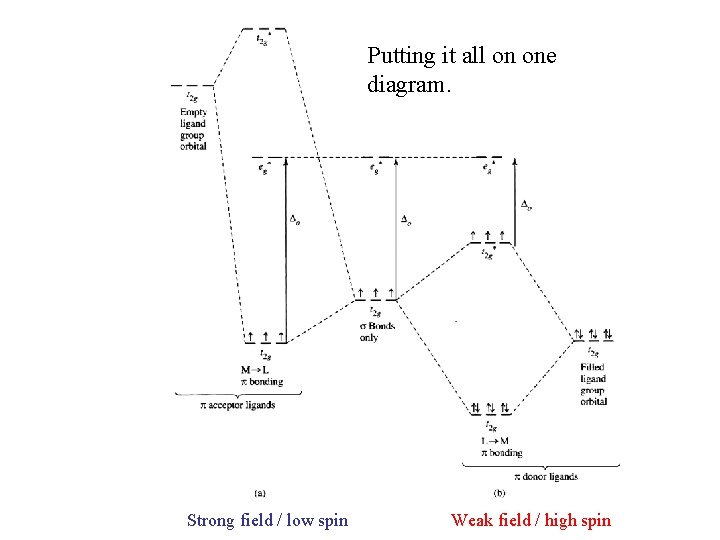
π-bonding may be introduced as a perturbation of the t 2 g/eg set: Case 1 (CN-, CO, C 2 H 4) empty π-orbitals on the ligands M L π-bonding (π-back bonding) t 2 g (π*) These are the SALC formed from the p orbitals of the ligands that can interac with the d on the metal. t 2 g eg eg Do D’o t 2 g Do has increased Stabilization t 2 g (π) ML 6 s-only ML 6 s+π (empty π-orbitals on ligands)
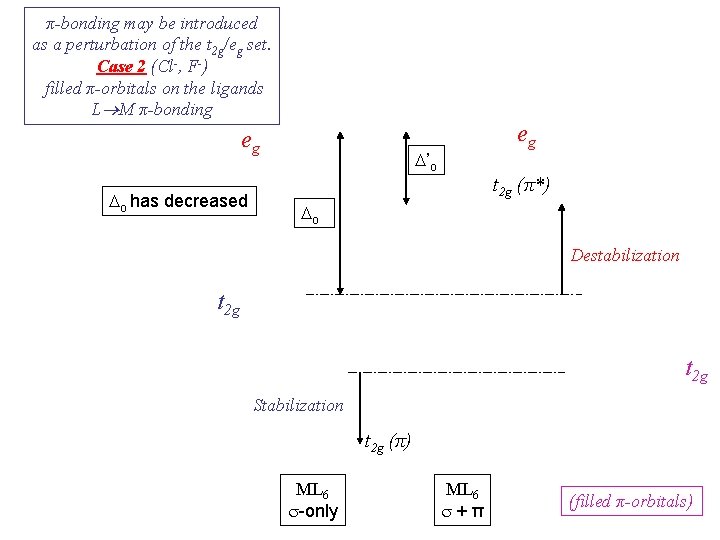
π-bonding may be introduced as a perturbation of the t 2 g/eg set. Case 2 (Cl-, F-) filled π-orbitals on the ligands L M π-bonding eg Do has decreased eg D’o t 2 g (π*) Do Destabilization t 2 g Stabilization t 2 g (π) ML 6 s-only ML 6 s+π (filled π-orbitals)
Putting it all on one diagram. Strong field / low spin Weak field / high spin
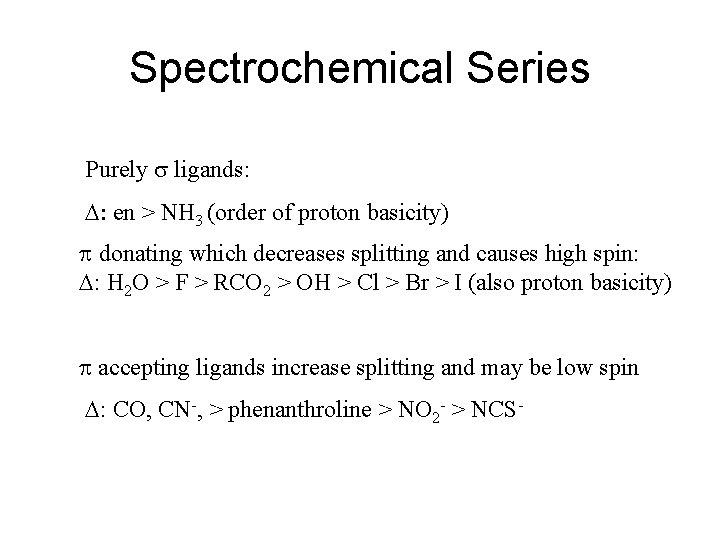
Spectrochemical Series Purely s ligands: D: en > NH 3 (order of proton basicity) p donating which decreases splitting and causes high spin: D: H 2 O > F > RCO 2 > OH > Cl > Br > I (also proton basicity) p accepting ligands increase splitting and may be low spin D: CO, CN-, > phenanthroline > NO 2 - > NCS-
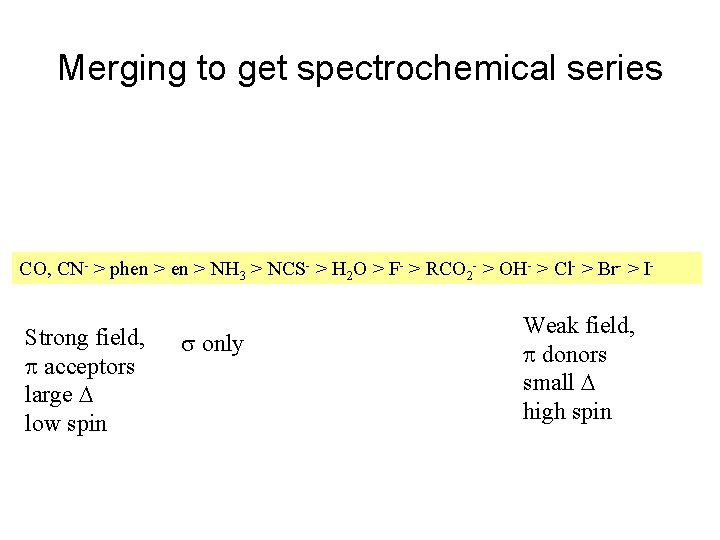
Merging to get spectrochemical series CO, CN- > phen > NH 3 > NCS- > H 2 O > F- > RCO 2 - > OH- > Cl- > Br- > I- Strong field, p acceptors large D low spin s only Weak field, p donors small D high spin
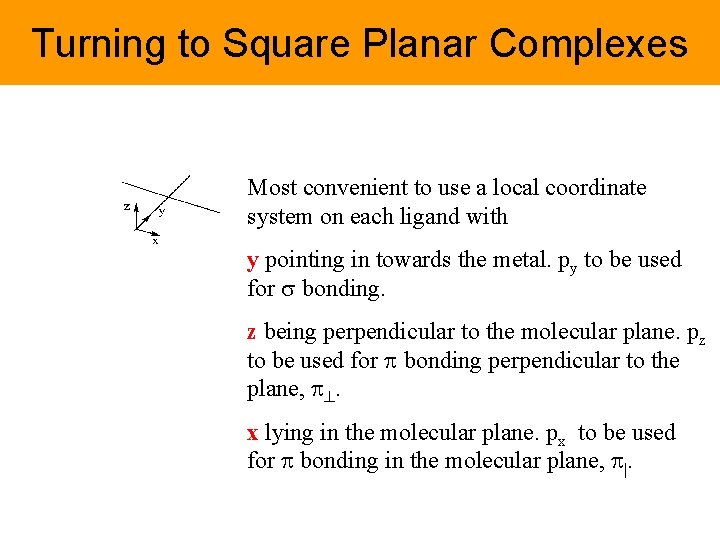
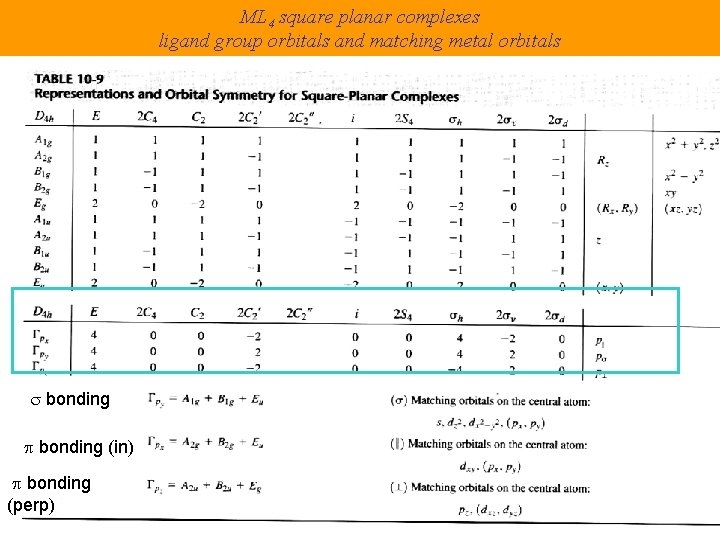
Turning to Square Planar Complexes Most convenient to use a local coordinate system on each ligand with y pointing in towards the metal. py to be used for s bonding. z being perpendicular to the molecular plane. pz to be used for p bonding perpendicular to the plane, p^. x lying in the molecular plane. px to be used for p bonding in the molecular plane, p|.
ML 4 square planar complexes ligand group orbitals and matching metal orbitals s bonding p bonding (in) p bonding (perp)
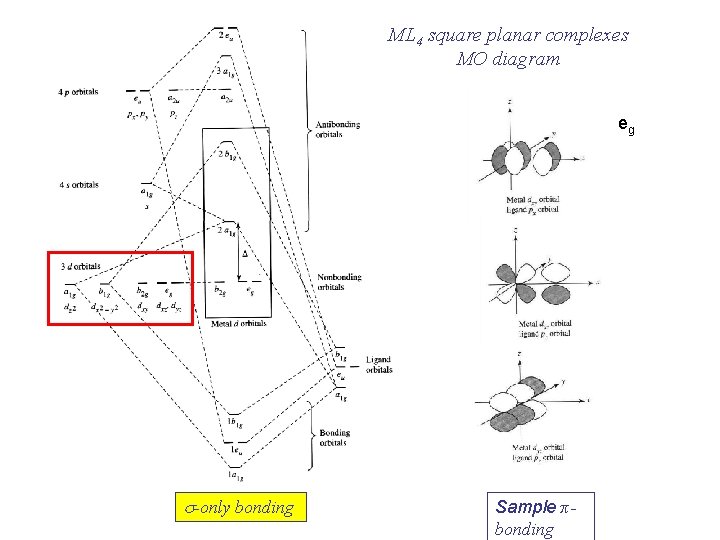
ML 4 square planar complexes MO diagram eg s-only bonding Sample π bonding
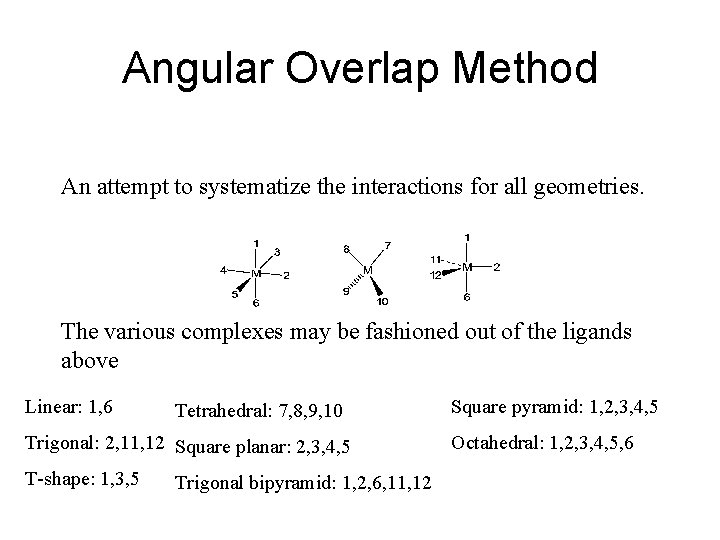
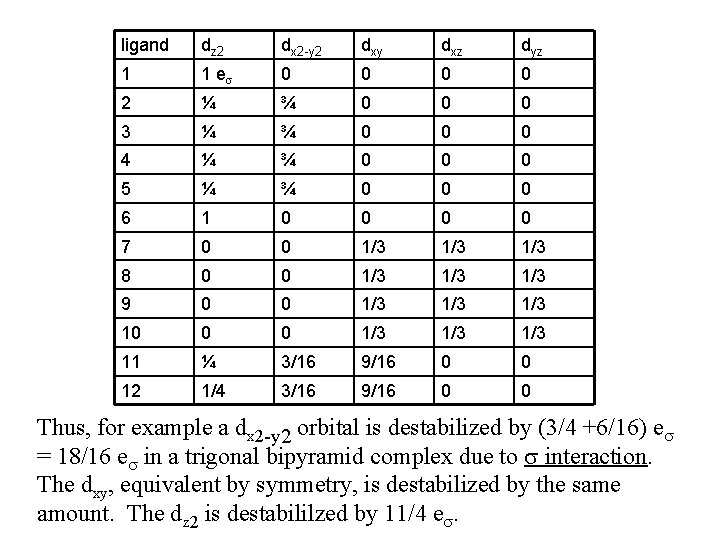
Angular Overlap Method An attempt to systematize the interactions for all geometries. The various complexes may be fashioned out of the ligands above Linear: 1, 6 Tetrahedral: 7, 8, 9, 10 Trigonal: 2, 11, 12 Square planar: 2, 3, 4, 5 T-shape: 1, 3, 5 Trigonal bipyramid: 1, 2, 6, 11, 12 Square pyramid: 1, 2, 3, 4, 5 Octahedral: 1, 2, 3, 4, 5, 6
Cont’d All s interactions with the ligands are stabilizing to the ligands and destabilizing to the d orbitals. The interaction of a ligand with a d orbital depends on their orientation with respect to each other, estimated by their overlap which can be calculated. The total destabilization of a d orbital comes from all the interactions with the set of ligands. For any particular complex geometry we can obtain the overlaps of a particular d orbital with all the various ligands and thus the destabilization.
ligand dz 2 dx 2 -y 2 dxy dxz dyz 1 1 es 0 0 2 ¼ ¾ 0 0 0 3 ¼ ¾ 0 0 0 4 ¼ ¾ 0 0 0 5 ¼ ¾ 0 0 0 6 1 0 0 7 0 0 1/3 1/3 8 0 0 1/3 1/3 9 0 0 1/3 1/3 10 0 0 1/3 1/3 11 ¼ 3/16 9/16 0 0 12 1/4 3/16 9/16 0 0 Thus, for example a dx 2 -y 2 orbital is destabilized by (3/4 +6/16) es = 18/16 es in a trigonal bipyramid complex due to s interaction. The dxy, equivalent by symmetry, is destabilized by the same amount. The dz 2 is destabililzed by 11/4 es.