
In the nineteen sixties Ralph Pearson developed the
- Slides: 50
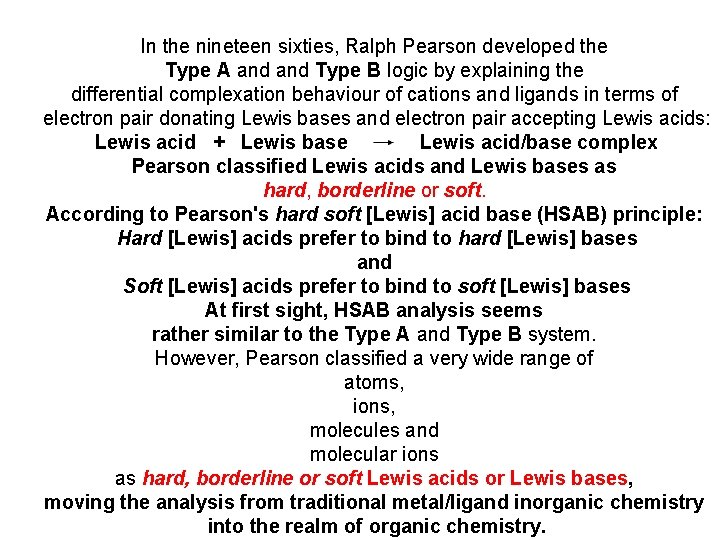
In the nineteen sixties, Ralph Pearson developed the Type A and Type B logic by explaining the differential complexation behaviour of cations and ligands in terms of electron pair donating Lewis bases and electron pair accepting Lewis acids: Lewis acid + Lewis base Lewis acid/base complex Pearson classified Lewis acids and Lewis bases as hard, borderline or soft. According to Pearson's hard soft [Lewis] acid base (HSAB) principle: Hard [Lewis] acids prefer to bind to hard [Lewis] bases and Soft [Lewis] acids prefer to bind to soft [Lewis] bases At first sight, HSAB analysis seems rather similar to the Type A and Type B system. However, Pearson classified a very wide range of atoms, ions, molecules and molecular ions as hard, borderline or soft Lewis acids or Lewis bases, moving the analysis from traditional metal/ligand inorganic chemistry into the realm of organic chemistry.
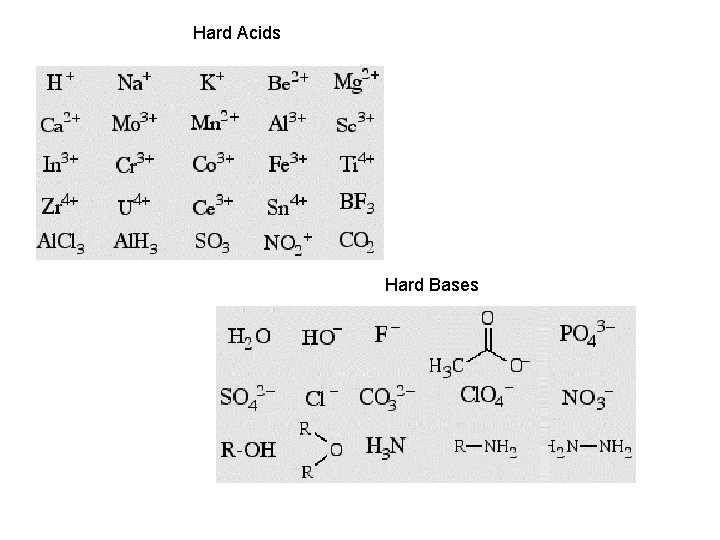
Hard Acids Hard Bases
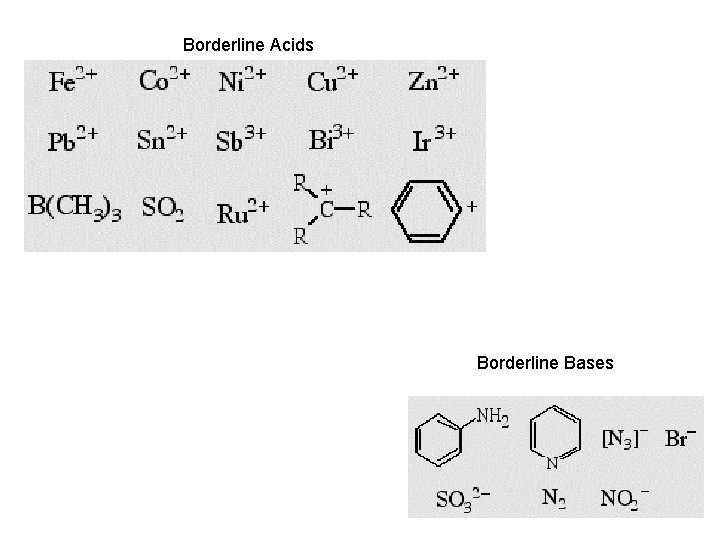
Borderline Acids Borderline Bases
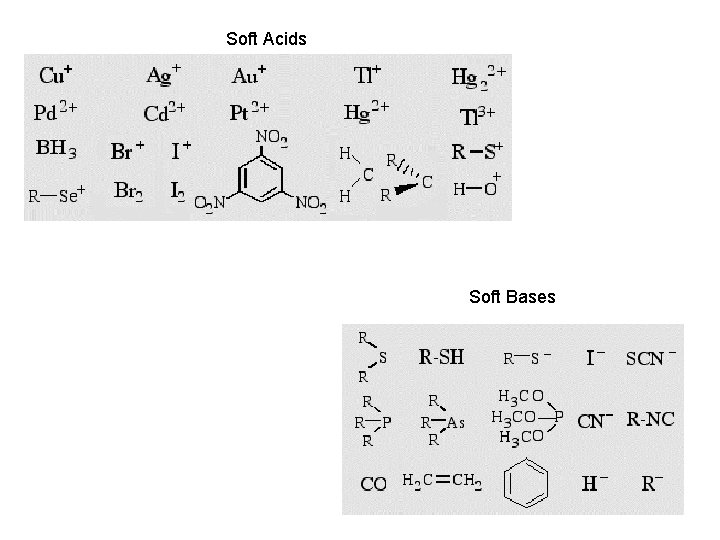
Soft Acids Soft Bases
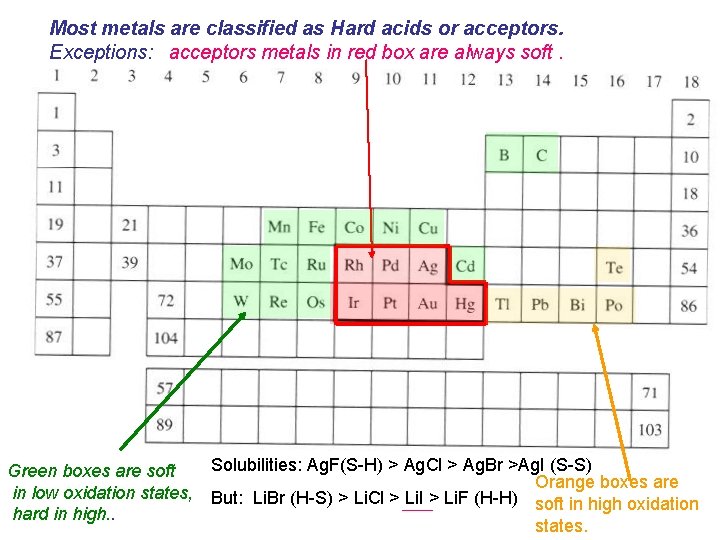
Most metals are classified as Hard acids or acceptors. Exceptions: acceptors metals in red box are always soft. Green boxes are soft in low oxidation states, hard in high. . Solubilities: Ag. F(S-H) > Ag. Cl > Ag. Br >Ag. I (S-S) Orange boxes are But: Li. Br (H-S) > Li. Cl > Li. I > Li. F (H-H) soft in high oxidation states.
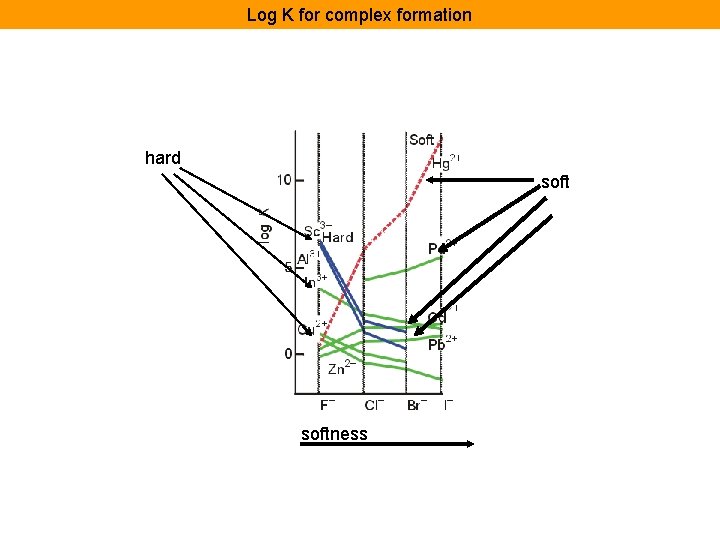
Log K for complex formation hard softness
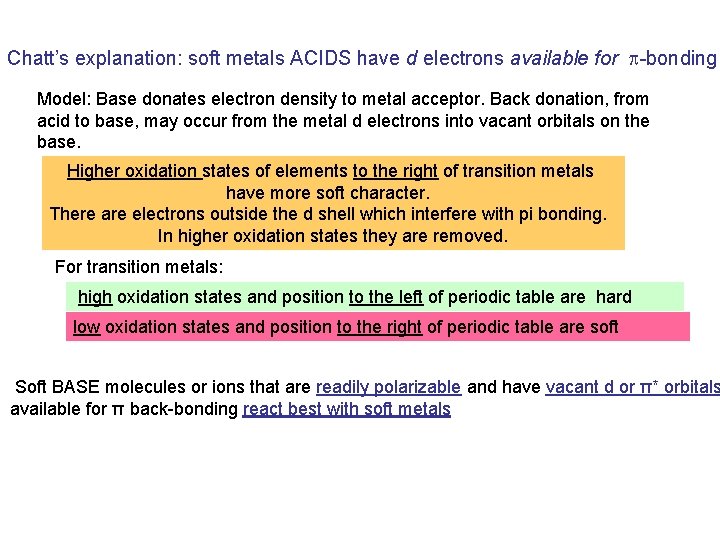
Chatt’s explanation: soft metals ACIDS have d electrons available for p-bonding Model: Base donates electron density to metal acceptor. Back donation, from acid to base, may occur from the metal d electrons into vacant orbitals on the base. Higher oxidation states of elements to the right of transition metals have more soft character. There are electrons outside the d shell which interfere with pi bonding. In higher oxidation states they are removed. For transition metals: high oxidation states and position to the left of periodic table are hard low oxidation states and position to the right of periodic table are soft Soft BASE molecules or ions that are readily polarizable and have vacant d or π* orbitals available for π back-bonding react best with soft metals
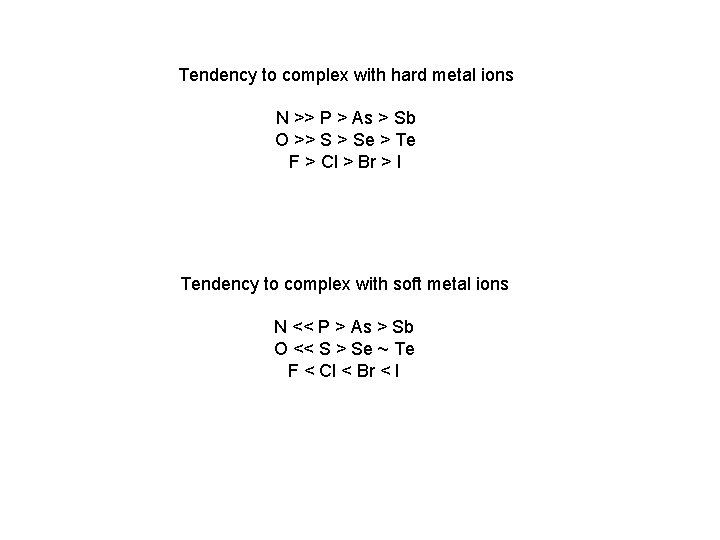
Tendency to complex with hard metal ions N >> P > As > Sb O >> S > Se > Te F > Cl > Br > I Tendency to complex with soft metal ions N << P > As > Sb O << S > Se ~ Te F < Cl < Br < I
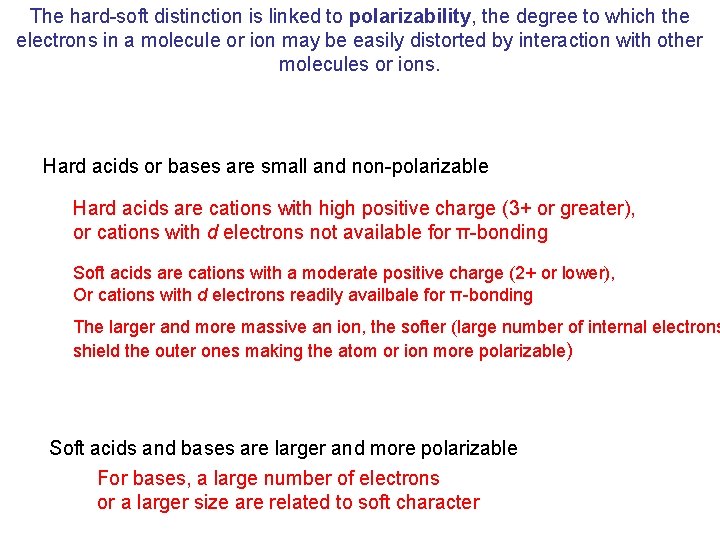
The hard-soft distinction is linked to polarizability, the degree to which the electrons in a molecule or ion may be easily distorted by interaction with other molecules or ions. Hard acids or bases are small and non-polarizable Hard acids are cations with high positive charge (3+ or greater), or cations with d electrons not available for π-bonding Soft acids are cations with a moderate positive charge (2+ or lower), Or cations with d electrons readily availbale for π-bonding The larger and more massive an ion, the softer (large number of internal electrons shield the outer ones making the atom or ion more polarizable) Soft acids and bases are larger and more polarizable For bases, a large number of electrons or a larger size are related to soft character
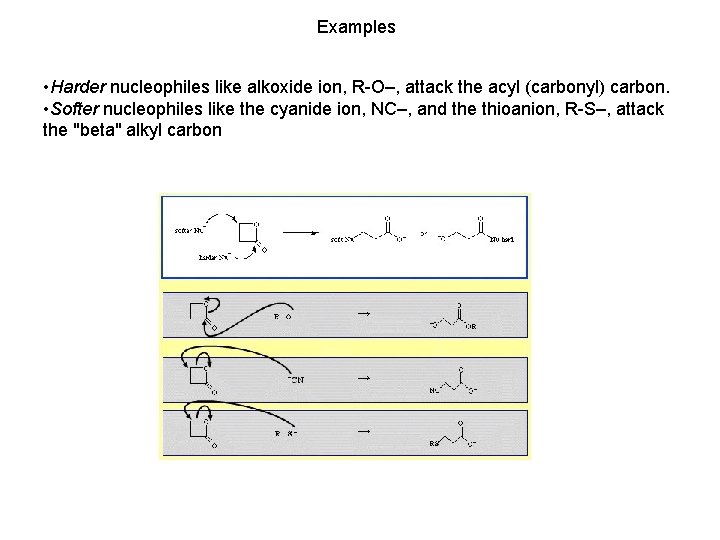
Examples • Harder nucleophiles like alkoxide ion, R-O–, attack the acyl (carbonyl) carbon. • Softer nucleophiles like the cyanide ion, NC–, and the thioanion, R-S–, attack the "beta" alkyl carbon
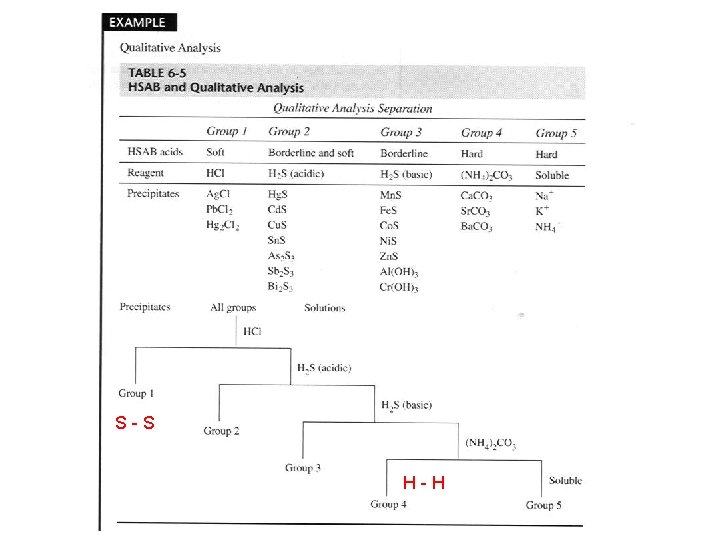
S-S H-H
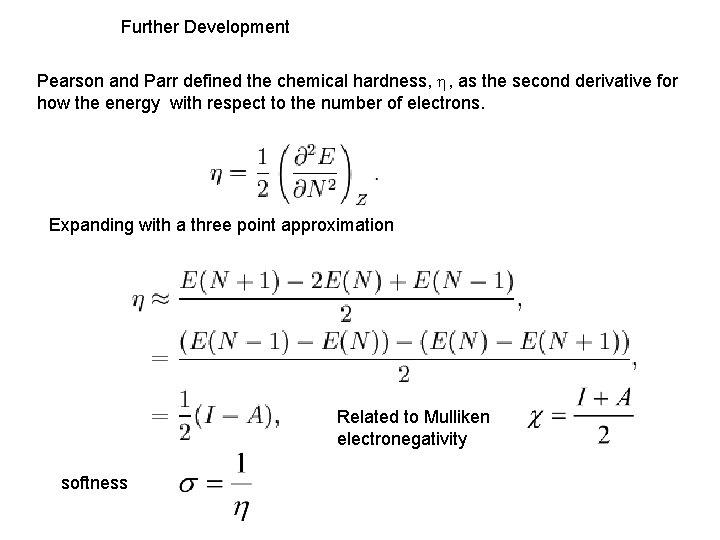
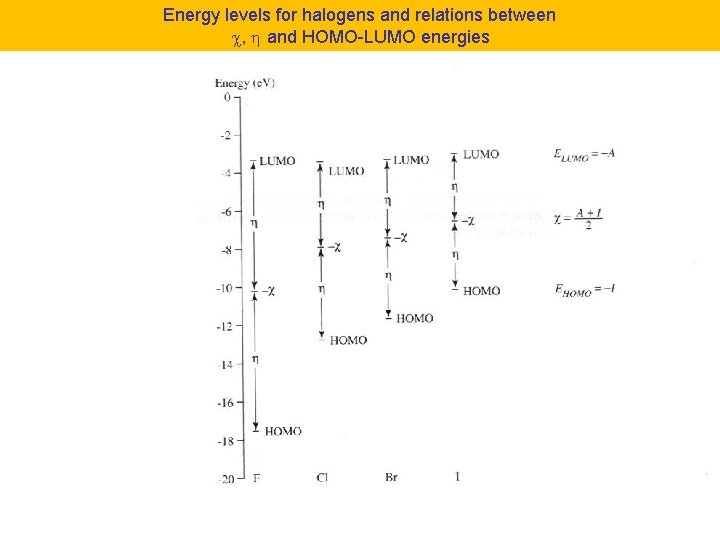
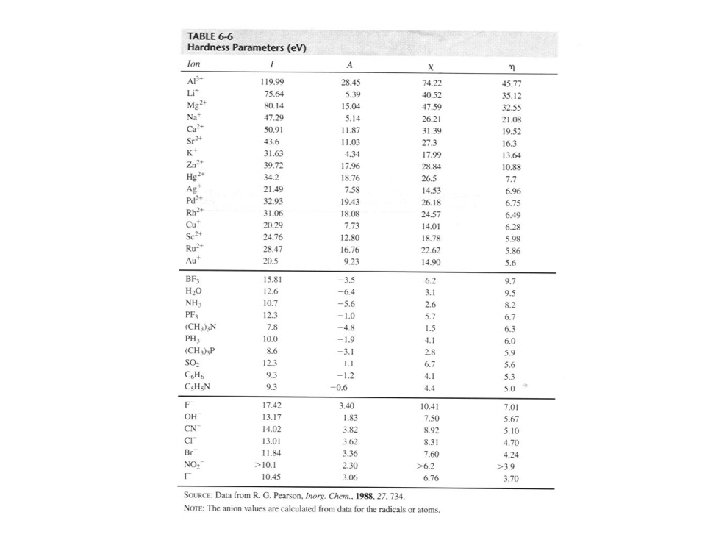
Further Development Pearson and Parr defined the chemical hardness, h, as the second derivative for how the energy with respect to the number of electrons. Expanding with a three point approximation Related to Mulliken electronegativity softness
Energy levels for halogens and relations between c, h and HOMO-LUMO energies
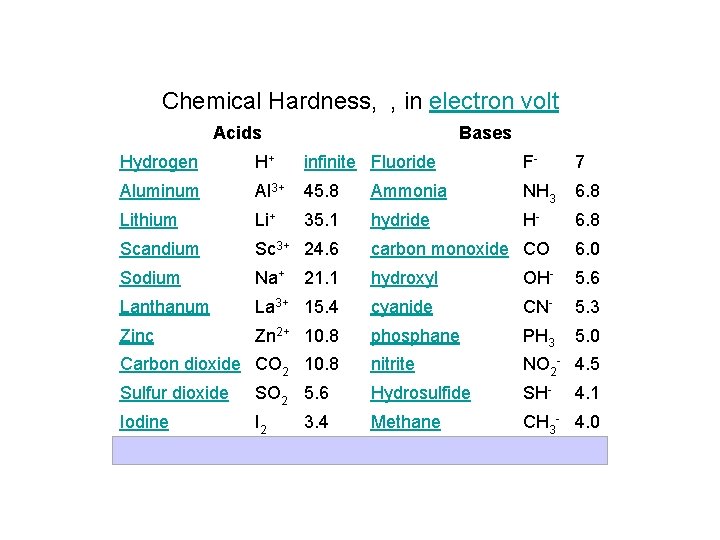
Chemical Hardness, , in electron volt Acids Bases Hydrogen H+ infinite Fluoride F- 7 Aluminum Al 3+ 45. 8 Ammonia NH 3 6. 8 Lithium Li+ 35. 1 hydride H- 6. 8 Scandium Sc 3+ 24. 6 carbon monoxide CO 6. 0 Sodium Na+ 21. 1 hydroxyl OH- 5. 6 Lanthanum La 3+ 15. 4 cyanide CN- 5. 3 Zinc Zn 2+ 10. 8 phosphane PH 3 5. 0 Carbon dioxide CO 2 10. 8 nitrite NO 2 - 4. 5 Sulfur dioxide SO 2 5. 6 Hydrosulfide SH- Iodine I 2 Methane CH 3 - 4. 0 3. 4 4. 1
Coordination Chemistry • General aspects (Ch. 9) • Bonding (Ch. 10) • Electronic spectra (Ch. 11) • Reaction mechanisms (Ch. 12)
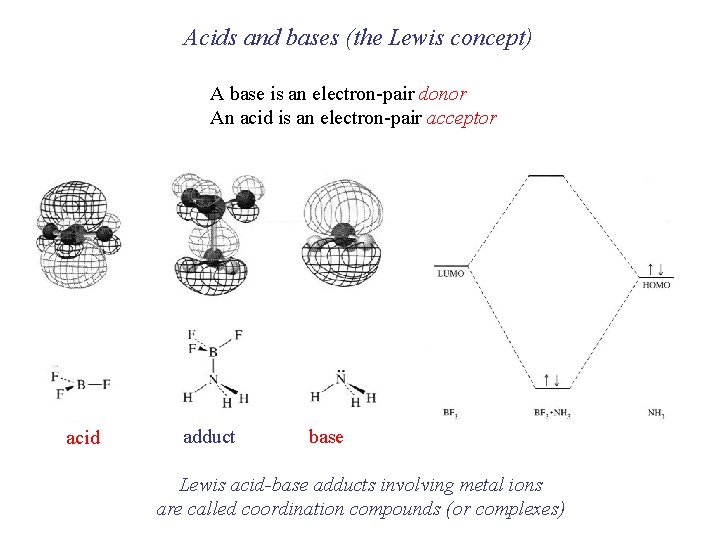
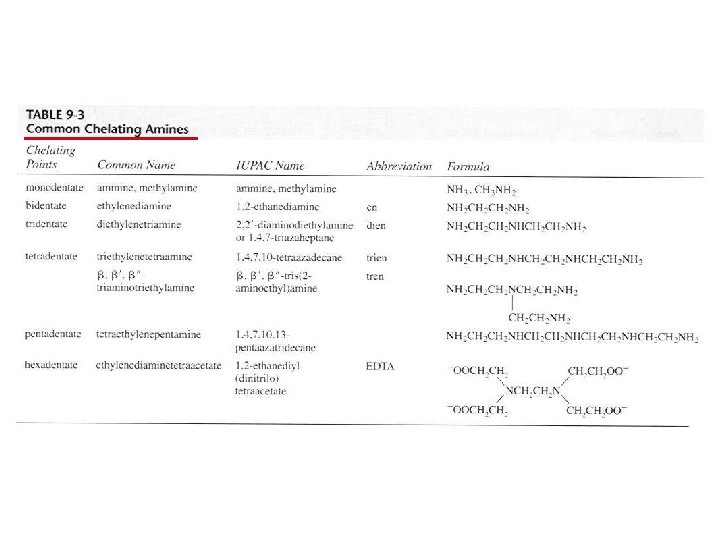
Acids and bases (the Lewis concept) A base is an electron-pair donor An acid is an electron-pair acceptor acid adduct base Lewis acid-base adducts involving metal ions are called coordination compounds (or complexes)
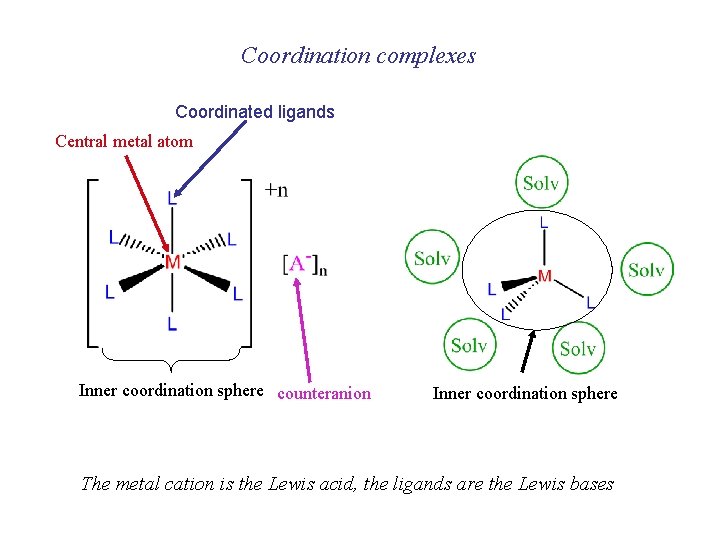
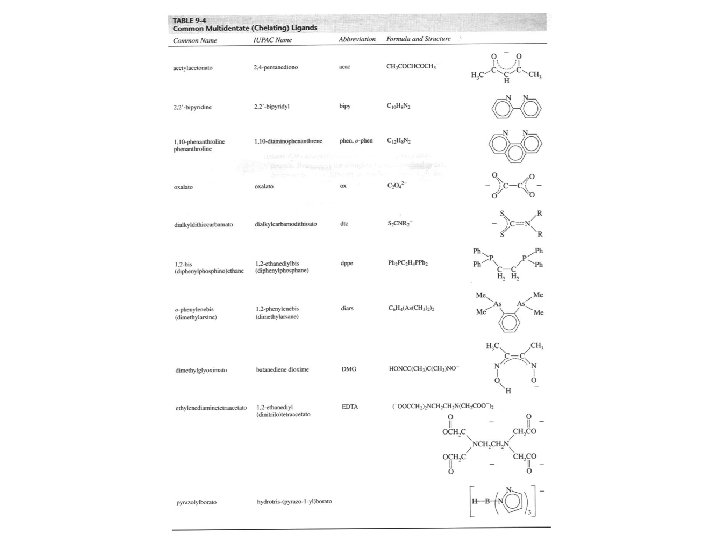
Coordination complexes Coordinated ligands Central metal atom Inner coordination sphere counteranion Inner coordination sphere The metal cation is the Lewis acid, the ligands are the Lewis bases
Naming coordination complexes
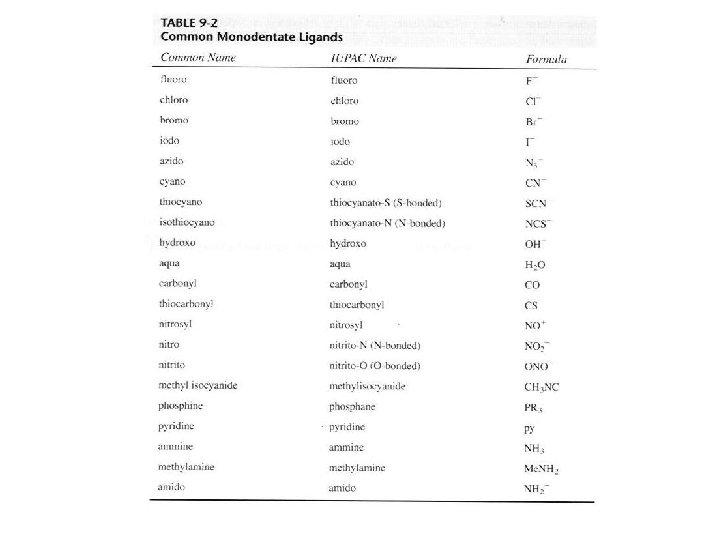
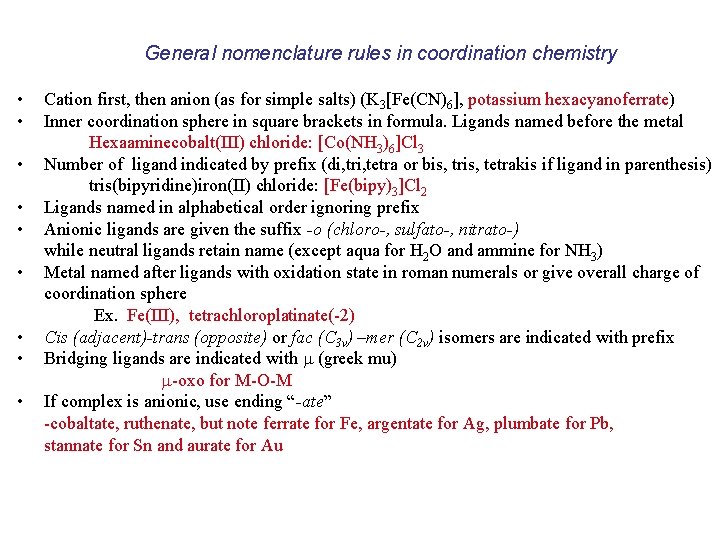
General nomenclature rules in coordination chemistry • • • Cation first, then anion (as for simple salts) (K 3[Fe(CN)6], potassium hexacyanoferrate) Inner coordination sphere in square brackets in formula. Ligands named before the metal Hexaaminecobalt(III) chloride: [Co(NH 3)6]Cl 3 Number of ligand indicated by prefix (di, tri, tetra or bis, tris, tetrakis if ligand in parenthesis) tris(bipyridine)iron(II) chloride: [Fe(bipy)3]Cl 2 Ligands named in alphabetical order ignoring prefix Anionic ligands are given the suffix -o (chloro-, sulfato-, nitrato-) while neutral ligands retain name (except aqua for H 2 O and ammine for NH 3) Metal named after ligands with oxidation state in roman numerals or give overall charge of coordination sphere Ex. Fe(III), tetrachloroplatinate(-2) Cis (adjacent)-trans (opposite) or fac (C 3 v) –mer (C 2 v) isomers are indicated with prefix Bridging ligands are indicated with m (greek mu) m-oxo for M-O-M If complex is anionic, use ending “-ate” -cobaltate, ruthenate, but note ferrate for Fe, argentate for Ag, plumbate for Pb, stannate for Sn and aurate for Au
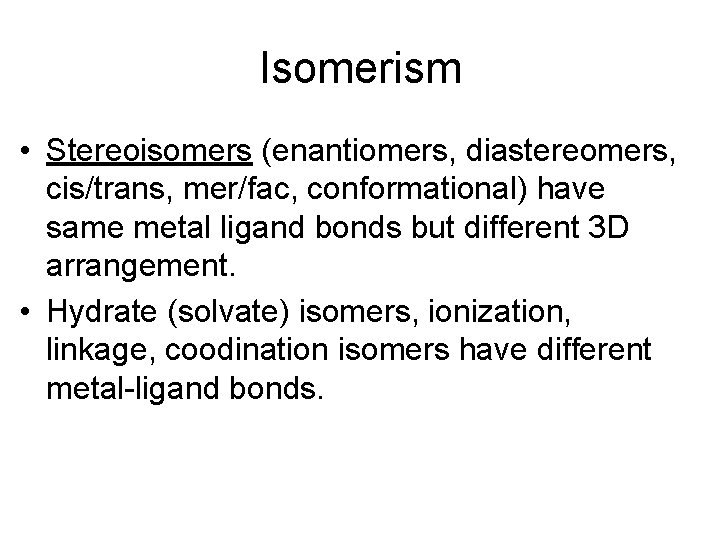
Isomerism • Stereoisomers (enantiomers, diastereomers, cis/trans, mer/fac, conformational) have same metal ligand bonds but different 3 D arrangement. • Hydrate (solvate) isomers, ionization, linkage, coodination isomers have different metal-ligand bonds.
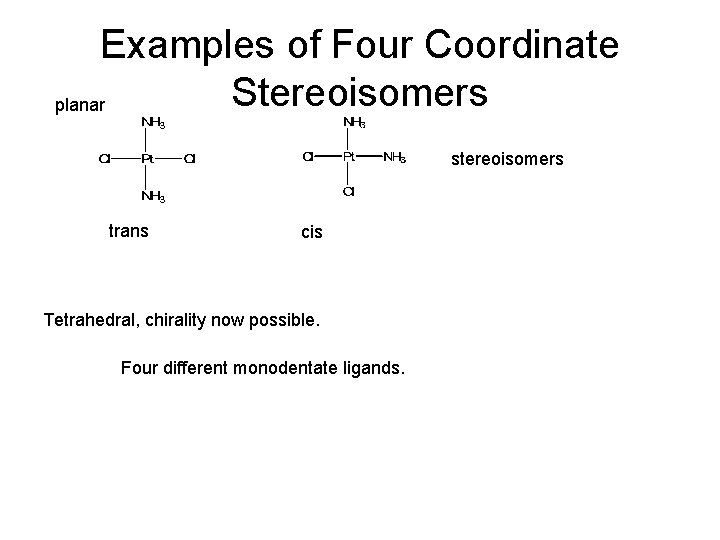
Examples of Four Coordinate Stereoisomers planar stereoisomers trans cis Tetrahedral, chirality now possible. Four different monodentate ligands.
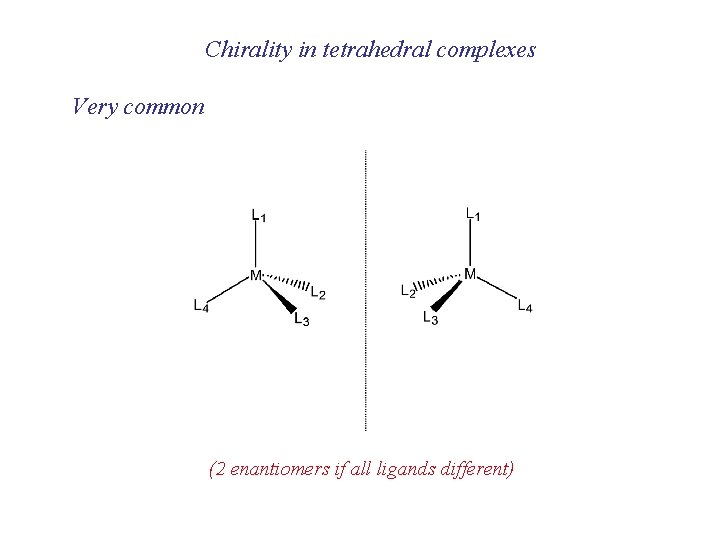
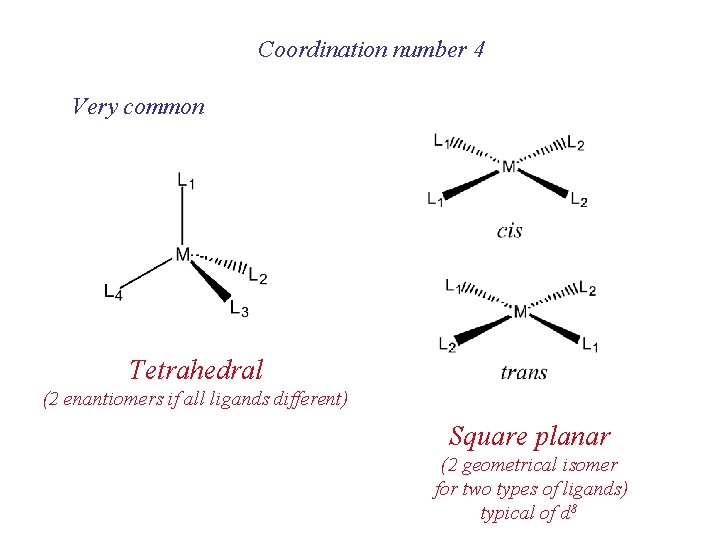
Chirality in tetrahedral complexes Very common (2 enantiomers if all ligands different)
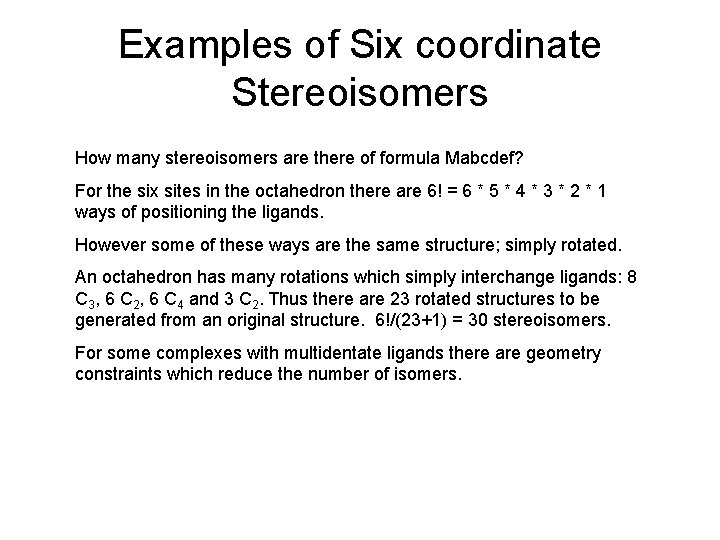
Examples of Six coordinate Stereoisomers How many stereoisomers are there of formula Mabcdef? For the six sites in the octahedron there are 6! = 6 * 5 * 4 * 3 * 2 * 1 ways of positioning the ligands. However some of these ways are the same structure; simply rotated. An octahedron has many rotations which simply interchange ligands: 8 C 3, 6 C 2, 6 C 4 and 3 C 2. Thus there are 23 rotated structures to be generated from an original structure. 6!/(23+1) = 30 stereoisomers. For some complexes with multidentate ligands there are geometry constraints which reduce the number of isomers.
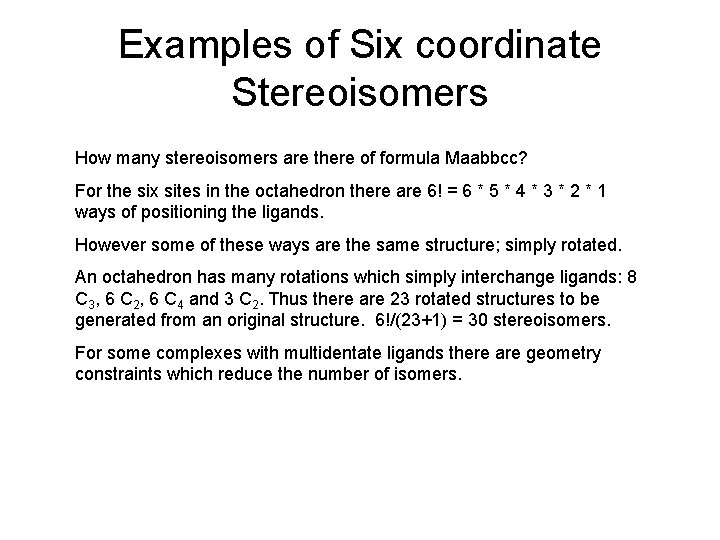
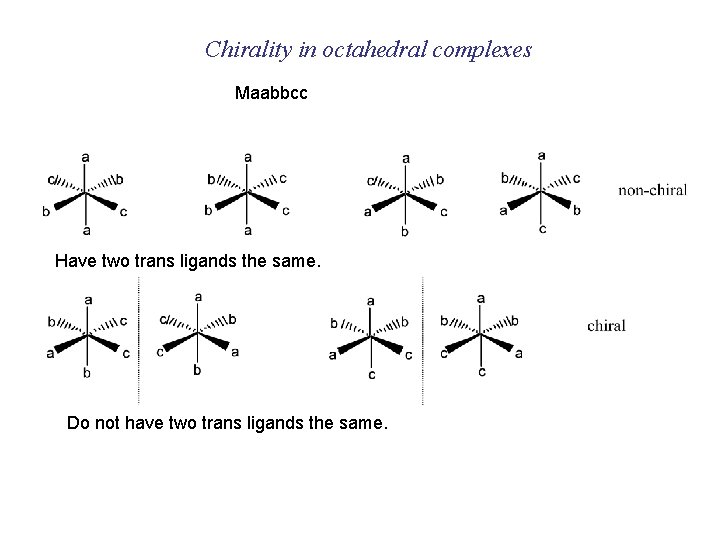
Examples of Six coordinate Stereoisomers How many stereoisomers are there of formula Maabbcc? For the six sites in the octahedron there are 6! = 6 * 5 * 4 * 3 * 2 * 1 ways of positioning the ligands. However some of these ways are the same structure; simply rotated. An octahedron has many rotations which simply interchange ligands: 8 C 3, 6 C 2, 6 C 4 and 3 C 2. Thus there are 23 rotated structures to be generated from an original structure. 6!/(23+1) = 30 stereoisomers. For some complexes with multidentate ligands there are geometry constraints which reduce the number of isomers.
Chirality in octahedral complexes Maabbcc Have two trans ligands the same. Do not have two trans ligands the same.
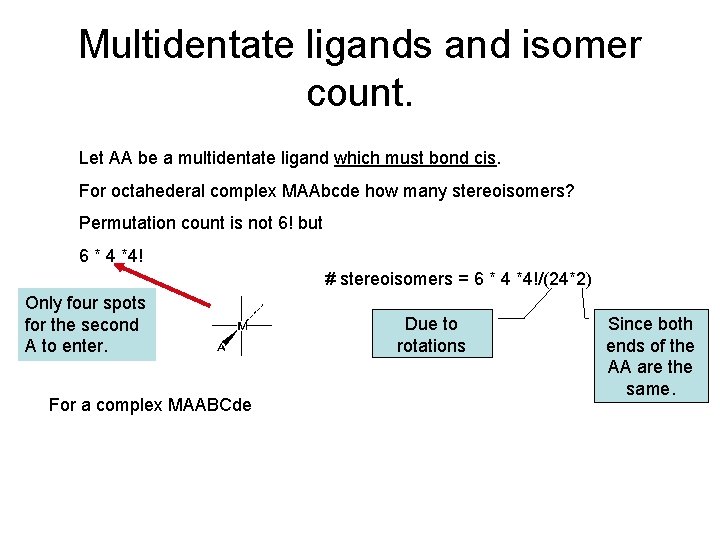
Multidentate ligands and isomer count. Let AA be a multidentate ligand which must bond cis. For octahederal complex MAAbcde how many stereoisomers? Permutation count is not 6! but 6 * 4 *4! # stereoisomers = 6 * 4 *4!/(24*2) Only four spots for the second A to enter. For a complex MAABCde Due to rotations Since both ends of the AA are the same.
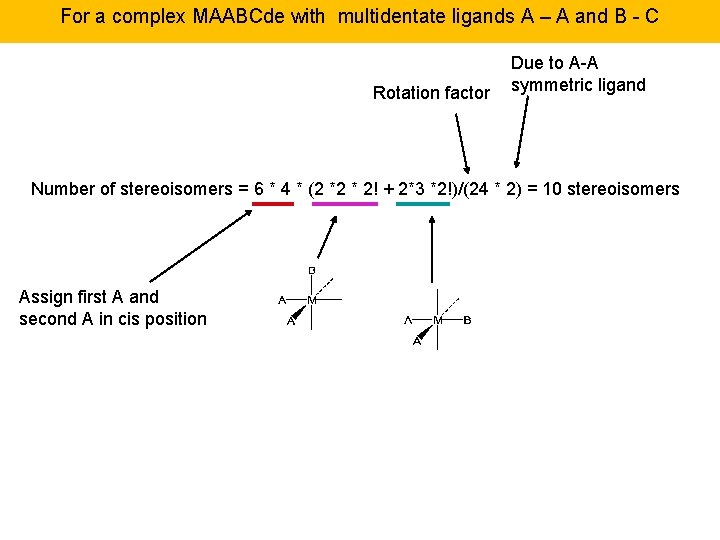
For a complex MAABCde with multidentate ligands A – A and B - C Rotation factor Due to A-A symmetric ligand Number of stereoisomers = 6 * 4 * (2 *2 * 2! + 2*3 *2!)/(24 * 2) = 10 stereoisomers Assign first A and second A in cis position
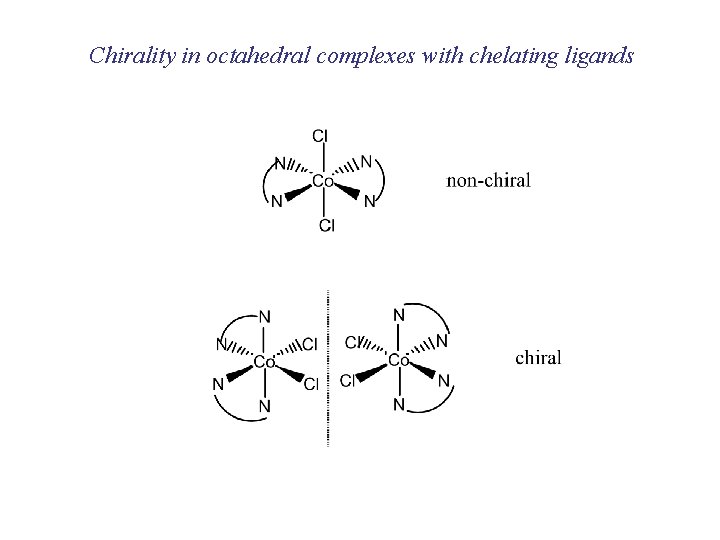
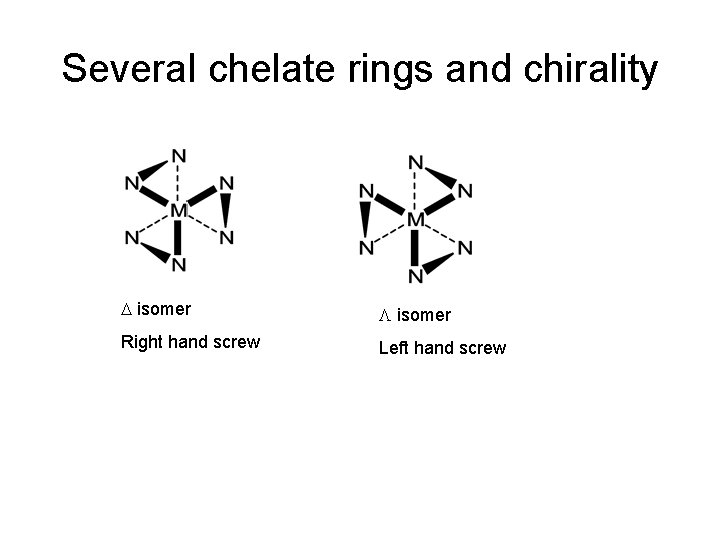
Chirality in octahedral complexes with chelating ligands
Several chelate rings and chirality D isomer L isomer Right hand screw Left hand screw
Conformational Isomers The chelate rings can have alternative conformations.
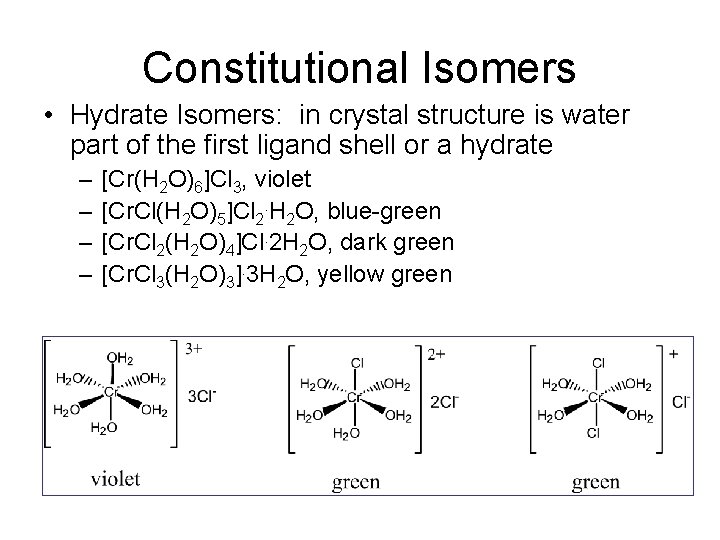
Constitutional Isomers • Hydrate Isomers: in crystal structure is water part of the first ligand shell or a hydrate – – [Cr(H 2 O)6]Cl 3, violet [Cr. Cl(H 2 O)5]Cl 2. H 2 O, blue-green [Cr. Cl 2(H 2 O)4]Cl. 2 H 2 O, dark green [Cr. Cl 3(H 2 O)3]. 3 H 2 O, yellow green
Constitutional Isomers • Ionization isomerization: different ions produced in solution – [Co(NH 3)5 SO 4]NO 3 & [Co(NH 3)5 NO 3] SO 4
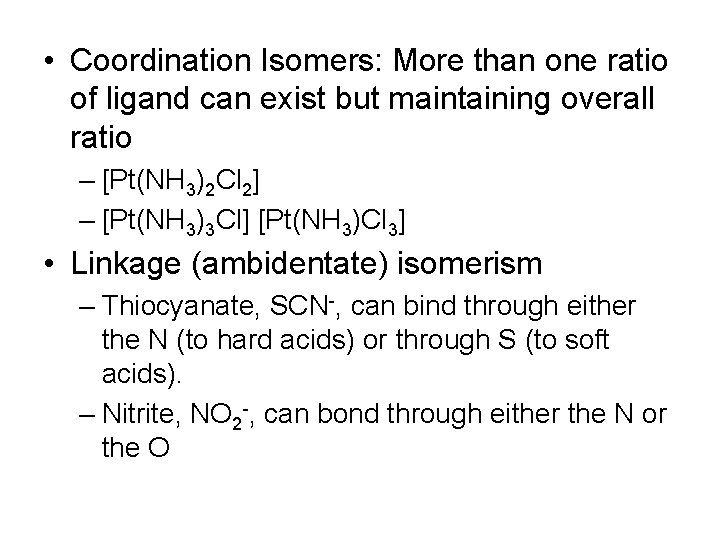
• Coordination Isomers: More than one ratio of ligand can exist but maintaining overall ratio – [Pt(NH 3)2 Cl 2] – [Pt(NH 3)3 Cl] [Pt(NH 3)Cl 3] • Linkage (ambidentate) isomerism – Thiocyanate, SCN-, can bind through either the N (to hard acids) or through S (to soft acids). – Nitrite, NO 2 -, can bond through either the N or the O
Typical coordination numbers and structures of coordination complexes and isomerism
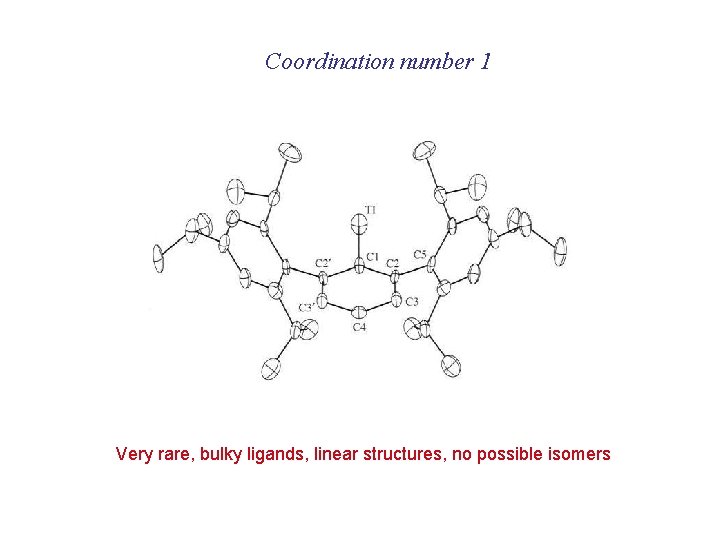
Coordination number 1 Very rare, bulky ligands, linear structures, no possible isomers
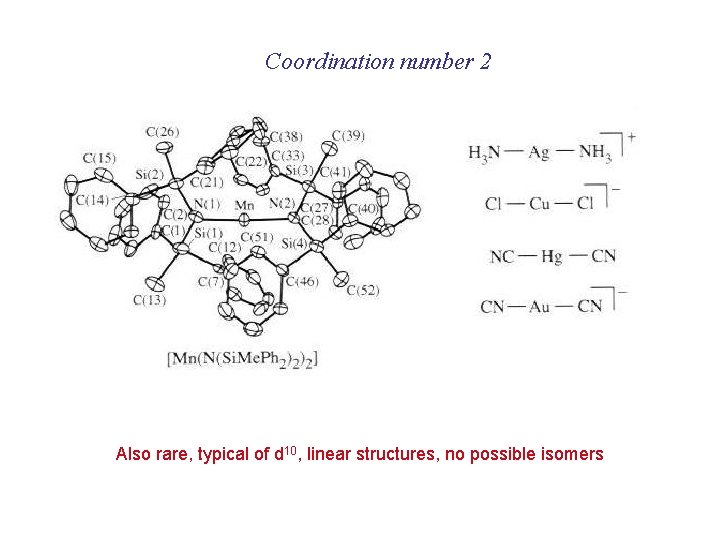
Coordination number 2 Also rare, typical of d 10, linear structures, no possible isomers
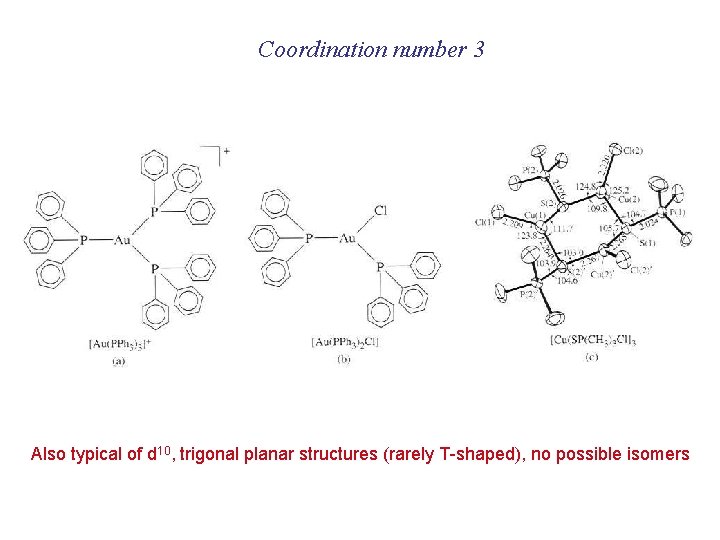
Coordination number 3 Also typical of d 10, trigonal planar structures (rarely T-shaped), no possible isomers
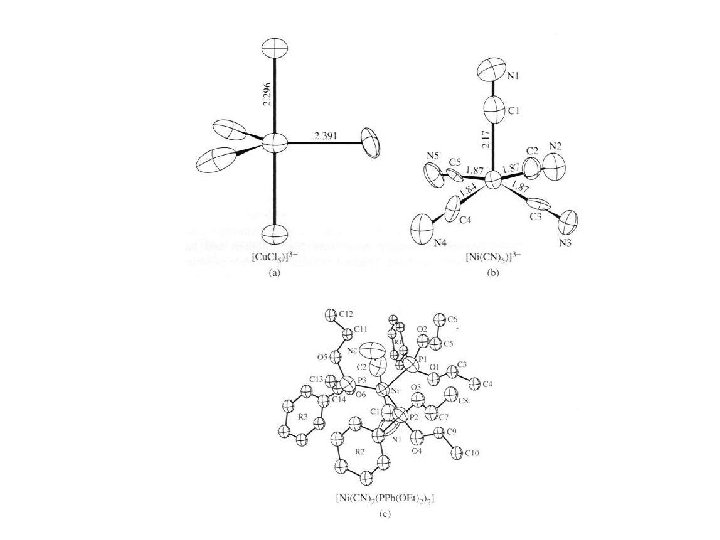
Coordination number 4 Very common Tetrahedral (2 enantiomers if all ligands different) Square planar (2 geometrical isomer for two types of ligands) typical of d 8
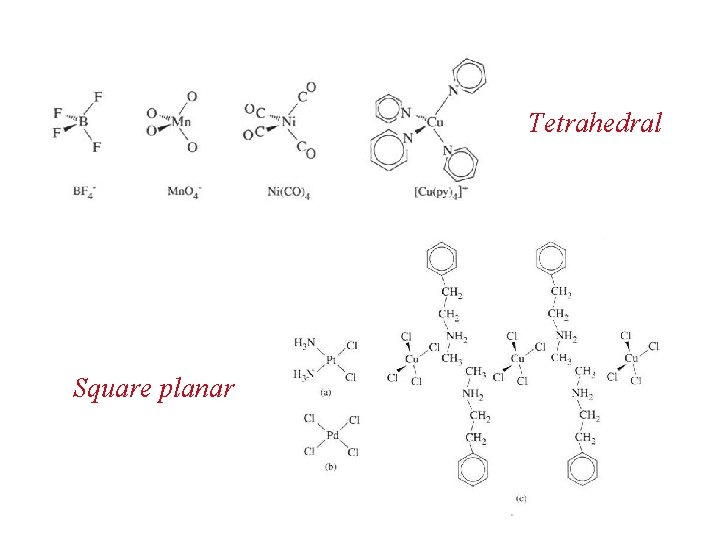
Tetrahedral Square planar
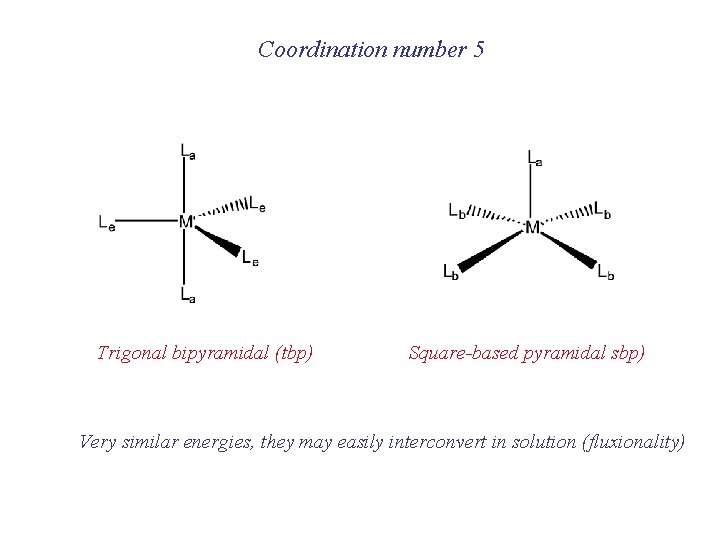
Coordination number 5 Trigonal bipyramidal (tbp) Square-based pyramidal sbp) Very similar energies, they may easily interconvert in solution (fluxionality)
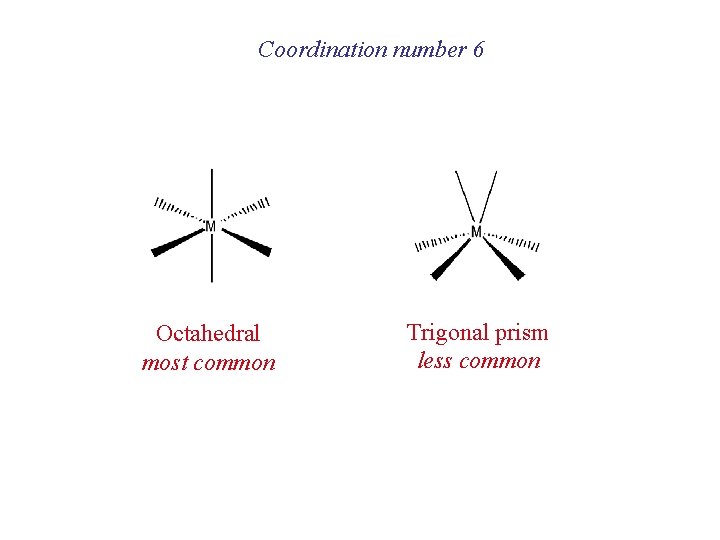
Coordination number 6 Octahedral most common Trigonal prism less common
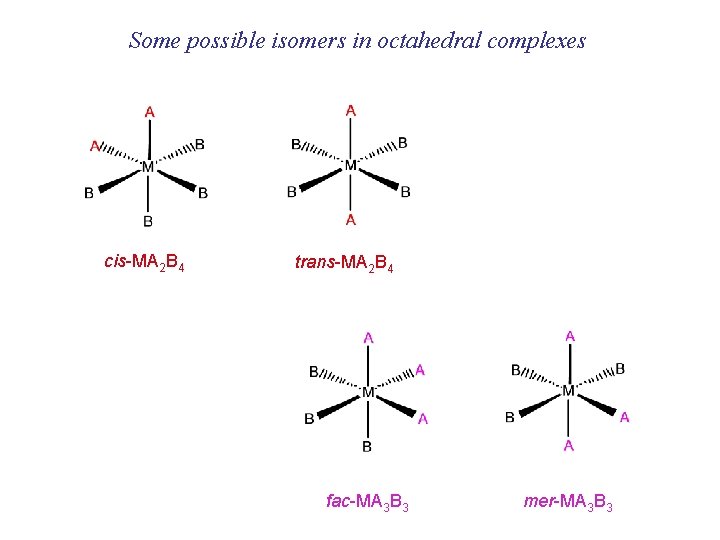
Some possible isomers in octahedral complexes cis-MA 2 B 4 trans-MA 2 B 4 fac-MA 3 B 3 mer-MA 3 B 3
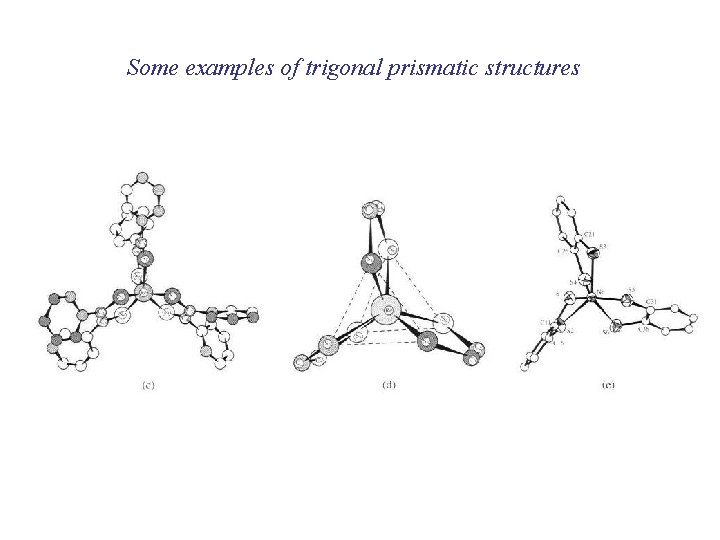
Some examples of trigonal prismatic structures
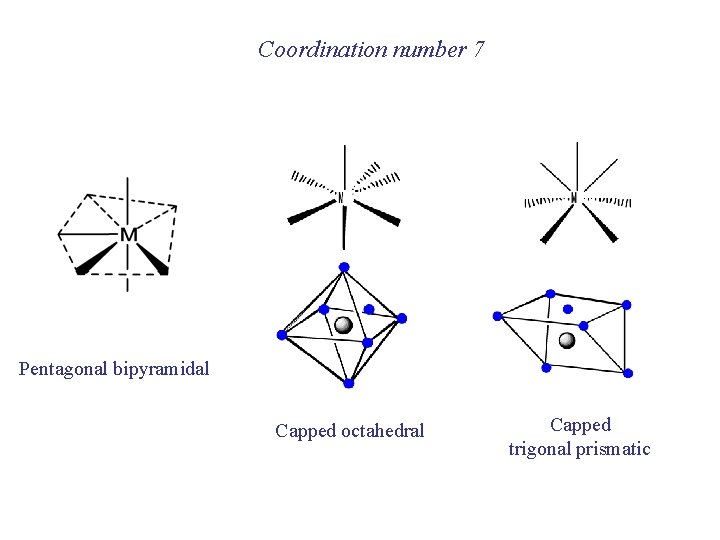
Coordination number 7 Pentagonal bipyramidal Capped octahedral Capped trigonal prismatic
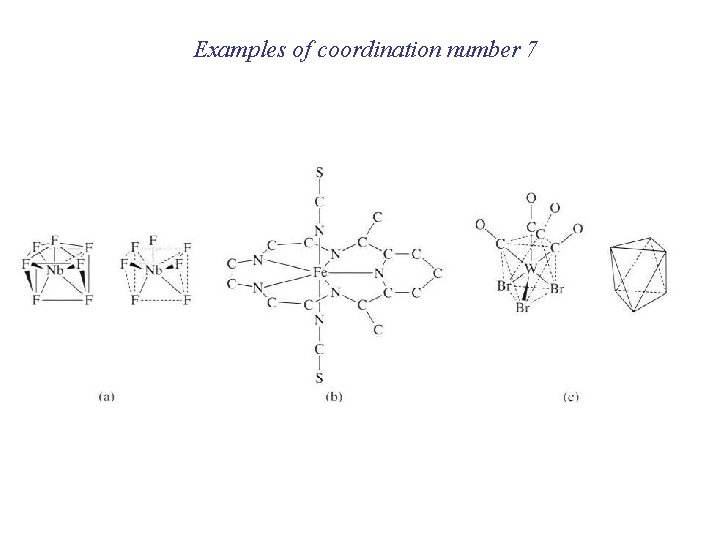
Examples of coordination number 7