May 2001 Paper 2 1 The sets A
- Slides: 11
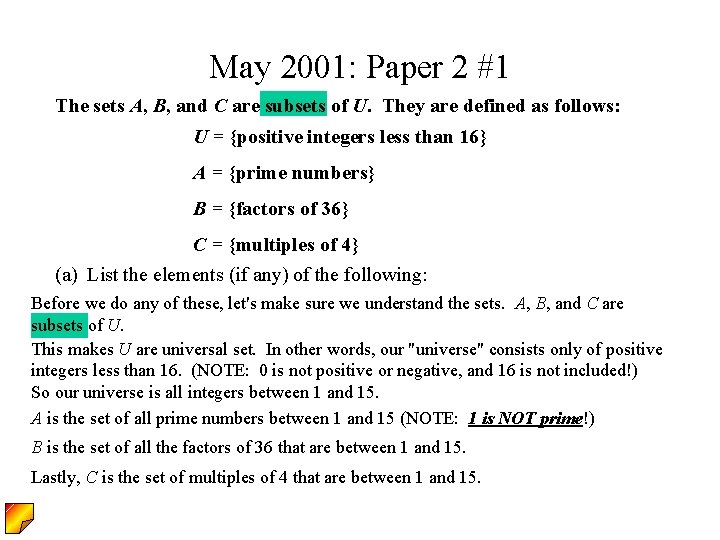
May 2001: Paper 2 #1 The sets A, B, and C are subsets of U. They are defined as follows: U = {positive integers less than 16} A = {prime numbers} B = {factors of 36} C = {multiples of 4} (a) List the elements (if any) of the following: Before we do any of these, let's make sure we understand the sets. A, B, and C are subsets of U. This makes U are universal set. In other words, our "universe" consists only of positive integers less than 16. (NOTE: 0 is not positive or negative, and 16 is not included!) So our universe is all integers between 1 and 15. A is the set of all prime numbers between 1 and 15 (NOTE: 1 is NOT prime!) B is the set of all the factors of 36 that are between 1 and 15. Lastly, C is the set of multiples of 4 that are between 1 and 15.
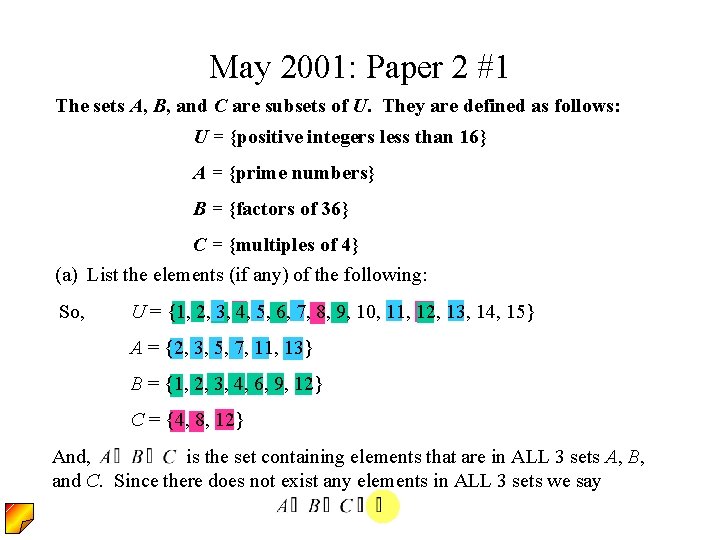
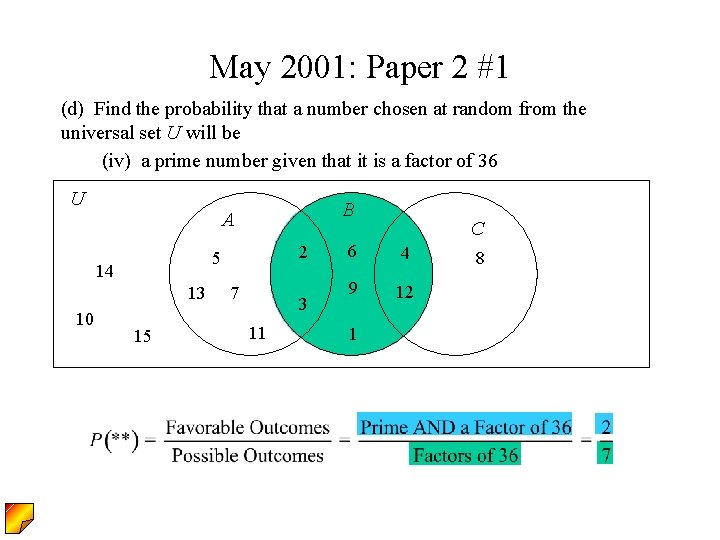
May 2001: Paper 2 #1 The sets A, B, and C are subsets of U. They are defined as follows: U = {positive integers less than 16} A = {prime numbers} B = {factors of 36} C = {multiples of 4} (a) List the elements (if any) of the following: So, U = {1, 2, 3, 4, 5, 6, 7, 8, 9, 10, 11, 12, 13, 14, 15} A = {2, 3, 5, 7, 11, 13} B = {1, 2, 3, 4, 6, 9, 12} C = {4, 8, 12} And, is the set containing elements that are in ALL 3 sets A, B, and C. Since there does not exist any elements in ALL 3 sets we say
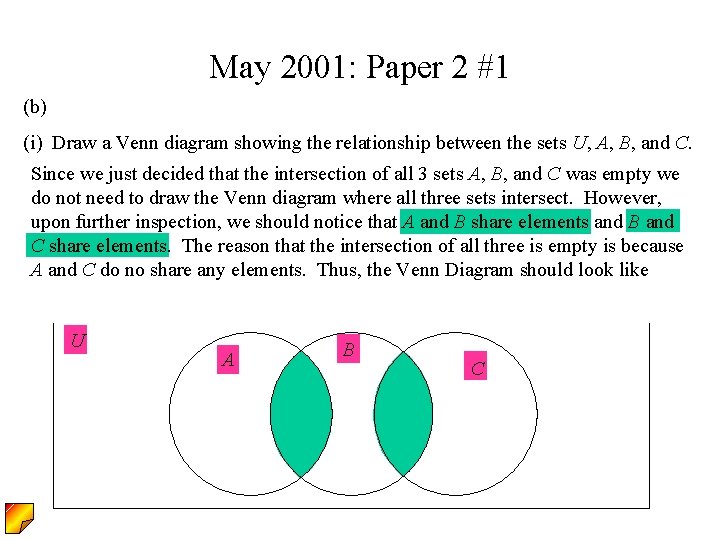
May 2001: Paper 2 #1 (b) (i) Draw a Venn diagram showing the relationship between the sets U, A, B, and C. Since we just decided that the intersection of all 3 sets A, B, and C was empty we do not need to draw the Venn diagram where all three sets intersect. However, upon further inspection, we should notice that A and B share elements and B and C share elements. The reason that the intersection of all three is empty is because A and C do no share any elements. Thus, the Venn Diagram should look like BE SURE TO LABEL ALL FOUR SETS FOR FULL CREDIT!!!! U A B C
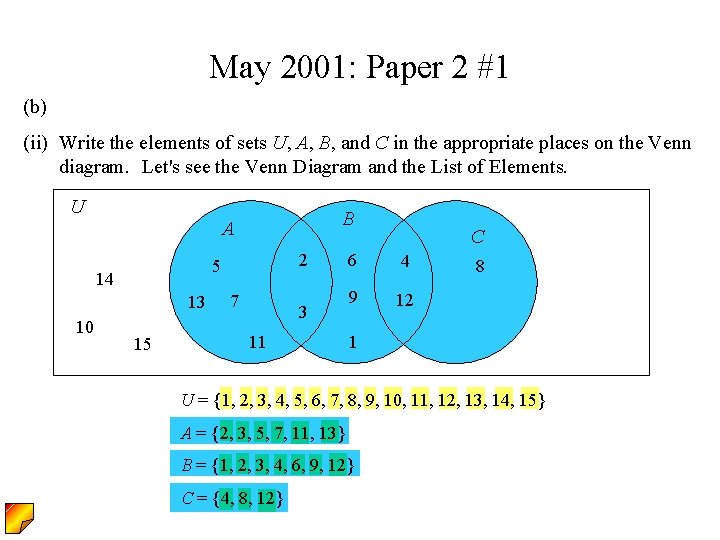
May 2001: Paper 2 #1 (b) (ii) Write the elements of sets U, A, B, and C in the appropriate places on the Venn diagram. Let's see the Venn Diagram and the List of Elements. U 2 5 14 13 10 B A 15 7 3 11 C 6 4 9 12 8 1 U = {1, 2, 3, 4, 5, 6, 7, 8, 9, 10, 11, 12, 13, 14, 15} A = {2, 3, 5, 7, 11, 13} B = {1, 2, 3, 4, 6, 9, 12} C = {4, 8, 12}
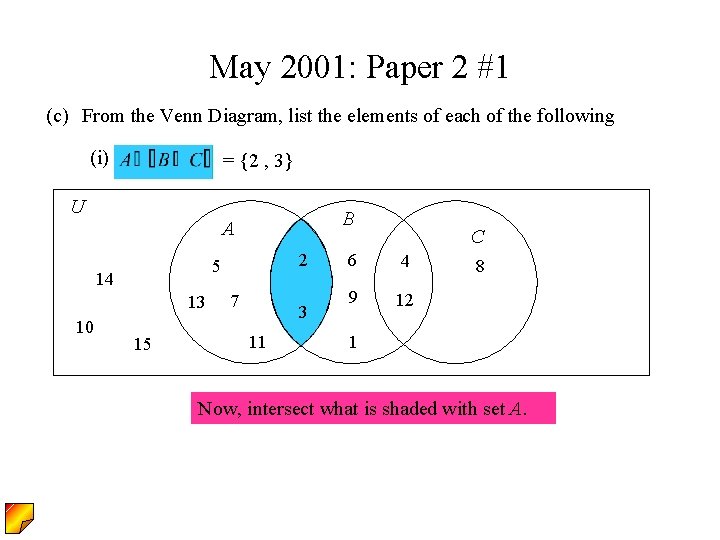
May 2001: Paper 2 #1 (c) From the Venn Diagram, list the elements of each of the following (i) =Means {2 , 3}all elements in B or C together (union). U 2 5 14 13 10 B A 15 7 3 11 C 6 4 9 12 8 1 Now, intersect what is shaded with set A.
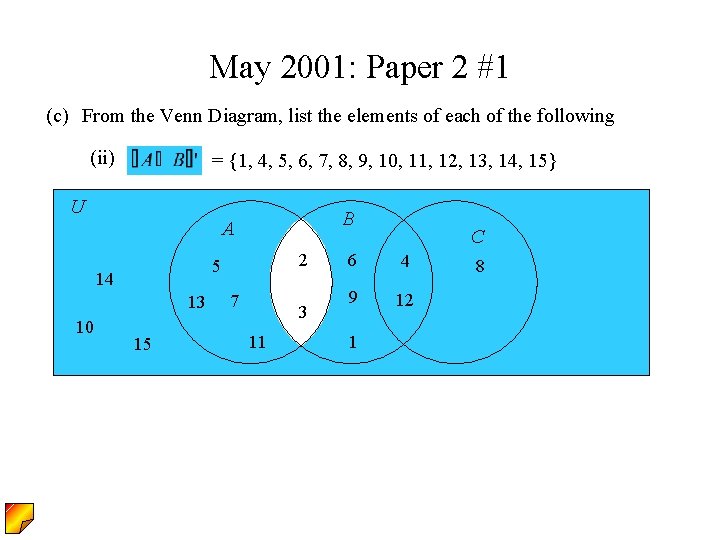
May 2001: Paper 2 #1 (c) From the Venn Diagram, list the elements of each of the following Means "complement"; all 13, elements "NOT" in = {1, 4, 5, 6, 7, 8, 9, 10, 11, 12, 14, 15} (ii) U 2 5 14 13 10 B A 15 7 3 11 C 6 4 9 12 1 8
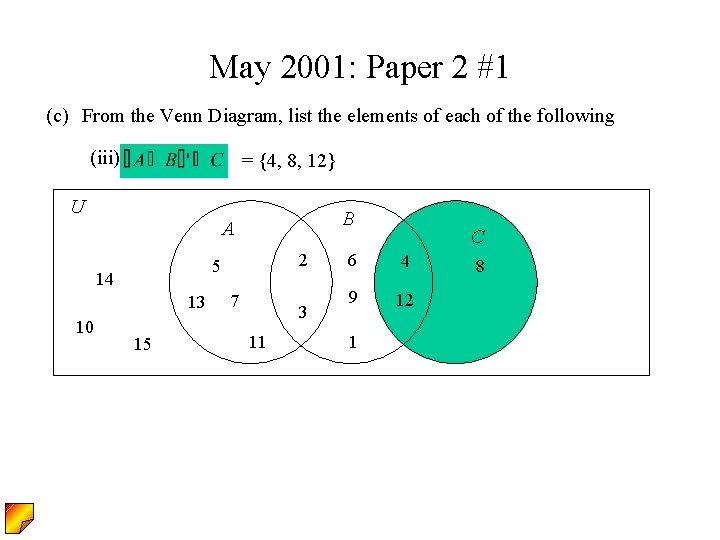
May 2001: Paper 2 #1 (c) From the Venn Diagram, list the elements of each of the following (iii) From the previous problem… = {4, 8, 12} U 2 5 14 13 10 B A 15 7 3 11 C 6 4 9 12 8 1 Now, intersect what is shaded with set C
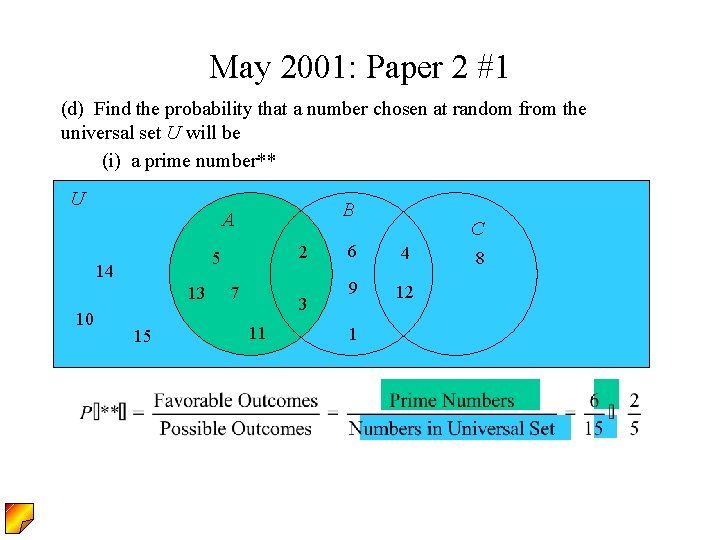
May 2001: Paper 2 #1 (d) Find the probability that a number chosen at random from the universal set U will be (i) a prime number** U 2 5 14 13 10 B A 15 7 3 11 C 6 4 9 12 1 8
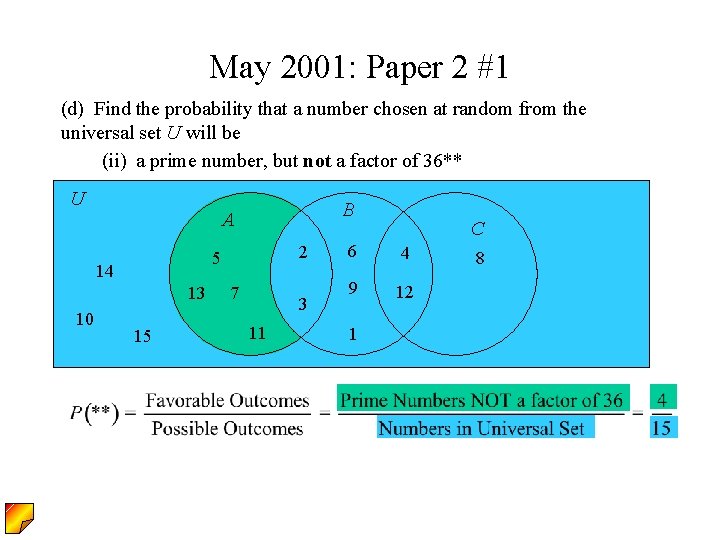
May 2001: Paper 2 #1 (d) Find the probability that a number chosen at random from the universal set U will be (ii) a prime number, but not a factor of 36** U 2 5 14 13 10 B A 15 7 3 11 C 6 4 9 12 1 8
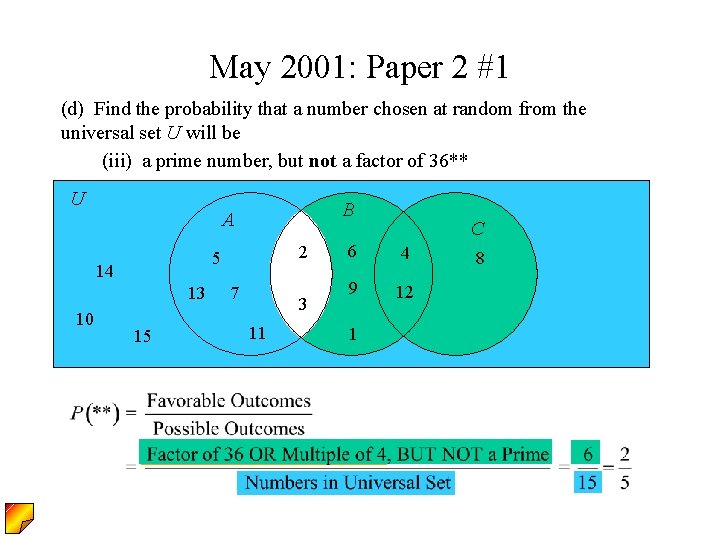
May 2001: Paper 2 #1 (d) Find the probability that a number chosen at random from the universal set U will be (iii) a prime number, but not a factor of 36** U 2 5 14 13 10 B A 15 7 3 11 C 6 4 9 12 1 8
May 2001: Paper 2 #1 (d) Find the probability that a number chosen at random from the universal set U will be (iv) a prime number given that it is a factor of 36 U 2 5 14 13 10 B A 15 7 3 11 C 6 4 9 12 1 8