Mathematical Statistics Lecture 10 Prof Dr M Junaid


- Slides: 29
Mathematical Statistics Lecture 10 Prof. Dr. M. Junaid Mughal 1
Last Class • Introduction to Probability • Additive Rules of Probability • Examples 2
Today’s Agenda • Introduction to Probability (continued) – Conditional Probability 3
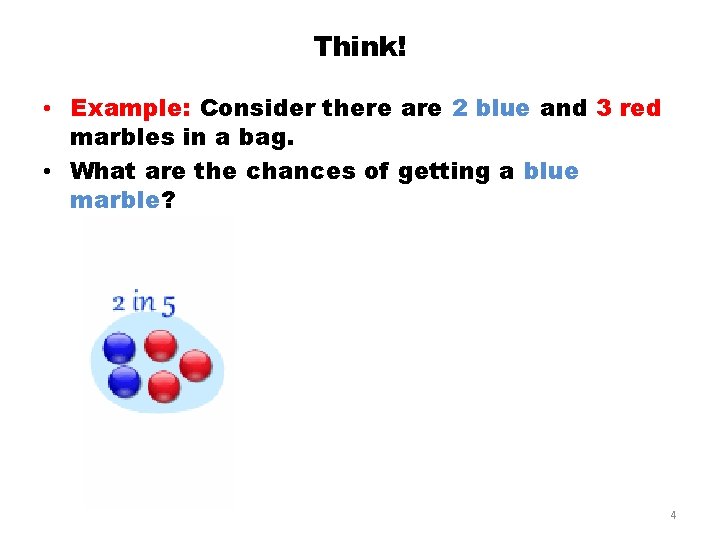
Think! • Example: Consider there are 2 blue and 3 red marbles in a bag. • What are the chances of getting a blue marble? 4
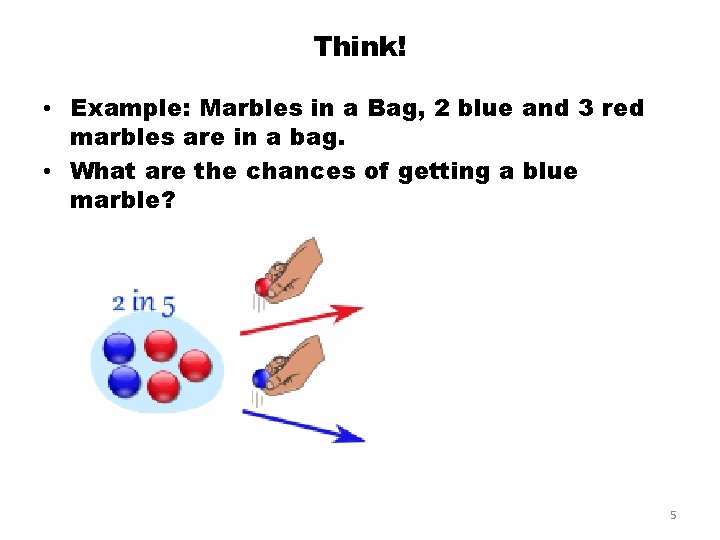
Think! • Example: Marbles in a Bag, 2 blue and 3 red marbles are in a bag. • What are the chances of getting a blue marble? 5
Think! • Example: Marbles in a Bag, 2 blue and 3 red marbles are in a bag. • What are the chances of getting a blue marble? 6
Think! • Example: Marbles in a Bag 2 blue and 3 red marbles are in a bag. • What are the chances of getting a blue marble? The chance is 2 in 5 • But after taking one out you change the chances! • So the next time: • if you got a red marble before, then the chance of a blue marble next is 2 in 4 • if you got a blue marble before, then the chance of a blue marble next is 1 in 4 7
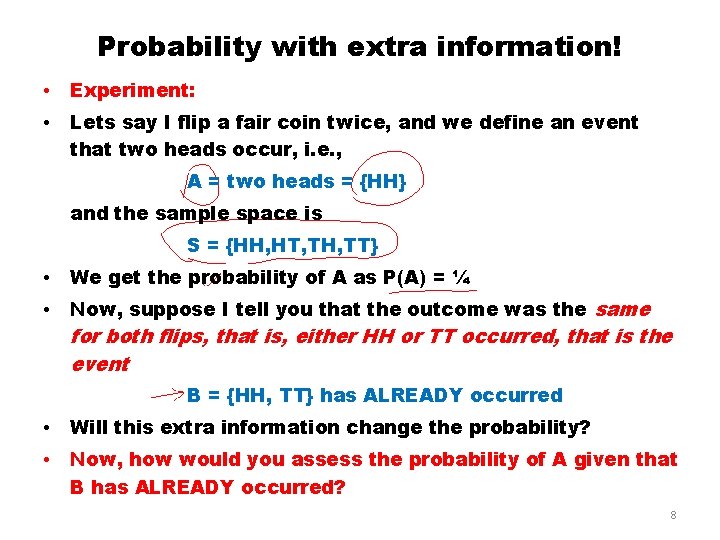
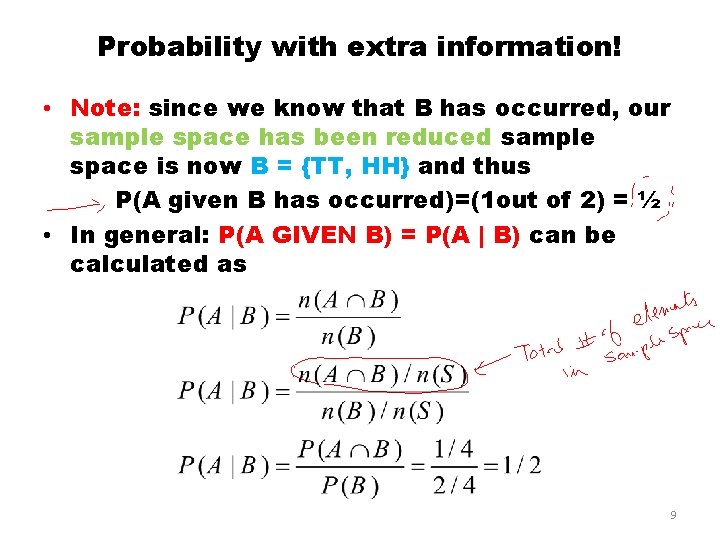
Probability with extra information! • Experiment: • Lets say I flip a fair coin twice, and we define an event that two heads occur, i. e. , A = two heads = {HH} and the sample space is S = {HH, HT, TH, TT} • We get the probability of A as P(A) = ¼ • Now, suppose I tell you that the outcome was the same for both flips, that is, either HH or TT occurred, that is the event B = {HH, TT} has ALREADY occurred • Will this extra information change the probability? • Now, how would you assess the probability of A given that B has ALREADY occurred? 8
Probability with extra information! • Note: since we know that B has occurred, our sample space has been reduced sample space is now B = {TT, HH} and thus P(A given B has occurred)=(1 out of 2) = ½ • In general: P(A GIVEN B) = P(A | B) can be calculated as 9
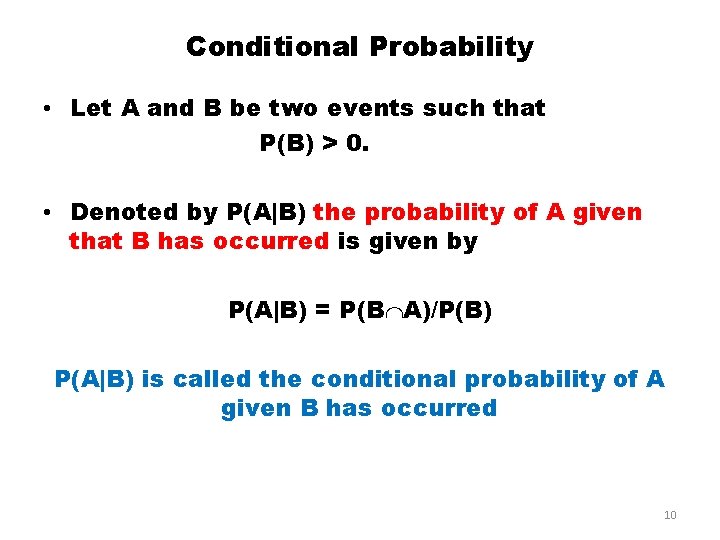
Conditional Probability • Let A and B be two events such that P(B) > 0. • Denoted by P(A|B) the probability of A given that B has occurred is given by P(A|B) = P(B A)/P(B) P(A|B) is called the conditional probability of A given B has occurred 10
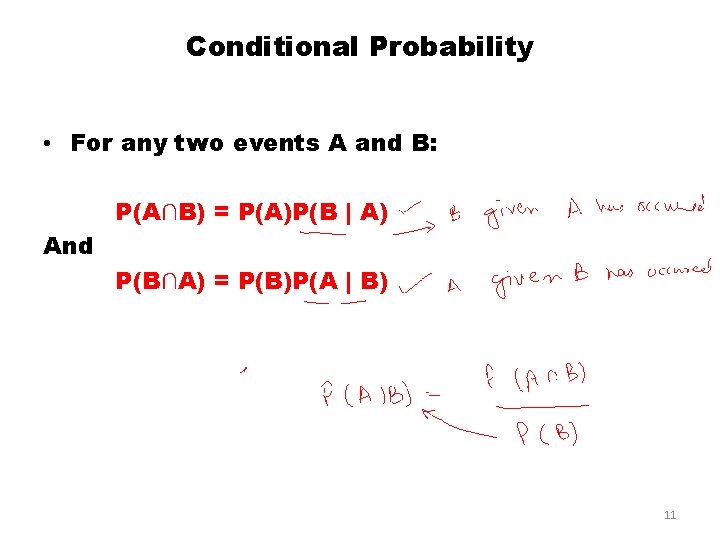
Conditional Probability • For any two events A and B: P(A∩B) = P(A)P(B | A) And P(B∩A) = P(B)P(A | B) 11
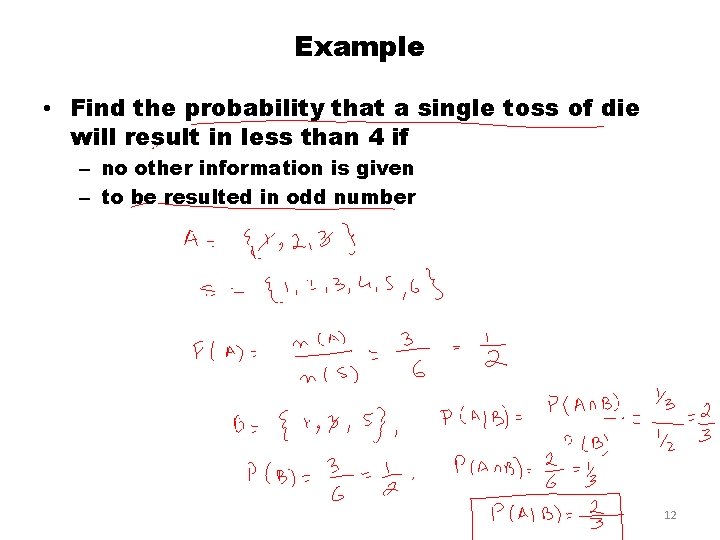
Example • Find the probability that a single toss of die will result in less than 4 if – no other information is given – to be resulted in odd number 12
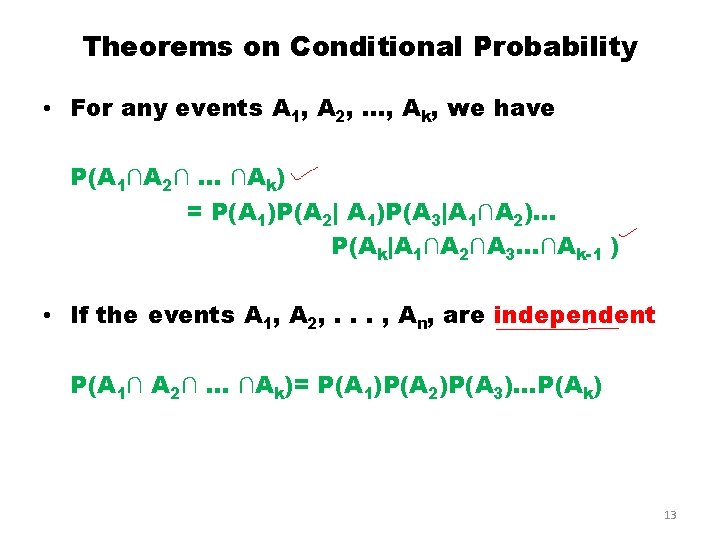
Theorems on Conditional Probability • For any events A 1, A 2, …, Ak, we have P(A 1∩A 2∩ … ∩Ak) = P(A 1)P(A 2| A 1)P(A 3|A 1∩A 2)… P(Ak|A 1∩A 2∩A 3…∩Ak-1 ) • If the events A 1, A 2, . . . , An, are independent P(A 1∩ A 2∩ … ∩Ak)= P(A 1)P(A 2)P(A 3)…P(Ak) 13
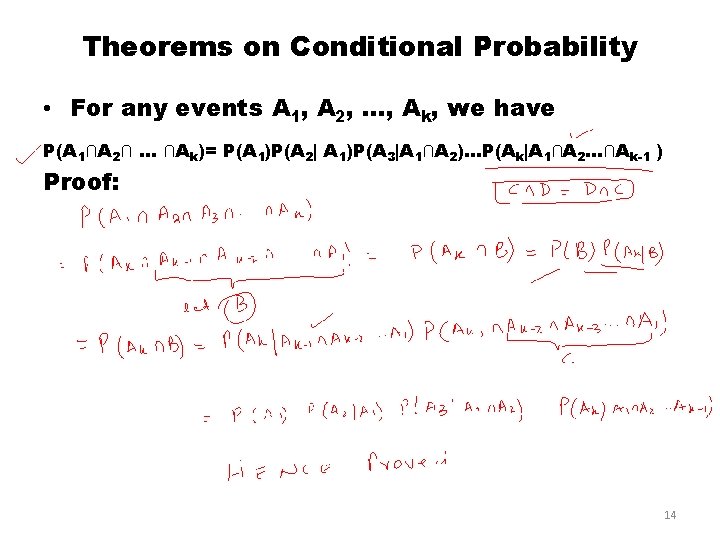
Theorems on Conditional Probability • For any events A 1, A 2, …, Ak, we have P(A 1∩A 2∩ … ∩Ak)= P(A 1)P(A 2| A 1)P(A 3|A 1∩A 2)…P(Ak|A 1∩A 2…∩Ak-1 ) Proof: 14
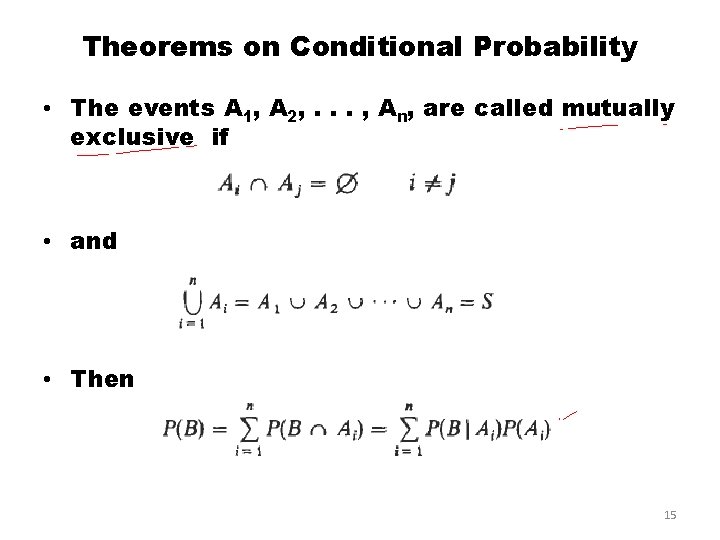
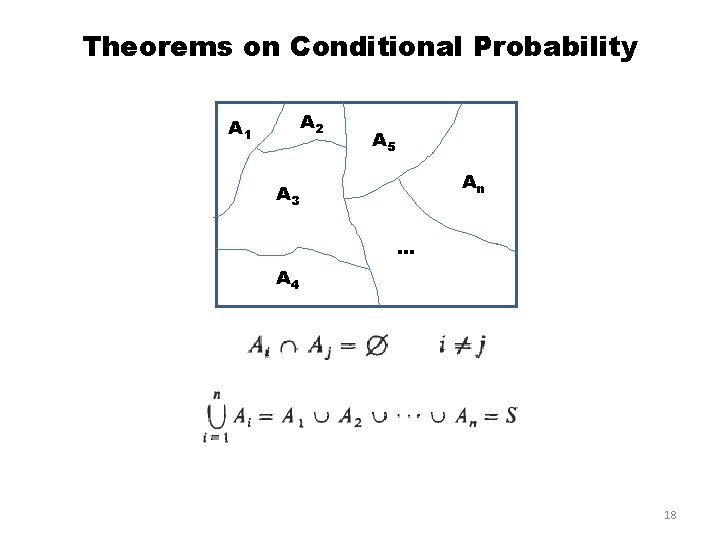
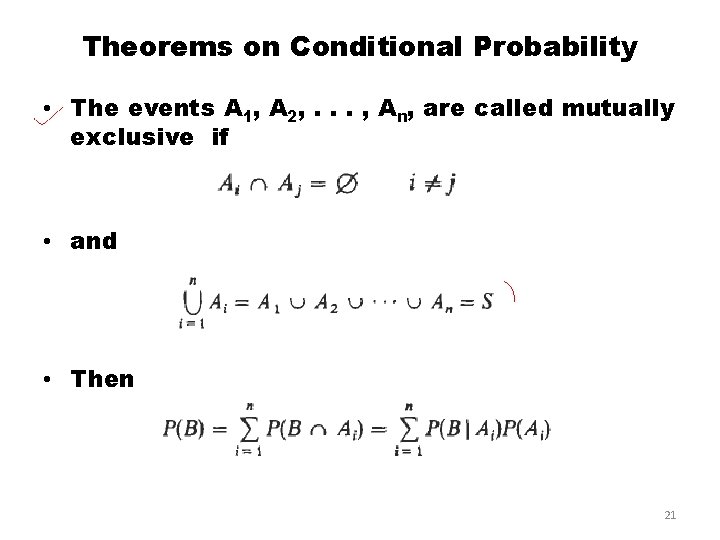
Theorems on Conditional Probability • The events A 1, A 2, . . . , An, are called mutually exclusive if • and • Then 15
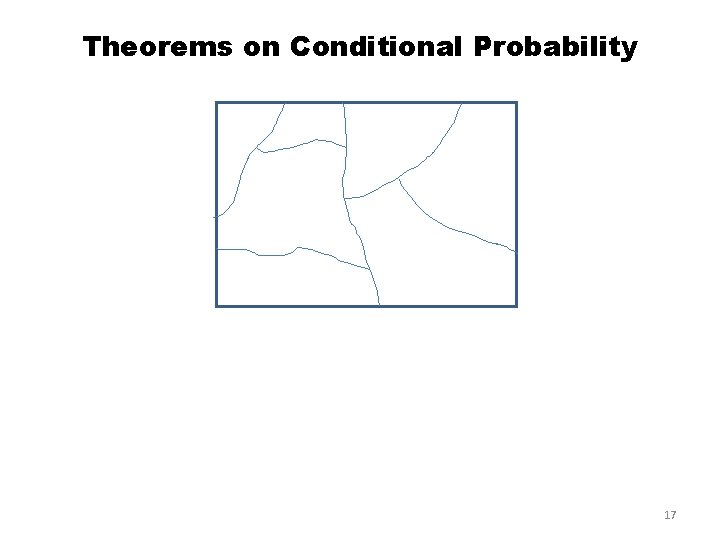
Theorems on Conditional Probability Sample Space 16
Theorems on Conditional Probability 17
Theorems on Conditional Probability A 2 A 1 A 5 An A 3 … A 4 18
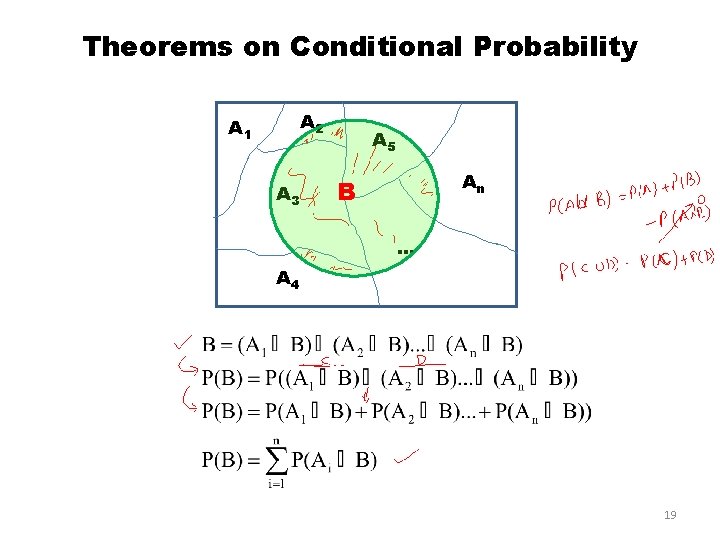
Theorems on Conditional Probability A 2 A 1 A 3 A 5 An B … A 4 19
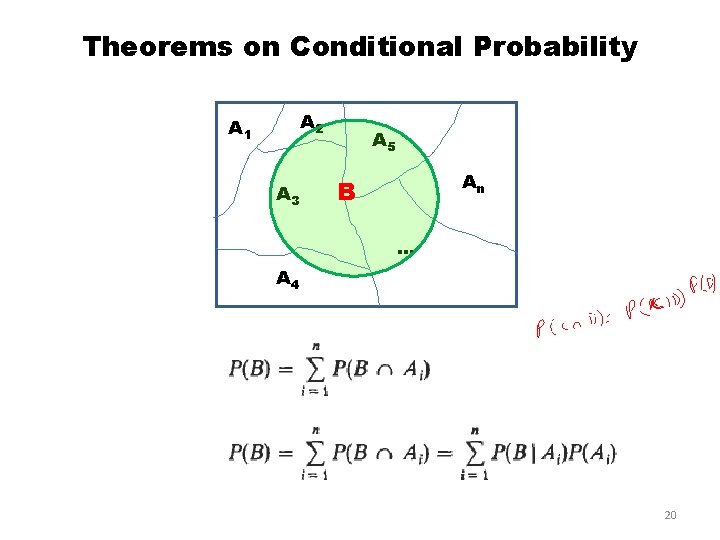
Theorems on Conditional Probability A 2 A 1 A 3 A 5 An B … A 4 20
Theorems on Conditional Probability • The events A 1, A 2, . . . , An, are called mutually exclusive if • and • Then 21
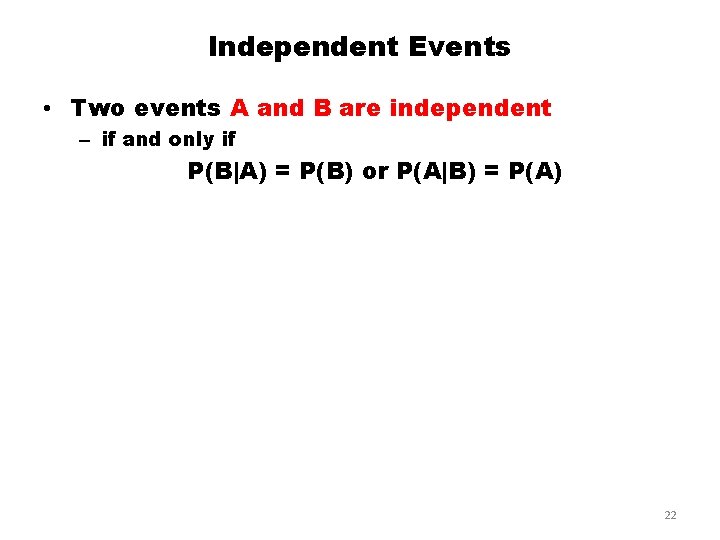
Independent Events • Two events A and B are independent – if and only if P(B|A) = P(B) or P(A|B) = P(A) 22
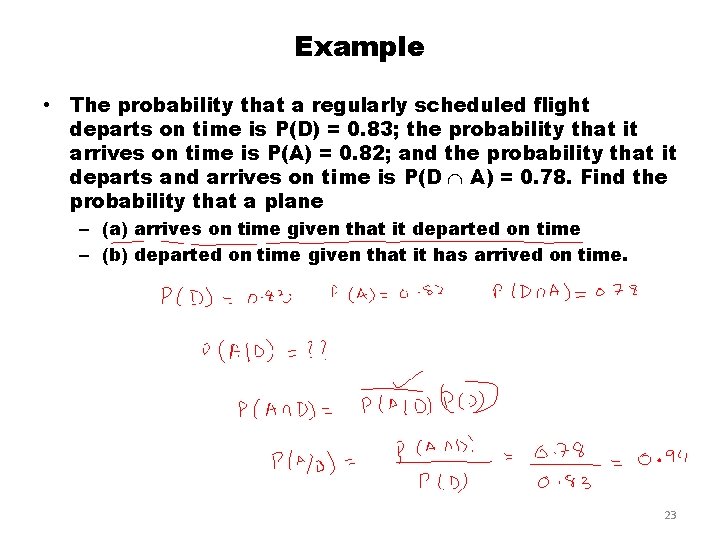
Example • The probability that a regularly scheduled flight departs on time is P(D) = 0. 83; the probability that it arrives on time is P(A) = 0. 82; and the probability that it departs and arrives on time is P(D A) = 0. 78. Find the probability that a plane – (a) arrives on time given that it departed on time – (b) departed on time given that it has arrived on time. 23
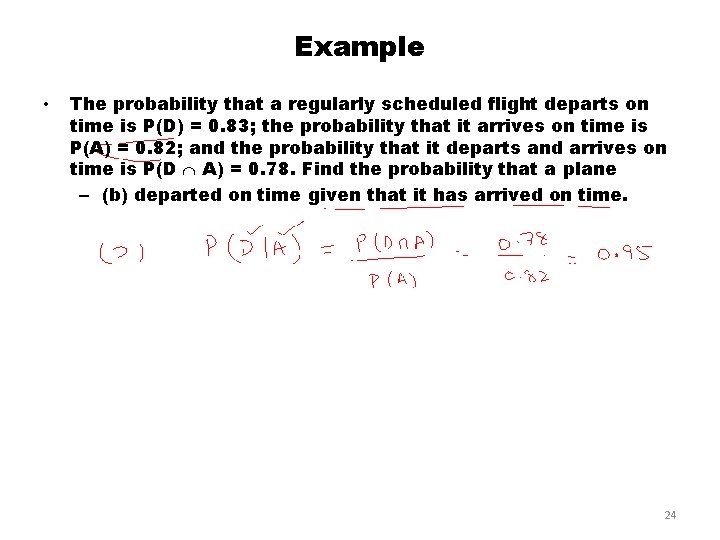
Example • The probability that a regularly scheduled flight departs on time is P(D) = 0. 83; the probability that it arrives on time is P(A) = 0. 82; and the probability that it departs and arrives on time is P(D A) = 0. 78. Find the probability that a plane – (b) departed on time given that it has arrived on time. 24
Example • Suppose that we have a fuse box containing 20 fuses, of which 5 are defective. If 2 fuses are selected at random and removed from the box in succession without replacing the first, what is the probability that both fuses are defective? 25
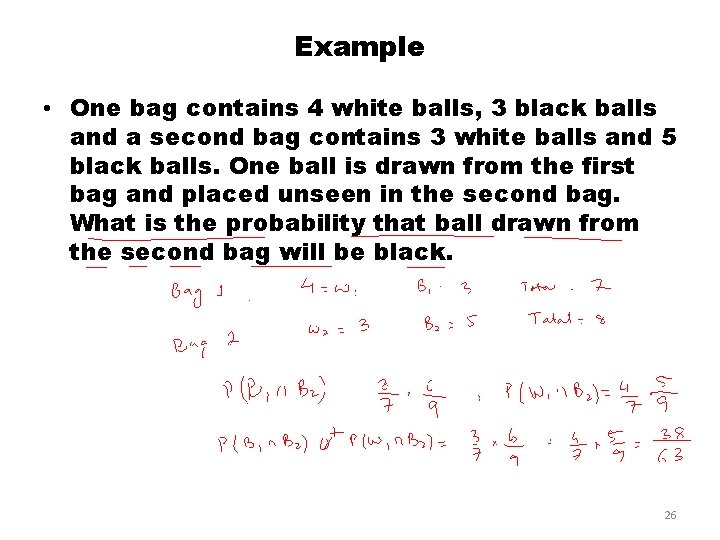
Example • One bag contains 4 white balls, 3 black balls and a second bag contains 3 white balls and 5 black balls. One ball is drawn from the first bag and placed unseen in the second bag. What is the probability that ball drawn from the second bag will be black. 26
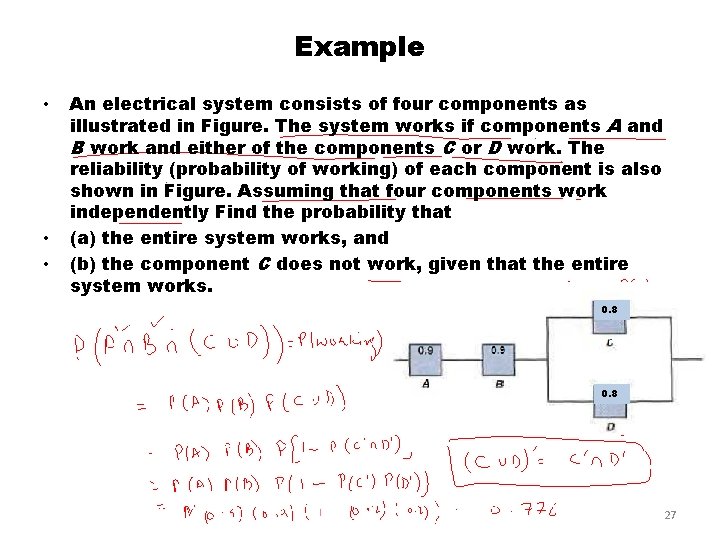
Example • • • An electrical system consists of four components as illustrated in Figure. The system works if components A and B work and either of the components C or D work. The reliability (probability of working) of each component is also shown in Figure. Assuming that four components work independently Find the probability that (a) the entire system works, and (b) the component C does not work, given that the entire system works. 0. 8 27
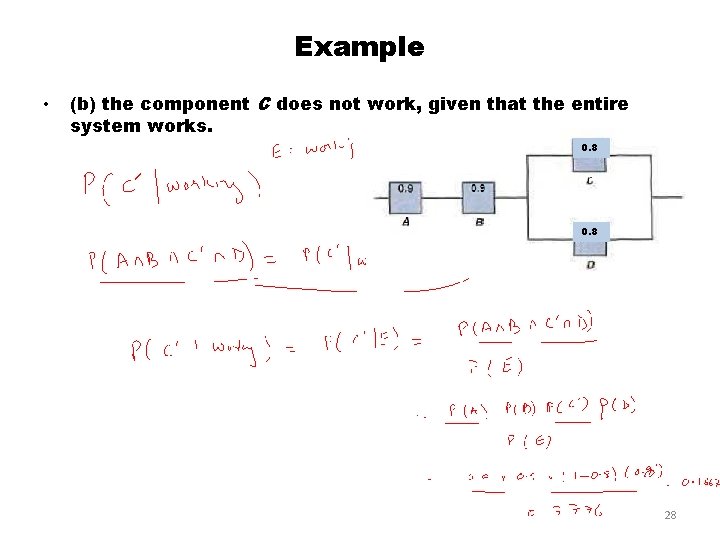
Example • (b) the component C does not work, given that the entire system works. 0. 8 28
Summary • • Introduction to Probability Conditional Probability Independent events Examples References • Probability and Statistics for Engineers and Scientists by Walpole • Schaum outline series in Probability and Statistics 29