Materials Handling Storage Use and Disposal l 29
- Slides: 43
Materials Handling, Storage, Use and Disposal l 29 CFR 1926 – Subpart H Presented by: ETTA, OSH Division, 919 -807 -2875 This presentation was created by the N. C. Department of Labor for safety and health training.
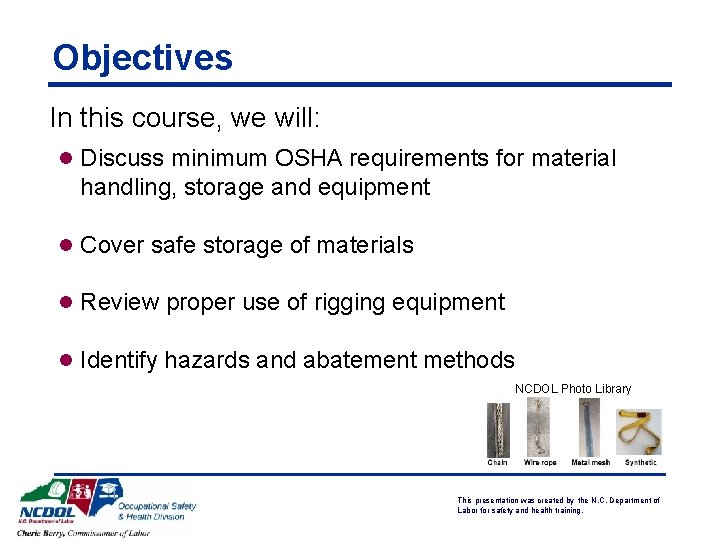
Objectives In this course, we will: l Discuss minimum OSHA requirements for material handling, storage and equipment l Cover safe storage of materials l Review proper use of rigging equipment l Identify hazards and abatement methods NCDOL Photo Library This presentation was created by the N. C. Department of Labor for safety and health training.
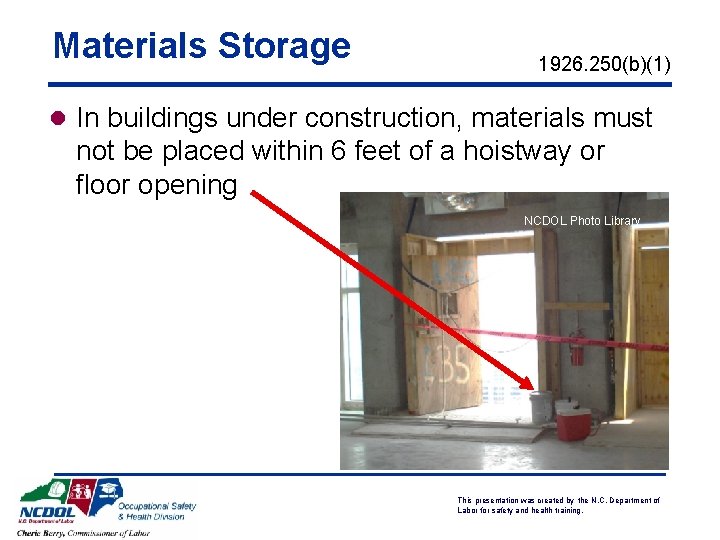
Materials Storage 1926. 250(b)(1) l In buildings under construction, materials must not be placed within 6 feet of a hoistway or floor opening NCDOL Photo Library This presentation was created by the N. C. Department of Labor for safety and health training.
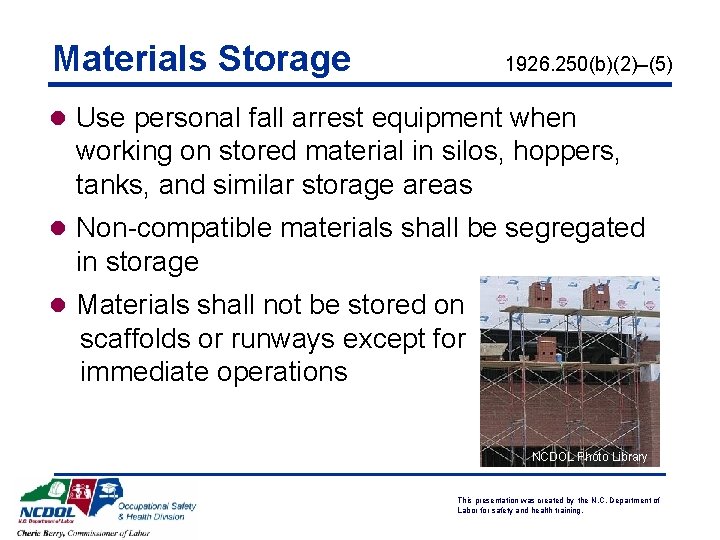
Materials Storage 1926. 250(b)(2)–(5) l Use personal fall arrest equipment when working on stored material in silos, hoppers, tanks, and similar storage areas l Non-compatible materials shall be segregated in storage l Materials shall not be stored on scaffolds or runways except for immediate operations NCDOL Photo Library This presentation was created by the N. C. Department of Labor for safety and health training.
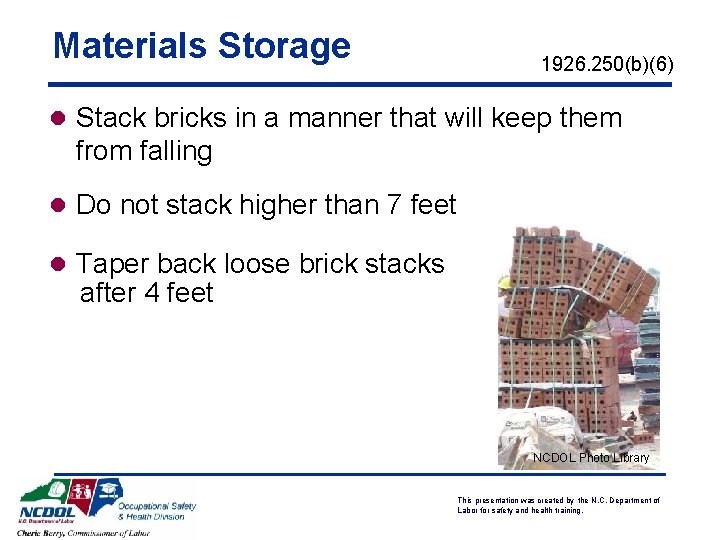
Materials Storage 1926. 250(b)(6) l Stack bricks in a manner that will keep them from falling l Do not stack higher than 7 feet l Taper back loose brick stacks after 4 feet NCDOL Photo Library This presentation was created by the N. C. Department of Labor for safety and health training.
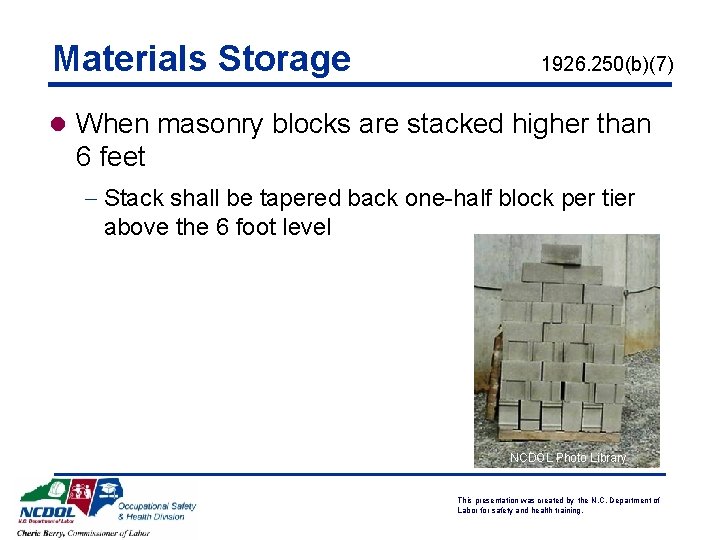
Materials Storage 1926. 250(b)(7) l When masonry blocks are stacked higher than 6 feet - Stack shall be tapered back one-half block per tier above the 6 foot level NCDOL Photo Library This presentation was created by the N. C. Department of Labor for safety and health training.
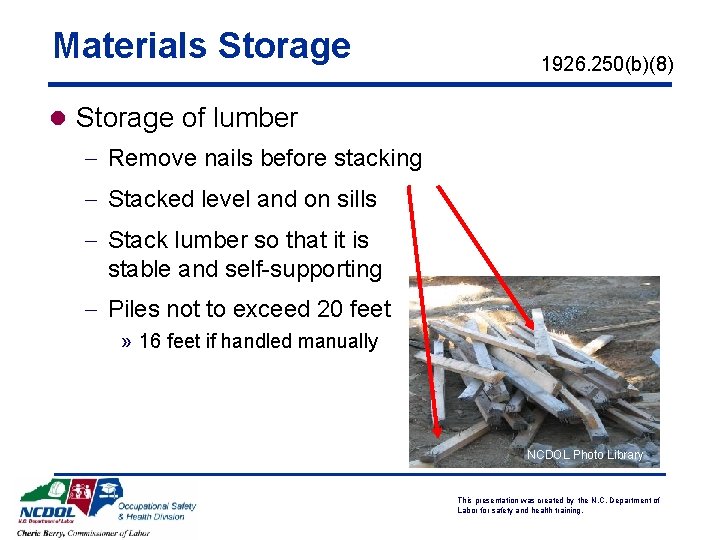
Materials Storage 1926. 250(b)(8) l Storage of lumber - Remove nails before stacking - Stacked level and on sills - Stack lumber so that it is stable and self-supporting - Piles not to exceed 20 feet » 16 feet if handled manually NCDOL Photo Library This presentation was created by the N. C. Department of Labor for safety and health training.
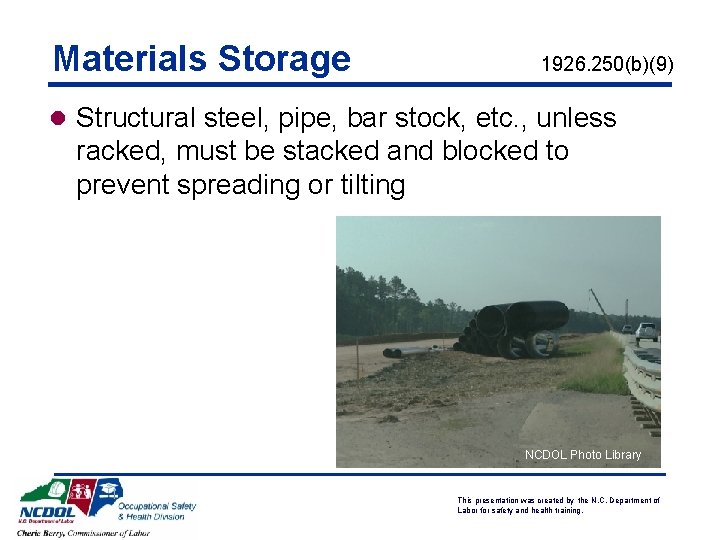
Materials Storage 1926. 250(b)(9) l Structural steel, pipe, bar stock, etc. , unless racked, must be stacked and blocked to prevent spreading or tilting NCDOL Photo Library This presentation was created by the N. C. Department of Labor for safety and health training.
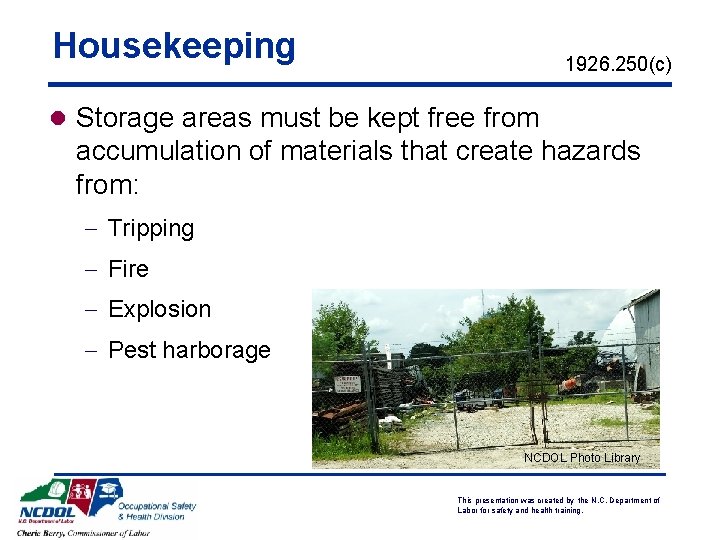
Housekeeping 1926. 250(c) l Storage areas must be kept free from accumulation of materials that create hazards from: - Tripping - Fire - Explosion - Pest harborage NCDOL Photo Library This presentation was created by the N. C. Department of Labor for safety and health training.
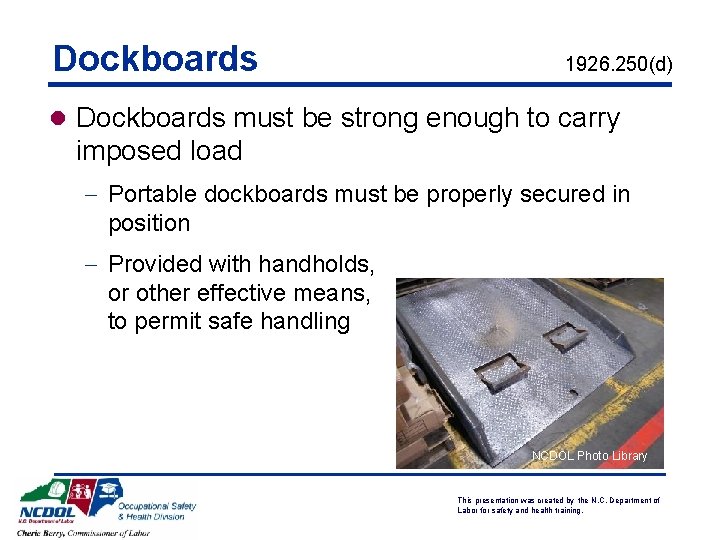
Dockboards 1926. 250(d) l Dockboards must be strong enough to carry imposed load - Portable dockboards must be properly secured in position - Provided with handholds, or other effective means, to permit safe handling NCDOL Photo Library This presentation was created by the N. C. Department of Labor for safety and health training.
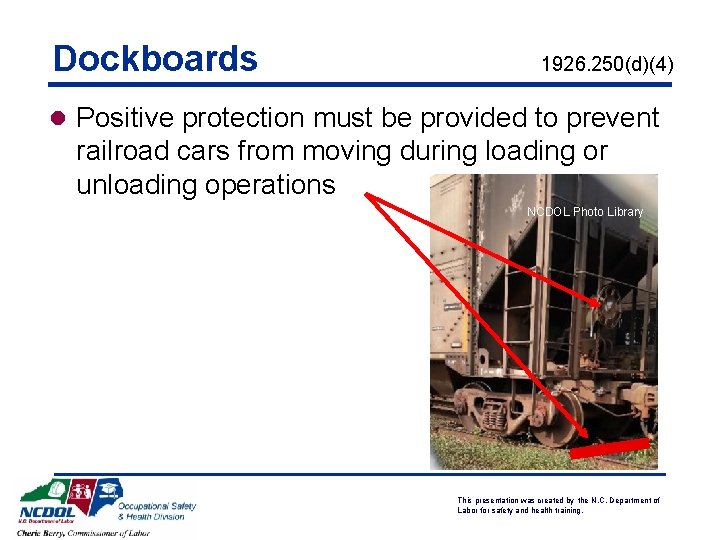
Dockboards 1926. 250(d)(4) l Positive protection must be provided to prevent railroad cars from moving during loading or unloading operations NCDOL Photo Library This presentation was created by the N. C. Department of Labor for safety and health training.
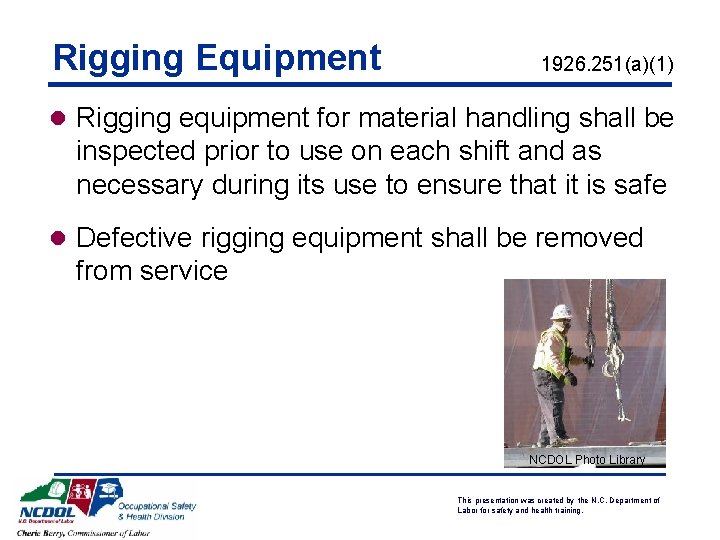
Rigging Equipment 1926. 251(a)(1) l Rigging equipment for material handling shall be inspected prior to use on each shift and as necessary during its use to ensure that it is safe l Defective rigging equipment shall be removed from service NCDOL Photo Library This presentation was created by the N. C. Department of Labor for safety and health training.
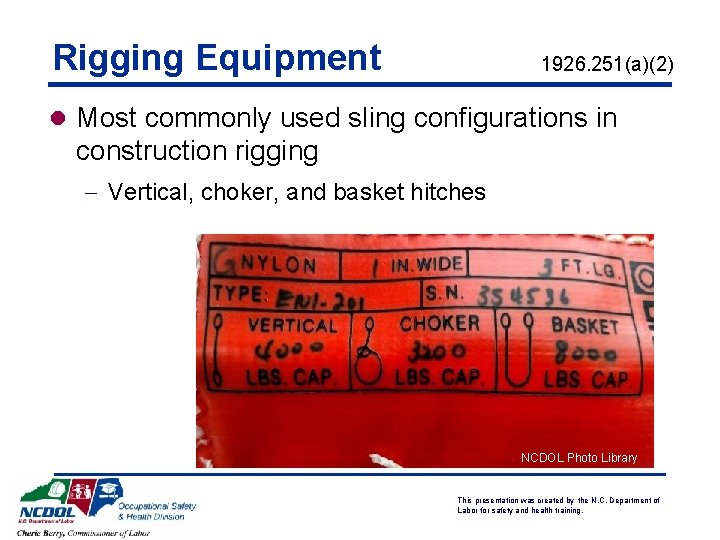
Rigging Equipment 1926. 251(a)(2) l Most commonly used sling configurations in construction rigging - Vertical, choker, and basket hitches NCDOL Photo Library This presentation was created by the N. C. Department of Labor for safety and health training.
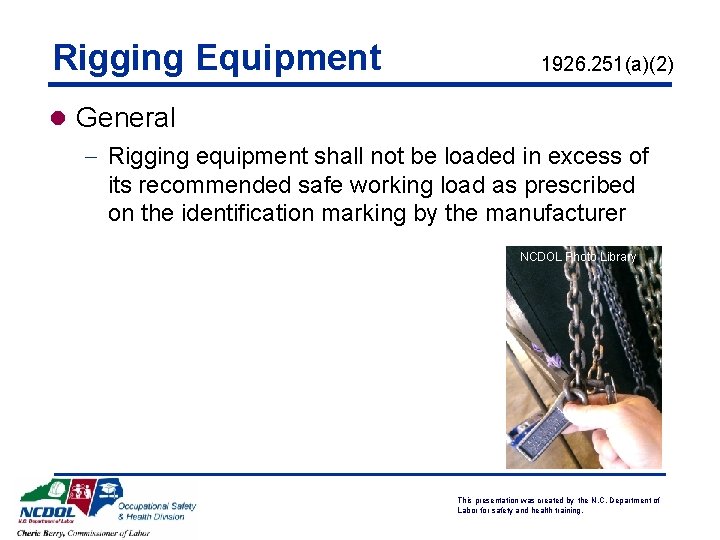
Rigging Equipment 1926. 251(a)(2) l General - Rigging equipment shall not be loaded in excess of its recommended safe working load as prescribed on the identification marking by the manufacturer NCDOL Photo Library This presentation was created by the N. C. Department of Labor for safety and health training.
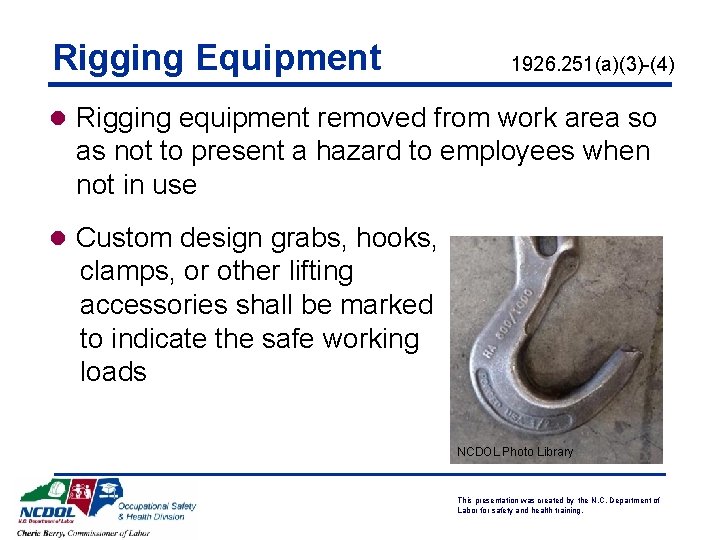
Rigging Equipment 1926. 251(a)(3)-(4) l Rigging equipment removed from work area so as not to present a hazard to employees when not in use l Custom design grabs, hooks, clamps, or other lifting accessories shall be marked to indicate the safe working loads NCDOL Photo Library This presentation was created by the N. C. Department of Labor for safety and health training.
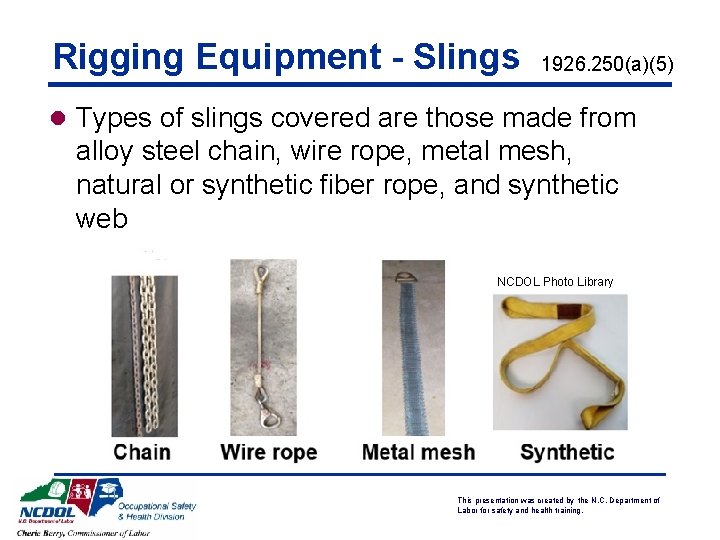
Rigging Equipment - Slings 1926. 250(a)(5) l Types of slings covered are those made from alloy steel chain, wire rope, metal mesh, natural or synthetic fiber rope, and synthetic web NCDOL Photo Library This presentation was created by the N. C. Department of Labor for safety and health training.
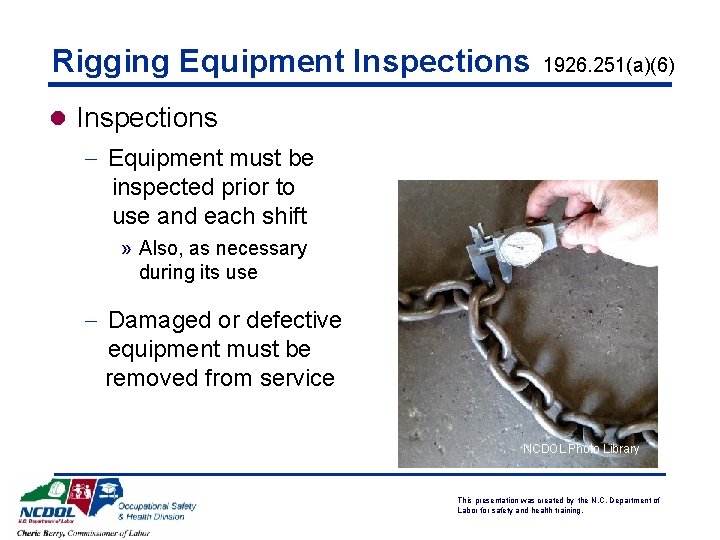
Rigging Equipment Inspections 1926. 251(a)(6) l Inspections - Equipment must be inspected prior to use and each shift » Also, as necessary during its use - Damaged or defective equipment must be removed from service NCDOL Photo Library This presentation was created by the N. C. Department of Labor for safety and health training.
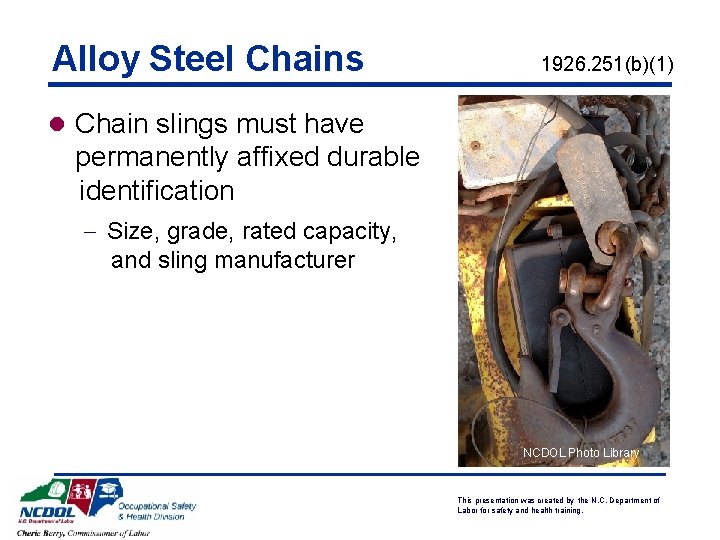
Alloy Steel Chains 1926. 251(b)(1) l Chain slings must have permanently affixed durable identification stating - Size, grade, rated capacity, and sling manufacturer NCDOL Photo Library This presentation was created by the N. C. Department of Labor for safety and health training.
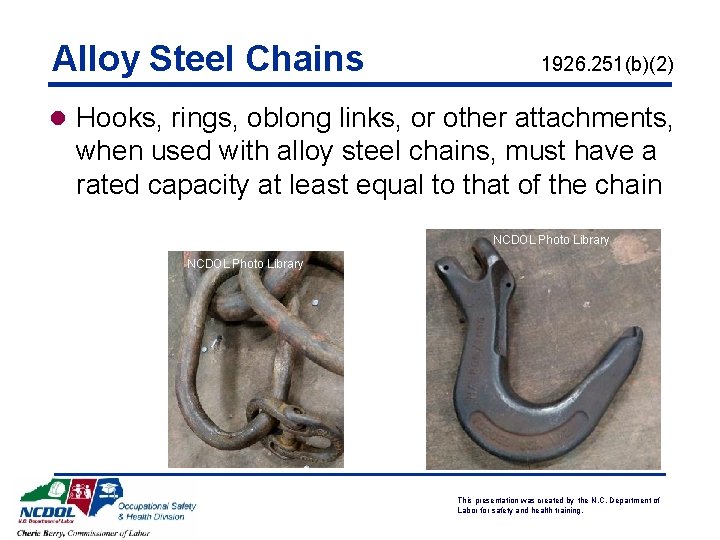
Alloy Steel Chains 1926. 251(b)(2) l Hooks, rings, oblong links, or other attachments, when used with alloy steel chains, must have a rated capacity at least equal to that of the chain NCDOL Photo Library This presentation was created by the N. C. Department of Labor for safety and health training.
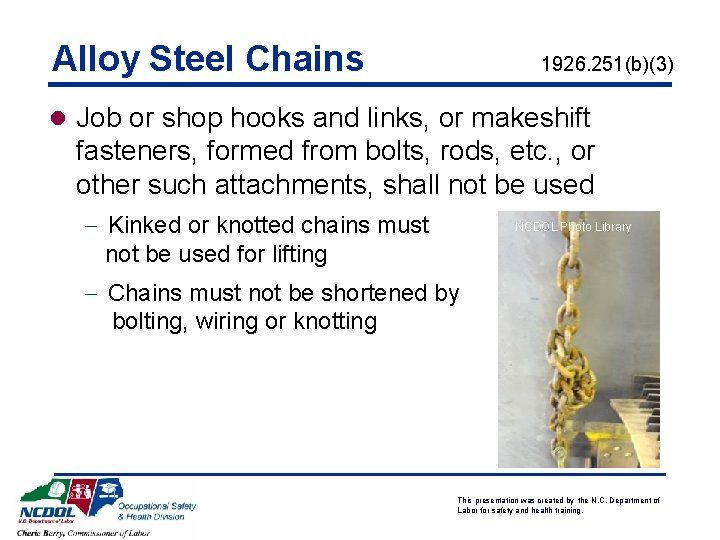
Alloy Steel Chains 1926. 251(b)(3) l Job or shop hooks and links, or makeshift fasteners, formed from bolts, rods, etc. , or other such attachments, shall not be used - Kinked or knotted chains must not be used for lifting NCDOL Photo Library - Chains must not be shortened by bolting, wiring or knotting This presentation was created by the N. C. Department of Labor for safety and health training.
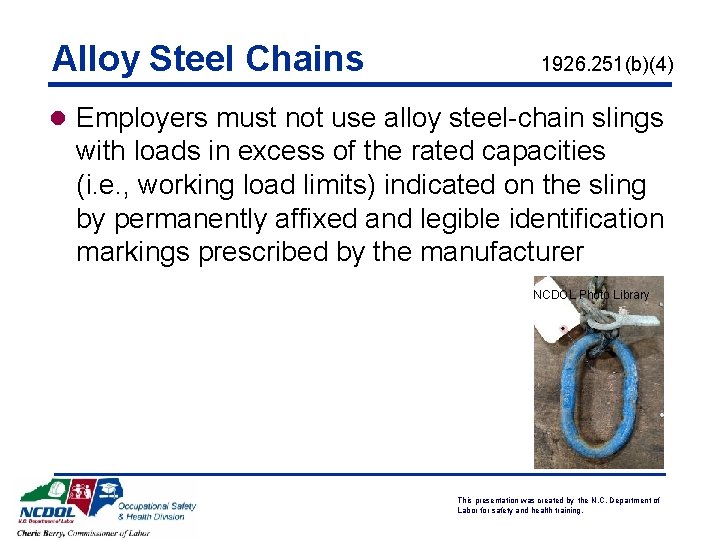
Alloy Steel Chains 1926. 251(b)(4) l Employers must not use alloy steel-chain slings with loads in excess of the rated capacities (i. e. , working load limits) indicated on the sling by permanently affixed and legible identification markings prescribed by the manufacturer NCDOL Photo Library This presentation was created by the N. C. Department of Labor for safety and health training.
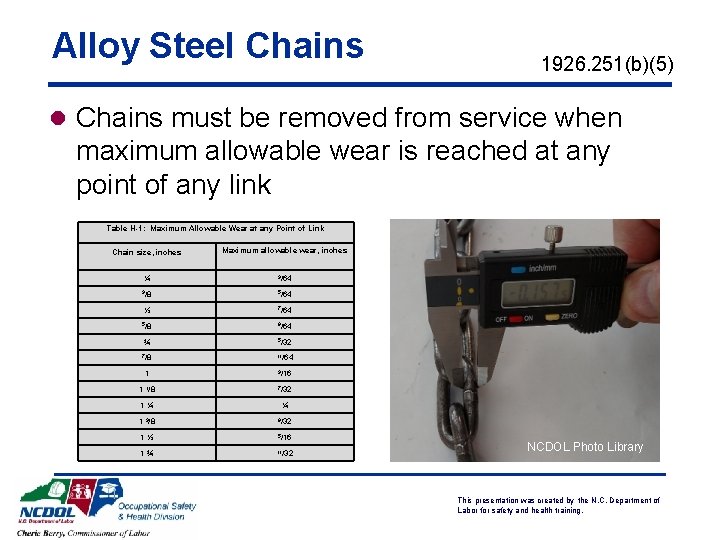
Alloy Steel Chains 1926. 251(b)(5) l Chains must be removed from service when maximum allowable wear is reached at any point of any link Table H-1: Maximum Allowable Wear at any Point of Link Chain size, inches Maximum allowable wear, inches ¼ 3/64 3/8 5/64 ½ 7/64 5/8 9/64 ¾ 5/32 7/8 11/64 1 3/16 1 1/8 7/32 1¼ 1 ¼ 3/8 9/32 1½ 5/16 1¾ 11/32 NCDOL Photo Library This presentation was created by the N. C. Department of Labor for safety and health training.
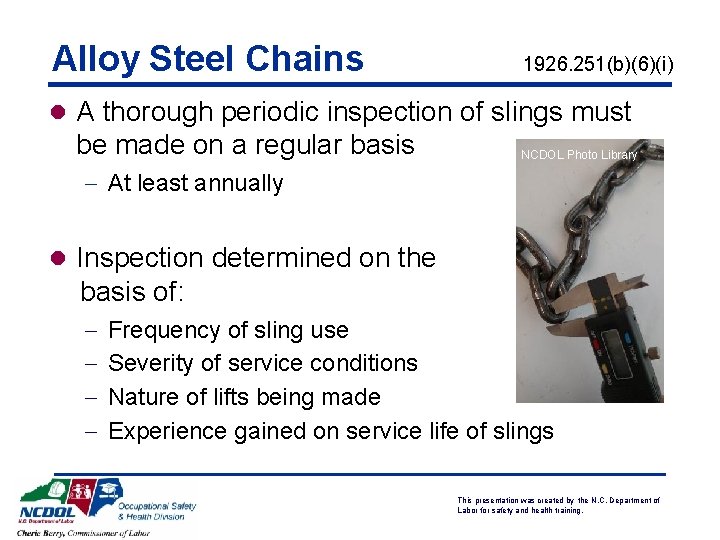
Alloy Steel Chains 1926. 251(b)(6)(i) l A thorough periodic inspection of slings must be made on a regular basis NCDOL Photo Library - At least annually l Inspection determined on the basis of: - Frequency of sling use Severity of service conditions Nature of lifts being made Experience gained on service life of slings This presentation was created by the N. C. Department of Labor for safety and health training.
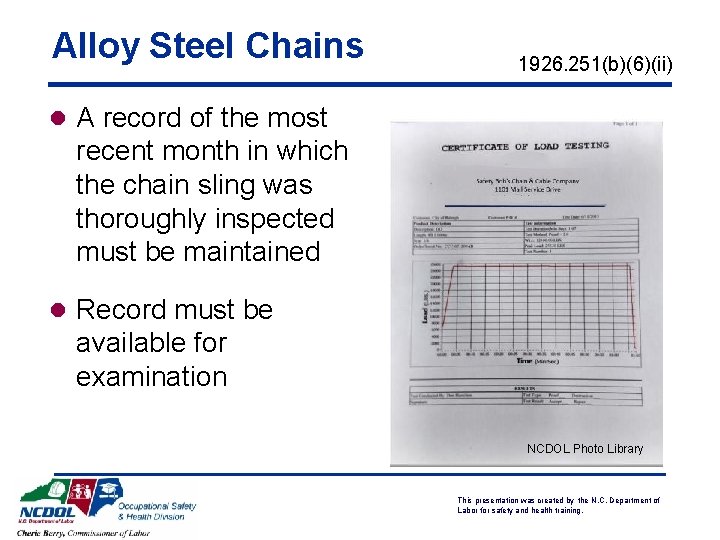
Alloy Steel Chains 1926. 251(b)(6)(ii) l A record of the most recent month in which the chain sling was thoroughly inspected must be maintained l Record must be available for examination NCDOL Photo Library This presentation was created by the N. C. Department of Labor for safety and health training.
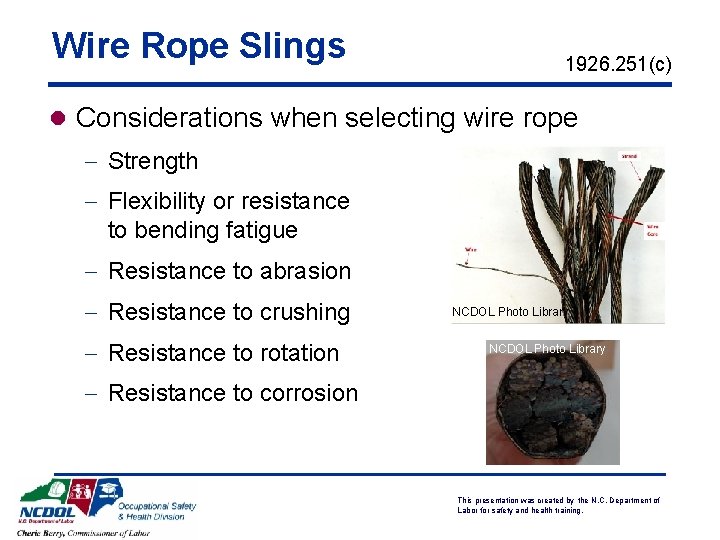
Wire Rope Slings 1926. 251(c) l Considerations when selecting wire rope - Strength - Flexibility or resistance to bending fatigue - Resistance to abrasion - Resistance to crushing - Resistance to rotation NCDOL Photo Library - Resistance to corrosion This presentation was created by the N. C. Department of Labor for safety and health training.
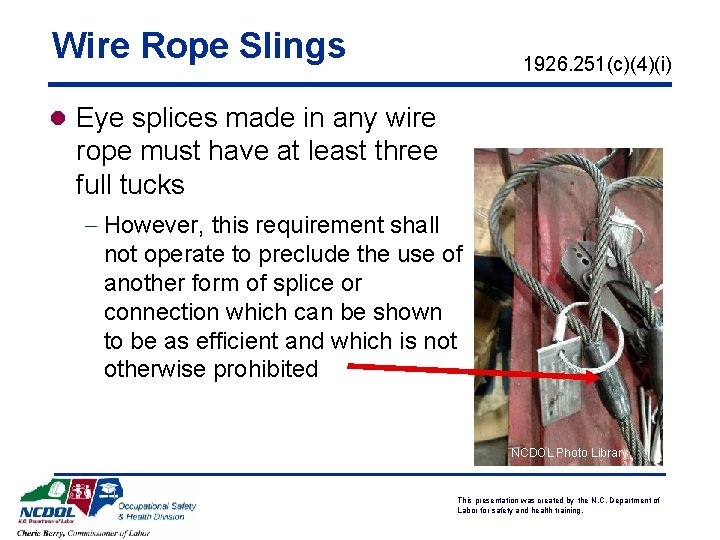
Wire Rope Slings 1926. 251(c)(4)(i) l Eye splices made in any wire rope must have at least three full tucks - However, this requirement shall not operate to preclude the use of another form of splice or connection which can be shown to be as efficient and which is not otherwise prohibited NCDOL Photo Library This presentation was created by the N. C. Department of Labor for safety and health training.
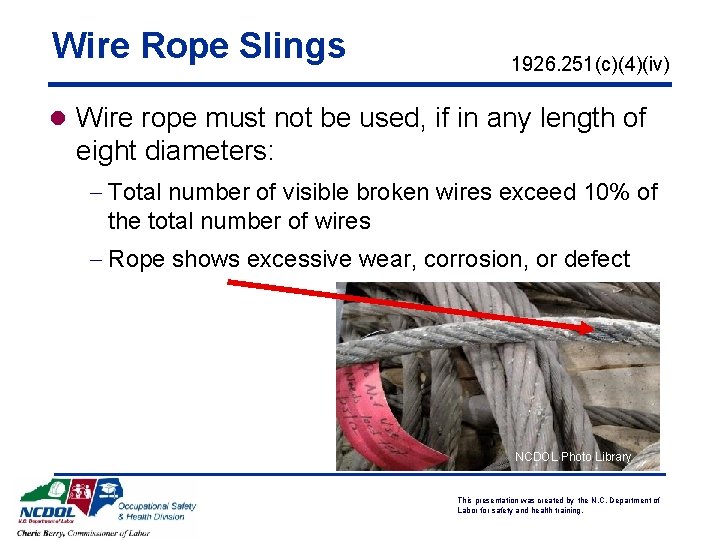
Wire Rope Slings 1926. 251(c)(4)(iv) l Wire rope must not be used, if in any length of eight diameters: - Total number of visible broken wires exceed 10% of the total number of wires - Rope shows excessive wear, corrosion, or defect NCDOL Photo Library This presentation was created by the N. C. Department of Labor for safety and health training.
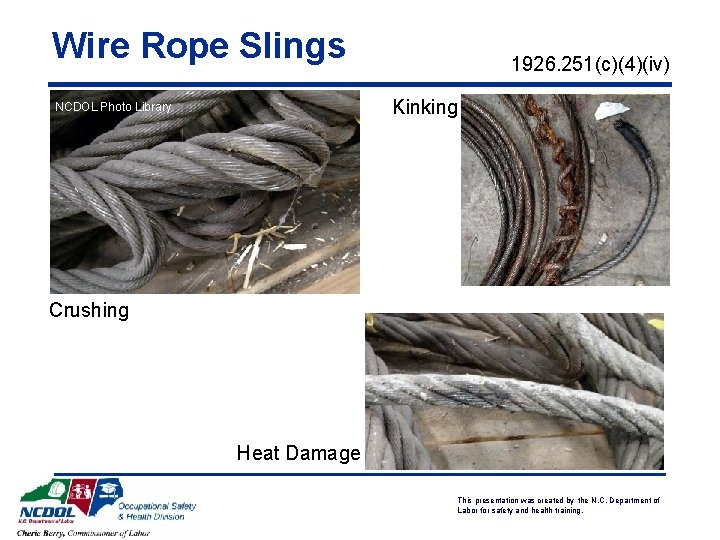
Wire Rope Slings 1926. 251(c)(4)(iv) Kinking NCDOL Photo Library Crushing Heat Damage NCDOL Photo Library This presentation was created by the N. C. Department of Labor for safety and health training.
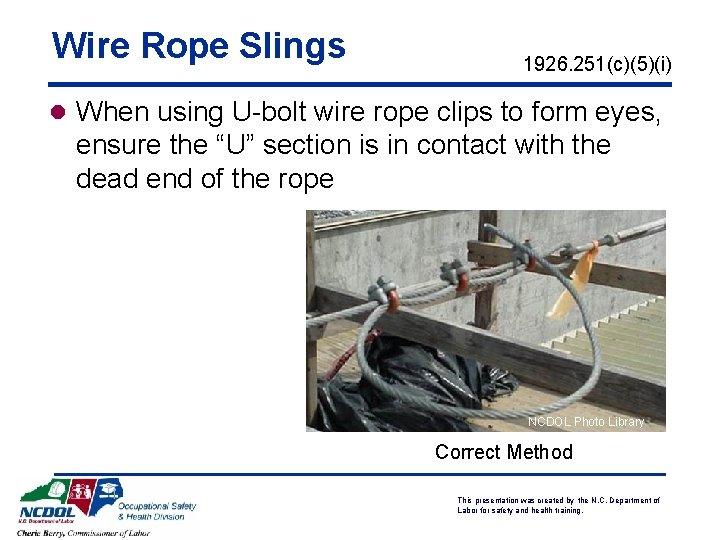
Wire Rope Slings 1926. 251(c)(5)(i) l When using U-bolt wire rope clips to form eyes, ensure the “U” section is in contact with the dead end of the rope NCDOL Photo Library Correct Method This presentation was created by the N. C. Department of Labor for safety and health training.
Natural/Synthetic Fiber Rope Slings 1926. 251(d)(1)/(7) l Do not exceed the rated capacities indicated on the sling l Use rope slings that have permanently affixed and legible identification markings that state the rated capacity for the type(s) of hitch(es) used and the angle upon which it is based, type of fiber material, and the number of legs (if more than one) This presentation was created by the N. C. Department of Labor for safety and health training.
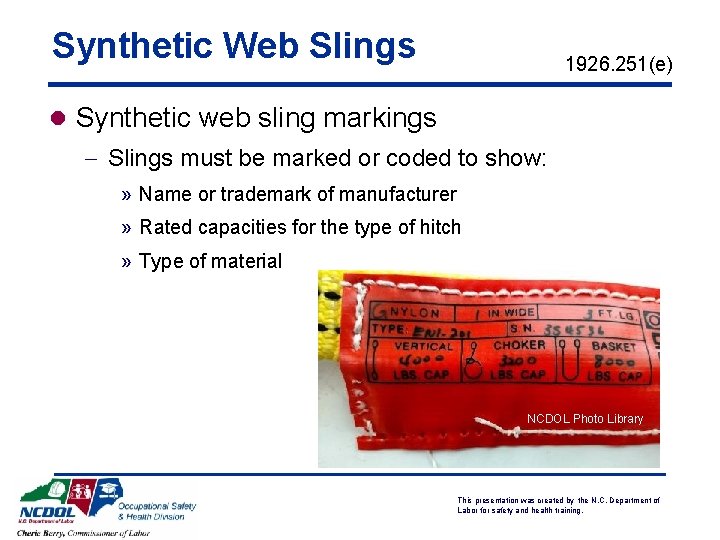
Synthetic Web Slings 1926. 251(e) l Synthetic web sling markings - Slings must be marked or coded to show: » Name or trademark of manufacturer » Rated capacities for the type of hitch » Type of material NCDOL Photo Library This presentation was created by the N. C. Department of Labor for safety and health training.
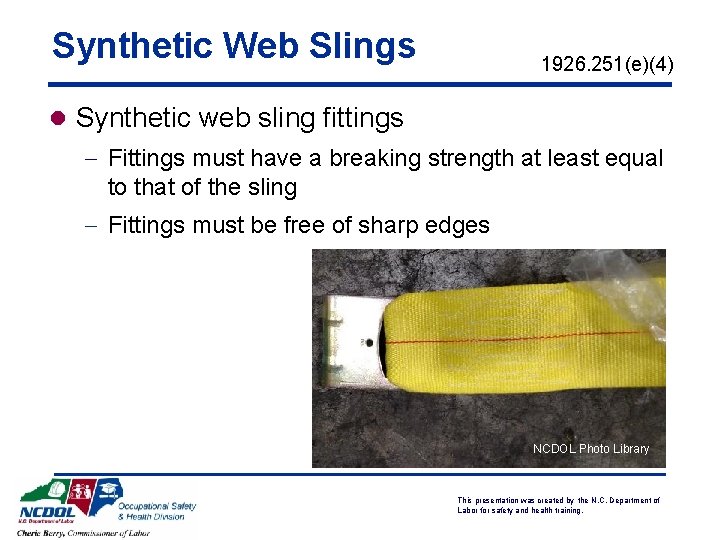
Synthetic Web Slings 1926. 251(e)(4) l Synthetic web sling fittings - Fittings must have a breaking strength at least equal to that of the sling - Fittings must be free of sharp edges NCDOL Photo Library This presentation was created by the N. C. Department of Labor for safety and health training.
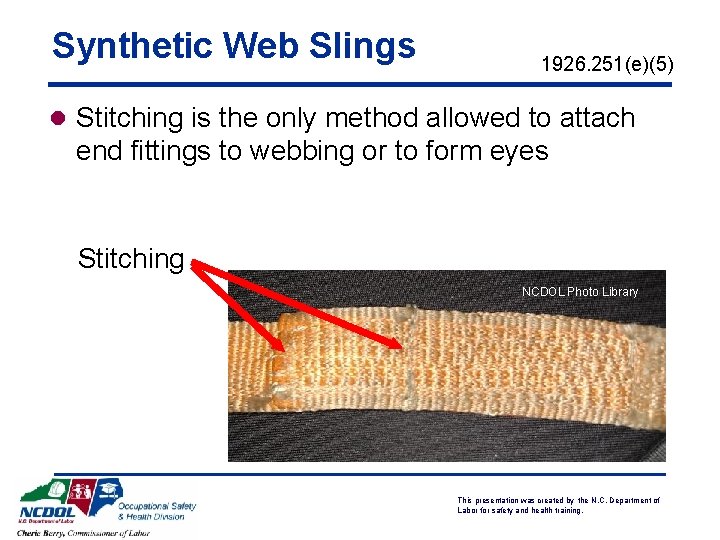
Synthetic Web Slings 1926. 251(e)(5) l Stitching is the only method allowed to attach end fittings to webbing or to form eyes Stitching NCDOL Photo Library This presentation was created by the N. C. Department of Labor for safety and health training.
Environmental Conditions 1926. 251(e)(6)-(7) l Chemicals - Nylon web slings shall not be used where fumes, vapors, sprays, mists or liquids of acids or phenolics are present - Polyester or polypropylene web slings, or web slings with aluminum fittings shall not be used where fumes, vapors, sprays, mists or liquids of caustics are present l Heat - Synthetic web slings of polyester and nylon shall not be used in excess of 180 degrees Fahrenheit (F) (82 degrees Celsius (C)) - Polypropylene web slings shall not be used at temperatures in excess of 200 degrees F (93. 33 degrees C) This presentation was created by the N. C. Department of Labor for safety and health training.
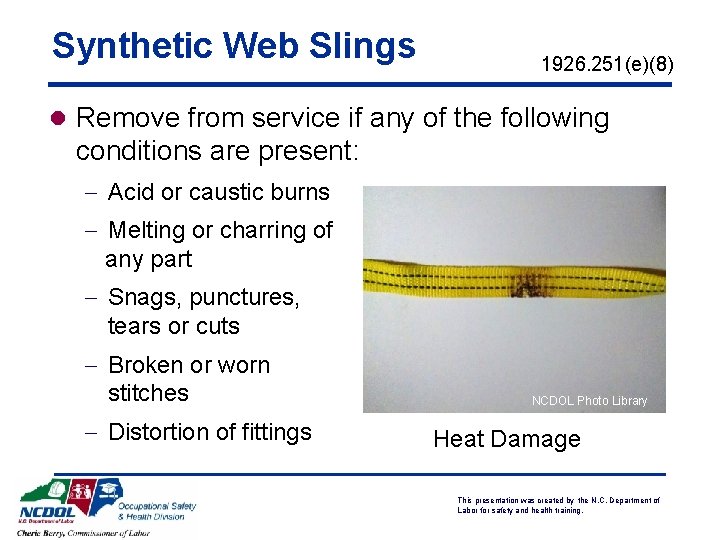
Synthetic Web Slings 1926. 251(e)(8) l Remove from service if any of the following conditions are present: - Acid or caustic burns - Melting or charring of any part - Snags, punctures, tears or cuts - Broken or worn stitches - Distortion of fittings NCDOL Photo Library Heat Damage This presentation was created by the N. C. Department of Labor for safety and health training.
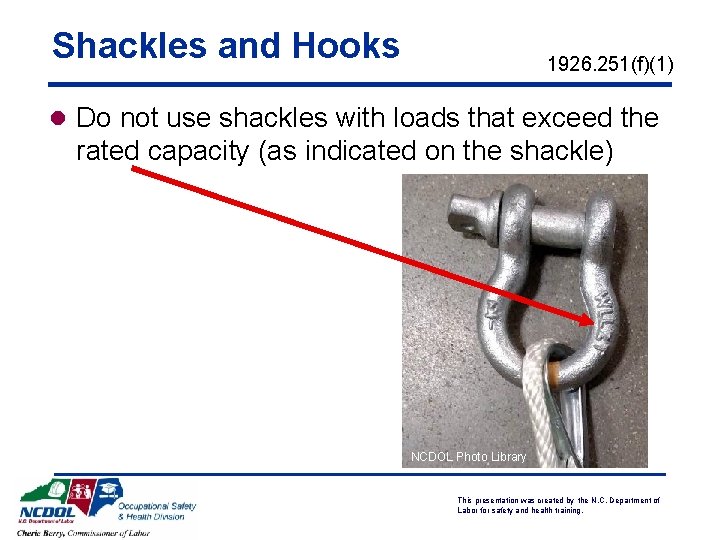
Shackles and Hooks 1926. 251(f)(1) l Do not use shackles with loads that exceed the rated capacity (as indicated on the shackle) NCDOL Photo Library This presentation was created by the N. C. Department of Labor for safety and health training.
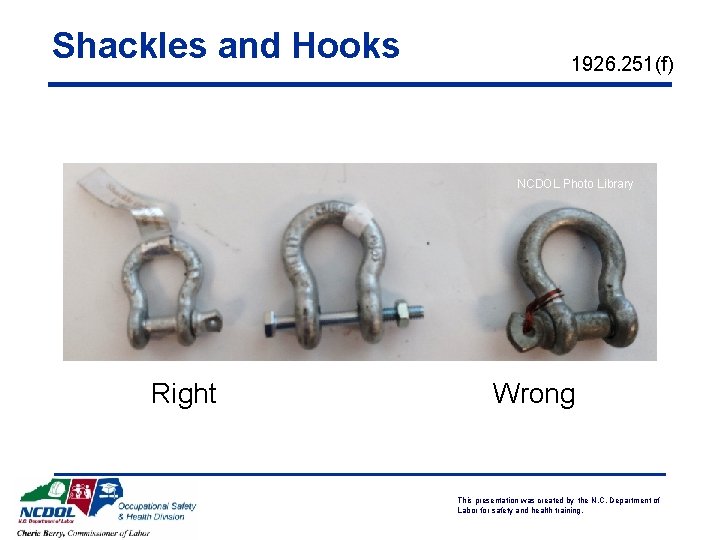
Shackles and Hooks 1926. 251(f) NCDOL Photo Library Right Wrong This presentation was created by the N. C. Department of Labor for safety and health training.
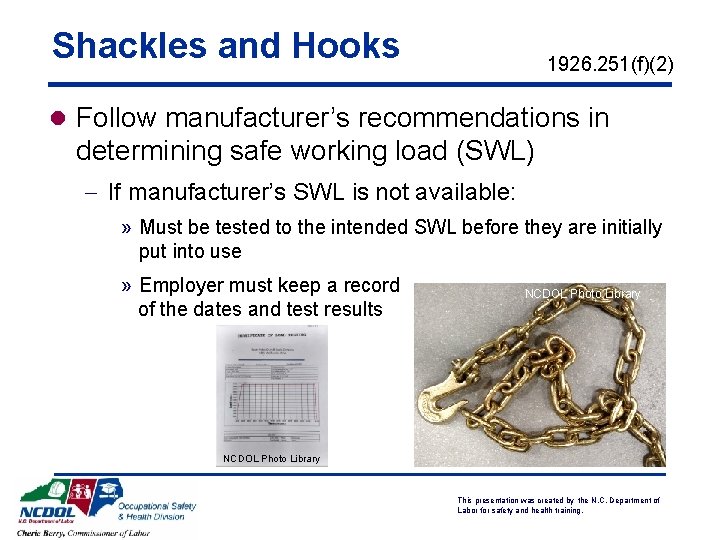
Shackles and Hooks 1926. 251(f)(2) l Follow manufacturer’s recommendations in determining safe working load (SWL) - If manufacturer’s SWL is not available: » Must be tested to the intended SWL before they are initially put into use » Employer must keep a record of the dates and test results NCDOL Photo Library This presentation was created by the N. C. Department of Labor for safety and health training.
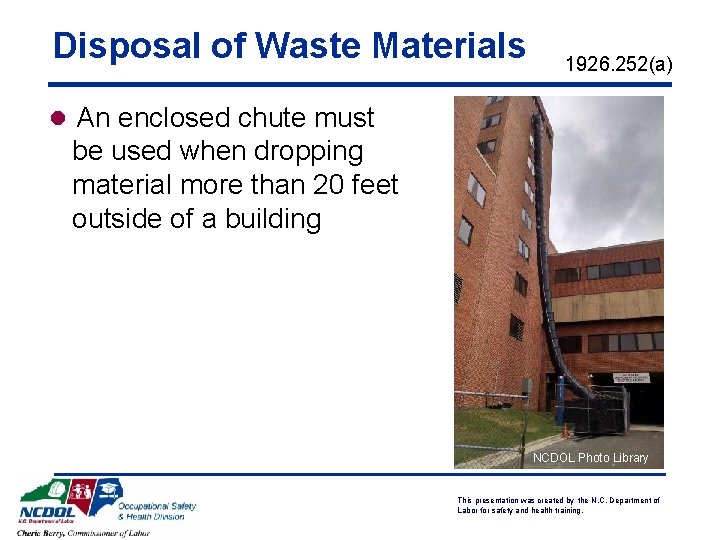
Disposal of Waste Materials 1926. 252(a) l An enclosed chute must be used when dropping material more than 20 feet outside of a building NCDOL Photo Library This presentation was created by the N. C. Department of Labor for safety and health training.
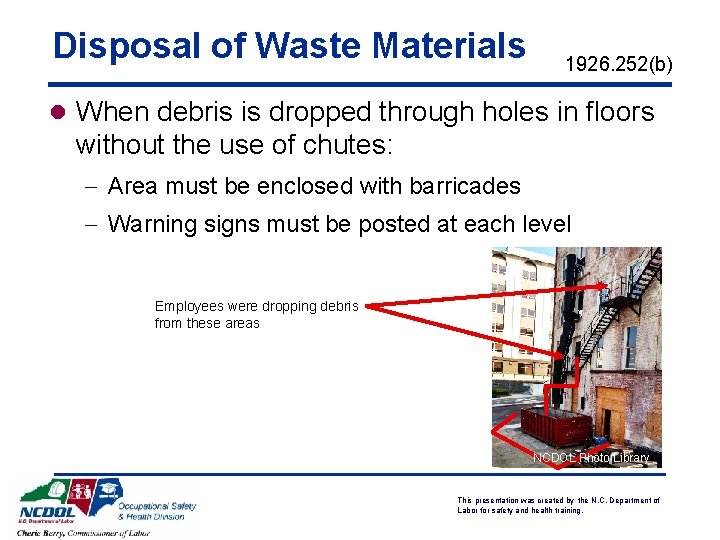
Disposal of Waste Materials 1926. 252(b) l When debris is dropped through holes in floors without the use of chutes: - Area must be enclosed with barricades - Warning signs must be posted at each level Employees were dropping debris from these areas NCDOL Photo Library This presentation was created by the N. C. Department of Labor for safety and health training.
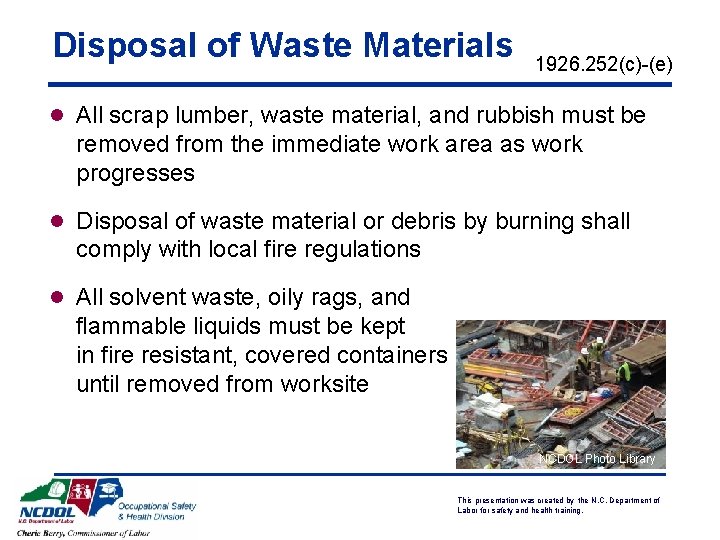
Disposal of Waste Materials 1926. 252(c)-(e) l All scrap lumber, waste material, and rubbish must be removed from the immediate work area as work progresses l Disposal of waste material or debris by burning shall comply with local fire regulations l All solvent waste, oily rags, and flammable liquids must be kept in fire resistant, covered containers until removed from worksite NCDOL Photo Library This presentation was created by the N. C. Department of Labor for safety and health training.
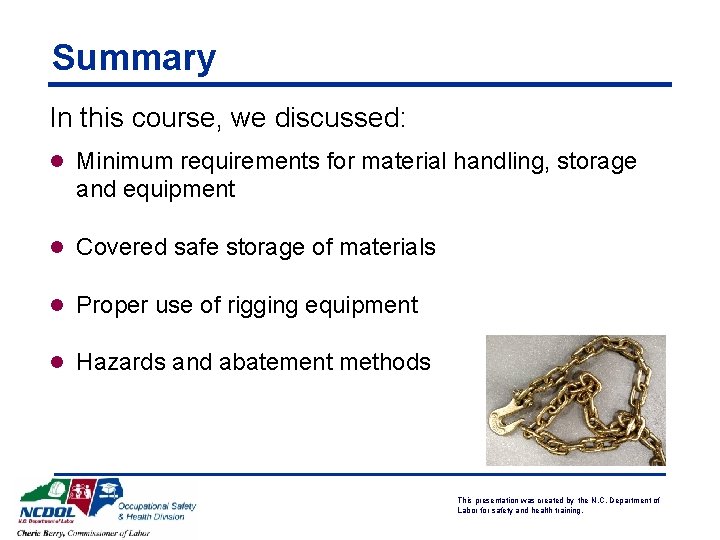
Summary In this course, we discussed: l Minimum requirements for material handling, storage and equipment l Covered safe storage of materials l Proper use of rigging equipment l Hazards and abatement methods This presentation was created by the N. C. Department of Labor for safety and health training.
Thank You For Attending! Final Questions? This presentation was created by the N. C. Department of Labor for safety and health training.