Management of distal femoral fractures moderated interactive session



- Slides: 17
Management of distal femoral fractures moderated interactive session AOTrauma Advances Course
Learning outcomes • List indications and techniques for plating open and MIPO and IM nailing of distal femoral fractures • Contrast outcomes and complications of possible surgical techniques • Assess potential complicating features, such as osteoporosis, articular displacement, and open fractures
Is retrograde IM nailing your first choice in treating extraarticular distal femoral fractures (33 -A)? 1. Never 2. Rarely 3. Occasionally 4. Commonly
Is plating your first choice in treating simple intraarticular distal femoral fractures (33 -C 1 and 33 -C 2)? 1. Never 2. Rarely 3. Occasionally 4. Commonly
Is plating your first choice in treating complex intraarticular distal femoral fractures (33 -C 3)? 1. Never 2. Rarely 3. Occasionally 4. Commonly
Key points from lectures Distal femoral fractures—plate fixation • They can be used with any fracture type • The kind of plate used depends on articular involvement and bone quality • Restore axial alignment, length and rotation in metaphysis, anatomical reduction of joint surfaces • Plate can be used as a reduction aid • Careful soft-tissue handling is key to success
Key points from lectures Distal femoral fractures—nail fixation • Nails are biomechanically superior and minimally invasive • Its indications are: – Periprosthetic fractures – Extraarticular fractures – Simple intraarticular fractures (33 -C 1 or C 2) • Fracture must be reduced prior to nail insertion
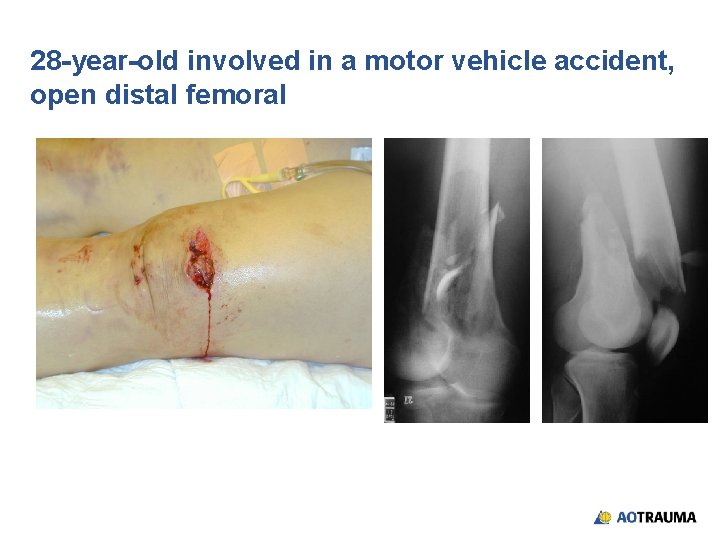
28 -year-old involved in a motor vehicle accident, open distal femoral
After I & D, your treatment of choice is: 1. DCS 2. Condylar LCP 3. Retrograde nailing 4. LISS 5. Angled blade plate
55 -year-old driver involved in a motor vehicle accident • Isolated lower leg injuries • Open grade II ipsilateral distal femoral fractures and mid-shaft tibial fractures
Your treatment of choice of the distal femoral fracture would be: 1. Antegrade IM nail 2. Retrograde IM nail 3. Locking plate (LISS / DFLCP) 4. Angled blade plate 5. DCS
Retrograde IM nailing
72 -year-old female pedestrian hit by car • Open ipsilateral distal femoral fracture and mid-shaft tibial fracture • Previous total knee arthroplasty 5 years ago
Treatment for the distal femur would be wound care followed by: 1. Condylar LCP 2. Retrograde IM nailing 3. Revision: total knee arthroplasty 4. LISS
Summary • Plating is an excellent option for distal femoral fractures especially for intraarticular and complex fractures • Retrograde IM nailing is an option for extraarticular and simple articular distal femoral fractures • Osteoporosis is a factor in plate selection • Periprosthetic fractures need careful attention and knowledge of the total knee arthroplasty will help you in choice of implants