MAIN OUTLINES OF FINNISH HISTORY AND CULTURE Esa
- Slides: 33
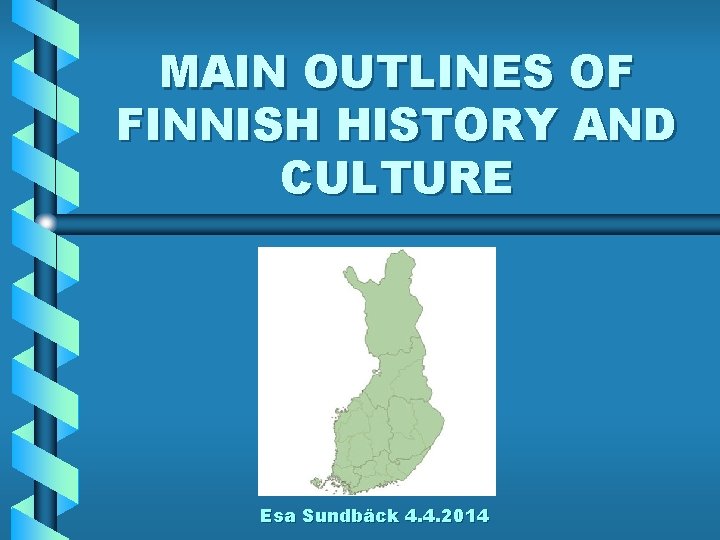
MAIN OUTLINES OF FINNISH HISTORY AND CULTURE Esa Sundbäck 4. 4. 2014
Basic information • population 5. 2 million • the third least densely populated country in Europe (after Iceland Norway) • territory: the fifth biggest country in Europe (after Germany, France, Spain and Sweden)
• bilingual country: Finnish 93%, Swedish 6%
Finnish culture
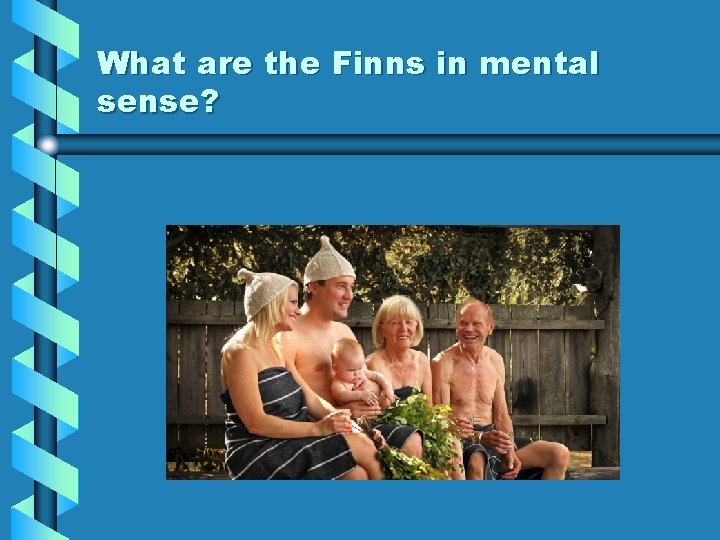
What are the Finns in mental sense?
1) Nation of silence -" if there is nothing important to be said, be quit" consequently, the Finns are NOT talkative (don’t blame yourself!)
2) Finns are restricted - not easy (and fast) to became a deep friend; but if it happens, the Finn is a really faithful and loyal friend let say throughout the life (? )
3) Finns are obedient to rules and laws – for the Finns things are either black or white, but not grey
Origin of the Finns • in the prehistory, population from different directions, then mixtured: origin partly from the east (Finno. Ugric people), partly from Western Europe
• language from the east = Finnish language belongs to the Finno-Ugric languages (together with Estonian, Hungarian in Europe - Mari, Udmurt and Komi in Russia
History
Periods of Finnish History • 1) Finland under Swedish reign 11551809 • 2) Finland under Russian reign 18091917 • 3) Independency 1917 -
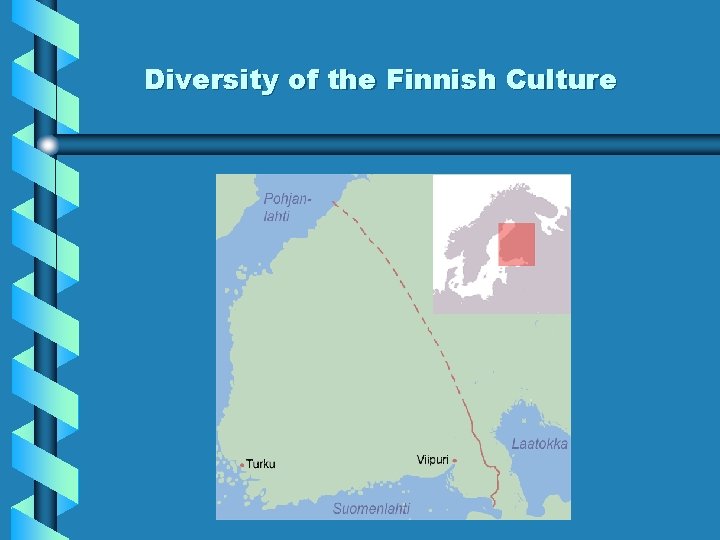
Finland under Swedish reign 11551809 • 10 th-12 th centuries - Finland a battlefield between Sweden (catholic church) and Novgorod (forthcoming Russia; orthodox church) ► Swedish influences to the western part, Russian influences to the eastern part of the country (diversity)
Diversity of the Finnish Culture
• Swedish dominance ► Catholic religion = Western Finland as a part of medieval Europe – in a cultural sense, Finland became a part of Europe (not Russia)
• Reformation in a Lutheran form to Sweden ► consequently, contemporary Finn's respect of law, rules and the obedience of the state
• consequence of Swedish rule over Finland = Swedish became the language of the ruling upper class - Finnish that of ordinary people
Finland under Russian reign 18091917: a Grand Duchy of Finland • separate entity as a part of Imperial Russia = 1) autonomious administration 2) Swedish law as contrary to Russian law in Russia 3) Lutheran religion as contrary to Orthodox religion in Russia
• awakening of Finnish nationalism in the 19 th century = improvement of the Finnish language's position in terms of Swedish language idea of Finnish culture and selfconsciousness characterizing Finnish speaking population
• Finnish nationalism was not addressed against Russia but the ruling Swedish-speaking elite in Finland (exception in European scale: the Finns did not rebel against Russia) =
• National Myth = Kalevala (Harry Potter) National composer = Jean Sibelius
Independent Finland 1917 - • February and October Revolutions in Russia 1917 ► detachment out of Russia as an independent country in the end of 1917
• Civil War in the Spring 1918: as a background, social and political unequality between the wealthy minority and the poor majority
• 1920 s and 1930 s: idea of a bilingual country as equal rights for both Finnish and Swedish throughout the country (not based on territorial distinction between Swedish or Finnish-speaking areas) why? - Finland aimed at cooperation with Sweden against the threat of Communist Soviet Union
• Second World War: Winter War 1939 -1940: Soviet invasion on Finland "Continuation War" (Finnish concept) against Soviet Union 1941 -1944 as ally of Nazi Germany
Finland at the time of the Cold War 1945 -1991: “Finlandization” and Kekkonen as President • Finland was under Soviet pressure and political influence: "Finlandisierung" or “Finlandization” (= a small country under the great power's influence, not really independent)
• in spite of Soviet dominance, Finland managed to stay as western democracy and avoided to be transformed to a Communist country as contrary to other Eastern European countries
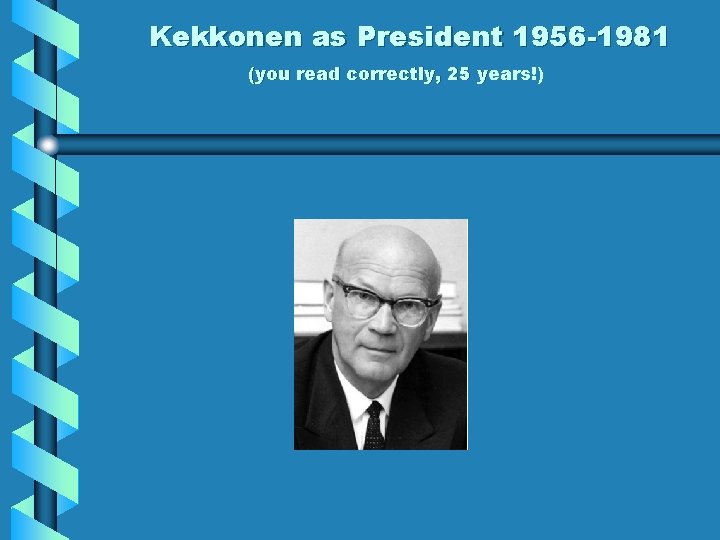
Kekkonen as President 1956 -1981 (you read correctly, 25 years!)
• concentration of power to his hands however, not illegal because Finnish Constitution gave lot of power to the President
• used his personal connections to Soviet leaders as a weapon against domestic political opponents in Finland
• censorship in Finland: did not allow to publish negative information on Soviet Union
• after Kekkonen's era, the power of Finnish President was diminished
• for further information: Jason Lavery: The History of Finland