M 2 LSN 4 Definition of Reflection and

- Slides: 15
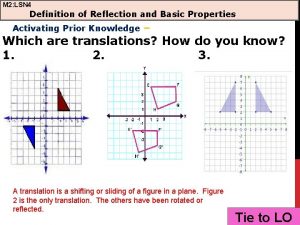
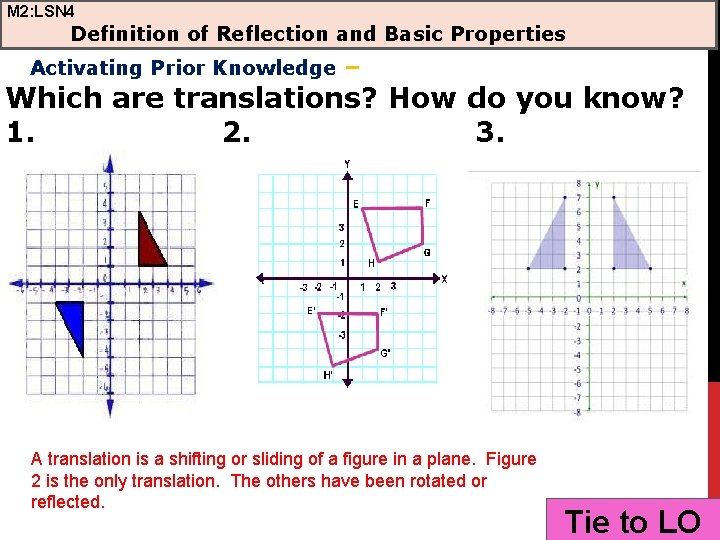
M 2: LSN 4 Definition of Reflection and Basic Properties Activating Prior Knowledge – Which are translations? How do you know? 1. 2. 3. A translation is a shifting or sliding of a figure in a plane. Figure 2 is the only translation. The others have been rotated or reflected. Tie to LO
Learning Objective Today, we will show that reflections share some of the same fundamental properties with translations. CFU
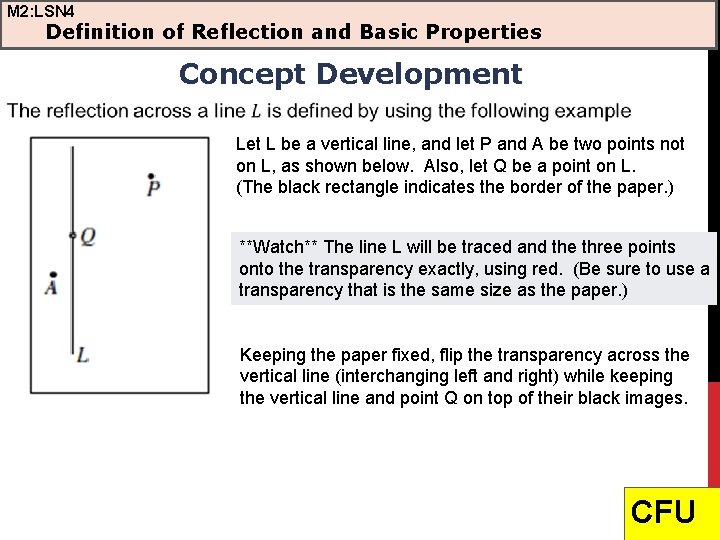
M 2: LSN 4 Definition of Reflection and Basic Properties Concept Development Let L be a vertical line, and let P and A be two points not on L, as shown below. Also, let Q be a point on L. (The black rectangle indicates the border of the paper. ) **Watch** The line L will be traced and the three points onto the transparency exactly, using red. (Be sure to use a transparency that is the same size as the paper. ) Keeping the paper fixed, flip the transparency across the vertical line (interchanging left and right) while keeping the vertical line and point Q on top of their black images. CFU
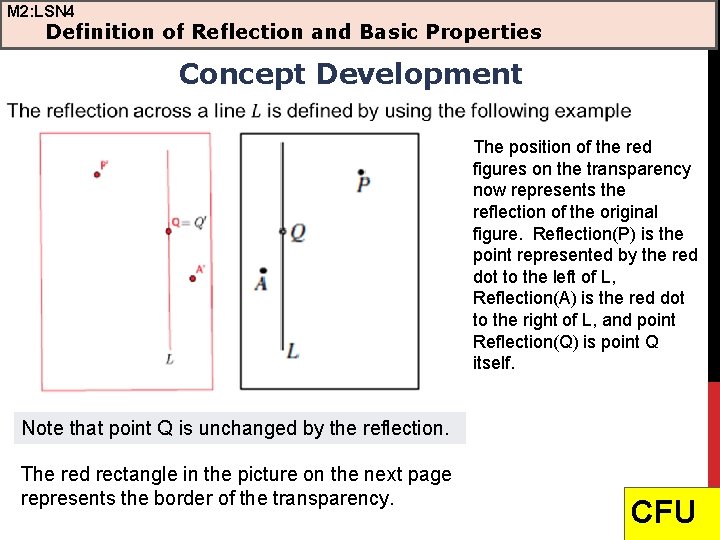
M 2: LSN 4 Definition of Reflection and Basic Properties Concept Development The position of the red figures on the transparency now represents the reflection of the original figure. Reflection(P) is the point represented by the red dot to the left of L, Reflection(A) is the red dot to the right of L, and point Reflection(Q) is point Q itself. Note that point Q is unchanged by the reflection. The red rectangle in the picture on the next page represents the border of the transparency. CFU
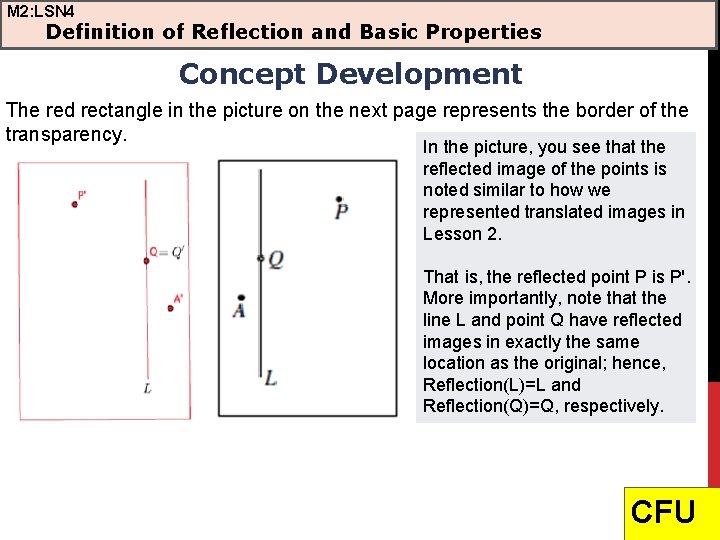
M 2: LSN 4 Definition of Reflection and Basic Properties Concept Development The red rectangle in the picture on the next page represents the border of the transparency. In the picture, you see that the reflected image of the points is noted similar to how we represented translated images in Lesson 2. That is, the reflected point P is P'. More importantly, note that the line L and point Q have reflected images in exactly the same location as the original; hence, Reflection(L)=L and Reflection(Q)=Q, respectively. CFU
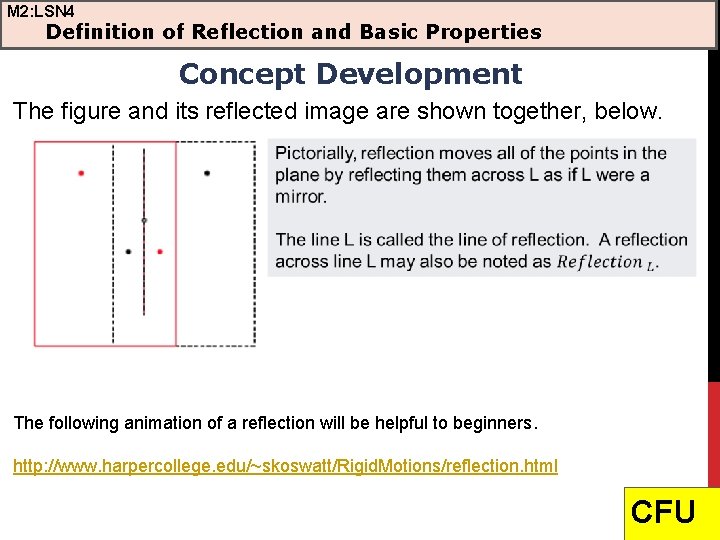
M 2: LSN 4 Definition of Reflection and Basic Properties Concept Development The figure and its reflected image are shown together, below. The following animation of a reflection will be helpful to beginners. http: //www. harpercollege. edu/~skoswatt/Rigid. Motions/reflection. html CFU
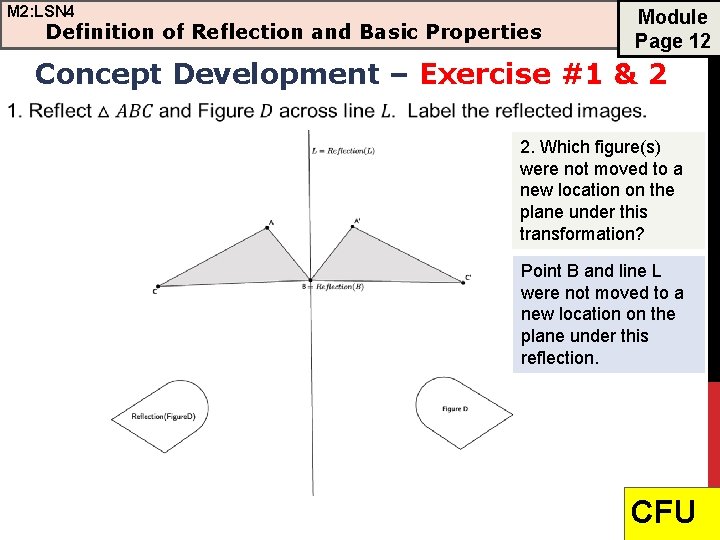
M 2: LSN 4 Definition of Reflection and Basic Properties Module Page 12 Concept Development – Exercise #1 & 2 2. Which figure(s) were not moved to a new location on the plane under this transformation? Point B and line L were not moved to a new location on the plane under this reflection. CFU
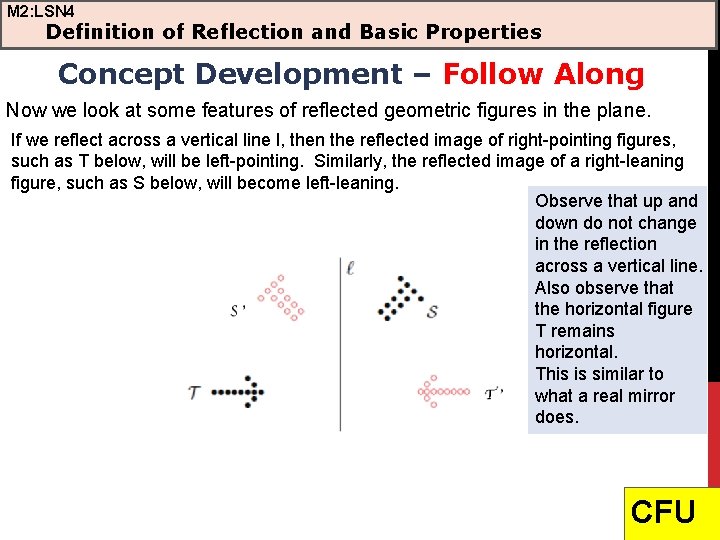
M 2: LSN 4 Definition of Reflection and Basic Properties Concept Development – Follow Along Now we look at some features of reflected geometric figures in the plane. If we reflect across a vertical line l, then the reflected image of right-pointing figures, such as T below, will be left-pointing. Similarly, the reflected image of a right-leaning figure, such as S below, will become left-leaning. Observe that up and down do not change in the reflection across a vertical line. Also observe that the horizontal figure T remains horizontal. This is similar to what a real mirror does. CFU
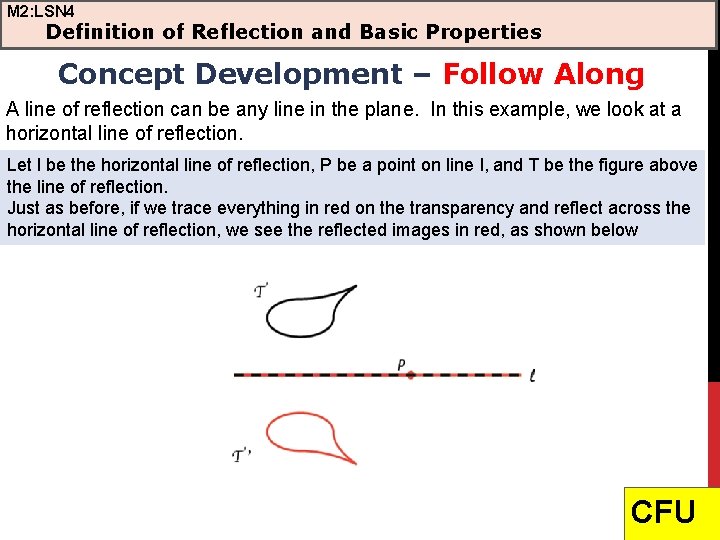
M 2: LSN 4 Definition of Reflection and Basic Properties Concept Development – Follow Along A line of reflection can be any line in the plane. In this example, we look at a horizontal line of reflection. Let l be the horizontal line of reflection, P be a point on line l, and T be the figure above the line of reflection. Just as before, if we trace everything in red on the transparency and reflect across the horizontal line of reflection, we see the reflected images in red, as shown below CFU
M 2: LSN 4 Definition of Reflection and Basic Properties Module Page 13 Skill Development/Guided Practice – Exercise #3 -4 4. Answer the questions about the image above. a. Use a protractor to measure the reflected ∠ABC. What do you notice? b. Use a ruler to measure the length of IJ and the length of the image of IJ after the reflection. What do you notice? The length of the reflected segment is the same as the original segment, 5 units. CFU
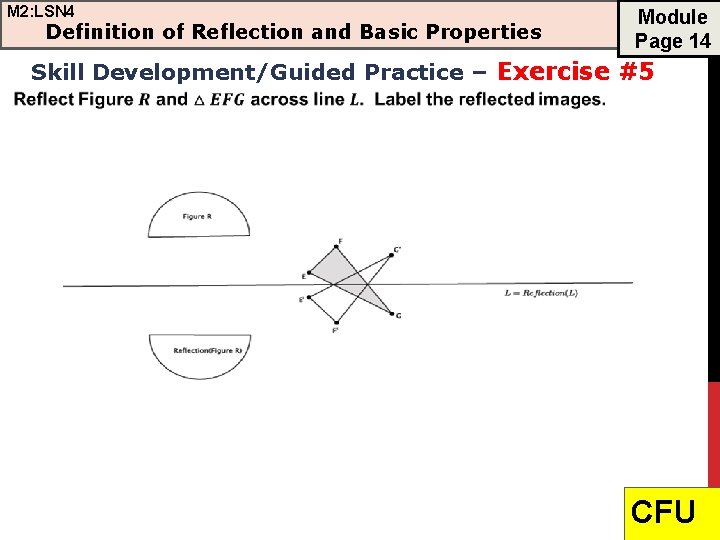
M 2: LSN 4 Definition of Reflection and Basic Properties Module Page 14 Skill Development/Guided Practice – Exercise #5 CFU
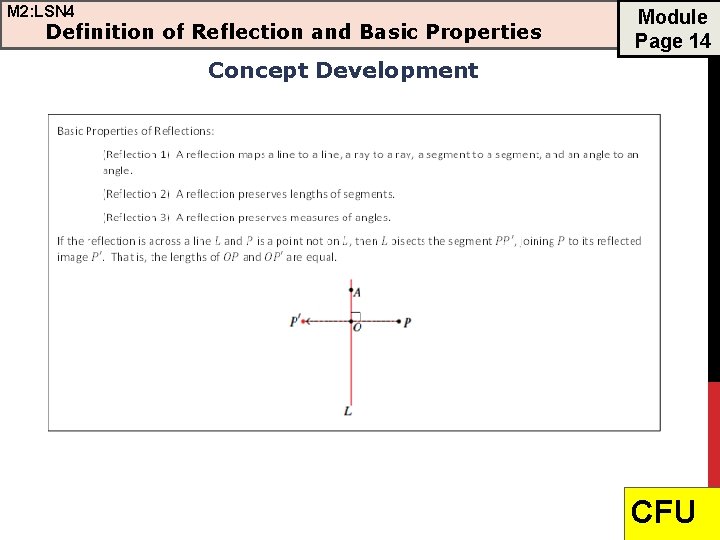
M 2: LSN 4 Definition of Reflection and Basic Properties Module Page 14 Concept Development CFU
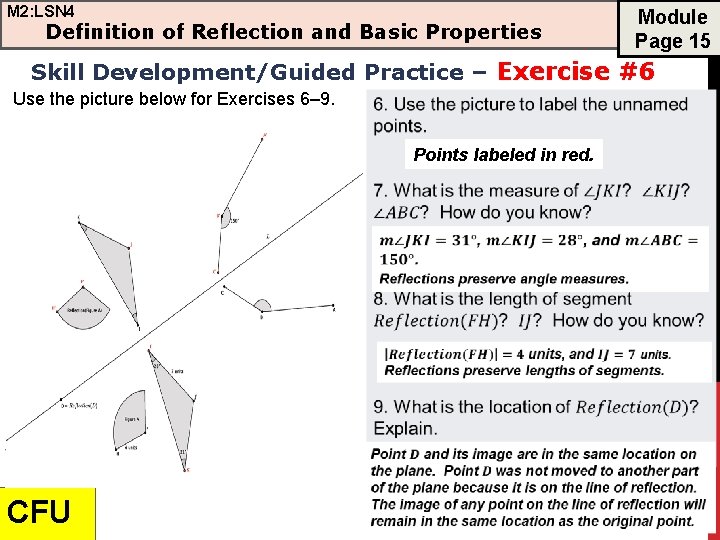
M 2: LSN 4 Definition of Reflection and Basic Properties Module Page 15 Skill Development/Guided Practice – Exercise #6 Use the picture below for Exercises 6– 9. Points labeled in red. CFU
Closure 1. What did we learn today? 2. Why is this important to you? 3. Why is a reflection also a rigid motion transformation? Homework – Problem Set 1 -7 S. 16 -17 CFU
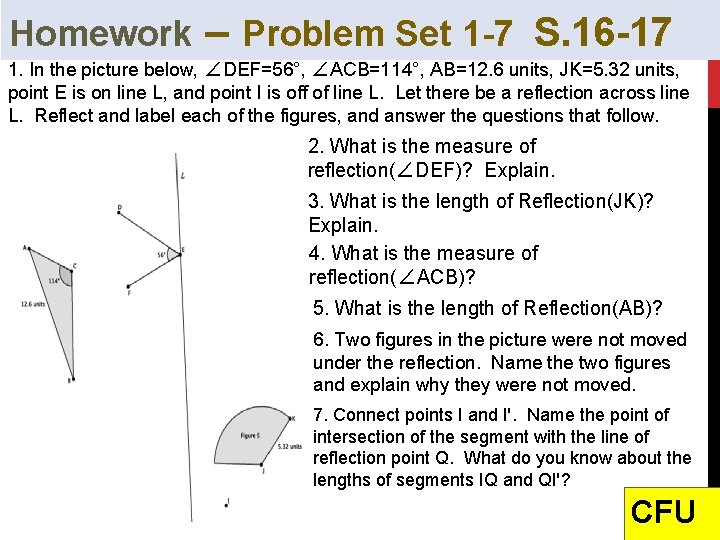
Homework – Problem Set 1 -7 S. 16 -17 1. In the picture below, ∠DEF=56°, ∠ACB=114°, AB=12. 6 units, JK=5. 32 units, point E is on line L, and point I is off of line L. Let there be a reflection across line L. Reflect and label each of the figures, and answer the questions that follow. 2. What is the measure of reflection(∠DEF)? Explain. 3. What is the length of Reflection(JK)? Explain. 4. What is the measure of reflection(∠ACB)? 5. What is the length of Reflection(AB)? 6. Two figures in the picture were not moved under the reflection. Name the two figures and explain why they were not moved. 7. Connect points I and I'. Name the point of intersection of the segment with the line of reflection point Q. What do you know about the lengths of segments IQ and QI'? CFU