Logical Fallacies CMaj Nicholas Schroder What is a


- Slides: 16
Logical Fallacies C/Maj Nicholas Schroder
What is a Logical Fallacy? • A mistake in logic; bad reasoning that corrupts a line of thought. • Weak, twisted, fallacious thinking keeps us from knowing the truth • These mistakes are so common (even among the brightest of people) that experts have identified 10 types of fallacies:
Ad Hominem • Latin, literally “to the man” • Essentially, instead of focusing on the logic of an opposing argument, an ad hominem attacks the other person.
Appeal to Authority • Definitely among the weakest of arguments, an appeal to authority tries to prove a claim by asserting that some smart person believes the claim to be true and therefore it must be true.
Post Hoc Fallacy • • The full name of this argument is: Post hoc ergo propter hoc (or Latin for After this, therefore because of this) It consists of 2 parts – A occurs before B. – Therefore A is the cause of B.
Appeal to Tradition • “We’ve always done it that way” • One of quickest ways to lose the ability to think for yourself is to always use this excuse. • This fallacy makes the assumption that older ideas are better, and that the leader’s job is to prevent change which goes against the very point of being a leader.
Red Herring • is a fallacy in which an irrelevant topic is presented in order to divert attention from the original issue • It distracts from the main point and there the opponent “wins” because he has gotten you off topic
Weak Analogy • People make comparisons all the time, however: • The problem arises because no matter how similar two things are, they are never exactly alike, and therefore, the argument breaks down.
Straw Man Fallacy • This fallacy attacks the opponent at their strongest point. • The point of this attack is to demonstrate that the opponent could never compete with their argument on their strongest day.
Begging the Question / Circular Reasoning • If your argument’s conclusion is the same as one of your premises, you’re begging the question. • The only people likely to be persuaded by circular reasoning are those who already agree with the original premise.
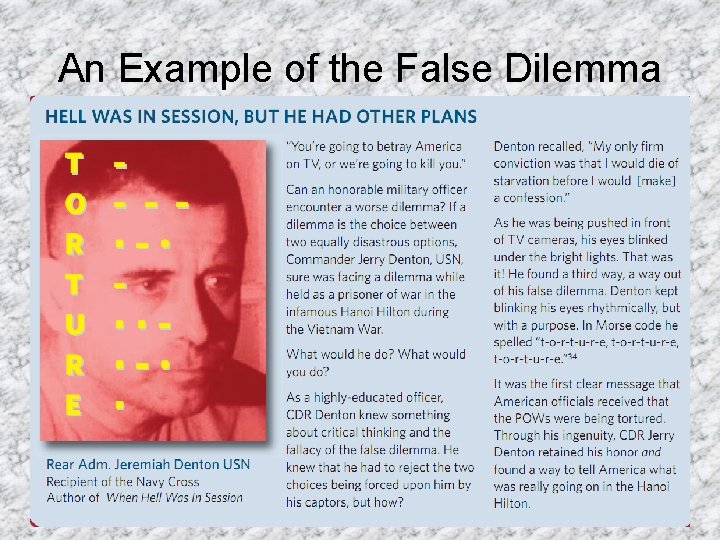
False Dilemma • This dilemma occurs when we are faced with two, but only two choices, and both are not very good creating an “either / or” situation • It is the mark of a good leader to find a third option even when faced with this problem.
An Example of the False Dilemma
Slippery Slope • Occurs when a person asserts that some event must inevitably follow from another without any argument for the inevitability of the event in question.
How to beat these pitfalls • THINK!!! • Examine your argument from every angle possible (if time permitted) • Remember that every action has a consequences and no argument can be bulletproof.
Questions?
Biblography • L 2 L Chapter 5 • http: //www. nizkor. org