Life Sciences At the University of Dundee 1
- Slides: 23
Life Sciences At the University of Dundee 1
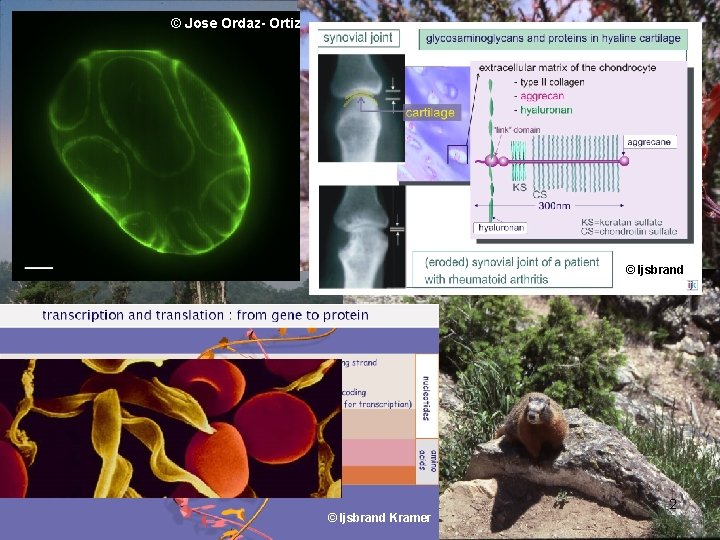
© Jose Ordaz- Ortiz © Ijsbrand Kramer © HEA Biosciences: Tom Tregenza © Ijsbrand Kramer 2
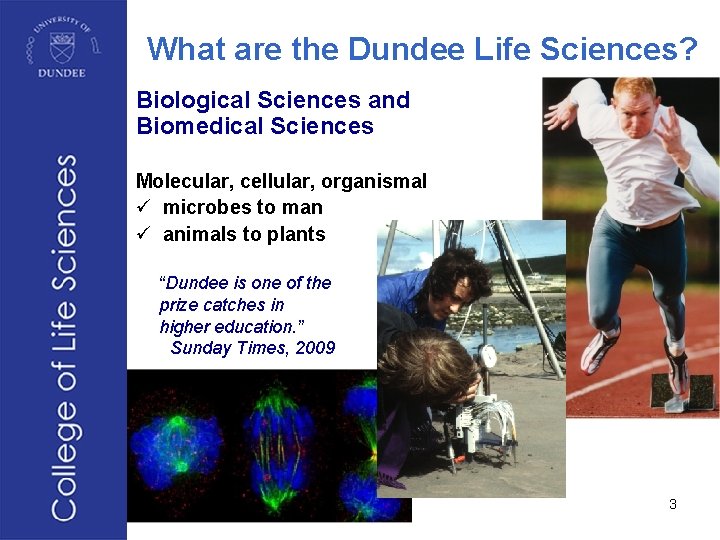
What are the Dundee Life Sciences? Biological Sciences and Biomedical Sciences Molecular, cellular, organismal ü microbes to man ü animals to plants “Dundee is one of the prize catches in higher education. ” Sunday Times, 2009 3
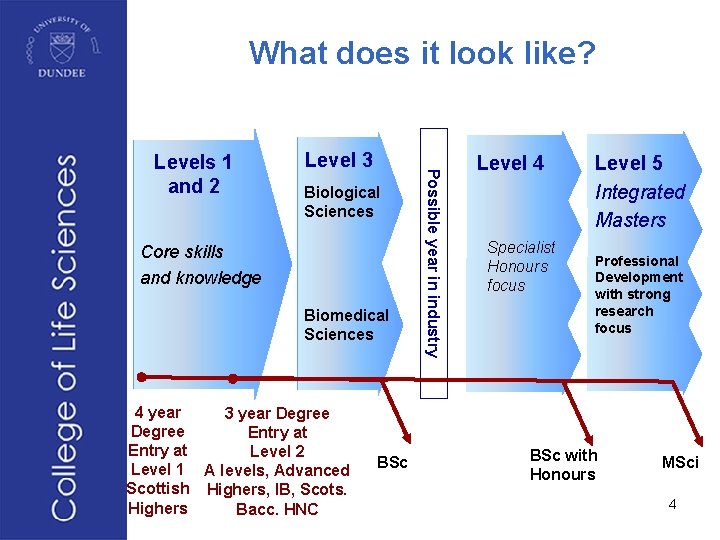
What does it look like? Level 3 Biological Sciences Core skills and knowledge Biomedical Sciences 4 year 3 year Degree Entry at Level 2 Level 1 A levels, Advanced Scottish Highers, IB, Scots. Highers Bacc. HNC BSc Possible year in industry Levels 1 and 2 Level 4 Specialist Honours focus Level 5 Integrated Masters Professional Development with strong research focus BSc with Honours MSci 4
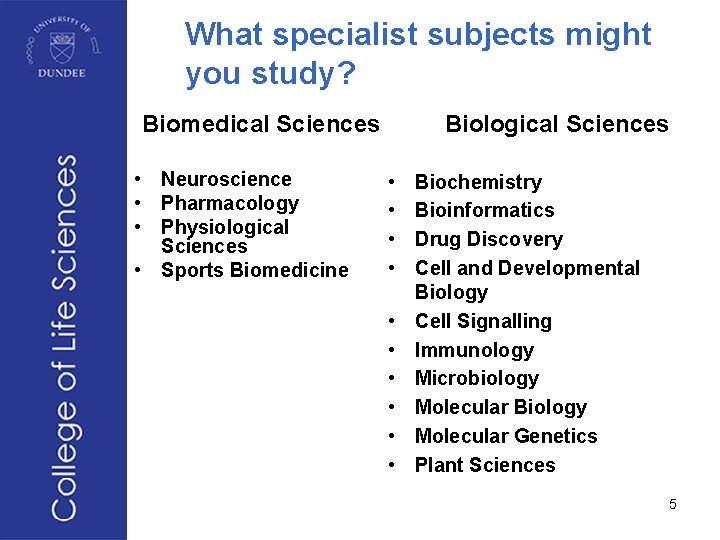
What specialist subjects might you study? Biomedical Sciences • Neuroscience • Pharmacology • Physiological Sciences • Sports Biomedicine Biological Sciences • • • Biochemistry Bioinformatics Drug Discovery Cell and Developmental Biology Cell Signalling Immunology Microbiology Molecular Biology Molecular Genetics Plant Sciences 5
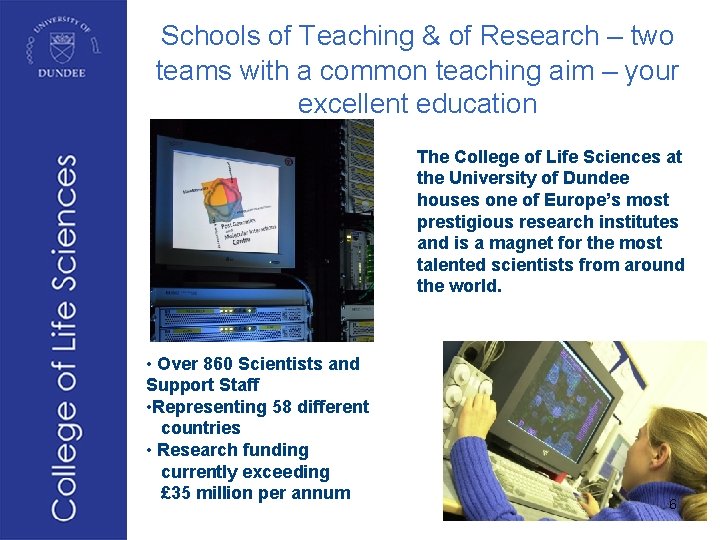
Schools of Teaching & of Research – two teams with a common teaching aim – your excellent education The College of Life Sciences at the University of Dundee houses one of Europe’s most prestigious research institutes and is a magnet for the most talented scientists from around the world. • Over 860 Scientists and Support Staff • Representing 58 different countries • Research funding currently exceeding £ 35 million per annum 6
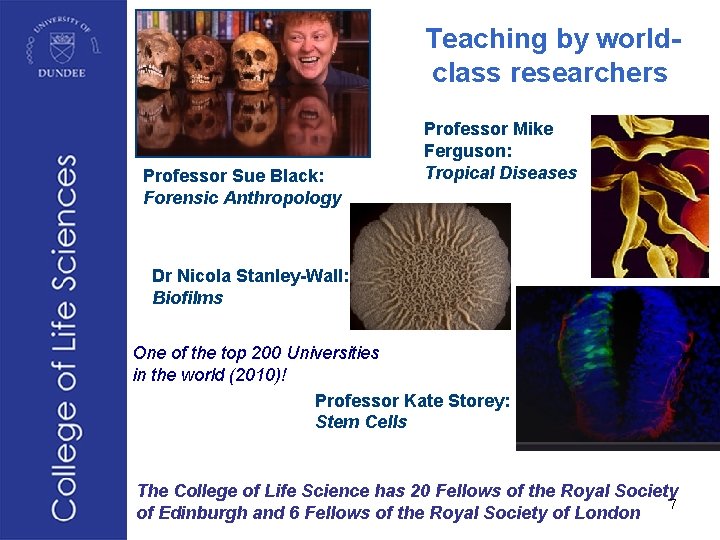
Teaching by world- class researchers Professor Sue Black: Forensic Anthropology Professor Mike Ferguson: Tropical Diseases Dr Nicola Stanley-Wall: Biofilms One of the top 200 Universities in the world (2010)! Professor Kate Storey: Stem Cells The College of Life Science has 20 Fellows of the Royal Society 7 of Edinburgh and 6 Fellows of the Royal Society of London
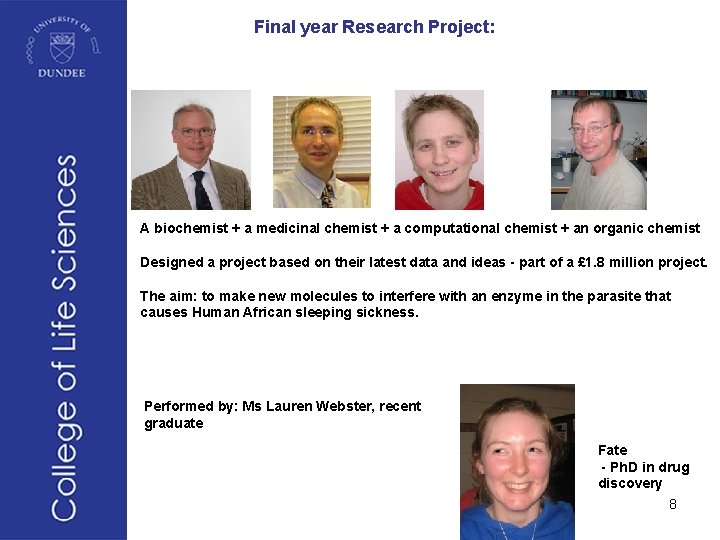
Final year Research Project: A biochemist + a medicinal chemist + a computational chemist + an organic chemist Designed a project based on their latest data and ideas - part of a £ 1. 8 million project. The aim: to make new molecules to interfere with an enzyme in the parasite that causes Human African sleeping sickness. Performed by: Ms Lauren Webster, recent graduate Fate - Ph. D in drug discovery 8
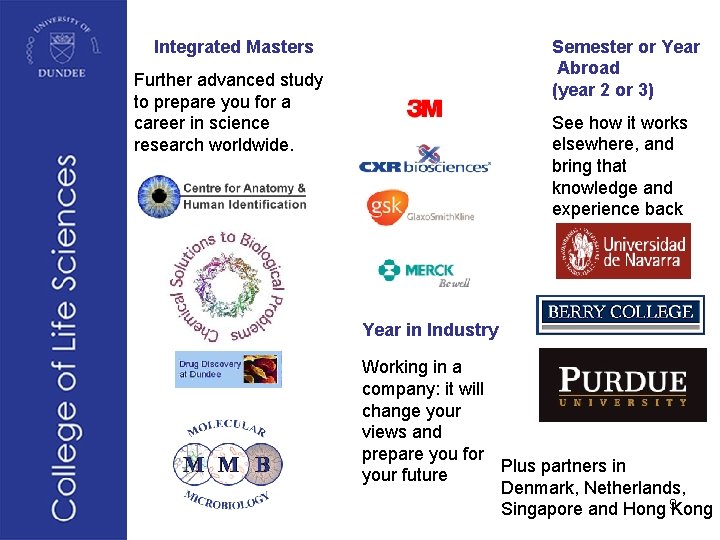
Integrated Masters Semester or Year Abroad (year 2 or 3) Further advanced study to prepare you for a career in science research worldwide. See how it works elsewhere, and bring that knowledge and experience back Year in Industry Working in a company: it will change your views and prepare you for Plus partners in your future Denmark, Netherlands, Singapore and Hong 9 Kong
Life Sciences at Dundee Times Higher Education Student • New curriculum Experience Survey, • Emphasises April 2012 Dundee, #1 in UK!!!! – Skills February 2011 – Labs Dundee, #1 in Scotland! – Core knowledge January 2010 – Problem solving Dundee, #1 in Scotland! – Personal development • Challenging but satisfying 10 Life Sciences
Course structure
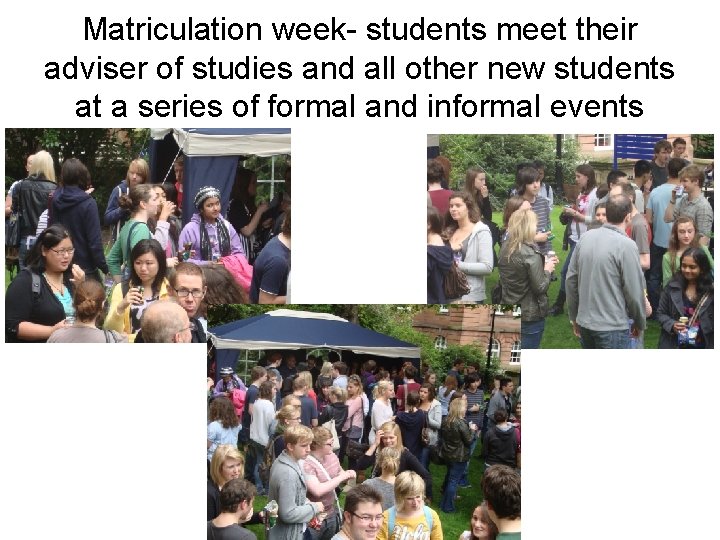
Matriculation week- students meet their adviser of studies and all other new students at a series of formal and informal events
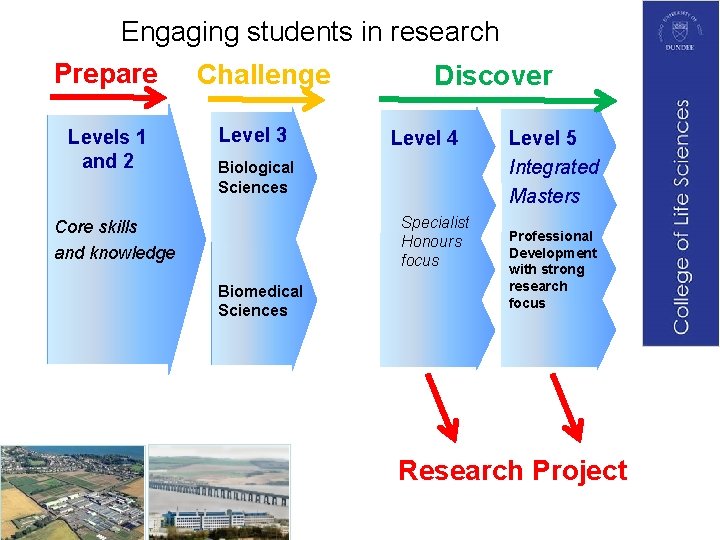
Engaging students in research Prepare Challenge Discover Levels 1 and 2 Level 3 Level 4 Biological Sciences Specialist Honours focus Core skills and knowledge Biomedical Sciences Level 5 Integrated Masters Professional Development with strong research focus Research Project
Level 1 (entry point for students with Highers) • In both semesters students take two theory and two practical modules • These start the preparation stage of the course • Students keep a record of all their skills – practical, numerical and communication skills • Lecturers are specialist teachers and the majority are Fellows of the HEA and possess teaching qualifications as well as Ph. Ds in their specialist science area
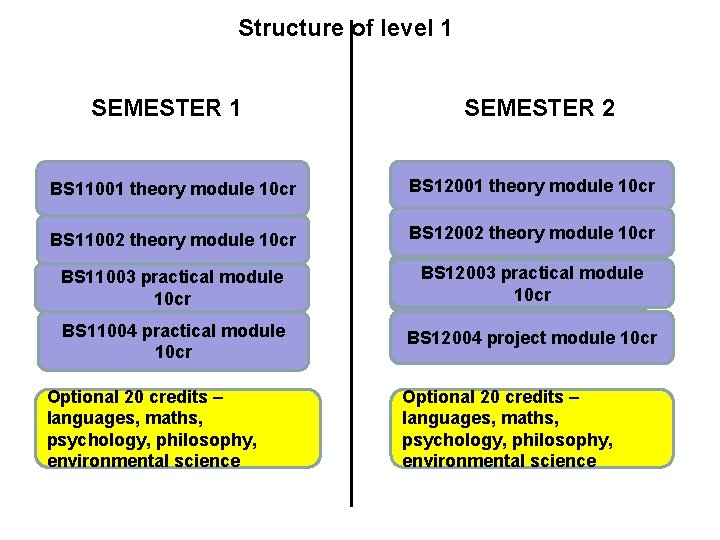
Structure of level 1 SEMESTER 2 BS 11001 theory module 10 cr BS 12001 theory module 10 cr BS 11002 theory module 10 cr BS 12002 theory module 10 cr BS 11003 practical module 10 cr BS 12003 practical module 10 cr BS 11004 practical module 10 cr BS 12004 project module 10 cr Optional 20 credits – languages, maths, psychology, philosophy, environmental science
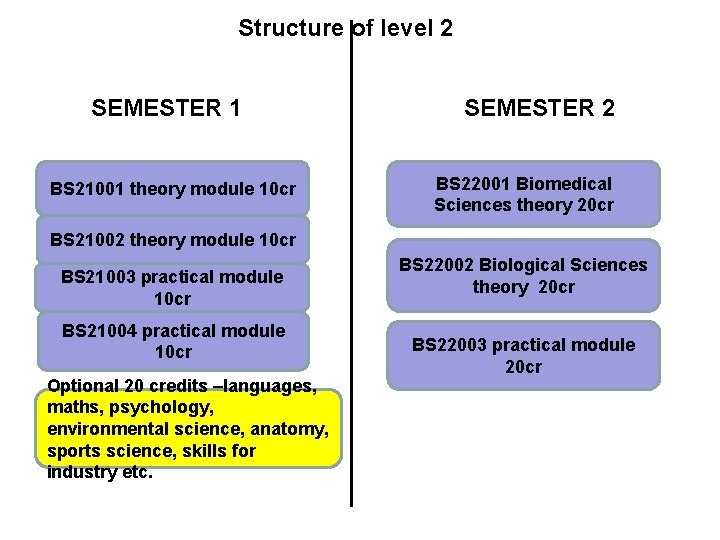
Level 2 (entry point for students with AH or A levels) • • Preparation for specialist study continues Optional module in semester one only Skills record continually updated Progression fair in semester two- meet the researchers and find out more about the specialist areas of study available • Most usual year to undertake either one semester or whole year exchange to another institution in Europe, North America or Asia
Structure of level 2 SEMESTER 1 BS 21001 theory module 10 cr SEMESTER 2 BS 22001 Biomedical Sciences theory 20 cr BS 21002 theory module 10 cr BS 21003 practical module 10 cr BS 21004 practical module 10 cr Optional 20 credits –languages, maths, psychology, environmental science, anatomy, sports science, skills for industry etc. BS 22002 Biological Sciences theory 20 cr BS 22003 practical module 20 cr
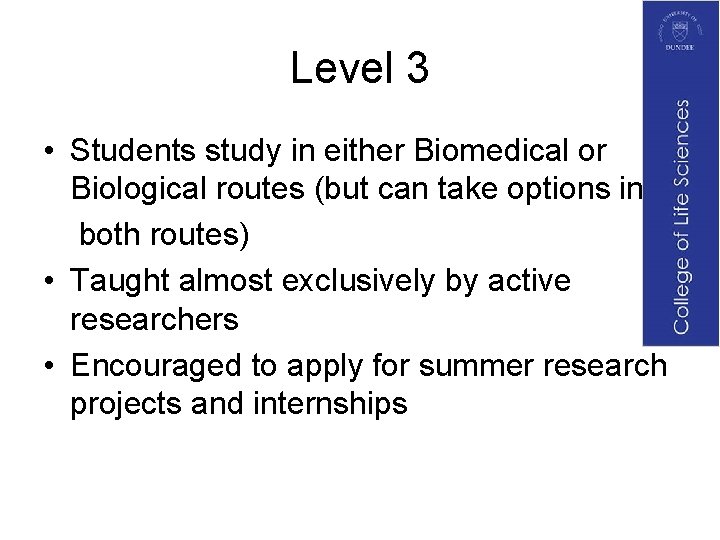
Level 3 • Students study in either Biomedical or Biological routes (but can take options in both routes) • Taught almost exclusively by active researchers • Encouraged to apply for summer research projects and internships
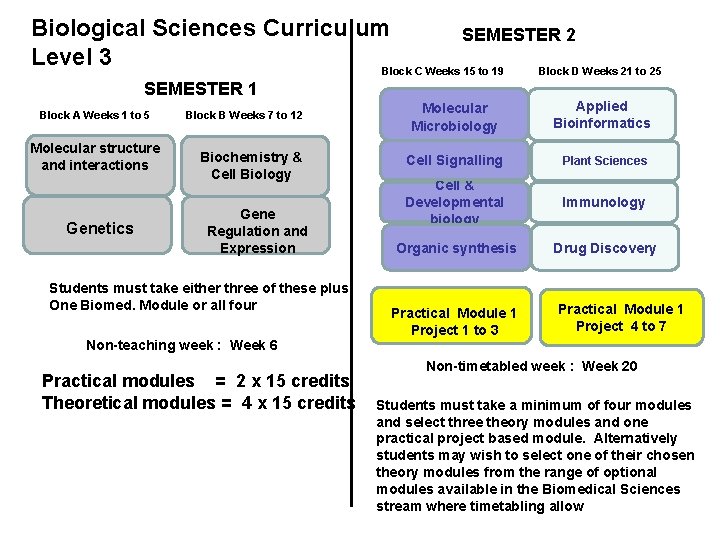
Biological Sciences Curriculum SEMESTER 2 Level 3 Block C Weeks 15 to 19 Block D Weeks 21 to 25 SEMESTER 1 Block A Weeks 1 to 5 Molecular structure and interactions Genetics Block B Weeks 7 to 12 Biochemistry & Cell Biology Gene Regulation and Expression Students must take either three of these plus One Biomed. Module or all four Non-teaching week : Week 6 Practical modules = 2 x 15 credits Theoretical modules = 4 x 15 credits Molecular Microbiology Applied Bioinformatics Cell Signalling Plant Sciences Cell & Developmental biology Immunology Organic synthesis Drug Discovery Practical Module 1 Project 1 to 3 Practical Module 1 Project 4 to 7 Non-timetabled week : Week 20 Students must take a minimum of four modules and select three theory modules and one practical project based module. Alternatively students may wish to select one of their chosen theory modules from the range of optional modules available in the Biomedical Sciences stream where timetabling allow
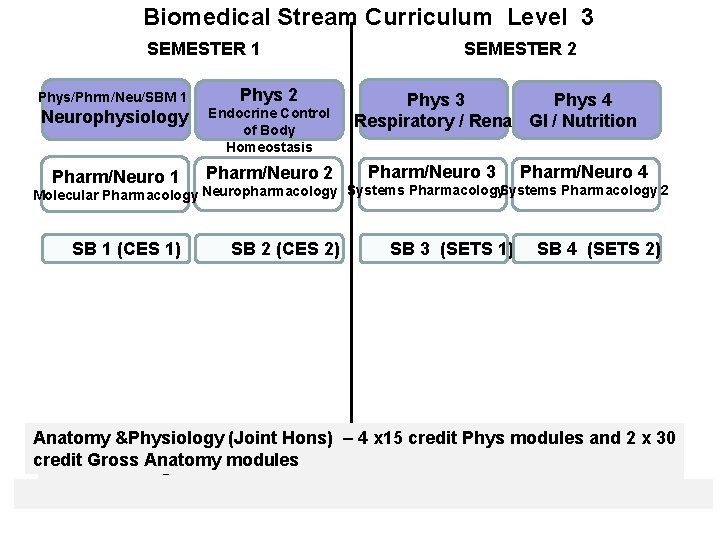
Biomedical Stream Curriculum Level 3 SEMESTER 1 Phys/Phrm/Neu/SBM 1 Phys 2 Neurophysiology Endocrine Control of Body Homeostasis Pharm/Neuro 1 Pharm/Neuro 2 SEMESTER 2 Phys 3 Phys 4 Respiratory / Renal GI / Nutrition Pharm/Neuro 3 Pharm/Neuro 4 Systems Pharmacology 2 Molecular Pharmacology Neuropharmacology Systems Pharmacology 1 SB 1 (CES 1) SB 2 (CES 2) SB 3 (SETS 1) SB 4 (SETS 2) Anatomy &Physiology (Joint Hons) – 4 x 15 credit Phys modules and 2 x 30 Phys students – 4 x 15 credit Phys modules and 4 x 15 credit Gross Anatomy modules Ph. N/SB/Biological modules
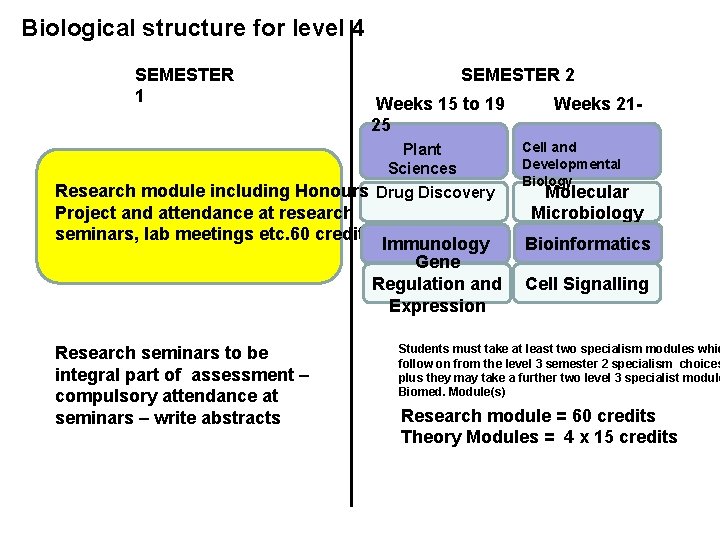
Biological structure for level 4 SEMESTER 1 SEMESTER 2 Weeks 15 to 19 Weeks 21 - 25 Plant Sciences Research module including Honours Drug Discovery Project and attendance at research seminars, lab meetings etc. 60 credits Immunology Gene Regulation and Expression Research seminars to be integral part of assessment – compulsory attendance at seminars – write abstracts Cell and Developmental Biology Molecular Microbiology Bioinformatics Cell Signalling Students must take at least two specialism modules whic follow on from the level 3 semester 2 specialism choices plus they may take a further two level 3 specialist module Biomed. Module(s) Research module = 60 credits Theory Modules = 4 x 15 credits
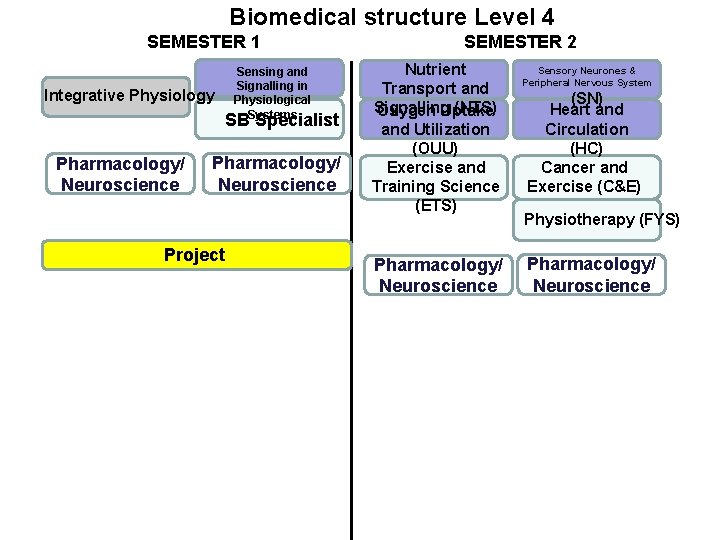
Biomedical structure Level 4 SEMESTER 1 Integrative Physiology Sensing and Signalling in Physiological Systems SB Specialist Pharmacology/ Neuroscience Project SEMESTER 2 Nutrient Transport and Signalling (NTS) Oxygen Uptake and Utilization (OUU) Exercise and Training Science (ETS) Pharmacology/ Neuroscience Sensory Neurones & Peripheral Nervous System (SN) Heart and Circulation (HC) Cancer and Exercise (C&E) Physiotherapy (FYS) Pharmacology/ Neuroscience
And finally from me • Thank you again for coming • Enjoy the rest of your visit • Please ask questions – the more you know, the better choice you can make 23