Lecture 7 Pricing Policies and Levels Dr Yacheng
- Slides: 25
Lecture 7 Pricing Policies and Levels Dr. Yacheng Sun, UC Boulder 1
Pricing Policies Dr. Yacheng Sun, UC Boulder 2
Learning Objectives l Understand the role of pricing policies in developing a strategic approach to pricing l Establish the link between a firm’s pricing actions and customer expectations future purchase behaviors l Provide frameworks for understanding customer behaviors and establishing policies to ensure profitable pricing outcomes l Illustrate common pricing policies and their impact on profitability Dr. Yacheng Sun, UC Boulder 3
Benefits Of Policy Driven Pricing l Provides greater consistency across customer base l Mitigates cost associated with ad-hoc discounting l Forces trade-offs & value recognition l Increases perceptions of price integrity l Creates more efficient selling process Dr. Yacheng Sun, UC Boulder 4
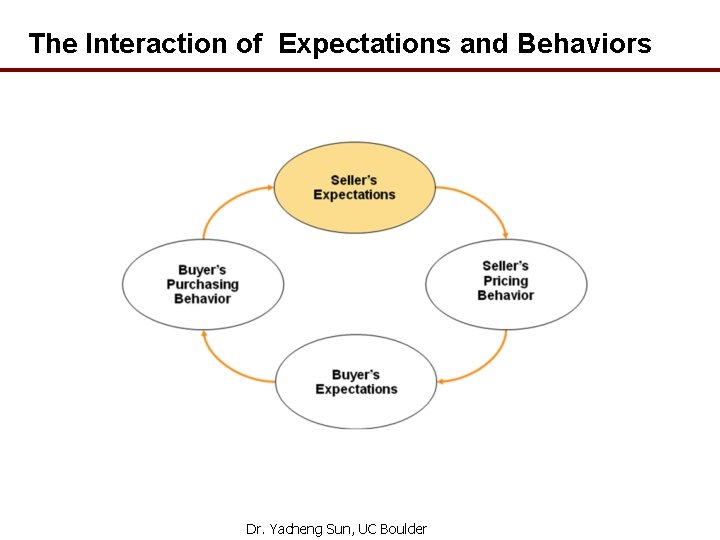
The Interaction of Expectations and Behaviors Dr. Yacheng Sun, UC Boulder
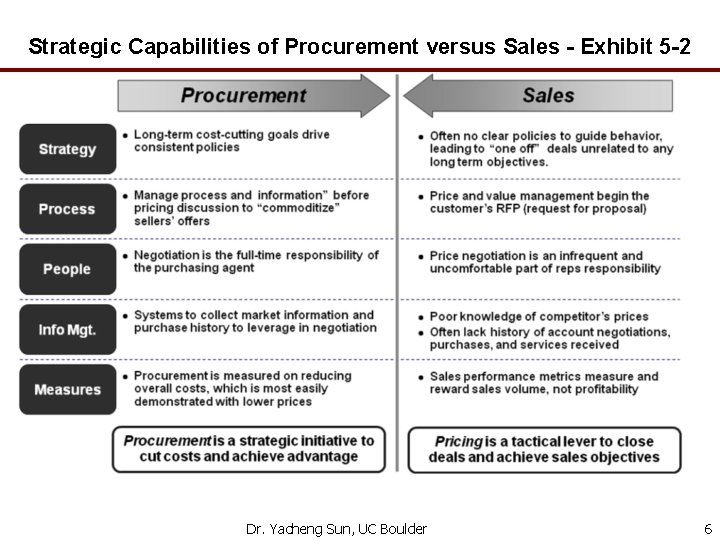
Strategic Capabilities of Procurement versus Sales - Exhibit 5 -2 Dr. Yacheng Sun, UC Boulder 6
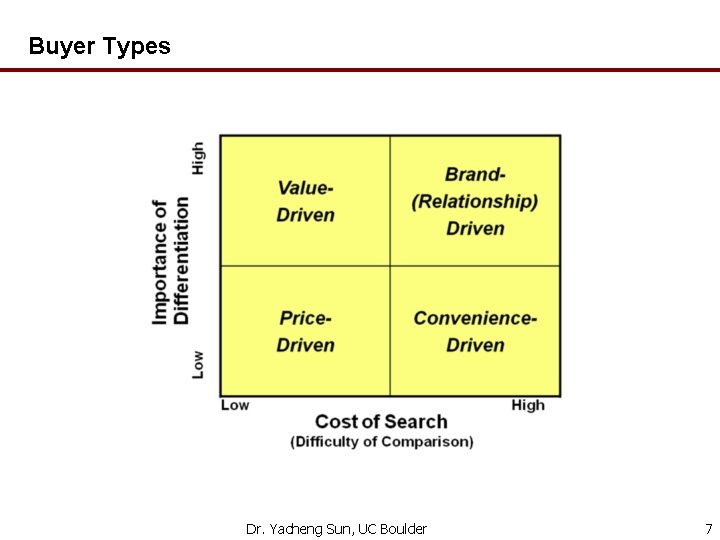
Buyer Types Dr. Yacheng Sun, UC Boulder 7
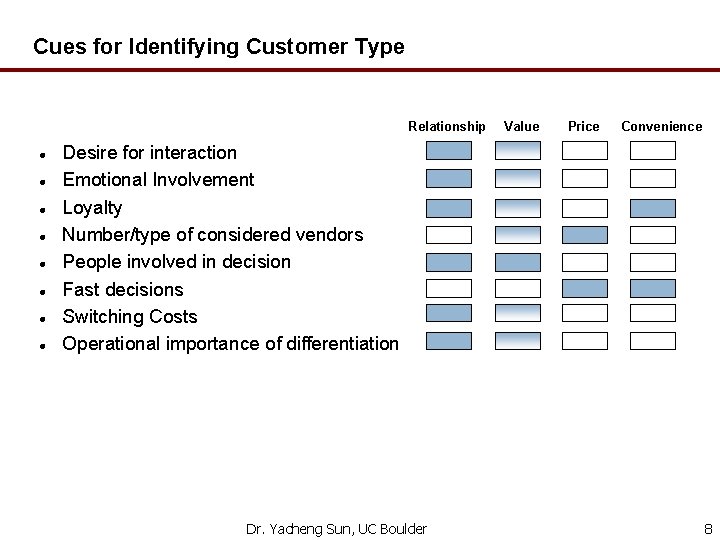
Cues for Identifying Customer Type Relationship l l l l Value Price Convenience Desire for interaction Emotional Involvement Loyalty Number/type of considered vendors People involved in decision Fast decisions Switching Costs Operational importance of differentiation Dr. Yacheng Sun, UC Boulder 8
Price Levels Dr. Yacheng Sun, UC Boulder 9
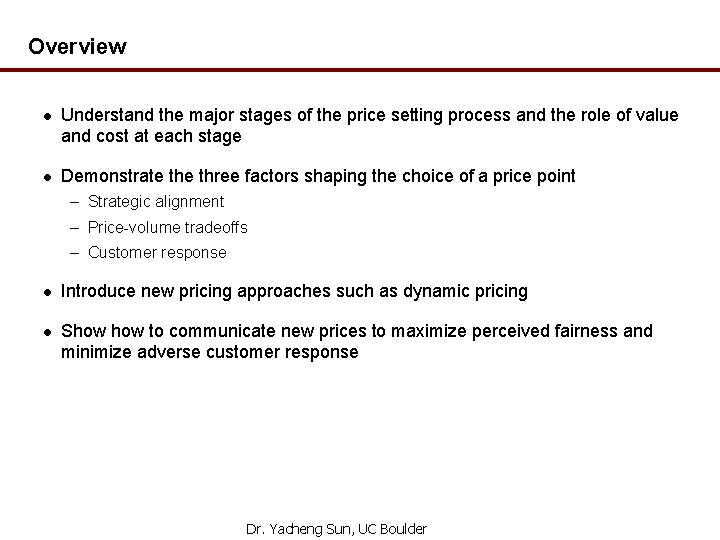
Overview l Understand the major stages of the price setting process and the role of value and cost at each stage l Demonstrate three factors shaping the choice of a price point – Strategic alignment – Price-volume tradeoffs – Customer response l Introduce new pricing approaches such as dynamic pricing l Show to communicate new prices to maximize perceived fairness and minimize adverse customer response Dr. Yacheng Sun, UC Boulder
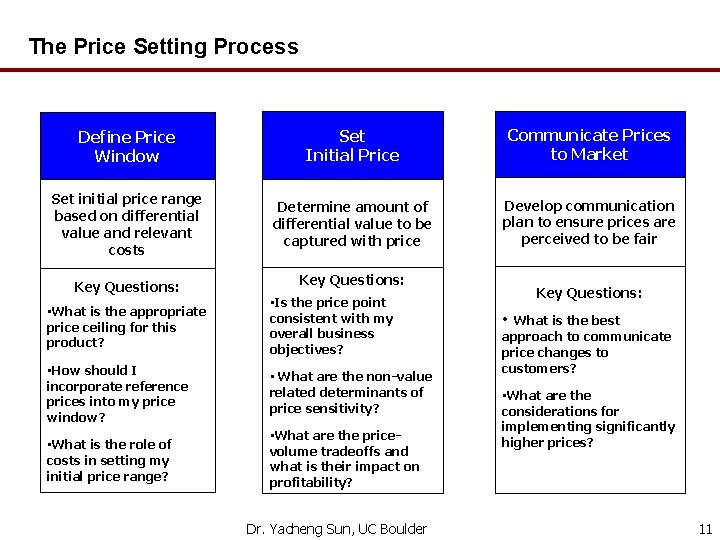
The Price Setting Process Define Price Window Set Initial Price Communicate Prices to Market Set initial price range based on differential value and relevant costs Determine amount of differential value to be captured with price Develop communication plan to ensure prices are perceived to be fair Key Questions: • What is the appropriate price ceiling for this product? • Is the price point consistent with my overall business objectives? • How should I incorporate reference prices into my price window? • What are the non-value related determinants of price sensitivity? • What is the role of costs in setting my initial price range? • What are the pricevolume tradeoffs and what is their impact on profitability? Dr. Yacheng Sun, UC Boulder Key Questions: • What is the best approach to communicate price changes to customers? • What are the considerations for implementing significantly higher prices? 11
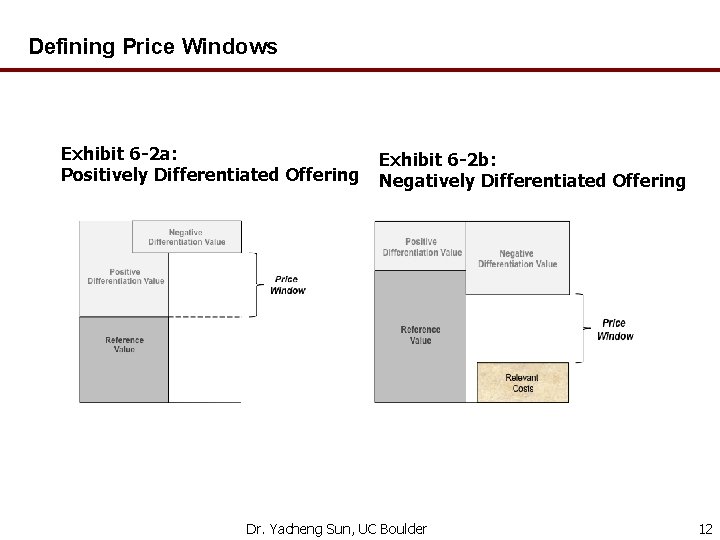
Defining Price Windows Exhibit 6 -2 a: Positively Differentiated Offering Exhibit 6 -2 b: Negatively Differentiated Offering Dr. Yacheng Sun, UC Boulder 12
Three Generic Pricing Strategies Skim Penetration Neutral Dr. Yacheng Sun, UC Boulder 13
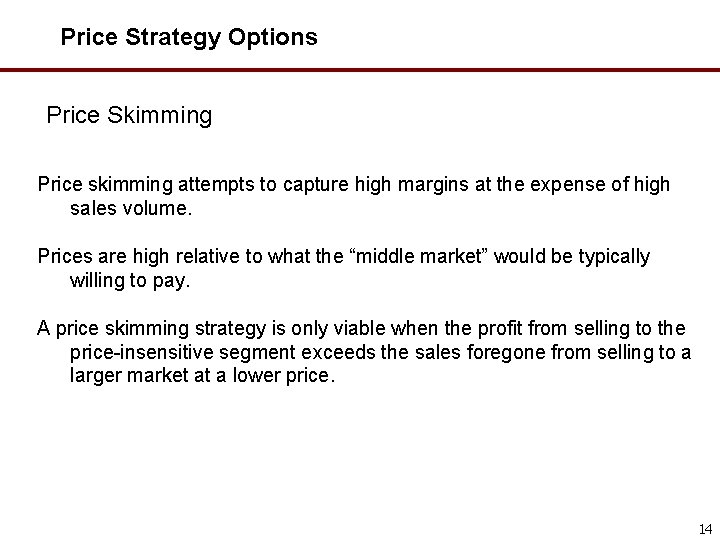
Price Strategy Options Price Skimming Price skimming attempts to capture high margins at the expense of high sales volume. Prices are high relative to what the “middle market” would be typically willing to pay. A price skimming strategy is only viable when the profit from selling to the price-insensitive segment exceeds the sales foregone from selling to a larger market at a lower price. 14
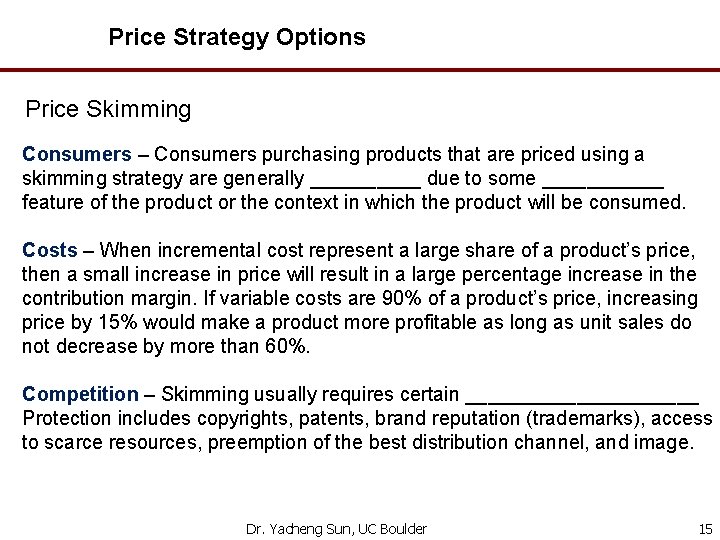
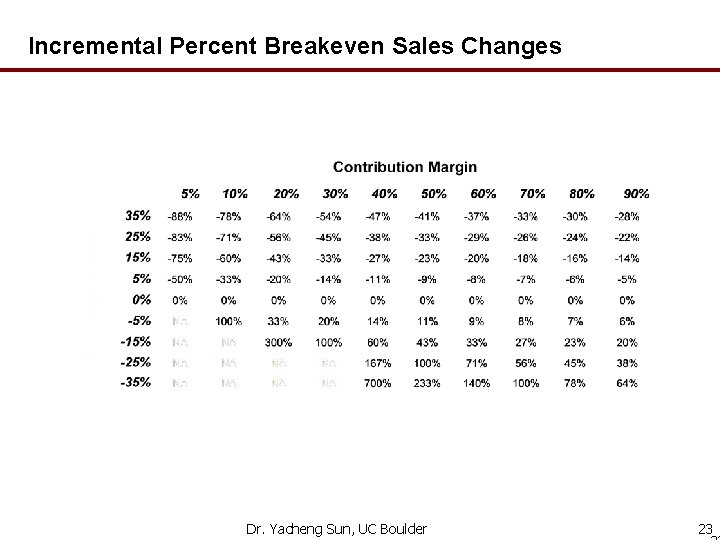
Price Strategy Options Price Skimming Consumers – Consumers purchasing products that are priced using a skimming strategy are generally _____ due to some ______ feature of the product or the context in which the product will be consumed. Costs – When incremental cost represent a large share of a product’s price, then a small increase in price will result in a large percentage increase in the contribution margin. If variable costs are 90% of a product’s price, increasing price by 15% would make a product more profitable as long as unit sales do not decrease by more than 60%. Competition – Skimming usually requires certain ___________ Protection includes copyrights, patents, brand reputation (trademarks), access to scarce resources, preemption of the best distribution channel, and image. Dr. Yacheng Sun, UC Boulder 15
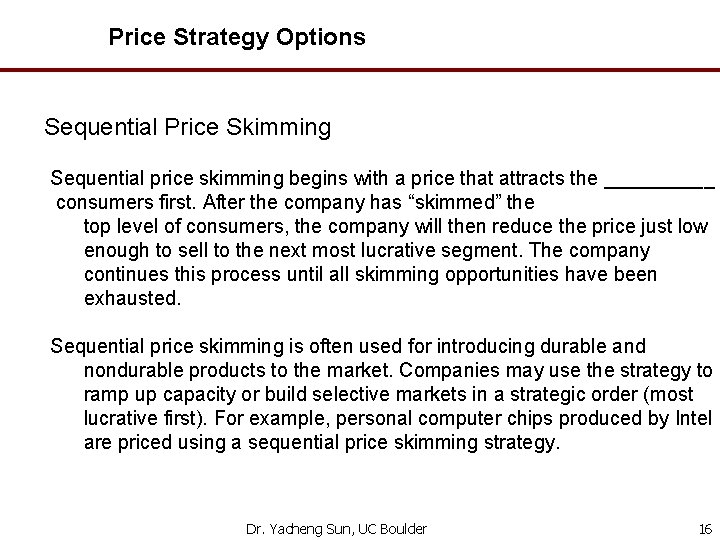
Price Strategy Options Sequential Price Skimming Sequential price skimming begins with a price that attracts the _____ consumers first. After the company has “skimmed” the top level of consumers, the company will then reduce the price just low enough to sell to the next most lucrative segment. The company continues this process until all skimming opportunities have been exhausted. Sequential price skimming is often used for introducing durable and nondurable products to the market. Companies may use the strategy to ramp up capacity or build selective markets in a strategic order (most lucrative first). For example, personal computer chips produced by Intel are priced using a sequential price skimming strategy. Dr. Yacheng Sun, UC Boulder 16
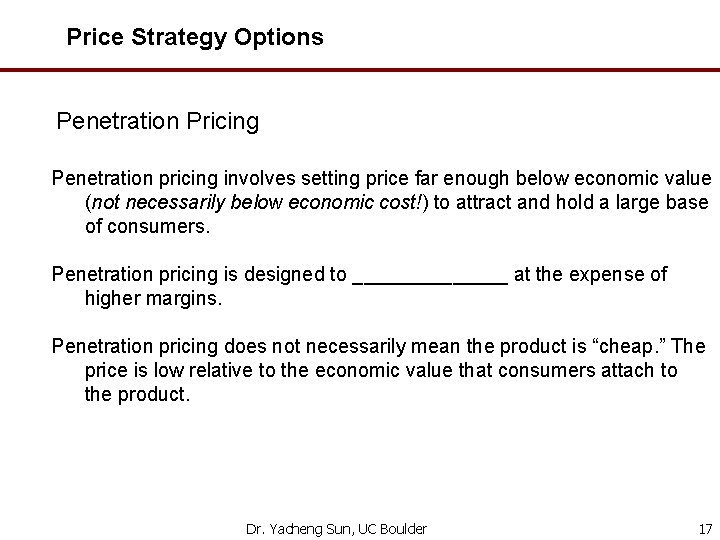
Price Strategy Options Penetration Pricing Penetration pricing involves setting price far enough below economic value (not necessarily below economic cost!) to attract and hold a large base of consumers. Penetration pricing is designed to _______ at the expense of higher margins. Penetration pricing does not necessarily mean the product is “cheap. ” The price is low relative to the economic value that consumers attach to the product. Dr. Yacheng Sun, UC Boulder 17
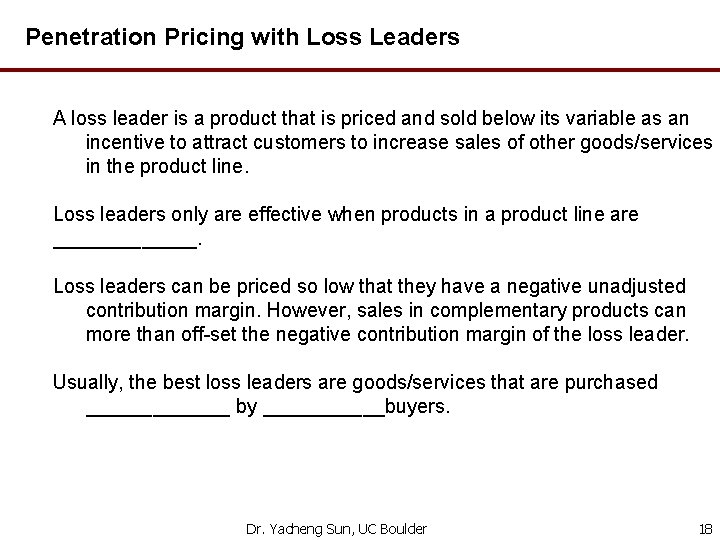
Penetration Pricing with Loss Leaders A loss leader is a product that is priced and sold below its variable as an incentive to attract customers to increase sales of other goods/services in the product line. Loss leaders only are effective when products in a product line are _______. Loss leaders can be priced so low that they have a negative unadjusted contribution margin. However, sales in complementary products can more than off-set the negative contribution margin of the loss leader. Usually, the best loss leaders are goods/services that are purchased _______ by ______buyers. Dr. Yacheng Sun, UC Boulder 18
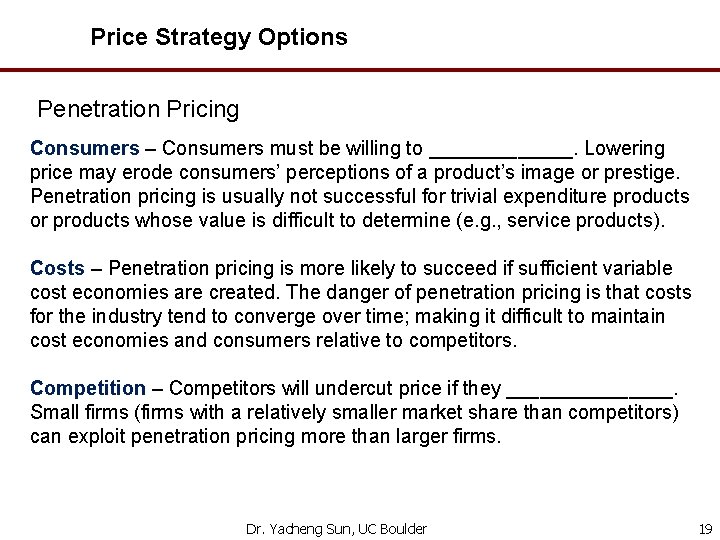
Price Strategy Options Penetration Pricing Consumers – Consumers must be willing to _______. Lowering price may erode consumers’ perceptions of a product’s image or prestige. Penetration pricing is usually not successful for trivial expenditure products or products whose value is difficult to determine (e. g. , service products). Costs – Penetration pricing is more likely to succeed if sufficient variable cost economies are created. The danger of penetration pricing is that costs for the industry tend to converge over time; making it difficult to maintain cost economies and consumers relative to competitors. Competition – Competitors will undercut price if they ________. Small firms (firms with a relatively smaller market share than competitors) can exploit penetration pricing more than larger firms. Dr. Yacheng Sun, UC Boulder 19
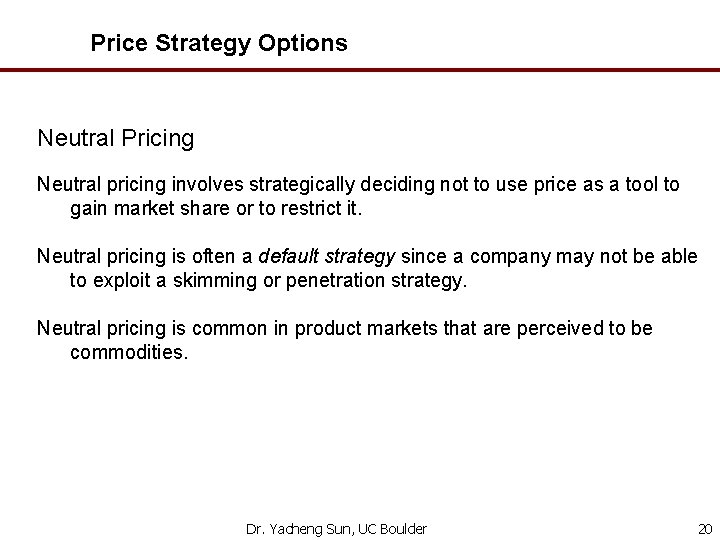
Price Strategy Options Neutral Pricing Neutral pricing involves strategically deciding not to use price as a tool to gain market share or to restrict it. Neutral pricing is often a default strategy since a company may not be able to exploit a skimming or penetration strategy. Neutral pricing is common in product markets that are perceived to be commodities. Dr. Yacheng Sun, UC Boulder 20
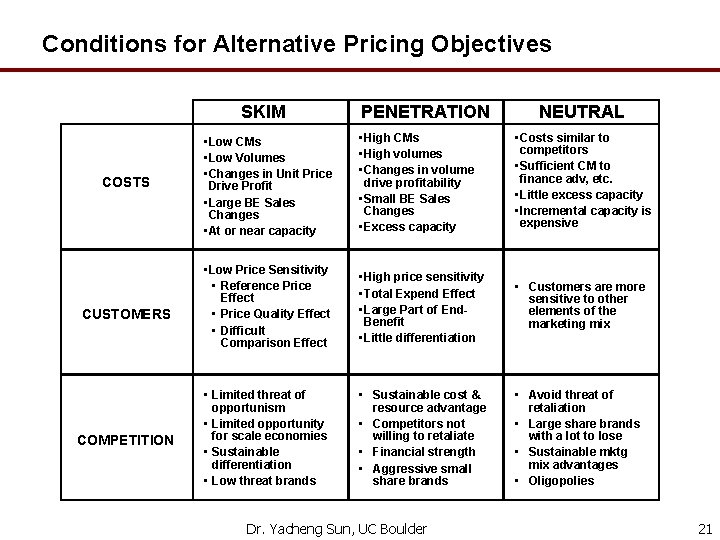
Conditions for Alternative Pricing Objectives SKIM COSTS CUSTOMERS COMPETITION PENETRATION NEUTRAL • Low CMs • Low Volumes • Changes in Unit Price Drive Profit • Large BE Sales Changes • At or near capacity • High CMs • High volumes • Changes in volume drive profitability • Small BE Sales Changes • Excess capacity • Costs similar to competitors • Sufficient CM to finance adv, etc. • Little excess capacity • Incremental capacity is expensive • Low Price Sensitivity • Reference Price Effect • Price Quality Effect • Difficult Comparison Effect • High price sensitivity • Total Expend Effect • Large Part of End. Benefit • Little differentiation • Customers are more sensitive to other elements of the marketing mix • Limited threat of opportunism • Limited opportunity for scale economies • Sustainable differentiation • Low threat brands • Sustainable cost & resource advantage • Competitors not willing to retaliate • Financial strength • Aggressive small share brands • Avoid threat of retaliation • Large share brands with a lot to lose • Sustainable mktg mix advantages • Oligopolies Dr. Yacheng Sun, UC Boulder 21
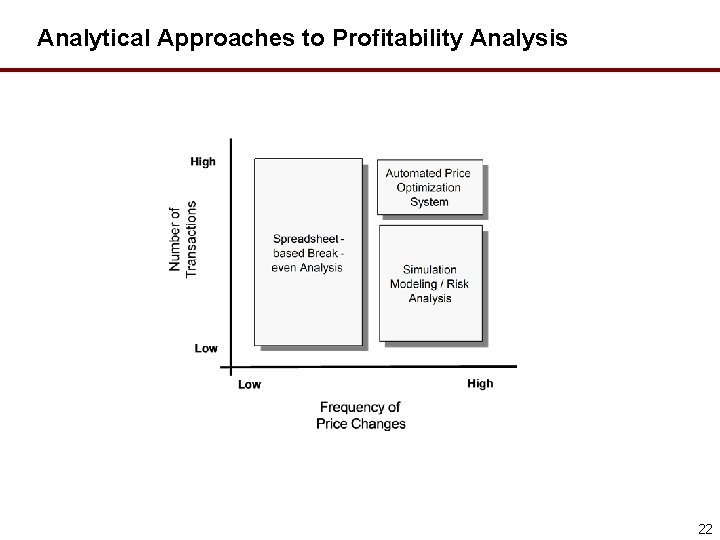
Analytical Approaches to Profitability Analysis 22
Incremental Percent Breakeven Sales Changes Dr. Yacheng Sun, UC Boulder 23
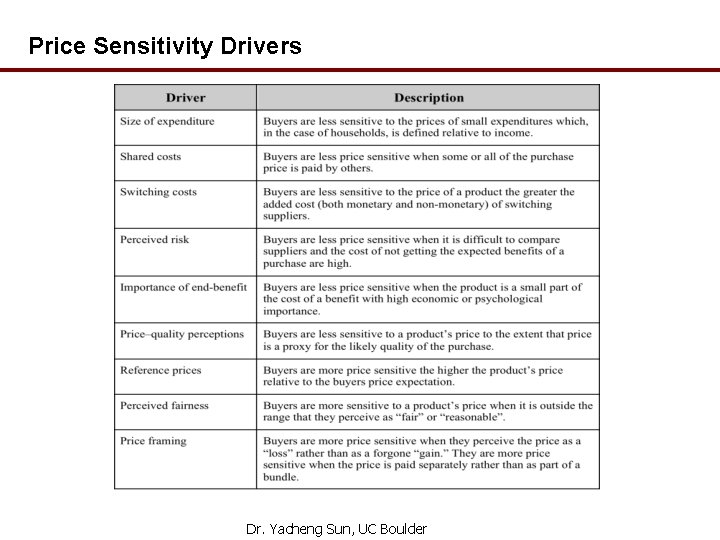
Price Sensitivity Drivers Dr. Yacheng Sun, UC Boulder
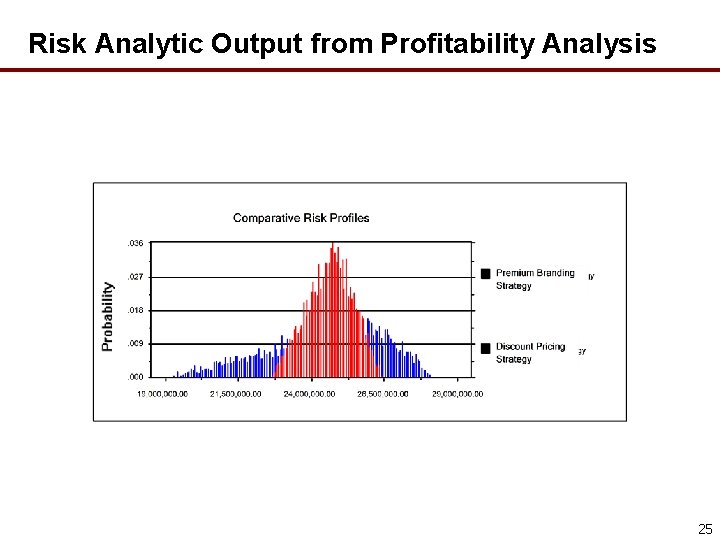
Risk Analytic Output from Profitability Analysis 25