Lecture 12 Environmental Management Accounting EMA Wiwik2010 1




- Slides: 28
Lecture 12 Environmental Management Accounting (EMA) Wiwik-2010 1
Definition There are many alternative definitions, but broadly defined… EMA is the identification, collection, analysis, and use of two types of information for internal decision-making: Ø Physical information on the use, flows, and fates of energy, water, and materials (including wastes) Ø Monetary information on environment-related costs, earnings, and savings EMA Expert Working Group of the United Nations Division for Sustainable Wiwik-2010 Development 2
Definition EMA combines financial and physical data and calculates the environmental costs of companies • Physical data on material and energy input, material flows, products, waste and emissions PEMA • financial data on expenditures, costs, earnings, savings related to company activities with potential environmental aspects or impacts MEMA Wiwik-2010 3
Why was EMA Developed? • EMA was conceived in recognition of some of the limitations of conventional practices for informing environmental management decisions – insufficient tracking of energy, materials, and wastes – “hiding” of costs in overhead accounts and elsewhere in the accounting records – lack of data on future and less tangible costs in the accounting records at all – Insufficient communications between the accounting and other departments/staff, e. g. , production, environmental, research… Wiwik-2010 4
PHYSICAL INFORMATION ü Flow of energy, water, materials and waste (MEFA) ü Physical Information § Materials Inputs § Product Outputs § Non-Product Outputs (Waste and Emissions) ü Materials/Mass Balances ü Physical Environmental Performance Indicators Wiwik-2010 5
MONETARY INFORMATION ü ENVIRONMENT-RELATED COSTS AND EARNINGS ü Cost Categories § § § Waste & Emission Control Costs Prevention & Other Environmental Management Costs Research & Development Costs Materials Costs of Non-Product Outputs Materials Costs of Product Outputs Less Tangible Costs ü Monetary Environmental Performance Indicators ü Environment-related Earnings and Savings ü Distribution of Costs by Environmental Domain Wiwik-2010 6
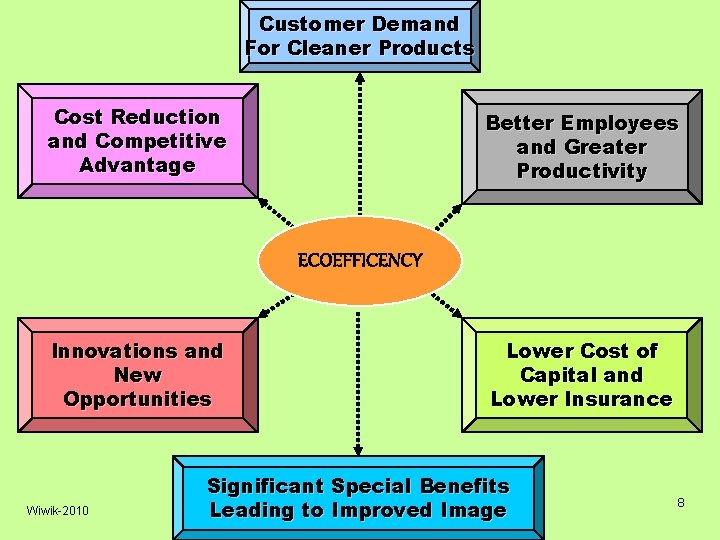
The Benefits of Ecoefficiency • Ecoefficiency essentially maintains that organizations can produce more useful goods and services while simultaneously reducing negative environmental impacts, resource consumption, and costs. Wiwik-2010 7
Customer Demand For Cleaner Products Cost Reduction and Competitive Advantage Better Employees and Greater Productivity ECOEFFICENCY Innovations and New Opportunities Wiwik-2010 Lower Cost of Capital and Lower Insurance Significant Special Benefits Leading to Improved Image 8
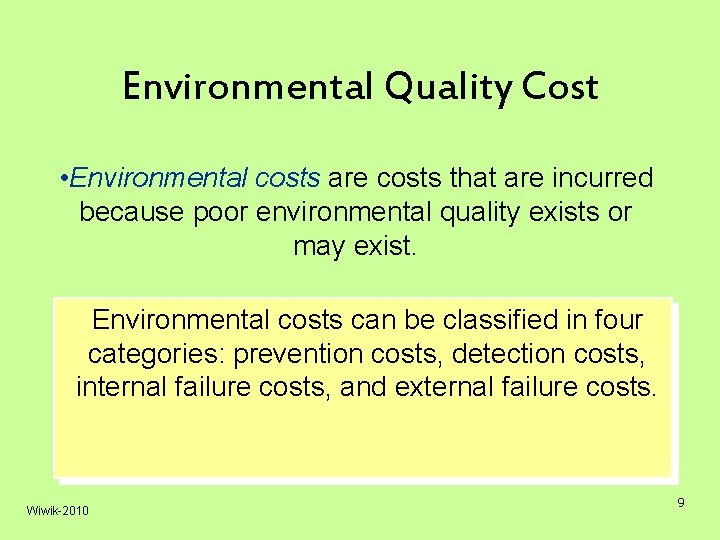
Environmental Quality Cost • Environmental costs are costs that are incurred because poor environmental quality exists or may exist. Environmental costs can be classified in four categories: prevention costs, detection costs, internal failure costs, and external failure costs. Wiwik-2010 9
Environmental Costs Are Often Underestimated • Research Findings: – For every dollar of waste cost that companies actually measure, another 2 to 3 dollars of cost are” hidden” in the accounting records, or are not on the books at all – Companies typically underestimate how much waste really costs them, sometimes by several orders of magnitude – This applies even to big, well-managed companies Wiwik-2010 10
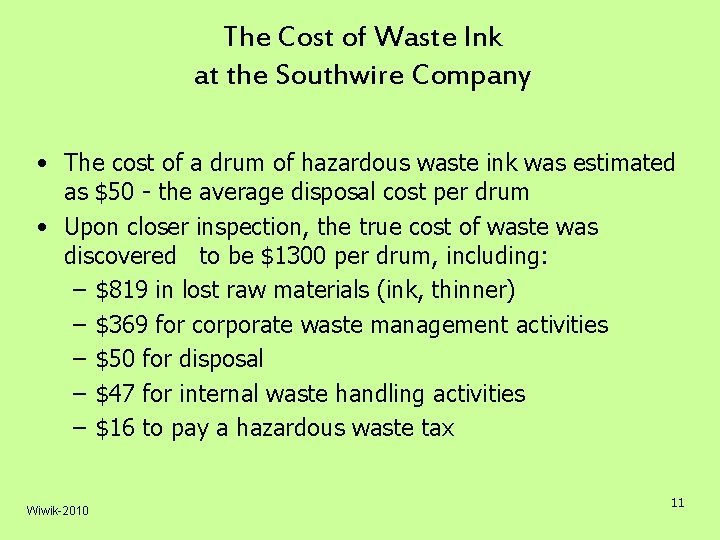
The Cost of Waste Ink at the Southwire Company • The cost of a drum of hazardous waste ink was estimated as $50 - the average disposal cost per drum • Upon closer inspection, the true cost of waste was discovered to be $1300 per drum, including: – $819 in lost raw materials (ink, thinner) – $369 for corporate waste management activities – $50 for disposal – $47 for internal waste handling activities – $16 to pay a hazardous waste tax Wiwik-2010 11
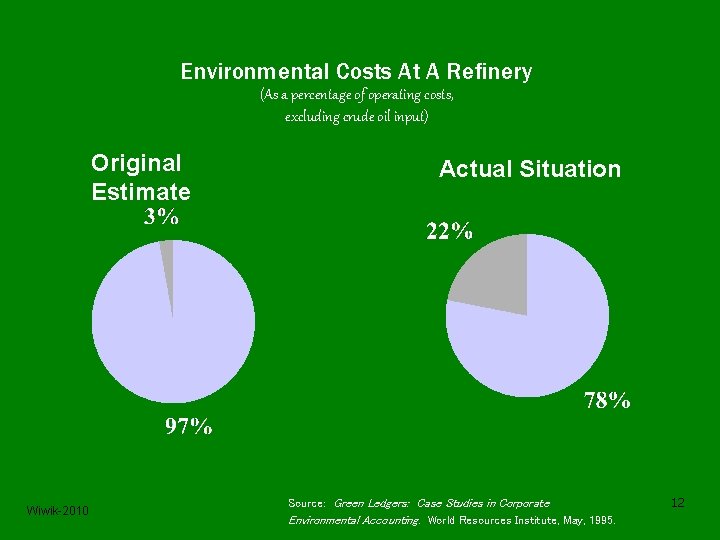
Environmental Costs At A Refinery (As a percentage of operating costs, excluding crude oil input) Original Estimate Wiwik-2010 Actual Situation Source: Green Ledgers: Case Studies in Corporate Environmental Accounting. World Resources Institute, May, 1995. 12
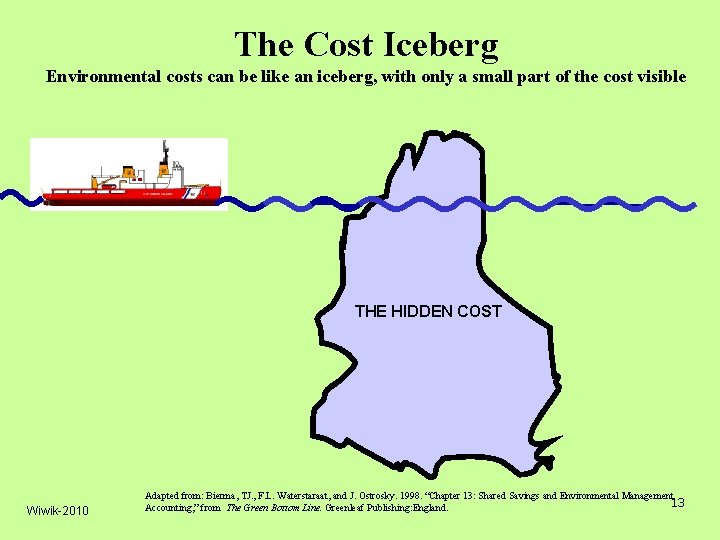
The Cost Iceberg Environmental costs can be like an iceberg, with only a small part of the cost visible THE HIDDEN COST Wiwik-2010 Adapted from: Bierma, TJ. , F. L. Waterstaraat, and J. Ostrosky. 1998. “Chapter 13: Shared Savings and Environmental Management 13 Accounting, ” from The Green Bottom Line. Greenleaf Publishing: England.
EMA “End-uses” EMA can provide the data needed for many environmental management initiatives – Cleaner Production/Pollution Prevention/Green Productivity – Design for Environment – Environmentally Preferable Purchasing – Environmental Supply Chain Management – Extended Producer Responsibility – Performance Meas. & Benchmarking – Corporate Environmental Reporting – etc. Wiwik-2010 14
EMA for Improved Capital Budgeting • Better identification, allocation, and analysis of environmental costs improves the process by which the profitability of potential investment projects are assessed. • Such investments include any capital project that has the major objective of controlling, reducing or preventing pollution. Wiwik-2010 15
Profitability Assessments of Proposed Sustainable Projects EMA can illustrate the potential profitability of projects that utilizes preventive management strategies by doing a better job of profitability assessment: – Comprehensive inclusion of relevant and significant costs and savings – Improved cost estimation and allocation – Longer analysis time horizons – Multiple profitability indicators Wiwik-2010 16
Comprehensive Inclusion of Relevant Costs and Savings (conventional and less tangible costs…) • The cost of lost manufacturing inputs – lost materials, energy, labor, capital, etc. • The cost of waste management – waste handling, regulatory compliance, waste treatment & disposal, etc. • Less tangible costs – reduced production throughput, reduced product quality, negative company image, liability, etc. Wiwik-2010 17
Financial Data for White Water and Reuse Project Costs and Savings: company analysis Fiber improved analysis *TCA Capital Costs $1, 469, 404 Annual Savings $ 350, 670 $ 911, 240 4. 2 years 1. 6 years $ 47, 696 $2, 073, 607 Financial Indicators: Payback Period Net Present Value Internal Rate of Return 17% 46% * Total Cost Assessment: Budgeting for Pollution Prevention, Tellus Institute, 1993 Wiwik-2010 18
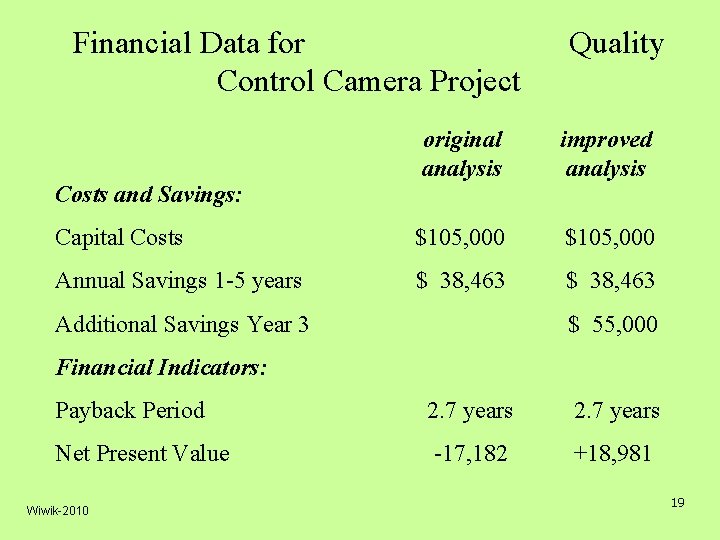
Financial Data for Control Camera Project Quality original analysis improved analysis Capital Costs $105, 000 Annual Savings 1 -5 years $ 38, 463 Costs and Savings: Additional Savings Year 3 $ 55, 000 Financial Indicators: Payback Period 2. 7 years Net Present Value -17, 182 +18, 981 Wiwik-2010 19
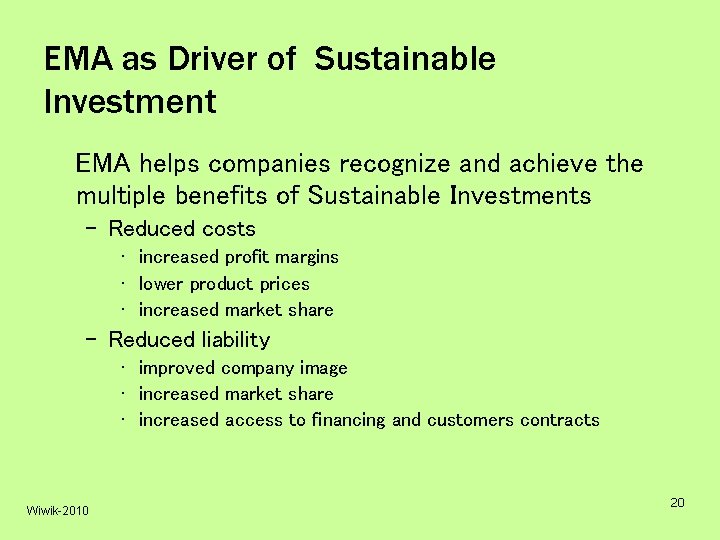
EMA as Driver of Sustainable Investment EMA helps companies recognize and achieve the multiple benefits of Sustainable Investments – Reduced costs • increased profit margins • lower product prices • increased market share – Reduced liability • improved company image • increased market share • increased access to financing and customers contracts Wiwik-2010 20
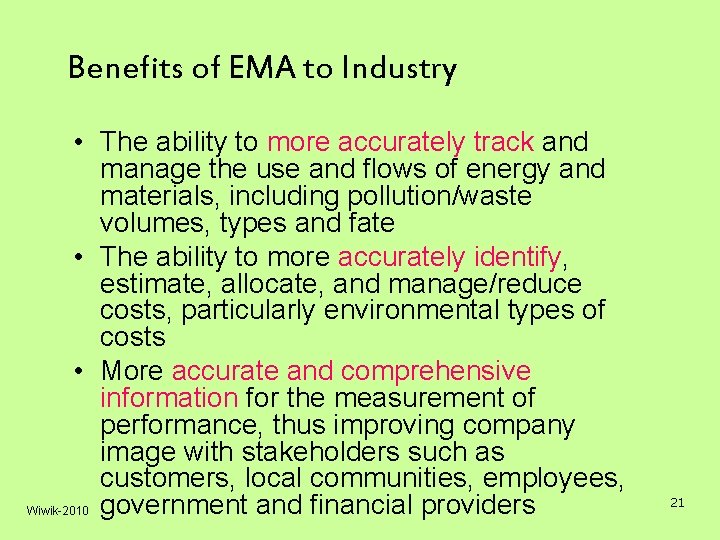
Benefits of EMA to Industry • The ability to more accurately track and manage the use and flows of energy and materials, including pollution/waste volumes, types and fate • The ability to more accurately identify, estimate, allocate, and manage/reduce costs, particularly environmental types of costs • More accurate and comprehensive information for the measurement of performance, thus improving company image with stakeholders such as customers, local communities, employees, Wiwik-2010 government and financial providers 21
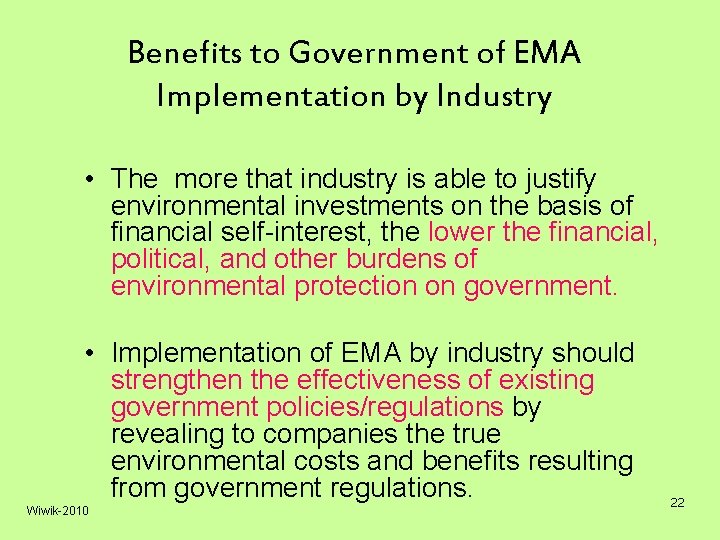
Benefits to Government of EMA Implementation by Industry • The more that industry is able to justify environmental investments on the basis of financial self-interest, the lower the financial, political, and other burdens of environmental protection on government. • Implementation of EMA by industry should strengthen the effectiveness of existing government policies/regulations by revealing to companies the true environmental costs and benefits resulting from government regulations. Wiwik-2010 22
EMA Development • United Nations Division for Sustainable Development’s Consultative Working Group on EMA • EMA Workbooks: – Environmental Management Accounting Procedures and Principles – EMA-Links: Government, Management, and Stakeholders – Policy Pathways for Promoting Environmental Management Accounting Wiwik-2010 23
UNDSD Expert Working Group on EMA … UNDSD = United Nations Division for Sustainable Development § EMA Working Group established in 1999 § Core members are government representatives from 30+ countries § Other members include invited representatives of accounting associations, academia, business, etc. § Group has met 8 times, each time in a different country § Group has discussed many international topics of debate surrounding EMA Wiwik-2010 24
EMA Education. . . Most initiatives to promote EMA around the world rely on voluntary adoption, with educational activities a core component: – guidance documents – case studies – curriculum development & training – software Wiwik-2010 25
EMA in North America Europe and Examples of initiatives in North America and Europe that promote EMA as a tool for many environmental programs – US EPA’s Environmental Accounting Project – Environmental Canada-Quebec Regional Office’s Private Sector P 2 Initiative – Graz (Austria) Department of Environmental Protection’s Eco Profit Initiative – UK Environment Agency’s EMA for Financial Accountants Project Wiwik-2010 26
EMA in Asia Examples of EMA and EMA-related projects and activities in Asia – Philippine Training Course on EMA and CP supported the US-Asia Environmental Partnership (USAEP) – Environmental Accounting Guideline published by the Ministry of Environment in Japan – UNEP’s CP Finance’s Profiting from CP Course in Vietnam – Taiwan Environmental Management Association’s EMA Training Project – Thailand Environment Institute’s Workshop on EMA Wiwik-2010 27
STOP GLOBAL WARMING - The End - Wiwik-2010 28