
MEB experience Adaptive Pathways PRIME Andre Elferink Dutch
MEB experience: Adaptive Pathways & PRIME Andre Elferink Dutch Medicines Evaluation Board Member Scientific Advice Working Party / PRIME oversight group Thanks for slides by Stiina Aarum, Anna F. Cerrata , B. Hiemstra, BIO Holland, P. Mol, H. Ovelgonne
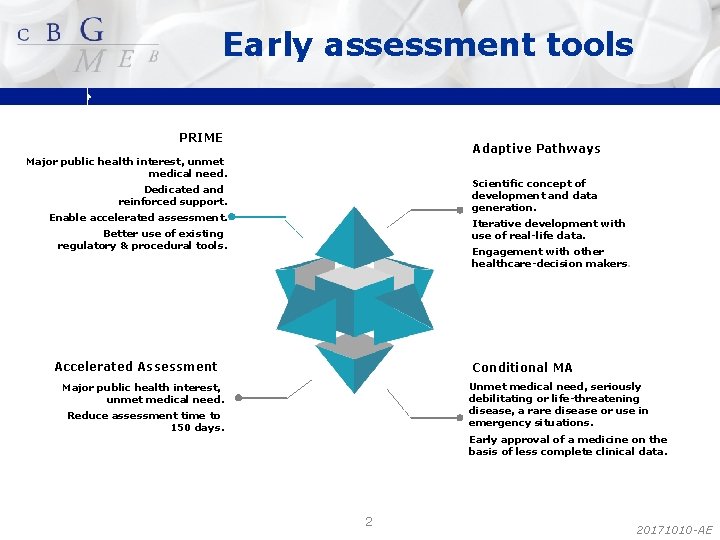
Early assessment tools PRIME Adaptive Pathways Major public health interest, unmet medical need. Scientific concept of development and data generation. Dedicated and reinforced support. Enable accelerated assessment. Iterative development with use of real-life data. Better use of existing regulatory & procedural tools. Engagement with other healthcare-decision makers. Accelerated Assessment Conditional MA Unmet medical need, seriously debilitating or life-threatening disease, a rare disease or use in emergency situations. Major public health interest, unmet medical need. Reduce assessment time to 150 days. Early approval of a medicine on the basis of less complete clinical data. 2 20171010 -AE
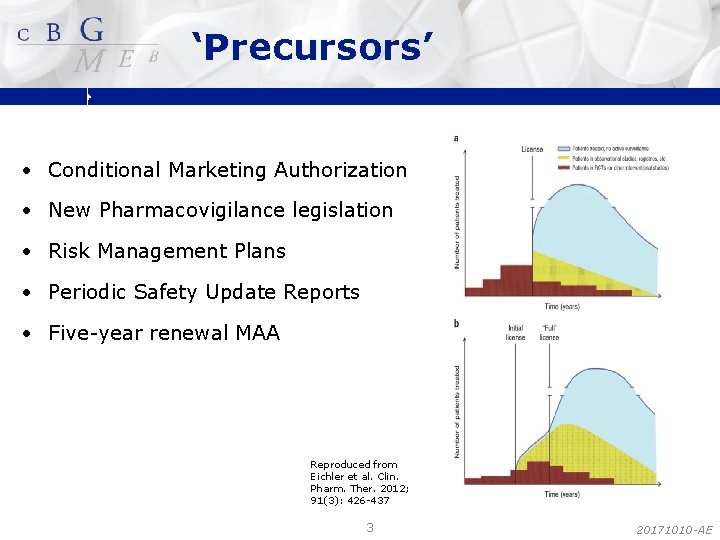
‘Precursors’ • Conditional Marketing Authorization • New Pharmacovigilance legislation • Risk Management Plans • Periodic Safety Update Reports • Five-year renewal MAA Reproduced from Eichler et al. Clin. Pharm. Ther. 2012; 91(3): 426 -437 3 20171010 -AE
Adaptive pathways Aim: To get good medicines to the patient as soon as possible Support the development selection of pathway of product and (potential) earlier access to medicines through early dialogue involving all stakeholders (regulators, HTAs, payers, patients, learned societies. …) 4 20171010 -AE
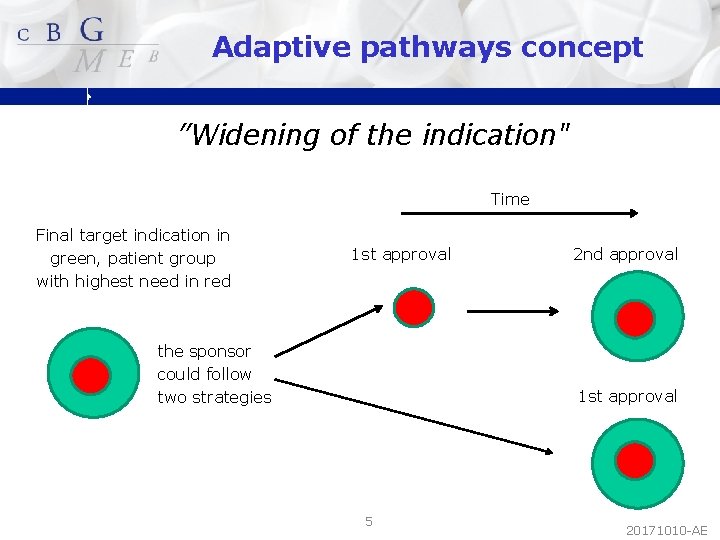
Adaptive pathways concept ”Widening of the indication" Time Final target indication in green, patient group with highest need in red 1 st approval the sponsor could follow two strategies 2 nd approval 1 st approval 5 20171010 -AE
Conditions • Prospective agreements on data requirements – Including data collection after registration – Including usage data, registry data – Between industry, HTA and regulator – Aligning HTA and licensing requirements • Post licensing data to – Reduce uncertainties – Widen the indication • Adaptive reimbursement to enforce collection of further evidence 6 20171010 -AE
HTA/payers perspective • Viability of introducing adaptive licensing depends on the assessments by HTA bodies and decision by payers • Regulatory requirements for evidence need to be better harmonized with HTA requirements • Allowance of - Reimbursement to rise from a initial lower level - Decreasing uncertainties of B/R - Conditions to be met - Conditions to be fulfilled 7 20171010 -AE
Initial experience • 39 products submitted as candidates • 11 selected for in-depth discussion with company • 4 SMEs • 5 are Orphan drugs • 2 are ATMP (Advanced Therapy Medicinal Products) • Main reasons for rejection were: – Development too advanced – Limited learning potential for a pilot 8 20171010 -AE
Criteria for selection • Unmet medical need • An iterative development plan (start in a well-defined subpopulation and expand, or have a Conditional Marketing Authorisation, may be surrogate endpoints and confirm) • Real World Data (safety and efficacy) can be acquired to supplement Clinical Trials - RCTs / PAES / PASS / Registies / Large Data basis / Off-label use • Input / commitment of all stakeholders likely 9 20171010 -AE
Rules of the game • Demonstration of a positive Benefit/Risk required. Involve all stakeholders to discuss how to demonstrate, and how to optimise requirements. • Embedded within existing regulatory tools Not a new procedure, not a new approval route. • A request for parallel EMA/HTA advice is expected to discuss science and requirements in depth i. e. a formal Scientific Advice letter • Acceptance/rejection in the AL pilot has no inference about approval potential 10 20171010 -AE
Challenges • HTA and EMA requirements not always well aligned. – After marketing authorisation reimbursement may take many years – Delaying patient access • HTAs do not form a homogeneous groups - Not all HTAs are interested in a scenario where reimbursements rise form am initial lower level - Some HTA’s reluctant to engage in earlier reimbursements - When uncertainties are still large Subsidizing drug development No chance to negotiate lower prices? Payment by performance 11 20171010 -AE
Challenges • Companies may also be reluctant to engage in early reimbursement - Less control - Risk of low initial reimbursement - Remaining to become the final reimbursement • Implementation of commitment to generate of additional data – Confirmative efficacy data may be needed – Confirmative efficacy data need to be generated – Safety data will need to be generated • After marketing authorisation there is limited use of real world data, from use of the product 12 20171010 -AE
Solutions • Talk earlier: HTA involvement at earlier stage recommended - Scientific Advice optimises resource use - Parallel HTA / EMA advice extremely helpful • Confidence in the regulation increase when commitments are fulfilled 13 20171010 -AE
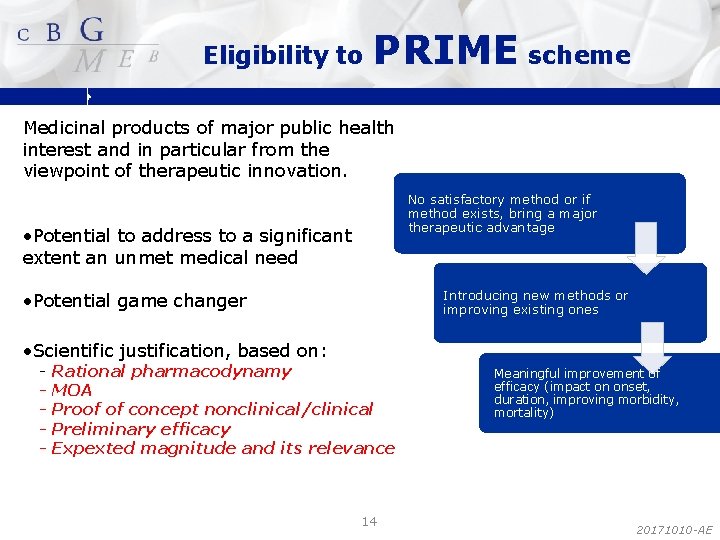
Eligibility to PRIME scheme Medicinal products of major public health interest and in particular from the viewpoint of therapeutic innovation. No satisfactory method or if method exists, bring a major therapeutic advantage • Potential to address to a significant extent an unmet medical need Introducing new methods or improving existing ones • Potential game changer • Scientific justification, based on: - Rational pharmacodynamy MOA Proof of concept nonclinical/clinical Preliminary efficacy Expexted magnitude and its relevance 14 Meaningful improvement of efficacy (impact on onset, duration, improving morbidity, mortality) 20171010 -AE
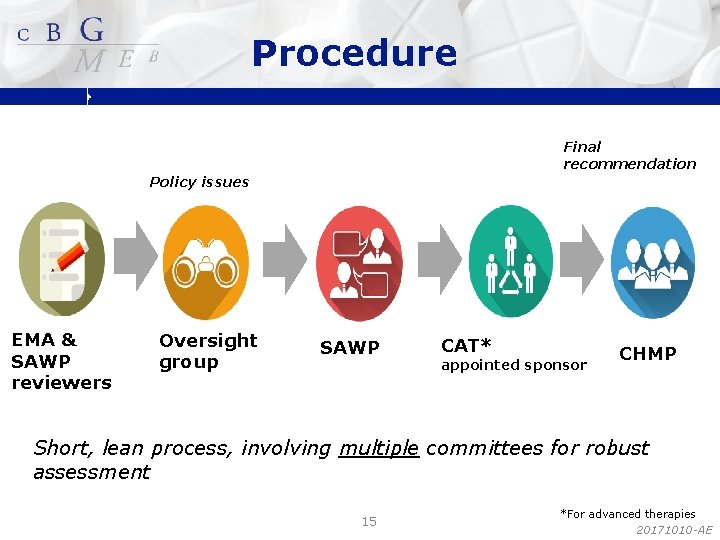
Procedure Final recommendation Policy issues EMA & SAWP reviewers Oversight group SAWP CAT* appointed sponsor CHMP Short, lean process, involving multiple committees for robust assessment 15 *For advanced therapies 20171010 -AE
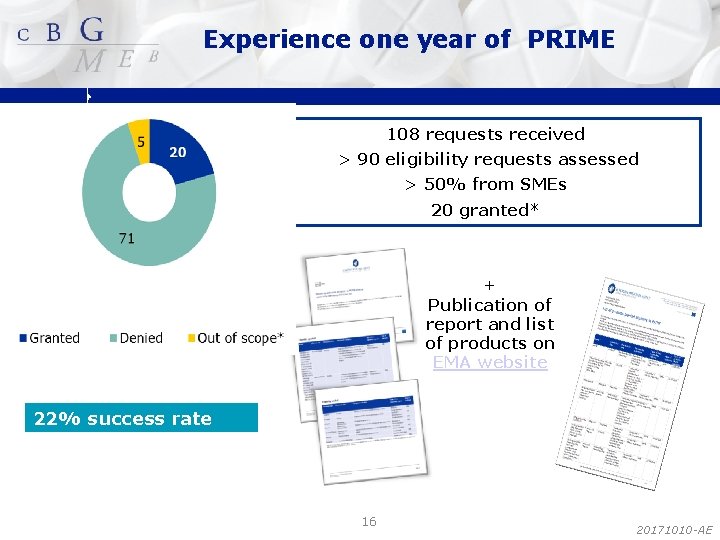
Experience one year of PRIME 108 requests received > 90 eligibility requests assessed > 50% from SMEs 20 granted* + Publication of report and list of products on EMA website 22% success rate 16 20171010 -AE
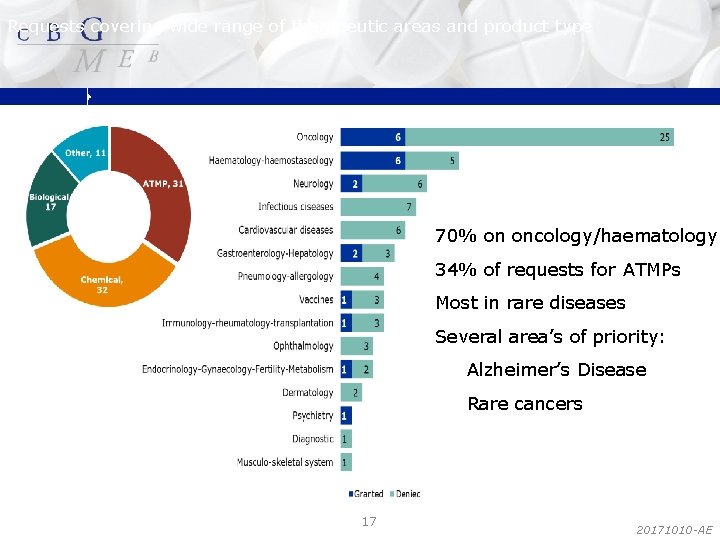
Requests covering wide range of therapeutic areas and product type 70% on oncology/haematology 34% of requests for ATMPs Most in rare diseases Several area’s of priority: Alzheimer’s Disease Rare cancers 17 20171010 -AE
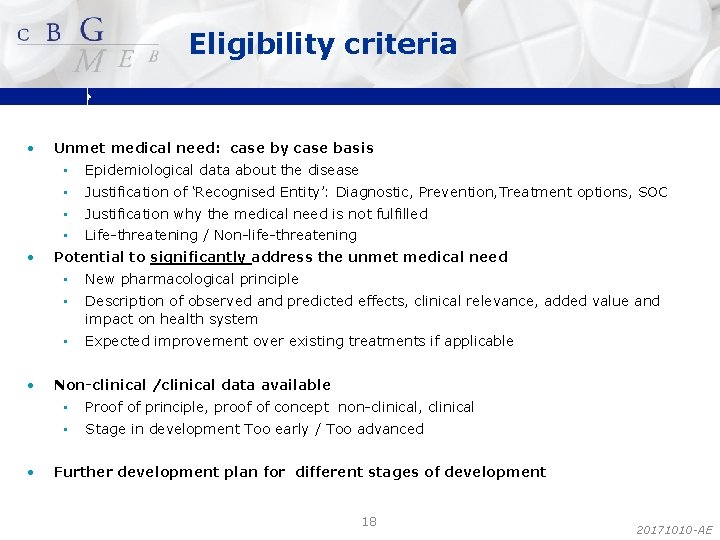
Eligibility criteria • • Unmet medical need: case by case basis • Epidemiological data about the disease • Justification of ‘Recognised Entity’: Diagnostic, Prevention, Treatment options, SOC • Justification why the medical need is not fulfilled • Life-threatening / Non-life-threatening Potential to significantly address the unmet medical need • New pharmacological principle • Description of observed and predicted effects, clinical relevance, added value and impact on health system • Expected improvement over existing treatments if applicable Non-clinical /clinical data available • Proof of principle, proof of concept non-clinical, clinical • Stage in development Too early / Too advanced Further development plan for different stages of development 18 20171010 -AE
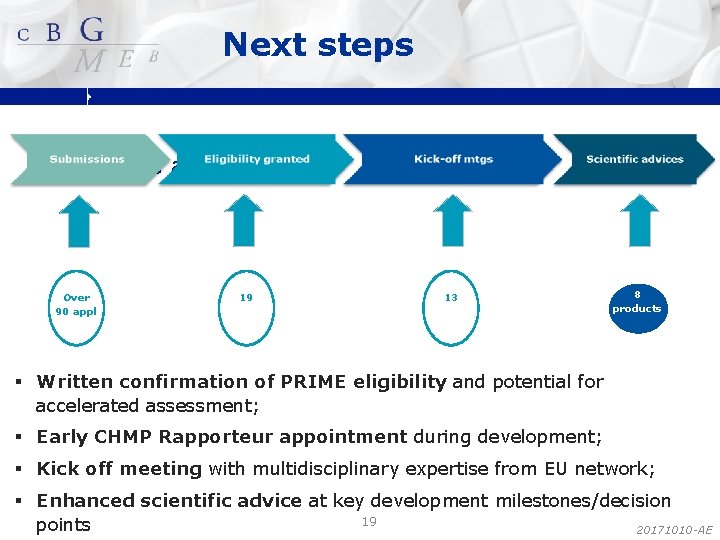
Next steps Where are we now? Over 90 appl 19 13 8 products § Written confirmation of PRIME eligibility and potential for accelerated assessment; § Early CHMP Rapporteur appointment during development; § Kick off meeting with multidisciplinary expertise from EU network; § Enhanced scientific advice at key development milestones/decision 19 points 20171010 -AE
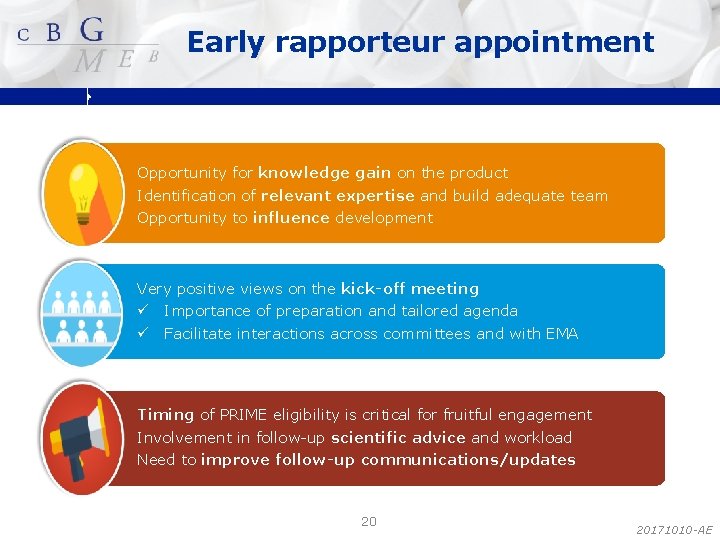
Early rapporteur appointment Early. Opportunity Rapporteur appointment for knowledge gain on the product Identification of relevant expertise and build adequate team Opportunity to influence development Very positive views on the kick-off meeting ü Importance of preparation and tailored agenda ü Facilitate interactions across committees and with EMA Timing of PRIME eligibility is critical for fruitful engagement Involvement in follow-up scientific advice and workload Need to improve follow-up communications/updates 20 20171010 -AE
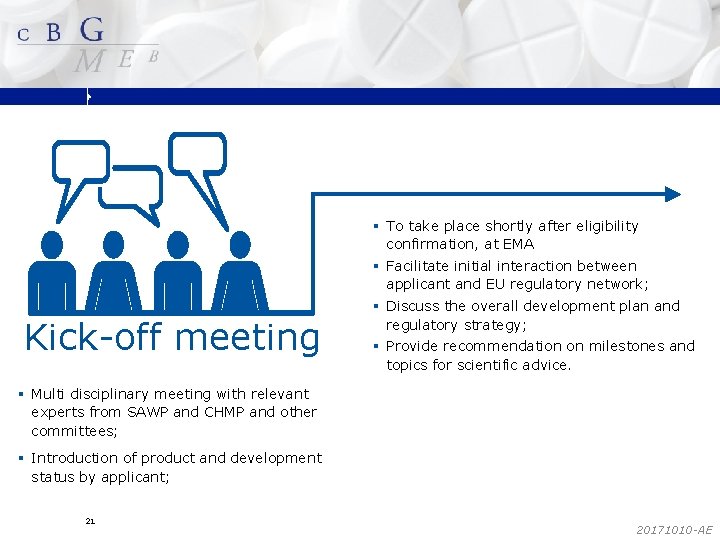
§ To take place shortly after eligibility confirmation, at EMA § Facilitate initial interaction between applicant and EU regulatory network; Kick-off meeting § Discuss the overall development plan and regulatory strategy; § Provide recommendation on milestones and topics for scientific advice. § Multi disciplinary meeting with relevant experts from SAWP and CHMP and other committees; § Introduction of product and development status by applicant; 21 20171010 -AE
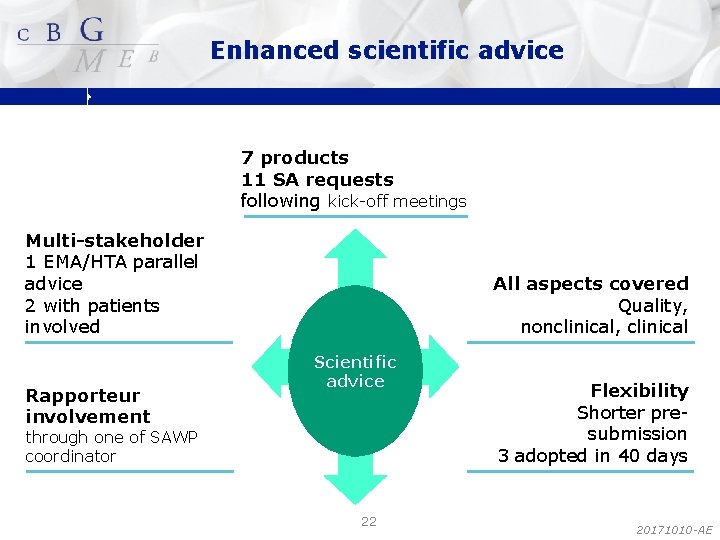
Enhanced scientific advice 7 products 11 SA requests following kick-off meetings Multi-stakeholder 1 EMA/HTA parallel advice 2 with patients involved Rapporteur involvement All aspects covered Quality, nonclinical, clinical Scientific advice through one of SAWP coordinator 22 Flexibility Shorter presubmission 3 adopted in 40 days 20171010 -AE
In summary, • Eligibility review: robust, short time, in writing • Quality of applications received is generally high • Kick-off meeting: excellent opportunity to initiate interaction and flag issues • Rapporteur appointment enables early identification of potential issues • Excellent collaboration across committees • Iterative scientific advices with opportunity for multistakeholders involvement • Scheme triggers discussions across product type / class 23 20171010 -AE
Challenges • Unmet medical need can not be defined unambiguously Cave: Disease slicing • High expectations: PRIME is not a guarantee for success Cave: Regression to the mean Back to the ground : The work still has to be done • Different expectations what should be in the clinical development plan – Clarify-Talk-Explain- future data 24 20171010 -AE
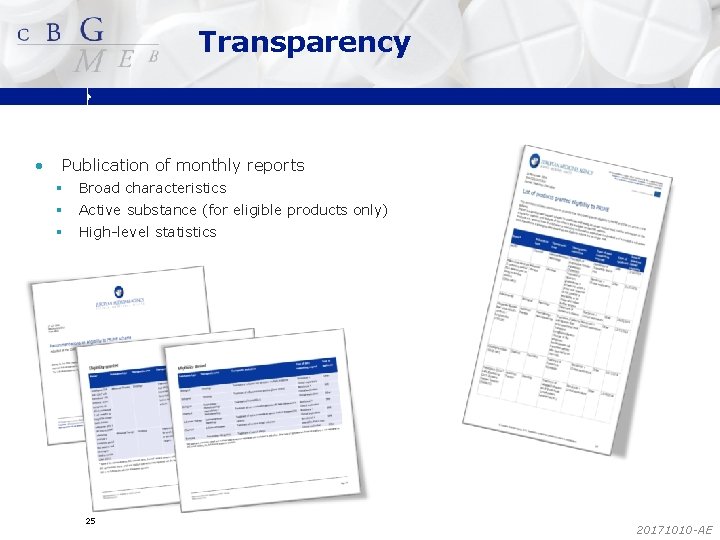
Transparency • Publication of monthly reports § Broad characteristics § Active substance (for eligible products only) § High-level statistics 25 20171010 -AE
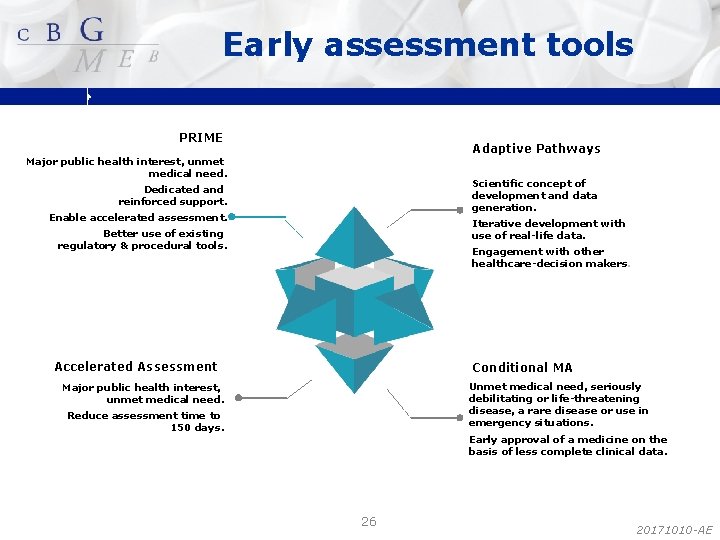
Early assessment tools PRIME Adaptive Pathways Major public health interest, unmet medical need. Scientific concept of development and data generation. Dedicated and reinforced support. Enable accelerated assessment. Iterative development with use of real-life data. Better use of existing regulatory & procedural tools. Engagement with other healthcare-decision makers. Accelerated Assessment Conditional MA Unmet medical need, seriously debilitating or life-threatening disease, a rare disease or use in emergency situations. Major public health interest, unmet medical need. Reduce assessment time to 150 days. Early approval of a medicine on the basis of less complete clinical data. 26 20171010 -AE

20171010 -AE 27 20171010
- Slides: 27