Learning and Mechanism Design Vasilis Syrgkanis Microsoft Research

- Slides: 32
Learning and Mechanism Design Vasilis Syrgkanis Microsoft Research, New England
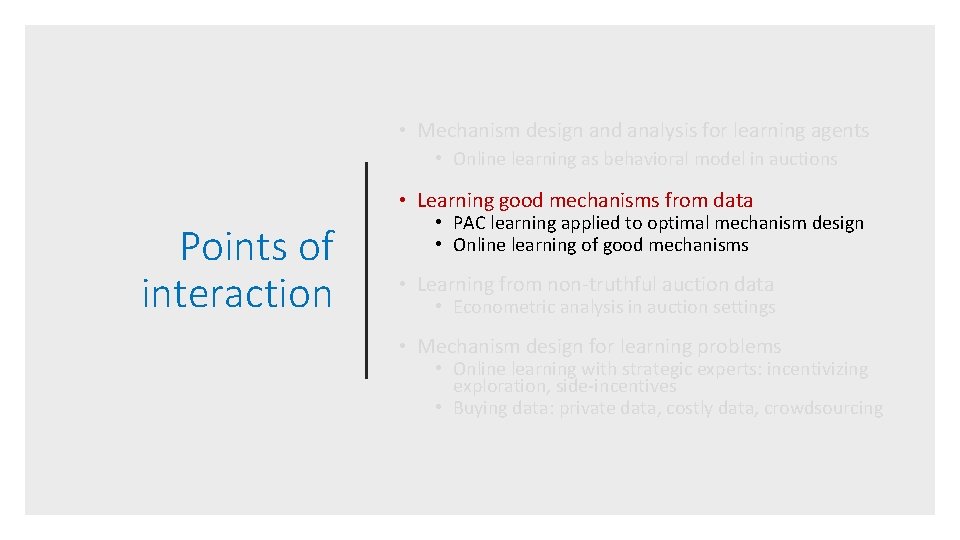
• Mechanism design and analysis for learning agents • Online learning as behavioral model in auctions • Learning good mechanisms from data Points of interaction • PAC learning applied to optimal mechanism design • Online learning of good mechanisms • Learning from non-truthful auction data • Econometric analysis in auction settings • Mechanism design for learning problems • Online learning with strategic experts: incentivizing exploration, side-incentives • Buying data: private data, costly data, crowdsourcing
• Mechanism design and analysis for learning agents • Online learning as behavioral model in auctions • Learning good mechanisms from data Points of interaction • PAC learning applied to optimal mechanism design • Online learning of good mechanisms • Learning from non-truthful auction data • Econometric analysis in auction settings • Mechanism design for learning problems • Online learning with strategic experts: incentivizing exploration, side-incentives • Buying data: private data, costly data, crowdsourcing
• Auctions in practice are simple and non-truthful Key Insights • How do players behave: simple adaptive learning algorithms, e. g. online learning • How good is the welfare of learning outcomes? • Is it computationally easy for players to learn? • Are there easily learnable simple mechanisms?
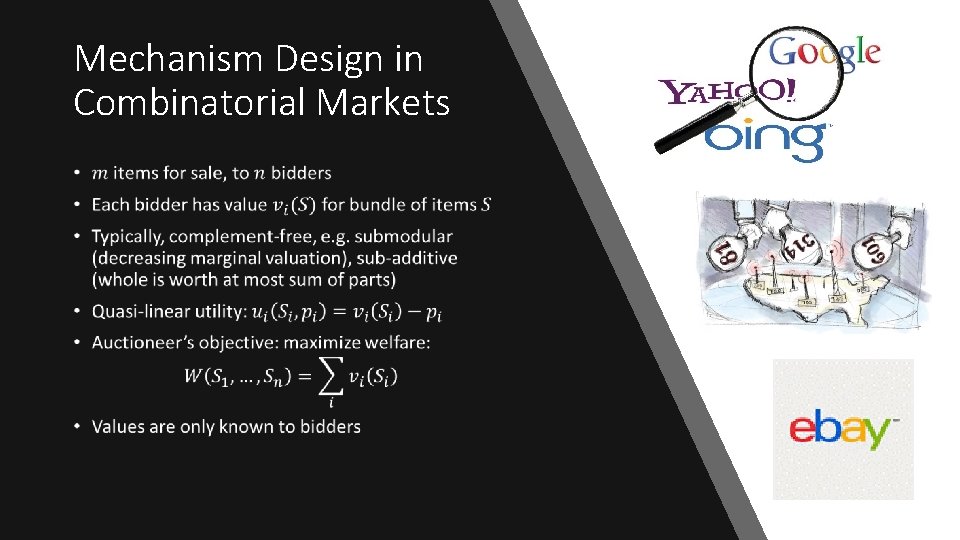
Mechanism Design in Combinatorial Markets •
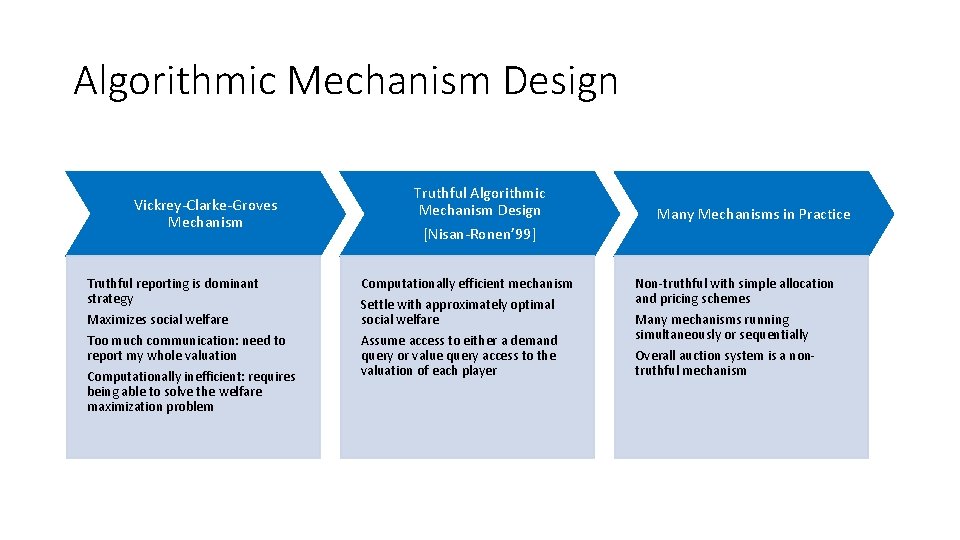
Algorithmic Mechanism Design Vickrey-Clarke-Groves Mechanism Truthful reporting is dominant strategy Maximizes social welfare Too much communication: need to report my whole valuation Computationally inefficient: requires being able to solve the welfare maximization problem Truthful Algorithmic Mechanism Design Many Mechanisms in Practice [Nisan-Ronen’ 99] Computationally efficient mechanism Settle with approximately optimal social welfare Assume access to either a demand query or value query access to the valuation of each player Non-truthful with simple allocation and pricing schemes Many mechanisms running simultaneously or sequentially Overall auction system is a nontruthful mechanism
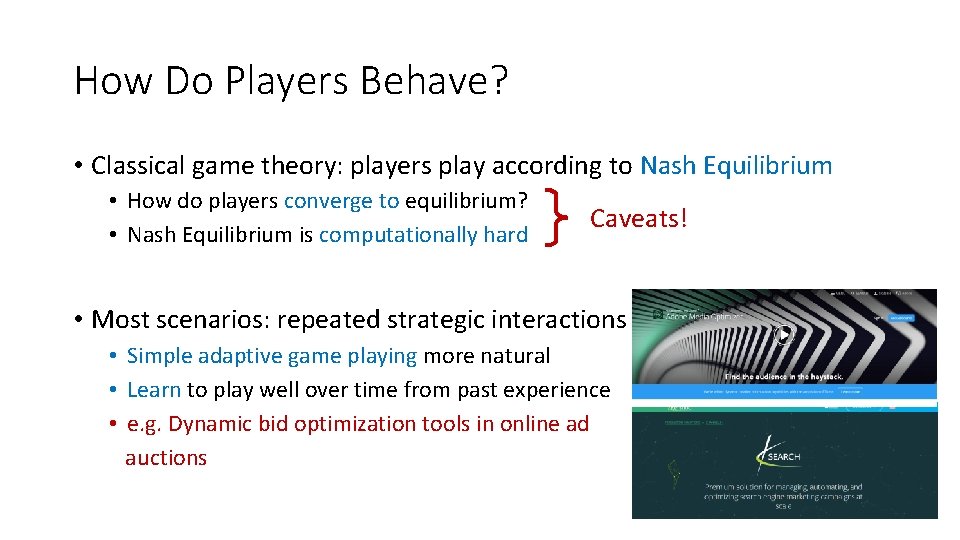
How Do Players Behave? • Classical game theory: players play according to Nash Equilibrium • How do players converge to equilibrium? • Nash Equilibrium is computationally hard Caveats! • Most scenarios: repeated strategic interactions • Simple adaptive game playing more natural • Learn to play well over time from past experience • e. g. Dynamic bid optimization tools in online ad auctions internet routing advertising auctions
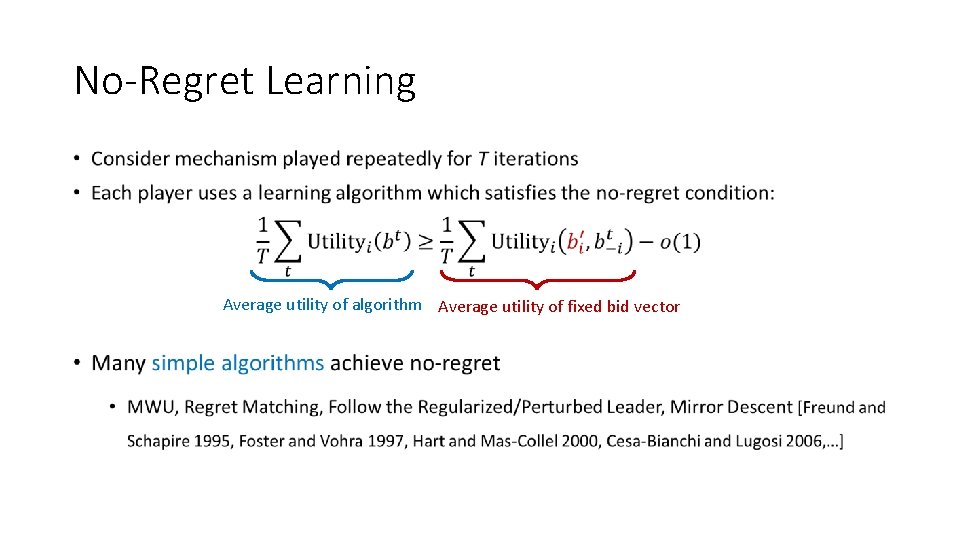
No-Regret Learning • Average utility of algorithm Average utility of fixed bid vector
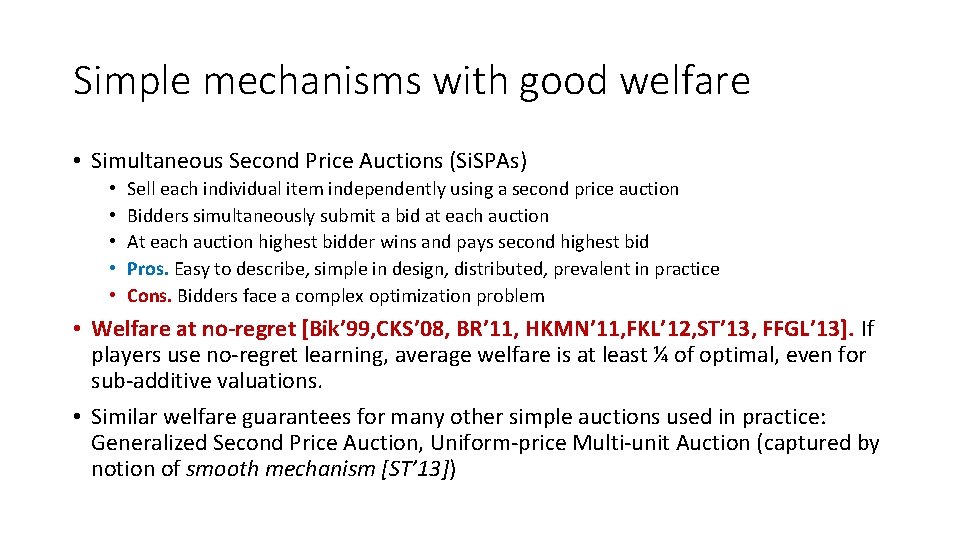
Simple mechanisms with good welfare • Simultaneous Second Price Auctions (Si. SPAs) • • • Sell each individual item independently using a second price auction Bidders simultaneously submit a bid at each auction At each auction highest bidder wins and pays second highest bid Pros. Easy to describe, simple in design, distributed, prevalent in practice Cons. Bidders face a complex optimization problem • Welfare at no-regret [Bik’ 99, CKS’ 08, BR’ 11, HKMN’ 11, FKL’ 12, ST’ 13, FFGL’ 13]. If players use no-regret learning, average welfare is at least ¼ of optimal, even for sub-additive valuations. • Similar welfare guarantees for many other simple auctions used in practice: Generalized Second Price Auction, Uniform-price Multi-unit Auction (captured by notion of smooth mechanism [ST’ 13])
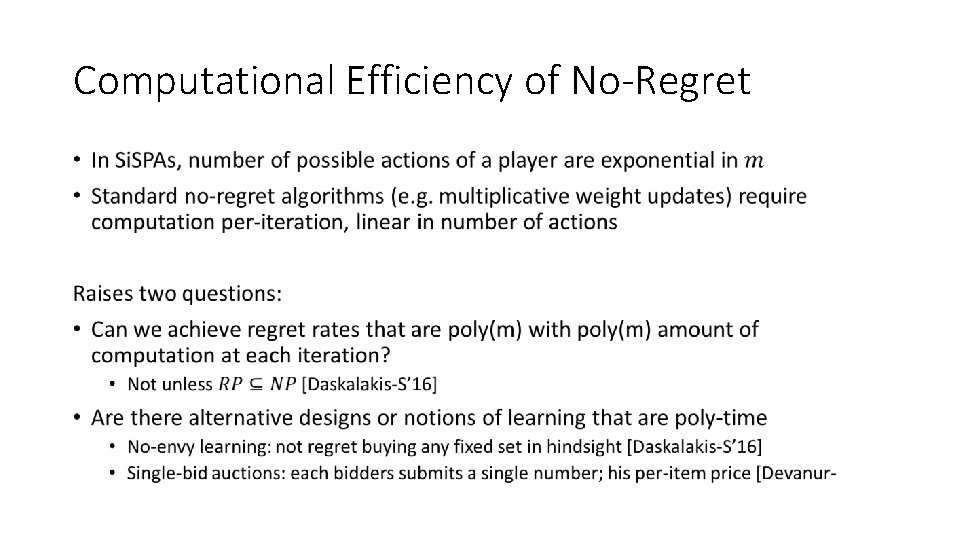
Computational Efficiency of No-Regret •
• Mechanism design and analysis for learning agents • Online learning as behavioral model in auctions • Learning good mechanisms from data Points of interaction • PAC learning applied to optimal mechanism design • Online learning of good mechanisms • Learning from non-truthful auction data • Econometric analysis in auction settings • Mechanism design for learning problems • Online learning with strategic experts: incentivizing exploration, side-incentives • Buying data: private data, costly data, crowdsourcing
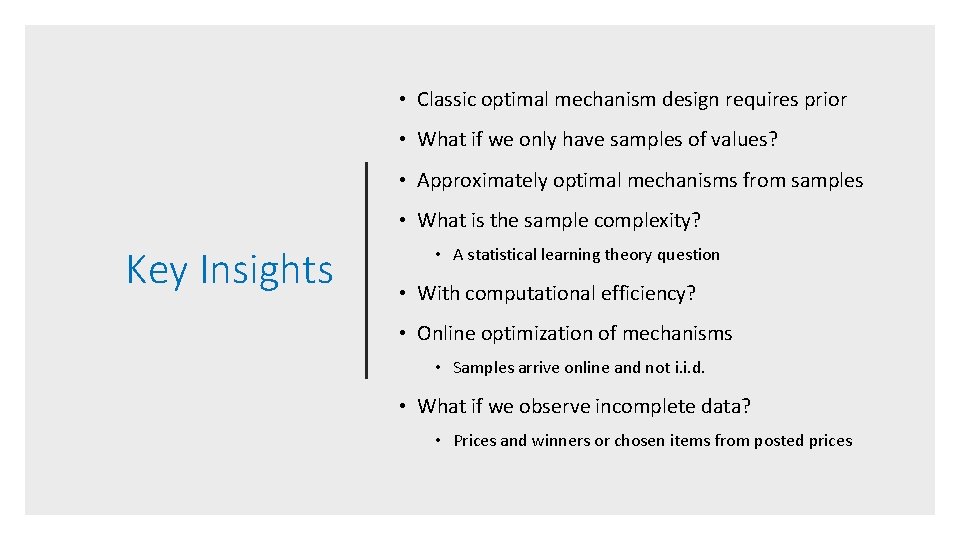
• Classic optimal mechanism design requires prior • What if we only have samples of values? • Approximately optimal mechanisms from samples • What is the sample complexity? Key Insights • A statistical learning theory question • With computational efficiency? • Online optimization of mechanisms • Samples arrive online and not i. i. d. • What if we observe incomplete data? • Prices and winners or chosen items from posted prices
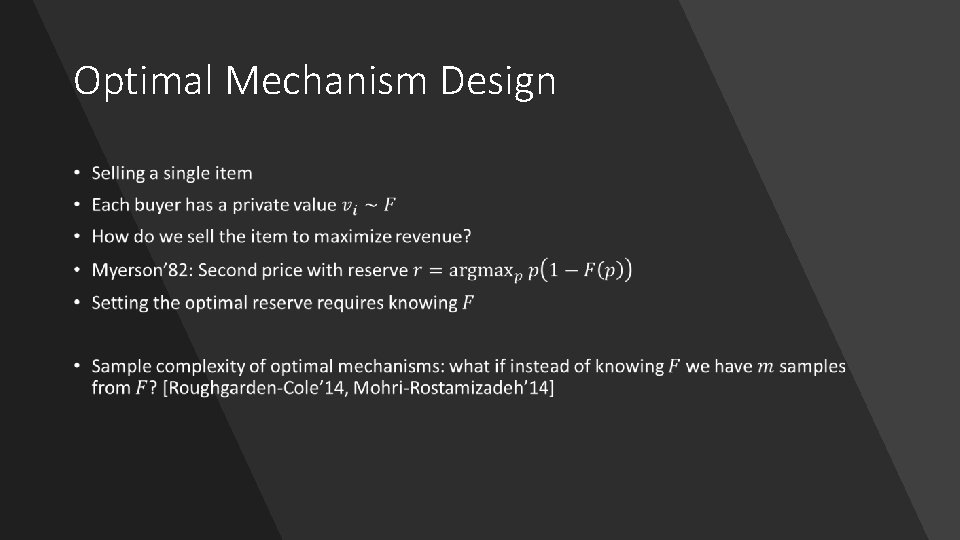
Optimal Mechanism Design •
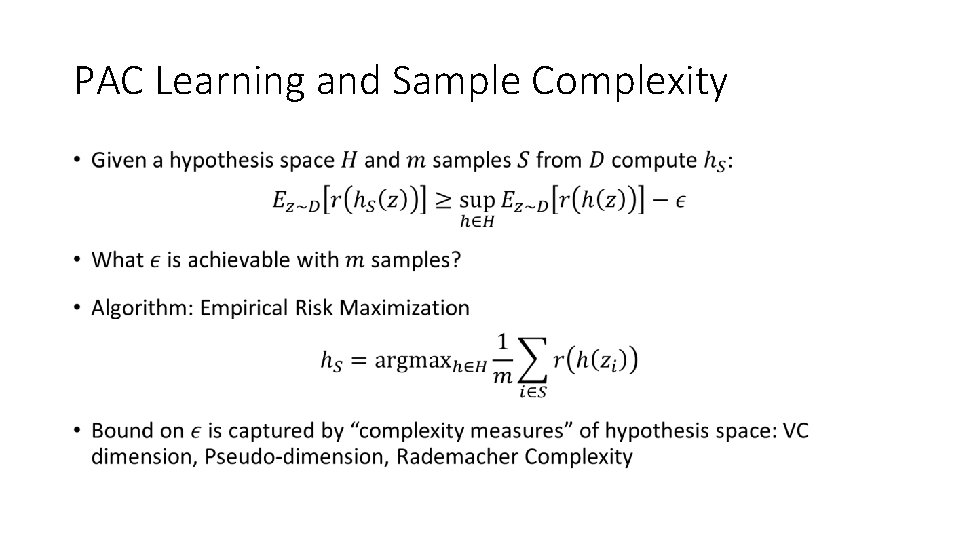
PAC Learning and Sample Complexity •
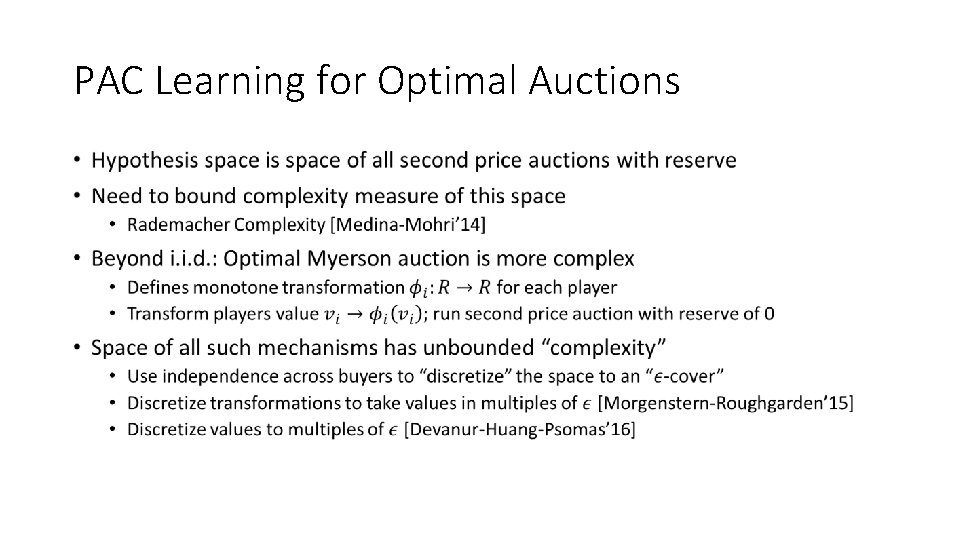
PAC Learning for Optimal Auctions •
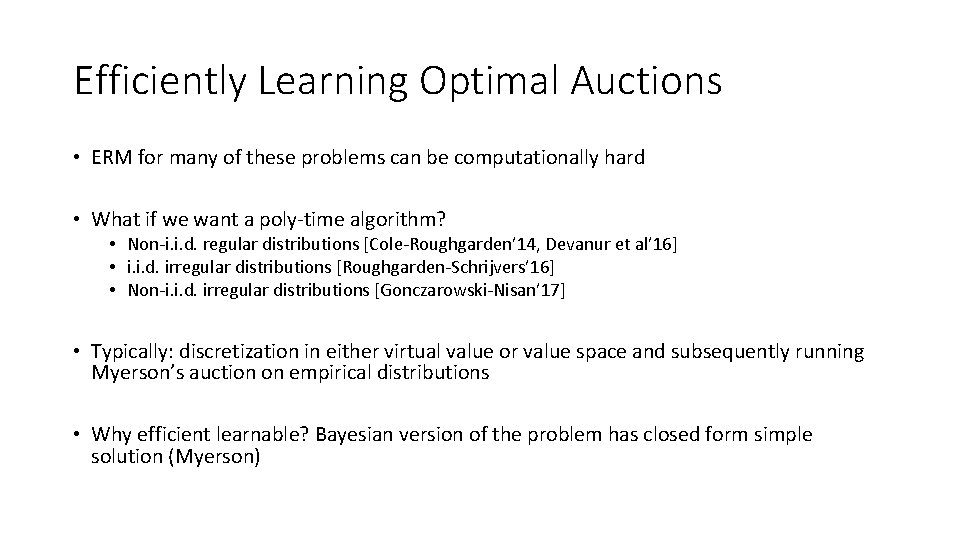
Efficiently Learning Optimal Auctions • ERM for many of these problems can be computationally hard • What if we want a poly-time algorithm? • Non-i. i. d. regular distributions [Cole-Roughgarden’ 14, Devanur et al’ 16] • i. i. d. irregular distributions [Roughgarden-Schrijvers’ 16] • Non-i. i. d. irregular distributions [Gonczarowski-Nisan’ 17] • Typically: discretization in either virtual value or value space and subsequently running Myerson’s auction on empirical distributions • Why efficient learnable? Bayesian version of the problem has closed form simple solution (Myerson)
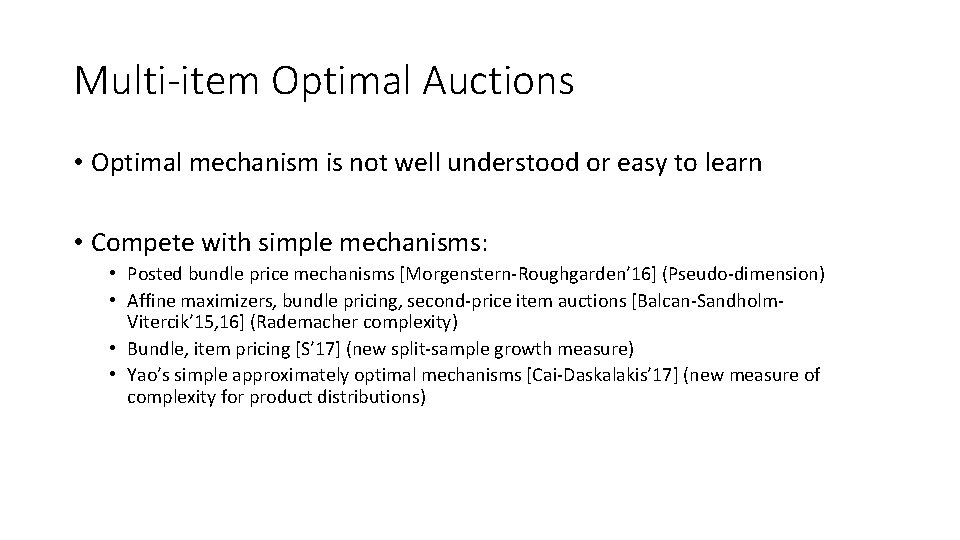
Multi-item Optimal Auctions • Optimal mechanism is not well understood or easy to learn • Compete with simple mechanisms: • Posted bundle price mechanisms [Morgenstern-Roughgarden’ 16] (Pseudo-dimension) • Affine maximizers, bundle pricing, second-price item auctions [Balcan-Sandholm. Vitercik’ 15, 16] (Rademacher complexity) • Bundle, item pricing [S’ 17] (new split-sample growth measure) • Yao’s simple approximately optimal mechanisms [Cai-Daskalakis’ 17] (new measure of complexity for product distributions)
Online Learning of Mechanisms • Valuation samples are not i. i. d. but coming in online arbitrary manner • Dynamically optimize mechanisms to perform as good as the best mechanism in hindsight? • Optimizing over second price auctions with player-specific reserves [Roughgarden-Wang’ 16] • Optimizing over Myerson style auction over discretized values [Bubeck et al’ 17] • Reductions from online to offline problem for discretized Myerson and other auctions [Dudik et al’ 17]
Learning from incomplete data • What if we only observe responses to posted prices? • Posting prices online and buyers selecting optimal bundle [Amin et al. ’ 14, Roth-Ullman-Wu’ 16] • Goal is to optimize revenue • Assumes goods are continuous and buyers value is strongly concave • What if we only observe winners and prices? • Can still compute good optimal reserve prices without learning values [Coey et al. ’ 17]
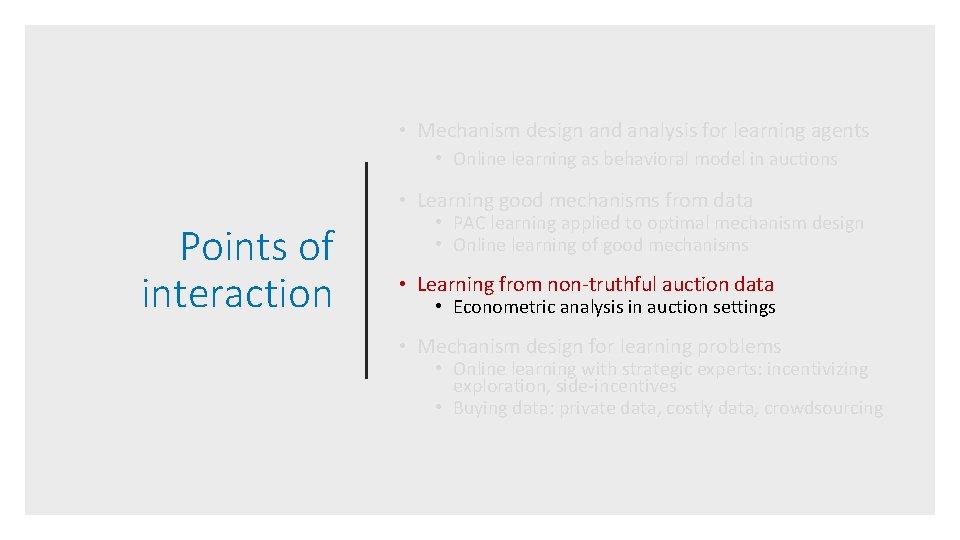
• Mechanism design and analysis for learning agents • Online learning as behavioral model in auctions • Learning good mechanisms from data Points of interaction • PAC learning applied to optimal mechanism design • Online learning of good mechanisms • Learning from non-truthful auction data • Econometric analysis in auction settings • Mechanism design for learning problems • Online learning with strategic experts: incentivizing exploration, side-incentives • Buying data: private data, costly data, crowdsourcing
• To make any inference we need to connect bids to values • Requires some form of equilibrium/behavioral assumption Key Insights • BNE, CE, No-regret learning • In many cases value distribution can be reconstructed from bid distribution • If goal is to optimize revenue or infer welfare properties then learning the value distribution is not needed
Learning from non-truthful data • What if we have data from a first price auction or a Generalized Second Price auction? • Auctions are not truthful: we only have samples of bids not values • Not a PAC learning problem any more • Requires structural modeling assumptions to connect bids to values • Bayes-Nash equilibrium, No-regret learners
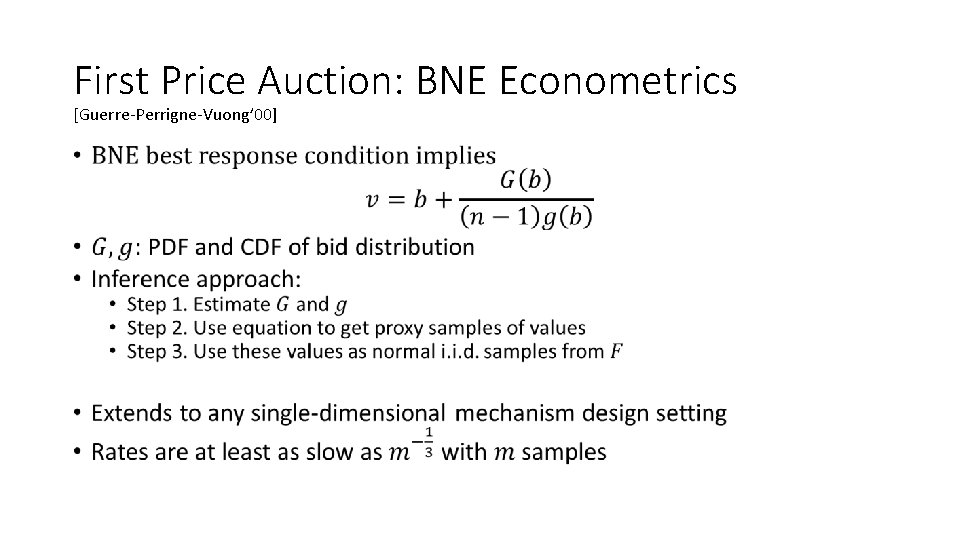
First Price Auction: BNE Econometrics [Guerre-Perrigne-Vuong’ 00] •
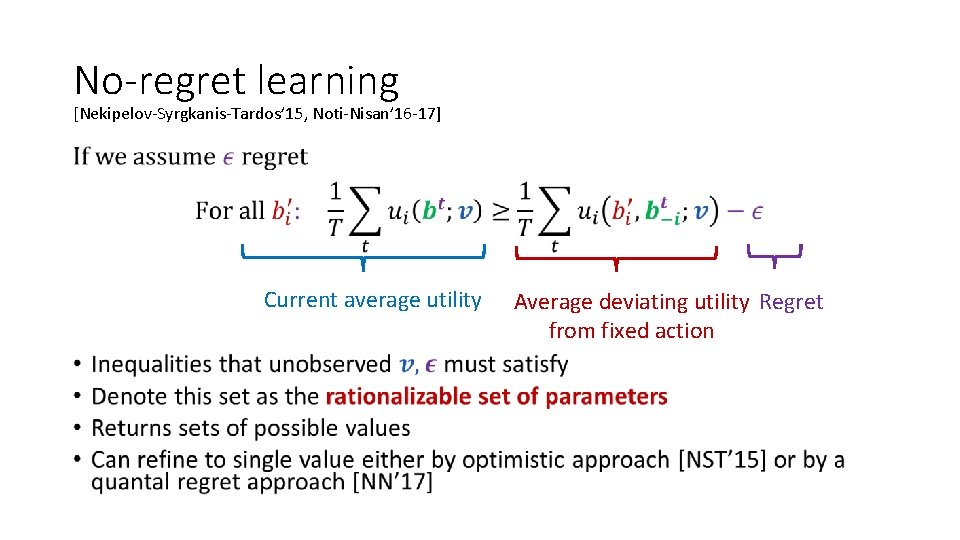
No-regret learning [Nekipelov-Syrgkanis-Tardos’ 15, Noti-Nisan’ 16 -17] • Current average utility Average deviating utility Regret from fixed action
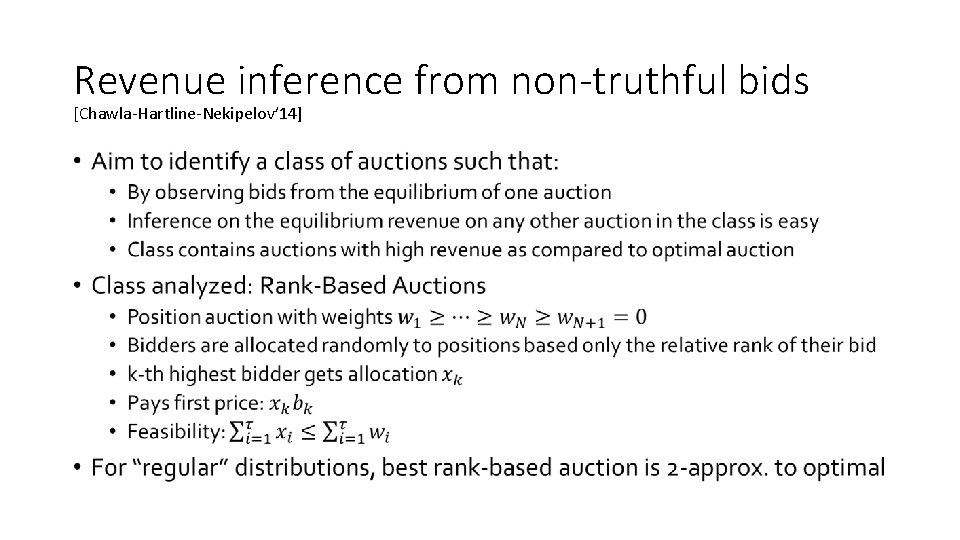
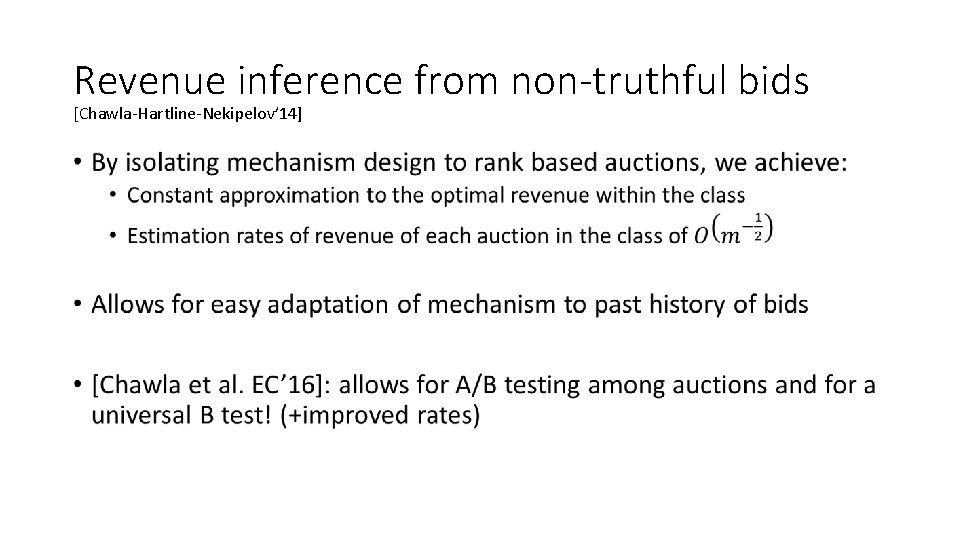
Revenue inference from non-truthful bids [Chawla-Hartline-Nekipelov’ 14] •
Revenue inference from non-truthful bids [Chawla-Hartline-Nekipelov’ 14] •
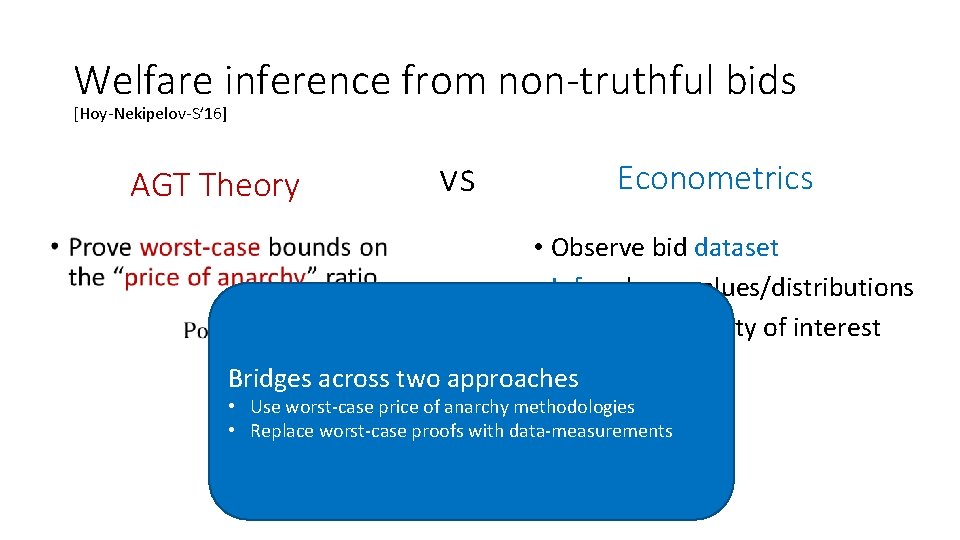
Welfare inference from non-truthful bids [Hoy-Nekipelov-S’ 16] AGT Theory • vs Econometrics • Observe bid dataset • Infer player values/distributions • Calculate quantity of interest Bridges across two approaches • Use worst-case price of anarchy methodologies • Replace worst-case proofs with data-measurements
• Mechanism design and analysis for learning agents • Online learning as behavioral model in auctions • Learning good mechanisms from data Points of interaction • PAC learning applied to optimal mechanism design • Online learning of good mechanisms • Learning from non-truthful auction data • Econometric analysis in auction settings • Mechanism design for learning problems • Online learning with strategic experts: incentivizing exploration, side-incentives • Buying data: private data, costly data, crowdsourcing
• Incentivizing exploration: online learning were choices are recommendations to strategic users • Users might have prior biases and need to be convinced • Goal is to incentivize taking a desired action Key Insights • Via information design or payment schemes • Achieve good regret rates despite incentives • Bying data: most machine learning tasks require inputs from humans • Crowdsourcing: incentivizing strategic agents to exert costly effort to produce labels • Private data: buying private data for agents that value privacy and have a cost for providing them
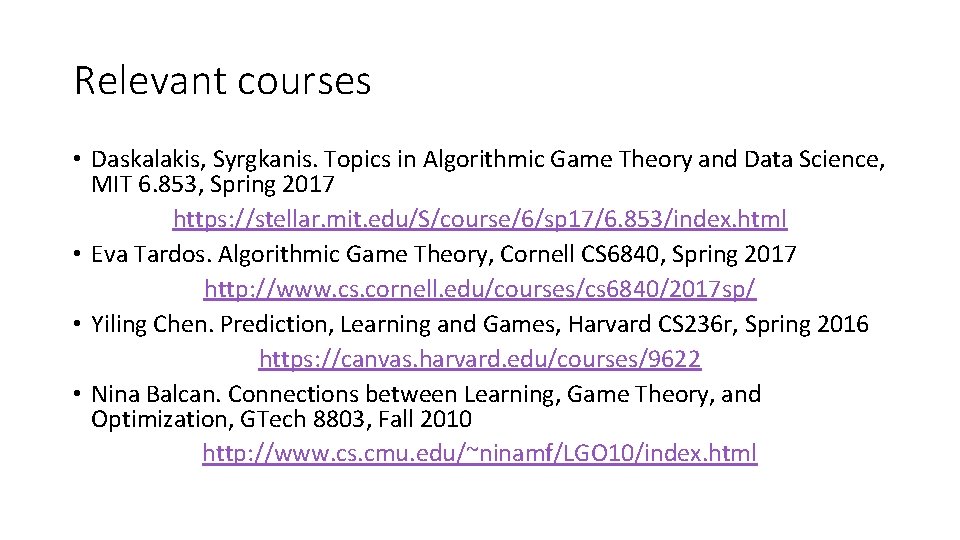
Relevant courses • Daskalakis, Syrgkanis. Topics in Algorithmic Game Theory and Data Science, MIT 6. 853, Spring 2017 https: //stellar. mit. edu/S/course/6/sp 17/6. 853/index. html • Eva Tardos. Algorithmic Game Theory, Cornell CS 6840, Spring 2017 http: //www. cs. cornell. edu/courses/cs 6840/2017 sp/ • Yiling Chen. Prediction, Learning and Games, Harvard CS 236 r, Spring 2016 https: //canvas. harvard. edu/courses/9622 • Nina Balcan. Connections between Learning, Game Theory, and Optimization, GTech 8803, Fall 2010 http: //www. cs. cmu. edu/~ninamf/LGO 10/index. html
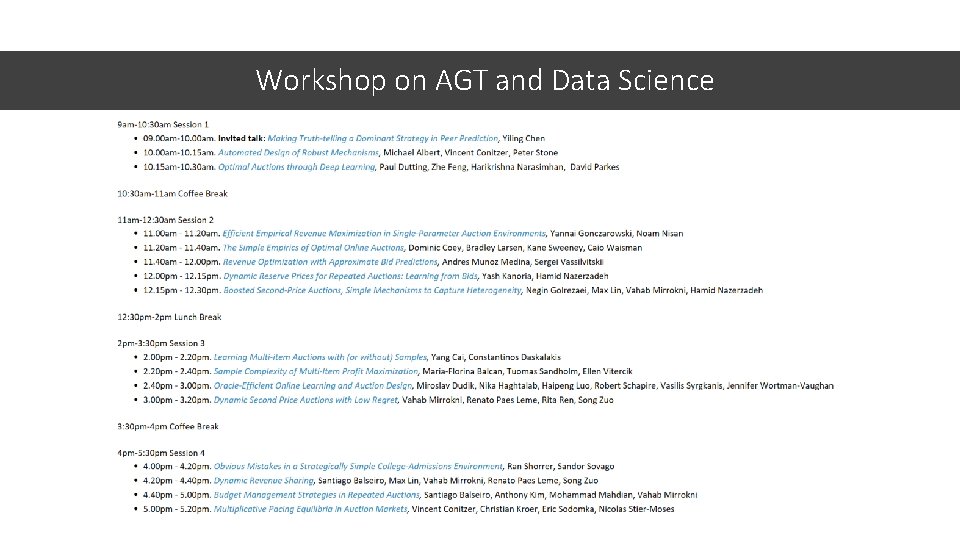
Workshop on AGT and Data Science
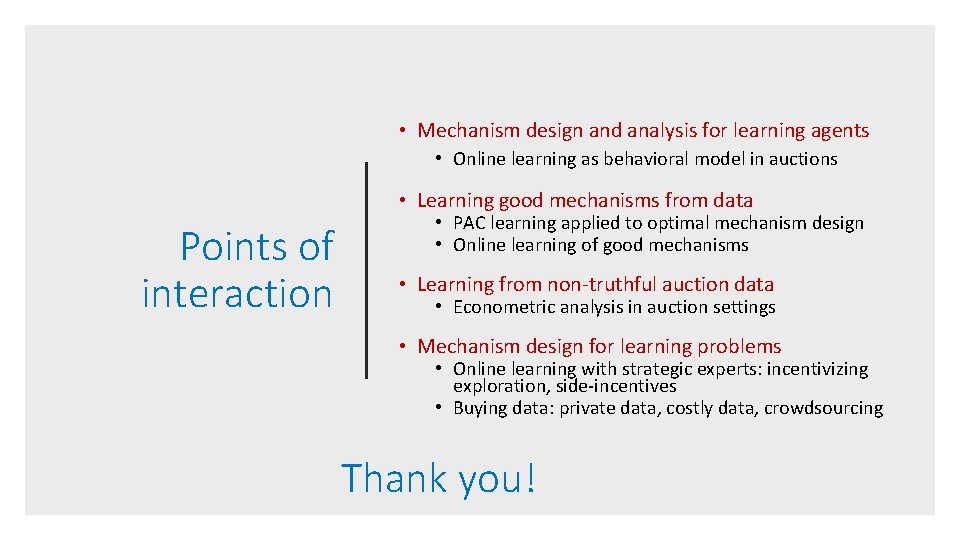
• Mechanism design and analysis for learning agents • Online learning as behavioral model in auctions • Learning good mechanisms from data Points of interaction • PAC learning applied to optimal mechanism design • Online learning of good mechanisms • Learning from non-truthful auction data • Econometric analysis in auction settings • Mechanism design for learning problems • Online learning with strategic experts: incentivizing exploration, side-incentives • Buying data: private data, costly data, crowdsourcing Thank you!