Learn it Practice it Master it LOVE IT

- Slides: 24
Learn it! Practice it! Master it! LOVE IT!!!
What is “subjunctive”? It is used to express uncertainty, doubt, emotional reaction, or future actions. ● The subjunctive conjugation of a verb is usually used in the second part of a sentence. “I want you to study. ” You may or may not do it, so “you to study” would be conjugated in the present subjunctive. The present tense is used to express what is completely true or false, what is clear, or what is concrete. ● Subjunctive is for areas of uncertainty.
Setup Words These words, used in the first clause of a sentence, set up the use of the subjunctive in the second clause. What is said after these words may or may not happen, so the conjugation of the second verb is not the present tense as you know it. • querer (ie) = to want • sugerir (ie) = to suggest • recomendar (ie) = to recommend • insistir en = to insist • esperar = to hope • ojalá que = hopefully / it’s hopeful
Setup Words I may want you to do something, but you may not do it. I may suggest that you read the rest of this, but… Your parents might recommend that you wash the dishes right away, but you might not do it at all. A friend may insist that you go with him, but you might not want to go. You might hope that something happens, but it may not happen.
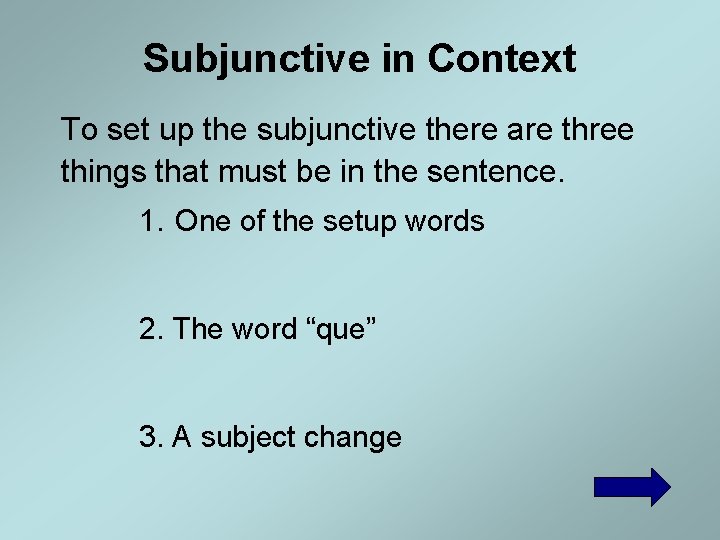
Subjunctive in Context To set up the subjunctive there are three things that must be in the sentence. 1. One of the setup words 2. The word “que” 3. A subject change
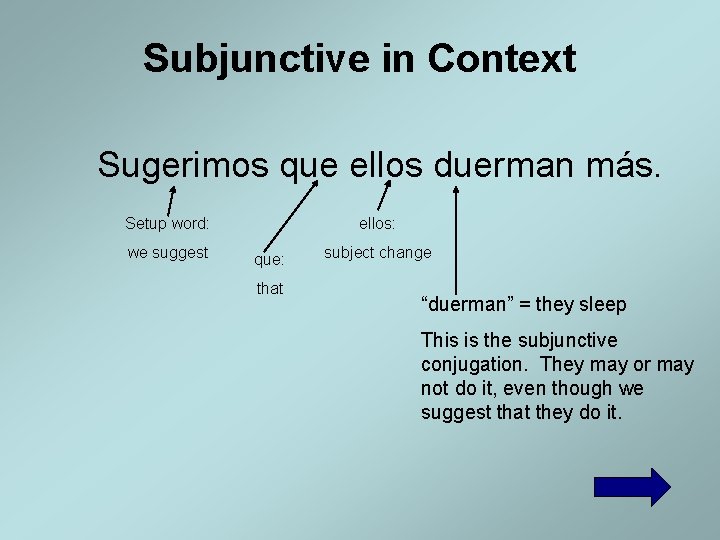
Subjunctive in Context Sugerimos que ellos duerman más. Setup word: we suggest ellos: que: that subject change “duerman” = they sleep This is the subjunctive conjugation. They may or may not do it, even though we suggest that they do it.
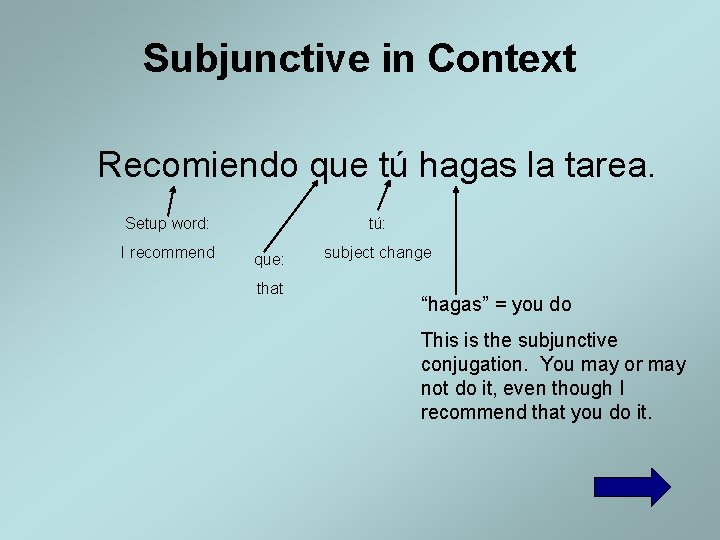
Subjunctive in Context Recomiendo que tú hagas la tarea. Setup word: I recommend tú: que: that subject change “hagas” = you do This is the subjunctive conjugation. You may or may not do it, even though I recommend that you do it.
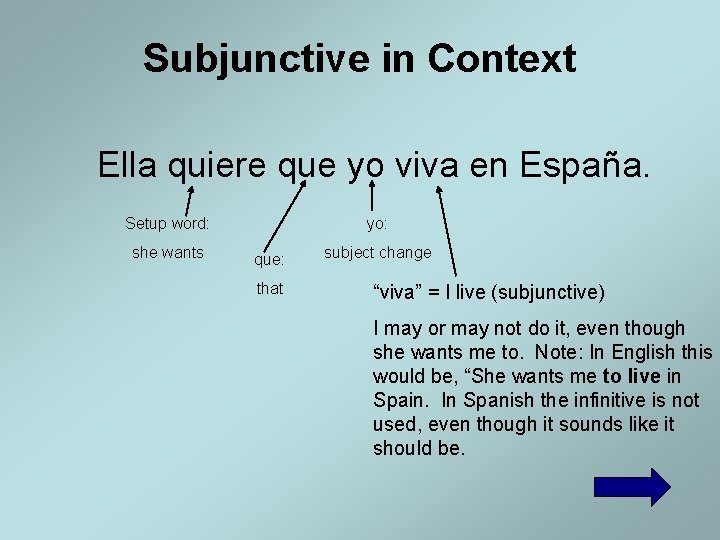
Subjunctive in Context Ella quiere que yo viva en España. Setup word: she wants yo: que: that subject change “viva” = I live (subjunctive) I may or may not do it, even though she wants me to. Note: In English this would be, “She wants me to live in Spain. In Spanish the infinitive is not used, even though it sounds like it should be.
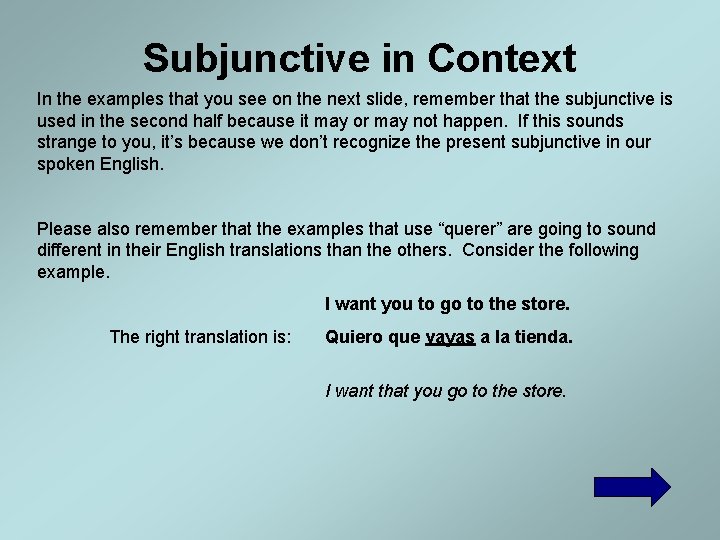
Subjunctive in Context In the examples that you see on the next slide, remember that the subjunctive is used in the second half because it may or may not happen. If this sounds strange to you, it’s because we don’t recognize the present subjunctive in our spoken English. Please also remember that the examples that use “querer” are going to sound different in their English translations than the others. Consider the following example. I want you to go to the store. The right translation is: Quiero que vayas a la tienda. I want that you go to the store.
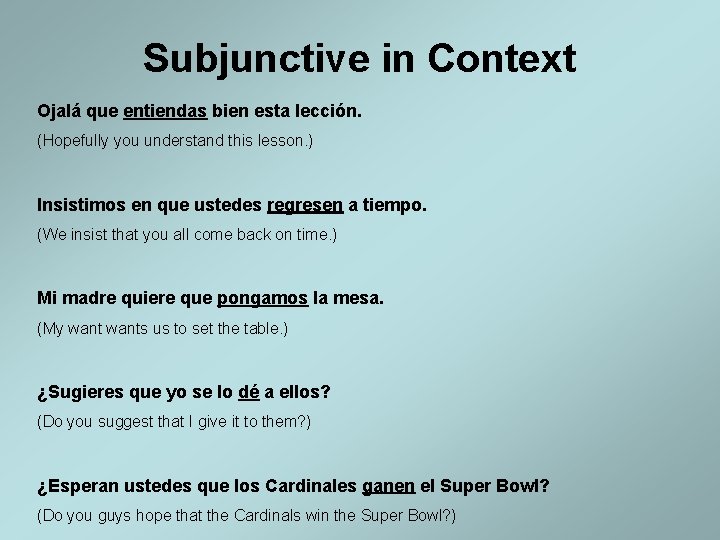
Subjunctive in Context Ojalá que entiendas bien esta lección. (Hopefully you understand this lesson. ) Insistimos en que ustedes regresen a tiempo. (We insist that you all come back on time. ) Mi madre quiere que pongamos la mesa. (My wants us to set the table. ) ¿Sugieres que yo se lo dé a ellos? (Do you suggest that I give it to them? ) ¿Esperan ustedes que los Cardinales ganen el Super Bowl? (Do you guys hope that the Cardinals win the Super Bowl? )
Forming the Subjunctive Verb Formation Menu The Basics Stem Changing Verbs Spelling Changes Irregular Verbs Home
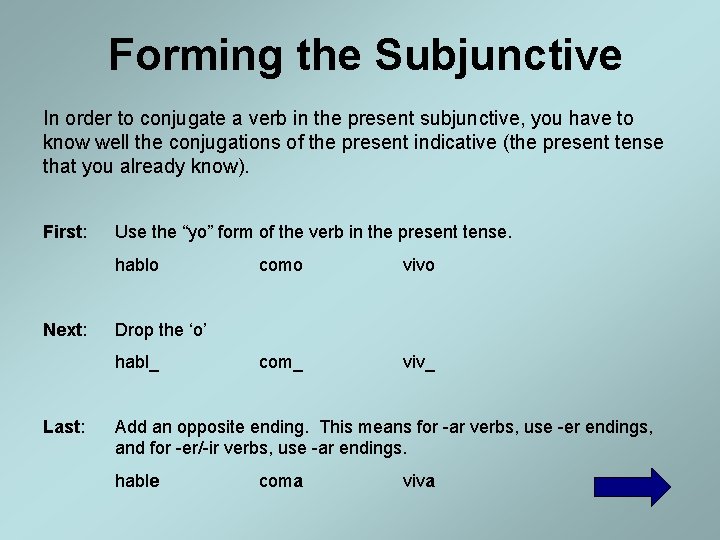
Forming the Subjunctive In order to conjugate a verb in the present subjunctive, you have to know well the conjugations of the present indicative (the present tense that you already know). First: Use the “yo” form of the verb in the present tense. hablo Next: vivo com_ viv_ Drop the ‘o’ habl_ Last: como Add an opposite ending. This means for -ar verbs, use -er endings, and for -er/-ir verbs, use -ar endings. hable coma viva
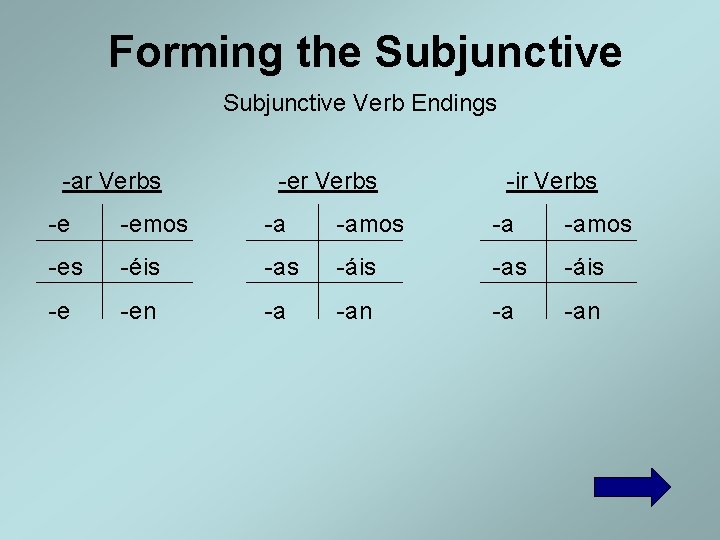
Forming the Subjunctive Verb Endings -ar Verbs -er Verbs -ir Verbs -e -emos -a -amos -es -éis -as -áis -e -en -a -an
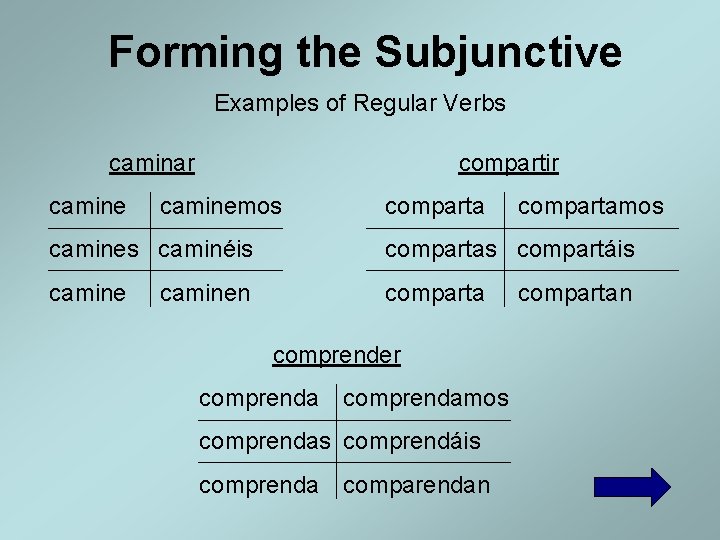
Forming the Subjunctive Examples of Regular Verbs caminar camine compartir caminemos compartamos camines caminéis compartas compartáis camine comparta caminen comprender comprendamos comprendas comprendáis comprenda comparendan compartan
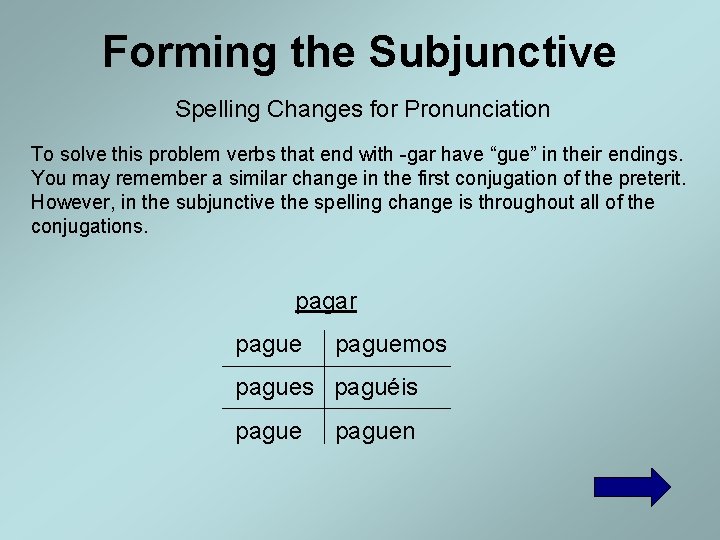
Forming the Subjunctive Spelling Changes for Pronunciation To solve this problem verbs that end with -gar have “gue” in their endings. You may remember a similar change in the first conjugation of the preterit. However, in the subjunctive the spelling change is throughout all of the conjugations. pagar paguemos pagues paguéis paguen
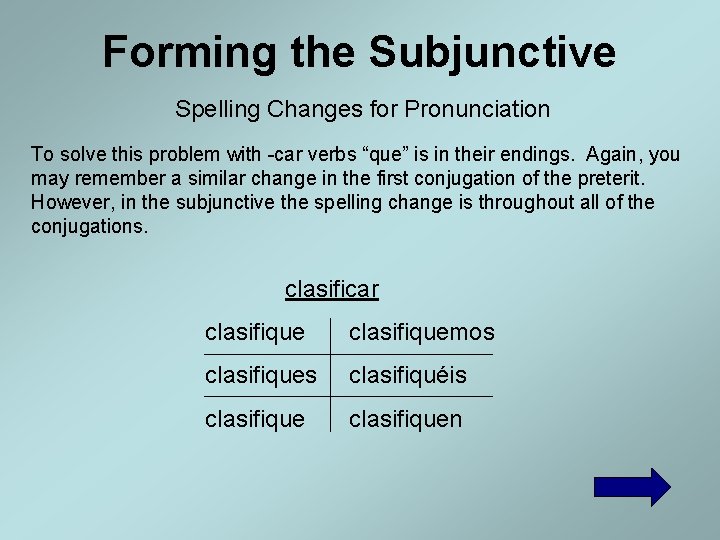
Forming the Subjunctive Spelling Changes for Pronunciation To solve this problem with -car verbs “que” is in their endings. Again, you may remember a similar change in the first conjugation of the preterit. However, in the subjunctive the spelling change is throughout all of the conjugations. clasificar clasifiquemos clasifiques clasifiquéis clasifiquen
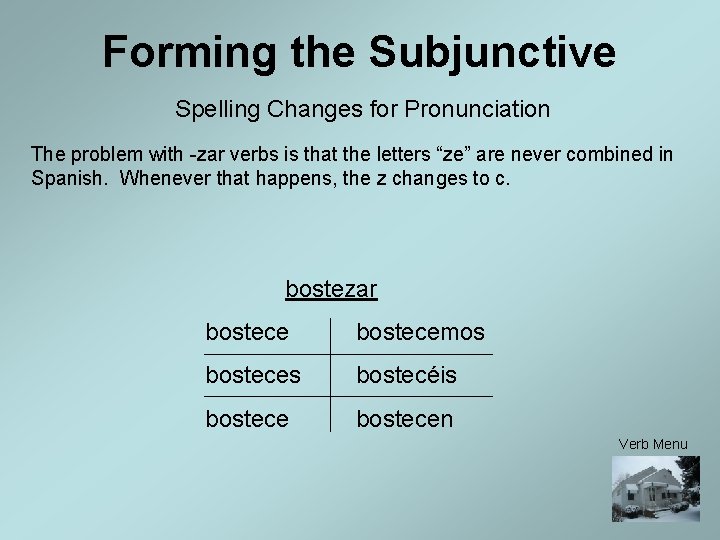
Forming the Subjunctive Spelling Changes for Pronunciation The problem with -zar verbs is that the letters “ze” are never combined in Spanish. Whenever that happens, the z changes to c. bostezar bostecemos bosteces bostecéis bostecen Verb Menu
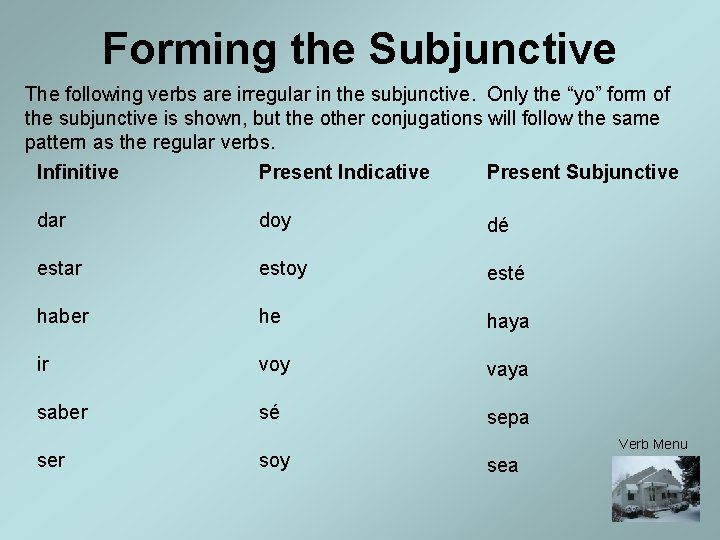
Forming the Subjunctive The following verbs are irregular in the subjunctive. Only the “yo” form of the subjunctive is shown, but the other conjugations will follow the same pattern as the regular verbs. Infinitive Present Indicative Present Subjunctive dar doy dé estar estoy esté haber he haya ir voy vaya saber sé sepa ser soy Verb Menu sea
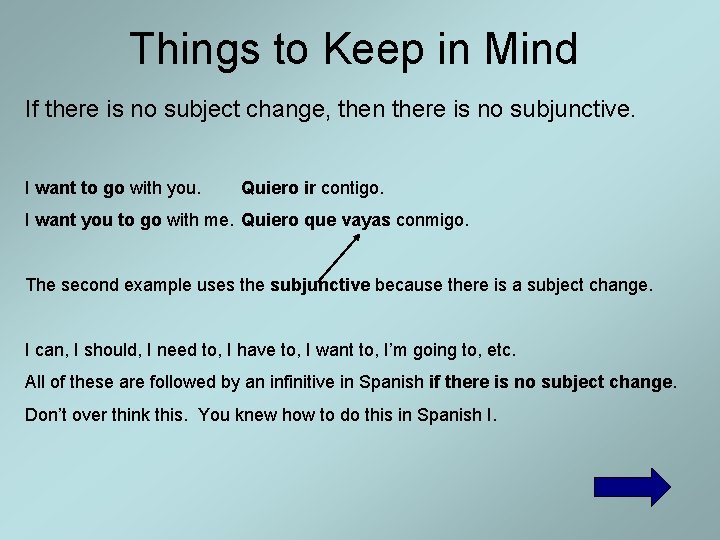
Things to Keep in Mind If there is no subject change, then there is no subjunctive. I want to go with you. Quiero ir contigo. I want you to go with me. Quiero que vayas conmigo. The second example uses the subjunctive because there is a subject change. I can, I should, I need to, I have to, I want to, I’m going to, etc. All of these are followed by an infinitive in Spanish if there is no subject change. Don’t over think this. You knew how to do this in Spanish I.
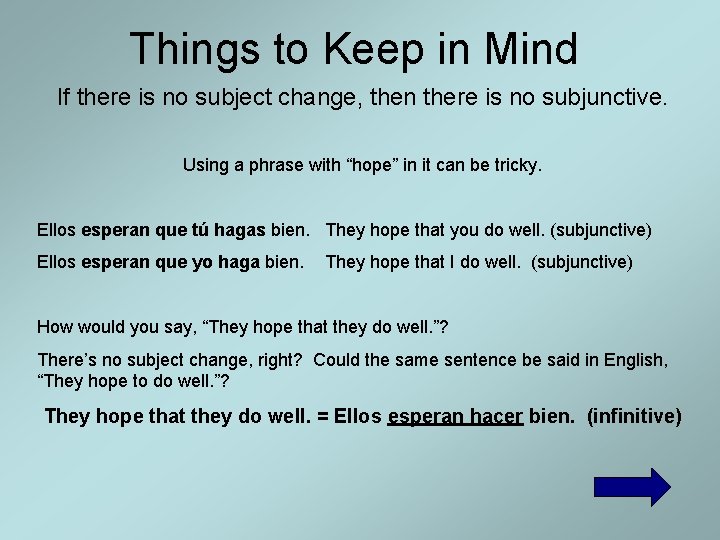
Things to Keep in Mind If there is no subject change, then there is no subjunctive. Using a phrase with “hope” in it can be tricky. Ellos esperan que tú hagas bien. They hope that you do well. (subjunctive) Ellos esperan que yo haga bien. They hope that I do well. (subjunctive) How would you say, “They hope that they do well. ”? There’s no subject change, right? Could the same sentence be said in English, “They hope to do well. ”? They hope that they do well. = Ellos esperan hacer bien. (infinitive)
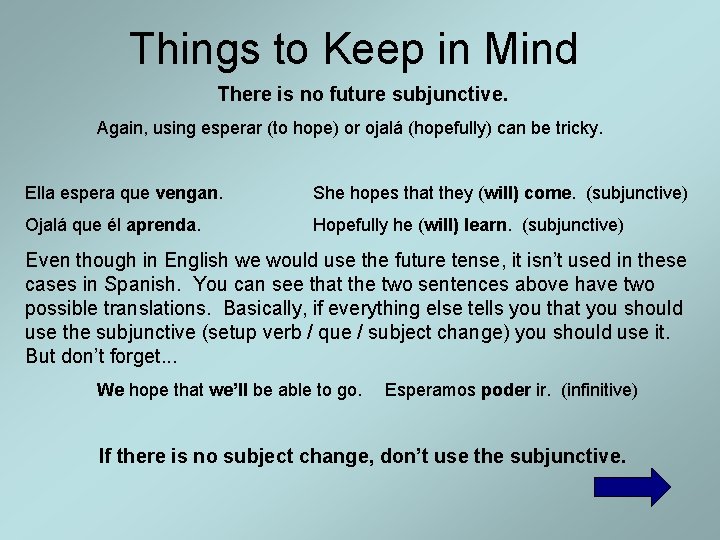
Things to Keep in Mind There is no future subjunctive. Again, using esperar (to hope) or ojalá (hopefully) can be tricky. Ella espera que vengan. She hopes that they (will) come. (subjunctive) Ojalá que él aprenda. Hopefully he (will) learn. (subjunctive) Even though in English we would use the future tense, it isn’t used in these cases in Spanish. You can see that the two sentences above have two possible translations. Basically, if everything else tells you that you should use the subjunctive (setup verb / que / subject change) you should use it. But don’t forget. . . We hope that we’ll be able to go. Esperamos poder ir. (infinitive) If there is no subject change, don’t use the subjunctive.
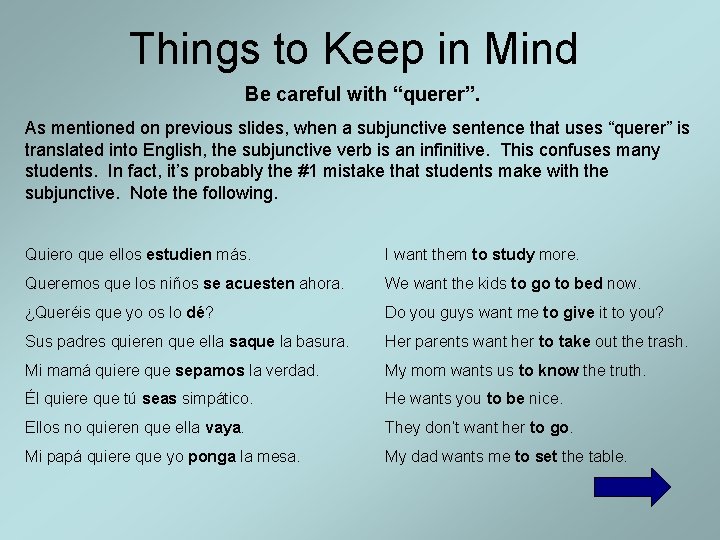
Things to Keep in Mind Be careful with “querer”. As mentioned on previous slides, when a subjunctive sentence that uses “querer” is translated into English, the subjunctive verb is an infinitive. This confuses many students. In fact, it’s probably the #1 mistake that students make with the subjunctive. Note the following. Quiero que ellos estudien más. I want them to study more. Queremos que los niños se acuesten ahora. We want the kids to go to bed now. ¿Queréis que yo os lo dé? Do you guys want me to give it to you? Sus padres quieren que ella saque la basura. Her parents want her to take out the trash. Mi mamá quiere que sepamos la verdad. My mom wants us to know the truth. Él quiere que tú seas simpático. He wants you to be nice. Ellos no quieren que ella vaya. They don’t want her to go. Mi papá quiere que yo ponga la mesa. My dad wants me to set the table.
Things to Keep in Mind Be careful with “querer”. It may help to think that you’re saying, “I want that they study. ” or “We want that the kids go to bed. ” It sounds a little funny, but it may keep you from using the infinitive when the subjunctive should be used. The examples below are WRONG. I’m showing them to you so that you can see how, to many, it makes sense to write sentences this way. Los quiero estuiar. (I want them to study. ) Queremos los niños asostrarse. (We want the kids to go to bed. ) ¿Me queréis dároslo? (Do you guys want me to give it to you? These sentences are right: Quiero que ellos estudien. Queremos que los niños se acuesten. ¿Queréis que yo os lo dé?
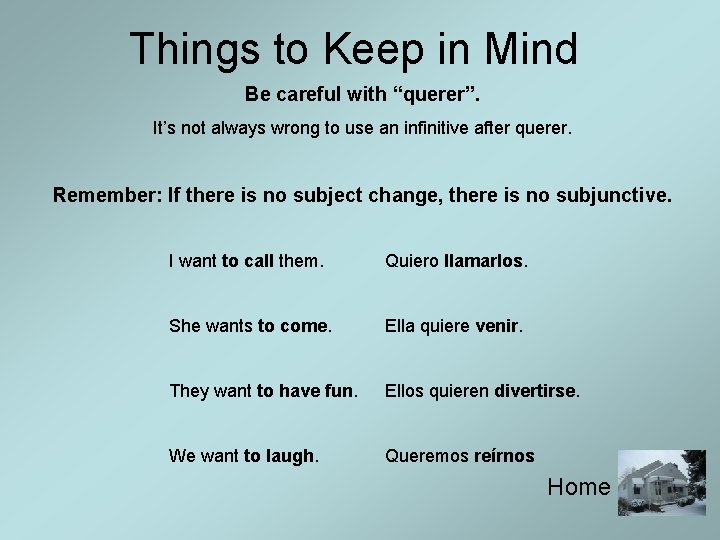
Things to Keep in Mind Be careful with “querer”. It’s not always wrong to use an infinitive after querer. Remember: If there is no subject change, there is no subjunctive. I want to call them. Quiero llamarlos. She wants to come. Ella quiere venir. They want to have fun. Ellos quieren divertirse. We want to laugh. Queremos reírnos Home