Layout Strategies 9 Power Point presentation to accompany

- Slides: 33
Layout Strategies 9 Power. Point presentation to accompany Heizer and Render Operations Management, Eleventh Edition Principles of Operations Management, Ninth Edition Power. Point slides by Jeff Heyl © 2014 Pearson Education, Inc. 9 -1
Outline ► ► ► Global Company Profile: Mc. Donald’s The Strategic Importance of Layout Decisions Types of Layout Office Layout Retail Layout Warehousing and Storage Layouts © 2014 Pearson Education, Inc. 9 -2
Outline - Continued ► ► Fixed-Position Layout Process-Oriented Layout Work Cells Repetitive and Product. Oriented Layout © 2014 Pearson Education, Inc. 9 -3
Learning Objectives When you complete this chapter you should be able to: 1. Discuss important issues in office layout 2. Define the objectives of retail layout 3. Discuss modern warehouse management and terms such as ASRS, cross-docking, and random stocking 4. Identify when fixed-position layouts are appropriate © 2014 Pearson Education, Inc. 9 -4
Learning Objectives When you complete this chapter you should be able to: 5. Explain how to achieve a good processoriented facility layout 6. Define work cell and the requirements of a work cell 7. Define product-oriented layout 8. Explain how to balance production flow in a repetitive or product-oriented facility © 2014 Pearson Education, Inc. 9 -5
Innovations at Mc. Donald’s ► Indoor seating (1950 s) ► Drive-through window (1970 s) ► Adding breakfast to the menu (1980 s) ► Adding play areas (late 1980 s) ► Redesign of the kitchens (1990 s) ► Self-service kiosk (2004) ► Now three separate dining sections © 2014 Pearson Education, Inc. 9 -6
Innovations at Mc. Donald’s ► Indoor seating (1950 s) ► Drive-through window. Six (1970 s) out of the are Adding breakfast to the seven menu (1980 s) layout Adding play areas (late decisions! 1980 s) Redesign of the kitchens (1990 s) ► Self-service kiosk (2004) ► Now three separate dining sections ► ► ► © 2014 Pearson Education, Inc. 9 -7
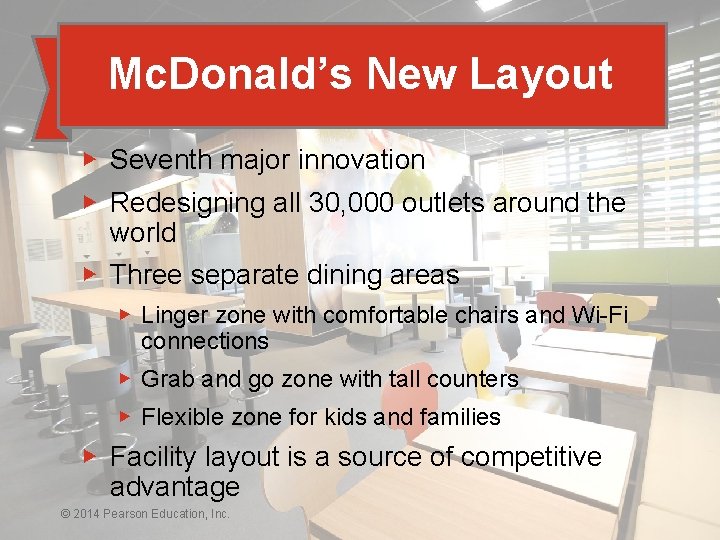
Mc. Donald’s New Layout ▶ Seventh major innovation ▶ Redesigning all 30, 000 outlets around the world ▶ Three separate dining areas ▶ Linger zone with comfortable chairs and Wi-Fi connections ▶ Grab and go zone with tall counters ▶ Flexible zone for kids and families ▶ Facility layout is a source of competitive advantage © 2014 Pearson Education, Inc. 9 -8
Strategic Importance of Layout Decisions The objective of layout strategy is to develop an effective and efficient layout that will meet the firm’s competitive requirements © 2014 Pearson Education, Inc. 9 -9
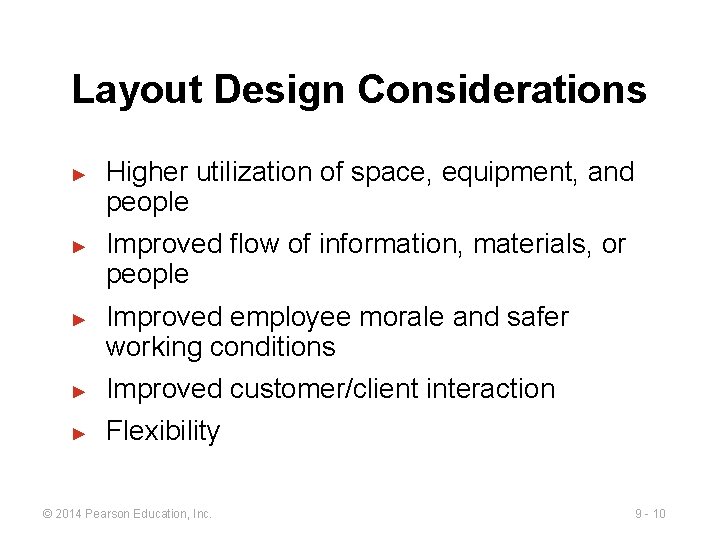
Layout Design Considerations ► ► ► Higher utilization of space, equipment, and people Improved flow of information, materials, or people Improved employee morale and safer working conditions ► Improved customer/client interaction ► Flexibility © 2014 Pearson Education, Inc. 9 - 10
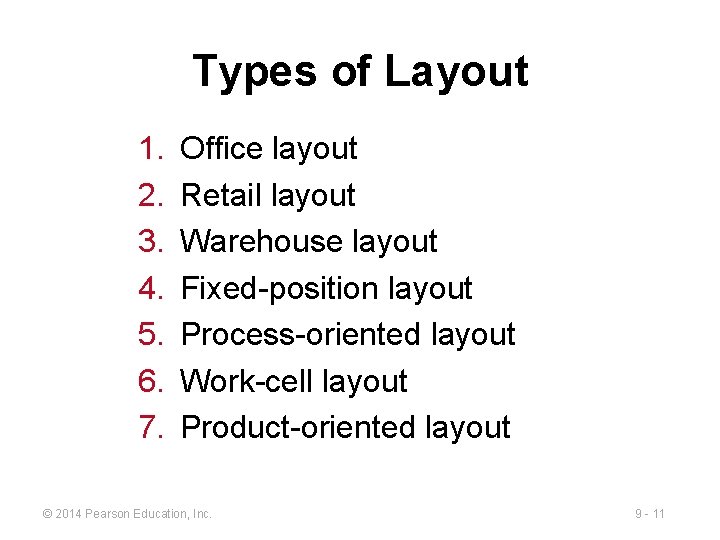
Types of Layout 1. 2. 3. 4. 5. 6. 7. Office layout Retail layout Warehouse layout Fixed-position layout Process-oriented layout Work-cell layout Product-oriented layout © 2014 Pearson Education, Inc. 9 - 11
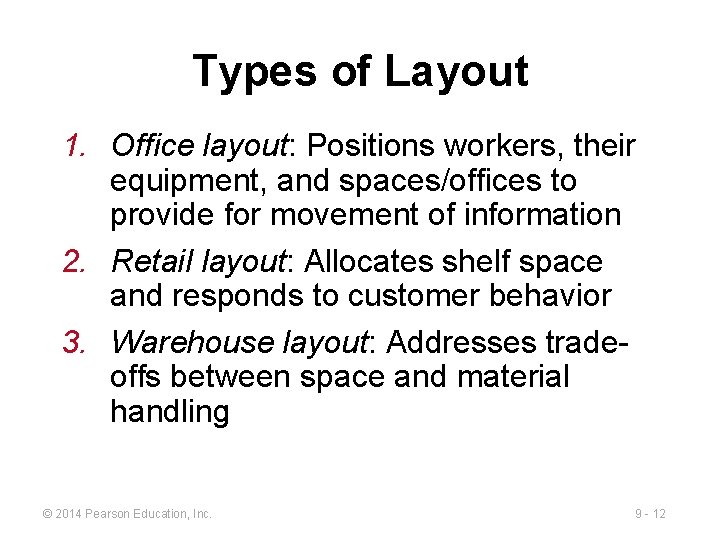
Types of Layout 1. Office layout: Positions workers, their equipment, and spaces/offices to provide for movement of information 2. Retail layout: Allocates shelf space and responds to customer behavior 3. Warehouse layout: Addresses tradeoffs between space and material handling © 2014 Pearson Education, Inc. 9 - 12
Types of Layout 4. Fixed-position layout: Addresses the layout requirements of large, bulky projects such as ships and buildings 5. Process-oriented layout: Deals with low-volume, high-variety production (also called job shop or intermittent production) © 2014 Pearson Education, Inc. 9 - 13
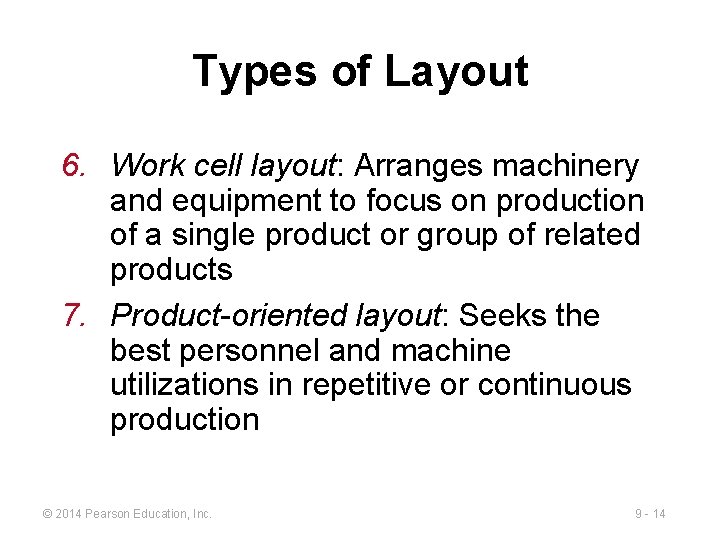
Types of Layout 6. Work cell layout: Arranges machinery and equipment to focus on production of a single product or group of related products 7. Product-oriented layout: Seeks the best personnel and machine utilizations in repetitive or continuous production © 2014 Pearson Education, Inc. 9 - 14
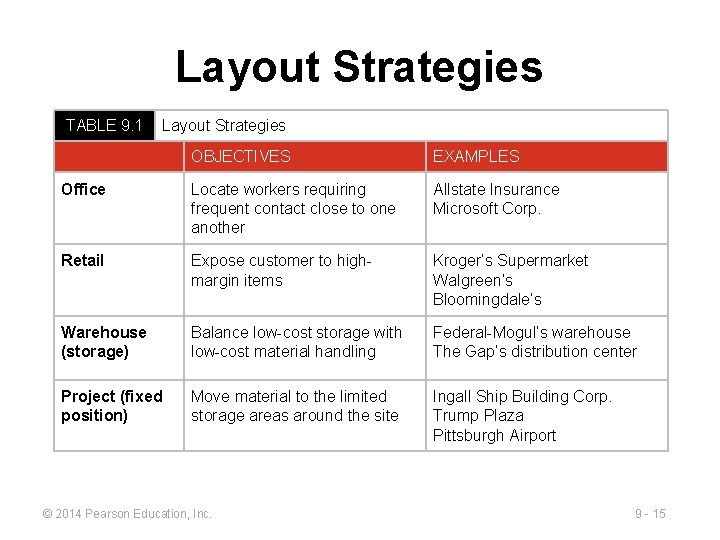
Layout Strategies TABLE 9. 1 Layout Strategies OBJECTIVES EXAMPLES Office Locate workers requiring frequent contact close to one another Allstate Insurance Microsoft Corp. Retail Expose customer to highmargin items Kroger’s Supermarket Walgreen’s Bloomingdale’s Warehouse (storage) Balance low-cost storage with low-cost material handling Federal-Mogul’s warehouse The Gap’s distribution center Project (fixed position) Move material to the limited storage areas around the site Ingall Ship Building Corp. Trump Plaza Pittsburgh Airport © 2014 Pearson Education, Inc. 9 - 15
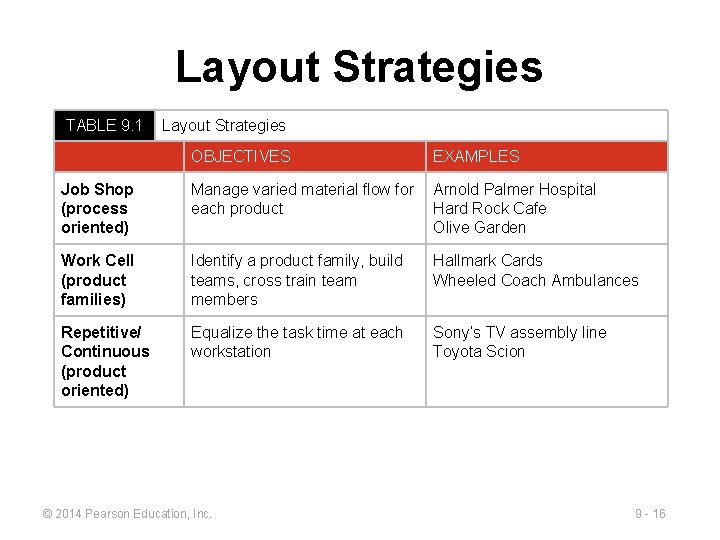
Layout Strategies TABLE 9. 1 Layout Strategies OBJECTIVES EXAMPLES Job Shop (process oriented) Manage varied material flow for each product Arnold Palmer Hospital Hard Rock Cafe Olive Garden Work Cell (product families) Identify a product family, build teams, cross train team members Hallmark Cards Wheeled Coach Ambulances Repetitive/ Continuous (product oriented) Equalize the task time at each workstation Sony’s TV assembly line Toyota Scion © 2014 Pearson Education, Inc. 9 - 16
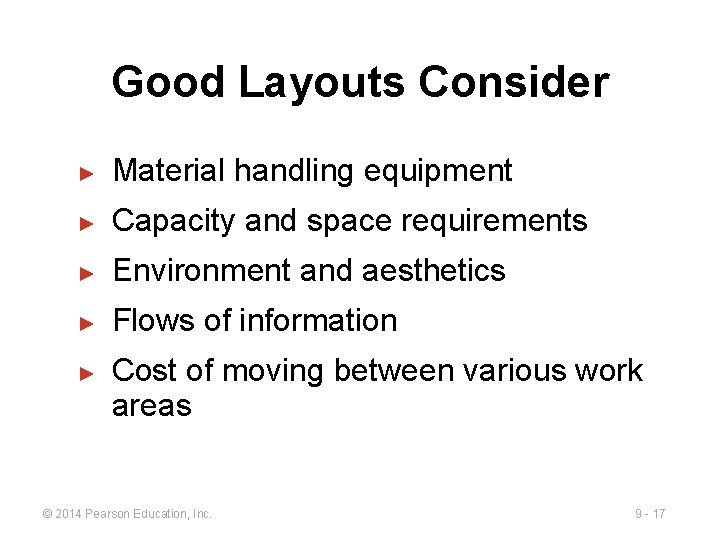
Good Layouts Consider ► Material handling equipment ► Capacity and space requirements ► Environment and aesthetics ► Flows of information ► Cost of moving between various work areas © 2014 Pearson Education, Inc. 9 - 17
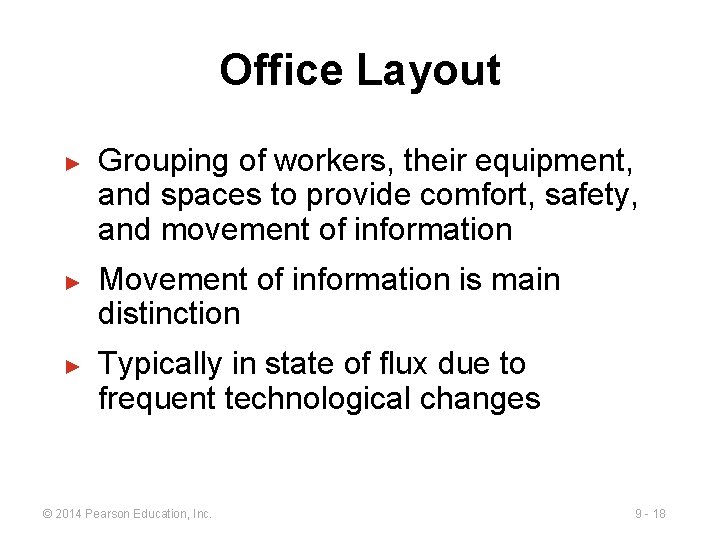
Office Layout ► ► ► Grouping of workers, their equipment, and spaces to provide comfort, safety, and movement of information Movement of information is main distinction Typically in state of flux due to frequent technological changes © 2014 Pearson Education, Inc. 9 - 18
Office Layout ► ► Three physical and social aspects ► Proximity ► Privacy ► Permission Two major trends ► Information technology ► Dynamic needs for space and services © 2014 Pearson Education, Inc. 9 - 19
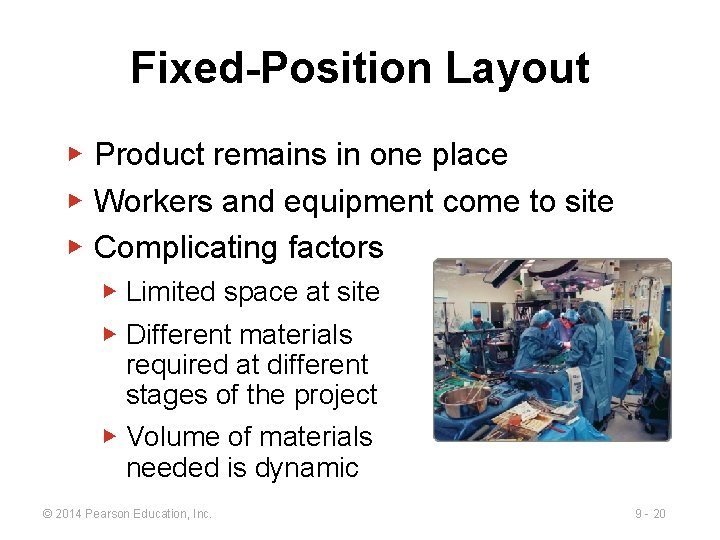
Fixed-Position Layout ▶ Product remains in one place ▶ Workers and equipment come to site ▶ Complicating factors ▶ Limited space at site ▶ Different materials required at different stages of the project ▶ Volume of materials needed is dynamic © 2014 Pearson Education, Inc. 9 - 20
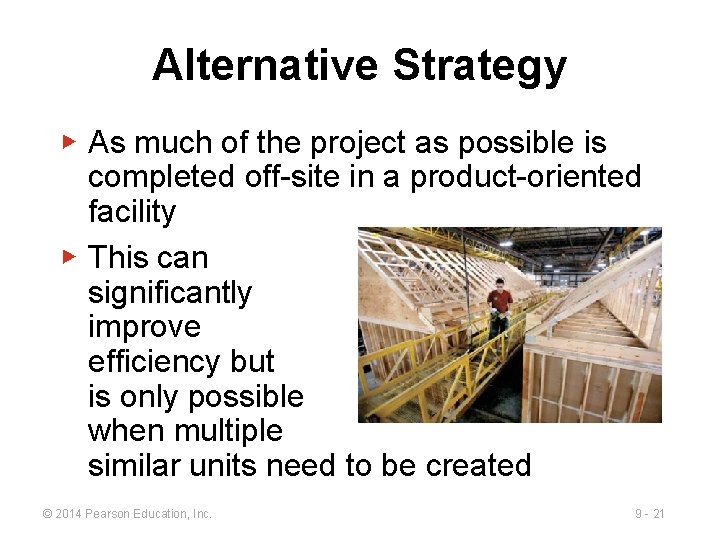
Alternative Strategy ▶ As much of the project as possible is completed off-site in a product-oriented facility ▶ This can significantly improve efficiency but is only possible when multiple similar units need to be created © 2014 Pearson Education, Inc. 9 - 21
Process-Oriented Layout ▶ Like machines and equipment are grouped together ▶ Flexible and capable of handling a wide variety of products or services ▶ Scheduling can be difficult and setup, material handling, and labor costs can be high © 2014 Pearson Education, Inc. 9 - 22
Process-Oriented Layout ▶ Arrange work centers so as to minimize the costs of material handling ▶ Basic cost elements are ▶ Number of loads (or people) moving between centers ▶ Distance loads (or people) move between centers © 2014 Pearson Education, Inc. 9 - 23
Work Cells/Cellular Layout ▶ Reorganizes people and machines into groups to focus on single products or product groups ▶ Group technology identifies products that have similar characteristics for particular cells ▶ Volume must justify cells ▶ Cells can be reconfigured as designs or volume changes © 2014 Pearson Education, Inc. 9 - 24
Advantages of Work Cells 1. Reduced work-in-process inventory 2. Less floor space required 3. Reduced raw material and finished goods inventories 4. Reduced direct labor cost 5. Heightened sense of employee participation 6. Increased equipment and machinery utilization 7. Reduced investment in machinery and equipment © 2014 Pearson Education, Inc. 9 - 25
Requirements of Work Cells ▶ Identification of families of products ▶ A high level of training, flexibility and empowerment of employees ▶ Being self-contained, with its own equipment and resources ▶ Test (poka-yoke) at each station in the cell © 2014 Pearson Education, Inc. 9 - 26
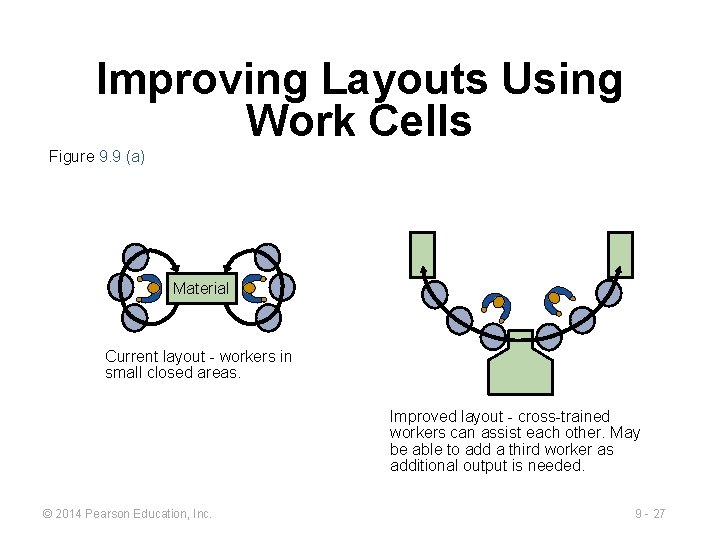
Improving Layouts Using Work Cells Figure 9. 9 (a) Material Current layout - workers in small closed areas. Improved layout - cross-trained workers can assist each other. May be able to add a third worker as additional output is needed. © 2014 Pearson Education, Inc. 9 - 27
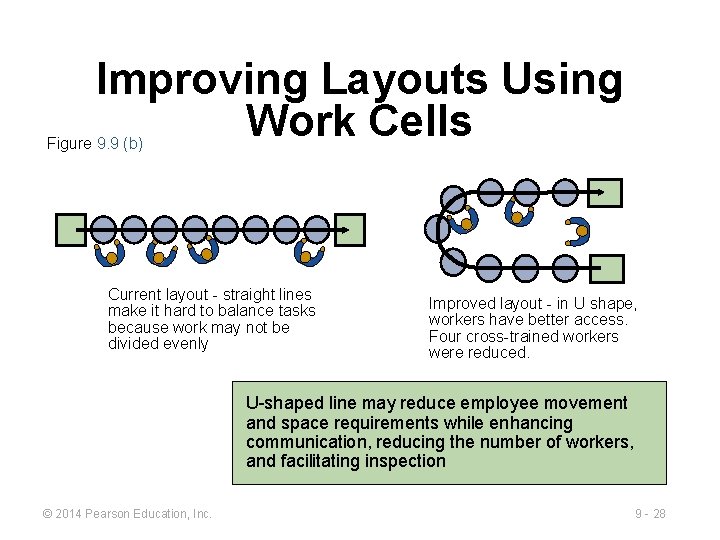
Improving Layouts Using Work Cells Figure 9. 9 (b) Current layout - straight lines make it hard to balance tasks because work may not be divided evenly Improved layout - in U shape, workers have better access. Four cross-trained workers were reduced. U-shaped line may reduce employee movement and space requirements while enhancing communication, reducing the number of workers, and facilitating inspection © 2014 Pearson Education, Inc. 9 - 28
Repetitive and Product. Oriented Layout Organized around products or families of similar high-volume, low-variety products 1. Volume is adequate for high equipment utilization 2. Product demand is stable enough to justify high investment in specialized equipment 3. Product is standardized or approaching a phase of life cycle that justifies investment 4. Supplies of raw materials and components are adequate and of uniform quality © 2014 Pearson Education, Inc. 9 - 29
Product-Oriented Layouts ► Fabrication line ► Builds components on a series of machines ► Machine-paced ► ► Require mechanical or engineering changes to balance Assembly line Both types of lines must be balanced ► Puts fabricated parts together at a series of so that the time to workstations perform the work at ► Paced by work tasks each station is the same ► Balanced by moving tasks © 2014 Pearson Education, Inc. 9 - 30
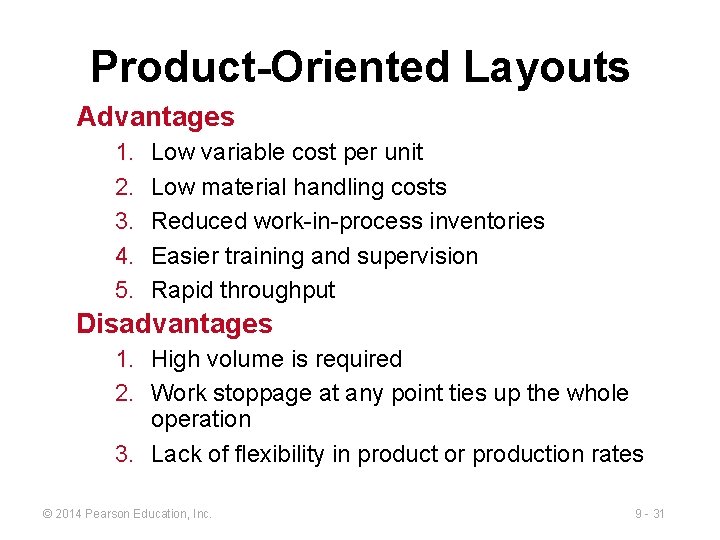
Product-Oriented Layouts Advantages 1. 2. 3. 4. 5. Low variable cost per unit Low material handling costs Reduced work-in-process inventories Easier training and supervision Rapid throughput Disadvantages 1. High volume is required 2. Work stoppage at any point ties up the whole operation 3. Lack of flexibility in product or production rates © 2014 Pearson Education, Inc. 9 - 31
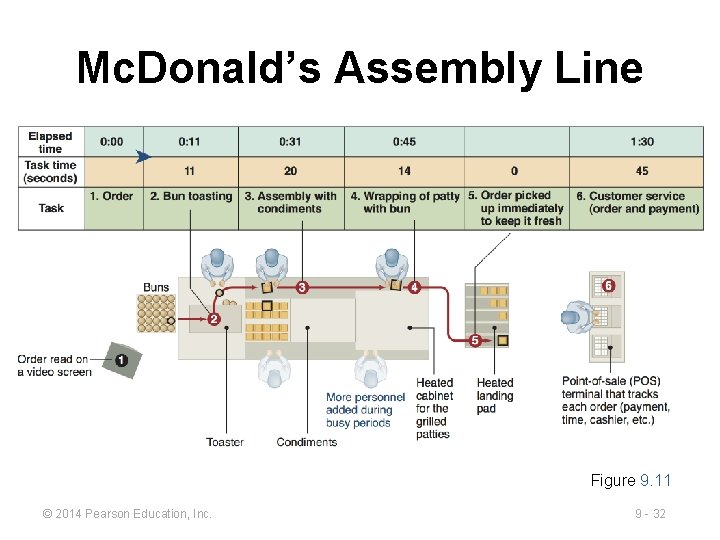
Mc. Donald’s Assembly Line Figure 9. 11 © 2014 Pearson Education, Inc. 9 - 32
All rights reserved. No part of this publication may be reproduced, stored in a retrieval system, or transmitted, in any form or by any means, electronic, mechanical, photocopying, recording, or otherwise, without the prior written permission of the publisher. Printed in the United States of America. © 2014 Pearson Education, Inc. 9 - 33