Latent Aspect Rating Analysis without Aspect Keyword Supervision

- Slides: 26
Latent Aspect Rating Analysis without Aspect Keyword Supervision Hongning Wang, Yue Lu, Cheng. Xiang Zhai {wang 296, yuelu 2, czhai}@cs. uiuc. edu Department of Computer Science University of Illinois at Urbana-Champaign Urbana IL, 61801 USA 1
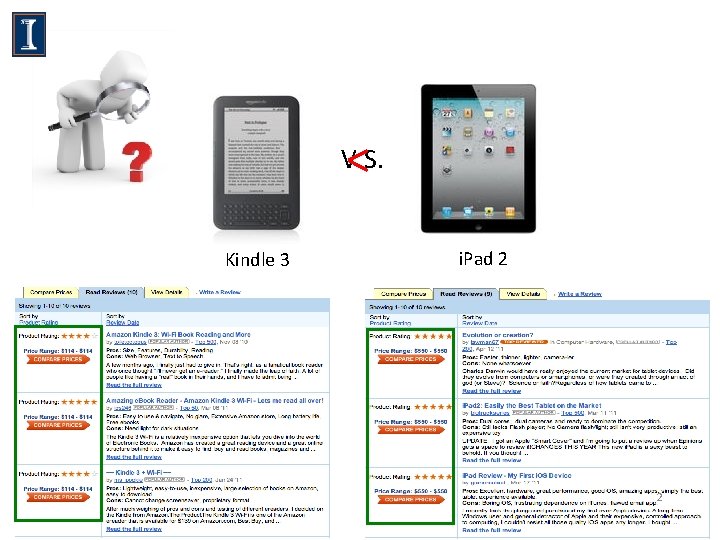
< V. S. Kindle 3 i. Pad 2 2
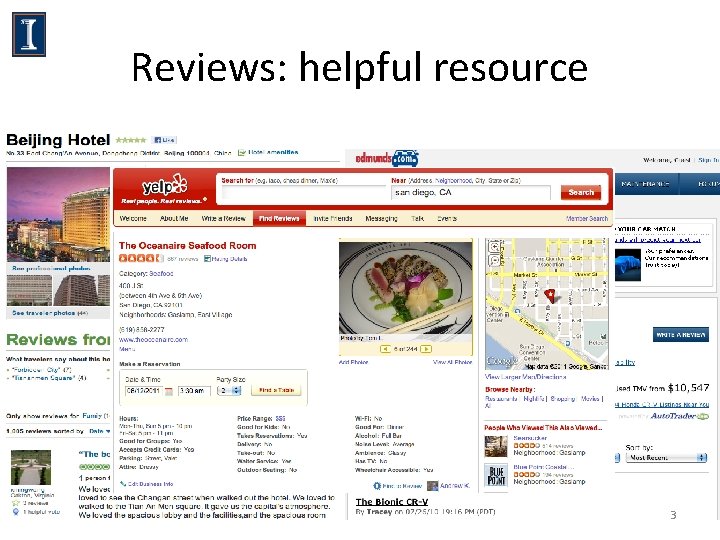
Reviews: helpful resource 3
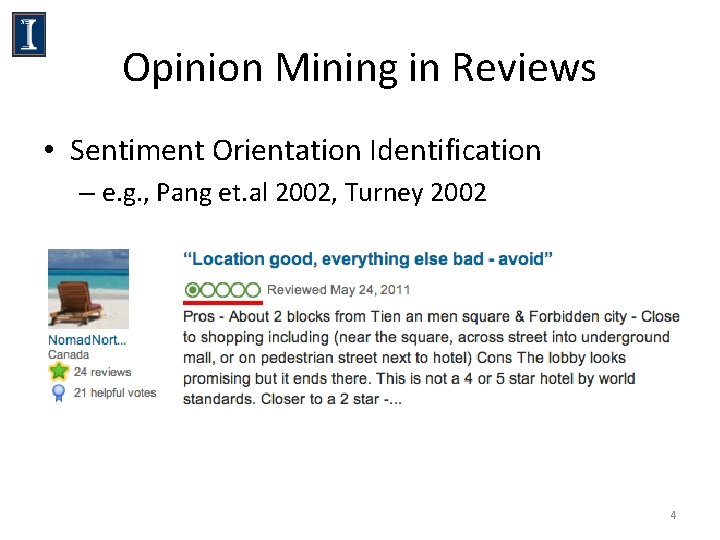
Opinion Mining in Reviews • Sentiment Orientation Identification – e. g. , Pang et. al 2002, Turney 2002 4
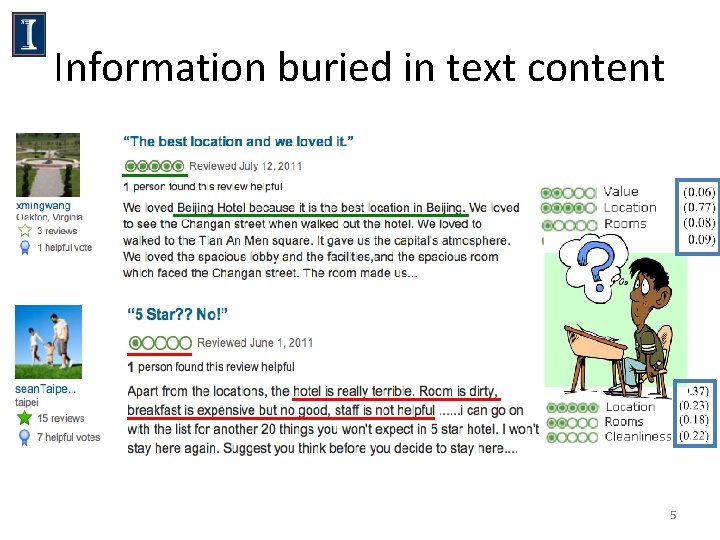
Information buried in text content 5
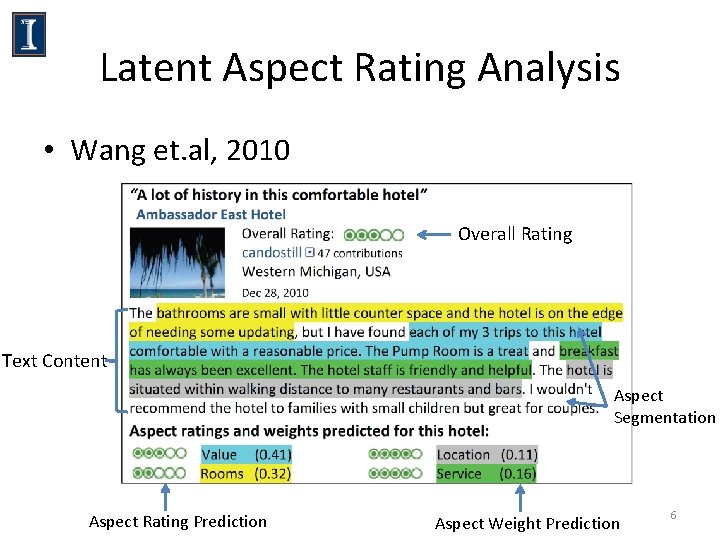
Latent Aspect Rating Analysis • Wang et. al, 2010 Overall Rating Text Content Aspect Segmentation Aspect Rating Prediction Aspect Weight Prediction 6
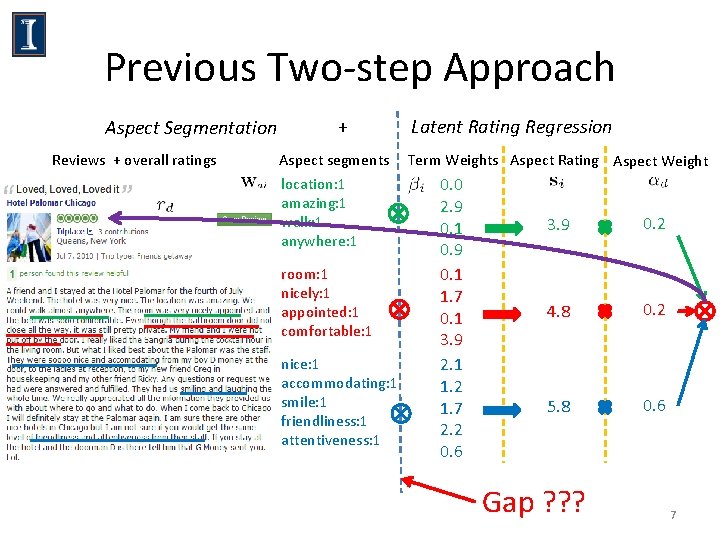
Previous Two-step Approach Aspect Segmentation Reviews + overall ratings + Aspect segments location: 1 amazing: 1 walk: 1 anywhere: 1 room: 1 nicely: 1 appointed: 1 comfortable: 1 nice: 1 accommodating: 1 smile: 1 friendliness: 1 attentiveness: 1 Latent Rating Regression Term Weights Aspect Rating Aspect Weight 0. 0 2. 9 0. 1 0. 9 0. 1 1. 7 0. 1 3. 9 2. 1 1. 2 1. 7 2. 2 0. 6 3. 9 0. 2 4. 8 0. 2 5. 8 0. 6 Gap ? ? ? 7
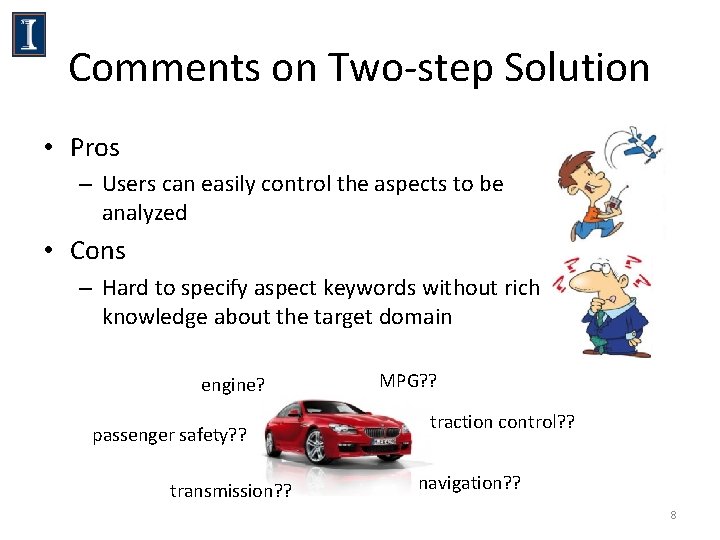
Comments on Two-step Solution • Pros – Users can easily control the aspects to be analyzed • Cons – Hard to specify aspect keywords without rich knowledge about the target domain engine? passenger safety? ? transmission? ? MPG? ? traction control? ? navigation? ? 8
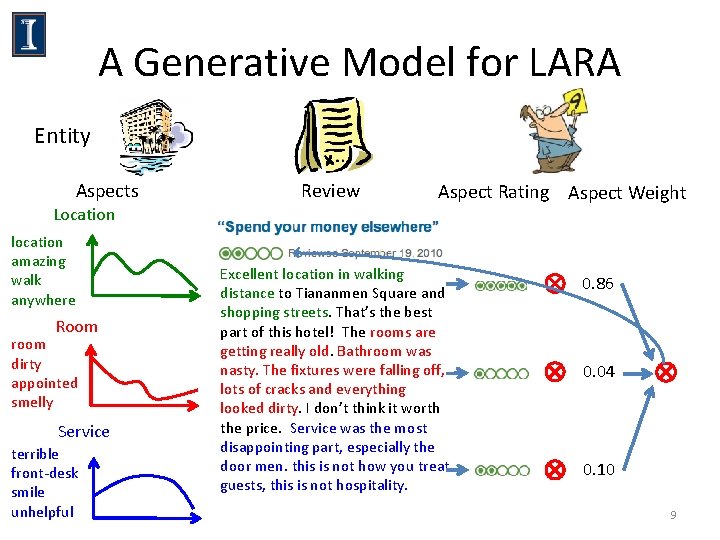
A Generative Model for LARA Entity Aspects Location location amazing walk anywhere Room room dirty appointed smelly Service terrible front-desk smile unhelpful Review Aspect Rating Aspect Weight Excellent location in walking distance to Tiananmen Square and shopping streets. That’s the best part of this hotel! The rooms are getting really old. Bathroom was nasty. The fixtures were falling off, lots of cracks and everything looked dirty. I don’t think it worth the price. Service was the most disappointing part, especially the door men. this is not how you treat guests, this is not hospitality. 0. 86 0. 04 0. 10 9
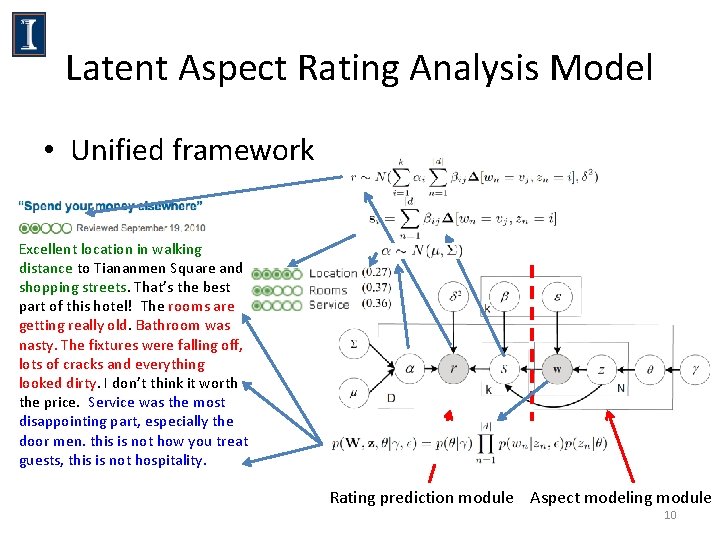
Latent Aspect Rating Analysis Model • Unified framework Excellent location in walking distance to Tiananmen Square and shopping streets. That’s the best part of this hotel! The rooms are getting really old. Bathroom was nasty. The fixtures were falling off, lots of cracks and everything looked dirty. I don’t think it worth the price. Service was the most disappointing part, especially the door men. this is not how you treat guests, this is not hospitality. Rating prediction module Aspect modeling module 10
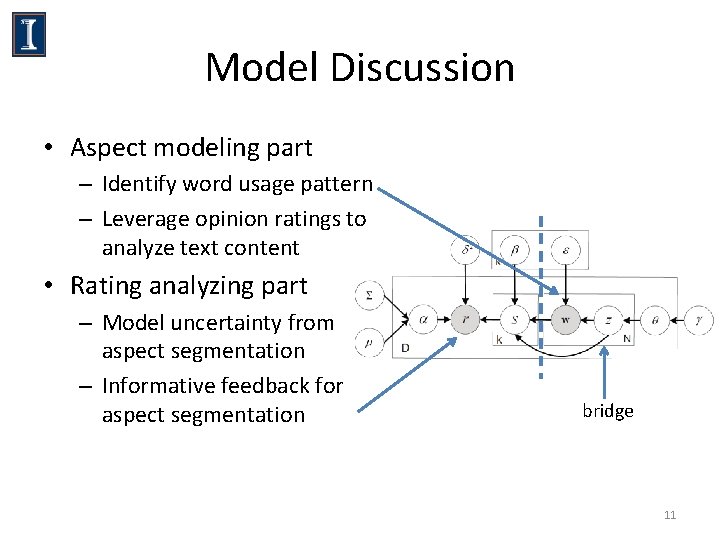
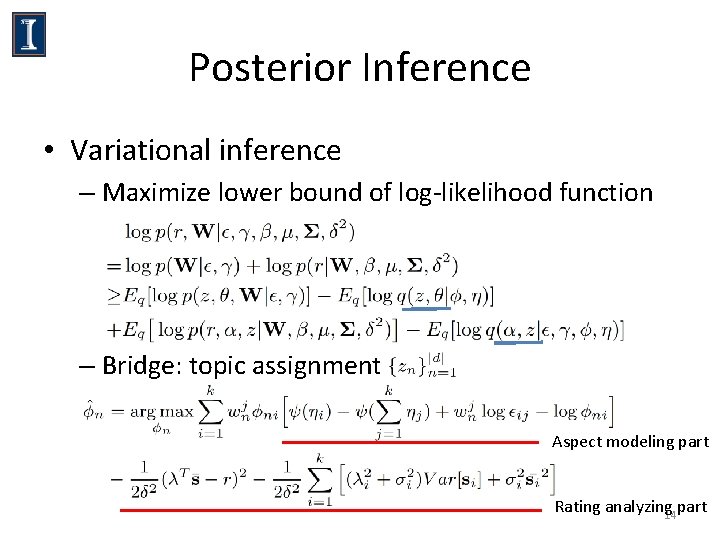
Model Discussion • Aspect modeling part – Identify word usage pattern – Leverage opinion ratings to analyze text content • Rating analyzing part – Model uncertainty from aspect segmentation – Informative feedback for aspect segmentation bridge 11
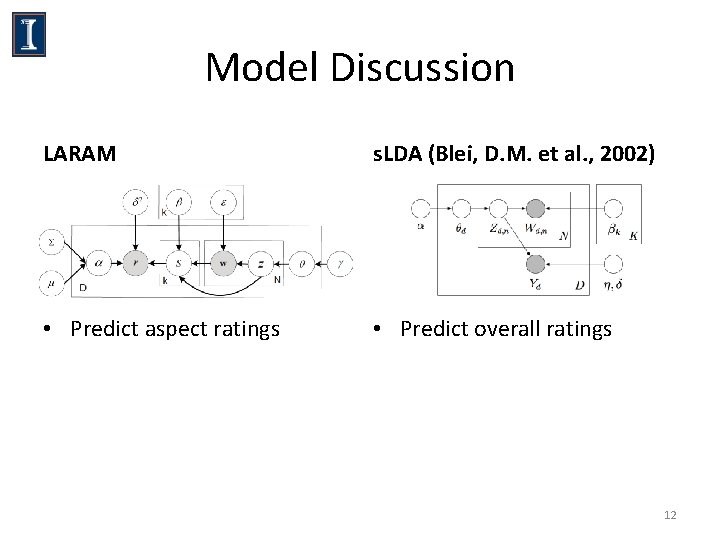
Model Discussion LARAM s. LDA (Blei, D. M. et al. , 2002) • Predict aspect ratings • Predict overall ratings 12
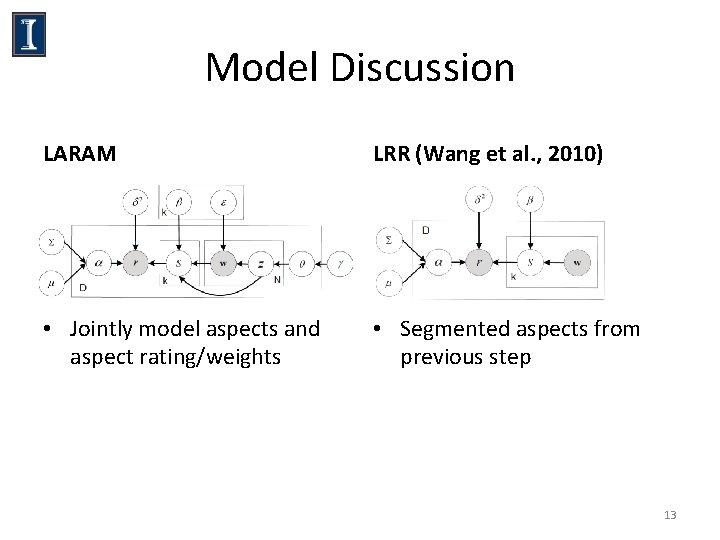
Model Discussion LARAM LRR (Wang et al. , 2010) • Jointly model aspects and aspect rating/weights • Segmented aspects from previous step 13
Posterior Inference • Variational inference – Maximize lower bound of log-likelihood function – Bridge: topic assignment Aspect modeling part Rating analyzing 14 part
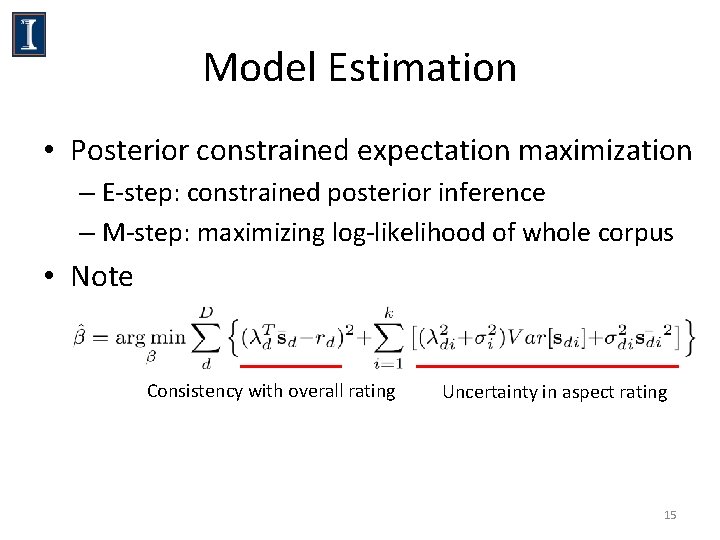
Model Estimation • Posterior constrained expectation maximization – E-step: constrained posterior inference – M-step: maximizing log-likelihood of whole corpus • Note Consistency with overall rating Uncertainty in aspect rating 15
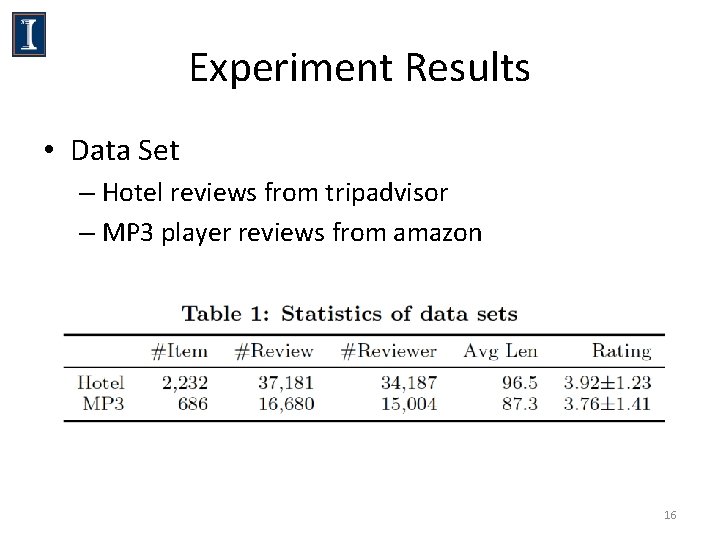
Experiment Results • Data Set – Hotel reviews from tripadvisor – MP 3 player reviews from amazon 16
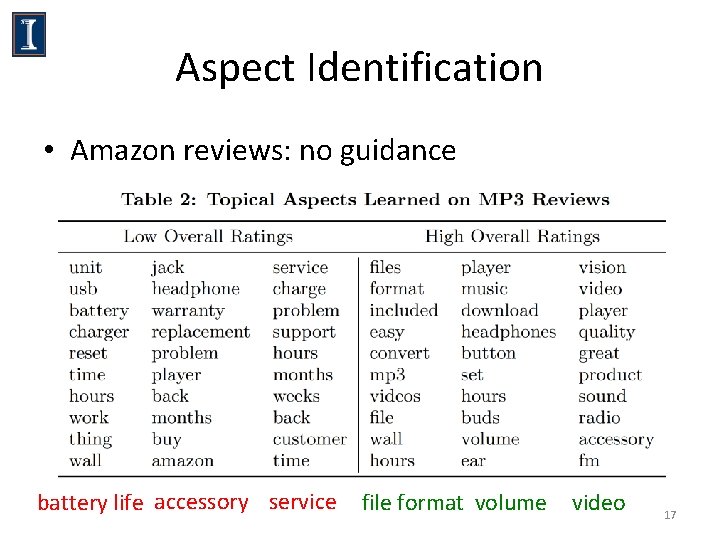
Aspect Identification • Amazon reviews: no guidance battery life accessory service file format volume video 17
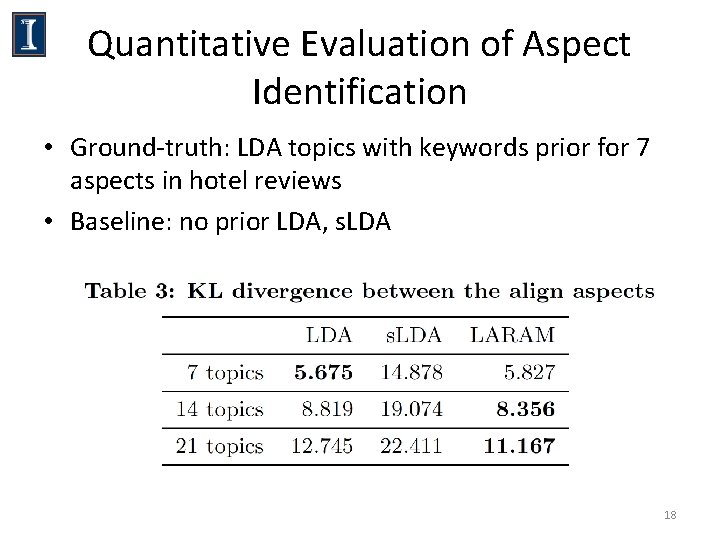
Quantitative Evaluation of Aspect Identification • Ground-truth: LDA topics with keywords prior for 7 aspects in hotel reviews • Baseline: no prior LDA, s. LDA 18
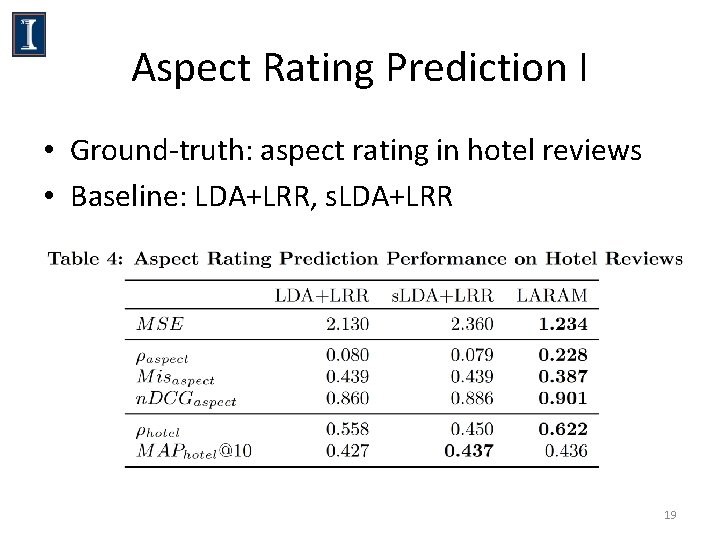
Aspect Rating Prediction I • Ground-truth: aspect rating in hotel reviews • Baseline: LDA+LRR, s. LDA+LRR 19
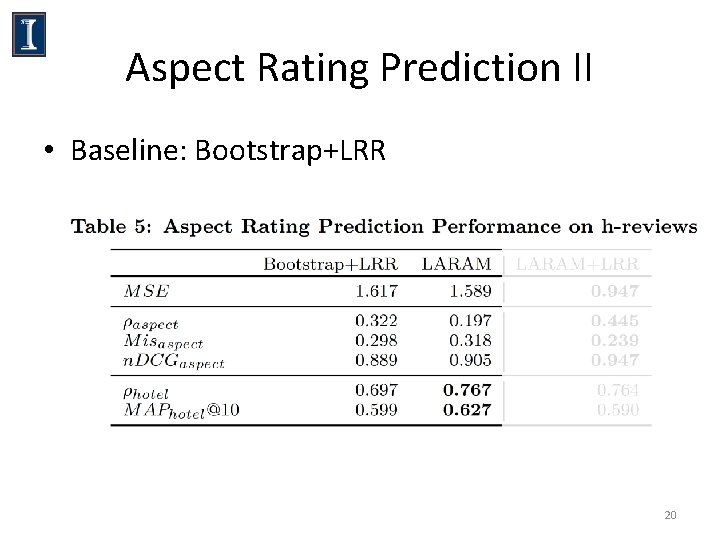
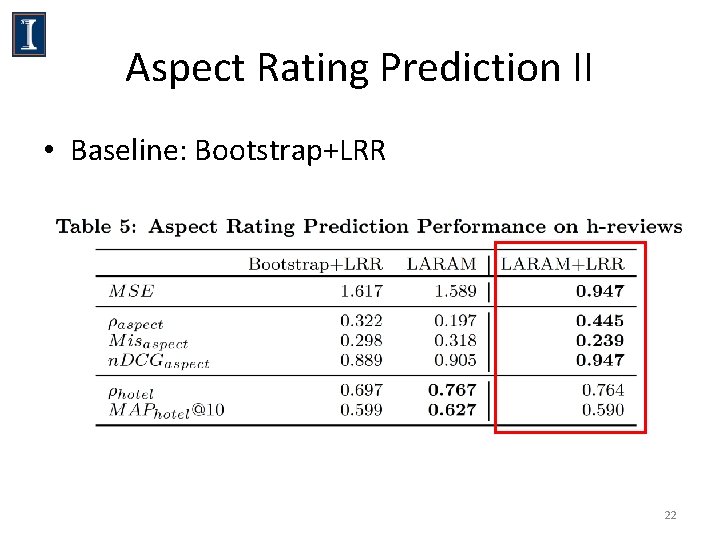
Aspect Rating Prediction II • Baseline: Bootstrap+LRR 20
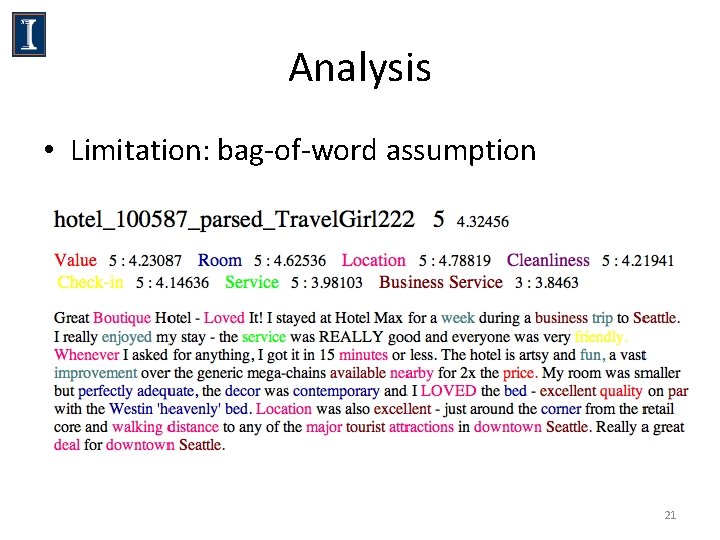
Analysis • Limitation: bag-of-word assumption 21
Aspect Rating Prediction II • Baseline: Bootstrap+LRR 22
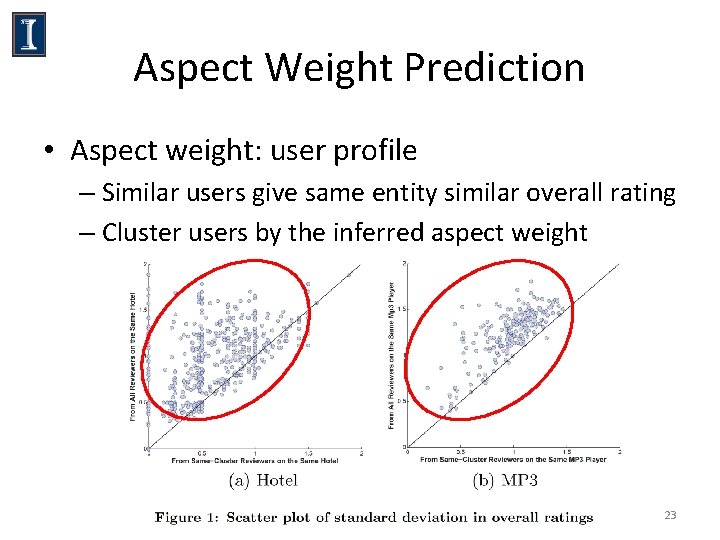
Aspect Weight Prediction • Aspect weight: user profile – Similar users give same entity similar overall rating – Cluster users by the inferred aspect weight 23
Conclusions • Latent Aspect Rating Analysis Model – Unified framework for exploring review text data with companion overall ratings – Simultaneously discover latent topical aspects, latent aspect ratings and weights on each aspect • Limitation – Bag-of-word assumption • Future work – Incorporate sentence boundary/proximity information – Address aspect sparsity in review content 24
References • Pang, B. , Lee, L. and Vaithyanathan, S. , Thumbs up? : sentiment classification using machine learning techniques. In Proceedings of the ACL-02 conference on Empirical methods in natural language processing, P 79 -86, 2002. • Turney, P. , Thumbs up or thumbs down? Semantic orientation applied to unsupervised classification of reviews. In Proceedings of the 40 th Annual Meeting of the Association for Computational Linguistics, P 417 -424, 2002. • Wang, H. , Lu, Y. and Zhai, C. , Latent aspect rating analysis on review text data: a rating regression approach, In Proceedings of the 16 th ACM SIGKDD, P 783 -792, 2010 • Blei, D. M. and Mc. Auliffe, J. D. , Supervised topic models, Advances in Neural Information Processing Systems, P 121 -128, 2008 • J. Graca, K. Ganchev, and B. Taskar. Expectation maximization and posterior constraints. In Advances in Neural Information Processing Systems, volume 20. MIT Press, 2007. 25
THANK YOU 26