King Saud university Norah Ali AlMoneef 1 We
- Slides: 24
King Saud university Norah Ali Al-Moneef 1
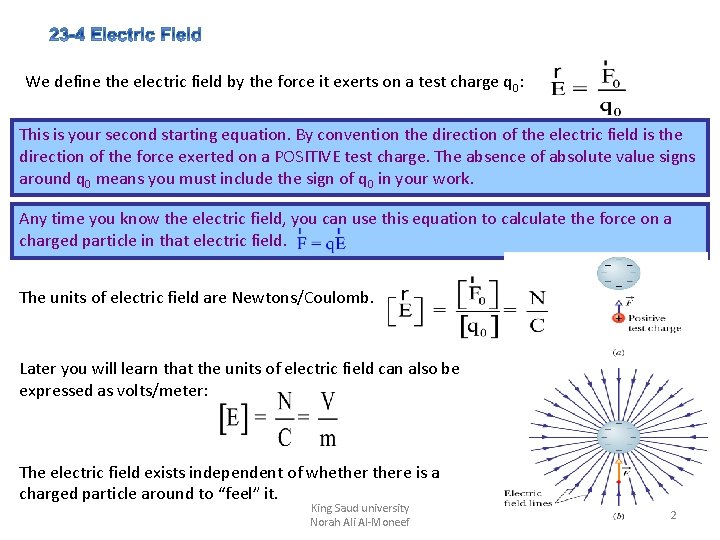
We define the electric field by the force it exerts on a test charge q 0: This is your second starting equation. By convention the direction of the electric field is the direction of the force exerted on a POSITIVE test charge. The absence of absolute value signs around q 0 means you must include the sign of q 0 in your work. Any time you know the electric field, you can use this equation to calculate the force on a charged particle in that electric field. The units of electric field are Newtons/Coulomb. Later you will learn that the units of electric field can also be expressed as volts/meter: The electric field exists independent of whethere is a charged particle around to “feel” it. King Saud university Norah Ali Al-Moneef 2
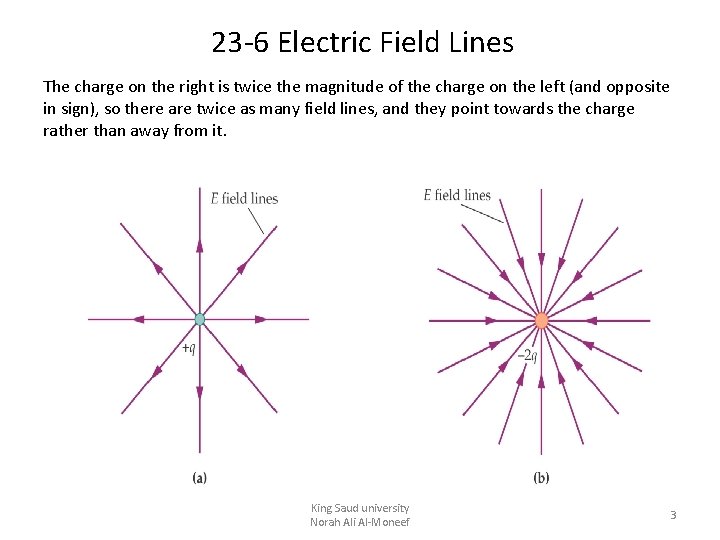
23 -6 Electric Field Lines The charge on the right is twice the magnitude of the charge on the left (and opposite in sign), so there are twice as many field lines, and they point towards the charge rather than away from it. King Saud university Norah Ali Al-Moneef 3
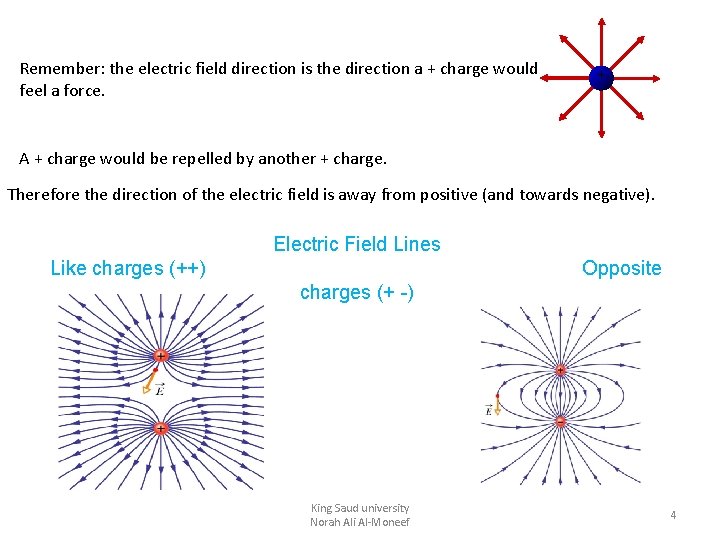
Remember: the electric field direction is the direction a + charge would feel a force. + A + charge would be repelled by another + charge. Therefore the direction of the electric field is away from positive (and towards negative). Electric Field Lines Like charges (++) Opposite charges (+ -) King Saud university Norah Ali Al-Moneef 4
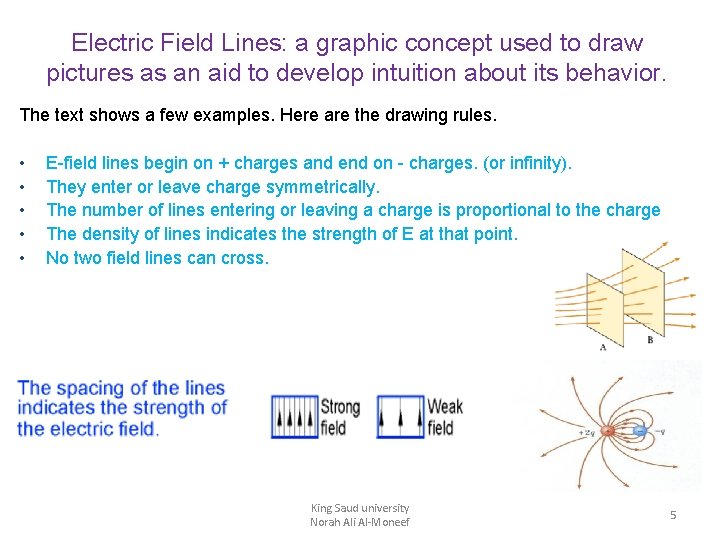
Electric Field Lines: a graphic concept used to draw pictures as an aid to develop intuition about its behavior. The text shows a few examples. Here are the drawing rules. • • • E-field lines begin on + charges and end on - charges. (or infinity). They enter or leave charge symmetrically. The number of lines entering or leaving a charge is proportional to the charge The density of lines indicates the strength of E at that point. No two field lines can cross. King Saud university Norah Ali Al-Moneef 5
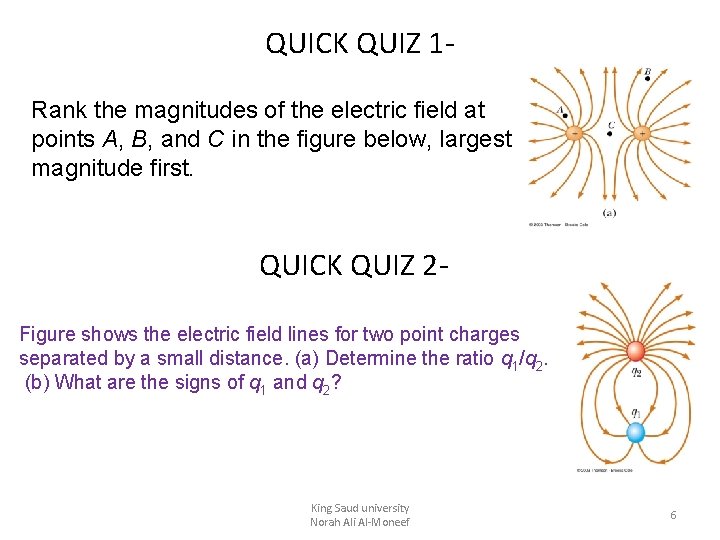
QUICK QUIZ 1 Rank the magnitudes of the electric field at points A, B, and C in the figure below, largest magnitude first. QUICK QUIZ 2 Figure shows the electric field lines for two point charges separated by a small distance. (a) Determine the ratio q 1/q 2. (b) What are the signs of q 1 and q 2? King Saud university Norah Ali Al-Moneef 6
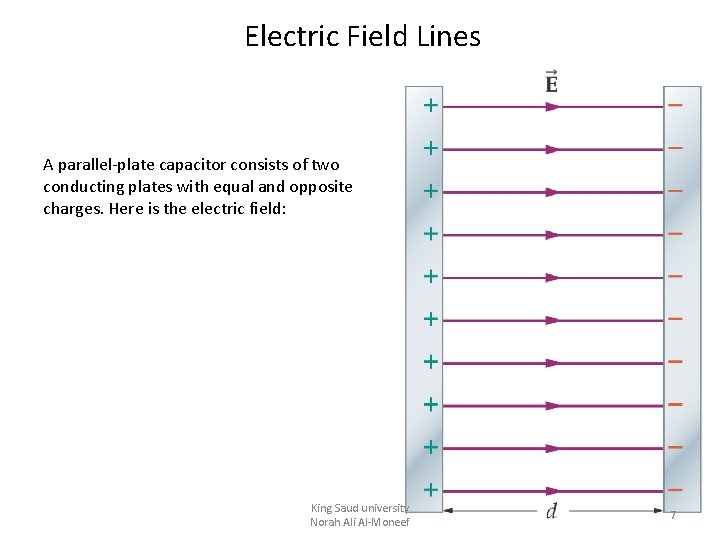
Electric Field Lines A parallel-plate capacitor consists of two conducting plates with equal and opposite charges. Here is the electric field: King Saud university Norah Ali Al-Moneef 7
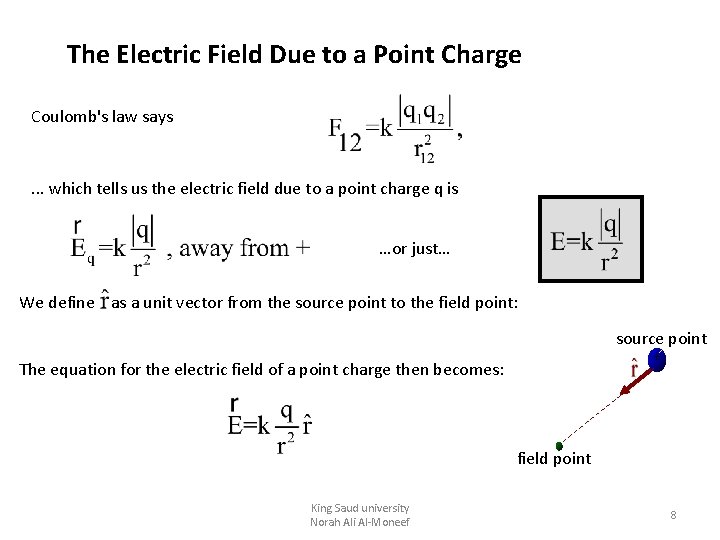
The Electric Field Due to a Point Charge Coulomb's law says . . . which tells us the electric field due to a point charge q is …or just… We define as a unit vector from the source point to the field point: source point + The equation for the electric field of a point charge then becomes: field point King Saud university Norah Ali Al-Moneef 8
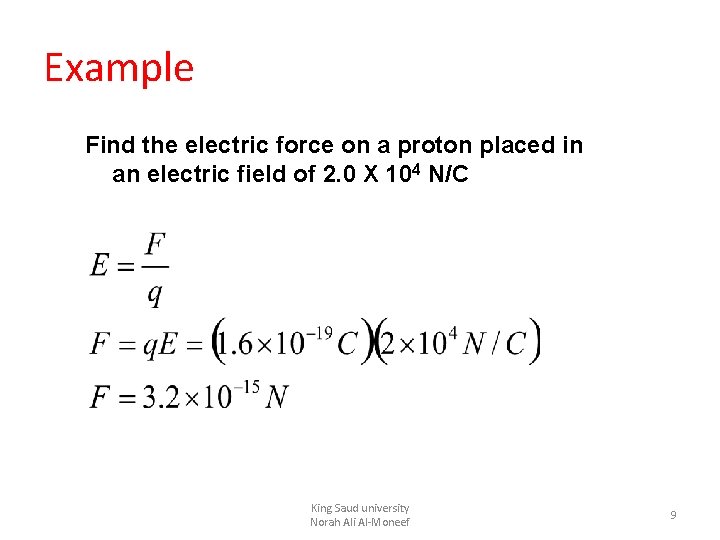
Example Find the electric force on a proton placed in an electric field of 2. 0 X 104 N/C King Saud university Norah Ali Al-Moneef 9
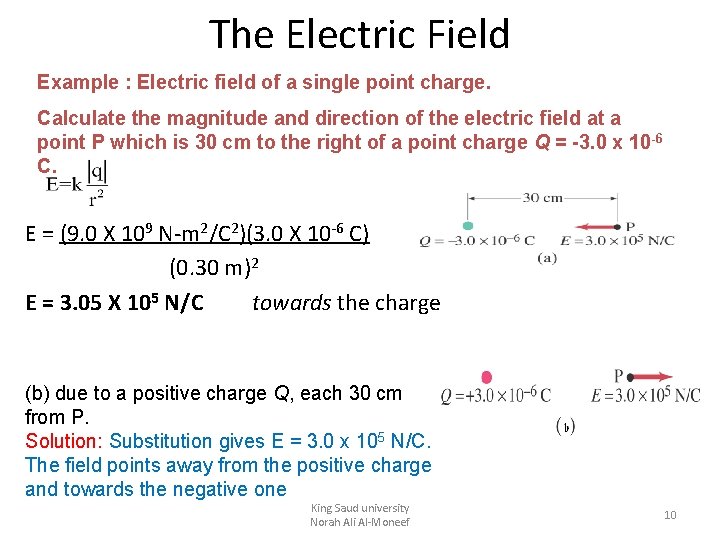
The Electric Field Example : Electric field of a single point charge. Calculate the magnitude and direction of the electric field at a point P which is 30 cm to the right of a point charge Q = -3. 0 x 10 -6 C. E = (9. 0 X 109 N-m 2/C 2)(3. 0 X 10 -6 C) (0. 30 m)2 E = 3. 05 X 105 N/C towards the charge (b) due to a positive charge Q, each 30 cm from P. Solution: Substitution gives E = 3. 0 x 105 N/C. The field points away from the positive charge and towards the negative one King Saud university Norah Ali Al-Moneef 10
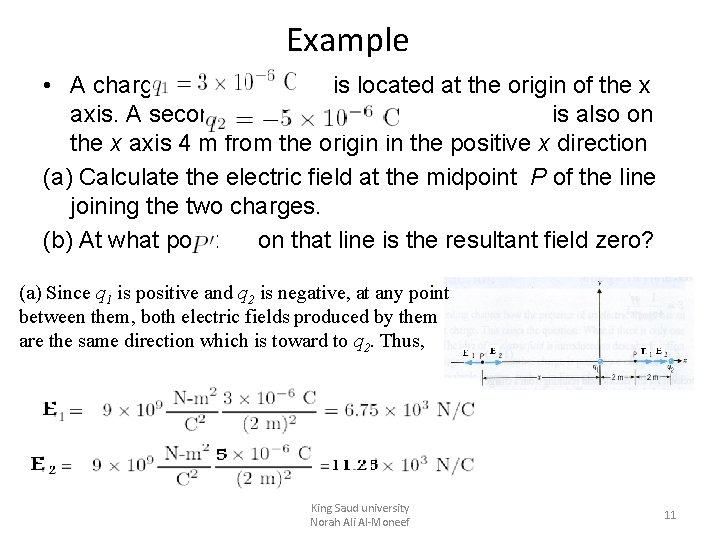
Example • A charge is located at the origin of the x axis. A second charge is also on the x axis 4 m from the origin in the positive x direction (a) Calculate the electric field at the midpoint P of the line joining the two charges. (b) At what point on that line is the resultant field zero? (a) Since q 1 is positive and q 2 is negative, at any point between them, both electric fields produced by them are the same direction which is toward to q 2. Thus, King Saud university Norah Ali Al-Moneef 11
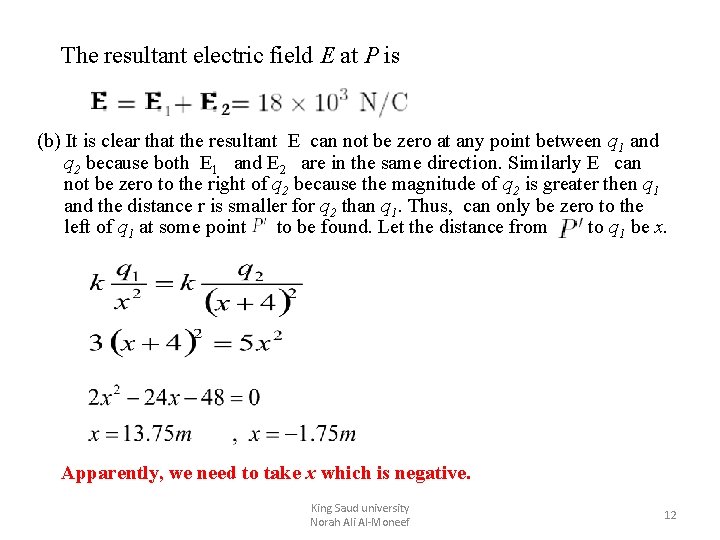
The resultant electric field E at P is (b) It is clear that the resultant E can not be zero at any point between q 1 and q 2 because both E 1 and E 2 are in the same direction. Similarly E can not be zero to the right of q 2 because the magnitude of q 2 is greater then q 1 and the distance r is smaller for q 2 than q 1. Thus, can only be zero to the left of q 1 at some point to be found. Let the distance from to q 1 be x. Apparently, we need to take x which is negative. King Saud university Norah Ali Al-Moneef 12
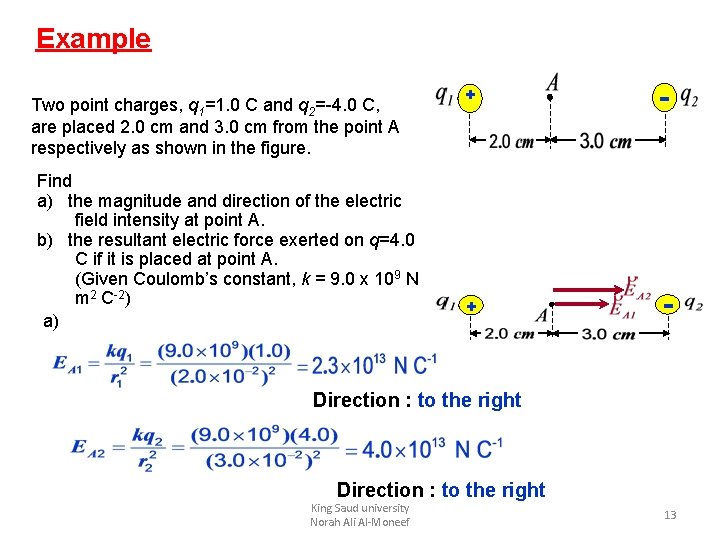
Example Two point charges, q 1=1. 0 C and q 2=-4. 0 C, are placed 2. 0 cm and 3. 0 cm from the point A respectively as shown in the figure. Find a) the magnitude and direction of the electric field intensity at point A. b) the resultant electric force exerted on q=4. 0 C if it is placed at point A. (Given Coulomb’s constant, k = 9. 0 x 109 N m 2 C-2) a) + - Direction : to the right King Saud university Norah Ali Al-Moneef 13
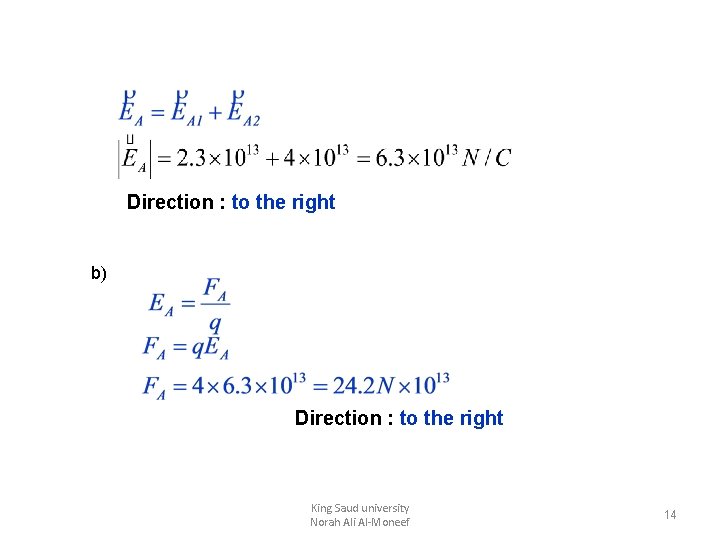
Direction : to the right b) Direction : to the right King Saud university Norah Ali Al-Moneef 14
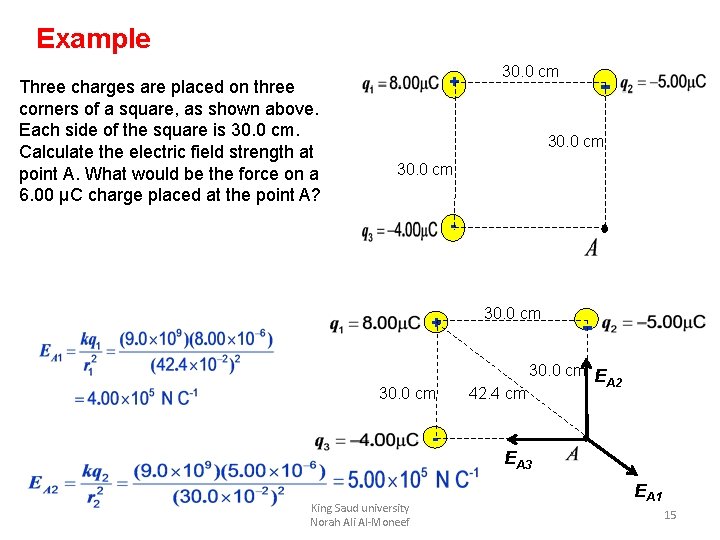
Example Three charges are placed on three corners of a square, as shown above. Each side of the square is 30. 0 cm. Calculate the electric field strength at point A. What would be the force on a 6. 00 µC charge placed at the point A? + 30. 0 cm - + 30. 0 cm - King Saud university Norah Ali Al-Moneef 30. 0 cm 42. 4 cm - 30. 0 cm E A 2 EA 3 EA 1 15
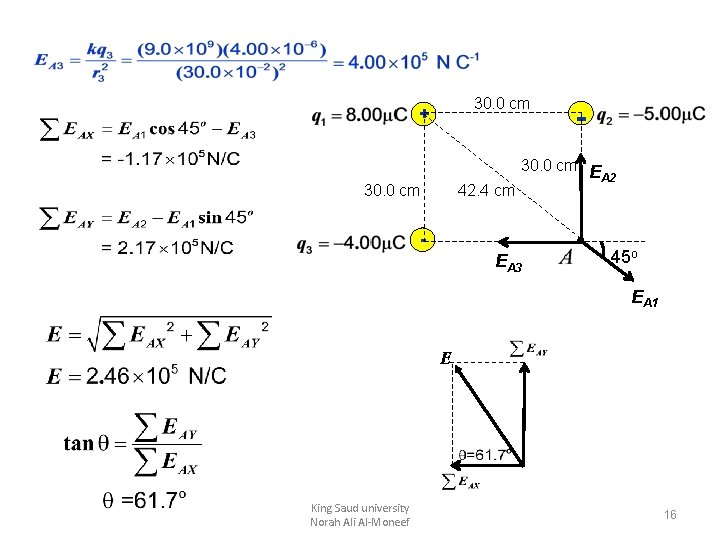
30. 0 cm + 30. 0 cm 42. 4 cm - 30. 0 cm E A 2 EA 3 45 o EA 1 E King Saud university Norah Ali Al-Moneef 16
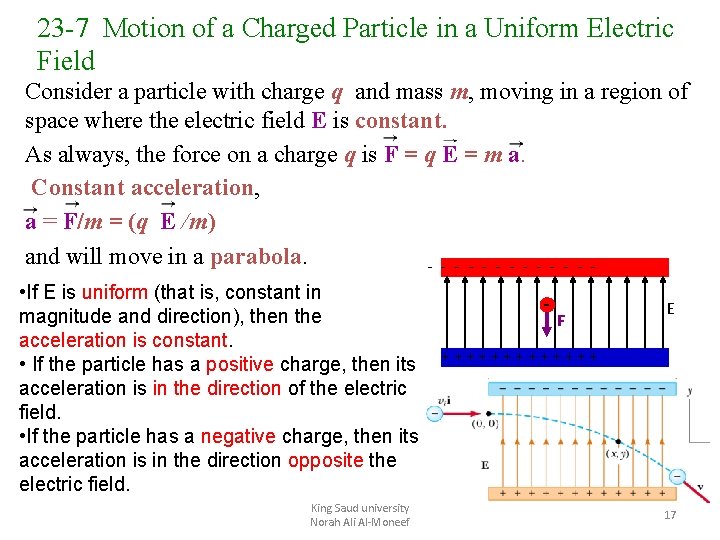
23 -7 Motion of a Charged Particle in a Uniform Electric Field Consider a particle with charge q and mass m, moving in a region of space where the electric field E is constant. As always, the force on a charge q is F = q E = m a. Constant acceleration, a = F/m = (q E /m) and will move in a parabola. - - - • If E is uniform (that is, constant in magnitude and direction), then the acceleration is constant. • If the particle has a positive charge, then its acceleration is in the direction of the electric field. • If the particle has a negative charge, then its acceleration is in the direction opposite the electric field. King Saud university Norah Ali Al-Moneef - F E + + + + 17
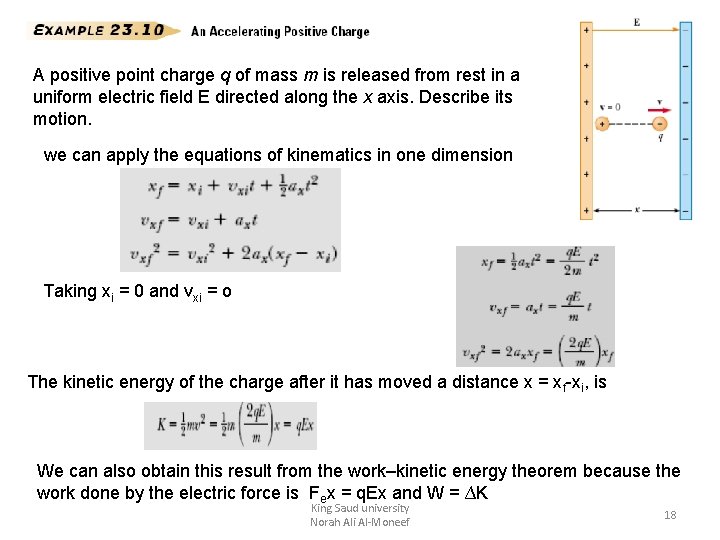
A positive point charge q of mass m is released from rest in a uniform electric field E directed along the x axis. Describe its motion. we can apply the equations of kinematics in one dimension Taking xi = 0 and vxi = o The kinetic energy of the charge after it has moved a distance x = xf-xi, is We can also obtain this result from the work–kinetic energy theorem because the work done by the electric force is Fex = q. Ex and W = ∆K King Saud university Norah Ali Al-Moneef 18
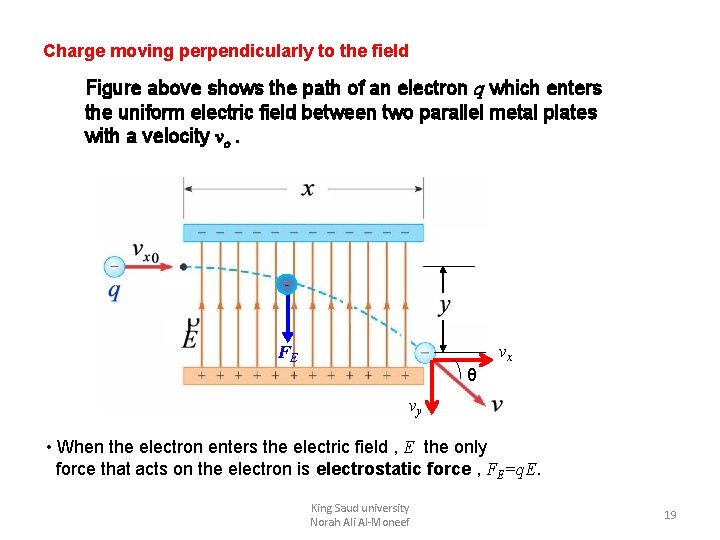
Charge moving perpendicularly to the field Figure above shows the path of an electron q which enters the uniform electric field between two parallel metal plates with a velocity vo. - vx FE θ vy • When the electron enters the electric field , E the only force that acts on the electron is electrostatic force , FE=q. E. King Saud university Norah Ali Al-Moneef 19
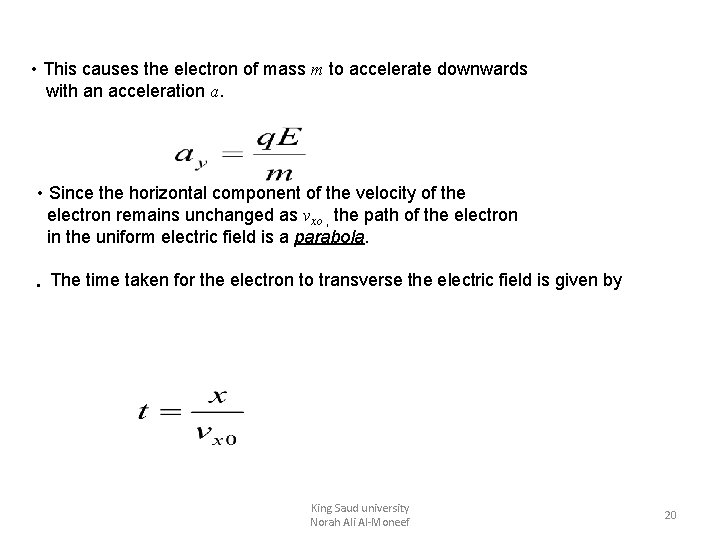
• This causes the electron of mass m to accelerate downwards with an acceleration a. • Since the horizontal component of the velocity of the electron remains unchanged as vxo , the path of the electron in the uniform electric field is a parabola. • The time taken for the electron to transverse the electric field is given by King Saud university Norah Ali Al-Moneef 20
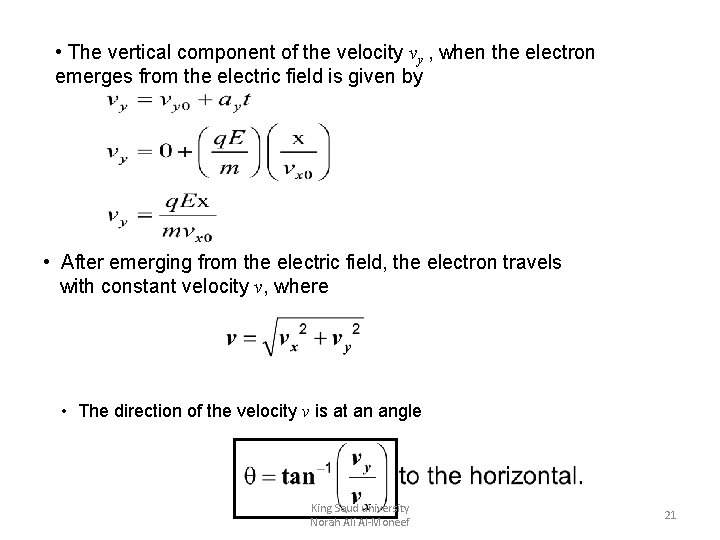
• The vertical component of the velocity vy , when the electron emerges from the electric field is given by • After emerging from the electric field, the electron travels with constant velocity v, where • The direction of the velocity v is at an angle King Saud university Norah Ali Al-Moneef 21
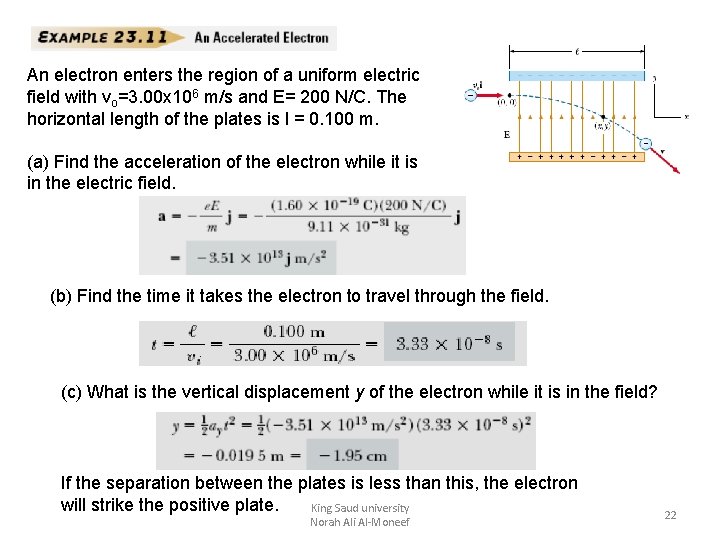
An electron enters the region of a uniform electric field with vo=3. 00 x 106 m/s and E= 200 N/C. The horizontal length of the plates is l = 0. 100 m. (a) Find the acceleration of the electron while it is in the electric field. (b) Find the time it takes the electron to travel through the field. (c) What is the vertical displacement y of the electron while it is in the field? If the separation between the plates is less than this, the electron will strike the positive plate. King Saud university Norah Ali Al-Moneef 22
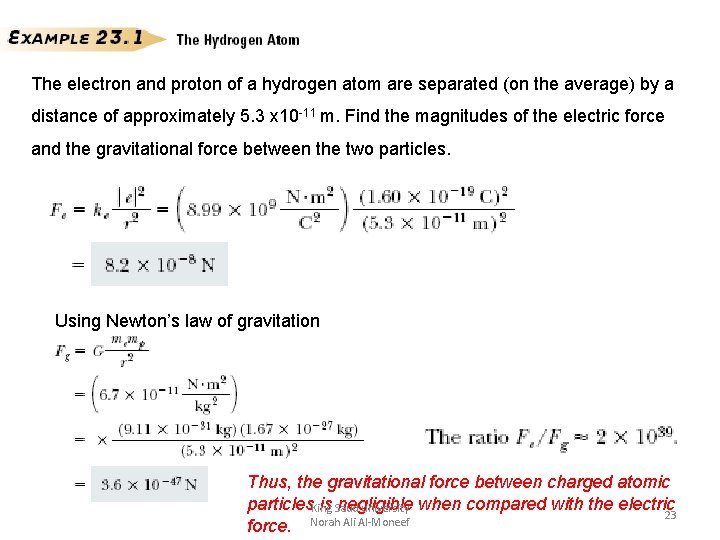
The electron and proton of a hydrogen atom are separated (on the average) by a distance of approximately 5. 3 x 10 -11 m. Find the magnitudes of the electric force and the gravitational force between the two particles. Using Newton’s law of gravitation Thus, the gravitational force between charged atomic particles. King is Saud negligible university when compared with the electric 23 force. Norah Ali Al-Moneef
King Saud university Norah Ali Al-Moneef 24