June 23 2004 P R Kumar Towards proliferation
- Slides: 20
June 23, 2004, P. R. Kumar Towards proliferation of ad hoc wireless networks P. R. Kumar (with V. Borkar, G. Baliga, S. Graham, P. Gupta, K. Huang, V. Kawadia, S. Narayanaswamy, V. Raghunathan, R. Rozovsky, L-L. Xie) Dept. of Electrical and Computer Engineering, and Coordinated Science Lab University of Illinois, Urbana-Champaign Email Web prkumar@uiuc. edu http: //black. csl. uiuc. edu/~prkumar Microsoft Mesh Networking Summit, Snoqualmie, June 23, 2004
June 23, 2004, P. R. Kumar One modest effort-in-the-making towards proliferation u u How to proliferate ad hoc networks? We don’t know what the “killer” applications are – Much genius in society » Applications will emerge – Great hunger for communication » Instant Messenger u Our attempt in the making: Idea – Develop a product – Give it away free – See what happens u Have developed software which will self-install – Addresses, routing, anonymity – Linux and Windows – Have not yet developed a distributed chat application u How to spark adoption? – A “business model” for giving it away free
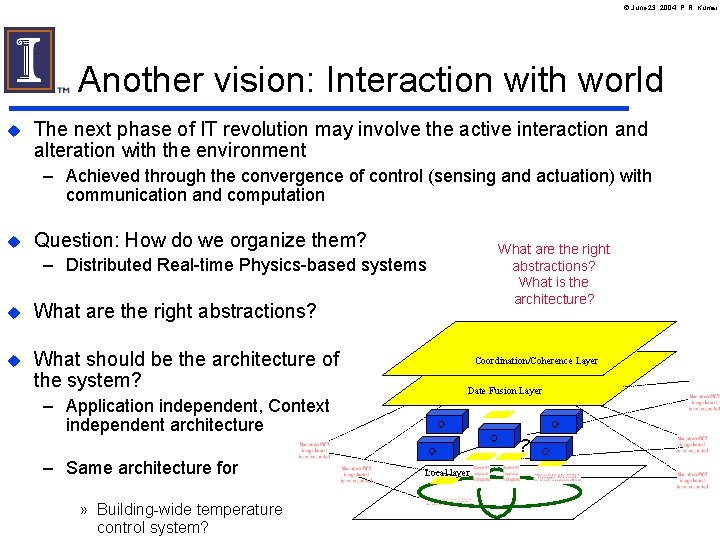
June 23, 2004, P. R. Kumar Another vision: Interaction with world u The next phase of IT revolution may involve the active interaction and alteration with the environment – Achieved through the convergence of control (sensing and actuation) with communication and computation u Question: How do we organize them? What are the right abstractions? What is the architecture? – Distributed Real-time Physics-based systems u What are the right abstractions? u What should be the architecture of the system? – Application independent, Context independent architecture Coordination/Coherence Layer Date Fusion Layer ? ? – Same architecture for » Building-wide temperature control system? Local layer
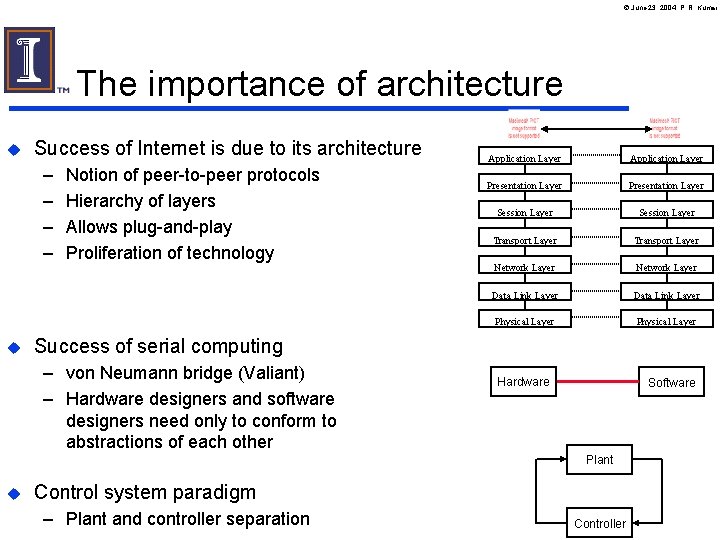
June 23, 2004, P. R. Kumar The importance of architecture u Success of Internet is due to its architecture – – u Notion of peer-to-peer protocols Hierarchy of layers Allows plug-and-play Proliferation of technology Application Layer Presentation Layer Session Layer Transport Layer Network Layer Data Link Layer Physical Layer Success of serial computing – von Neumann bridge (Valiant) – Hardware designers and software designers need only to conform to abstractions of each other Hardware Software Plant u Control system paradigm – Plant and controller separation Controller
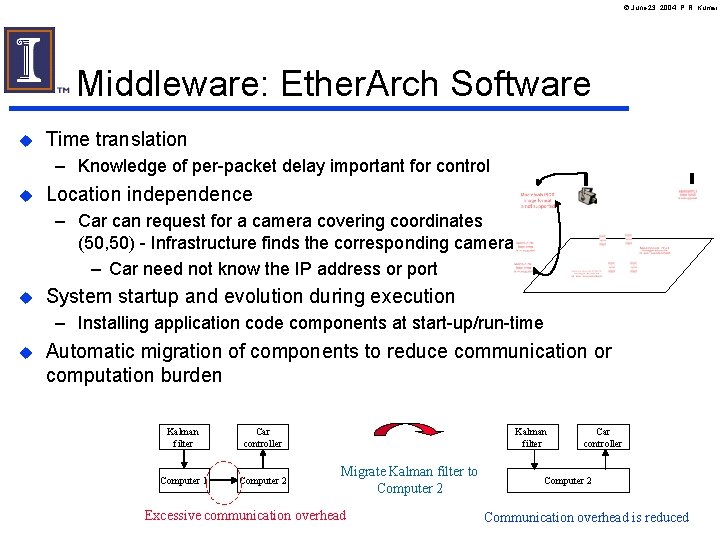
June 23, 2004, P. R. Kumar Middleware: Ether. Arch Software u Time translation – Knowledge of per-packet delay important for control u Location independence – Car can request for a camera covering coordinates (50, 50) - Infrastructure finds the corresponding camera – Car need not know the IP address or port u System startup and evolution during execution – Installing application code components at start-up/run-time u Automatic migration of components to reduce communication or computation burden Kalman filter Car controller Computer 1 Computer 2 Kalman filter Migrate Kalman filter to Computer 2 Excessive communication overhead Car controller Computer 2 Communication overhead is reduced
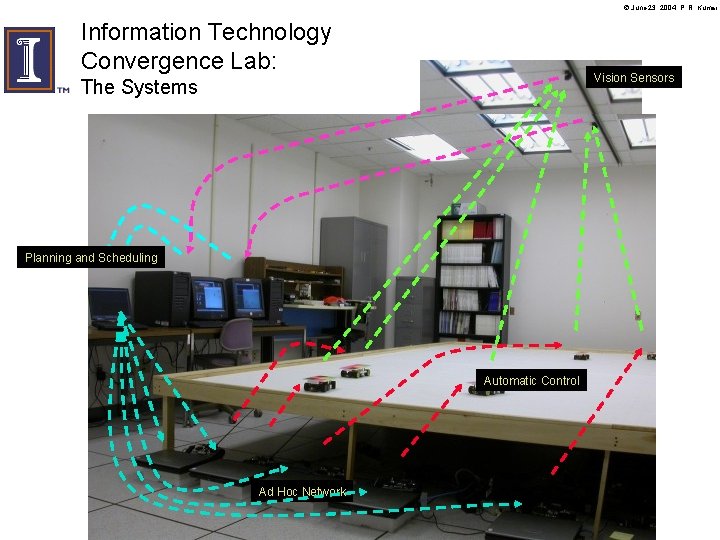
June 23, 2004, P. R. Kumar Information Technology Convergence Lab: Vision Sensors The Systems Planning and Scheduling Automatic Control Ad Hoc Network
June 23, 2004, P. R. Kumar IT Convergence Lab u Movie
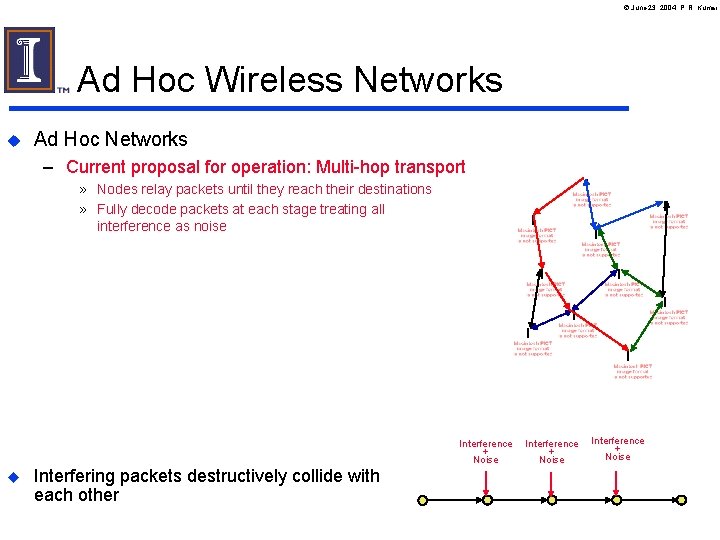
June 23, 2004, P. R. Kumar Ad Hoc Wireless Networks u Ad Hoc Networks – Current proposal for operation: Multi-hop transport » Nodes relay packets until they reach their destinations » Fully decode packets at each stage treating all interference as noise Interference + Noise u Interfering packets destructively collide with each other Interference + Noise
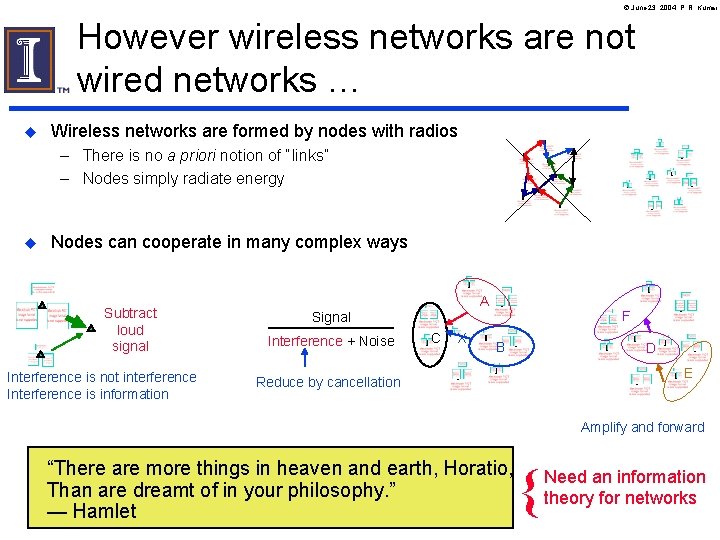
June 23, 2004, P. R. Kumar However wireless networks are not wired networks … u Wireless networks are formed by nodes with radios – There is no a priori notion of “links” – Nodes simply radiate energy u Nodes can cooperate in many complex ways Subtract loud signal Interference is not interference Interference is information A F Signal Interference + Noise C X B D E Reduce by cancellation Amplify and forward “There are more things in heaven and earth, Horatio, Than are dreamt of in your philosophy. ” — Hamlet Need an information theory for networks
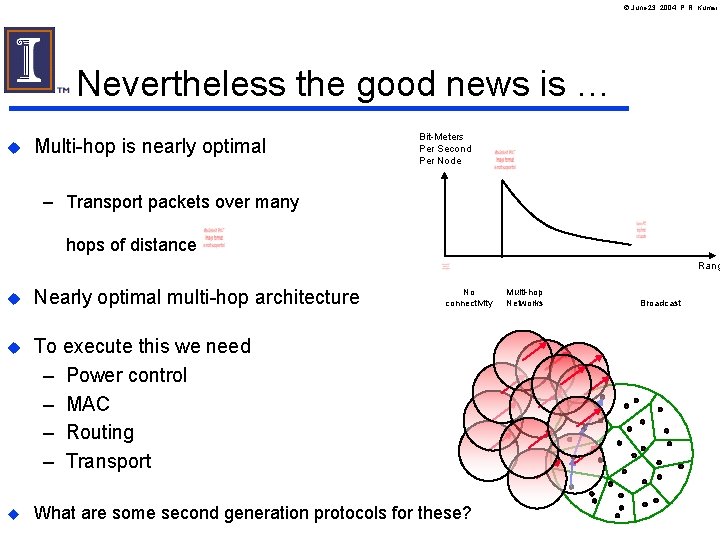
June 23, 2004, P. R. Kumar Nevertheless the good news is … u Multi-hop is nearly optimal Bit-Meters Per Second Per Node – Transport packets over many hops of distance Rang u Nearly optimal multi-hop architecture u To execute this we need – Power control – MAC – Routing – Transport u What are some second generation protocols for these? No connectivity Multi-hop Networks Broadcast
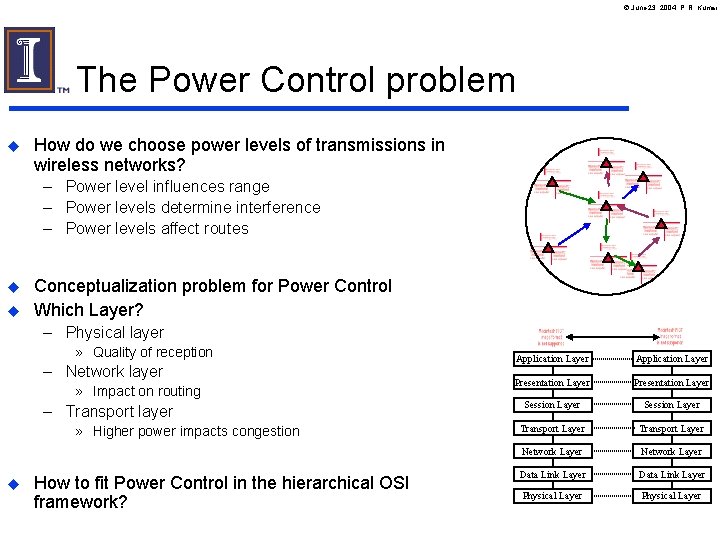
June 23, 2004, P. R. Kumar The Power Control problem u How do we choose power levels of transmissions in wireless networks? – Power level influences range – Power levels determine interference – Power levels affect routes u u Conceptualization problem for Power Control Which Layer? – Physical layer » Quality of reception – Network layer » Impact on routing – Transport layer » Higher power impacts congestion u How to fit Power Control in the hierarchical OSI framework? Application Layer Presentation Layer Session Layer Transport Layer Network Layer Data Link Layer Physical Layer
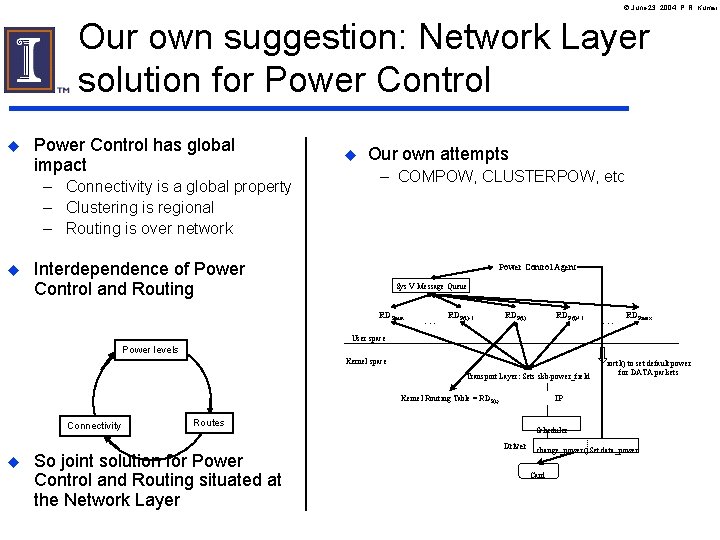
June 23, 2004, P. R. Kumar Our own suggestion: Network Layer solution for Power Control u Power Control has global impact – Connectivity is a global property – Clustering is regional – Routing is over network u u Our own attempts – COMPOW, CLUSTERPOW, etc Interdependence of Power Control and Routing Power Control Agent Sys V Message Queue RDPmin …. RDP(t)-1 RDP(t)+1 …. RDPmax User space Power levels Kernel space Transport Layer: Sets skb-power_field IP Kernel Routing Table = RDP(t) Connectivity Routes Scheduler Driver u So joint solution for Power Control and Routing situated at the Network Layer ioctl() to set default power for DATA packets change_power()Set data_power Card
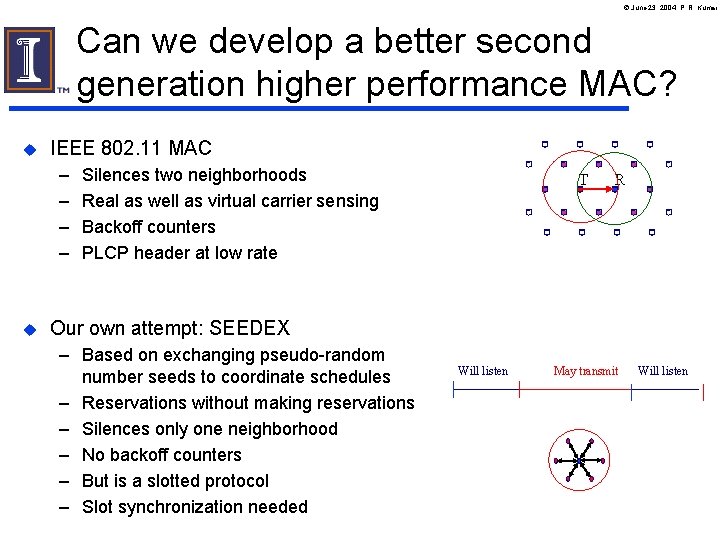
June 23, 2004, P. R. Kumar Can we develop a better second generation higher performance MAC? u IEEE 802. 11 MAC – – u Silences two neighborhoods Real as well as virtual carrier sensing Backoff counters PLCP header at low rate T R Our own attempt: SEEDEX – Based on exchanging pseudo-random number seeds to coordinate schedules – Reservations without making reservations – Silences only one neighborhood – No backoff counters – But is a slotted protocol – Slot synchronization needed Will listen May transmit Will listen
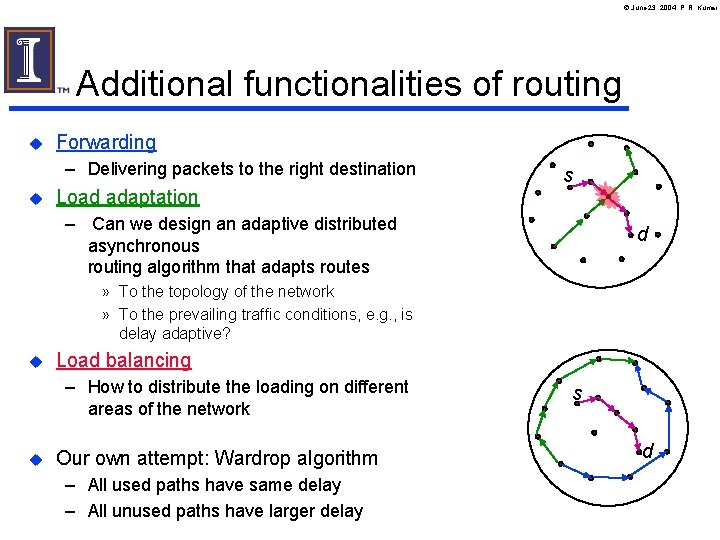
June 23, 2004, P. R. Kumar Additional functionalities of routing u Forwarding – Delivering packets to the right destination u Load adaptation s – Can we design an adaptive distributed asynchronous routing algorithm that adapts routes d » To the topology of the network » To the prevailing traffic conditions, e. g. , is delay adaptive? u Load balancing – How to distribute the loading on different areas of the network u Our own attempt: Wardrop algorithm – All used paths have same delay – All unused paths have larger delay s d
June 23, 2004, P. R. Kumar Last but not least u Hardware – That we can develop on – That gives enough interfaces that we can write software – That we can experiment with u That will spark proliferation – A la IEEE 802. 11
June 23, 2004, P. R. Kumar To obtain papers u Papers can be downloaded from http: //black. csl. uiuc. edu/~prkumar u For hard copies send email to prkumar@uiuc. edu
June 23, 2004, P. R. Kumar Some thoughts on Mesh Networks
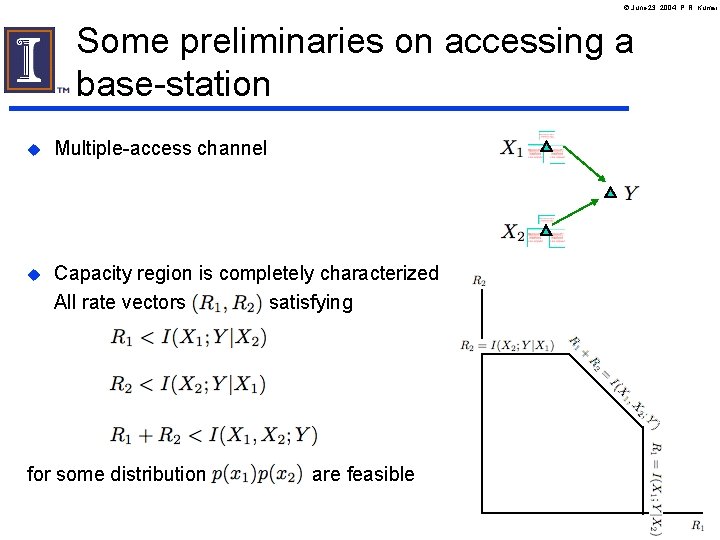
June 23, 2004, P. R. Kumar Some preliminaries on accessing a base-station u Multiple-access channel u Capacity region is completely characterized All rate vectors satisfying for some distribution are feasible
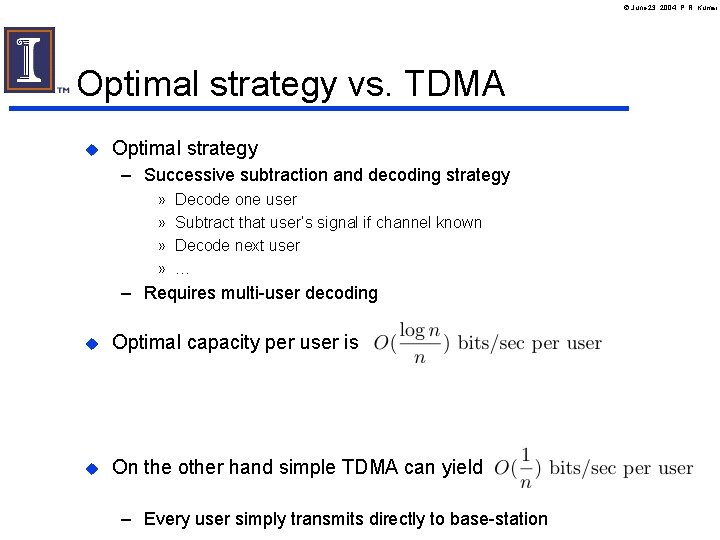
June 23, 2004, P. R. Kumar Optimal strategy vs. TDMA u Optimal strategy – Successive subtraction and decoding strategy » » Decode one user Subtract that user’s signal if channel known Decode next user … – Requires multi-user decoding u Optimal capacity per user is u On the other hand simple TDMA can yield – Every user simply transmits directly to base-station
June 23, 2004, P. R. Kumar So what are the issues in multihopping to a base-station? u Protocol issues – Power control can be used to » Save energy at mobile nodes » Trade-off between energy and delay – Medium access issues may get complicates » If power control gets sophisticated – Routing may be simplified if there is only one sink – Transport level may need design due to need for interfacing multi-hop wireless with wired Internet – Interesting cross-layer design issues » Power control, medium access, routing, transport – Further interesting issues when allowing operation in ad hoc as well as just reaching base-station