Jal Jeevan Mission Department of Drinking Water Sanitation
- Slides: 24
Jal Jeevan Mission Department of Drinking Water & Sanitation Ministry of Jal Shakti, Government of India
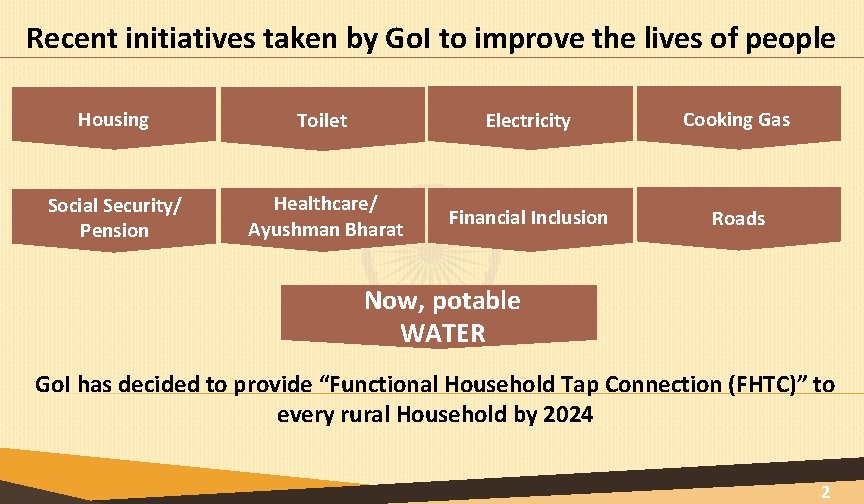
Recent initiatives taken by Go. I to improve the lives of people Housing Social Security/ Pension Toilet Healthcare/ Ayushman Bharat Toilet Electricity Cooking Gas Financial Inclusion Roads Now, potable WATER Go. I has decided to provide “Functional Household Tap Connection (FHTC)” to every rural Household by 2024 2
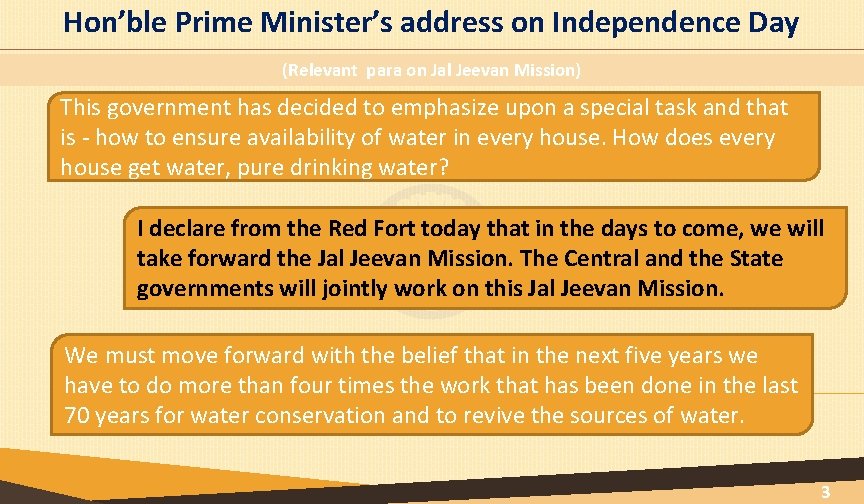
Hon’ble Prime Minister’s address on Independence Day (Relevant para on Jal Jeevan Mission) This government has decided to emphasize upon a special task and that is - how to ensure availability of water in every house. How does every house get water, pure drinking water? I declare from the Red Fort today that in the days to come, we will take forward the Jal Jeevan Mission. The Central and the State governments will jointly work on this Jal Jeevan Mission. We must move forward with the belief that in the next five years we have to do more than four times the work that has been done in the last 70 years for water conservation and to revive the sources of water. 3
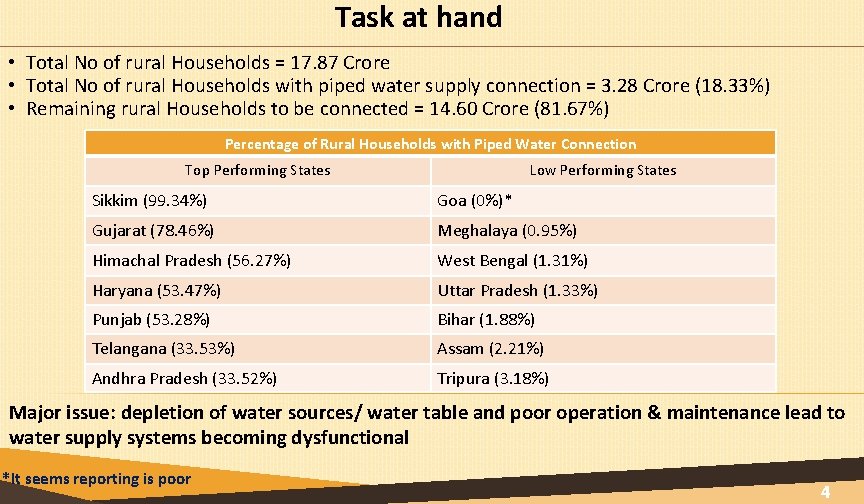
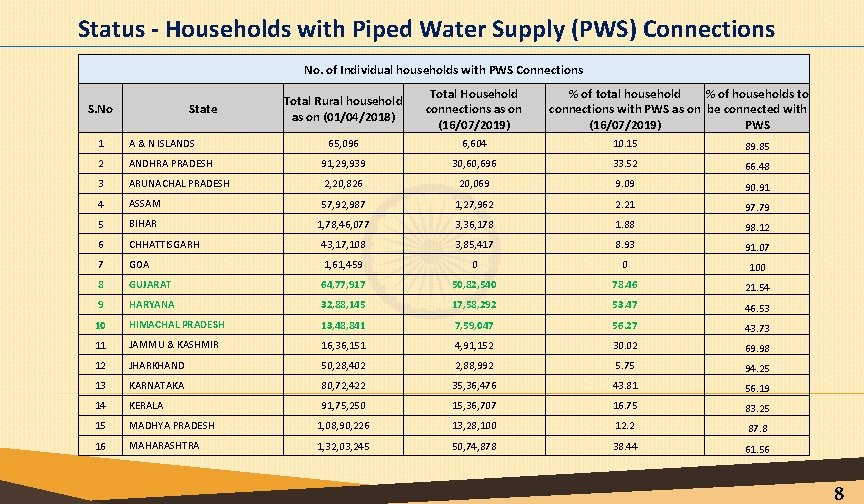
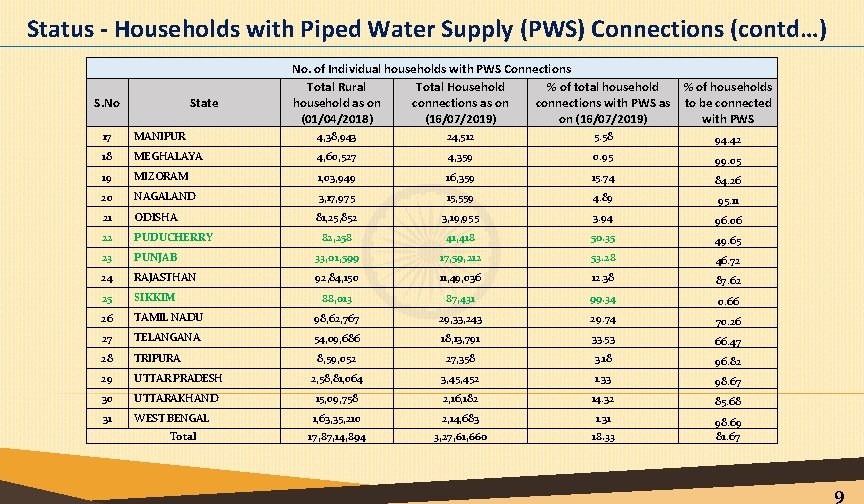
Task at hand • Total No of rural Households = 17. 87 Crore • Total No of rural Households with piped water supply connection = 3. 28 Crore (18. 33%) • Remaining rural Households to be connected = 14. 60 Crore (81. 67%) Percentage of Rural Households with Piped Water Connection Top Performing States Low Performing States Sikkim (99. 34%) Goa (0%)* Gujarat (78. 46%) Meghalaya (0. 95%) Himachal Pradesh (56. 27%) West Bengal (1. 31%) Haryana (53. 47%) Uttar Pradesh (1. 33%) Punjab (53. 28%) Bihar (1. 88%) Telangana (33. 53%) Assam (2. 21%) Andhra Pradesh (33. 52%) Tripura (3. 18%) Major issue: depletion of water sources/ water table and poor operation & maintenance lead to water supply systems becoming dysfunctional *It seems reporting is poor 4
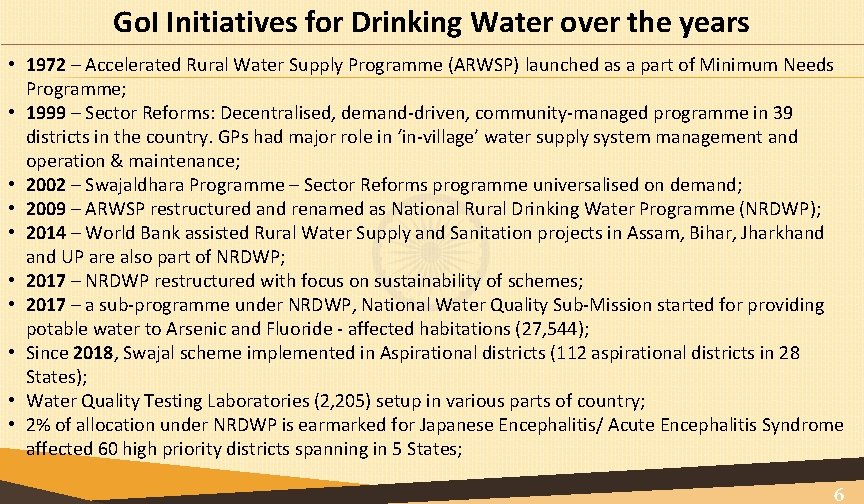
Go. I Initiatives for Drinking Water over the years • 1972 – Accelerated Rural Water Supply Programme (ARWSP) launched as a part of Minimum Needs Programme; • 1999 – Sector Reforms: Decentralised, demand-driven, community-managed programme in 39 districts in the country. GPs had major role in ‘in-village’ water supply system management and operation & maintenance; • 2002 – Swajaldhara Programme – Sector Reforms programme universalised on demand; • 2009 – ARWSP restructured and renamed as National Rural Drinking Water Programme (NRDWP); • 2014 – World Bank assisted Rural Water Supply and Sanitation projects in Assam, Bihar, Jharkhand UP are also part of NRDWP; • 2017 – NRDWP restructured with focus on sustainability of schemes; • 2017 – a sub-programme under NRDWP, National Water Quality Sub-Mission started for providing potable water to Arsenic and Fluoride - affected habitations (27, 544); • Since 2018, Swajal scheme implemented in Aspirational districts (112 aspirational districts in 28 States); • Water Quality Testing Laboratories (2, 205) setup in various parts of country; • 2% of allocation under NRDWP is earmarked for Japanese Encephalitis/ Acute Encephalitis Syndrome affected 60 high priority districts spanning in 5 States; 6
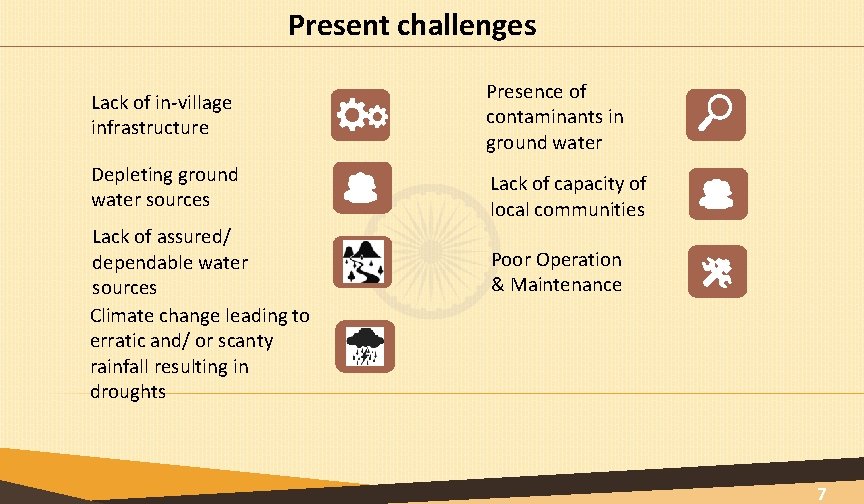
Present challenges Lack of in-village infrastructure Presence of contaminants in ground water Depleting ground water sources Lack of capacity of local communities Lack of assured/ dependable water sources Climate change leading to erratic and/ or scanty rainfall resulting in droughts Poor Operation & Maintenance 7
Status - Households with Piped Water Supply (PWS) Connections No. of Individual households with PWS Connections S. No State Total Rural household as on (01/04/2018) Total Household connections as on (16/07/2019) % of total household % of households to connections with PWS as on be connected with (16/07/2019) PWS 65, 096 6, 604 10. 15 89. 85 1 A & N ISLANDS 2 ANDHRA PRADESH 91, 29, 939 30, 696 33. 52 66. 48 3 ARUNACHAL PRADESH 2, 20, 826 20, 069 9. 09 90. 91 4 ASSAM 57, 92, 987 1, 27, 962 2. 21 97. 79 5 BIHAR 1, 78, 46, 077 3, 36, 178 1. 88 98. 12 6 CHHATTISGARH 43, 17, 108 3, 85, 417 8. 93 91. 07 7 GOA 1, 61, 459 0 0 100 8 GUJARAT 64, 77, 917 50, 82, 540 78. 46 21. 54 9 HARYANA 32, 88, 145 17, 58, 292 53. 47 46. 53 10 HIMACHAL PRADESH 13, 48, 841 7, 59, 047 56. 27 43. 73 11 JAMMU & KASHMIR 16, 36, 151 4, 91, 152 30. 02 69. 98 12 JHARKHAND 50, 28, 402 2, 88, 992 5. 75 94. 25 13 KARNATAKA 80, 72, 422 35, 36, 476 43. 81 56. 19 14 KERALA 91, 75, 250 15, 36, 707 16. 75 83. 25 15 MADHYA PRADESH 1, 08, 90, 226 13, 28, 100 12. 2 87. 8 16 MAHARASHTRA 1, 32, 03, 245 50, 74, 878 38. 44 61. 56 8
Status - Households with Piped Water Supply (PWS) Connections (contd…) S. No State No. of Individual households with PWS Connections Total Rural Total Household % of total household as on connections with PWS as (01/04/2018) (16/07/2019) on (16/07/2019) % of households to be connected with PWS 17 MANIPUR 4, 38, 943 24, 512 5. 58 94. 42 18 MEGHALAYA 4, 60, 527 4, 359 0. 95 99. 05 19 MIZORAM 1, 03, 949 16, 359 15. 74 84. 26 20 NAGALAND 3, 17, 975 15, 559 4. 89 95. 11 21 ODISHA 81, 25, 852 3, 19, 955 3. 94 96. 06 22 PUDUCHERRY 82, 258 41, 418 50. 35 49. 65 23 PUNJAB 33, 01, 599 17, 59, 212 53. 28 46. 72 24 RAJASTHAN 92, 84, 150 11, 49, 036 12. 38 87. 62 25 SIKKIM 88, 013 87, 431 99. 34 0. 66 26 TAMIL NADU 98, 62, 767 29, 33, 243 29. 74 70. 26 27 TELANGANA 54, 09, 686 18, 13, 791 33. 53 66. 47 28 TRIPURA 8, 59, 052 27, 358 3. 18 96. 82 29 UTTAR PRADESH 2, 58, 81, 064 3, 452 1. 33 98. 67 30 UTTARAKHAND 15, 09, 758 2, 16, 182 14. 32 85. 68 31 WEST BENGAL 1, 63, 35, 210 2, 14, 683 1. 31 17, 87, 14, 894 3, 27, 61, 660 18. 33 98. 69 81. 67 Total 9
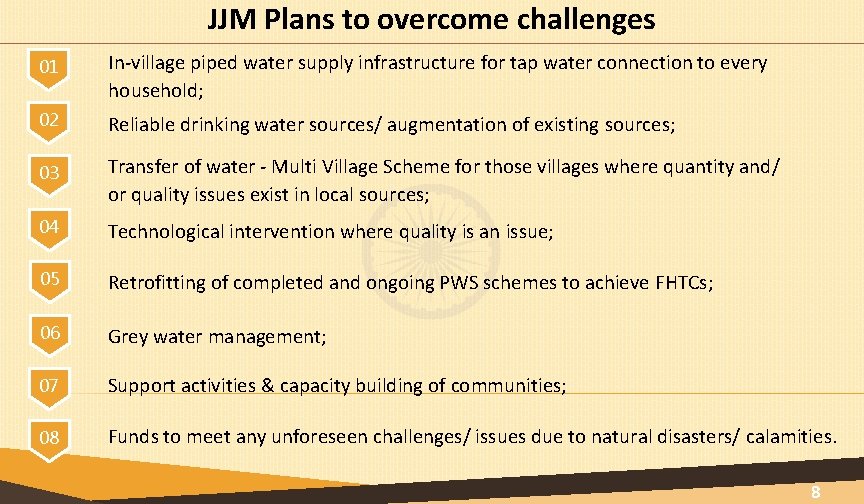
JJM Plans to overcome challenges 01 In-village piped water supply infrastructure for tap water connection to every household; 02 Reliable drinking water sources/ augmentation of existing sources; 03 Transfer of water - Multi Village Scheme for those villages where quantity and/ or quality issues exist in local sources; 04 Technological intervention where quality is an issue; 05 Retrofitting of completed and ongoing PWS schemes to achieve FHTCs; 06 Grey water management; 07 Support activities & capacity building of communities; 08 Funds to meet any unforeseen challenges/ issues due to natural disasters/ calamities. 8
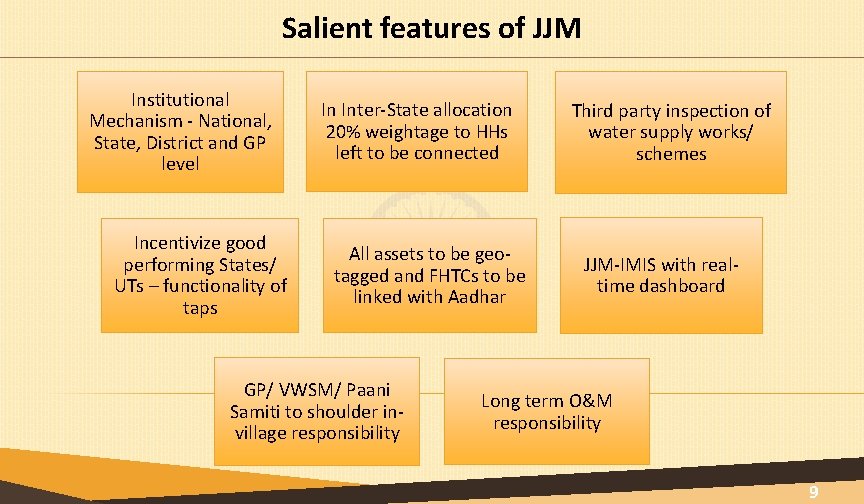
Salient features of JJM Institutional Mechanism - National, State, District and GP level Incentivize good performing States/ UTs – functionality of taps In Inter-State allocation 20% weightage to HHs left to be connected All assets to be geotagged and FHTCs to be linked with Aadhar GP/ VWSM/ Paani Samiti to shoulder invillage responsibility Third party inspection of water supply works/ schemes JJM-IMIS with realtime dashboard Long term O&M responsibility 9
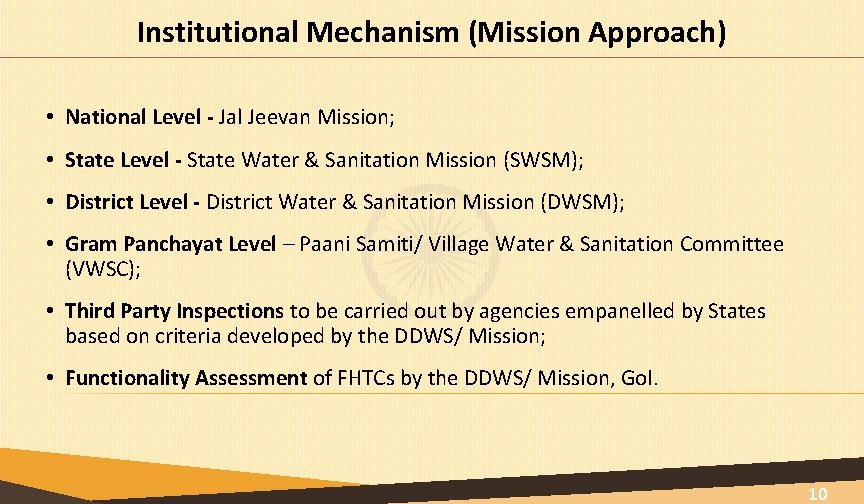
Institutional Mechanism (Mission Approach) • National Level - Jal Jeevan Mission; • State Level - State Water & Sanitation Mission (SWSM); • District Level - District Water & Sanitation Mission (DWSM); • Gram Panchayat Level – Paani Samiti/ Village Water & Sanitation Committee (VWSC); • Third Party Inspections to be carried out by agencies empanelled by States based on criteria developed by the DDWS/ Mission; • Functionality Assessment of FHTCs by the DDWS/ Mission, Go. I. 10
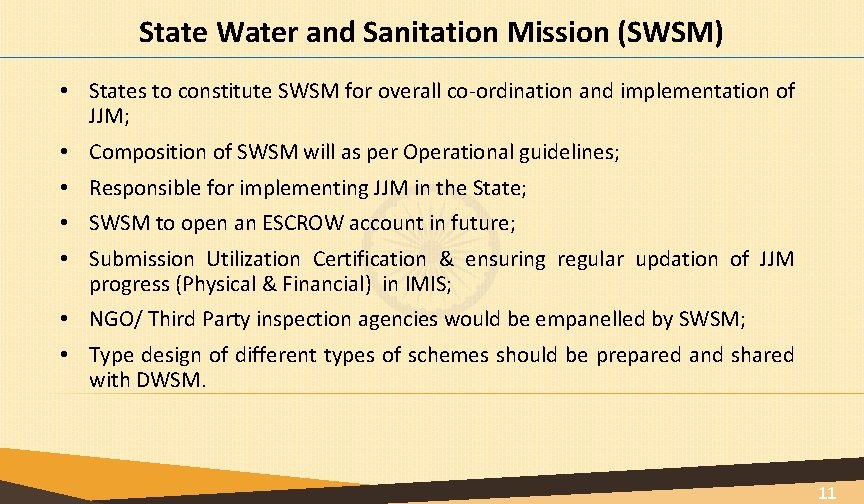
State Water and Sanitation Mission (SWSM) • States to constitute SWSM for overall co-ordination and implementation of JJM; • Composition of SWSM will as per Operational guidelines; • Responsible for implementing JJM in the State; • SWSM to open an ESCROW account in future; • Submission Utilization Certification & ensuring regular updation of JJM progress (Physical & Financial) in IMIS; • NGO/ Third Party inspection agencies would be empanelled by SWSM; • Type design of different types of schemes should be prepared and shared with DWSM. 11
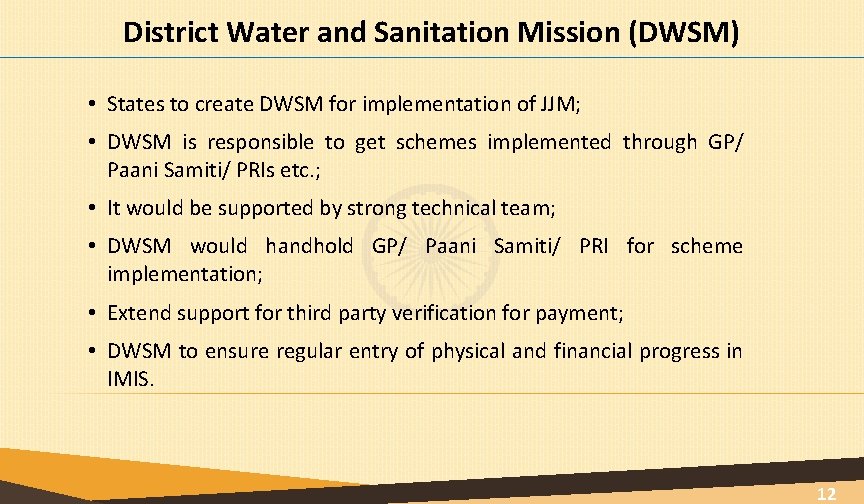
District Water and Sanitation Mission (DWSM) • States to create DWSM for implementation of JJM; • DWSM is responsible to get schemes implemented through GP/ Paani Samiti/ PRIs etc. ; • It would be supported by strong technical team; • DWSM would handhold GP/ Paani Samiti/ PRI for scheme implementation; • Extend support for third party verification for payment; • DWSM to ensure regular entry of physical and financial progress in IMIS. 12
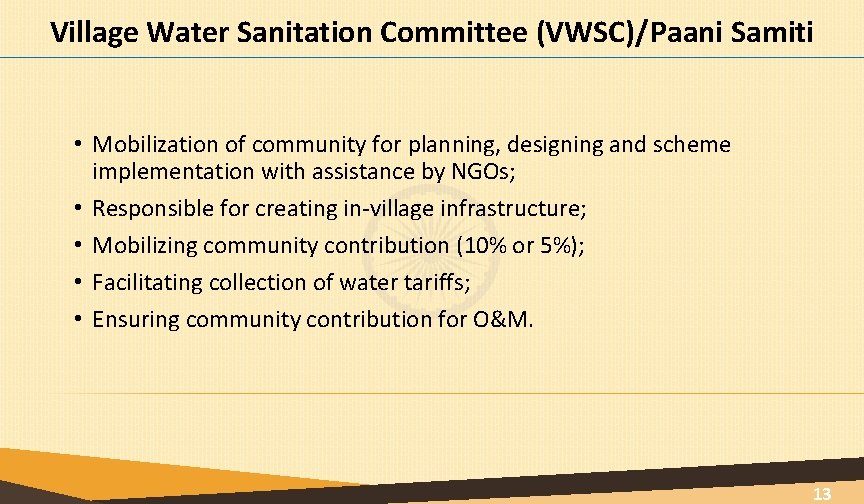
Village Water Sanitation Committee (VWSC)/Paani Samiti • Mobilization of community for planning, designing and scheme implementation with assistance by NGOs; • Responsible for creating in-village infrastructure; • Mobilizing community contribution (10% or 5%); • Facilitating collection of water tariffs; • Ensuring community contribution for O&M. 13
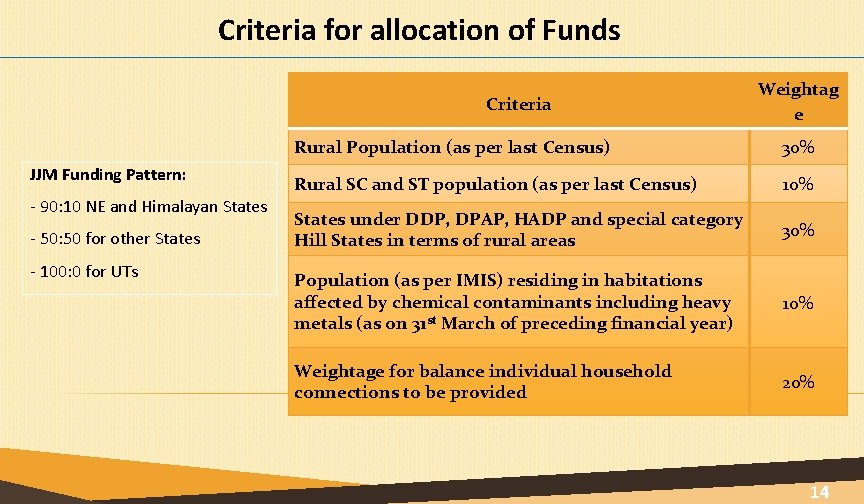
Criteria for allocation of Funds Criteria JJM Funding Pattern: - 90: 10 NE and Himalayan States - 50: 50 for other States - 100: 0 for UTs Weightag e Rural Population (as per last Census) 30% Rural SC and ST population (as per last Census) 10% States under DDP, DPAP, HADP and special category Hill States in terms of rural areas 30% Population (as per IMIS) residing in habitations affected by chemical contaminants including heavy metals (as on 31 st March of preceding financial year) 10% Weightage for balance individual household connections to be provided 20% 14
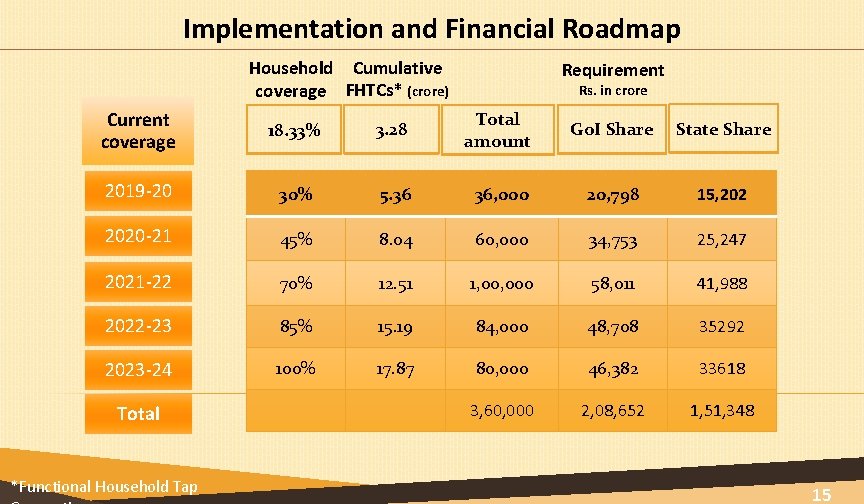
Implementation and Financial Roadmap Household Cumulative coverage FHTCs* (crore) Requirement Rs. in crore Current coverage 18. 33% 3. 28 Total amount Go. I Share State Share 2019 -20 30% 5. 36 36, 000 20, 798 15, 2020 -21 45% 8. 04 60, 000 34, 753 25, 247 2021 -22 70% 12. 51 1, 000 58, 011 41, 988 2022 -23 85% 15. 19 84, 000 48, 708 35292 2023 -24 100% 17. 87 80, 000 46, 382 33618 3, 60, 000 2, 08, 652 1, 51, 348 Total *Functional Household Tap 15
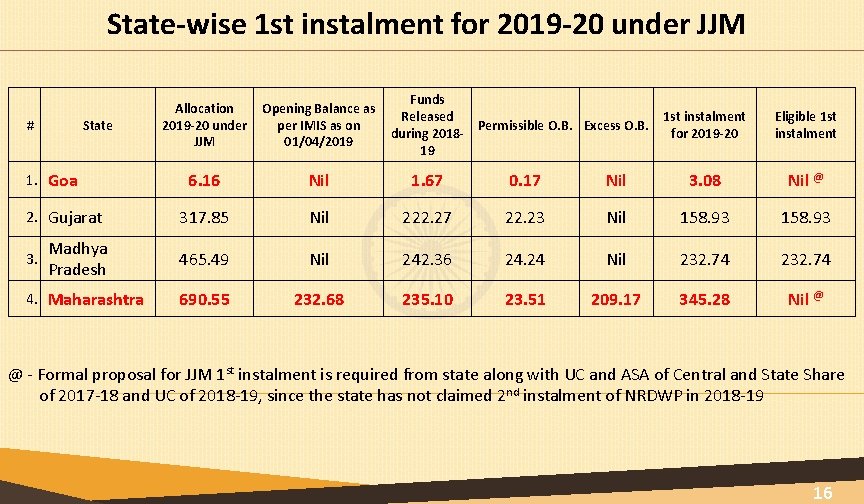
State-wise 1 st instalment for 2019 -20 under JJM # State 1. Goa 2. Gujarat 3. Madhya Pradesh 4. Maharashtra Funds Released Permissible O. B. Excess O. B. during 201819 Allocation 2019 -20 under JJM Opening Balance as per IMIS as on 01/04/2019 6. 16 Nil 1. 67 0. 17 317. 85 Nil 222. 27 465. 49 Nil 690. 55 232. 68 1 st instalment for 2019 -20 Eligible 1 st instalment Nil 3. 08 Nil @ 22. 23 Nil 158. 93 242. 36 24. 24 Nil 232. 74 235. 10 23. 51 209. 17 345. 28 Nil @ @ - Formal proposal for JJM 1 st instalment is required from state along with UC and ASA of Central and State Share of 2017 -18 and UC of 2018 -19, since the state has not claimed 2 nd instalment of NRDWP in 2018 -19 16
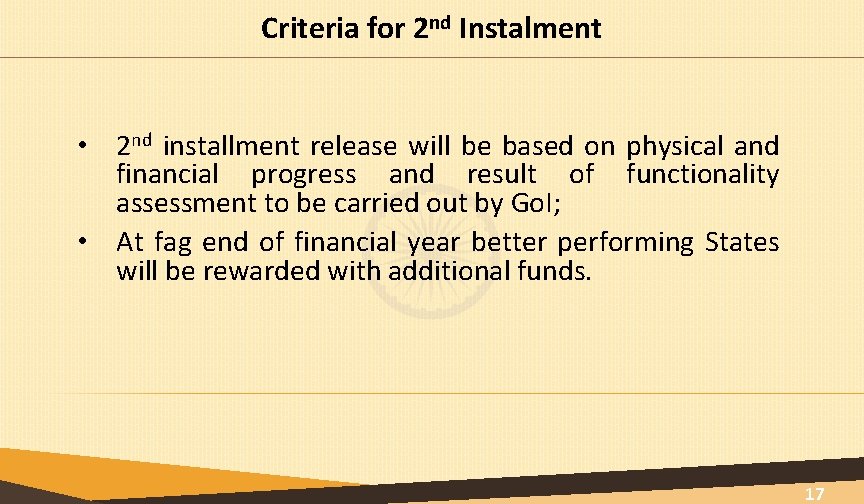
Criteria for 2 nd Instalment • 2 nd installment release will be based on physical and financial progress and result of functionality assessment to be carried out by Go. I; • At fag end of financial year better performing States will be rewarded with additional funds. 17
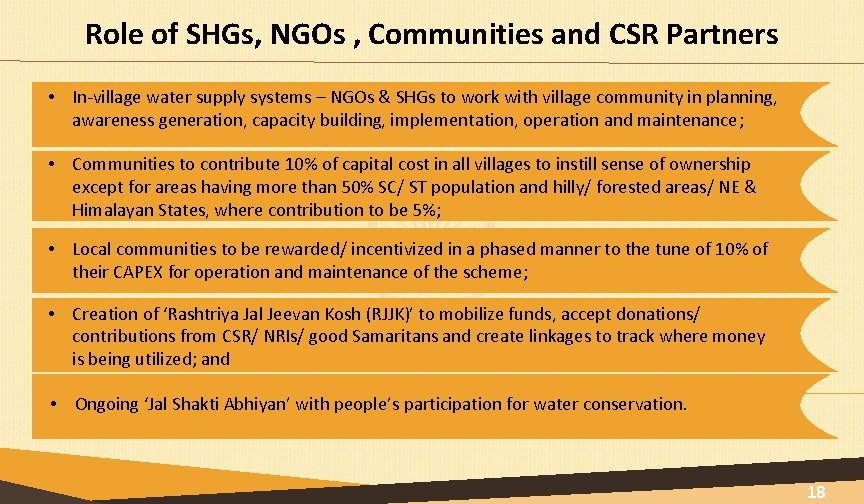
Role of SHGs, NGOs , Communities and CSR Partners • In-village water supply systems – NGOs & SHGs to work with village community in planning, awareness generation, capacity building, implementation, operation and maintenance; • Communities to contribute 10% of capital cost in all villages to instill sense of ownership except for areas having more than 50% SC/ ST population and hilly/ forested areas/ NE & Himalayan States, where contribution to be 5%; • Local communities to be rewarded/ incentivized in a phased manner to the tune of 10% of their CAPEX for operation and maintenance of the scheme; • Creation of ‘Rashtriya Jal Jeevan Kosh (RJJK)’ to mobilize funds, accept donations/ contributions from CSR/ NRIs/ good Samaritans and create linkages to track where money is being utilized; and • Ongoing ‘Jal Shakti Abhiyan’ with people’s participation for water conservation. 18
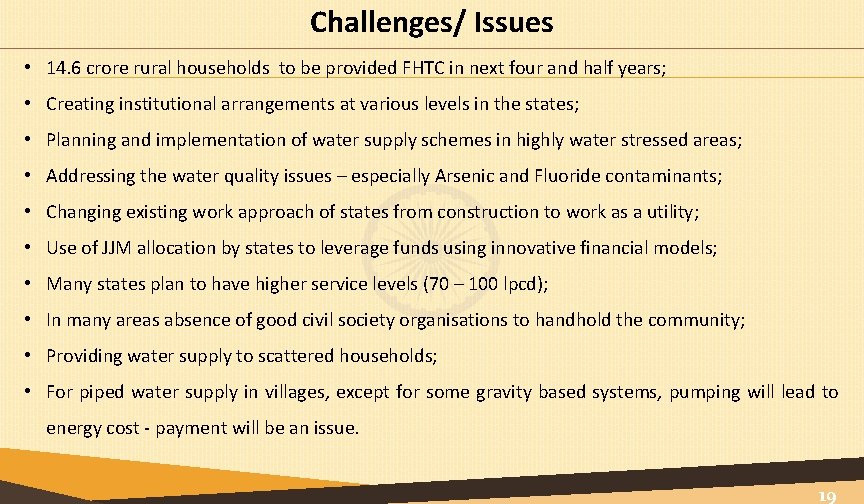
Challenges/ Issues • 14. 6 crore rural households to be provided FHTC in next four and half years; • Creating institutional arrangements at various levels in the states; • Planning and implementation of water supply schemes in highly water stressed areas; • Addressing the water quality issues – especially Arsenic and Fluoride contaminants; • Changing existing work approach of states from construction to work as a utility; • Use of JJM allocation by states to leverage funds using innovative financial models; • Many states plan to have higher service levels (70 – 100 lpcd); • In many areas absence of good civil society organisations to handhold the community; • Providing water supply to scattered households; • For piped water supply in villages, except for some gravity based systems, pumping will lead to energy cost - payment will be an issue. 19
Implementation Strategy • Approx. 50% villages have potable groundwater, where Single Village Scheme could be implemented; • About 30% villages in DDP, DDAP and other areas having water availability is an issue, in addition to rainwater harvesting, transfer of water from long distance is required; • Nearly 3. 3% of total habitations are quality affected, where either water has to be treated insitu or water grid needs to be developed by bringing water from long distance; • In water-stressed and quality affected areas, water-grid is to be developed; • At national level, big trust/ foundation may be associated with the Mission; • States to develop water grids and are encouraged to avail soft loans from external agencies like NABARD, World Bank, ADB, etc. ; • States to allocate water resources for drinking and domestic use; • For water security, states may be encouraged to develop reservoir exclusively for drinking water; • Campaign to conserve water; protect/ preserve water bodies like ponds, lakes, small rivers/ rivulets, etc. and maintain source of potable water. 20
Way Forward • Retrofitting of completed and on-going Piped Water Supply (PWS) schemes and raise service level; • Where water in adequate quantity and of desired quality exists, Single Village Scheme (SVS) will be ideal; • Water-stressed and quality-affected areas to have bulk water transfer/ treatment plant/ distribution network where the villages to have their own distribution network; • In coastal areas/ high salinity areas – technological solution like desalination plant, utilizing excess heat generated by such heat generating industries to be explored; • To reduce power bill of community, solar pumps to be encouraged; • In hot and cold deserts where it might be difficult to have piped water supply, alternative options to be explored. 22
Tasks for States • Constitution of SWSM/ DWSM/ Paani Samiti/ VWSM at earliest, if not done yet; • Funds will be transferred to nodal account along with State share in 15 days. In future ESCROW account will be opened; • PFMS compliance by states; • Identification of ongoing/ completed NRDWP projects for retrofitting to provide FHTC; • Year-wise action plan for the district on the strength of village action plans; • Suitable order may be passed under Panchayati Raj Act of the state, thereby asking all the Gram Panchayats to constitute water committee/ Paani Samiti; • Identification of NGOs/ VOs working in the field of rural drinking water supply for handholding the community; • Empanelment of third party inspection agencies; • A design/template be prepared to provide in-village water supply at service level @ 55 lpcd; • Community participation- Jan Andolan. 23
Social Media: @jaljeevan_ Jal Jeevan Mission, India Thank You for your attention 23