Ioana Andreea Stnescu Felix Hamza Lup Nazime Tuncay
- Slides: 18
Ioana Andreea Stănescu Felix Hamza Lup Nazime Tuncay
The main purpose of this article is to present a series of World Wide Web Consortium (W 3 C) recommendations in conjunction with the mobile standards to bridge the technical requirements of mobile technologies in order to improve the learner experience of the Web on mobile devices
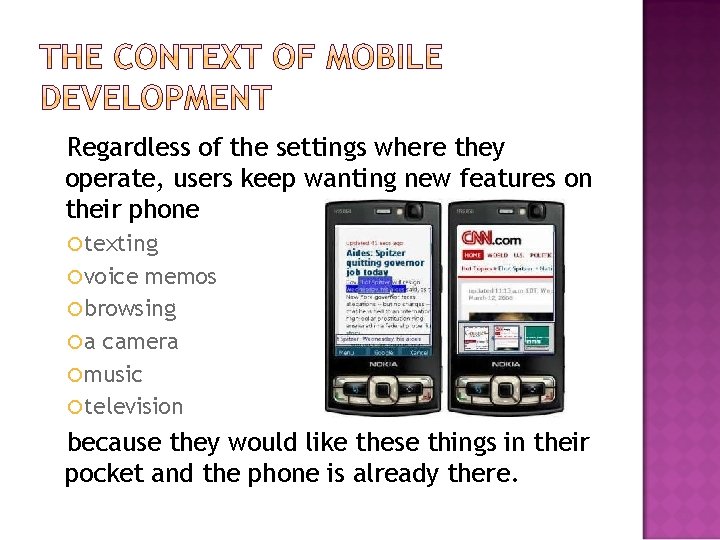
Regardless of the settings where they operate, users keep wanting new features on their phone texting voice memos browsing a camera music television because they would like these things in their pocket and the phone is already there.
recall: access to remote or local stored web pages, graphics, photographs, sounds, videos, formatted text documents, spreadsheets, databases, forms, SCORM learning objects. record: create images; record sounds and videos; create text files, spreadsheets, databases; record learner assessment, scores, or other learning data. relate: post text to web-log for commenting, add comments to blogs, edit collaborative wiki or document on the web; send/ receive SMS/ MMS; initiate/ receive voice calls and VOIP calls; read/ respond to discussion posts; participate in synchronous text chat.
reinterpret: edit graphic images, photographs; use interactive activity of application on local devices; play educational games; edit text-based documents, spreadsheets, databases or forms; create/interpret 2 D barcodes. associated teaching and learning activities: discover resources suitable for mobile delivery from resource collections/repositories.
Desktop web sites would not work well on a mobile device People are not willing to read long documents on tiny screens Most users will not pay for a service that provides text freely available elsewhere
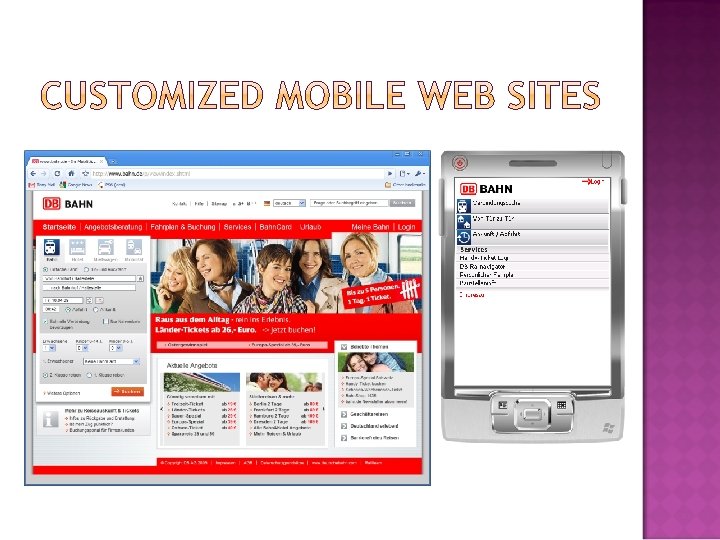
Most mobile applications are miniaturized versions of similar desktop applications They have all the limitations of the desktop applications, all the limitations of the mobile devices, and typically some extra limitations due to the ‘sacrifices’ designers and developers make as they move applications from desktop to mobile devices break the “miniaturized” trend and provide sound customization mobile learning requires more than a “copy” & “paste” operation
Mobile device input is often difficult URIs are very difficult to type Forms are hard to fill in Cellular data networks offer very different network characteristics such as latency, bandwidth, costs and reliability than fixed data networks Mobile devices frequently support only limited types of content Advertising materials do not work well on small devices
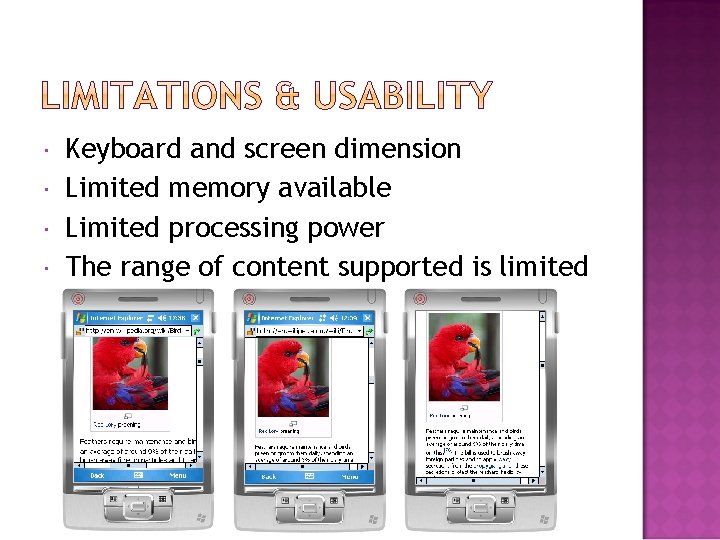
Keyboard and screen dimension Limited memory available Limited processing power The range of content supported is limited
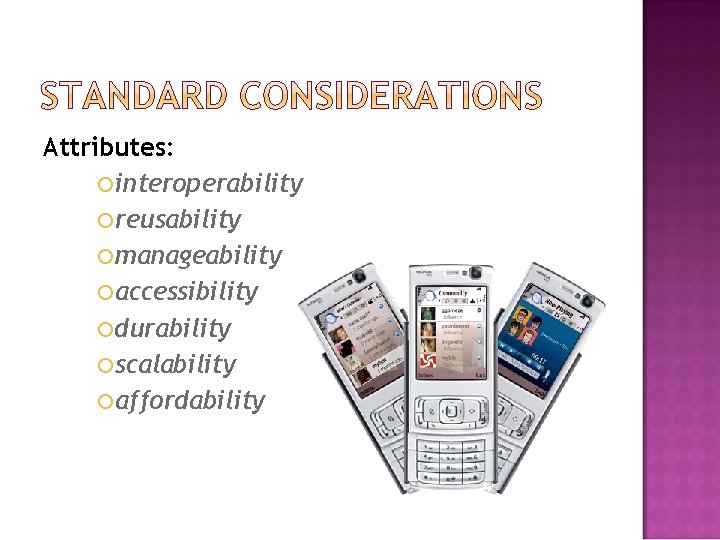
Attributes: interoperability reusability manageability accessibility durability scalability affordability
Ensure resources are compatible with the default delivery contexts and minimise demands on memory, processor and presentation. Exploit the capabilities of specific devices to maximise quality and usability, either through adaptable content or delivery modes or by providing alternative formats for resources optimised for a range of devices. Remember that the speed at which mobile devices can access networked data wirelessly is well below the speeds via a network (e. g. broadband or LAN), with the cost of data rates still very high. Content prepared for wireless delivery needs to be much leaner than content prepared for local networks for example, especially in terms of loading and playback. Some loss in quality is to be expected.
enable frequent users to use shortcuts: this reduces the number of interactions and to increase the pace of interaction. offer informative feedback: a beep when pressing a key or an error message for an invalid input value, help the user continue accessing content. design dialogs to yield closure: users are give the satisfaction of accomplishment and completion. support internal locus of control: users want to be in charge of the system, so it has to be designed such that users initiate actions rather than respond to them.
consistency across multiple platforms and devices for the same application as users, and implicit learners, may need to switch between their desktop machines and different mobile devices frequently. reversal of actions may be more difficult for mobile devices because of lack of available resources and computing power. reduce short-term memory load so very little memorization is required during the performance of tasks, allowing the learner to focus on the content. Developers need to take into account that a mobile learner deals with potentially more distractions than with a desktop computer. Handsfree interaction or even eyes-free interaction can provide valid solutions to assure freedom of movement during interaction.
Content provided by accessing a URI should yield a thematically coherent experience when accessed from different devices Device capabilities should be exploited to provide an enhanced user experience Provide solutions for deficient implementations referring to differences in interpretation between browsers and also deficiencies in implementation caused by non-support of mandatory features.
Tests on actual devices Keep the URIs of site entry points short Provide minimal navigation at the top of the page Provide a balance structure Provide consistent navigation mechanisms Assign access keys to links in navigational menus and frequently accessed functionality Do not cause pop-ups or other windows to appear without informing the user Use clear and simple language
Ensure that the overall size of page is appropriate to the memory of the device Limit scrolling to one direction Avoid large or high resolution images; if used, images should be resized at the server Avoid using tables Do not use frames Provide informative error messages and a means of navigating away from an error message back to useful information Avoid free text entry where possible, and provide pre -selected default values where possible
E-mail: ioana. stanescu@ats. com. ro felix. hamza-lup@armstrong. edu nazime. tuncay@mebnet. net THANK YOU!