
APPROACH TO DIFFICULT PATIENTS Prof Hamza Abdulghani ROAD
APPROACH TO “DIFFICULT PATIENTS” Prof. Hamza Abdulghani
ROAD MAP Who are difficult patients? v Factors; patient's being difficult v Management of individual situation v Conclusion v
LET US REVIEW SOME IMPORTANT POINTS FROM YESTERDAY TWO SESSIONS Only 20% of ill people visit their doctors Rapport; sympathy and empathy Why pt has come? Summary Psychosocial aspects (Bio-psycosocial approach) ICE Negotiation & gift wrapping Some models Communication issues? ?
Who are Difficult pts?
Case-1 Ahmad, 50 -year-old, was seen by another colleague last week. Clinically he was OK. Some lab investigation was requested. He has come today to review these investigation results
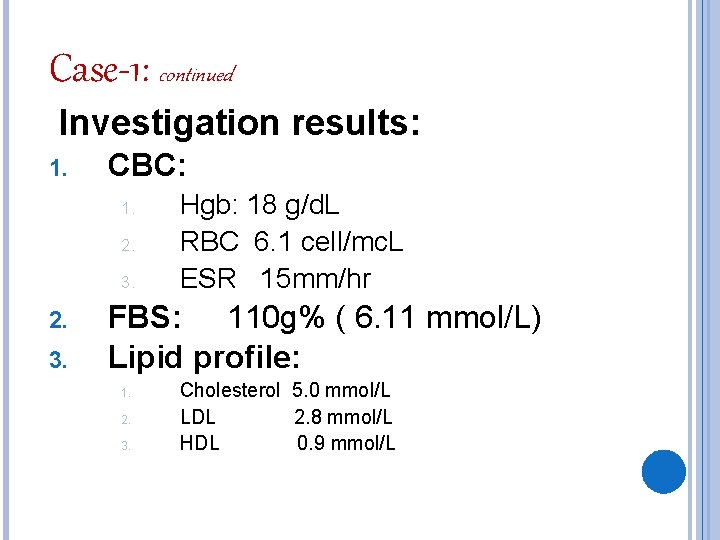
Case-1: continued Investigation results: 1. CBC: 1. 2. 3. Hgb: 18 g/d. L RBC 6. 1 cell/mc. L ESR 15 mm/hr FBS: 110 g% ( 6. 11 mmol/L) Lipid profile: 1. 2. 3. Cholesterol 5. 0 mmol/L LDL 2. 8 mmol/L HDL 0. 9 mmol/L
Introduction: ØBetween 10 and 60% perceived as being “difficult” (Wasan et al, 2005) ØHealthcare provider attitudes also contribute to difficult patient encounters. Ø Healthcare providers with decreased empathy and poor attitudes towards patient psychosocial issues perceived more patient-encounters as difficult. Ø (Jackson and Kroenke ; 1999)
Common terminology v. Difficult patients? v. Challenging patients v Heart-sink patients v Frequent flayers v Dysphoric patients
Heart-sink Patient: “Refers to the doctor’s emotions which are triggered by certain patients” O Dowd 1988
Dysphoria The feelings felt in the pit of your stomach when their (the patients) names are seen on the morning appointment list. CG Ellis 1984
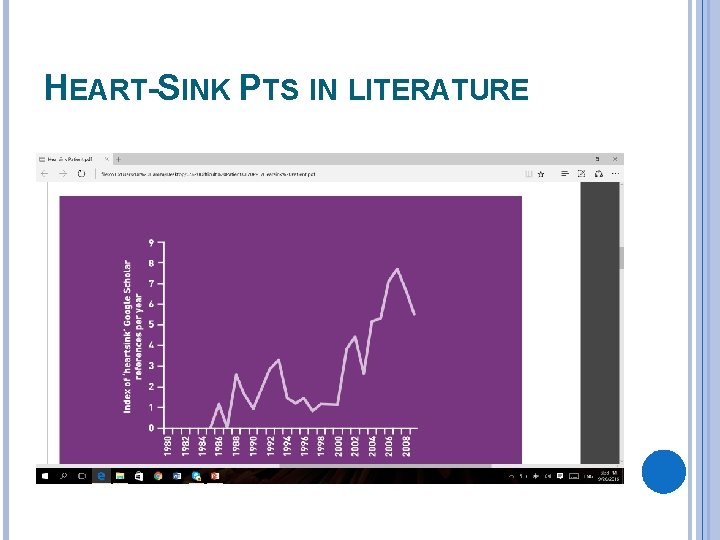
HEART-SINK PTS IN LITERATURE
Where are the problem? Doctor OR Patient
Heart-sink patients Represent acknowledgment and frank expression of unconscious and unresolved feelings between doctor-patient relationship. Heart-sink Relation-ship
Types Common in General/Family Med practice v Demanding v Withdrawn or uncommunicative v Anxious patients. v Angry or aggressive patients. v Expert patients.
TYPES (CONTN…): Patients who don’t get well. Non-compliant patients. Overly demanding patients. Overly talkative and non-relevant talk
Drug seekers. Borderline or narcissistic personality disorder. Multiple Angry medical problems (“too much time”). patients
CASE-2 Ali, age 44, employed at a bank, has chronic headache that he has complained off and on about for several years. He has no other past medical history. Physical examination strongly suggests that he suffers from tension-type headaches. he demands magnetic resonance imaging (MRI) of the brain. You responded that the diagnosis is clear and no need of MRI.
CASE-2 CONTINUED Mr. Ali responded “I think there’s something wrong in there, ” he has stated repeatedly. “I have visited another private clinic and a very senior doctor, more experienced than you, has to do an MRI for me, why can’t you? ” He added: “I think he knows better than you. After all these, it is not from your pocket money”
CASE-3 Mr. Omar is a 37 -year-old man who has lost his lots of Money and his buetiful house in Share market. Mr. Omar appears to have lost his sense of well-being. He has developed chronic—and debilitating— musculoskeletal pain in his neck and low back and has been unable to work since then. He was sent out from his job. At his last 2 visits, Mr. Omar requested increasing doses of oxycodone, insisting that nothing else alleviates the pain. When you suggested a nonopioid analgesic like NSAID, he broke down in tears. “Nobody takes my pain seriously. I have lost my job. Now you don’t even believe I’m in pain.
CASE-4 Ayesha is a 45 -year-old socially isolated widow who lost her husband two years ago. She has three kids. She is suffering from multiple somatic symptoms, including fatigue, abdominal pain, back pain, joint pain, and dizziness. As a result, she has undergone numerous diagnostic procedures, including colonoscopy, and various blood tests, all of which have been negative. Ayesha consistently requires longer than the usual 20 -minute visit. When you try to end an appointment, she typically brings up new issues. “Two days ago, I had this pain in my belly and left shoulder. I think that there must be something wrong with me. Can you examine me? ”
REFLECTION ON THE CASES Ø What are the difficulty with these cases Ø Frustrating Ø Not clinically complex cases Ø Patients dissatisfaction Ø These are difficult patients or Difficult Dr-Pt relationship
“Difficult” is in the eye of health care providers. Often have psychiatric diagnosis. Easier to cope if understand they are distressed and not just a source of upset. Learn clinical detachment; treat as symptom.
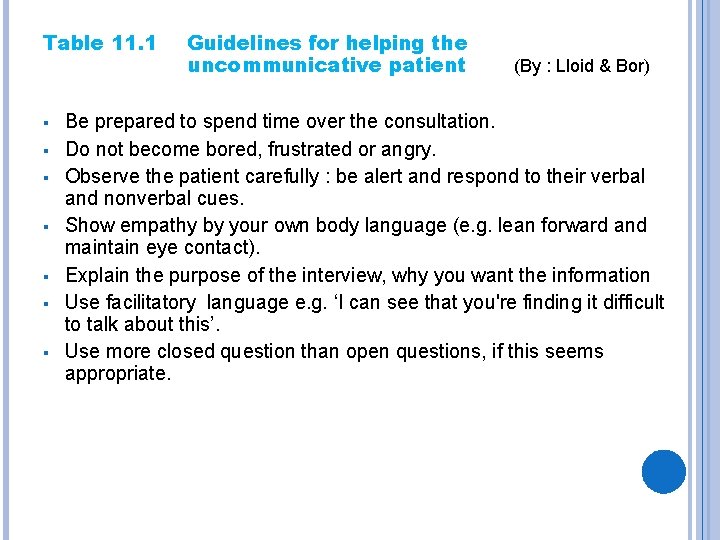
Table 11. 1 § § § § Guidelines for helping the uncommunicative patient (By : Lloid & Bor) Be prepared to spend time over the consultation. Do not become bored, frustrated or angry. Observe the patient carefully : be alert and respond to their verbal and nonverbal cues. Show empathy by your own body language (e. g. lean forward and maintain eye contact). Explain the purpose of the interview, why you want the information Use facilitatory language e. g. ‘I can see that you're finding it difficult to talk about this’. Use more closed question than open questions, if this seems appropriate.
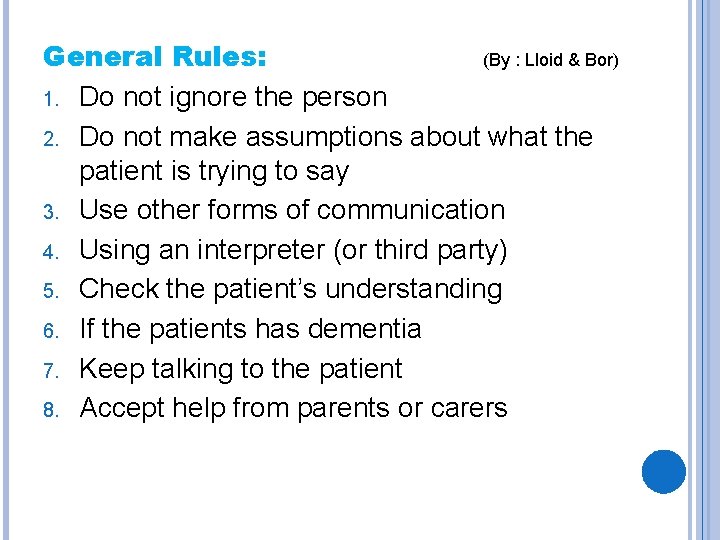
General Rules: (By : Lloid & Bor) 1. Do not ignore the person 2. Do not make assumptions about what the patient is trying to say 3. Use other forms of communication 4. Using an interpreter (or third party) 5. Check the patient’s understanding 6. If the patients has dementia 7. Keep talking to the patient 8. Accept help from parents or carers
Uncommunicative Patients Ø How we start or appear with such patients? Ø Previous experiment Ø Context Ø Patient may be shy, sad, depressed or in pain. Ø Female patients. q Identify the cause and etc.
Depressed Patient Stressed § Really depressed § Expression of emotion §
Anxious Patient v. May vor be normal Morbid anxiety
Angry Patient v. Some factors v. Internal or external
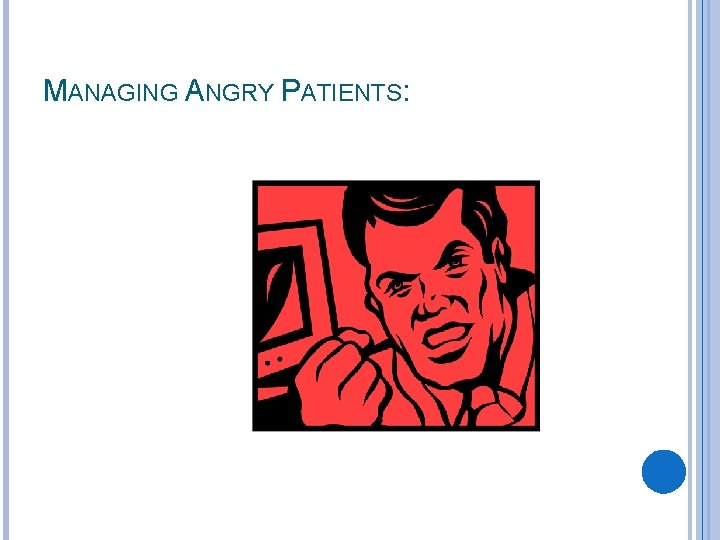
MANAGING ANGRY PATIENTS:
HELPFUL TECHNIQUES FOR ANGRY PTS Always address anger; don’t ignore it. Take a “one down” position and apologize for real transgressions or for not meeting patient’s expectations. Correct mistakes when possible. Avoid escalating anger. Ask patient to speak more slowly since you are having trouble following him.
MORE TECHNIQUES: Assess danger (prior history of violence, escalating behavior, clenching fists, etc. ); Get help. Arrange for both of you to be able to “escape” room if necessary.
Management of Patients GENERAL RULES
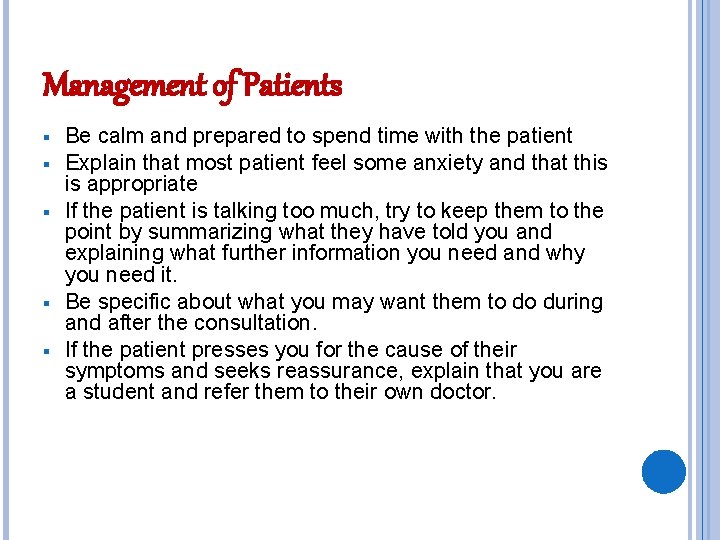
Management of Patients § § § Be calm and prepared to spend time with the patient Explain that most patient feel some anxiety and that this is appropriate If the patient is talking too much, try to keep them to the point by summarizing what they have told you and explaining what further information you need and why you need it. Be specific about what you may want them to do during and after the consultation. If the patient presses you for the cause of their symptoms and seeks reassurance, explain that you are a student and refer them to their own doctor.
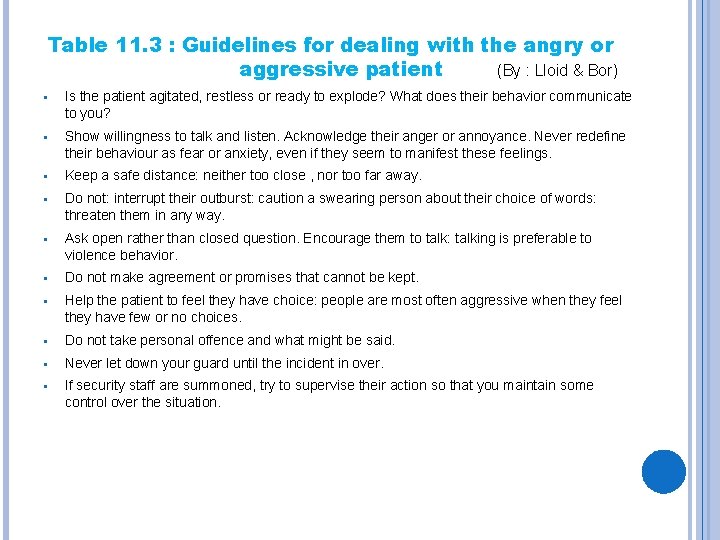
Table 11. 3 : Guidelines for dealing with the angry or aggressive patient (By : Lloid & Bor) § Is the patient agitated, restless or ready to explode? What does their behavior communicate to you? § Show willingness to talk and listen. Acknowledge their anger or annoyance. Never redefine their behaviour as fear or anxiety, even if they seem to manifest these feelings. § Keep a safe distance: neither too close , nor too far away. § Do not: interrupt their outburst: caution a swearing person about their choice of words: threaten them in any way. § Ask open rather than closed question. Encourage them to talk: talking is preferable to violence behavior. § Do not make agreement or promises that cannot be kept. § Help the patient to feel they have choice: people are most often aggressive when they feel they have few or no choices. § Do not take personal offence and what might be said. § Never let down your guard until the incident in over. § If security staff are summoned, try to supervise their action so that you maintain some control over the situation.
Thanks Questions?
- Slides: 36