INVENTORY MANAGEMENT ECONOMIC ORDER QUANTITY JIT AND THEORY

- Slides: 38
INVENTORY MANAGEMENT: ECONOMIC ORDER QUANTITY, JIT, AND THEORY OF CONSTRAINTS CHAPTER 20 © 2014 Cengage Learning. All Rights Reserved. May not be copied, scanned, or duplicated, in whole or in part, except for use as permitted in a license distributed with a certain product or service or otherwise on a password-protected website for classroom use.
CHAPTER 20 OBJECTIVES 1. Describe the just-in-case inventory management model 2. Discuss just-in-time (JIT) inventory management 3. Explain the basic concepts of constrained optimization 4. Define theory of constraints, and tell how it can be used to manage inventory © 2014 Cengage Learning. All Rights Reserved. May not be copied, scanned, or duplicated, in whole or in part, except for use as permitted in a license distributed with a certain product or service or otherwise on a password-protected website for classroom use.
JUST-IN-CASE INVENTORY MANAGEMENT • Just-in-case inventory management: a traditional inventory model based on anticipated demand • Three types of inventory costs can be readily identifies with inventory • The cost of acquiring inventory • The cost of holding inventory • The cost of not having inventory on hand when needed LO-1 © 2014 Cengage Learning. All Rights Reserved. May not be copied, scanned, or duplicated, in whole or in part, except for use as permitted in a license distributed with a certain product or service or otherwise on a password-protected website for classroom use.
JUST-IN-CASE INVENTORY MANAGEMENT • Ordering costs: costs of placing and receiving an order • Examples: costs of processing an order (clerical costs and documents), insurance for shipment, and unloading costs LO-1 © 2014 Cengage Learning. All Rights Reserved. May not be copied, scanned, or duplicated, in whole or in part, except for use as permitted in a license distributed with a certain product or service or otherwise on a password-protected website for classroom use.
JUST-IN-CASE INVENTORY MANAGEMENT • Setup costs: costs of preparing equipment and facilities so they can be used to produce a particular product or component • Examples: wages of idled production workers, the cost of idled production facilities (lost income), and the costs of test runs (labor, materials, and overhead) LO-1 © 2014 Cengage Learning. All Rights Reserved. May not be copied, scanned, or duplicated, in whole or in part, except for use as permitted in a license distributed with a certain product or service or otherwise on a password-protected website for classroom use.
JUST-IN-CASE INVENTORY MANAGEMENT • Carrying costs: costs of holding inventory • Examples: insurance, inventory taxes, obsolescence, opportunity cost of capital tied up in inventory, handling costs, and storage LO-1 © 2014 Cengage Learning. All Rights Reserved. May not be copied, scanned, or duplicated, in whole or in part, except for use as permitted in a license distributed with a certain product or service or otherwise on a password-protected website for classroom use.
JUST-IN-CASE INVENTORY MANAGEMENT • Stock-out costs: costs of not having a product available when demanded by a customer • Examples: lost sales (both current and future), the costs of expediting (increased transportation charges, overtime, and so on), and the costs of interrupted production LO-1 © 2014 Cengage Learning. All Rights Reserved. May not be copied, scanned, or duplicated, in whole or in part, except for use as permitted in a license distributed with a certain product or service or otherwise on a password-protected website for classroom use.
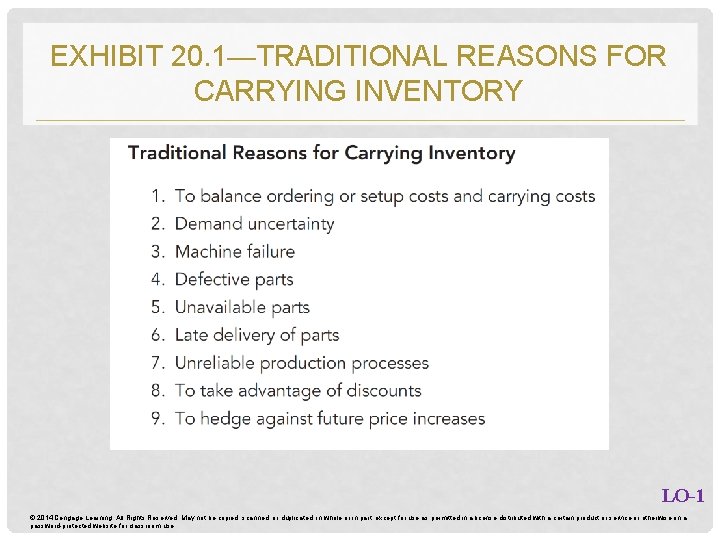
EXHIBIT 20. 1—TRADITIONAL REASONS FOR CARRYING INVENTORY LO-1 © 2014 Cengage Learning. All Rights Reserved. May not be copied, scanned, or duplicated, in whole or in part, except for use as permitted in a license distributed with a certain product or service or otherwise on a password-protected website for classroom use.
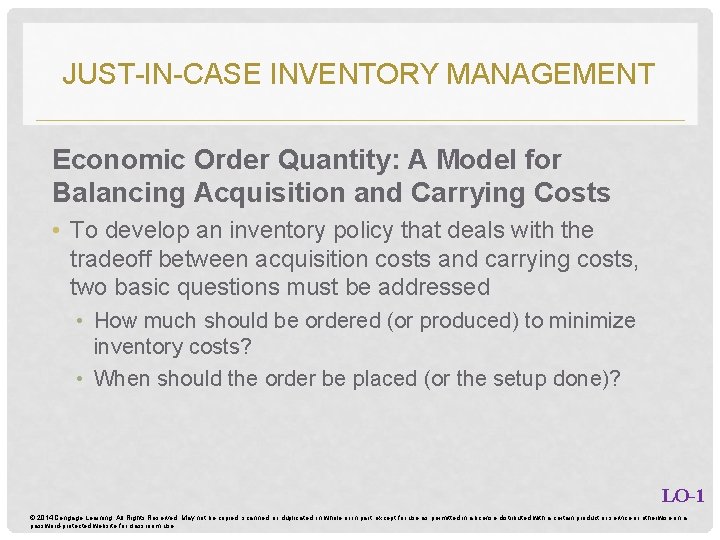
JUST-IN-CASE INVENTORY MANAGEMENT Economic Order Quantity: A Model for Balancing Acquisition and Carrying Costs • To develop an inventory policy that deals with the tradeoff between acquisition costs and carrying costs, two basic questions must be addressed • How much should be ordered (or produced) to minimize inventory costs? • When should the order be placed (or the setup done)? LO-1 © 2014 Cengage Learning. All Rights Reserved. May not be copied, scanned, or duplicated, in whole or in part, except for use as permitted in a license distributed with a certain product or service or otherwise on a password-protected website for classroom use.
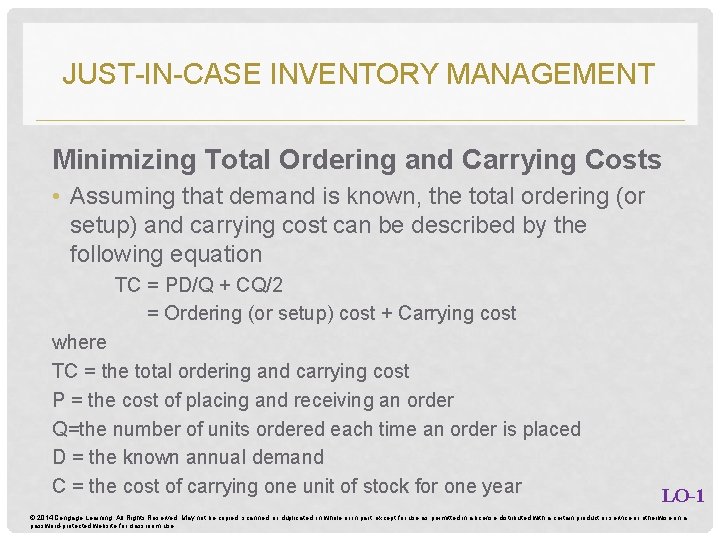
JUST-IN-CASE INVENTORY MANAGEMENT Minimizing Total Ordering and Carrying Costs • Assuming that demand is known, the total ordering (or setup) and carrying cost can be described by the following equation TC = PD/Q + CQ/2 = Ordering (or setup) cost + Carrying cost where TC = the total ordering and carrying cost P = the cost of placing and receiving an order Q=the number of units ordered each time an order is placed D = the known annual demand C = the cost of carrying one unit of stock for one year LO-1 © 2014 Cengage Learning. All Rights Reserved. May not be copied, scanned, or duplicated, in whole or in part, except for use as permitted in a license distributed with a certain product or service or otherwise on a password-protected website for classroom use.
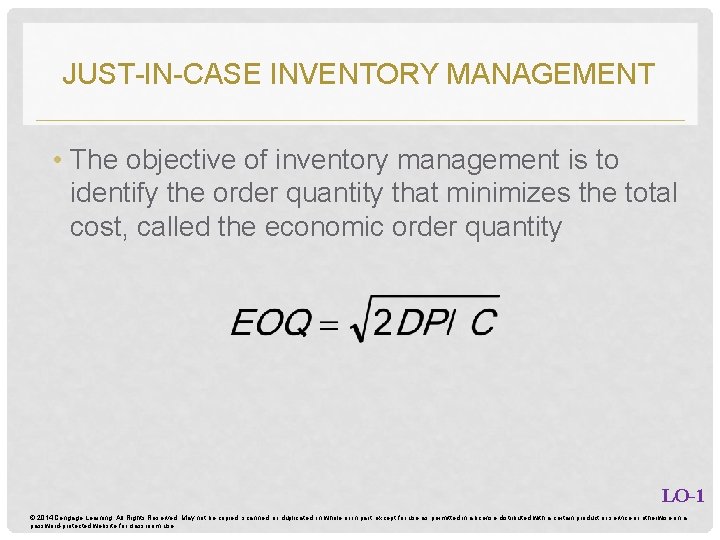
JUST-IN-CASE INVENTORY MANAGEMENT • The objective of inventory management is to identify the order quantity that minimizes the total cost, called the economic order quantity LO-1 © 2014 Cengage Learning. All Rights Reserved. May not be copied, scanned, or duplicated, in whole or in part, except for use as permitted in a license distributed with a certain product or service or otherwise on a password-protected website for classroom use.
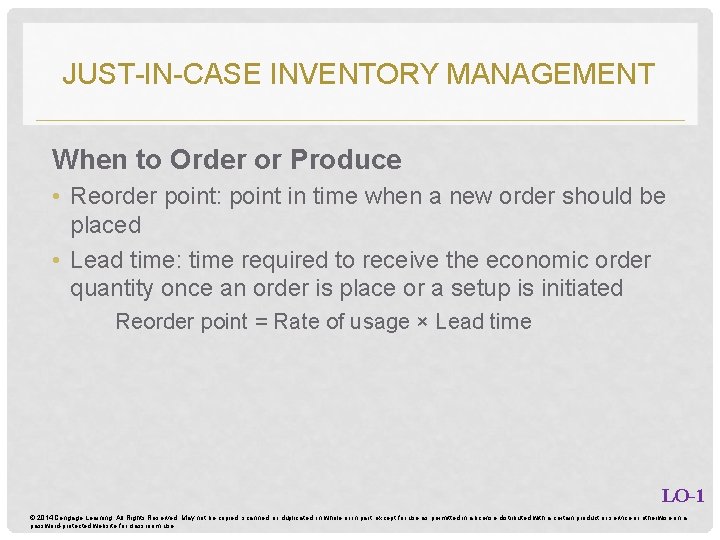
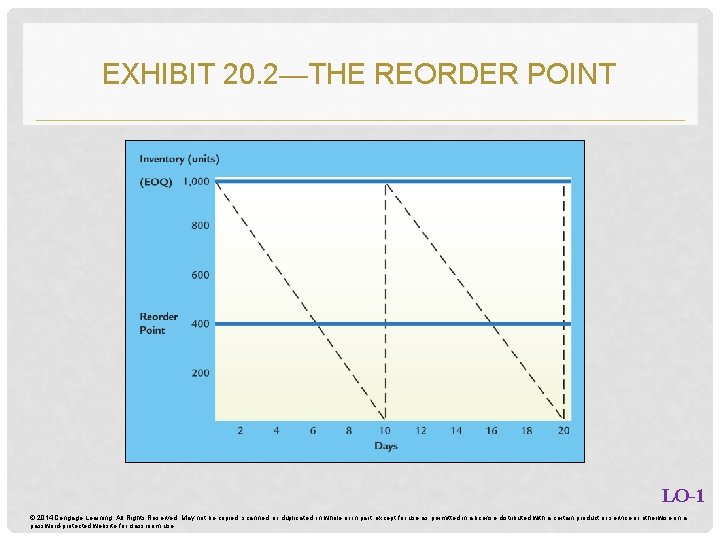
JUST-IN-CASE INVENTORY MANAGEMENT When to Order or Produce • Reorder point: point in time when a new order should be placed • Lead time: time required to receive the economic order quantity once an order is place or a setup is initiated Reorder point = Rate of usage × Lead time LO-1 © 2014 Cengage Learning. All Rights Reserved. May not be copied, scanned, or duplicated, in whole or in part, except for use as permitted in a license distributed with a certain product or service or otherwise on a password-protected website for classroom use.
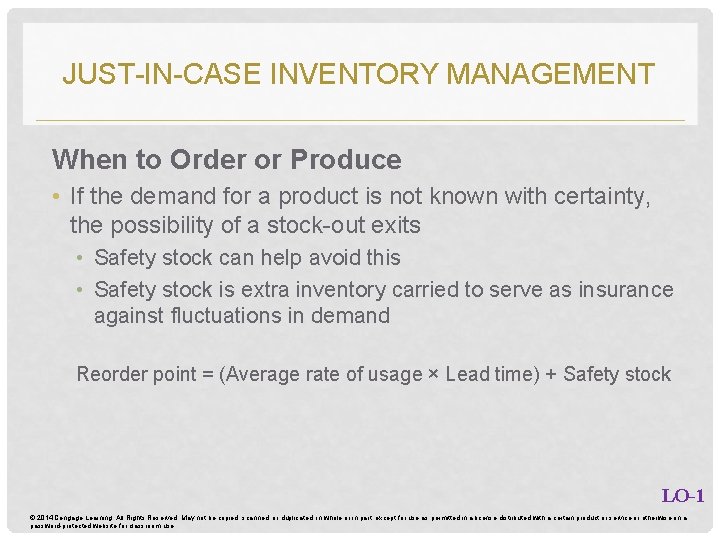
JUST-IN-CASE INVENTORY MANAGEMENT When to Order or Produce • If the demand for a product is not known with certainty, the possibility of a stock-out exits • Safety stock can help avoid this • Safety stock is extra inventory carried to serve as insurance against fluctuations in demand Reorder point = (Average rate of usage × Lead time) + Safety stock LO-1 © 2014 Cengage Learning. All Rights Reserved. May not be copied, scanned, or duplicated, in whole or in part, except for use as permitted in a license distributed with a certain product or service or otherwise on a password-protected website for classroom use.
EXHIBIT 20. 2—THE REORDER POINT LO-1 © 2014 Cengage Learning. All Rights Reserved. May not be copied, scanned, or duplicated, in whole or in part, except for use as permitted in a license distributed with a certain product or service or otherwise on a password-protected website for classroom use.
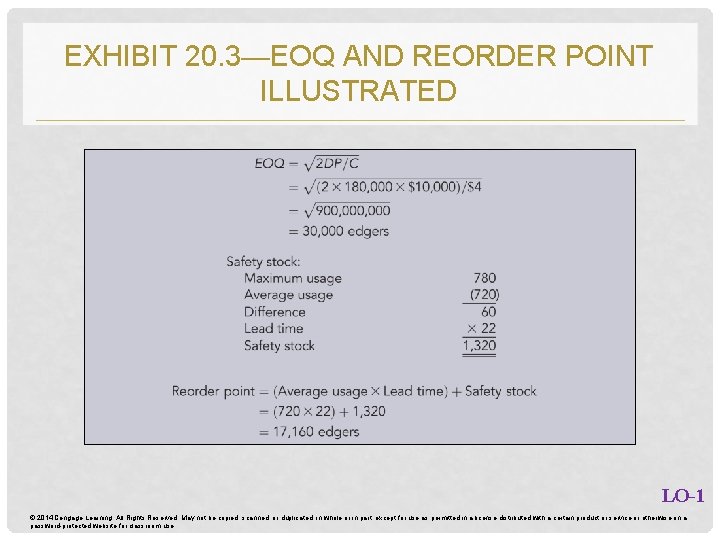
EXHIBIT 20. 3—EOQ AND REORDER POINT ILLUSTRATED LO-1 © 2014 Cengage Learning. All Rights Reserved. May not be copied, scanned, or duplicated, in whole or in part, except for use as permitted in a license distributed with a certain product or service or otherwise on a password-protected website for classroom use.
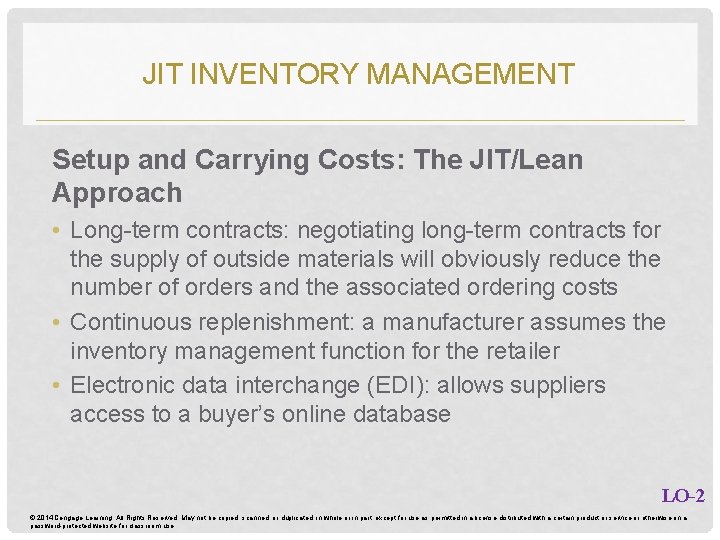
JIT INVENTORY MANAGEMENT Setup and Carrying Costs: The JIT/Lean Approach • Long-term contracts: negotiating long-term contracts for the supply of outside materials will obviously reduce the number of orders and the associated ordering costs • Continuous replenishment: a manufacturer assumes the inventory management function for the retailer • Electronic data interchange (EDI): allows suppliers access to a buyer’s online database LO-2 © 2014 Cengage Learning. All Rights Reserved. May not be copied, scanned, or duplicated, in whole or in part, except for use as permitted in a license distributed with a certain product or service or otherwise on a password-protected website for classroom use.
JIT INVENTORY MANAGEMENT Due-Date Performance: The JIT (Lean) Solution • Measure of a firm’s ability to respond to customer needs • Lead times are reduced so that the company can meet requested delivery dates and to respond quickly to the demands of the market • Lead times are reduced by reducing setup times, improving quality, and using cellular manufacturing LO-2 © 2014 Cengage Learning. All Rights Reserved. May not be copied, scanned, or duplicated, in whole or in part, except for use as permitted in a license distributed with a certain product or service or otherwise on a password-protected website for classroom use.
JIT INVENTORY MANAGEMENT Avoidance of Shutdown and Process Reliability: The JIT/Lean Approach • Total preventive maintenance: zero machine failures • Total quality control: the problem of defective parts is solved by striving for zero defects • The Kanban system: ensure that parts or materials are available when needed LO-2 © 2014 Cengage Learning. All Rights Reserved. May not be copied, scanned, or duplicated, in whole or in part, except for use as permitted in a license distributed with a certain product or service or otherwise on a password-protected website for classroom use.
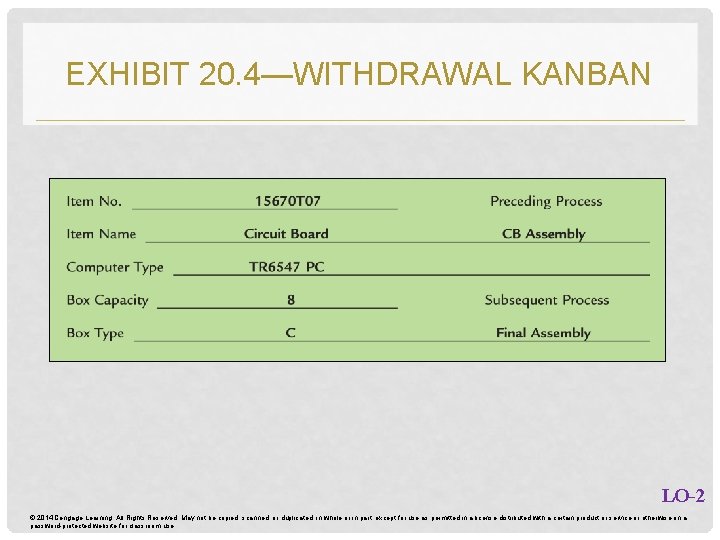
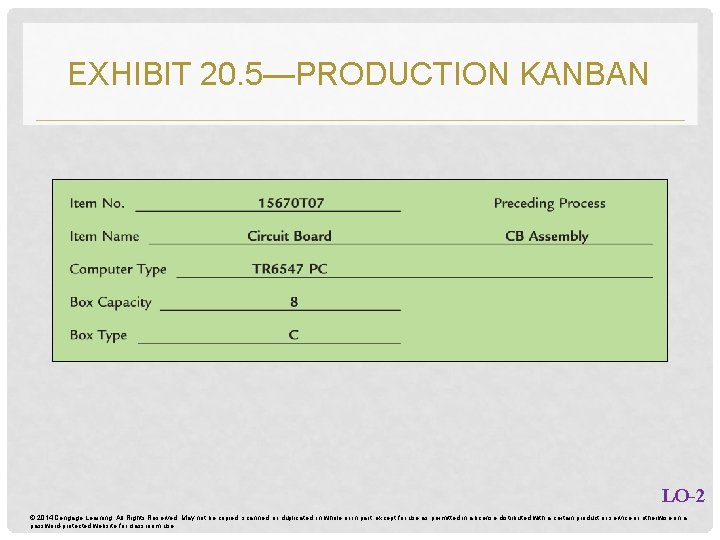
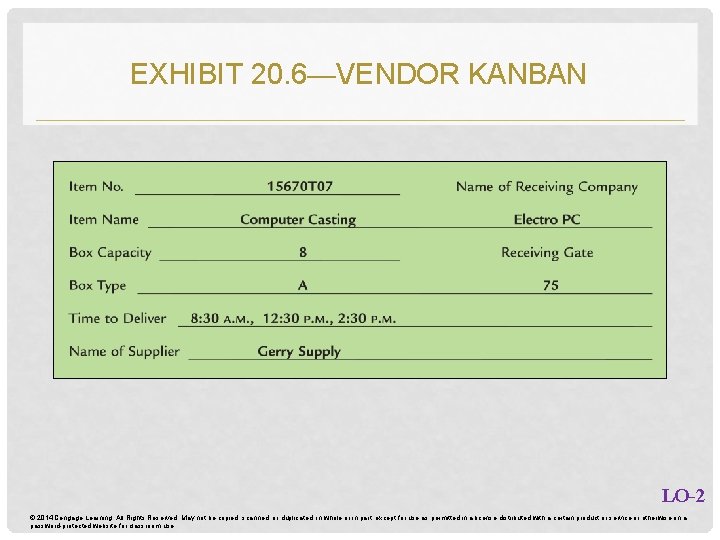
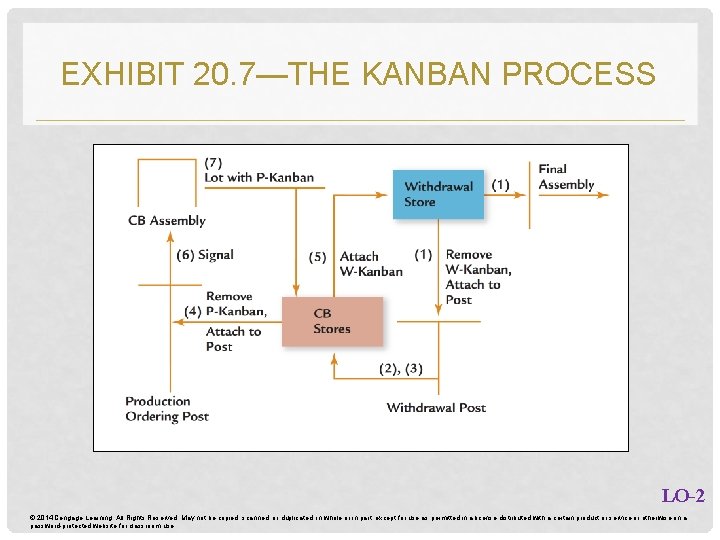
JIT INVENTORY MANAGEMENT The Kanban System • Withdrawal Kanban specifies the quantity that a subsequent process should withdraw from the preceding process • A production Kanban specifies the quantity that the preceding process should produce • A vendor Kanban is used to notify suppliers to deliver more parts; it also specifies when the parts are needed LO-2 © 2014 Cengage Learning. All Rights Reserved. May not be copied, scanned, or duplicated, in whole or in part, except for use as permitted in a license distributed with a certain product or service or otherwise on a password-protected website for classroom use.
EXHIBIT 20. 4—WITHDRAWAL KANBAN LO-2 © 2014 Cengage Learning. All Rights Reserved. May not be copied, scanned, or duplicated, in whole or in part, except for use as permitted in a license distributed with a certain product or service or otherwise on a password-protected website for classroom use.
EXHIBIT 20. 5—PRODUCTION KANBAN LO-2 © 2014 Cengage Learning. All Rights Reserved. May not be copied, scanned, or duplicated, in whole or in part, except for use as permitted in a license distributed with a certain product or service or otherwise on a password-protected website for classroom use.
EXHIBIT 20. 6—VENDOR KANBAN LO-2 © 2014 Cengage Learning. All Rights Reserved. May not be copied, scanned, or duplicated, in whole or in part, except for use as permitted in a license distributed with a certain product or service or otherwise on a password-protected website for classroom use.
EXHIBIT 20. 7—THE KANBAN PROCESS LO-2 © 2014 Cengage Learning. All Rights Reserved. May not be copied, scanned, or duplicated, in whole or in part, except for use as permitted in a license distributed with a certain product or service or otherwise on a password-protected website for classroom use.
JIT INVENTORY MANAGEMENT Discounts and Price Increases: JIT Purchasing Versus Holding Inventories • Negotiate long-term contracts with a few chosen suppliers located close to the production facility and establish more extensive supplier involvement • Stipulate prices and acceptable quality levels • Reduce dramatically the number of orders placed, which helps to drive down the ordering cost LO-2 © 2014 Cengage Learning. All Rights Reserved. May not be copied, scanned, or duplicated, in whole or in part, except for use as permitted in a license distributed with a certain product or service or otherwise on a password-protected website for classroom use.
JIT INVENTORY MANAGEMENT JIT’s Limitations • • Patience in implications is needed Time is required JIT may cause lost sales and stressed workers Production may be interrupted due to an absence of inventory LO-2 © 2014 Cengage Learning. All Rights Reserved. May not be copied, scanned, or duplicated, in whole or in part, except for use as permitted in a license distributed with a certain product or service or otherwise on a password-protected website for classroom use.
BASIC CONCEPTS OF CONSTRAINED OPTIMIZATION • Every firm faces limited resources and limited demand for each product • External constraints: limiting factors imposed on the firm from external sources, such as market demand • Internal constraints: limiting factors found within the firm, such as machine or labor time availability LO-3 © 2014 Cengage Learning. All Rights Reserved. May not be copied, scanned, or duplicated, in whole or in part, except for use as permitted in a license distributed with a certain product or service or otherwise on a password-protected website for classroom use.
BASIC CONCEPTS OF CONSTRAINED OPTIMIZATION • Loose constraints: constraints whose limited resources are not fully used by a product mix are • Binding constraint: a product mix that uses all of the limited resources of a constraint • Constrained optimization is choosing the optimal mix given the constraints faced by the firm LO-3 © 2014 Cengage Learning. All Rights Reserved. May not be copied, scanned, or duplicated, in whole or in part, except for use as permitted in a license distributed with a certain product or service or otherwise on a password-protected website for classroom use.
BASIC CONCEPTS OF CONSTRAINED OPTIMIZATION One Binding Internal Constraint • The function to be optimized (maximized in the case of contribution margin) is called the objective function LO-3 © 2014 Cengage Learning. All Rights Reserved. May not be copied, scanned, or duplicated, in whole or in part, except for use as permitted in a license distributed with a certain product or service or otherwise on a password-protected website for classroom use.
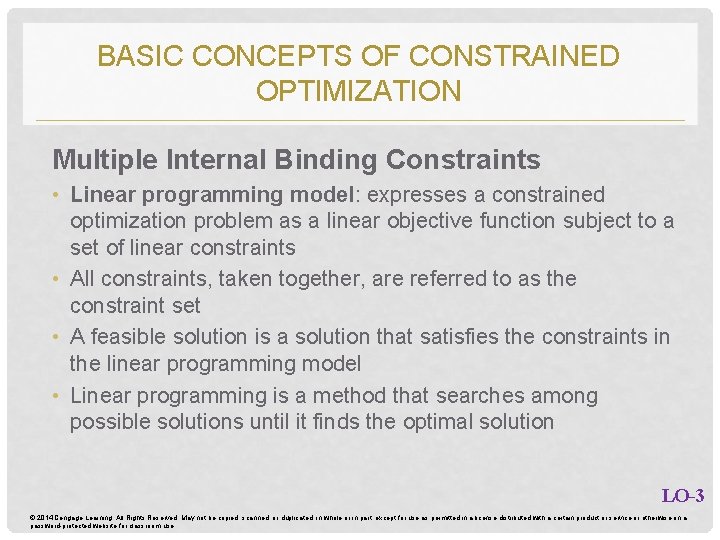
BASIC CONCEPTS OF CONSTRAINED OPTIMIZATION Multiple Internal Binding Constraints • Linear programming model: expresses a constrained optimization problem as a linear objective function subject to a set of linear constraints • All constraints, taken together, are referred to as the constraint set • A feasible solution is a solution that satisfies the constraints in the linear programming model • Linear programming is a method that searches among possible solutions until it finds the optimal solution LO-3 © 2014 Cengage Learning. All Rights Reserved. May not be copied, scanned, or duplicated, in whole or in part, except for use as permitted in a license distributed with a certain product or service or otherwise on a password-protected website for classroom use.
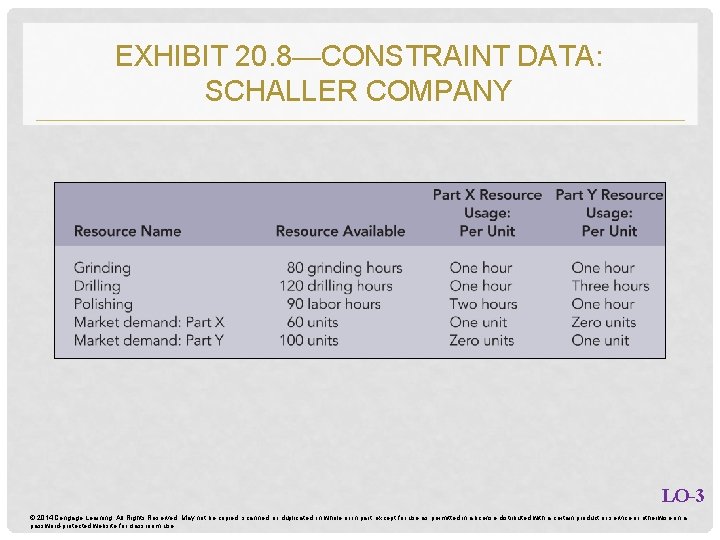
EXHIBIT 20. 8—CONSTRAINT DATA: SCHALLER COMPANY LO-3 © 2014 Cengage Learning. All Rights Reserved. May not be copied, scanned, or duplicated, in whole or in part, except for use as permitted in a license distributed with a certain product or service or otherwise on a password-protected website for classroom use.
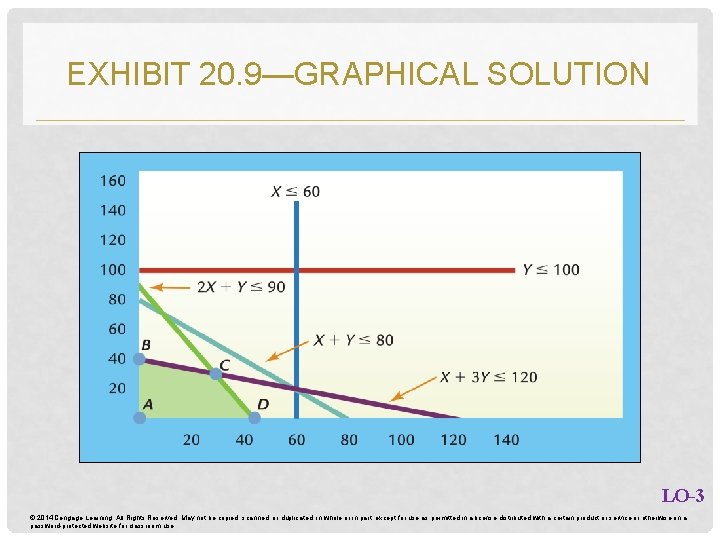
EXHIBIT 20. 9—GRAPHICAL SOLUTION LO-3 © 2014 Cengage Learning. All Rights Reserved. May not be copied, scanned, or duplicated, in whole or in part, except for use as permitted in a license distributed with a certain product or service or otherwise on a password-protected website for classroom use.
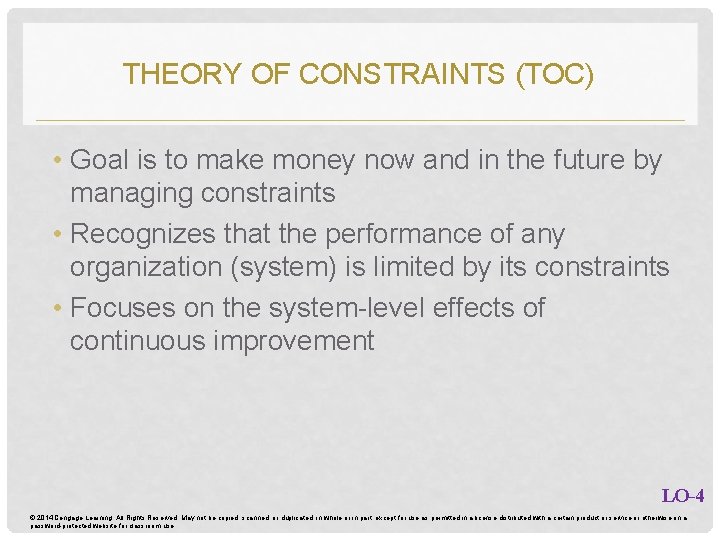
THEORY OF CONSTRAINTS (TOC) • Goal is to make money now and in the future by managing constraints • Recognizes that the performance of any organization (system) is limited by its constraints • Focuses on the system-level effects of continuous improvement LO-4 © 2014 Cengage Learning. All Rights Reserved. May not be copied, scanned, or duplicated, in whole or in part, except for use as permitted in a license distributed with a certain product or service or otherwise on a password-protected website for classroom use.
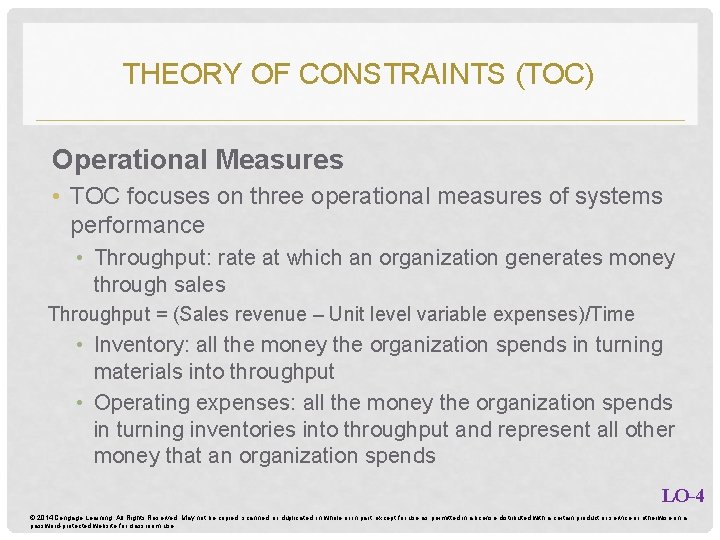
THEORY OF CONSTRAINTS (TOC) Operational Measures • TOC focuses on three operational measures of systems performance • Throughput: rate at which an organization generates money through sales Throughput = (Sales revenue – Unit level variable expenses)/Time • Inventory: all the money the organization spends in turning materials into throughput • Operating expenses: all the money the organization spends in turning inventories into throughput and represent all other money that an organization spends LO-4 © 2014 Cengage Learning. All Rights Reserved. May not be copied, scanned, or duplicated, in whole or in part, except for use as permitted in a license distributed with a certain product or service or otherwise on a password-protected website for classroom use.
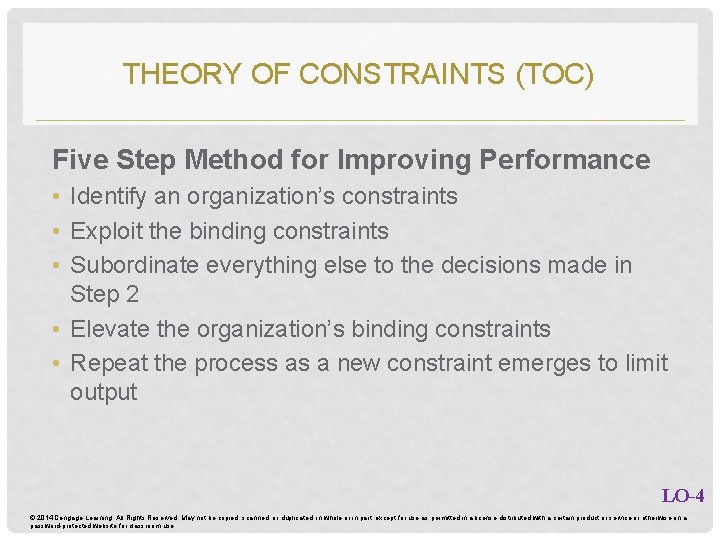
THEORY OF CONSTRAINTS (TOC) Five Step Method for Improving Performance • Identify an organization’s constraints • Exploit the binding constraints • Subordinate everything else to the decisions made in Step 2 • Elevate the organization’s binding constraints • Repeat the process as a new constraint emerges to limit output LO-4 © 2014 Cengage Learning. All Rights Reserved. May not be copied, scanned, or duplicated, in whole or in part, except for use as permitted in a license distributed with a certain product or service or otherwise on a password-protected website for classroom use.
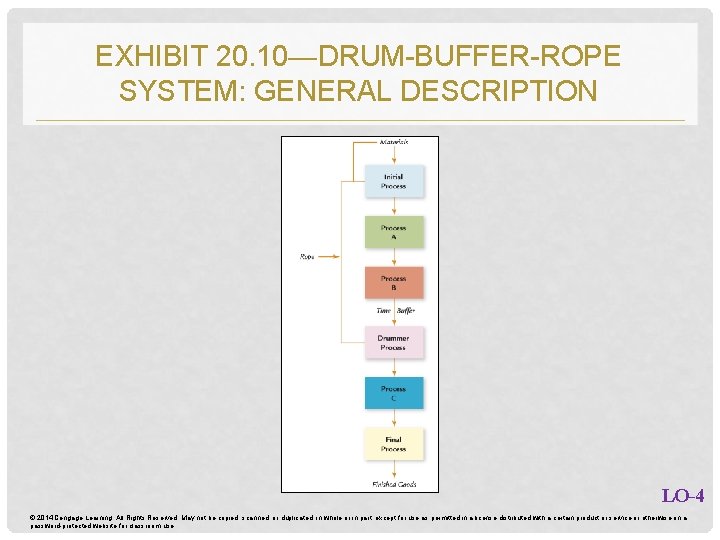
EXHIBIT 20. 10—DRUM-BUFFER-ROPE SYSTEM: GENERAL DESCRIPTION LO-4 © 2014 Cengage Learning. All Rights Reserved. May not be copied, scanned, or duplicated, in whole or in part, except for use as permitted in a license distributed with a certain product or service or otherwise on a password-protected website for classroom use.
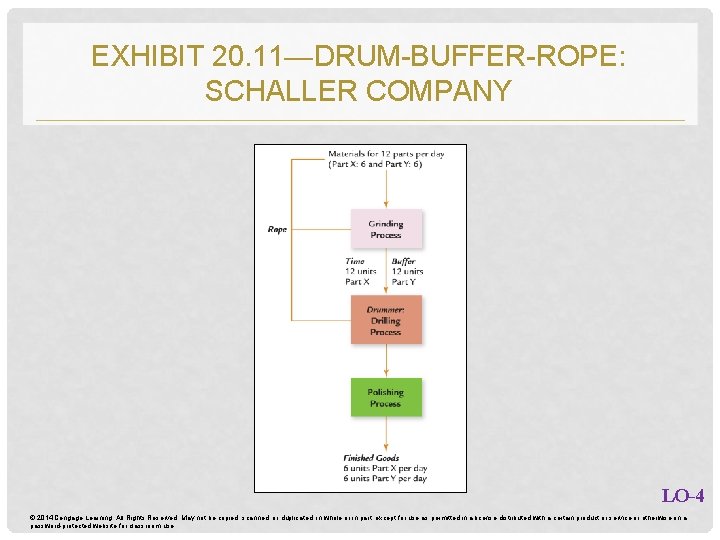
EXHIBIT 20. 11—DRUM-BUFFER-ROPE: SCHALLER COMPANY LO-4 © 2014 Cengage Learning. All Rights Reserved. May not be copied, scanned, or duplicated, in whole or in part, except for use as permitted in a license distributed with a certain product or service or otherwise on a password-protected website for classroom use.
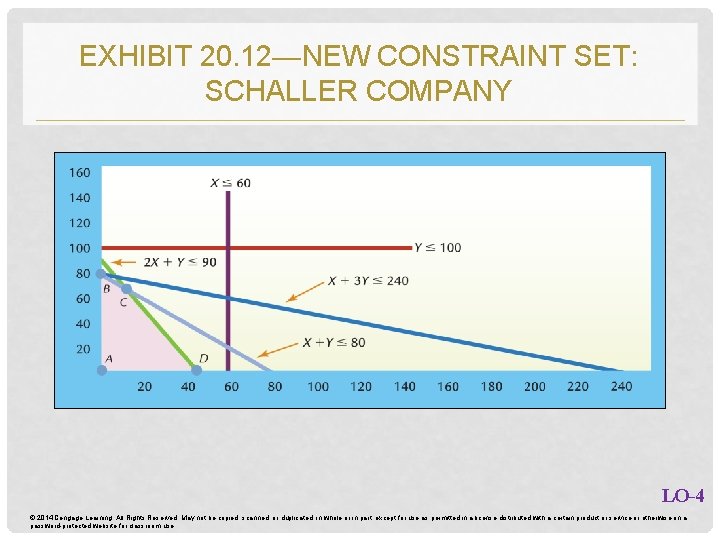
EXHIBIT 20. 12—NEW CONSTRAINT SET: SCHALLER COMPANY LO-4 © 2014 Cengage Learning. All Rights Reserved. May not be copied, scanned, or duplicated, in whole or in part, except for use as permitted in a license distributed with a certain product or service or otherwise on a password-protected website for classroom use.
END OF CHAPTER 20 © 2014 Cengage Learning. All Rights Reserved. May not be copied, scanned, or duplicated, in whole or in part, except for use as permitted in a license distributed with a certain product or service or otherwise on a password-protected website for classroom use.