Introduction to TSCA Joel A Tickner Sc D
- Slides: 22
Introduction to TSCA Joel A. Tickner, Sc. D Lowell Center for Sustainable Production joel_tickner@uml. edu April 27, 2005
Overview n Passed in 1976 following several years of debate and revisions n n Notable incidents involving chemicals CEQ 1971 Report Toxic Substances Lack of data on chemicals in commerce n Lack of government oversight n n Designed as an early warning system to identify potential dangers before chemicals are widely dispersed through commerce
Congressional Intent n “The most effective and efficient time to prevent unreasonable risks to public health or the environment is prior to first manufacture…it is at this point that the costs of regulation in terms of human suffering, jobs lost, wasted capital expenditures and other costs are lowest. ”
TSCA Purposes n n n To encourage or require industry to develop adequate data on the health and environmental effects of chemicals To regulate chemicals that pose unreasonable risk of injury to health or the environment and to take action against imminent hazards Not to unnecessarily impede technologic innovation (subservient to second).
TSCA Definitions n n n Covers industrial chemicals and excludes pesticides, food additives, drugs, cosmetics and preparations Regulates both manufacturers, processors (including importers) Distinguishes new from existing substances: n n n A new chemical substance is “any chemical substance which is not included in the chemical substance list compiled and published under TSCA section 8(b)" TSCA Inventory is a list of all chemical substances in commerce prior to 1979 and those that have come on market (about 81, 000 chemicals with 27 k polymers) New chemicals amount to about 1% by volume of chemicals on market.
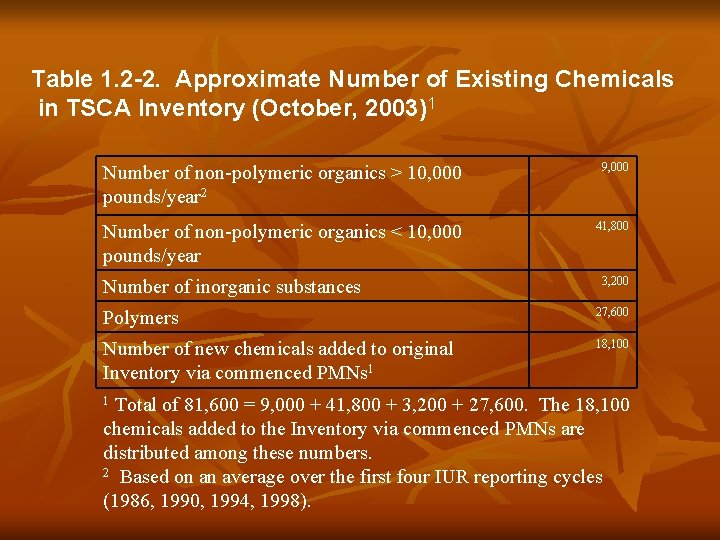
Table 1. 2 -2. Approximate Number of Existing Chemicals in TSCA Inventory (October, 2003)1 Number of non-polymeric organics > 10, 000 pounds/year 2 9, 000 Number of non-polymeric organics < 10, 000 pounds/year 41, 800 Number of inorganic substances 3, 200 Polymers 27, 600 Number of new chemicals added to original Inventory via commenced PMNs 1 18, 100 Total of 81, 600 = 9, 000 + 41, 800 + 3, 200 + 27, 600. The 18, 100 chemicals added to the Inventory via commenced PMNs are distributed among these numbers. 2 Based on an average over the first four IUR reporting cycles (1986, 1990, 1994, 1998). 1
Key components of TSCA n n Allows EPA to regulate toxic substances in a broad way from outright bans to labeling. Authorizes EPA to require industry to test old and new substances. Permits EPA to exercise regulatory control over the introduction of new chemicals at premanufacture stage Contains wide reaching recordkeeping and reporting requirementsl
Key Sections of TSCA n n n n Section 4 – Chemical Testing Section 5 – New Chemicals Section 6 – Regulation of Hazardous Chemical Substances Section 7 – Imminent Hazards Section 8 - Reporting and Retention of Information Section 9 – Relationship to other laws Section 14 - Disclosure of data Section 26 – Ability to regulate categories of chemicals
Section 4 – Chemical Testing n n n Compels EPA administrator to require testing of a chemical substance or mixture, new or existing if: The subject chemical or mixture “may present an unreasonable risk (hazard/risk finding) or The chemical will be produced in substantial quantities and either may enter the environment in substantial quantities or lead to significant human exposure (exposure finding) and Inadequate data exist for use in risk assessment and Testing is necessary to develop the needed data
How and When n n n All rules undergo economic analysis and public notice and comment and costs are shared among companies subject to the rule Must adhere to published test guidelines Interagency Testing Committee (federal reps) identify TSCA chemicals to add to Priority Testing List – must issue rule within 1 year EPA requests for testing from other EPA offices and federal agencies – no deadline Often use Enforceable Consent Agreements Data on about 200 chemicals through rulemaking
High Production Volume Challenge n n In response to EPA Data Availability report EPA initiates HPV voluntary challenge to chemical industry to provide basic testing data and robust summaries 2800 chemicals to start n n 1900 sponsored 500 orphans (some no longer HPV) Represents about 99% of total tonnage Fixed program scope doesn’t account for new ones or lower volume chemicals
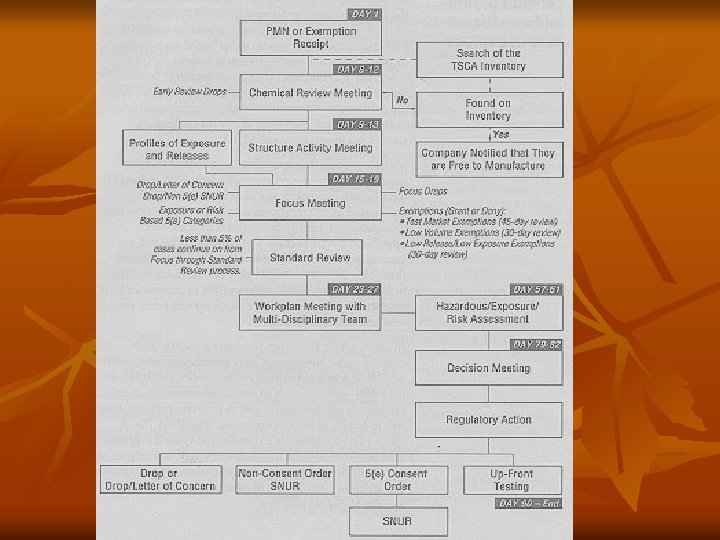
Section 5 – New Chemicals Review n Manufacturers or importers of new chemical substances must submit a Pre-Manufacture Notification at least 90 days before production (only one PMN per chemical) n n n PMN must contain information on the chemical, structure, byproducts, use, manufacturing, and any test data or information on impacts in possession or reasonably ascertainable (no test data requirements) – confidentiality provisions EPA then has 90 days to review during which stage can request more data, prohibit or limit manufacture or halt review process. If no action manufacturer can submit Notice of Commencement and may begin manufacture or import Exemptions for R&D, polymers, Low volume, Low Release and exposure, Test marketing
Aspects of EPA New Chemicals Review n n Multi-disciplinary screening process Interaction with manufacturers about potential problems n n n Chemical categories Informal negotiation Tools for industry to promote safer chemical syntheses and products n n P 2 Review and Framework Sustainable Futures
Outcomes of New Chemicals Review n n n No action Voluntary withdrawal Section 5 e order to prohibit or limit activities associated with the chemical if: there are insufficient data to evaluate effects and (1) it may present an unreasonable risk; or (2) it is or will be produced in substantial quantities or result in substantial exposure Usually use Consent Orders which include: exposure mitigation, testing, labeling and hazard communication and record keeping Section 5 f order limiting the substance if substance presents or will present an unreasonable risk.
Significant New Use Rules (SNUR) n n n Section 5 e order only binding on original PMN submitter. SNUR mimics consent order and extends to other companies that want to manufacture Can also use to capture new uses of substances that may result in an unreasonable risk (notice and comment procedure) Can also be used for existing chemicals when discontinued production (PBDEs), discontinued use, increased volume production, or new uses. Anyone who wants to manufacture or import a chemical subject to a SNUR must submit a Significant New Use Notification to EPA 90 days prior.
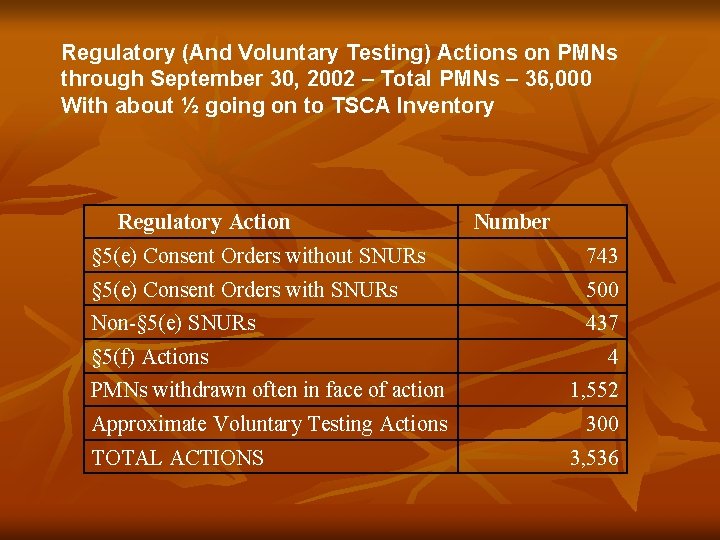
Regulatory (And Voluntary Testing) Actions on PMNs through September 30, 2002 – Total PMNs – 36, 000 With about ½ going on to TSCA Inventory Regulatory Action Number § 5(e) Consent Orders without SNURs 743 § 5(e) Consent Orders with SNURs 500 Non-§ 5(e) SNURs 437 § 5(f) Actions 4 PMNs withdrawn often in face of action 1, 552 Approximate Voluntary Testing Actions 300 TOTAL ACTIONS 3, 536
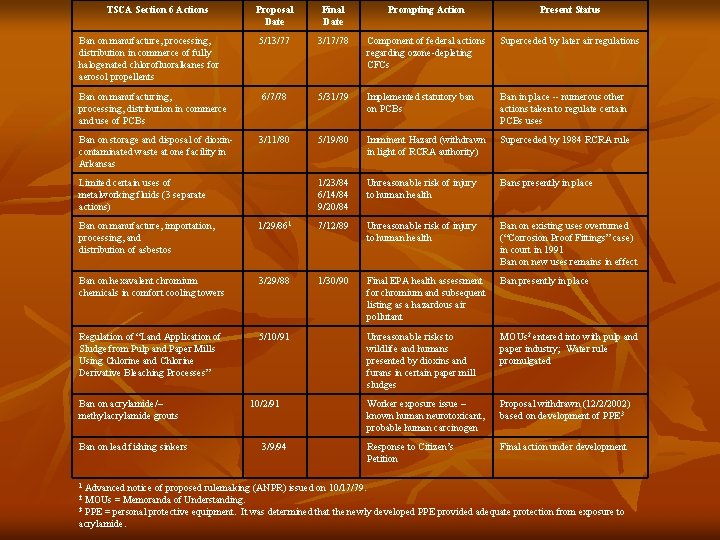
Section 6 – Risk Management of Existing Substances n n n EPA must demonstrate that one ore more activities involving a substance or mixture presents or will present an unreasonable risk EPA must evaluate health and environmental effects, exposure, benefits of the substance, availability of substitutes and economic effects (must choose least burdensome form of regulation and balance costs and benefits) Actions from prohibitions to risk communications and use of consent orders and preliminary notices
TSCA Section 6 Actions Proposal Date Final Date Prompting Action Present Status Ban on manufacture, processing, distribution in commerce of fully halogenated chlorofluoralkanes for aerosol propellents 5/13/77 3/17/78 Component of federal actions regarding ozone-depleting CFCs Superceded by later air regulations Ban on manufacturing, processing, distribution in commerce and use of PCBs 6/7/78 5/31/79 Implemented statutory ban on PCBs Ban in place -- numerous other actions taken to regulate certain PCBs uses Ban on storage and disposal of dioxincontaminated waste at one facility in Arkansas 3/11/80 5/19/80 Imminent Hazard (withdrawn in light of RCRA authority) Superceded by 1984 RCRA rule 1/23/84 6/14/84 9/20/84 Unreasonable risk of injury to human health Bans presently in place Limited certain uses of metalworking fluids (3 separate actions) Ban on manufacture, importation, processing, and distribution of asbestos 1/29/861 7/12/89 Unreasonable risk of injury to human health Ban on existing uses overturned (“Corrosion Proof Fittings” case) in court in 1991 Ban on new uses remains in effect Ban on hexavalent chromium chemicals in comfort cooling towers 3/29/88 1/30/90 Final EPA health assessment for chromium and subsequent listing as a hazardous air pollutant Ban presently in place Regulation of “Land Application of Sludge from Pulp and Paper Mills Using Chlorine and Chlorine Derivative Bleaching Processes” 5/10/91 Unreasonable risks to wildlife and humans presented by dioxins and furans in certain paper mill sludges MOUs 2 entered into with pulp and paper industry; Water rule promulgated Worker exposure issue – known human neurotoxicant, probable human carcinogen Proposal withdrawn (12/2/2002) based on development of PPE 3 Response to Citizen’s Petition Final action under development Ban on acrylamide/– methylacrylamide grouts Ban on lead fishing sinkers 10/2/91 3/9/94 Advanced notice of proposed rulemaking (ANPR) issued on 10/17/79. MOUs = Memoranda of Understanding. 3 PPE = personal protective equipment. It was determined that the newly developed PPE provided adequate protection from exposure to acrylamide. 1 2
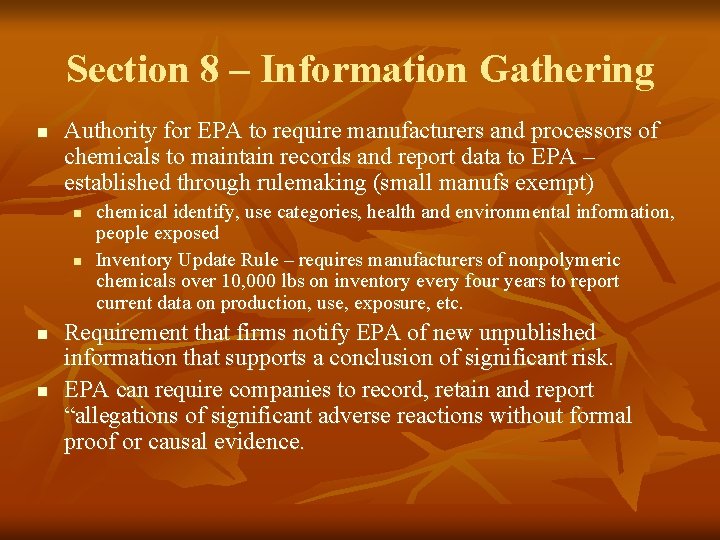
Section 8 – Information Gathering n Authority for EPA to require manufacturers and processors of chemicals to maintain records and report data to EPA – established through rulemaking (small manufs exempt) n n chemical identify, use categories, health and environmental information, people exposed Inventory Update Rule – requires manufacturers of nonpolymeric chemicals over 10, 000 lbs on inventory every four years to report current data on production, use, exposure, etc. Requirement that firms notify EPA of new unpublished information that supports a conclusion of significant risk. EPA can require companies to record, retain and report “allegations of significant adverse reactions without formal proof or causal evidence.
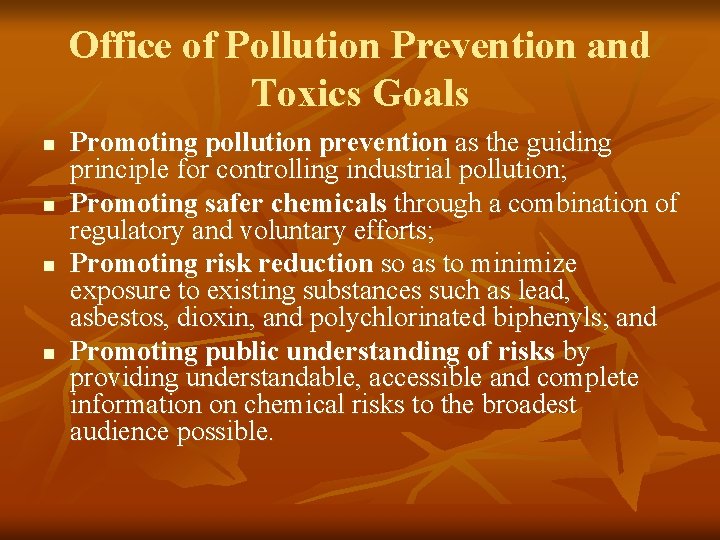
Office of Pollution Prevention and Toxics Goals n n Promoting pollution prevention as the guiding principle for controlling industrial pollution; Promoting safer chemicals through a combination of regulatory and voluntary efforts; Promoting risk reduction so as to minimize exposure to existing substances such as lead, asbestos, dioxin, and polychlorinated biphenyls; and Promoting public understanding of risks by providing understandable, accessible and complete information on chemical risks to the broadest audience possible.
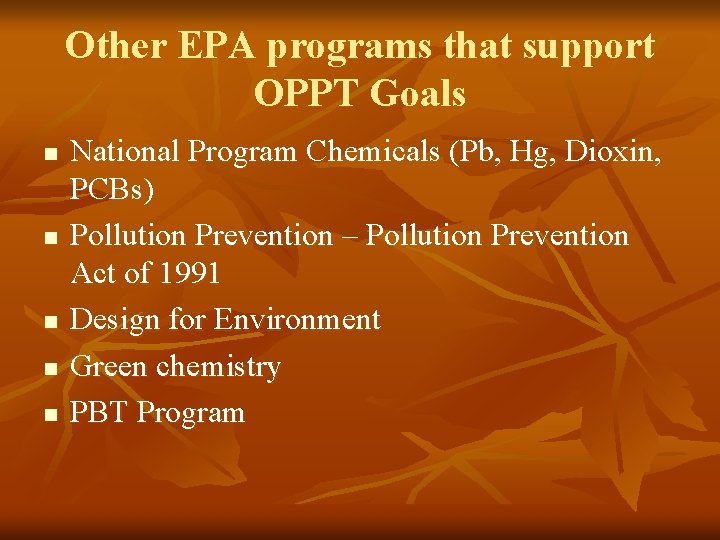
Other EPA programs that support OPPT Goals n n n National Program Chemicals (Pb, Hg, Dioxin, PCBs) Pollution Prevention – Pollution Prevention Act of 1991 Design for Environment Green chemistry PBT Program