
ICT Research and Teaching for Criminal Justice Practitioners






- Slides: 28
ICT, Research and Teaching for Criminal Justice Practitioners Dr Joel Miller School of Criminal Justice Rutgers-Newark
ICT Introduction Unit Name
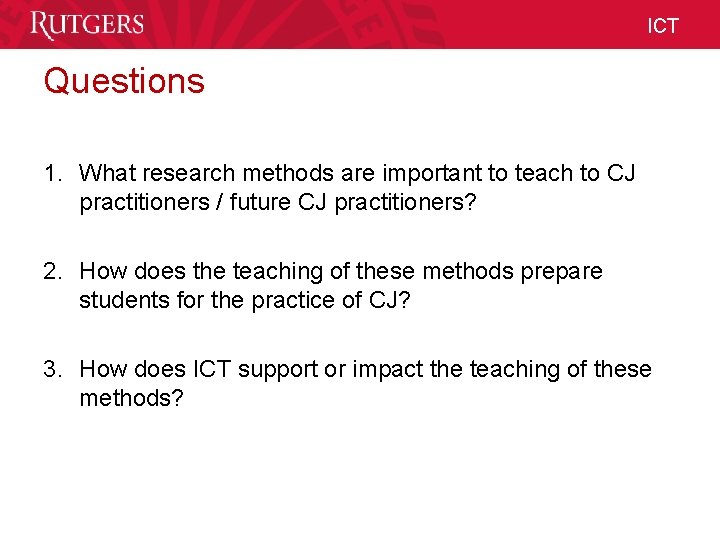
ICT Questions 1. What research methods are important to teach to CJ practitioners / future CJ practitioners? 2. How does the teaching of these methods prepare students for the practice of CJ? 3. How does ICT support or impact the teaching of these methods? Unit Name
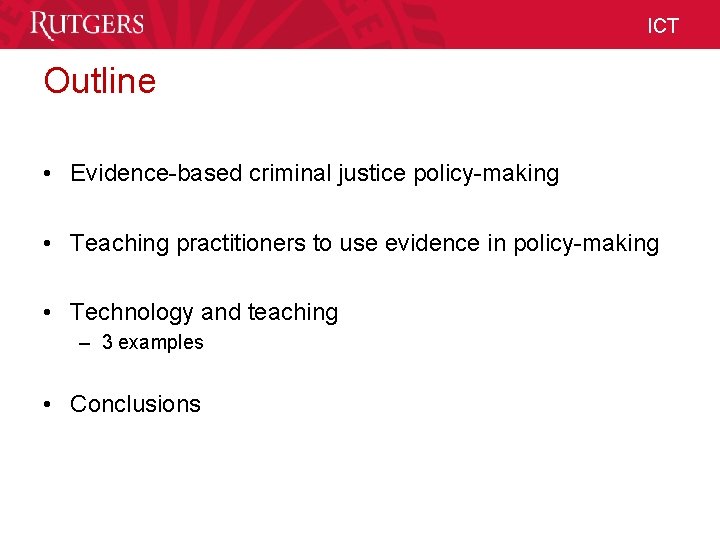
ICT Outline • Evidence-based criminal justice policy-making • Teaching practitioners to use evidence in policy-making • Technology and teaching – 3 examples • Conclusions Unit Name
ICT Evidence-based criminal justice policy-making Unit Name
ICT Evidence-based policy-making (EBP) • Shift towards evidence-based policing-making (especially from 1990 s) • Reflects broader shifts in public policy-making • Inspired, in part, by federal assessment of “what works” in addressing crime and offending (Sherman et al. , 1997) • Influenced by innovations in criminal justice strategies for addressing crime and offending behavior Unit Name
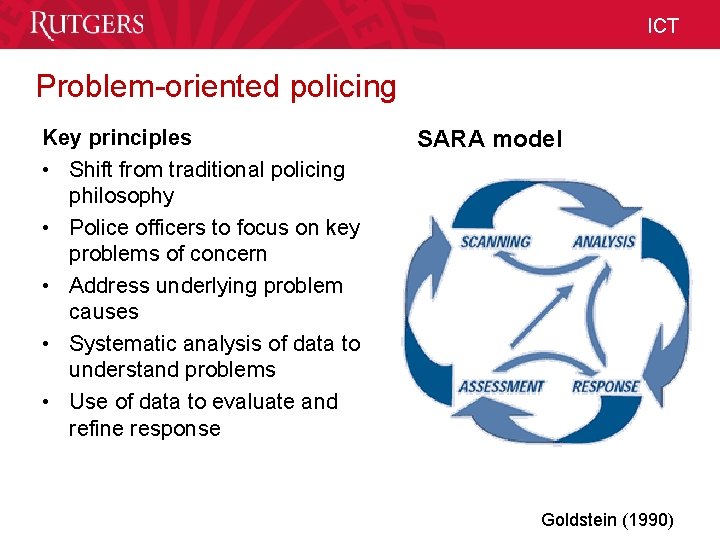
ICT Problem-oriented policing Key principles • Shift from traditional policing philosophy • Police officers to focus on key problems of concern • Address underlying problem causes • Systematic analysis of data to understand problems • Use of data to evaluate and refine response Unit Name SARA model Goldstein (1990)
ICT Risk-Need-Responsivity (RNR) model • Corrections systems (e. g. prison, parole, probation) to target effective methods of rehabilitation • Measure the risk posed by system clients of recidivism, and respond proportionately (uses actuarial methods) • Measure criminogenic needs of system clients (e. g. criminal peers, antisocial attitudes, antisocial • Target services at key criminogenic needs with effective services (e. g. cognitive behavioral programs) Unit Name Bonta and Andrews (2007)
ICT Technology and EBP • Shifts in technology have supported evidence-based approach • Computerization of criminal justice system records (i. e. electronic administrative data) – Data relates to case management, services, crime and recidivism – Facilitates generate, sharing and analysis of data • Other advances: – Analytical software – notably Geographical Information Systems (GIS) – Online survey tools Unit Name
ICT Teaching practitioners to use evidence in policy-making Unit Name
ICT Teaching practitioners • Research and statistical skills – Bivariate and multivariate data analysis – Data collection and measurement – Evaluation methods • Planning skills – Interpreting prior evaluation literature – Designing mechanisms, – Use of logic models • A “problem-solving” approach – Influenced by “Action Research” model (Lewin 1946) – Practitioners or policy-makers as participants/partners in research to develop policies/practices Unit Name
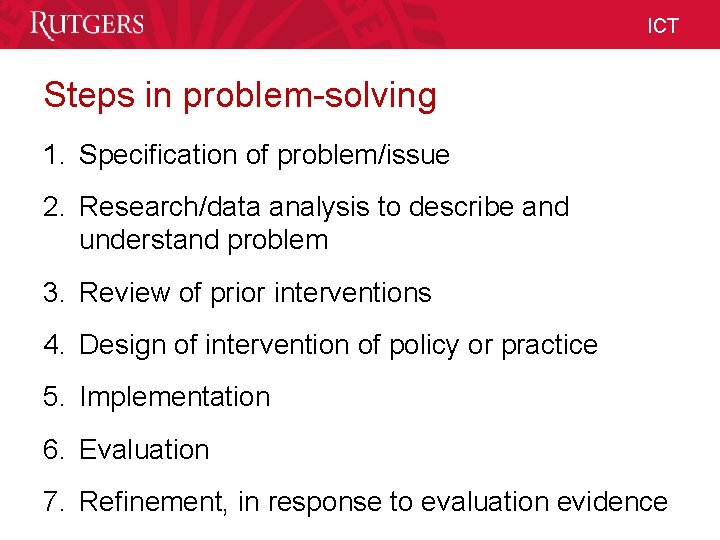
ICT Steps in problem-solving 1. Specification of problem/issue 2. Research/data analysis to describe and understand problem 3. Review of prior interventions 4. Design of intervention of policy or practice 5. Implementation 6. Evaluation 7. Refinement, in response to evaluation evidence Unit Name
ICT Examples of problems Particular types of crime, delinquency or disorder • Offender recidivism • Street crime • Domestic violence • Graffiti • etc. Unit Name Policies or actions of justice officials • Jail overcrowding • Racial profiling by police • Serving mental health needs among jail inmates • etc.
ICT Technology and teaching Unit Name
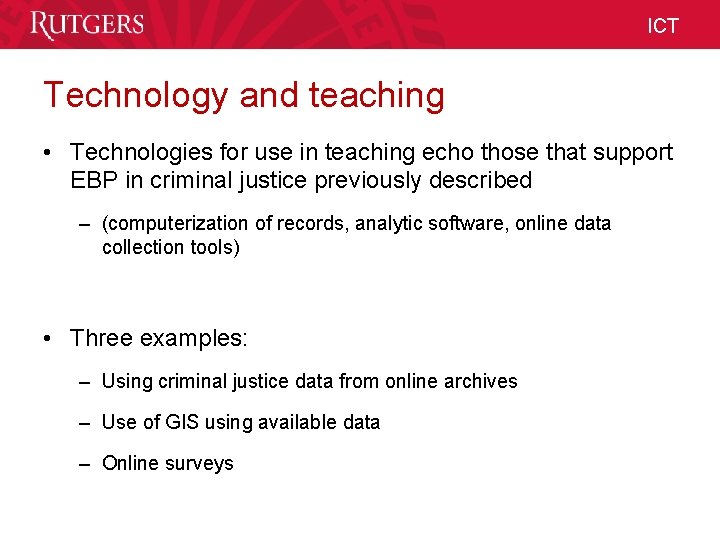
ICT Technology and teaching • Technologies for use in teaching echo those that support EBP in criminal justice previously described – (computerization of records, analytic software, online data collection tools) • Three examples: – Using criminal justice data from online archives – Use of GIS using available data – Online surveys Unit Name
ICT Example 1: Online crime/criminal justice data archives Unit Name
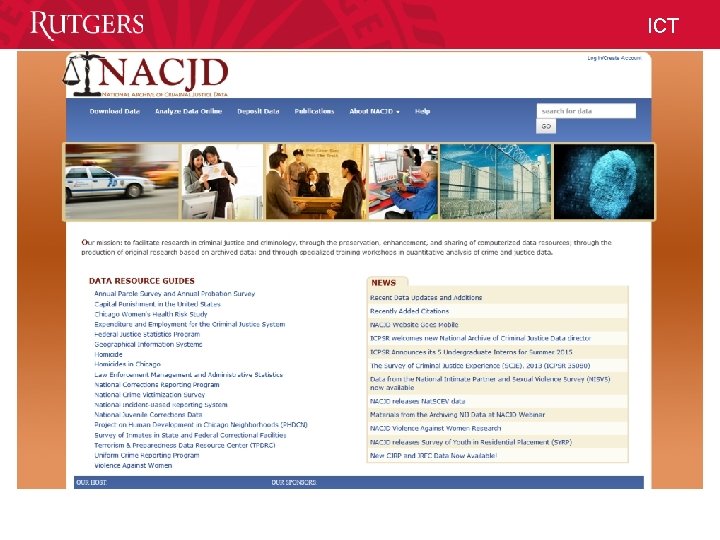
ICT Unit Name
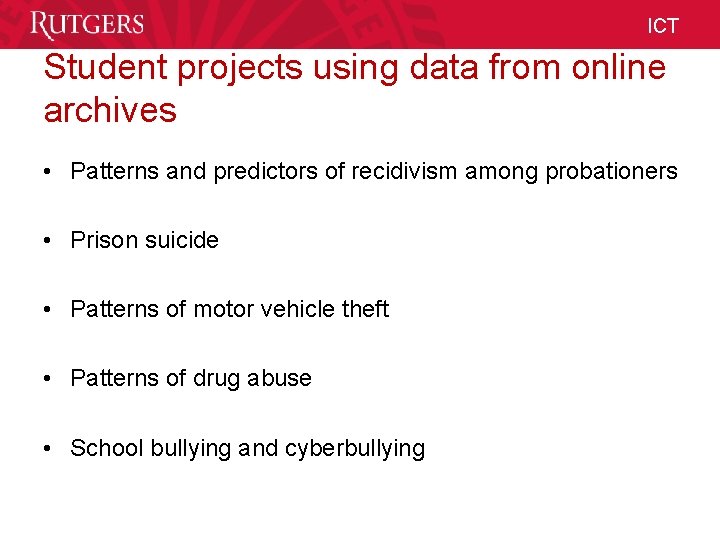
ICT Student projects using data from online archives • Patterns and predictors of recidivism among probationers • Prison suicide • Patterns of motor vehicle theft • Patterns of drug abuse • School bullying and cyberbullying Unit Name
ICT Example 2: Mapping with GIS Unit Name
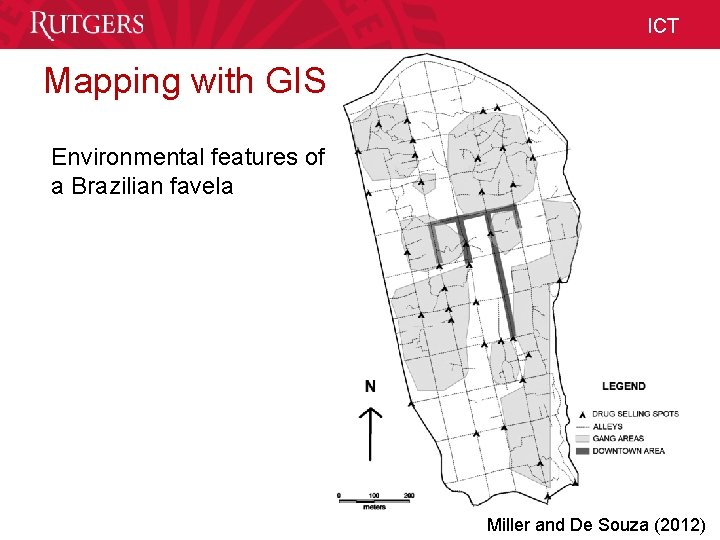
ICT Mapping with GIS Environmental features of a Brazilian favela Unit Name Miller and De Souza (2012)
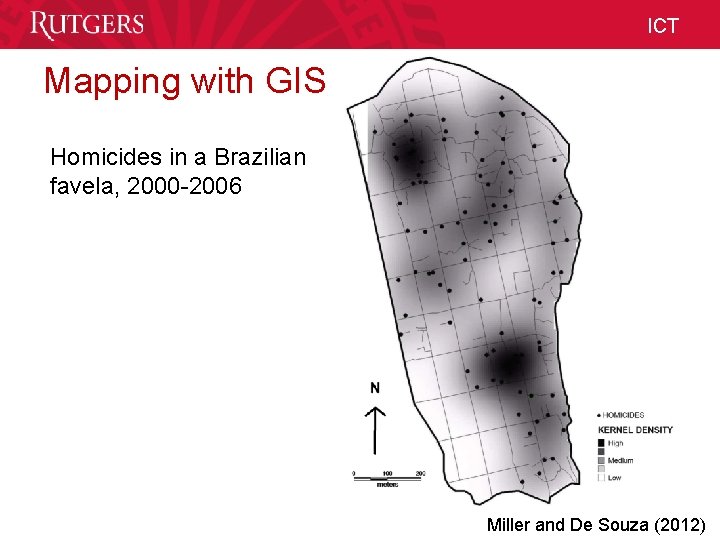
ICT Mapping with GIS Homicides in a Brazilian favela, 2000 -2006 Unit Name Miller and De Souza (2012)
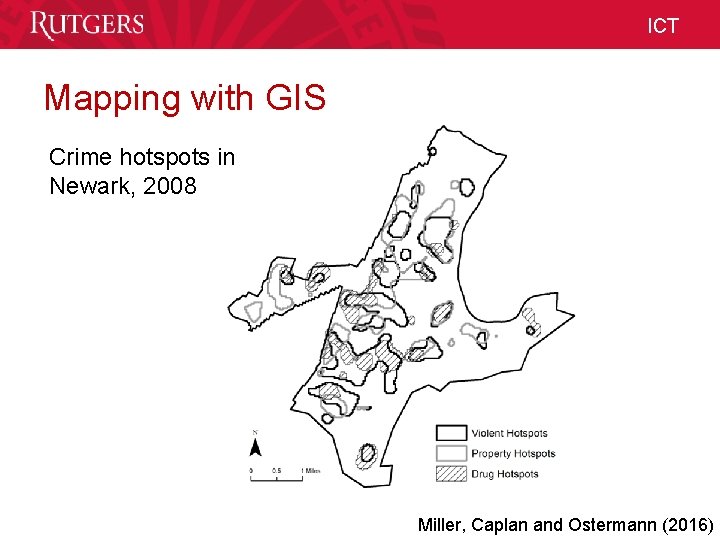
ICT Mapping with GIS Crime hotspots in Newark, 2008 Unit Name Miller, Caplan and Ostermann (2016)
ICT Example 3: Collecting data with web-based survey tools Unit Name
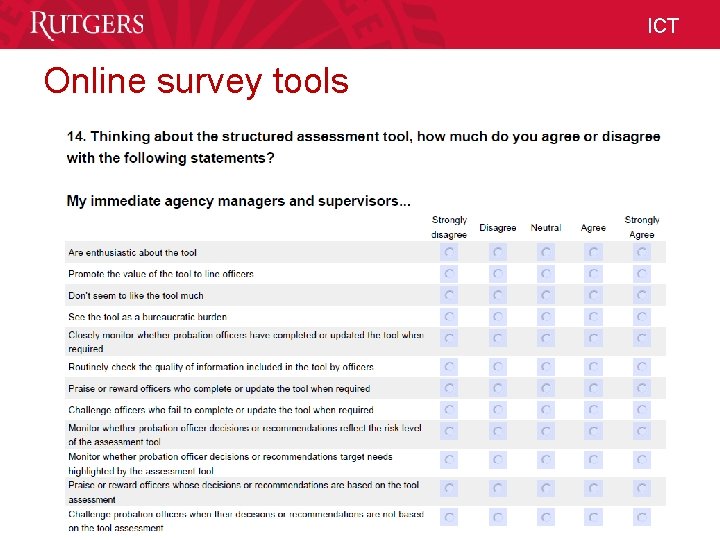
ICT Online survey tools Unit Name
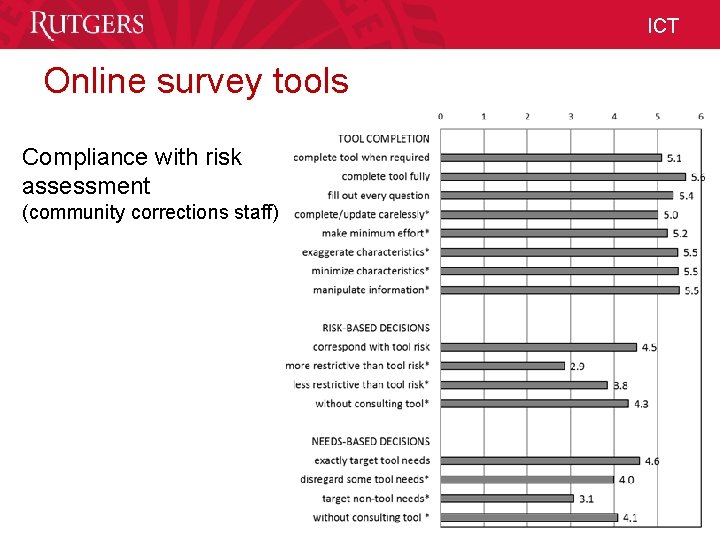
ICT Online survey tools Compliance with risk assessment (community corrections staff) Unit Name
ICT Conclusions Unit Name
ICT Conclusions • Evidence increasingly important in CJ policy-making and practice • Educating current/future practitioners may best emphasize a problem solving / “action research” approach (rather than traditional academic model) • Technological innovations that support evidence-based policymaking also support teaching methods, including – Electronic data on crime and justice issues – Analytic software, such as GIS – Web-based data collection tools Unit Name
ICT, Research and Teaching for Criminal Justice Practitioners Dr Joel Miller School of Criminal Justice Rutgers-Newark