Introduction to Physiology and Transport Faisal I Mohammed
- Slides: 22
Introduction to Physiology and Transport Faisal I. Mohammed, MD, Ph. D
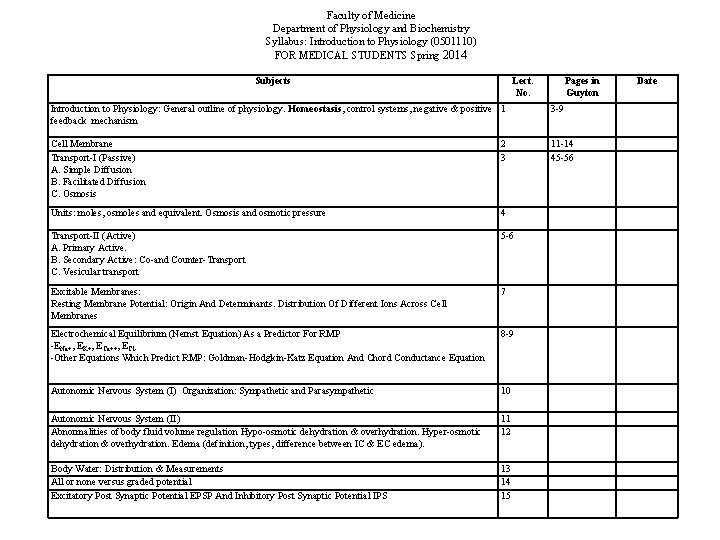
Faculty of Medicine Department of Physiology and Biochemistry Syllabus: Introduction to Physiology (0501110) FOR MEDICAL STUDENTS Spring 2014 Subjects Lect. No. Pages in Guyton Introduction to Physiology: General outline of physiology. Homeostasis, control systems, negative & positive 1 feedback mechanism 3 -9 Cell Membrane Transport-I (Passive) A. Simple Diffusion B. Facilitated Diffusion C. Osmosis 2 3 11 -14 45 -56 Units: moles, osmoles and equivalent. Osmosis and osmotic pressure 4 Transport-II (Active) A. Primary Active. B. Secondary Active: Co-and Counter-Transport C. Vesicular transport 5 -6 Excitable Membranes: Resting Membrane Potential: Origin And Determinants. Distribution Of Different Ions Across Cell Membranes 7 Electrochemical Equilibrium (Nernst Equation) As a Predictor For RMP -ENa+, EK+, ECa++, ECl-Other Equations Which Predict RMP: Goldman-Hodgkin-Katz Equation And Chord Conductance Equation 8 -9 Autonomic Nervous System (I) Organization: Sympathetic and Parasympathetic 10 Autonomic Nervous System (II) Abnormalities of body fluid volume regulation Hypo-osmotic dehydration & overhydration. Hyper-osmotic dehydration & overhydration. Edema (definition, types, difference between IC & EC edema). 11 12 Body Water: Distribution & Measurements All or none versus graded potential Excitatory Post Synaptic Potential EPSP And Inhibitory Post Synaptic Potential IPS 13 14 15 Date
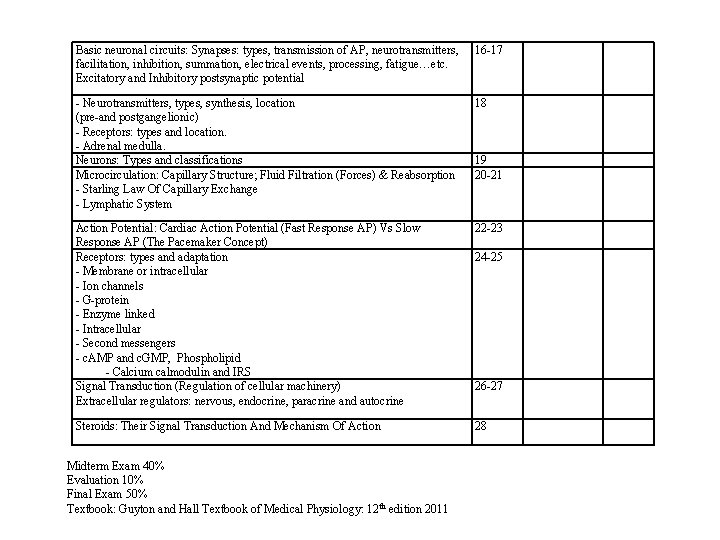
Basic neuronal circuits: Synapses: types, transmission of AP, neurotransmitters, facilitation, inhibition, summation, electrical events, processing, fatigue…etc. Excitatory and Inhibitory postsynaptic potential 16 -17 - Neurotransmitters, types, synthesis, location (pre-and postgangelionic) - Receptors: types and location. - Adrenal medulla. Neurons: Types and classifications Microcirculation: Capillary Structure; Fluid Filtration (Forces) & Reabsorption - Starling Law Of Capillary Exchange - Lymphatic System 18 Action Potential: Cardiac Action Potential (Fast Response AP) Vs Slow Response AP (The Pacemaker Concept) Receptors: types and adaptation - Membrane or intracellular - Ion channels - G-protein - Enzyme linked - Intracellular - Second messengers - c. AMP and c. GMP, Phospholipid - Calcium calmodulin and IRS Signal Transduction (Regulation of cellular machinery) Extracellular regulators: nervous, endocrine, paracrine and autocrine 22 -23 Steroids: Their Signal Transduction And Mechanism Of Action 28 Midterm Exam 40% Evaluation 10% Final Exam 50% Textbook: Guyton and Hall Textbook of Medical Physiology: 12 th edition 2011 19 20 -21 24 -25 26 -27
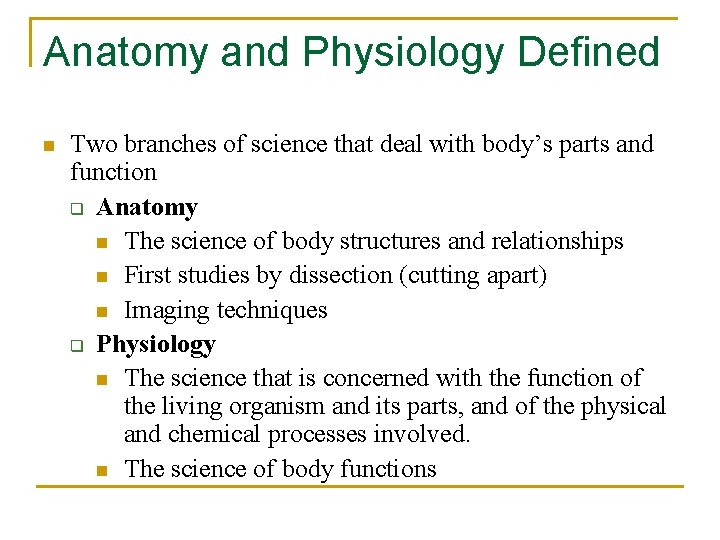
Anatomy and Physiology Defined n Two branches of science that deal with body’s parts and function q Anatomy n The science of body structures and relationships n First studies by dissection (cutting apart) n Imaging techniques q Physiology n The science that is concerned with the function of the living organism and its parts, and of the physical and chemical processes involved. n The science of body functions
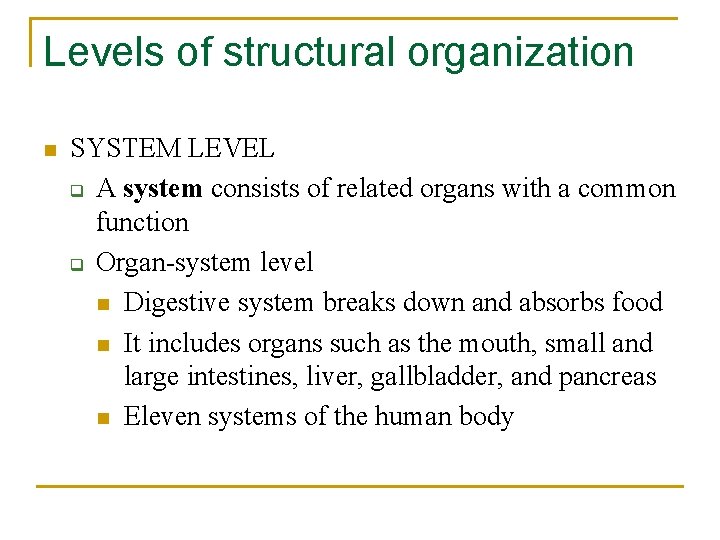
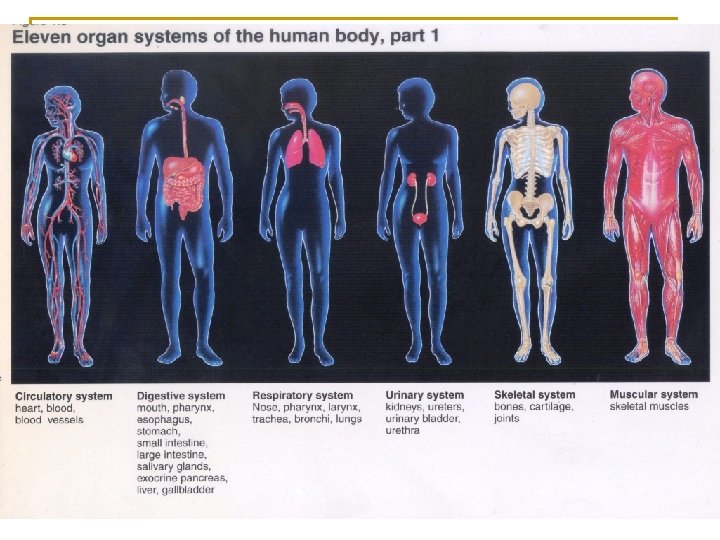
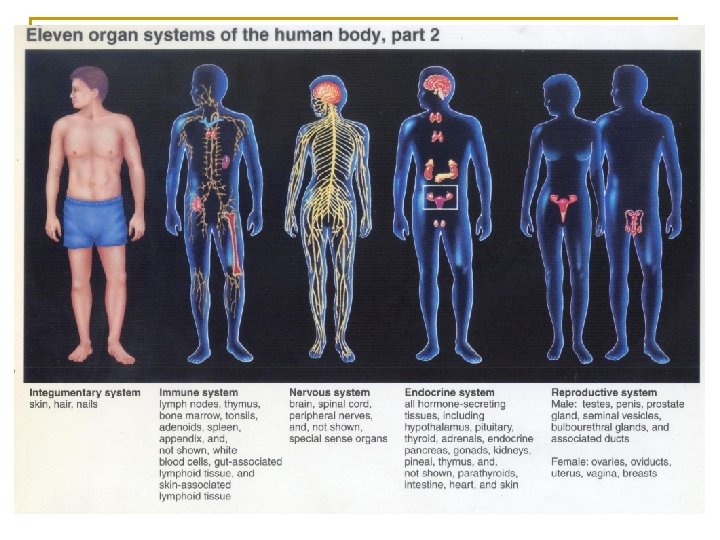
Levels of structural organization n SYSTEM LEVEL q A system consists of related organs with a common function q Organ-system level n Digestive system breaks down and absorbs food n It includes organs such as the mouth, small and large intestines, liver, gallbladder, and pancreas n Eleven systems of the human body
Homeostasis n A condition of equilibrium (balance) in the body’s internal environment. Maintain an almost constant internal environment q Dynamic condition q Narrow range is compatible with maintaining life q Example n Blood glucose levels range between 70 and 110 mg of glucose/d. L of blood n Whole body contributes to maintain the internal environment within normal limits
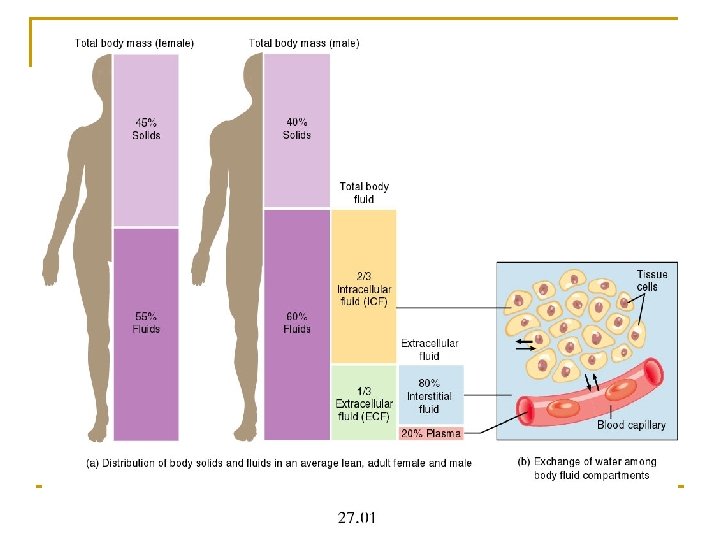
Homeostasis and Body Fluids n Maintaining the volume and composition of body fluids are important q Body fluids are defined as dilute, watery solutions containing dissolved chemicals inside or outside of the cell q Intracellular Fluid (ICF) n Fluid within cells q Extracellular Fluid (ECF) n Fluid outside cells n Interstitial fluid is ECF between cells and tissues
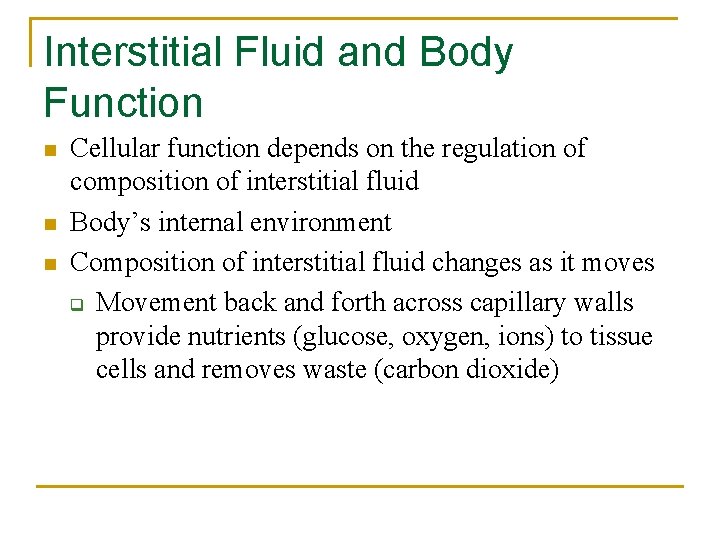
Interstitial Fluid and Body Function n Cellular function depends on the regulation of composition of interstitial fluid Body’s internal environment Composition of interstitial fluid changes as it moves q Movement back and forth across capillary walls provide nutrients (glucose, oxygen, ions) to tissue cells and removes waste (carbon dioxide)
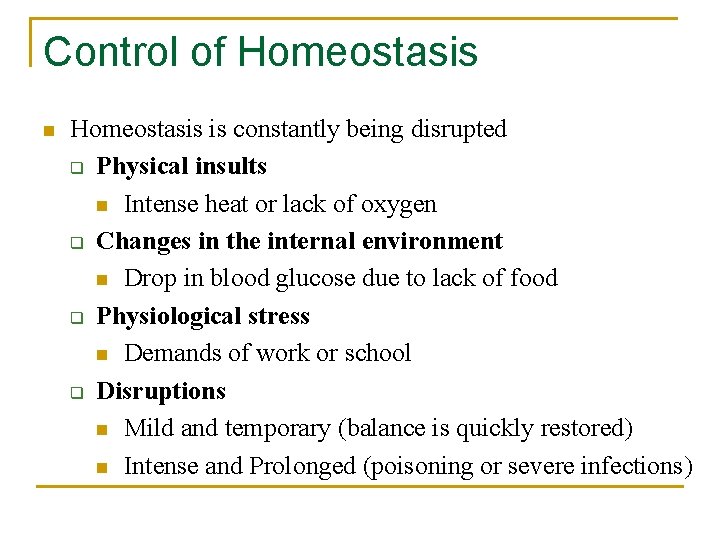
Control of Homeostasis n Homeostasis is constantly being disrupted q Physical insults n Intense heat or lack of oxygen q Changes in the internal environment n Drop in blood glucose due to lack of food q Physiological stress n Demands of work or school q Disruptions n Mild and temporary (balance is quickly restored) n Intense and Prolonged (poisoning or severe infections)
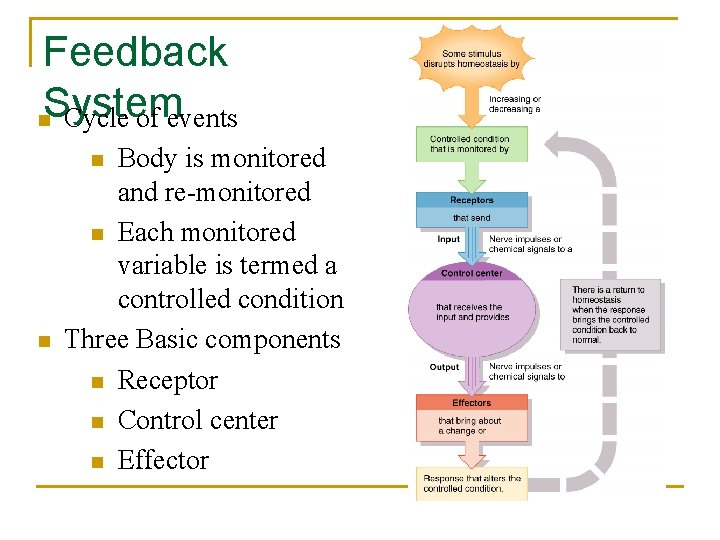
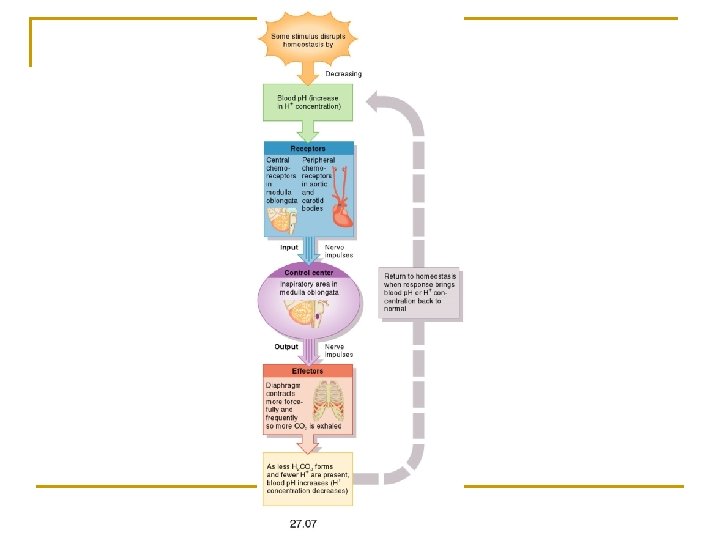
Feedback System n Cycle of events Body is monitored and re-monitored n Each monitored variable is termed a controlled condition Three Basic components n Receptor n Control center n Effector n n
Feedback Systems n Receptor q Body structure that monitors changes in a controlled condition q Sends input to the control center n Nerve ending of the skin in response to temperature change
Feedback Systems n Control Center q Brain q Sets the range of values to be maintained q Evaluates input received from receptors and generates output command q Nerve impulses, hormones n Brains acts as a control center receiving nerve impulses from skin temperature receptors
Feedback Systems n Effector q Receives output from the control center q Produces a response or effect that changes the controlled condition n Found in nearly every organ or tissue n Body temperature drops the brain sends and impulse to the skeletal muscles to contract n Shivering to generate heat
Negative and Positive Feedback systems n n Negative Feedback systems q Reverses a change in a controlled condition n Regulation of blood pressure (force exerted by blood as it presses again the walls of the blood vessels) Positive Feedback systems q Strengthen or reinforce a change in one of the body’s controlled conditions n Normal child birth
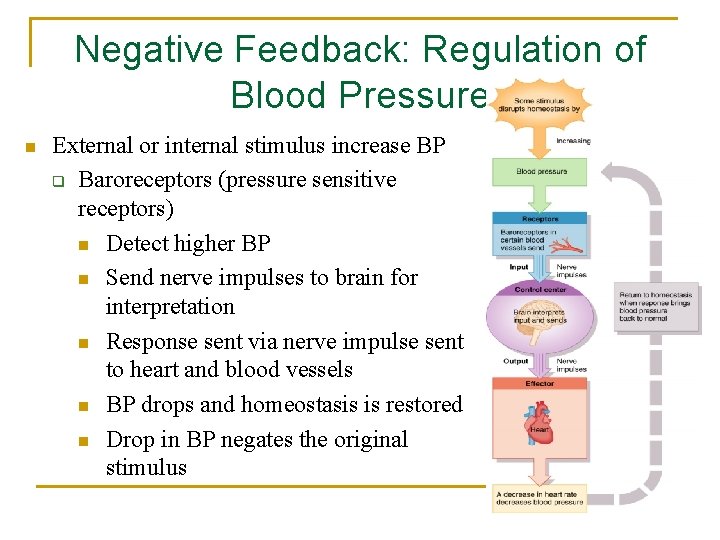
Negative Feedback: Regulation of Blood Pressure n External or internal stimulus increase BP q Baroreceptors (pressure sensitive receptors) n Detect higher BP n Send nerve impulses to brain for interpretation n Response sent via nerve impulse sent to heart and blood vessels n BP drops and homeostasis is restored n Drop in BP negates the original stimulus
Positive Feedback: Blood Loss n n Normal conditions, heart pumps blood under pressure to body cells (oxygen and nutrients) Severe blood loss q Blood pressure drops q Cells receive less oxygen and function less efficiently q If blood loss continues n Heart cells become weaker n Heart doesn’t pump n BP continues to fall
Homeostatic Imbalances n Normal equilibrium of body processes are disrupted q Moderate imbalance n Disorder or abnormality of structure and function n Disease specific for an illness with recognizable signs and symptoms n Signs are objective changes such as a fever or swelling n Symptoms are subjective changes such as headache q Severe imbalance n Death
Thank You University of Jordan 22