Introduction to Multiplayer Network Technology Thomas Lidy Introduction

- Slides: 21
Introduction to Multiplayer Network Technology Thomas Lidy
Introduction n Networking - used in. . . – – – Thomas Lidy e-commerce training & education distributed engineering & design entertainment multi player games „networked virtual environments“ Introduction to Multiplayer Network Technology 2/20
Networked Virtual Environment n software system – – – Thomas Lidy multiple users interact in real-time shared sense of space and time realistic 3 D graphics and sound a way to communicate interaction with the virtual environment Introduction to Multiplayer Network Technology 3/20
Networked Virtual Environment n components – – Thomas Lidy graphics engines and displays communication and control devices processing systems data network Introduction to Multiplayer Network Technology 4/20
Origins of virtual environments origins in military (and industry) n academic research in networked virtual environments n virtual worlds on PC class systems - 3 D games n Thomas Lidy Introduction to Multiplayer Network Technology 5/20
Origins in military n SIMNET – – n started 1983 developed for DARPA DIS (protocol) – – – Thomas Lidy defined after 1989 standardized packets (PDUs) distributed & heterogeneous Introduction to Multiplayer Network Technology 6/20
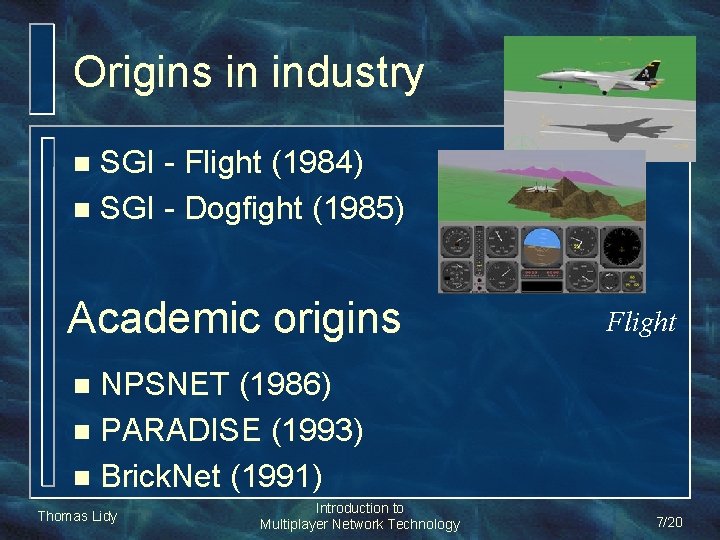
Origins in industry SGI - Flight (1984) n SGI - Dogfight (1985) n Academic origins Flight NPSNET (1986) n PARADISE (1993) n Brick. Net (1991) n Thomas Lidy Introduction to Multiplayer Network Technology 7/20
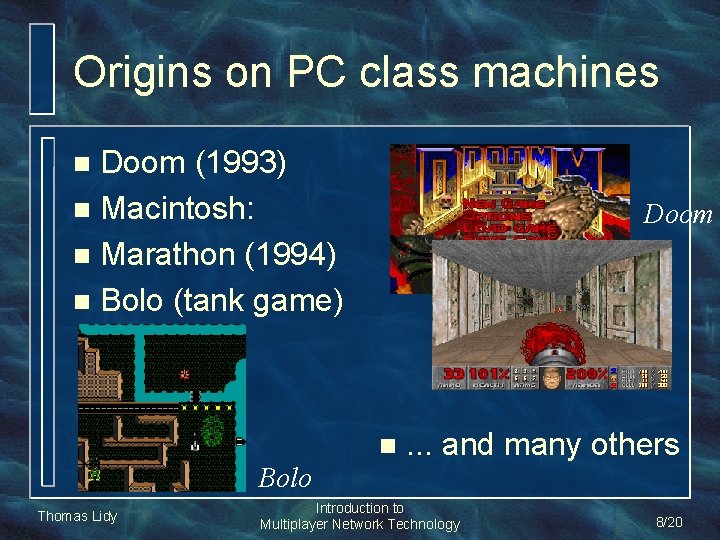
Origins on PC class machines Doom (1993) n Macintosh: n Marathon (1994) n Bolo (tank game) n Doom n . . . and many others Bolo Thomas Lidy Introduction to Multiplayer Network Technology 8/20
Network Technology n Issues for networking – Latency l – Bandwidth l – data rate: how many bits per second Reliability l Thomas Lidy time required from one host to another how much data is lost Introduction to Multiplayer Network Technology 9/20
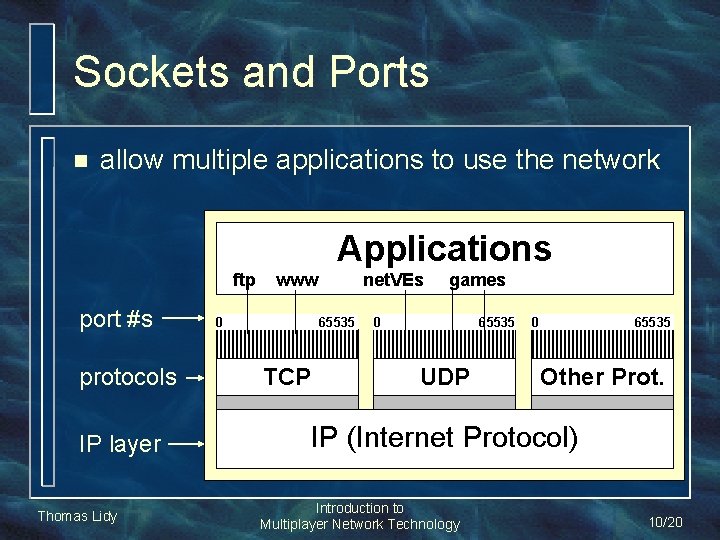
Sockets and Ports n allow multiple applications to use the network Applications ftp port #s protocols IP layer Thomas Lidy www 0 net. VEs 65535 TCP games 0 65535 UDP 0 65535 Other Prot. IP (Internet Protocol) Introduction to Multiplayer Network Technology 10/20
Internet Protocol (IP) low-level protocol n basic services n splits & reassembles packets n TTL field („time to live“) n other protocols lie on top of IP n Thomas Lidy Introduction to Multiplayer Network Technology 11/20
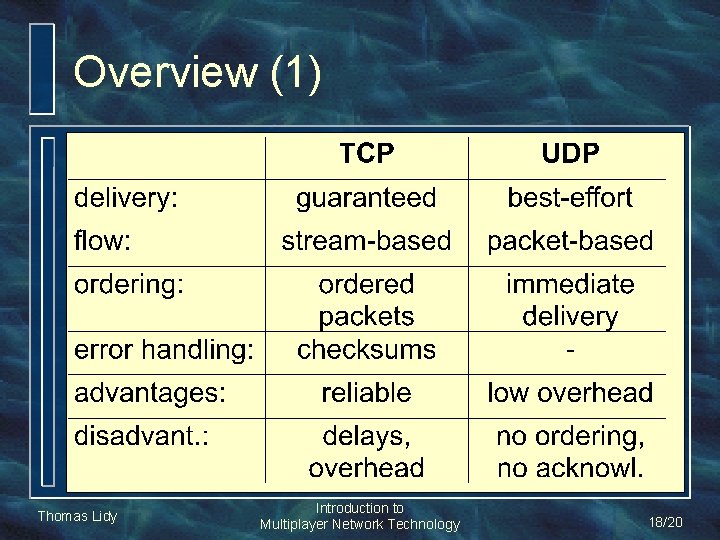
Transmission Control Protocol (TCP) layered on top of IP ( TCP/IP) n simple point-to-point connection n automatic acknowledgments n error checking n correct packet order n reliability n Thomas Lidy Introduction to Multiplayer Network Technology 12/20
User Datagram Protocol (UDP) also layered on top of IP n connectionless n packet-by-packet basis n best-efforts delivery (not reliable) n less processing time faster n deal with packet loss and ordering! n Thomas Lidy Introduction to Multiplayer Network Technology 13/20
IP Broadcasting instead of sending multiple copies of a packet to all destinations n single transmission to all hosts in the network n broadcasting to address 255 n disadvantages: n – – Thomas Lidy expensive for hosts that are not interested delivery only on LAN - not Internet-wide! Introduction to Multiplayer Network Technology 14/20
IP Multicasting receiver-controlled distribution n interested hosts subscribe to a list n packets are sent down distribution paths n no burdens for hosts not interested n less overhead than broadcasting n appropriate for Internet use n Thomas Lidy Introduction to Multiplayer Network Technology 15/20
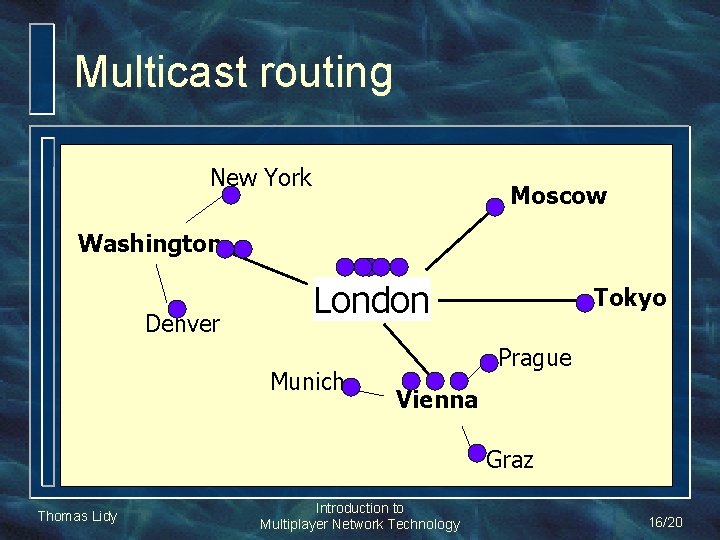
Multicast routing New York Moscow Washington Denver London Munich Tokyo Prague Vienna Graz Thomas Lidy Introduction to Multiplayer Network Technology 16/20
IP Multicasting n addressing – – n pseudo IP (class D address): range 224. 0. 0. 0 - 239. 255 can be used temporarily or reserved by IANA problems – – – Thomas Lidy routers must be multicast-capable not yet available troughout the Internet multicast routers communicate directly with each other through the MBONE Introduction to Multiplayer Network Technology 17/20
Overview (1) Thomas Lidy Introduction to Multiplayer Network Technology 18/20
Overview (2) Thomas Lidy Introduction to Multiplayer Network Technology 19/20
Networking today - Conclusion n n networking: essential part of multi player environments designers must carefully select protocols and network archtitecture multicasting: most efficient technique for large-scale net. VEs games today use client/server, peer-to-peer multicasting probably becomes more globally available with IPv 6 Thomas Lidy Introduction to Multiplayer Network Technology 20/20
The End Thomas Lidy