
Introduction to Metal and Sand Casting Fundamentals of
- Slides: 13
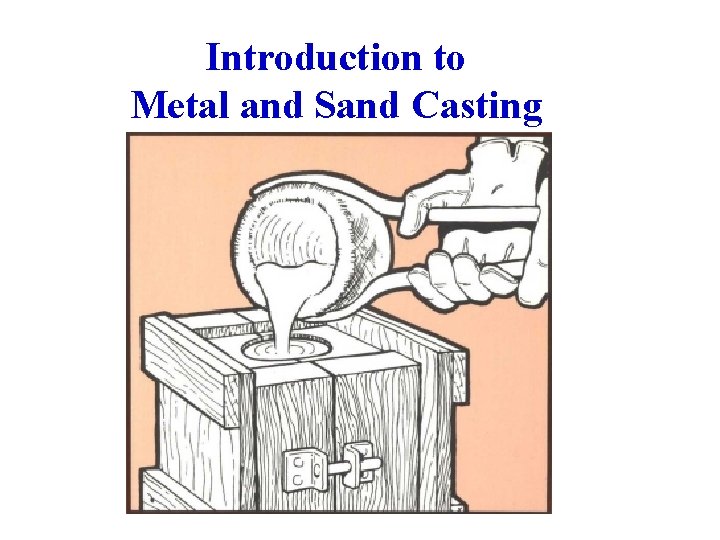
Introduction to Metal and Sand Casting
Fundamentals of Casting Ø Casting, one of the oldest manufacturing processes, dates back to 4000 B. C. when copper arrowheads ( )ﺭﺃﺲ ﺍﻟﺴﻬﻢ were made. Ø Casting processes basically involve the introduction of a molten metal into a mold cavity, where upon solidification, the metal takes on the shape of the mold cavity. Ø Simple and complicated shapes can be made from any metal that can be melted. Ø Casting sizes range form few mm (teeth of a zipper )ﺳﺴﺘﺔ to 10 m (propellers of ocean liners ﺭﻓﺎﺹ ﺑﻮﺍﺧﺮ )ﺍﻟﻤﺤﻴﻂ.
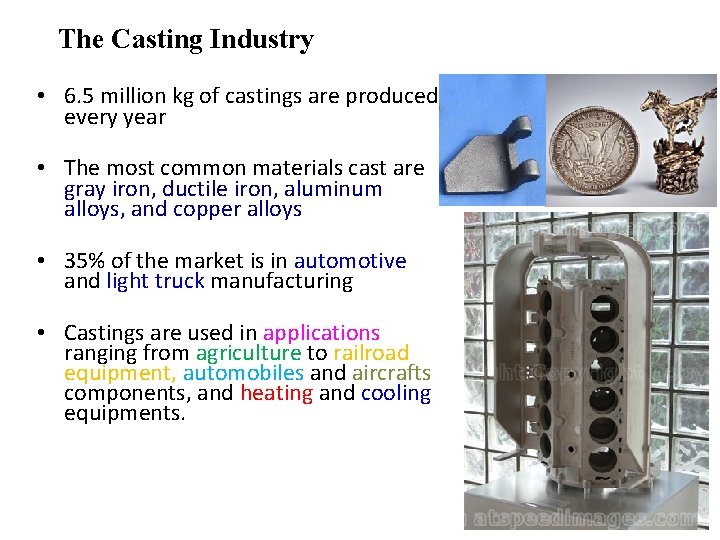
The Casting Industry • 6. 5 million kg of castings are produced every year • The most common materials cast are gray iron, ductile iron, aluminum alloys, and copper alloys • 35% of the market is in automotive and light truck manufacturing • Castings are used in applications ranging from agriculture to railroad equipment, automobiles and aircrafts components, and heating and cooling equipments.
Capabilities and Advantages of Casting 1. 2. 3. 4. 5. 6. Can create complex part geometries Can create both external and internal shapes Some casting processes are net shape; others are near net shape Cast material is isotropic. It has the same physical and mechanical properties along any direction. It is economical, with very little wastage: the extra metal in each casting is remelted and re-used Can produce a wide variety of sized parts: – Large parts: engine blocks, cylinder heads, railway wheels, pipes……etc. – Small parts: dental crowns, jewelry, gears, brake components. Limitations of Casting 1. 2. 3. 4. Porosity (empty spaces within the metal - reduces the strength of metal) Limitations on mechanical properties Poor dimensional accuracy and surface finish for some processes (sand casting) Safety hazards to workers due to hot molten metals
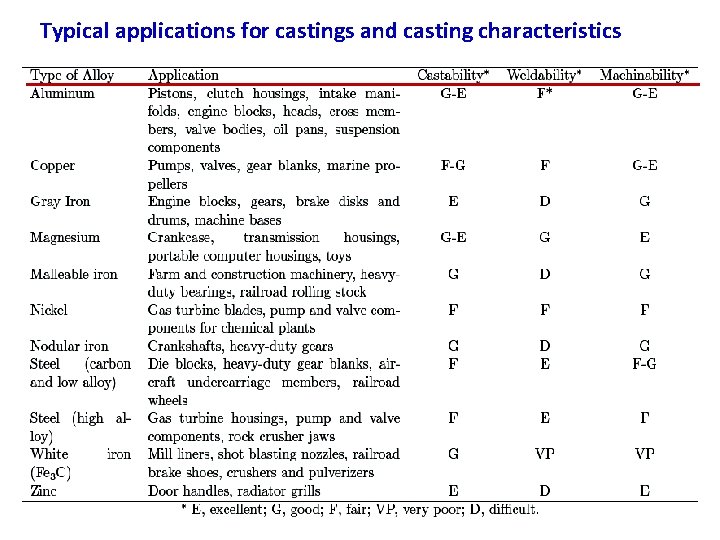
Typical applications for castings and casting characteristics
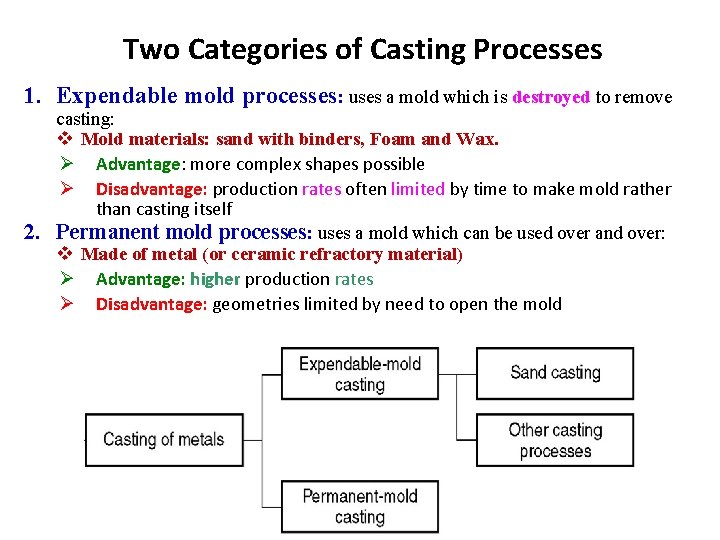
Two Categories of Casting Processes 1. Expendable mold processes: uses a mold which is destroyed to remove casting: v Mold materials: sand with binders, Foam and Wax. Ø Advantage: more complex shapes possible Ø Disadvantage: production rates often limited by time to make mold rather than casting itself 2. Permanent mold processes: uses a mold which can be used over and over: v Made of metal (or ceramic refractory material) Ø Advantage: higher production rates Ø Disadvantage: geometries limited by need to open the mold
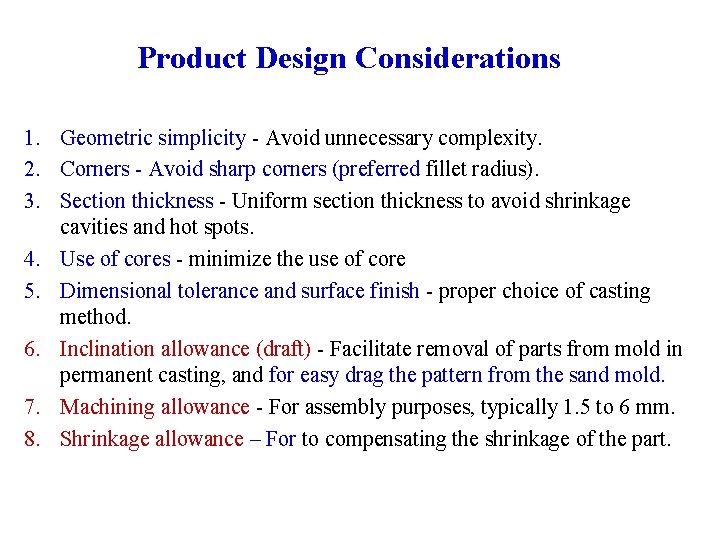
Product Design Considerations 1. Geometric simplicity - Avoid unnecessary complexity. 2. Corners - Avoid sharp corners (preferred fillet radius). 3. Section thickness - Uniform section thickness to avoid shrinkage cavities and hot spots. 4. Use of cores - minimize the use of core 5. Dimensional tolerance and surface finish - proper choice of casting method. 6. Inclination allowance (draft) - Facilitate removal of parts from mold in permanent casting, and for easy drag the pattern from the sand mold. 7. Machining allowance - For assembly purposes, typically 1. 5 to 6 mm. 8. Shrinkage allowance – For to compensating the shrinkage of the part.
Sand Casting
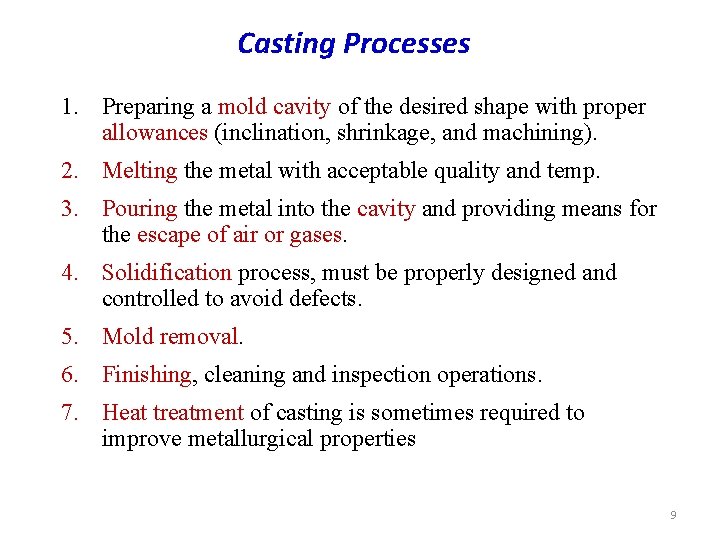
Casting Processes 1. Preparing a mold cavity of the desired shape with proper allowances (inclination, shrinkage, and machining). 2. Melting the metal with acceptable quality and temp. 3. Pouring the metal into the cavity and providing means for the escape of air or gases. 4. Solidification process, must be properly designed and controlled to avoid defects. 5. Mold removal. 6. Finishing, cleaning and inspection operations. 7. Heat treatment of casting is sometimes required to improve metallurgical properties 9
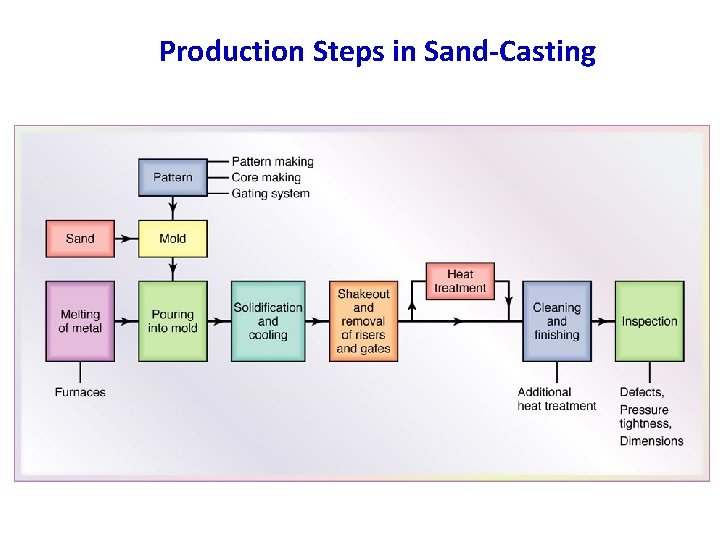
Production Steps in Sand-Casting
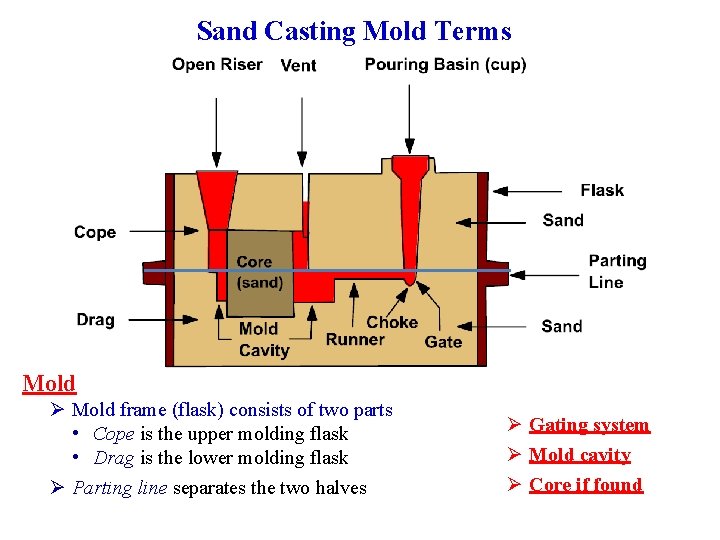
Sand Casting Mold Terms Mold Ø Mold frame (flask) consists of two parts • Cope is the upper molding flask • Drag is the lower molding flask Ø Parting line separates the two halves Ø Gating system Ø Mold cavity Ø Core if found
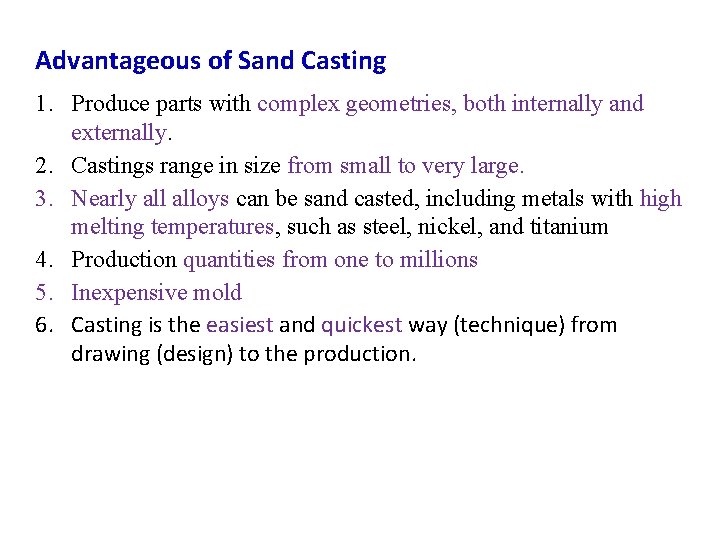
Advantageous of Sand Casting 1. Produce parts with complex geometries, both internally and externally. 2. Castings range in size from small to very large. 3. Nearly alloys can be sand casted, including metals with high melting temperatures, such as steel, nickel, and titanium 4. Production quantities from one to millions 5. Inexpensive mold 6. Casting is the easiest and quickest way (technique) from drawing (design) to the production.
Disadvantageous of Sand Casting 1. Porosity ( ( )ﺍﻟﻤﺴﺎﻣﻴﺔ empty spaces within the metal - reduces the strength of metal) 2. Limitation on mechanical properties 3. Poor dimensional accuracy 4. Poor surface finish 5. Safety hazards to humans and environmental problems 6. Slower production rate 7. Removal of pattern of the thin and small parts is very difficult