
WATER Dr Muhammad Shoaib MBBS MPH Senior Lecturer
WATER Dr. Muhammad Shoaib MBBS, MPH Senior Lecturer Department of community Medicine MBBS MC
Potable Water: Water that is free from pathogenic agents and harmful chemical substances, pleasant to taste, free from smell and has no harmful effects on the body even after prolonged use is called potable water.
Daily requirement of water: 150 -200 liters ( 35 -40 gallons ) are required person per day for all purposes.
Polluted water: Water that contains offensive and not necessarily the infectious materials is called polluted water. Water that contains necessarily infectious agent is called contaminated water.
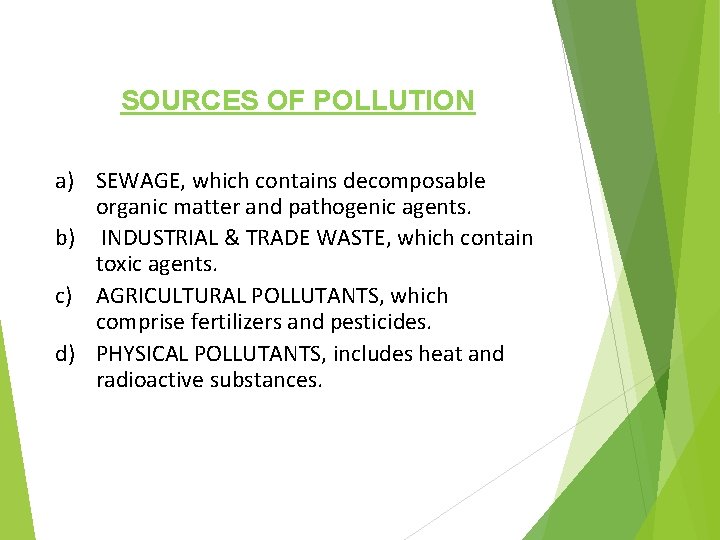
SOURCES OF POLLUTION a) SEWAGE, which contains decomposable organic matter and pathogenic agents. b) INDUSTRIAL & TRADE WASTE, which contain toxic agents. c) AGRICULTURAL POLLUTANTS, which comprise fertilizers and pesticides. d) PHYSICAL POLLUTANTS, includes heat and radioactive substances.
HAZARDS OF WATER POLLUTION Man’s health may be affected by the ingestion of contaminated water directly or through food and by the use of contaminated water for purposes of personal hygiene and recreation. The hazards of water pollution may be classified into two broad groups: ❖ Biological Hazards ❖ Chemical Hazards
BIOLOGICAL HAZARDS: - These comprise the classical water borne diseases caused by the presence of an infective agents or an aquatic host in water.
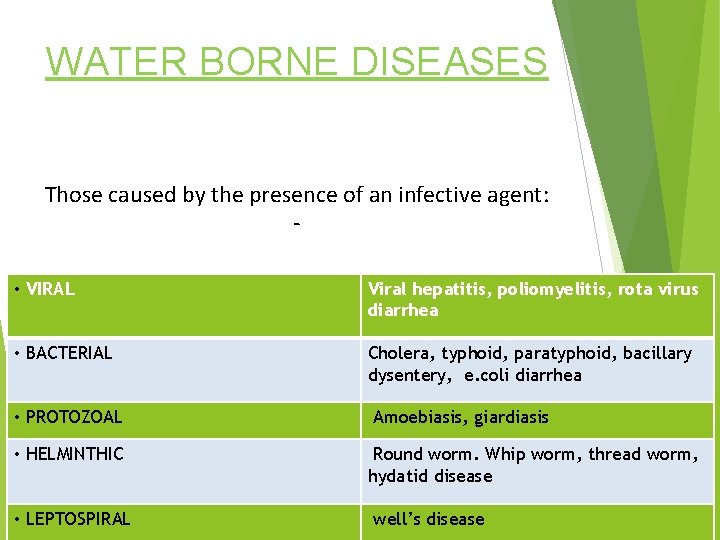
WATER BORNE DISEASES Those caused by the presence of an infective agent: • VIRAL Viral hepatitis, poliomyelitis, rota virus diarrhea • BACTERIAL Cholera, typhoid, paratyphoid, bacillary dysentery, e. coli diarrhea • PROTOZOAL • HELMINTHIC • LEPTOSPIRAL Amoebiasis, giardiasis Round worm. Whip worm, thread worm, hydatid disease well’s disease
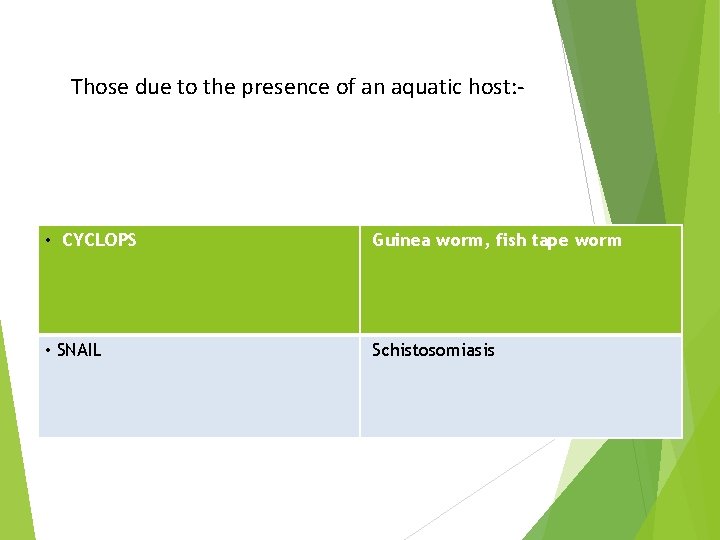
Those due to the presence of an aquatic host: - • CYCLOPS Guinea worm, fish tape worm • SNAIL Schistosomiasis
CHEMICAL HAZARDS: Chemical pollutants from industrial and agricultural wastes are increasingly finding their way into public water supplies. These pollutants include detergent solvents, cyanides, heavy metals, minerals & organic acids, nitrogenous substances, bleaching agents, dyes, pigments, sulfides, ammonia and toxic organic compounds.
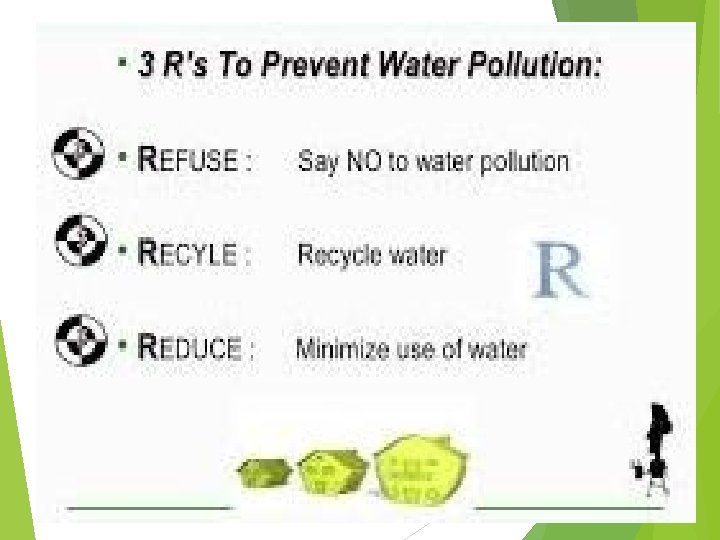
METHODS TO PREVENT POLLUTION 1. Educating the public about its harmful effects to human and environment. 2. Environmental laws. 3. Do not dispose off household chemicals or cleaning agents down the sink or toilet. 4. Reuse, Recycle and Reduce the use of water.
HARDNESS OF WATER Hardness may be defined as “soap destroying power of water”. • Water is considered as hard if large quantities of soap are required to produce lather. • Hardness is mainly caused by: Ø Calcium & Magnesium bicarbonates ( Temporary Hardness ) Ø Calcium & Magnesium sulphates, Chlorides and nitrates. ( Permanent Hardness)
Temporary hardness is also called as “carbonate hardness” and Permanent hardness is also called as “non-carbonate hardness. Hardness is expressed in terms of milli equivalent per liter. 1 m. Eq/L of hardness producing ion is equal to 50 mg Ca. CO 3 in one liter of water. Studies have shown that hard water decreases the prevalence of IHD & HTN.
DISADVANTAGES OF HARDNESS 1. It consumes more soap & detergents. 2. When hard water is heated, the carbonates are precipitated and bring about is furring or scaling of boilers adversely effects cooking. food cooked in soft water retains its natural color and appearance. 3. Fabrics washed in hard water do not have a long life. 4. Hardness shortens the life of pipes & fixtures.
REMOVAL OF HARDNESS 1. a. b. c. d. REMOVAL OF TEMPORARY HARDNESS: Boiling Addition of lime Addition of sodium carbonate Permutit process 2. REMOVAL OF PERMANENT HARDNESS: a. Addition of sodium carbonate b. Permutit process ( Base Exchange Process)
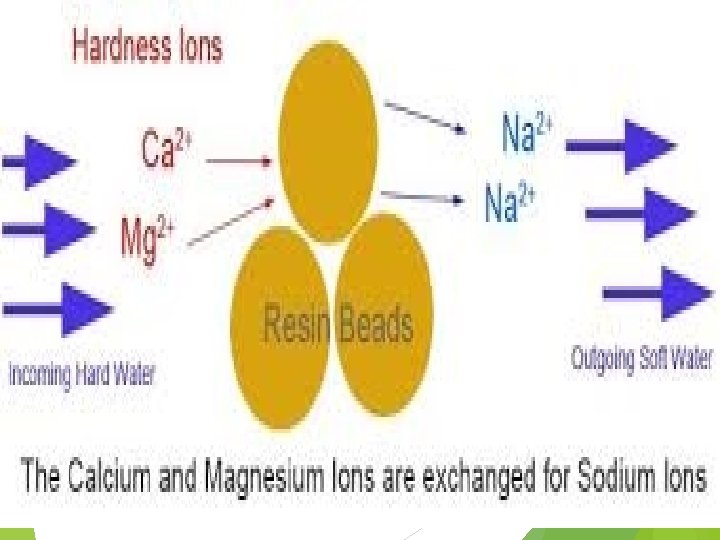
PERMUTIT PROCESS ( Base Exchange Process) In the treatment of large supplies, permutit process is used. Sodium permutit is a complex compound of sodium, aluminium and silica. It has the property of exchanging sodium cation for calcium & magnesium ions in water. When hard water is passed through the permutit the calcium & magnesium ions are entirely removed by base exchange and sodium permutit is converted into calcium & magnesium permutit.
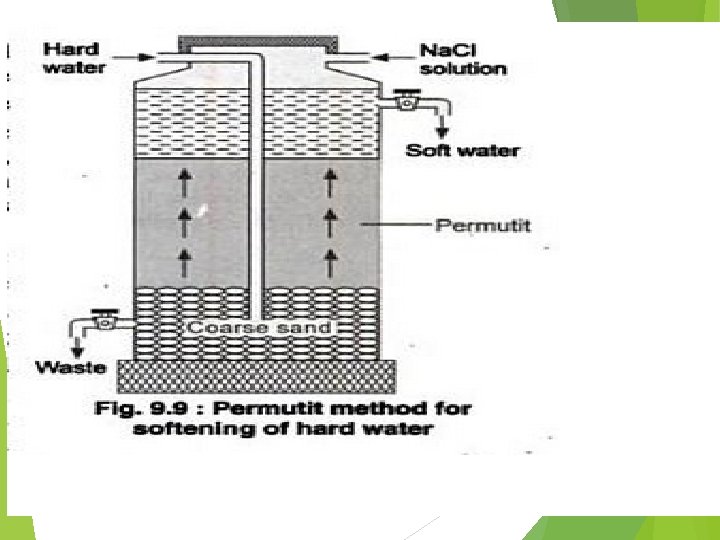
By this process, water can be converted to ZERO hardness, since water of zero hardness is corrosive, a part of raw water is mixed with the softened water to secure the desired hardness. ADVANTAGES: • It can be regenerated by treating with concentrated solution of sodium chloride or brine and washing away the soluble calcium & magnesium chloride formed. • It removes both temporary & permanent hardness.
PURIFICATION OF WATER Purification of water is very important and it is done 1. On a large scale 2. On a small scale 1. PURIFICATION OF WATER ON A LARGE SCALE: Large scale water supplies are derived either from deep wells or surface water. Deep wells are usually satisfactory while surface water is generally contaminated and requires purification to render them safe for domestic use.
It is purified in 4 stages: 1. Storage 2. Sedimentation 3. Filtration 4. Chlorination 1. STORAGE: It is one of the best means of improving water quality. 1. ADVANTAGES: a. It reduces the bacterial content of water. It is one of the greatest benefit of storage.
b. Suspended impurities also settles down due to the effect of gravity. c. It decreases the level of free ammonia and causes rise of nitrates due to oxidizing action of aerobic bacteria upon organic matter. • LIMITATIONS: Storage beyond 2 weeks is not recommended due to growth of algae that result in change in taste & odor. Copper sulphate may be added to control algae. Ø
2. SEDIMENTATION: Storage allows heavier particles to settle down this is called as sedimentation. It is preliminary to filtration and It can be hastened by addition of chemical coagulant called ALUM (Aluminium Sulphate) with a dose of about 35 mg/litre and it is detained for about 4 -6 hours then clarified water is taken out. If water becomes acidic, lime must be added to neutralize it. • ADVANTAGE: It helps rapid clogging of filters.
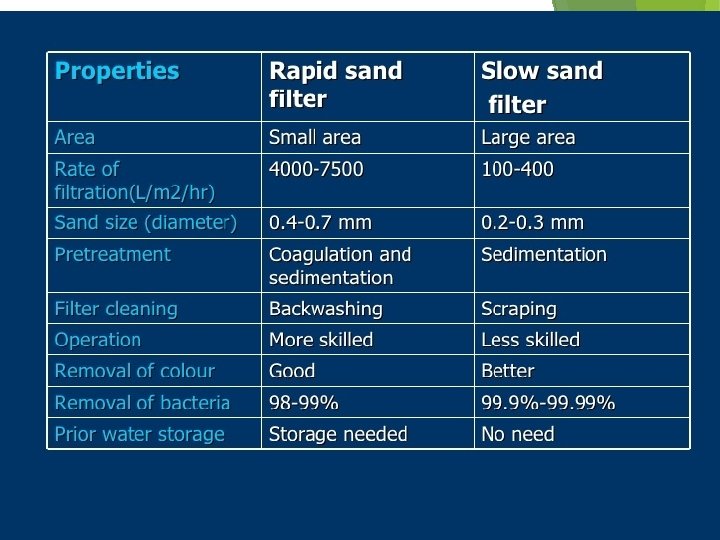
3. FILTRATION: Sand is the oldest and most universally used method of purification. Two main type of filters are commonly used: • Slow sand or biological filters using fine sand • Rapid sand or mechanical filters using coarse sand.
SLOW SAND FILTER First used for water purification in 1804 in Scotland. It is generally accepted as the standard method of water purification. It consists of: A. Supernatant / raw water B. Sand bed C. An under drainage system D. A system of filter control valves
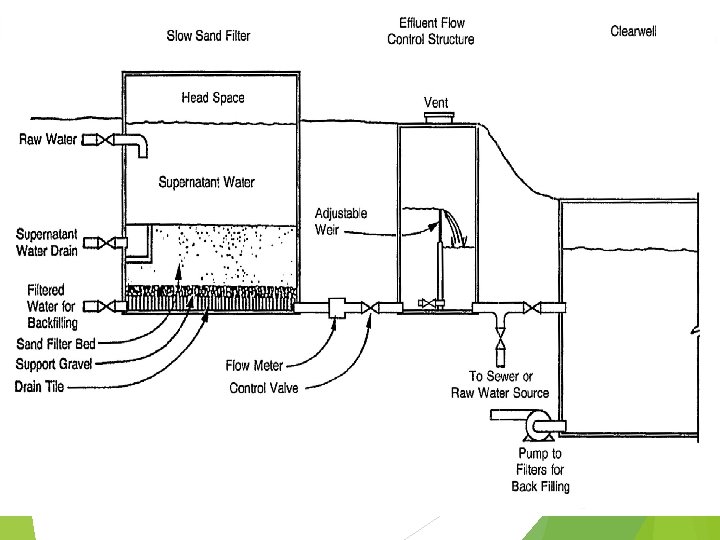
A. SUPERNATANT / RAW WATER: Water which is present above the sand bed is called as supernatant water. Its level always kept constant. A. PURPOSE: => It provides a constant head of water so as to overcome the resistance of the filter bed. => It promotes the downward flow of water through the sand bed. => It provides a waiting period of some hours for the raw water to undergo partial purification by sedimentation and oxidation.
B. SAND BED: • QUALITIES: It is the most important part of the filter. Its thickness is about 1. 2 meters. Its diameter is between 0. 15 -0. 35 mm. It should be clean & free from clay and organic matter. It is supported by a layer of graded grave which also prevents the fine grains being carried into the drainage pipes.
MECHANISM OF ACTION: Water percolates through the sand bed gradually and is subjected to a number of purification processes namely: • mechanical straining • sedimentation • adsorption • oxidation & bacterial action.
VITAL LAYER: After some time, surface of sand bed gets covered with a slimy & gelatinous layer which consists of thread like algae and plankton, diatoms and bacteria. This layer is called as “vital layer or biological layer”. The formation of vital layer is called as “ripening of filter”
It takes few days for the vital layer to fully formed and once formed it extends for 2 -3 cm into the top portion of sand bed. ADVANTAGES OF VITAL LAYER: 1. It removes organic matter. 2. It holds back bacteria. 3. It oxidizes ammonia nitrogen into nitrates. 4. It yields bacteria free water.
C. UNDER DRAINAGE SYSTEM: It is at the bottom of filter bed. It consists of porous or perforated pipes. Pipes provides: => outlet for filtered water and => supporting the filter medium above.
• FILTER BOX: It is an open box and rectangular in shape. It contains supernatant water, sand bed and under drainage system. D. FILTER CONTROL VALVES: Filter is equipped with valves which are present in the outlet pipe system. • It maintains a steady rate of filtration.
WHEN TO CLEAN THE FILTER BED? ? When the bed resistance increases to such an extent that regulating valve has to be kept fully open, it is time to clean the filter bed. HOW TO CLEAN? ? Supernatant water is drained off and sand bed is cleaned by scraping off the top portion of the sand layer to a depth of 1 -2 cm.
ADVANTAGES OF SLOW SAND FILTER: 1. It is simple to construct & operate. 2. It is cheaper. 3. Physical, chemical & bacteriological quality of filtered water is very high. 4. It reduces bacterial content by 99. 9%.
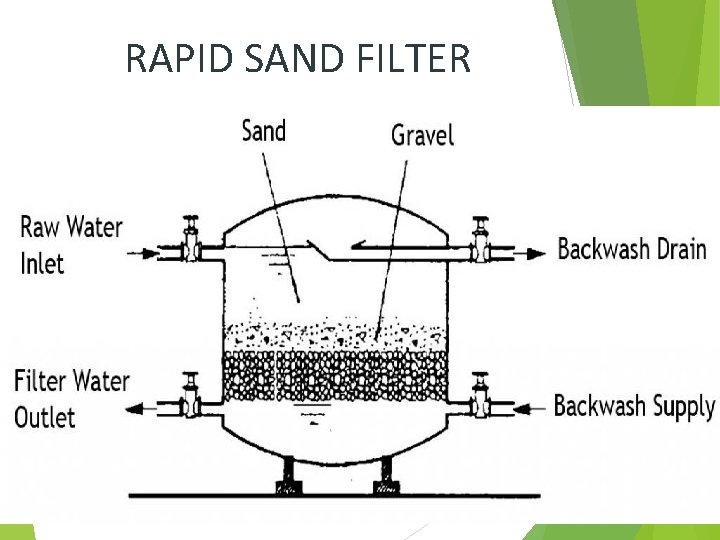
RAPID SAND FILTER They are of two types: 1. Gravity type (Paterson’s type) 2. Pressure type (Candy’s type) • STEPS INVOLVED: They include: • Coagulation • Rapid mixing • Flocculation • Sedimentation • Filtration
RAPID SAND FILTER
• COAGULATION: When raw water is passed through this filter, it is subjected to coagulation. Alum is used in the dose of 5 -40 mg/liter depending upon turbidity & color. The p. H has to be adjusted by adding lime or soda ash.
• RAPID MIXING: The treated water is subjected to rapid mixing in a mixing chamber for few minutes. This allows quick and thorough dissemination of alum throughout the water.
• FLOCCULATION: The next phase is slow and gentle stirring of water in a flocculation chamber for 30 minutes. It results in the formation of thick and copious white flocculent precipitate of aluminium hydroxide.
• SEDIMENTATION: The coagulated water is now led into sedimentation tanks where it is detained for 2 -6 hours when flocculent precipitate together with impurities and bacteria settle down in the tank. That precipitate is called as “sludge” that is removed from time to time without disturbing the operation of the tank.
• FILTRATION: The partly clarified water is now subjected to rapid sand filtration. FILTER BEDS: • It is made up of coarse sand. • Rate of filtration is 5 -15 m 3/m 2/hour. • After some time alum-floc forms slimy layer comparable to vital layer of slow sand filter. • It has same function as that of vital layer.
WHEN AND HOW TO CLEAN RAPID SAND FILTER? ? When the “loss of head” approaches 7 -8 feet, filtration is stopped and filters are subjected to washing process known as “BACK WASHING” • BACK WASHING: Washing which is accomplished by reversing the flow of water through the sand bed is called as back washing.
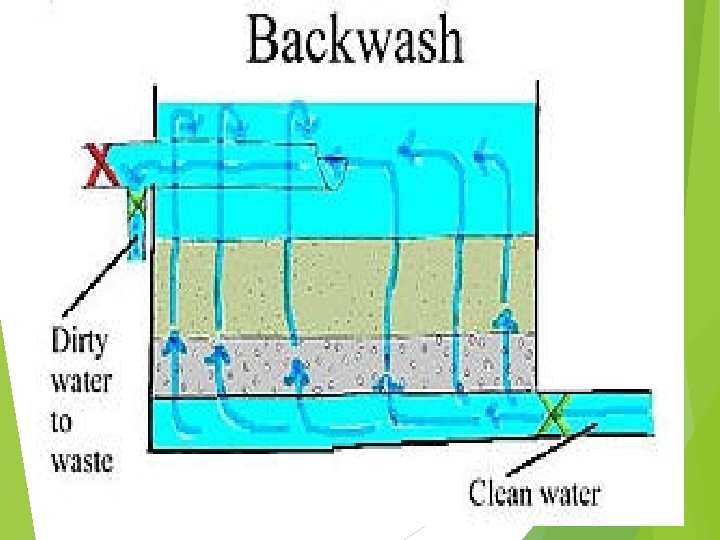
PURPOSE: It dislodges the impurities and cleans up the sand bed. Washing is stopped when clear sand is visible and wash water is sufficiently clear. The whole process takes about 15 minutes.
ADVANTAGES OF RAPID SAND FILTER: 1. 2. 3. 4. 5. 6. 7. They can deal with raw water directly. No preliminary storage is required. The filter beds requires less space. Filtration is rapid. Washing of filter is easy. There is more flexibility of operation. Their initial cost is high but they are cost effective in the long run.
4. CHLORINATION: Chlorination is one of the greatest advances in water purification. ADVANTAGES: • Chlorine kills pathogenic bacteria. • Chlorine oxidizes iron, manganese & hydrogen sulphide. • It destroys some taste & odour producing constituents. • It controls algae. • It aids coagulation.
ACTION OF CHLORINE: When chlorine is added to water there is formation of hydrochloric & hypochloric acid. HCL is neutralized by the alkalinity of water. Hypochloric acid ionizes to form H and hypochlorite ion. Chlorine acts best as disinfectant when the p. H of water is around 7 because of predominance of hypochloric acid.
PRINCIPLES OF CHLORINATION: 1. Water should be clean & free from turbidity. 2. Chlorine demand of water should be estimated. CHLORINE DEMAND: It is the difference between the amount of residual chlorine remaining at the end of a specific period of contact (about 60 minutes) at a given temperature and p. H of water. OR
The amount of chlorine that is required to destroy bacteria and oxidize all organic matter and ammonial substances present in water. BREAK-POINT: The point at which the chloride demand of water is met is called the “break-point”. If further chlorine is added, it begins to appear in the water.
3. The presence of free residual chlorine for a contact period of at least one hour is essential to kill bacteria & viruses. 4. The minimum recommended concentration of free chlorine is 0. 5 gm/l for one hour. 5. The sum of chlorine demand of specific water plus free residual chlorine of 0. 5 gm/l constitutes the correct dose of chlorine to be applied.
METHOD OF CHLORINATION: For disinfecting on a large scale, chlorine is applied either as chlorine gas, chloramine or perchloron. Chlorine gas is the first choice. Chloramines have a slower action and are loose compounds of chlorine and ammonia. Perchloron is a calcium compound which carries 60 -70% of available chlorine.
BREAK-POINT CHLORINATION: Addition of chlorine to water produces chloramines. If chlorine dose in water is increased, a reduction in residual chlorine occurs due to destruction of chloramines by added chlorine. This falling residual chlorine will continue and with further increase in chlorine dose and after a stage, the residual chlorine begins to increase in proportion to the added dose of chlorine.
This point at which the residual chlorine appears and all combined chlorines are completely destroyed is the break point. SUPERCHLORINATION: Super-chlorination followed by de-chlorination comprises the addition of large amount of chlorine to the water and removal of excess chlorine after disinfection. • APPLICABILITY: It is applicable to heavily polluted water whose quality fluctuates greatly.
2. PURIFICATION OF WATER ON A SMALL SCALE: Three methods are generally used either singly or in combination. a. Boiling b. Chemical disinfection c. Filtration
a. BOILING: Water must be brought to a “rolling-boil” for 10 -20 minutes. Disadvantage: It does not offer any residual protection against microbial contamination. b. CHEMICAL DISINFECTION: 1). BLEACHING POWDER: It is a white amorphous powder with a pungent
smell of chlorine. Also called as chlorinated lime. Free residual chlorine of 0. 5 mg/l at the end of one hour contact must be ensured. 2). CHLORINE SOLUTION: May be prepared from bleaching powder. 3). HIGH TEST HYPOCHLORITE: It is a calcium compound which contains 6070% of available chlorine. It is more stable than bleaching powder.
4). CHLORINE TABLETS: They are good for disinfecting small quantities of water but are costly e. g Halazone tablets. 5). IODINE: It may be used for emergency disinfection of water. 2 drops of 2% ethanol solution of iodine will suffice for one liter of water. 20 -30 mins of contact time is required. Disadvantage: • High cost • It is physiologically active
c. FILTRATION: Water can be purified on a small scale by filtering through ceramic filters such as Pasteur Chamber land filter. The essential part of the filter is “candle” made of porcelain.
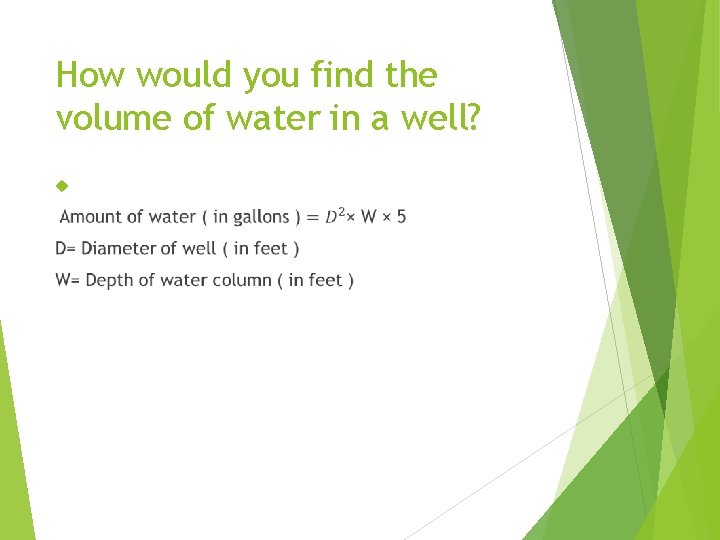
How would you find the volume of water in a well?

THANK YOU
- Slides: 63