Introduction to Linguistics II Ling 2 121 C

- Slides: 24
Introduction to Linguistics II Ling 2 -121 C, group b Lecture 6 Eleni Miltsakaki AUTH Spring 2006 1
Review: Semantics • • What is semantics? – The study of the linguistic meaning of morphemes, words, phrases, and sentences. What is lexical semantics? – The study of the meaning of words and the meaning relations among them. • What is ‘the lexicon”? • • – The mental storehouse of the info about words and morphemes What is phrasal or sentential semantics? – The meaning of syntactic units larger than the word What is pragmatic meaning? – The effect of context on sentence meaning. E. g. , “It’s open here” meaning “Open the window” 2
Review: Semantics • What are ‘semantic properties’? Name a few. – Human, young, male, etc. • What evidence do we have for the existence of semantic properties? – Slips of the tongue • How do we represent semantic properties – Features with positive and negative values 3
Semantics: Review • What are: – Homonyms – Polysemy – Heteronyms – Homographs 4
Synonyms • Words that sound different but have the same (or almost the same) meaning are synonyms. – Apathetic, phlegmatic, passive, sluggish, indifferent – Sofa, couch • Degree of similarity depends on number of semantic properties that two words share 5
Antonyms • Words that are opposite in meaning are antonyms – Beautiful – ugly (=not beautiful) – Big – small, hot – cold • Gradable properties – Tiny, small, medium, large, huge, gigantic – “not tiny” doesn’t mean “gigantic”. 6
Gradable antonyms • Marked – unmarked – How high is the mountain? (not “How low is the mountain? ”) – “high” is the unmarked member of the pair “high-low” 7
Relational opposites • Relational opposites display symmetry in their meaning: e. g. , if X gives Y to Z then Z receives Y from X – Give – receive – Buy – sell – Teacher – pupil • Comparative forms of gradable pairs of adjectives often form relational pairs – Mary is taller than Sally – A Mercedes is more expensive than a Smart. 8
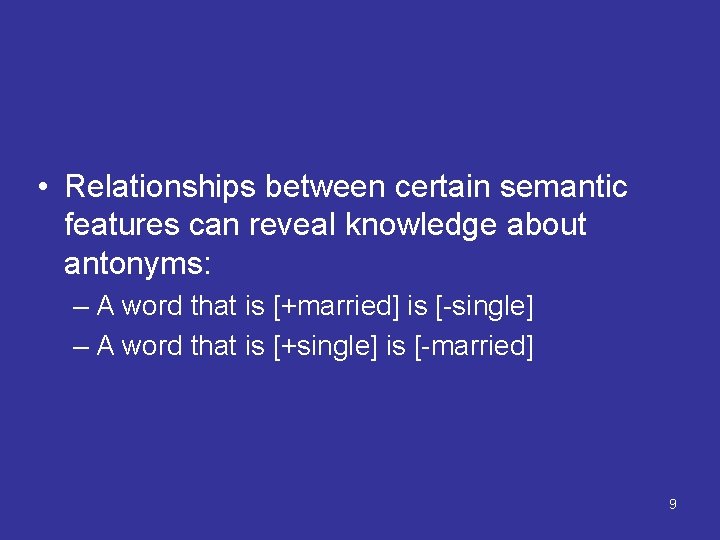
• Relationships between certain semantic features can reveal knowledge about antonyms: – A word that is [+married] is [-single] – A word that is [+single] is [-married] 9
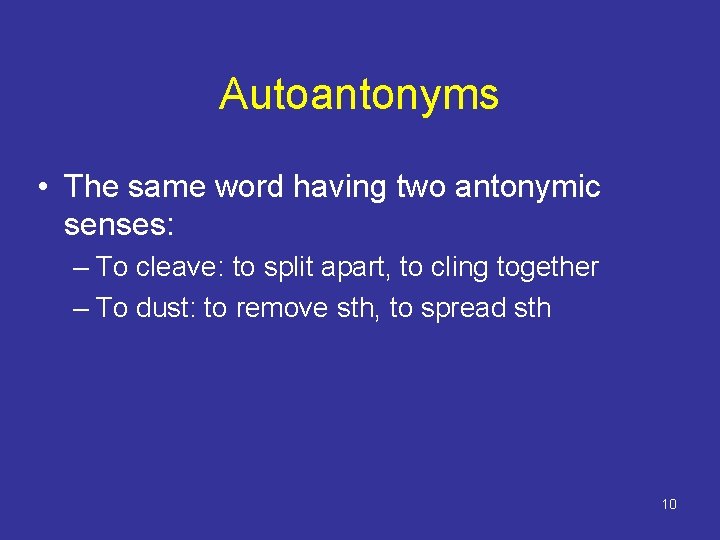
Autoantonyms • The same word having two antonymic senses: – To cleave: to split apart, to cling together – To dust: to remove sth, to spread sth 10
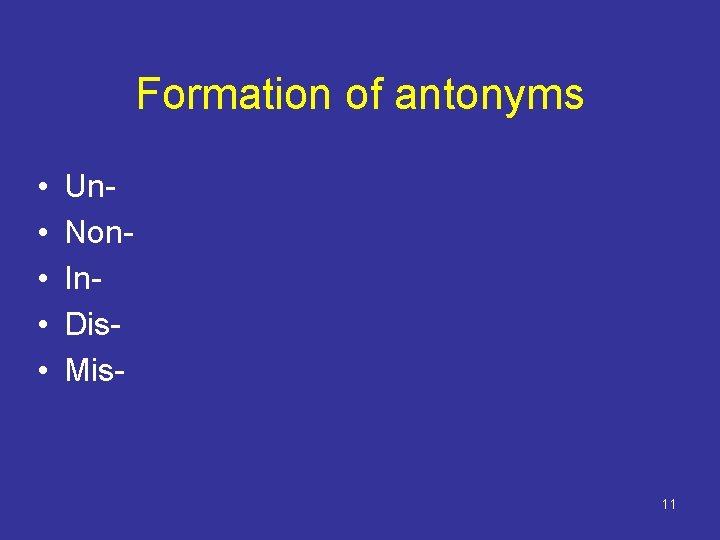
Formation of antonyms • • • Un. Non. In. Dis. Mis- 11
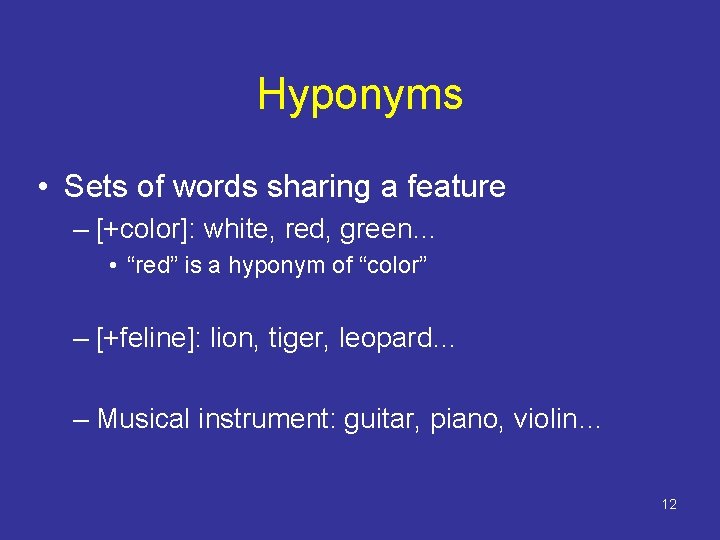
Hyponyms • Sets of words sharing a feature – [+color]: white, red, green… • “red” is a hyponym of “color” – [+feline]: lion, tiger, leopard… – Musical instrument: guitar, piano, violin… 12
Metonyms • A metonym substitutes for the object that is meant, the name of an attribute or concept associated with that object. – Crown: king – Kremlin: government of Russia 13
Retronyms • Expressions that used to be redundant – Day baseball – Silent movie – Surface mail 14
Phrase and sentence meaning • The Principle of Compositionality: – The whole is the sum of its parts – The meaning of a phrase is “composed” from the meaning of its parts The study of how word meanings combine into phrase and sentence meanings, and the meaning relationships among these larger units is called phrasal or sentential semantics 15
Phrasal meaning: Nouns • Noun-centered meaning – Red balloon: ‘red’ adds the property ‘red’ to the balloon – The red balloon: ‘the’ means a particular instance of a balloon 16
Adjective and nouns • The semantic rules for adj-noun combinations are complex – A good friend is a kind of friend – But a false friend is not a friend – For an ‘alleged murderer’ we don’t know if we have a murderer or not 17
Nouns and prepositions • With: accompanies, is part of • In: spatial relationship… • Headedness: – “the house with the white fence” is a hous – Red brick: kind of brick – But brick red: a shade of red (because red is the head) 18
Noun compounds • In noun compounds the head is the final noun – Doghouse: kind of house – Housedog: kind of dog 19
• Meanings build on meanings! • Meaning combinations make sense because of the semantic rules of grammar. 20
Sense and reference • Knowing the meaning of a noun means knowing what the noun refers to. – The mason put the red brick on the wall • Knowing the meaning of ‘red brick’ means that we are able to identify the object. • The object “pointed to” by the description “the red brick” is called the referent. • The noun phrase “the red brick” has reference. 21
Sense and reference • If two noun phrases refer to the same object, they are called coreferential. • This doesn’t mean they have the same “meaning”! • Some additional meaning is present with a different description, called sense. 22
Sense and reference • A noun phrase has sense and reference and the combination of the two constitutes its meaning. • Knowing the sense of a noun (intension) helps us identify its reference (extension) • Consider “The President of the United States” – Its sense is stable – Its reference changes 23
Sense and reference • Proper names, e. g. , John have reference but no sense • Other nouns have sense and reference, e. g. the President of the U. S. • Others have sense but no reference (The present King of France is bald) 24