Introducing the Narrative Essay Mc Loughlin John FreedHardeman
- Slides: 43
Introducing the Narrative Essay Mc. Loughlin, John. Freed-Hardeman University 2007
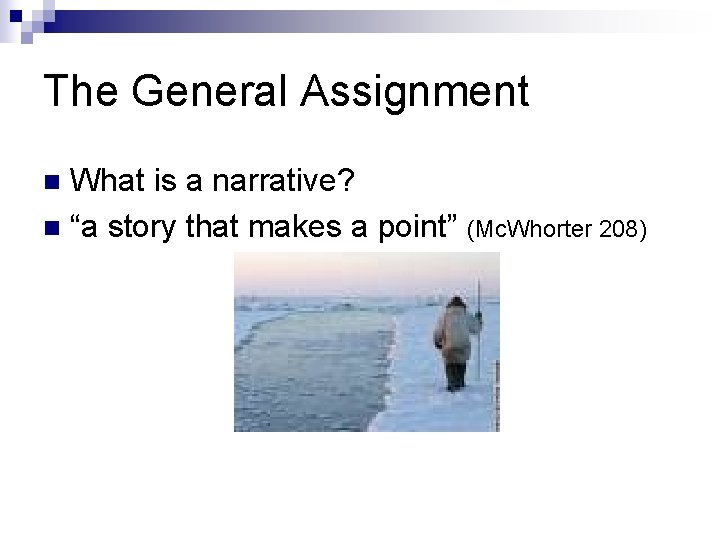
The General Assignment What is a narrative? n “a story that makes a point” (Mc. Whorter 208) n
Why do we tell stories? “We are drawn to stories because our own life is a story and we are looking for help. Stories help us in many ways. They tell us we are not alone, and that what has happened to us happened first to others and that they made it through. They also help us see, however, that our own story is not big enough, that the world is larger and more varied than our limited experience. They help us to be more fully human by stimulating and appealing to all that we are—mind, body, spirit. They help by calling us into relationship—with other people, with other places and times, with creation, and with God. They help us by giving us courage to be the kinds of characters we should be in our own stories, and by making us laugh, empathize, and exercise judgment. But most of all, stories help us by telling us the truth, without which we cannot live. ”—Daniel Taylor
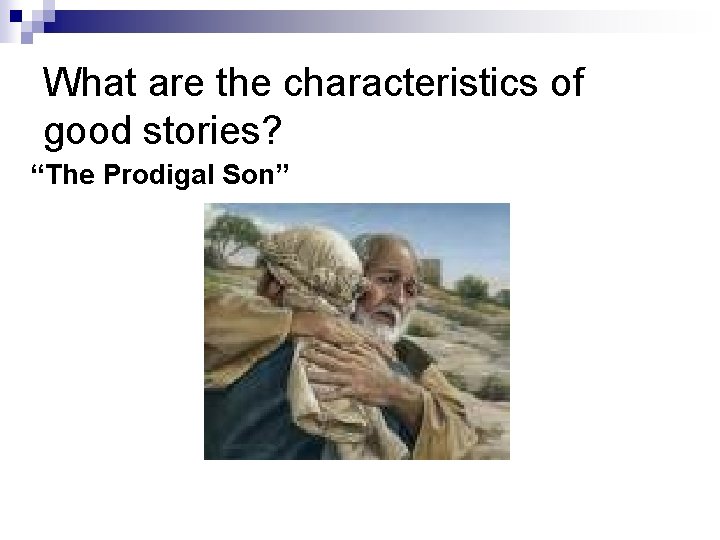
What are the characteristics of good stories? “The Prodigal Son”
Narratives Have a Plot!! n n n Plot: a unified, coherent, meaningful sequence of events Aristotle: He’s the man! “Tragedy is an imitation of an action that is complete, and whole, and of a certain magnitude. A whole is that which has a beginning, a middle, and an end. A beginning is that which does not itself follow anything by causal necessity, but after which something naturally is or comes to be. An end, on the contrary, is that which itself naturally follows some other thing, either by necessity, or as a rule, but has nothing following it. A middle is that which follows something as some other thing follows it. A well constructed plot, therefore, must neither begin nor end at haphazard [. . . ]”
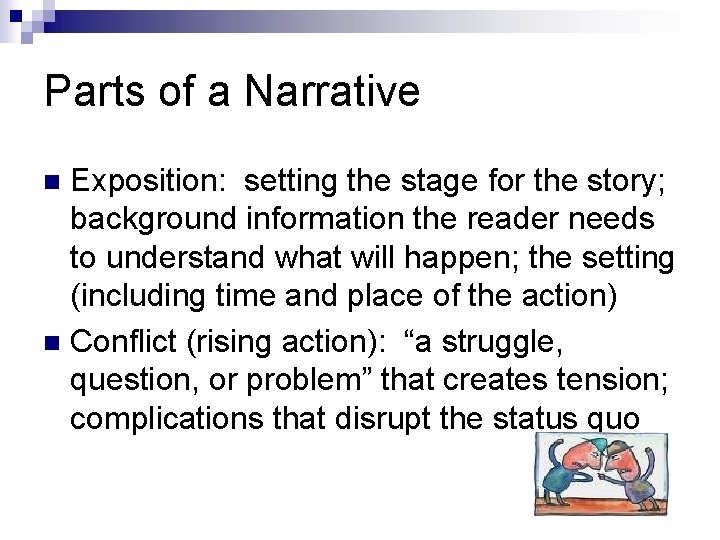
Parts of a Narrative Exposition: setting the stage for the story; background information the reader needs to understand what will happen; the setting (including time and place of the action) n Conflict (rising action): “a struggle, question, or problem” that creates tension; complications that disrupt the status quo n
Parts of a Narrative Climax: the emotional highpoint of the narrative; a moment of crisis; the moment after which nothing else is the same n Denouement: the “unraveling” of the plot; the consequences of the climax n
Advice for Constructing the Narrative Essay Strive for a balance of “show and tell. ” n Consider: Are you writing about an event or experience that is new or unfamiliar to your readers? Or are you writing about an experience that most everyone has had at some point? n
Elements to Include in your Narrative n n n Start by locating the central conflict in your story. Conflict between you and another person. Conflict in yourself. Conflict provides motivation and purpose for characters’ actions and helps your readers stay interested in your story. After you’ve identified the conflict, arrange the action so readers know how the conflict started, how it developed, and how it was resolved. TENSION and PACE are your friends.
It’s OUR turn! Narrative Essay Assignment
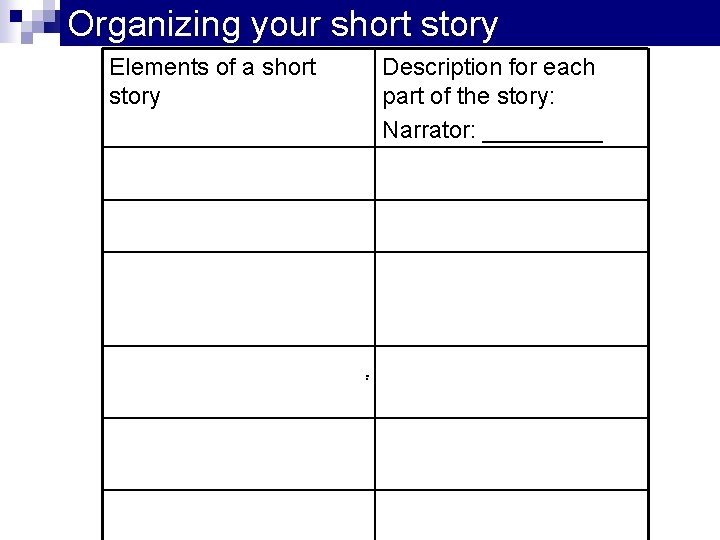
Organizing your short story Elements of a short story Exposition (introduces the setting and the characters) Problem (explains the major conflict in the story) Rising Action (events or actions that develop the conflict and lead to the climax of the story) Climax (highest point of tension in the story; usually at the end of the story) Resolution (how the conflict is resolved; the solution to the problem) Moral (the life lesson of the story) Description for each part of the story: Narrator: _____
Dialogue… things to remember n n n Use dialogue to help reveal the personalities, backgrounds, and ideas of the character. Be careful to use proper punctuation so you clearly communicate to your reader who is speaking. Keep these rules in mind…
Rule #1 n n Enclose a person’s exact words in quotation marks. If you are not using the speaker’s exact words (that is, if you are using indirect quotation), do not use quotation marks. Examples: “You must be quiet while the teacher is reading, Larry, ” the student said impatiently. (direct quotation) ¨ Every time I had pointed out to her the waste of talking in class when we could both talk after class, she had told me it was better like that… (indirect quotation) ¨
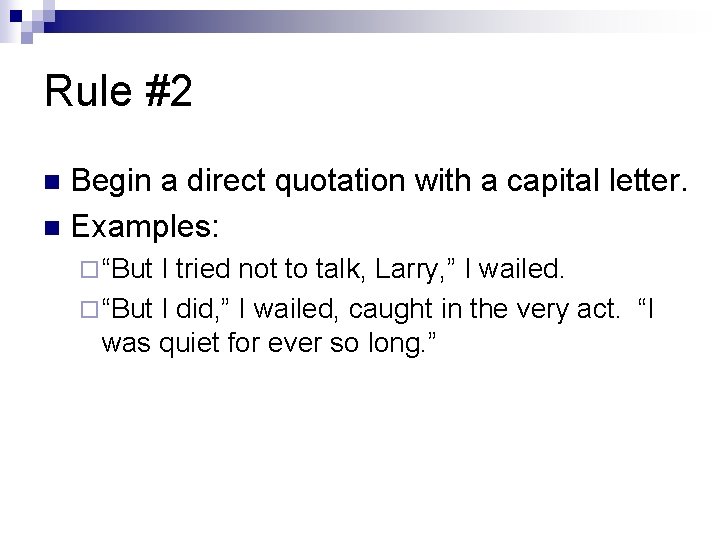
Rule #2 Begin a direct quotation with a capital letter. n Examples: n ¨ “But I tried not to talk, Larry, ” I wailed. ¨ “But I did, ” I wailed, caught in the very act. “I was quiet for ever so long. ”
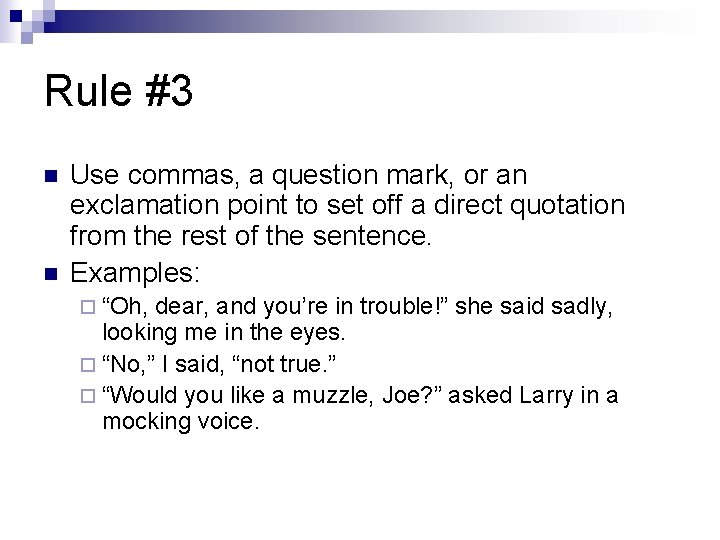
Rule #3 n n Use commas, a question mark, or an exclamation point to set off a direct quotation from the rest of the sentence. Examples: ¨ “Oh, dear, and you’re in trouble!” she said sadly, looking me in the eyes. ¨ “No, ” I said, “not true. ” ¨ “Would you like a muzzle, Joe? ” asked Larry in a mocking voice.
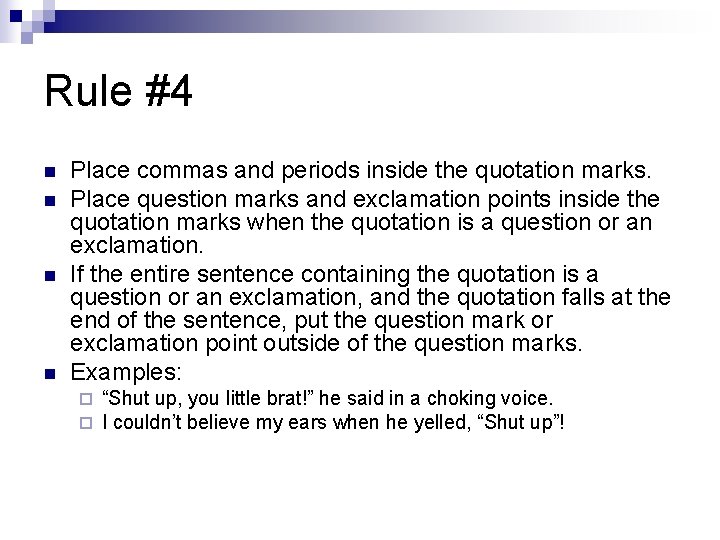
Rule #4 n n Place commas and periods inside the quotation marks. Place question marks and exclamation points inside the quotation marks when the quotation is a question or an exclamation. If the entire sentence containing the quotation is a question or an exclamation, and the quotation falls at the end of the sentence, put the question mark or exclamation point outside of the question marks. Examples: ¨ ¨ “Shut up, you little brat!” he said in a choking voice. I couldn’t believe my ears when he yelled, “Shut up”!
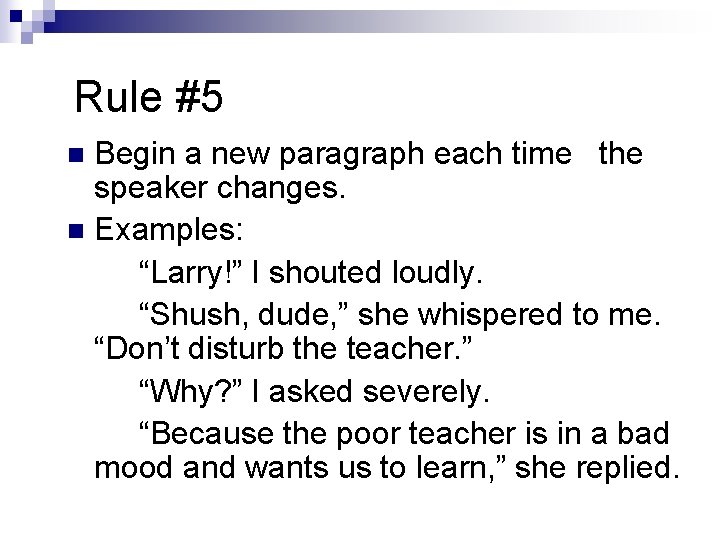
Rule #5 Begin a new paragraph each time the speaker changes. n Examples: “Larry!” I shouted loudly. “Shush, dude, ” she whispered to me. “Don’t disturb the teacher. ” “Why? ” I asked severely. “Because the poor teacher is in a bad mood and wants us to learn, ” she replied. n
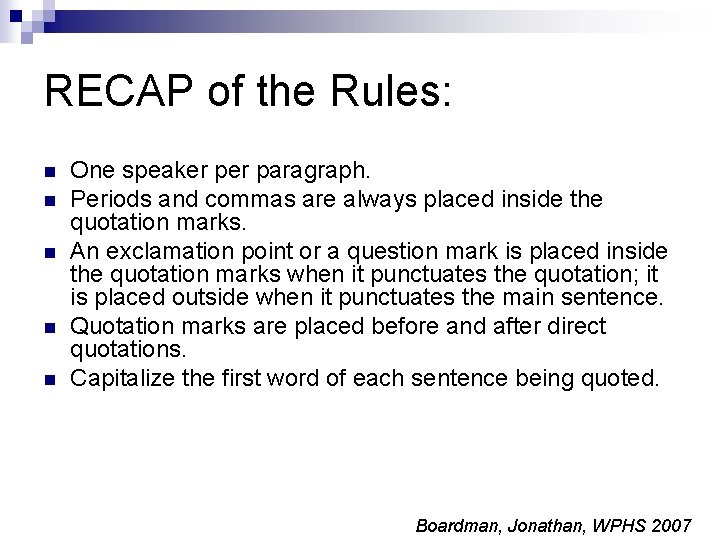
RECAP of the Rules: n n n One speaker paragraph. Periods and commas are always placed inside the quotation marks. An exclamation point or a question mark is placed inside the quotation marks when it punctuates the quotation; it is placed outside when it punctuates the main sentence. Quotation marks are placed before and after direct quotations. Capitalize the first word of each sentence being quoted. Boardman, Jonathan, WPHS 2007
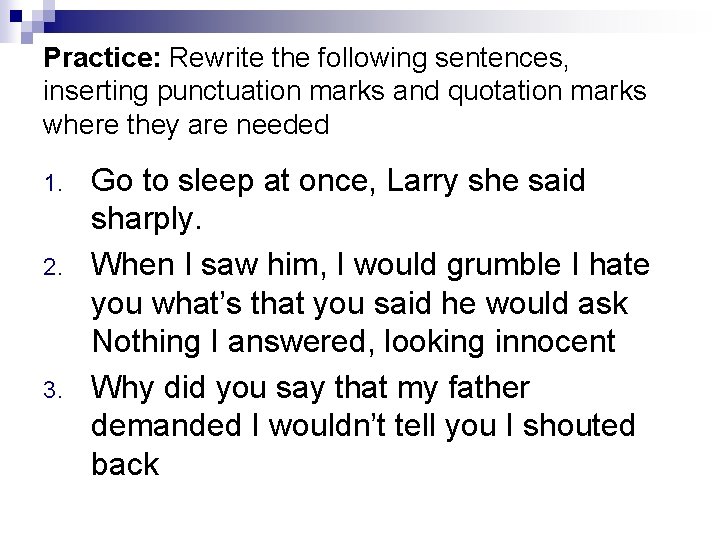
Practice: Rewrite the following sentences, inserting punctuation marks and quotation marks where they are needed 1. 2. 3. Go to sleep at once, Larry she said sharply. When I saw him, I would grumble I hate you what’s that you said he would ask Nothing I answered, looking innocent Why did you say that my father demanded I wouldn’t tell you I shouted back
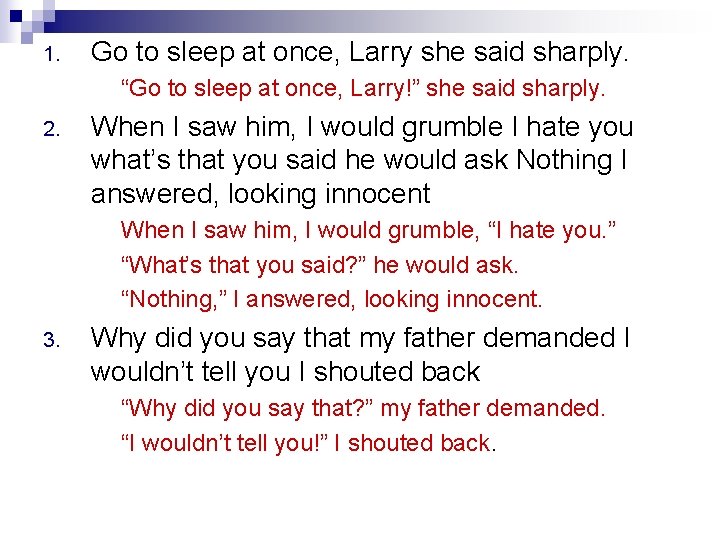
1. Go to sleep at once, Larry she said sharply. “Go to sleep at once, Larry!” she said sharply. 2. When I saw him, I would grumble I hate you what’s that you said he would ask Nothing I answered, looking innocent When I saw him, I would grumble, “I hate you. ” “What’s that you said? ” he would ask. “Nothing, ” I answered, looking innocent. 3. Why did you say that my father demanded I wouldn’t tell you I shouted back “Why did you say that? ” my father demanded. “I wouldn’t tell you!” I shouted back.
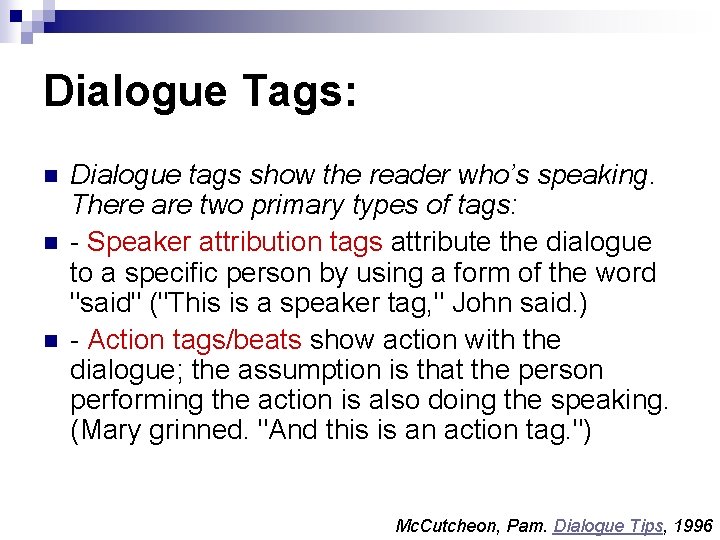
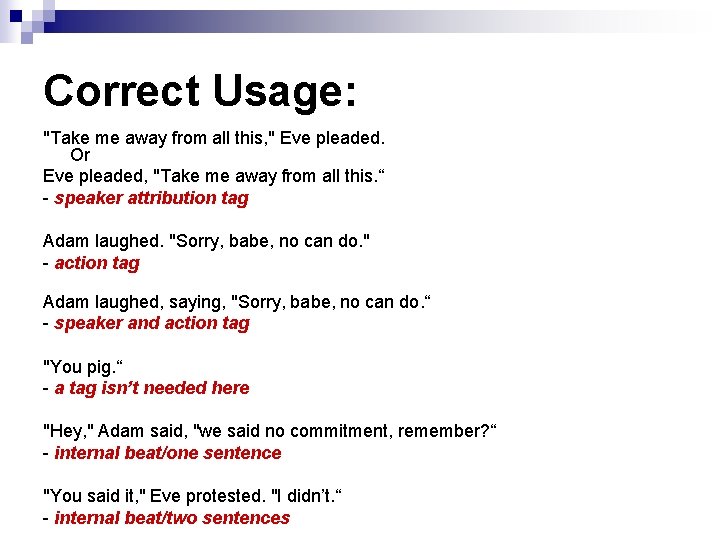
Dialogue Tags: n n n Dialogue tags show the reader who’s speaking. There are two primary types of tags: - Speaker attribution tags attribute the dialogue to a specific person by using a form of the word "said" ("This is a speaker tag, " John said. ) - Action tags/beats show action with the dialogue; the assumption is that the person performing the action is also doing the speaking. (Mary grinned. "And this is an action tag. ") Mc. Cutcheon, Pam. Dialogue Tips, 1996
Correct Usage: "Take me away from all this, " Eve pleaded. Or Eve pleaded, "Take me away from all this. “ - speaker attribution tag Adam laughed. "Sorry, babe, no can do. " - action tag Adam laughed, saying, "Sorry, babe, no can do. “ - speaker and action tag "You pig. “ - a tag isn’t needed here "Hey, " Adam said, "we said no commitment, remember? “ - internal beat/one sentence "You said it, " Eve protested. "I didn’t. “ - internal beat/two sentences
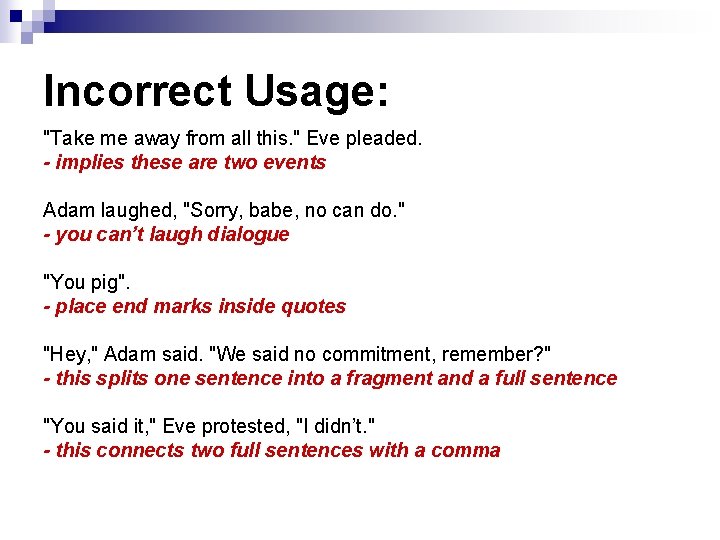
Incorrect Usage: "Take me away from all this. " Eve pleaded. - implies these are two events Adam laughed, "Sorry, babe, no can do. " - you can’t laugh dialogue "You pig". - place end marks inside quotes "Hey, " Adam said. "We said no commitment, remember? " - this splits one sentence into a fragment and a full sentence "You said it, " Eve protested, "I didn’t. " - this connects two full sentences with a comma
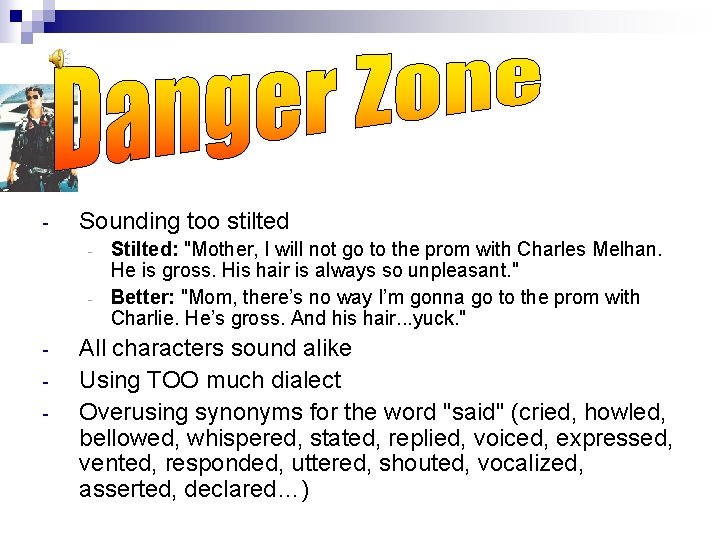
- Sounding too stilted Stilted: "Mother, I will not go to the prom with Charles Melhan. He is gross. His hair is always so unpleasant. " - Better: "Mom, there’s no way I’m gonna go to the prom with Charlie. He’s gross. And his hair. . . yuck. " - - All characters sound alike Using TOO much dialect Overusing synonyms for the word "said" (cried, howled, bellowed, whispered, stated, replied, voiced, expressed, vented, responded, uttered, shouted, vocalized, asserted, declared…)
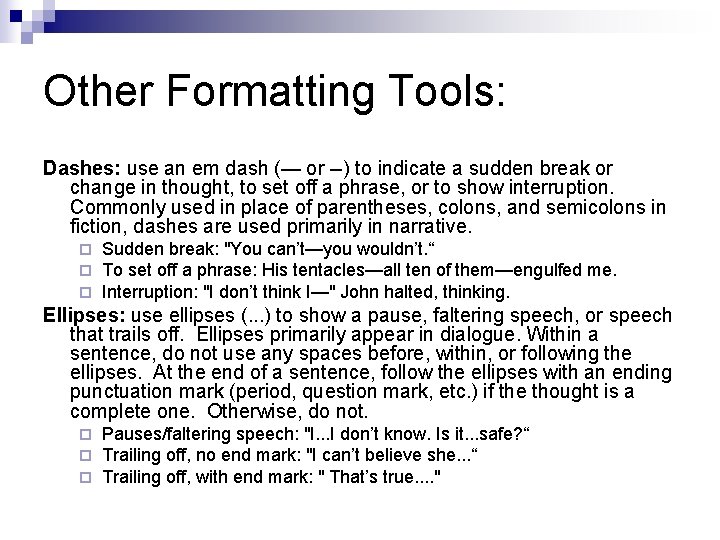
Other Formatting Tools: Dashes: use an em dash (— or --) to indicate a sudden break or change in thought, to set off a phrase, or to show interruption. Commonly used in place of parentheses, colons, and semicolons in fiction, dashes are used primarily in narrative. ¨ ¨ ¨ Sudden break: "You can’t—you wouldn’t. “ To set off a phrase: His tentacles—all ten of them—engulfed me. Interruption: "I don’t think I—" John halted, thinking. Ellipses: use ellipses (. . . ) to show a pause, faltering speech, or speech that trails off. Ellipses primarily appear in dialogue. Within a sentence, do not use any spaces before, within, or following the ellipses. At the end of a sentence, follow the ellipses with an ending punctuation mark (period, question mark, etc. ) if the thought is a complete one. Otherwise, do not. ¨ ¨ ¨ Pauses/faltering speech: "I. . . I don’t know. Is it. . . safe? “ Trailing off, no end mark: "I can’t believe she. . . “ Trailing off, with end mark: " That’s true. . "
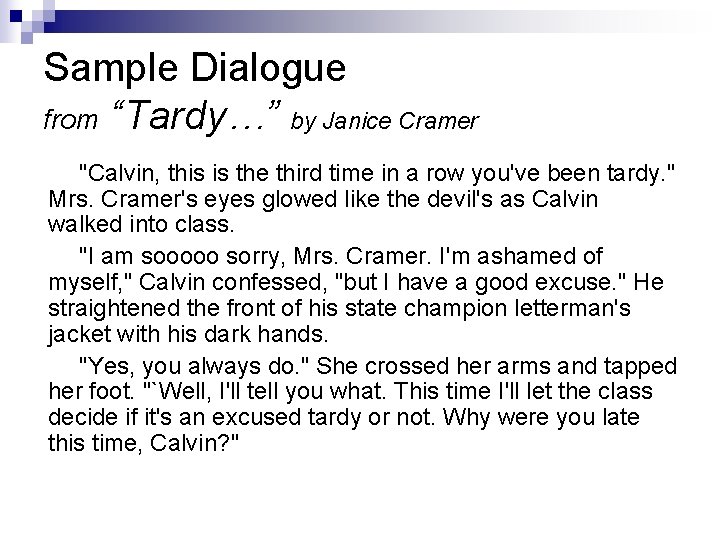
Sample Dialogue from “Tardy…” by Janice Cramer "Calvin, this is the third time in a row you've been tardy. " Mrs. Cramer's eyes glowed like the devil's as Calvin walked into class. "I am sooooo sorry, Mrs. Cramer. I'm ashamed of myself, " Calvin confessed, "but I have a good excuse. " He straightened the front of his state champion letterman's jacket with his dark hands. "Yes, you always do. " She crossed her arms and tapped her foot. "`Well, I'll tell you what. This time I'll let the class decide if it's an excused tardy or not. Why were you late this time, Calvin? "
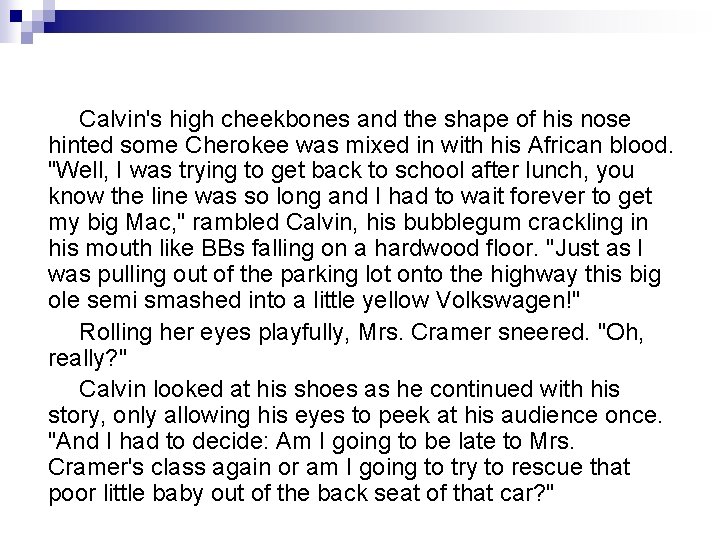
Calvin's high cheekbones and the shape of his nose hinted some Cherokee was mixed in with his African blood. "Well, I was trying to get back to school after lunch, you know the line was so long and I had to wait forever to get my big Mac, " rambled Calvin, his bubblegum crackling in his mouth like BBs falling on a hardwood floor. "Just as I was pulling out of the parking lot onto the highway this big ole semi smashed into a little yellow Volkswagen!" Rolling her eyes playfully, Mrs. Cramer sneered. "Oh, really? " Calvin looked at his shoes as he continued with his story, only allowing his eyes to peek at his audience once. "And I had to decide: Am I going to be late to Mrs. Cramer's class again or am I going to try to rescue that poor little baby out of the back seat of that car? "
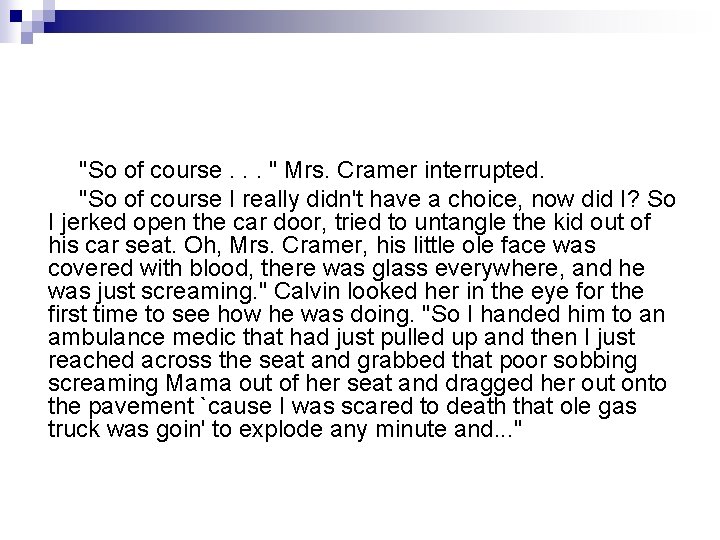
"So of course. . . " Mrs. Cramer interrupted. "So of course I really didn't have a choice, now did I? So I jerked open the car door, tried to untangle the kid out of his car seat. Oh, Mrs. Cramer, his little ole face was covered with blood, there was glass everywhere, and he was just screaming. " Calvin looked her in the eye for the first time to see how he was doing. "So I handed him to an ambulance medic that had just pulled up and then I just reached across the seat and grabbed that poor sobbing screaming Mama out of her seat and dragged her out onto the pavement `cause I was scared to death that ole gas truck was goin' to explode any minute and. . . "
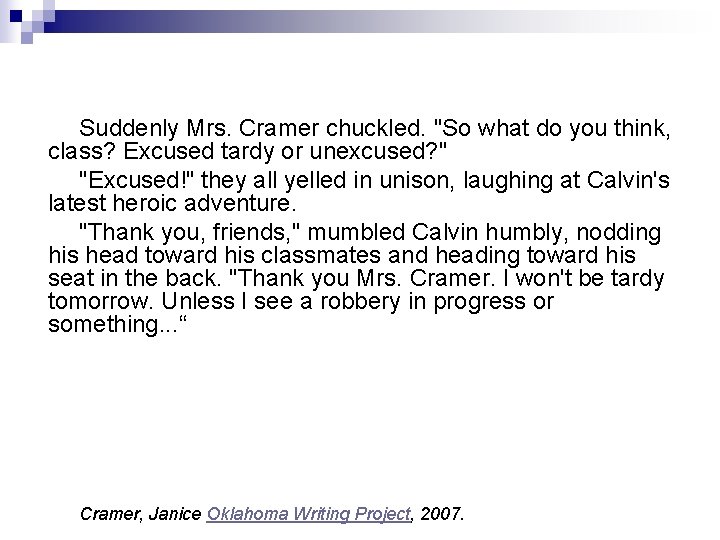
Suddenly Mrs. Cramer chuckled. "So what do you think, class? Excused tardy or unexcused? " "Excused!" they all yelled in unison, laughing at Calvin's latest heroic adventure. "Thank you, friends, " mumbled Calvin humbly, nodding his head toward his classmates and heading toward his seat in the back. "Thank you Mrs. Cramer. I won't be tardy tomorrow. Unless I see a robbery in progress or something. . . “ Cramer, Janice Oklahoma Writing Project, 2007.
Writing n Spend some time writing dialogue in your narrative essay.
Showing not Telling
n n Telling: The football player tackled me hard. Showing: As I caught the ball, it felt like a grenade went off in my stomach and a dam burst on the side of my head. A million stars exploded and careened out of my vision and I heard a keening sound like grasshoppers wailing into the darkness. I flew through the air and finally my head slammed into the grass. I lay there crumpled, bruised, but breathing.
n n Telling: The guitar solo was awesome! Showing: All of a sudden, the lights went out the solitary spotlight beam found its target: the guitarist stood alone. Then he began his solo. At first, it began slow and melodic, but quickly gained speed and power. The notes seemed to pierce my skin and gather in a cold lump in the pit of my stomach. My skin felt electrified; I closed my eyes, raised my hands, and took in all the sound.
Telling: Mom bought me a jacket I didn’t like. n Showing: See “The Jacket” by Gary Soto. n
Telling: Grandma’s dinner made me sick. n Showing: n
Telling: The aliens looked gross. n Showing: n
Showing not Telling n Tip: eliminate “to be” verbs
Blocking & Interior Monologue
Blocking & Interior Monologue n What makes good blocking & interior Monologue ¨ (facial expression, posture, location of items, etc. ). n n “Dramatic” volunteer As our volunteer acts out the scene, take notes on the blocking and implied interior monologue. Compose the scene into a sentence or two. Share
n You are frustrated after having written multiple drafts. You sit down at the computer with writer’s block.
n You’re walking down a dark, unfamiliar alley, with frightening smells, and sudden frightening noises.
n You sneak into the living room on Christmas Morning and inspect your present before your parents wake.
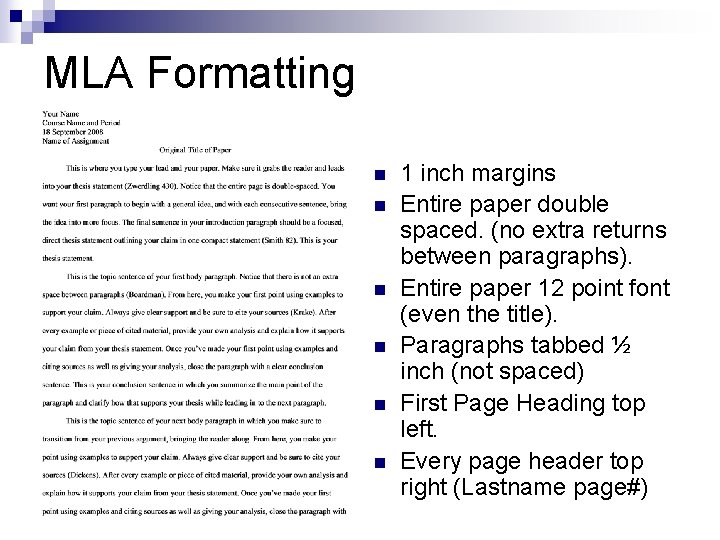
MLA Formatting n n n 1 inch margins Entire paper double spaced. (no extra returns between paragraphs). Entire paper 12 point font (even the title). Paragraphs tabbed ½ inch (not spaced) First Page Heading top left. Every page header top right (Lastname page#)