
Maths Recovery Training and implementation in the context

- Slides: 18
Maths Recovery Training and implementation in the context of DEIS Noreen O’Loughlin National Coordinator, Maths Recovery © Noreen O’Loughlin
What are the origins of Maths Recovery? Initially developed in Australia the in 1990 s as an intervention programme In NSW, from 1997 onward, adopted as a statewide, systemic programme for classroom teachers (Count me in too) Widely used in Australia, New Zealand, England, Scotland, Wales, USA, Canada An early number programme now focusing on: intensive intervention classroom teaching © Noreen O’Loughlin
What is Maths Recovery? It is the most elaborated body of pedagogical content knowledge related to early number. © Noreen O’Loughlin
What is Maths Recovery? Maths Recovery is strongly based on research from the following areas: n Children’s early numerical knowledge n Constructivism n Children’s Counting (Steffe) © Noreen O’Loughlin
What is Maths Recovery? There two pillars which form the basis of Maths Recovery training are n n Maths Recovery Assessment Maths Recovery Teaching © Noreen O’Loughlin
Mathematics Recovery Assessment Maths Recovery Assessment is a form of dynamic assessment. It is n Not age-related n Not curriculum-based n No reading, no writing It produces detailed, thorough, informative results which allows for immediate transfer to teaching. © Noreen O’Loughlin
Mathematics Recovery Assessment Maths Recovery Assessment is interview-based and routinely videotaped. It provides n n extensive and detailed information about a child’s numerical knowledge information about a child’s most advanced numerical strategy © Noreen O’Loughlin
Pedagogical tools in Maths Recovery n Assessment Schedules (see next slide) n Learning Framework in Number - to guide assessment n Instructional Framework in Early Number - to guide teaching n Specially developed instructional procedures and approaches © Noreen O’Loughlin
Assessment Schedules Assessments 1. 1 and 1. 2 include tasks on n Early arithmetical strategies n Base-ten arithmetical strategies n FNWS and NWA n BNWS and NWB n Numeral identification Assessments 2. 1 and 2. 2 include tasks on n Finger/spatial patterns, number relationships Assessments 3. 1 and 3. 2 include tasks on n Early multiplication and division © Noreen O’Loughlin
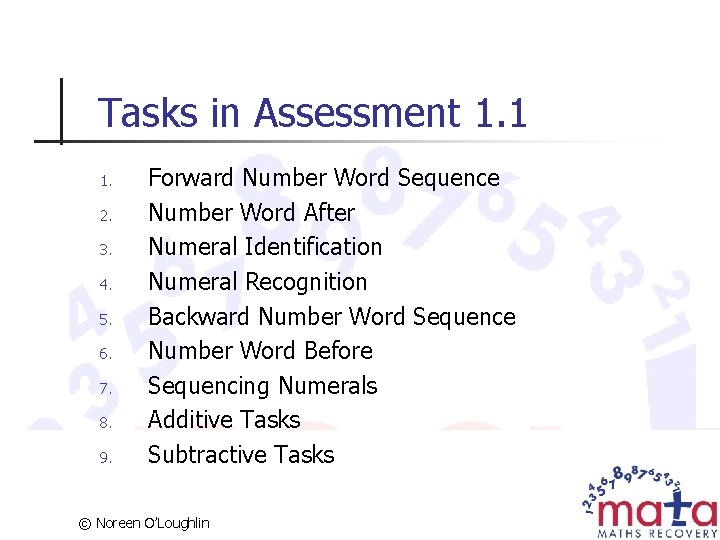
Tasks in Assessment 1. 1 1. 2. 3. 4. 5. 6. 7. 8. 9. Forward Number Word Sequence Number Word After Numeral Identification Numeral Recognition Backward Number Word Sequence Number Word Before Sequencing Numerals Additive Tasks Subtractive Tasks © Noreen O’Loughlin
Maths Recovery Teaching Maths Recovery teaching is suitable for n individuals n small groups n whole class instruction n in-class application n or a combination of some or all of these Instruction is guided by: initial comprehensive assessment on-going observational assessment © Noreen O’Loughlin
Maths Recovery Teaching Focuses on (initially): n n Facility with number sequences, forward and backward Knowledge of numerals Sophistication of counting to solve problems Early topics for structuring numbers © Noreen O’Loughlin
Maths Recovery Training n n Training of one Learning Support/Resource Teacher/SEN teacher per school as MR Specialist Teacher (8 days – no substitution provided) 4 sets of 2 days, approx a month apart n n n Days 1, 2, 3, 4: Maths Recovery Assessment Days 5, 6, 7, 8: Maths Recovery Teaching Seminar on Maths Recovery teaching ‘Teaching Number in the Classroom’ for relevant class teacher (1 day – with substitution) © Noreen O’Loughlin
Implementing Maths Recovery n Targeting first class usually n Identified by standardised test scores and/or class teacher n Identification of the lowest attainers n Administration of Maths Recovery assessment to potential Maths Recovery recipients n Decision on implementation of Maths Recovery teaching plan n Provision of a programme of intensive, individualised, group and/or whole class/in-class instruction © Noreen O’Loughlin
Implementing Maths Recovery n n Maths Recovery teacher is normally expected to give Maths Recovery 2 hours per day Intensive teaching of low-attaining pupils by Maths Recovery teachers for teaching cycles of 10 -15 weeks (30 min daily, 4/5 days a week) © Noreen O’Loughlin
Implementing Maths Recovery It involves n n A holistic approach involving principals, classroom teachers, specialist Maths Recovery teachers and pupils Agree programme for individuals/whole class which will be taught by class teacher and by specialist Maths Recovery teachers © Noreen O’Loughlin
Implementing Maths Recovery Crucial factors critical to the effectiveness of the programme are n n A whole-school focus on numeracy Ongoing professional development A supportive leadership team Structural changes designed to assist implementation of the programme © Noreen O’Loughlin
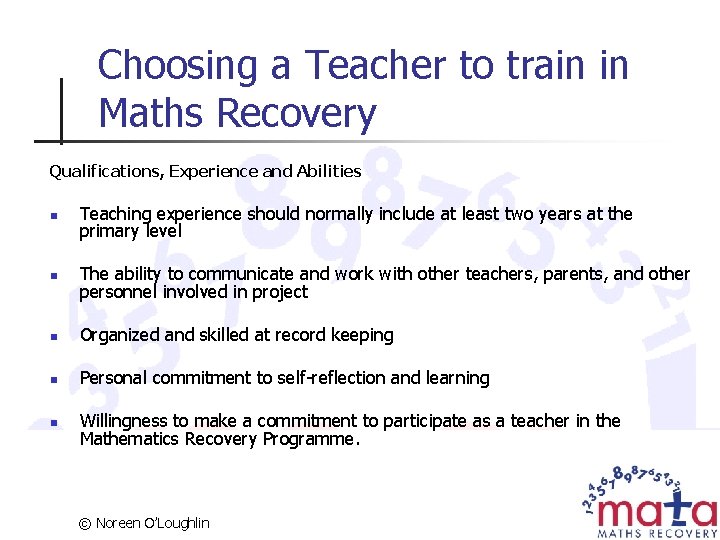
Choosing a Teacher to train in Maths Recovery Qualifications, Experience and Abilities n Teaching experience should normally include at least two years at the primary level n The ability to communicate and work with other teachers, parents, and other personnel involved in project n Organized and skilled at record keeping n Personal commitment to self-reflection and learning n Willingness to make a commitment to participate as a teacher in the Mathematics Recovery Programme. © Noreen O’Loughlin