
Supporting inhouse solicitors How our Standards and Regulations
- Slides: 34
Supporting in-house solicitors: How our Standards and Regulations apply to you
Agenda 8. 00 8. 30 8. 40 9. 10 9: 25 9: 45 10: 00 Registration Welcome Carol Westrop, Head of Legal Policy and Advice Our enforcement strategy and approach to reporting Carol Westrop, Head of Legal Policy and Advice Case study: Non-disclosure agreements Ben Davis, Team Leader, Investigation and Supervision Our new Standards and Regulations Robert Loughlin, Executive Director, Operations and Performance Questions Close
Our enforcement strategy and approach to reporting Carol Westrop, Head of Legal Policy and Advice
The Principles and Codes Principles: apply to all solicitors, whoever they are and wherever they work Code for individuals: applies to all solicitors, whoever they are and wherever they work
Code for individuals • Relevance to in-house • Structure and key issues covered
Working in-house • Regulation • Ethics, independence and conflicts • Continuing competence • Useful Reading: “In-House Lawyers' Ethics - Institutional Logics, Legal Risk and the Tournament of Influence” - Richard Moorhead, Steven Vaughan, Cristina Godinho
Working in-house • Specific Risks – Acts or omissions by your organisation giving rise to concerns, both legal and ethical – NDAs
Reporting matters of concern Improved clarity for the profession and public When concerns should be reported Protection for those who wish to report Our expectations Issues raised and our approach
Reporting concerns • Report to us (or another approved regulator): ü Any facts or matters that you reasonably believe are capable of amounting to a serious breach ü Promptly • Do not stop anyone else who wants to make a report to us
Reporting concerns • Important for us to receive information at an early stag, especially where this may result in us taking regulatory action • Early engagement helps make sure that we can look out for any patterns or trends using information we already hold • Guidance and case studies
Role of enforcement Protecting clients and the public Sanction not a primary purpose Deterrence and wider messaging Maintaining and upholding standards Upholding public confidence in provision of legal services
Enforcement Strategy Clarity for the public and the profession Clearly serious conduct Mitigating and aggravating factors Contextual mitigation Making your decision
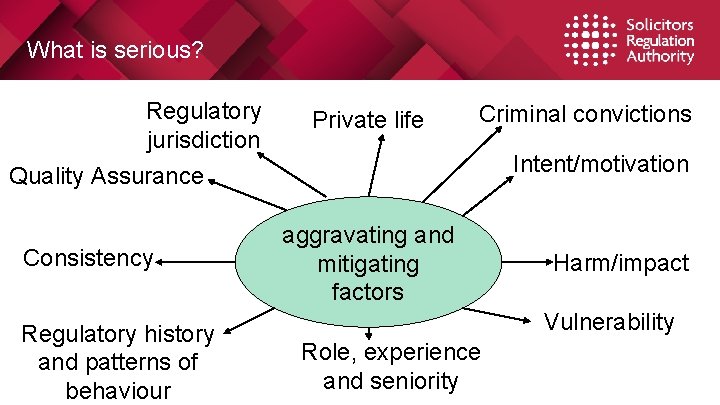
What is serious? Regulatory jurisdiction Private life Criminal convictions Intent/motivation Quality Assurance Consistency Regulatory history and patterns of behaviour aggravating and mitigating factors Harm/impact Vulnerability Role, experience and seniority
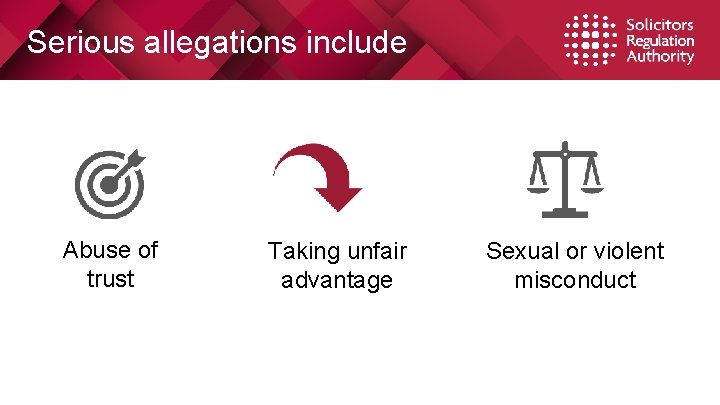
Serious allegations include Abuse of trust Taking unfair advantage Sexual or violent misconduct
Questions?
Case study: non-disclosure agreement Ben Davis Team Leader, Investigation and Supervision
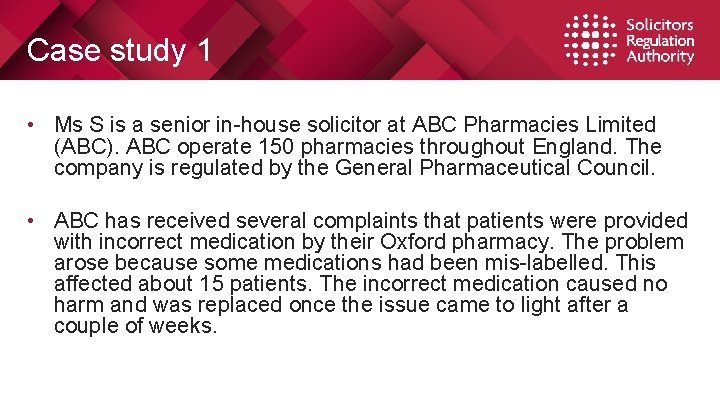
Case study 1 • Ms S is a senior in-house solicitor at ABC Pharmacies Limited (ABC). ABC operate 150 pharmacies throughout England. The company is regulated by the General Pharmaceutical Council. • ABC has received several complaints that patients were provided with incorrect medication by their Oxford pharmacy. The problem arose because some medications had been mis-labelled. This affected about 15 patients. The incorrect medication caused no harm and was replaced once the issue came to light after a couple of weeks.
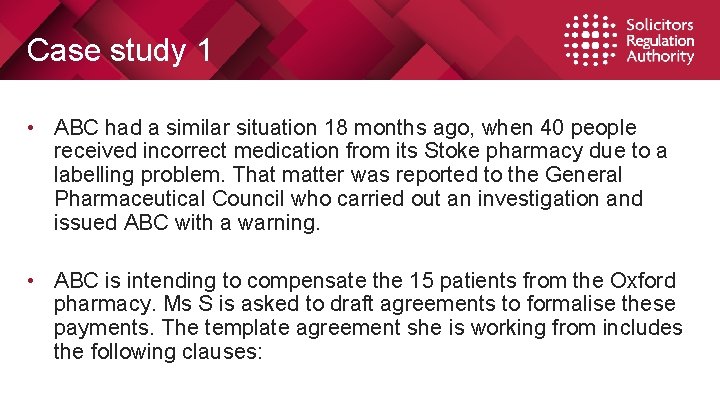
Case study 1 • ABC had a similar situation 18 months ago, when 40 people received incorrect medication from its Stoke pharmacy due to a labelling problem. That matter was reported to the General Pharmaceutical Council who carried out an investigation and issued ABC with a warning. • ABC is intending to compensate the 15 patients from the Oxford pharmacy. Ms S is asked to draft agreements to formalise these payments. The template agreement she is working from includes the following clauses:
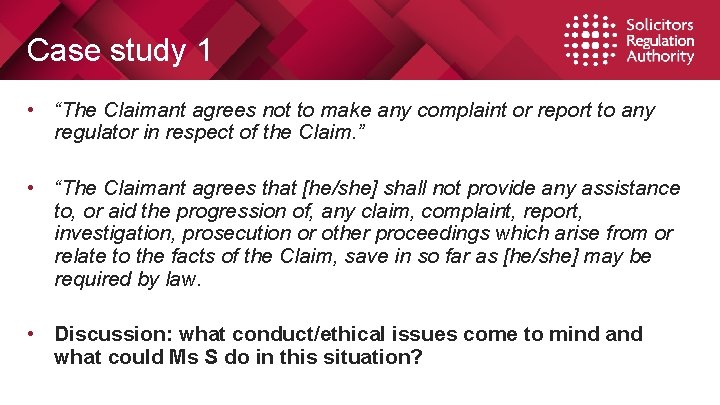
Case study 1 • “The Claimant agrees not to make any complaint or report to any regulator in respect of the Claim. ” • “The Claimant agrees that [he/she] shall not provide any assistance to, or aid the progression of, any claim, complaint, report, investigation, prosecution or other proceedings which arise from or relate to the facts of the Claim, save in so far as [he/she] may be required by law. • Discussion: what conduct/ethical issues come to mind and what could Ms S do in this situation?
SRA Standards and Regulations Robert Loughlin, Executive Director Operations and Performance
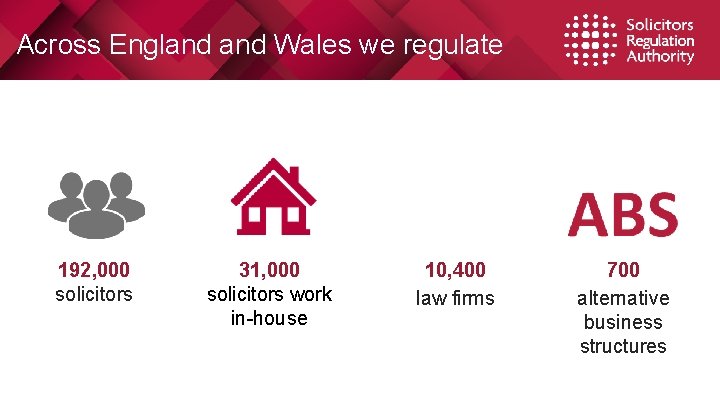
Across England Wales we regulate 192, 000 solicitors 31, 000 solicitors work in-house 10, 400 law firms 700 alternative business structures
Our key priorities High standards Reducing bureaucracy Better public information Consistent qualification standards Appropriate public protection
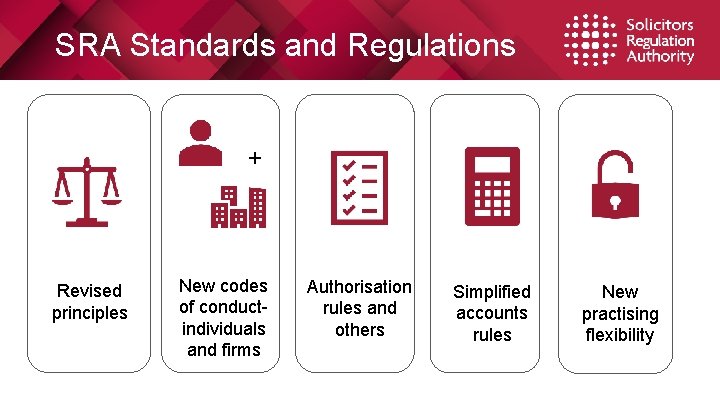
SRA Standards and Regulations + Revised principles New codes of conduct- individuals and firms Authorisation rules and others Simplified accounts rules New practising flexibility
SRA Standards and Regulations Focus on standards, but without prescription Getting rid of unnecessary bureaucracy Short, user-friendly Greater freedom about where and how solicitors can practise
Principles Apply to all solicitors Ten principles down to seven Honesty and integrity separate
Codes of Conduct Code for individuals: Applies to all solicitors, whoever they are and wherever they work Code for firms: Sets out standards and business controls expected of firms No indicative behaviours
Practising flexibility • SRA-regulated freelance solicitor - reserved • SRA-regulated freelance solicitor - unreserved • Solicitors able to offer unreserved legal services to the public from an unregulated business
SRA-regulated freelancers Work on your own Do not employ staff Deal directly with clients
Working outside a law firm Principles and Codes apply Unreserved legal services only Business doesn’t have to be SRA-regulated
Working in the not for profit sector • Removal of restrictions on how and where solicitors can practise • If client money is held in the solicitor’s name, some of our Accounts Rules will apply • There are no special rules that apply to pro bono work
Working in the not for profit sector • Professional indemnity insurance is required for carrying on reserved legal activities • 3 years practice requirement does not apply to those working in not for profit bodies
In-house solicitors – what you need to do • Read the new Code of Conduct for Solicitors and our Principles - they apply to all solicitors, wherever they work • Understand our enforcement strategy which underpins our rules • Know your duty to report serious concerns promptly
Guidance and support Guidance and resources Enforcement in practice Professional ethics helpline and webchat Research and reports
Resources for you beta. sra. org. uk – see the new rules on our development website sra. org. uk/newregs – guidance and resources to help you Professional Ethics: 0370 606 2577 Follow us on Twitter: @sra_solicitors